Near-death, but happy
A near-death experience (NDE) is a personal or subjective experience associated with what are called near-death episodes. In a near-death episode, a person has been declared clinically dead, is very near death, or is in a situation where death is impending, likely or expected. The situations where people have reported near death experiences have been accidents, military combat, childbirth, or suicide attempts. (1, 2)
The term or phrase near-death experience is said to have been first used by Dr. Raymond Moody in his book titled Life After Life published in 1975. Many researchers have since studied the situations, circumstances, contents, and consequences of NDEs. People who have experienced near death episodes say it encompasses multiple sensations including detachment from the body, feelings of levitation, serenity, security, warmth, the experience of absolute dissolution, and the presence of a light. The recurrent theme is the feeling of a strange sense of warmth and joy.
Some reports says 38%-50% of the adult population in USA who have come very close to clinical death have had a near-death experience. However, those who have had near-death experiences often criticize and disagree with the term “near-death.” They say it is incorrect because they claim they were absolutely sure that they were most certainly dead, not just near-death. (1, 2, 3, 4)
Most of us have heard or discussed the term “hear-death experience” and many have been discussed this phenomenon with friends.
However, there is an older phenomenon that many of us have not heard or even talked of although it has been around for centuries. “Near-life experience.”
*****
Near life but not quite there and very unhappy
We define Near-Life Experience (NLE) as a personal experience associated with impending life – the possibility that finally the life a person had envisioned is within his or her grasp – one is nearly alive but not quite. (5)
What do you mean by near-life, aren’t we all living? How could I talk to you, interact with you if I were not living? This was the reaction of a colleague when we brought up the phenomenon of near-life experiences.
We simply asked him: What do we mean when we tell ourselves or someone else: Get a life!
Does that mean we still do not have a life? How can we go out and get a life if we were not alive? Dead people do not just walk out of their houses (or caskets) and get a life. But we only expect people who are alive to do that – go out and get a life.
Yet we are alive; otherwise how could we be working all the time, and leading that dull, boring, routine life. For many of us caught up in the unidimensional mode of work – work and more work. Working just to pay the bills and be able to get through the day and have a roof over one’s head. But this is not the life we had in mind. So are our lives stored in our memories. But how can we recollect something that we have not experienced yet? Or is our life in our imagination? How can we imagine something that we do not comprehend? And yet, we often find ourselves telling ourselves: I need to get a life.
The expression – Get a life – is a clear vindication of our claim that all us are merely loitering from incident to incident, moving from one rite of passage to another, and engaging in near-life experiences instead of living the real life. We are all, it seems, near life; but not yet there.
Are we there yet? This does not seem to be a child’s irritating, oft-repeated question when we are travelling. Rather, it seems like a question we should be asking ourselves all the time.
A near-life experience is said to encompass multiple sensations including a sense of finally being able to leave the so-called existence one is leading and grasping the real thing; a sense or feeling that one will be finally secure, a feeling of warmth; and the presence of a light – that one cannot see but only feel its warmth in one’s heart. And one feels a strange sense of loss when that desired life fades away from ones sight or leaves ones grasp and one comes back to the so-called crappy existence one is leading.
So are there people who have had near-life experiences?
In the past when the Pareto principle applied, and 20% of the world ruled and controlled the rest of the 80% it was said that nearly 80% of people had a near life experience – they believed in magic at first and then in God and they simply kept trying.
In the last few decades 1% of the super-wealthy rule, control, and occupy the lives of the remaining 99%, it is said that only 1% have had a near-life experience. Well, some of us might think it is good news because that means the rest of us are actually living. No! The rest have simply given up.
People are either too tired or too poor to even care.
Those who have encountered near-death experiences (NDEs) report emotions that can be broadly classified into two broad categories. Some have pleasurable NDEs – which include feelings of love, joy, peace, bliss. While another group has experienced painful NDE such as feelings of terror, horror, anger, isolation, guilt.
The painful category of NDE is miniscule compared to the vast majority who say that NDEs are pleasurable; and both types report that the experience or sensation is hyper-real—sharper than what they have ever felt in their real earthly life.
In the case of near-life experiences (NLE), the painful experience in the only one experienced by most people. Many of us continue to believe that we experience life when we experience bliss. Bliss is extreme happiness. Only time people experience pleasure in a near-life experience is when they take some mind-altering substance. But then the very act of consuming a mind-altering substance makes it a not so real life experience. Experiencing life in an altered state of consciousness would not constitute living the real life, would it?
I could have been somebody OR Be all that you can be
Our research on near-life experiences have found that they differ by age group. However, both the young and the old have near-life experiences. Degeneration and the problems of aging may be the privilege of only the old; but near-life experience, like the phenomenon of death, it seems is quite egalitarian – cuts across age, caste and afflicts the poor and the middle class. No amount of education or getting into privileged occupation can impact our near-life experience.
Thus near-life experiences can be classified differently in two people who live in the same home.
In the middle aged father or mother near life experiences can be summed up in the phrase: “I could have been somebody.”
This is the middle-aged father or mother playing the character of Marlon Brando in On the Waterfront, a 1954 film, and ruing their life choices. Complaining about all the people who never helped them to become the person they could have; about no one realizing their potential, giving them a break.
For the teenage son or daughter engrossed in a virtual war on a video game or lying on the internet in their face-book page to get more “likes” and to attract attention and interest, this is about pretending to be someone he or she is not. This approach to life has been classified in the famous US army slogan : Be all that you can be.
And in the virtual world, one can actually be anything as long as never meet the person face to face. The “Be all that you can be” near-life experiencers are constantly connected online but never connect at a human level.
Various questions come to mind: Is my life, the one I want to live, only in mind or is it real? If there is a life that I am supposed to lead then what is this life that I am actually leading or experiencing?
Is this what I really wanted? I know that is not what I thought my life would be – but then this is what I got. Should I just accept it and go along, play along as if I enjoy it or should I shout out loud and complain?
Maybe I did not want this life but this is what I have got? So is this my life now? Am I condemned to live in this slum? Or as the protagonist in the Oscar-award winning film Life is Beautiful would argue: Life is like living in a concentration camp anyway, we have to use music and philosophy and create games to make life livable and beautiful? If we are condemned to playing games in and with our life, then is playing games our real life?
Both the young and the old caught up in their own webs of near-life experiences – busy, multi-tasking, and no time to live.
*****
Can we ever eliminate the causes of Near Life Experience?
It is important not to dismiss “near-life experience” as simply the opposite of living in the moment or mindfulness. Near-life experiences are more than the phenomenon of mindfulness.
Mindfulness (the English word) is derived from the Buddhist term anapanasati. Mindfulness is commonly known as living in the moment and can be the intentional, accepting and non-judgmental focus of one’s attention on the emotions, thoughts and sensations occurring in the present moment. Many people try to gain mindfulness through training in meditational practices.
The Buddhist term originates from the word “sati” in the ancient Pali language and the Sanskrit word smṛti. However, it is important to note that the underlying meaning of both sati and smrti involves the act of recollection. Sati means, “moment to moment awareness of present events,” and “remembering to be aware of something or to do something at a designated time in the future”.
It is reported that the Abhidhammattha-sangaha, a key abhidharma text from the Theravada tradition, defines sati as follows: “The word sati derives from a root meaning ‘to remember,’ but as a mental factor it signifies presence of mind, attentiveness to the present, rather than the faculty of memory regarding the past. It has the characteristic of not wobbling, i.e. not floating away from the object. Its function is absence of confusion or non-forgetfulness.” (6)
Near-life experience cannot be completely conflated with mindfulness. While being in the moment may be an important aspect pf living. There are other components of living that are non-psychological.
Research from neuroscience explains NDEs in terms of various physiological and psychological factors, while some NDE researchers in the field of near-death studies advocate for a transcendental explanation
So what would explain our consistent encounters with near-life experience and the absence of ever experiencing life? Is the reality of life merely a psychological entity as mindfulness or other psychologists using mindfulness to treat depression and other mental disorders argue? Or is life physiological (based on matter alone) or a combination of both or is life spiritual and transcendental? As the Eastern ancients would say it is not matter or mind that explains the mystery of life, but it is consciousness (separate from both mind and matter) that gives rise to all the rest.
The answers are not straightforward nor is the pathway to the answer easy. What we suggest is that each one of us explore our own near-life situations. We think about it, share it. One can explore own consciousness individually; however, despite many underlying similarities, each life is unique and what we are looking for is benefit of knowledge for all. Therefore, a common knowledge has to be discovered and shared. This requires collective effort. It is the collective pool of experiences that will give rise to a better understanding of near-life experience and how to transform near life experiences into real life experiences.
Instead of funding more unnecessary research on disease and pharmaceuticals that only increase our near-life status; foundations should establish research agencies and universities to study in-depth the nature of near-life experiences, study the underlying explanations and determinants so why most of us are not living the life we have and continuing to have near-life experiences instead?
Why does LIFE elude the living?
Can we create a world where we eliminate the causes of near-life experiences and ensure that all of us actually live?
******
To be or not to be
Perhaps Shakespeare answered it for us all when he wrote those memorable lines which are part of the famous monologue in the play “Hamlet” and alludes to Hamlet’s suicidal intent. The revelation that Hamlet’s father, the King, was killed by his own brother (Hamlet’s uncle), who then goes on to marry the king’s wife (Hamlet’s) mother generates Oedipal impulses in Hamlet and drives him nearly insane. Hamlet wants to die, kill himself, but he also seeks revenge.
In the classic scene, he first thinks of suicide, “To die, to sleep- no more,” Then he fears that even after death, he may still not get the peace he wants. He is worried that there may be no peace even in death:
“ ‘Tis a consummation
Devoutly to be wished. To die, to sleep,
To sleep, perchance to Dream; Aye, there’s the rub,
For in that sleep of death, what dreams may come,,..”
The moral and mental pain that Hamlet’s character feels is captured by the soliloquy: “To be or not to be,” which also becomes the play’s emotional essence.
Hamlet (ofcourse Shakespeare) does touch upon two different topics which may be central to the understanding of near-life experiences (NLEs) – SLEEP and DREAM.
However, we think that although they came close, perhaps Hamlet (and Shakespeare of course) also missed the point – he may just have been another victim of Maya (the illusion of life) – a mere mortal afraid of death, caught up in the flesh and the pleasures of material living. As the next few lines show Hamlet calls death the undiscovered country from which no traveler has returned. Obviously, Hamlet (and in turn Shakespeare) was simply not aware of the phenomenon of “Near-Death Experience (NDE).” Hamlet chose to bear the drudgery of his painful near-life experience because he was afraid of death unlike the experience of hyper-real pleasure in near-death expressed by most of those who have gone through a near death experience (NDE).
“To grunt and sweat under a weary life,
But that the dread of something after death,
The undiscovered Country, from whose bourn
No Traveler returns, Puzzles the will,
And makes us rather bear those ills we have,
Than fly to others that we know not of.”
What would have happened if Hamlet had actually killed himself – embraced death rather than engaged in a monologue questioning death?
A person who has near-death experiences says: I almost kissed death and then someone pulled me back into life. Does that automatically mean that all of us who have near-life experiences have almost kissed my life and then something or someone pulled us back into this – what we have right now?
The question begs to be asked: When do I actually live? What is my life?
When I go from mind-full-ness to mind-empty-ness? What is mind-empty-ness? Is it mindless-ness because many among us are engaging in mindless acts? No, mind-empty-ness is different from mind-full-ness and from mind-less-ness. In order to define mind-empty-ness one may have to follow the analytic method of negation termed neti neti (not this, not this) advocated by the Advaita philosophers. In order to understand something one starts by trying to understand what it is not.
Perhaps I will understand mind-empty-ness when I die – because perhaps then my brain may become truly inactive. The one type of sleep when my brain is truly switched off. I will sleep and when I sleep in my death my brain will truly rest. It will no longer be active like the brain of a person alive because the brain never sleeps even when we are sleeping. (7, 8) At that moment both my recollections of my life and my dreams or imaginings of my life will become one with what my actual reality is.
Is this akin to turiya? The Mandukya Upanishad describes three psychological states of consciousness: waking, dreaming, and deep (dreamless) sleep. The waking and dreaming states are not considered true experiences of reality and truth because of the acute divide between the self and the non-self. One is aware of one’s boundaries. In dreamless sleep, one is not conscious of external or internal objects, no awareness of thoughts, yet the fact that we say that I am not conscious of anything proves that the “I” is still present. It is only the fourth (in Sanskrit language turiya means fourth) transcendental form that underlies and transcends the three common states of consciousness of waking, dreaming, and dreamless sleep which there is complete dissolution of boundaries and the experience of pure awareness or pure consciousness.
Is there, then, a continuum between life and death and if there is, then, is meditation the only way to get there? Or, for mere mortals such as us, is sleep the bridge that allows us to actually enter and be a part of that continuum? Is sleep the natural state and way to get to life? Perhaps we do not sleep because we get tired by running round all day. On the other hand we may be running around all day because sleep demands that we expend the excess energy that keeps us from sleeping? Would that not be the correct way to describe new born babies and children? Sleep seems to be their natural way of life. They run around and scream all day only to drop down to sleep within minutes. Perhaps it is through the exploration and deeper examination of sleep that we will understand death and by doing so understand life.
I may not become one with God after my death but what will perhaps happen is my dreams or what is in my mind will become one with what I actually am – just a baby, wanting to sleep. Perhaps, for the majority of us, our near-life experience becomes real-life only after death.
“The Universe begins to look more like a great thought than like a great machine.“
Sir James Jeans (1877 – 1946)
British scientist
Author of book Physics and Philosophy (1943)
——————————————-
© Madhav Pakhare and Nilesh Chatterjee
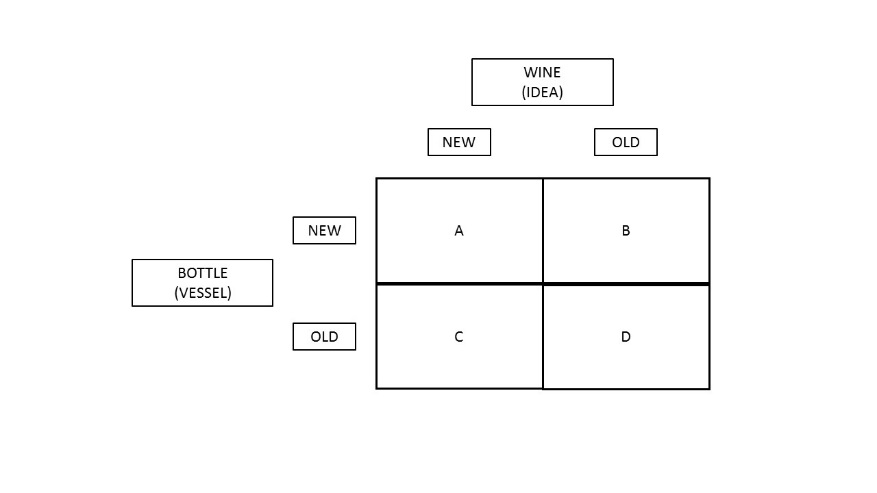
Note: Someone asked us whether NLE was not just another attempt to re-package old wine in a new bottle? For that discussion, please wait for the next article where we have created the 2 X 2 typology of old wine / new wine and old bottle / new bottle. Assuming that the bottle represents the human existence and wine represents the idea or thought or energy; and it came out looking something like this. In box D the vessel is old, and the energy or thought is also old. In our minds this could represent the existing human condition – both a baby and the elderly. However, someone among us who ends with a higher consciousness, maybe an Einstein or a Gandhi or Bohr or Russel or Bohm may be in C because they have a fresh consciousness. The issue is with the boxes A and B because we are talking of a new bottle or vessel. Read more in the next piece.
References
- International Association for Near-Death Studies: http://iands.org/about-ndes.html
- Near-Death Experience Research Foundation: http://www.nderf.org/
- Near-Death Experiences and the After-life: http://www.near-death.com/
- Near-Death Experience: http://en.wikipedia.org/wiki/Near-death_experience
- Goodlife Zen: http://goodlifezen.com/have-you-had-a-near-life-experience-5-crucial-tips-on-how-to-feel-fully-alive/
- Mindfulness: http://en.wikipedia.org/wiki/Mindfulness
- Brain Basics: Understanding Sleep: NIH – National Institute of Neurological Disorders and Stroke http://www.ninds.nih.gov/disorders/brain_basics/understanding_sleep.htm
- While you sleep, your brain keeps working: http://psychcentral.com/blog/archives/2008/08/03/while-you-sleep-your-brain-keeps-working/