Author: Nilesh (Page 1 of 2)

Why do you sit on an elevated golden throne, Master?

By Brett Davidson [April 2016]

Sanya-sin (Ssin): Why do you sit on an elevated golden throne, Master? Why not sit down here on the floor with the rest of us?

Guru-ji (G-ji):  Surely you can guess the answer for yourself.

Ssin:  Is it because you want to feel superior to the rest of us?

G-ji:  No … I don’t want to feel superior, and yet I am compelled to pretend, for                                  your sake, as though I am.

Ssin:  Why is this, Master?

G-ji:  I feel superior because I listen to all your idiotic opinions about the world, all day  long, and I accept your opinions. Without liking them, I accept them. But very few people can accept mine. Sannyasins say stupid things, and I smile and nod. I smile at the beauty of the utter meaninglessness of your perceptions. Then I say something, I respond to you, and people are shocked.  They try to correct me. They tell me I am not “permitted” to think or say what I say.

xx      Occasionally, my recognition of this dynamic gives me a feeling of superiority …  which is exceedingly unfortunate for me. Because, in truth, I’m in no way superior to you. And yet your chronic inflexibility tempts me into suspecting that  I might be, in some way, existing at a higher level.

           Ha! Such moments fade quickly, and the light of the Divine disperses this time-wasting confusion.

           Here I sit before you — God’s Fool! — watching the discordant flow of your poisoned minds, accepting you as you are. And, daily, I endure the voices and finger-wagging of those accusing me, your so-called Master, of being “cruel” and “inhumane” by sannyasins who’ve tricked themselves into believing they’ve grasped miniscule scraps of insight about life and death.

x
xxxxxI express my awareness of this situation by elevating myself. As soon as you’ve learned to accept my idiotic opinions as readily as you accept your own, we can all sit together at the same level.

Ssin:  Will you then come down and sit among us, Master?

G-ji:   No, I will not. I shall invite you to be seated upon your own thrones, up here with me.

–———–

As overheard by Bear Rajneesh, Esquire in Pune on April 1, 2016 and whispered as a mantra in Brett Davidson’s left ear.


I am so sorry

By María D Gómez [April 2016]

The internet is just great. Thanks to this tool we have been able to meet again after having lost touch for 25 years. Time does fly. It seems like yesterday when we met in college and went together to look for our very first apartment. I remember very well the fabulous parties you hosted and how much you liked going for a walk after snowstorms.
 
In the last 25 years I’ve been married twice, I had three children and I have never stopped working. I am currently going through my second divorce.

And what about you? What have you been doing all this time?

Unbelievable. How come you did not marry even once? Thus you could not manage to build your life. I’m so sorry, you seemed like a very smart person in college.

© María Gómez, 2016

Oedipal Loverbirds

March 16, morning-time … ghosts of  New York slipping and gliding in and out of cerebral cortex tissues before the Ultimate Sun appears retinal and gleaming in Tower Shinery of World Trade and Wall St. Environs. Out on sidewalk (9:00 a.m.) the sun smells like September Sea.

7:00 p.m., 10 hours later, in Julliard School at 60 Lincoln Center Plaza … scraggle-scraggle hard-scrabble Depression Dustbowl white woman harpy convulsed with pleasure … withered left hand gingerly fingering her son’s psychotic right ear … her claw like right hand twitching to Beethoven rhythm being performed on cello and piano in a hall crowded with Odd Onlookers …  the pathetic son: a mother-complex murderer in the making at Julliard School of Murderously Meticulous Muzak …

AH! … Mother’s ear-gasm inception begins, her crone-skull thrown back in repeated throes of ecstasy … rotting hippie Birkenstocks … feet tapping in time now to Bach’s Gamba Sonata No. 3 in a minor key — her tragic son-husband meanwhile laughing and flirting and short-hair head bobbing with diseased Oedipal enthusiasm to sugar-cello dripping with honeycomb angles and hexagonally-metered geo-metrics …

And NOW (7:10) the dilapidated skeletal mother plays coy little girl, a joyful innocent … her rank hole-mouth gaping wide with feigned (??) wonder as the hairy bow of the cellist saws melodies into the air …

She leans over, smiling, as if to lick the boy’s pimpled 35-year-old neck … whispers … and he counts time with his fingers drumming his long sharp Dracula nails into his threadbare corduroy pants … fingers most definitely unsuited for the caressing of young female bodies …

At (7:40) she removes her Eyeglasses of Madness to wipe away a tear as the music swells and sweetens and simultaneously saddens, leans over, rests dagger-sharp elbows upon wrecked knees — head nodding again — and she stands, suddenly, at (8:04) and somehow manages to shuffle the entire assemblage of her de-engineered body-frame up and away from her chair, down the aisle and towards the exit … URGENT, it seems … seeking toilets? … privacy for secret emotional release? …

Oedipus sits, meanwhile, sweating — bald patch in his short brown hair gleaming under the harsh auditorium lights … his head bowed reverently, like a monk … his big baby lips sputtering, blubbering arcane prayers … and scratches his rash-ravaged cheek with one long Fu Manchu index-fingernail …

(8:10) — Mother gone now a whole six minutes … her chair a drab black that mutely waits to receive a pair of disheveled buttocks …

Now (8:18) … Praise Gaia! She returns at last, sits, and Oed’s right arm swings around her bowed shoulders … they almost embrace, then break away, shyly …

Her terrible right paw begins to glide sensually down his upper back between the shoulder blades … she hugs herself, head shaking and rolling as though SHE were banging the piano! …

Brahms now … Cello Sonata No. 2 in F Major … and suddenly Mother leans to her left , colorless eyes bulging wide, mouth open again, a mummified Hippie Smeagol, enraptured … and once again they look into each others’ eyes … and she’s having flashbacks of now at (8:26) …

It’s 1968 again … her slick little tongue pops pinkly out of her fish mouth (no lips!) … at at 8:29 her upper body leans at a 45-degree angle, into the aisle, an electrified ponytail of cigarette-smoke-colored hair flapping fanatically above the polished pine-board floor …

Mother’s right curls into a hard little fist, and then opens like the dorsal fin a fresh-water trout … and her filthy sandal slips off her right foot, and the toes curl while Junior falls asleep …

Mother presses her feeble fingers to her forehead (imagine Rodin’s Thinker), nods in approval of the cello show … now places her drapes her left arm again around her son’s sleeping shoulders … and they lean toward one another, this time touching, like sweethearts in the backseat of Ford convertible circa 1957 … and he appears to have dropped into a state of pure narcoleptic stupor  … and Mother then begins to cackle eerily, and with her right hand removes her dimestore glasses, her juiceless eyes staring in pure amazement at the tortured puppet movements of the cellist …

The husband-son then opens his eyes, and breathes through his mouth … his eyes dip downwards and they study Mothers blue oxygen-deprived toenails (poor circulation?), and it seems their romance is fading a bit and that they’re out of sync …

Oedipus wakes!

And falls asleep again …

Mother, at (8:43) then thrusts her trembling aged hands between her legs, arches her spine and tosses her skull back one last time … and when the music’s over she slips both bloodless feet once again into her Peruvian sandals, and the insane piano bangs more Beethoven, and she leaps from her seat as though stung with a high-powered police taser, leans against her husband-substitute, places her head upon his forlorn shoulder, playing the daughter-role once again …

It is (8:50) … and all is as well at the Julliard School of Music as can be expected!

© Lee Poe, 2016

Sex-selective abortions in India


What if we had no birthdates; just “death-dates” instead?

Halloween, on October 31, is now a Hallmark celebration. A global event celebrated by people around the world as a fun-day with candy and costume. Hallowed Evening, or the evening before All Saints Day – All Souls day, a celebration of the dead and departed, has now become a global party, a globalized commodity with some offering Halloween sales.

 Catrinas_2 wiki


However, some still traditionally go to cemeteries and pray for the souls of the departed. And sometimes the party is taken to the cemetery. Day of the Dead, or Dia de Muertos, celebrated in the first two days of November is a national holiday in Mexico. People go to the graves of the deceased, leave their possessions, offer their favorite foods and beverages and flowers, and build ofrendas or private altars at home to honor the dead and departed.


Brazil has the public holiday of Finados on November 2. In India, there is the Hindu tradition of pitru paksha, which usually falls in the month of August-September, as families conduct death rites of Shraddha or Tarpan, and offer prayers for the souls of departed ancestors. Then, there is the Bon festival in Japan celebrated in August and similar festivals in Africa.


All these festivals across the world are special ways of bringing the past into the present, even if for one day, and celebrate the existence of our ancestors. We make the dead alive when we remember.


However, reading about the days of the dead made me wonder. While we spend one specific day remembering those who have died, trying to know them again; what if we knew (and remembered) that one specific day when we would die.

 CemetarioAlmoloyaRio1995


What if we all had death-dates instead of birth-dates?


What if parents, families, doctors, midwives, entire communities somehow lost all memory of the day and date when a child was born and all that they knew, for certain, was the exact date he or she would die.


How would life turn out if we had death-dates instead of birth-dates?


For instance, if someone’s death date was 6th of July, would we wish them and sing happy death-date to you? We would perhaps get a cake with candles to celebrate his death-date, and for once, blowing out candles at death-day celebrations would assume real meaning.


With the current attention of birthdates we focus a lot on life, and the mystery of life. However, with a world of death dates we may just start focusing our attention on living.


A birth-date gives us a start date for life while we are happy that someone is born and tell them to celebrate this wonderful thing called life; we often ponder about an uncertain future and end up making this life miserable. A death-date, on the other hand, gives us a very specific end-date; and maybe that might just push us to enjoy things a little more. Would we become hedonists, or follow the teachings of Epicurus, or just turn stoic?


Would some of us invest money and buy doctors and geneticists in order to delay our death dates? But then death-dates are fixed like birth-dates, even if we sometimes lie about them, and cannot be moved. What would we do then? Try to swap our death-date with someone else? Try to cheat ourselves just like we do with time when we change the clock to save daylight.


Would we lie about our death-dates? After all, many people lie about their birth-dates? Lying about birth-dates makes us younger in other people’s eyes? What would lying about death-dates achieve? Would we claim that our death-date was earlier than scheduled or later? What date would our driver’s license have – or our passports?


And what about horoscopes – that entire astrology industry would perhaps suffer because the most important event of our future, our death, has already been predicted and determined.


How would the inherent determinism of having something like a fixed death-date influence the life of free-will? What are the choices we would make if we had death-dates instead of birth-dates?


(… to be continued)


© Nilesh Chatterjee, 2015


Images Courtesy

https://en.wikipedia.org/wiki/File:Catrinas_2.jpg

https://en.wikipedia.org/wiki/File:CemetarioAlmoloyaRio1995.jpg


Case of the missing girl child in India: The tragedy of communicating social development as economic advancement rather than cultural transformation

Nearly 1.4 million girls were missing at birth in 2008. In India, half a million girls go missing at birth each year – more than the number of girls born annually in the UK . Missing girls at birth is a result of sex-selective abortions (SSA), which is the voluntary termination of pregnancy based on the anticipated or predicted sex of the child.


Sex-selective abortions: The global situation


Missing girls at birth is a result of sex-selective abortions (SSA), i.e. the voluntary termination of pregnancy based on the anticipated or predicted sex of the child. This measure of missing girls is estimated by comparing the sex ratio at birth with the sex ratio in comparable populations with no gender discrimination—typically, high-income countries (World Bank, 2012). The overall sex ratio at birth, conventionally measured as number of males per 100 female births in a population, is also used as a proxy measure to understand the magnitude of missing girls or sex-selective abortions in a country (Eberstadt, 2011).


According to a World Bank report (2012), approximately 1.4 million girls were missing at birth in 2008, a third of the total number of missing women in the world. In India alone, half a million girls go missing at birth each year – more than the number of girls born annually in the UK (Jha et al, 2011; Bhalotra and Cochrane, 2011).


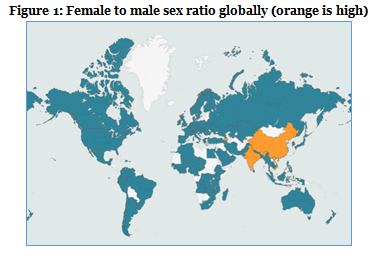
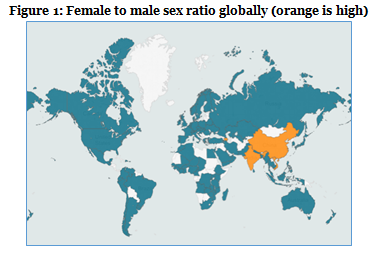
However, globally, most countries (highlighted in blue in figure 1) have a low male to female sex ratio at birth, ranging 1.02 in Zimbabwe and Zambia, 1.03 in South Africa, Tanzania and Kenya, 1.04 in Finland and Argentina, and 1.05 in the USA, Canada and the UK.  China and India (highlighted in orange) have the highest male to female sex ratios at birth at 1.17 and 1.11 (McKinsey Global Institute, 2015). Other Asian countries such as Vietnam, Singapore, and Taiwan also have skewed sex ratios with more males than females at birth.


Figure 1-Female to male sex ratio globally


Mara Hvistendahl in her book: Unnatural Selection: Choosing Boys Over Girls and the Consequences of a World Full of Men (2011) reports that there are over 160 million females “missing” from Asia’s population which is more than the entire female population of the United States. However, gender imbalance—which is mainly the result of sex selective abortion—is no longer strictly an Asian problem. It is found in Armenia, Azerbaijan, Macedonia, Eastern Europe and even some pockets in the United States (Hvistendahl, 2011).


Missing girls at birth in India

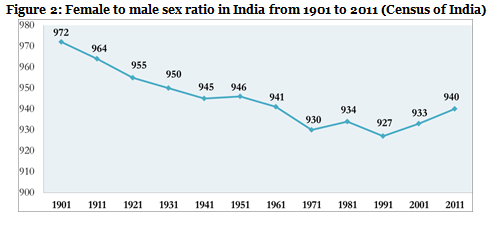
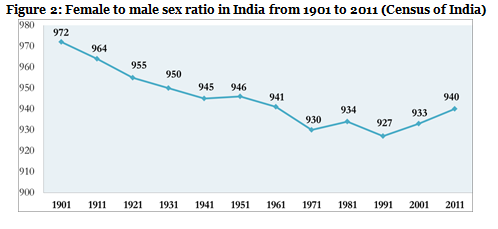
In India, the sex ratio is shown as the number of females per 1000 males at a specific point in time. Since the 1990’s, the country has recorded a skewed sex ratio, dropping to a low of 927 females per 1000 males (which is 107 males per 100 females) in 1991 (see figure 2). A recent study published in the Lancet (Jha et al, 2011) estimated that 4-12 million girls were aborted in India in the last 3 decades. The study also showed that selective abortion of girls had increased in last 20 years and is now common all over the country.


Figure 2- Female to male sex ratio in india from 1901 to 2011

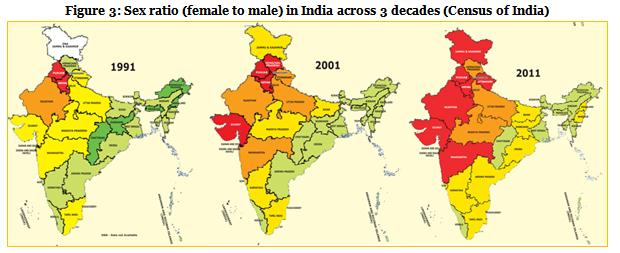
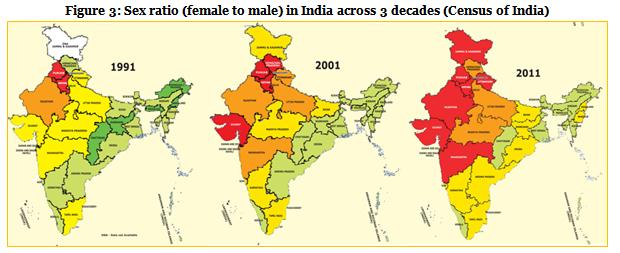
While the overall sex ratio has shown an improvement in the last 2 decades, it has however masked the inter-state variations especially between the north and south Indian states (see figure 3). According to the latest estimates (Census, 2011), the number of females per 1000 males in north Indian states such as Haryana and Punjab stand at 879 (114 males per 100 females) and 895 (112 males per 100 females), while south Indian states such Kerala and Tamil Nadu have recorded a sex ratio of 1084 and 996 (almost 100 males per 1oo females) respectively.


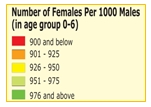
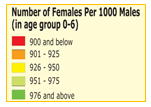
Geographically, the problem of sex selective abortion is more prevalent in the north and west Indian states (highlighted in red in figure 3 with a sex ratio of 900 and below), which are economically developed but also patriarchal and hence put enormous weight on having a son.


p1

Figure 3.2-Key to image 3.1

In 2011, 7 of the 29 Indian states (highlighted in red) showed a sex ratio of 900 and below, as compared to 4 states in 2001 and 2 states in 1991. The number of states highlighted in dark green (sex ratio of 976 and above) and light green (sex ratio of 951-975) has reduced over the last 3 decades.


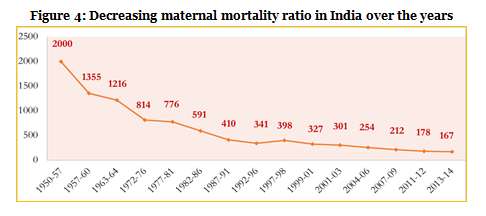
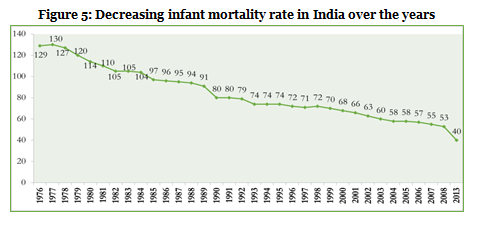
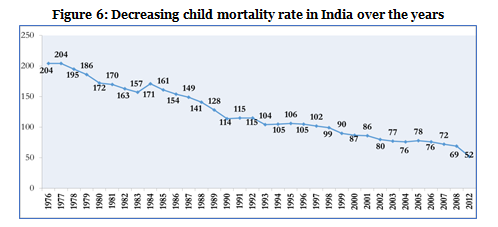
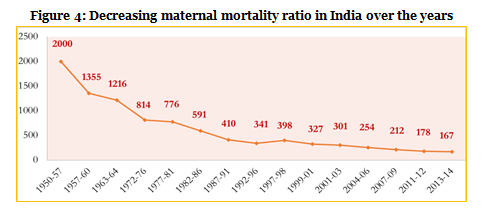
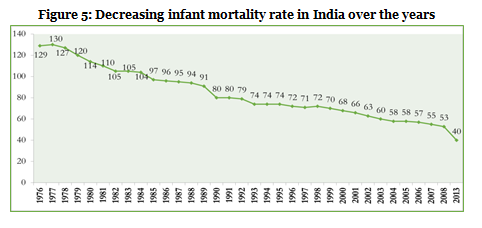
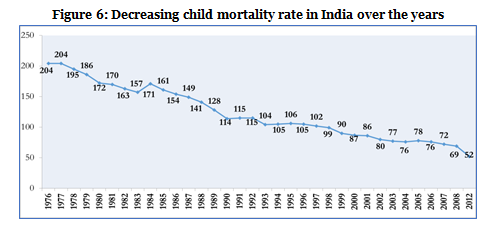
The Lancet publication mentioned above (Jha et al, 2011) also reported that the risk of selective abortion of girls was highest in the second birth, especially in families where the first child was a daughter, and this practice was found to be more common among wealthy and educated households. While the female to male sex ratio in India has worsened over the years, other critical indicators such as maternal and child mortality rates have improved (Office of the Registrar General & Census Commissioner of India, 2011, 2012, 2014; MoHFW, 2011). The maternal mortality ratio (number of maternal deaths in 100,000 live births) has dropped from 2000 in the 1950’s to 167 in 2014. Infant (under 1 year) and child (under 5 years) mortality rates have also dropped over the years (see figures 5 and 6). A closer look at the sex-wise infant and child mortality rates does indeed show higher deaths of female children than male. While the overall infant mortality rate (IMR) is 40, the male IMR is 39 and the female IMR is 42. Child mortality rates (CMR) show a similar gap as the male CMR stands at 49 while the female CMR is 56. However despite the gender differences, it is important to note the trend that the mortality of the female child is also decreasing over time, although slower than the male child.


Figure 4-Decreasing maternal mortality ratio in india over the years

Figure 5-Decreasing IMR in India over the years 

Figure 6-Decreasing child mortality rate in India over the years


Amartya Sen (2003) rightly pointed out that in the past decade; there have been two opposite movements: female disadvantage in mortality has typically been reduced substantially (see figures 2-6), but this has been counterbalanced by a new female disadvantage—that in natality—through sex specific abortions aimed against the female fetus.


Government actions to address gender discrimination at birth

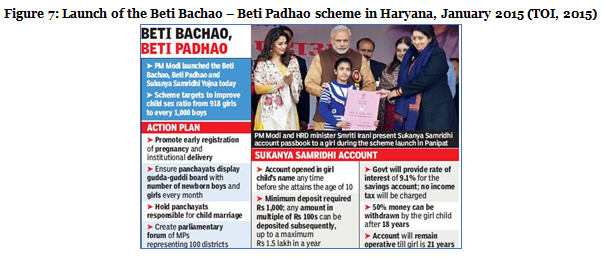
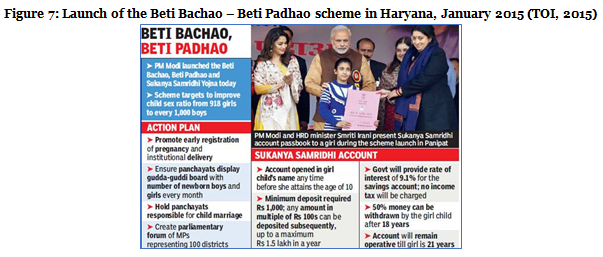
In 2015, the current government of India and the Prime Minister, Narendra Modi himself, launched the program, ‘Beti Bachao-Beti Padhao’ (BBBP – which translates to Save the Daughter – Educate the Daughter). This program was launched symbolically in the state of Haryana which has very highly skewed sex ratio in favor of males; and was done with much fanfare and press coverage before the arrival of US President, Barack Obama for the Indian Republic Day celebrations in the month of January, 2015. Seen in the image (Figure 7) below, is Prime Minister, Narendra Modi along with Smriti Irani, Minister of Human Resources Development (right) and Madhuri Dixit, a popular Bollywood actress, during the launch of the BBBP scheme in Haryana.


Figure 7-Launch of Beti Bachao, beti padhao scheme in haryana


The BBBP aims to improve sex ratio at birth by preventing sex-selective abortions, ensuring survival and protection of the girl child, and safeguarding education and participation of the girl child. The scheme is being implemented through a national campaign in 100 selected districts low in sex ratio. While BBBP states ambitious but much required goals and broad plans; since its launch, no concrete operational steps have been visible under this scheme. The only emphasis has been observed in the implementation of the already existing PCPNDT (Pre-Conception and Pre-Natal Diagnostic Techniques) Act launched in 1994, which regulates and monitors the use of ultrasound technology to prevent misuse for sex determination and selective abortion.


The BBBP scheme is being implemented by the Ministry for Women and Child Development (WCD) because the population group of child or girl child falls under this ministry. However, the very component of saving the daughter from SSA falls under Health (and requires involvement of Ministry of Health & Family Welfare) and the component of “Educate the girl child” requires the involvement of the departments of Education or Ministry of Human Resources. The nature of this scheme requires convergence and collaboration across departments and ministries, and multi-sectoral, multi-stakeholder engagement and involvement. The government is not very effective at this kind of work that requires collaboration within its own ministries. Also, the success of the program will require certain actions from public citizens, the lack of which may impede the goals of saving the girl child. However, to engage and move the public will require a greater degree of trust between government and public, which is currently at its lowest in India given all the corruption scams involving ministers and government departments.


Furthermore, addressing sex-selective abortion will require going against the grain of traditions and current cultural and social mores. This means it is not just about launching a program on the media but about implementing it seriously and honestly. And there is not much history or evidence to support the prediction that the BBBP program will be successfully executed.


Moreover, there is the larger issue of cultural transformation towards the equality of rights of every individual, whichever gender, class or caste groups they belong to. This cultural transformation has been extremely difficult in India, especially with respect to gender and status of women.


In a recent development, however, the Ministry of Health and Family Welfare has initiated the process of developing a mini media campaign (with at least with a set of TVCs or television commercials and radio spots) to publicize and influence the realization of the BBBP objectives in the country. The Ministry may also steer towards a more comprehensive 360 degree communication campaign that includes elements of Interpersonal Communication (IPC) for frontline workers and some mid-media components. Though, the Ministry’s budget has been cut in recent months and it is not too confident that incentivized frontline workers, who are mostly women from the villages they serve, will be able to address deep rooted cultural norms that determine the practice of SSA.


However, before we go into the details of sex selective abortion, we would like to step back and examine the larger context and frame of India’s development over the past few decades, especially after India became independent of the colonial rule of the British in 1947.


Larger context of India’s development and rapid change

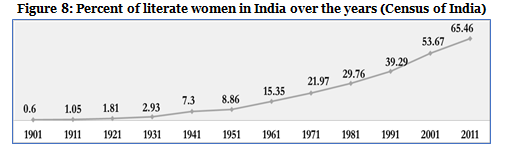
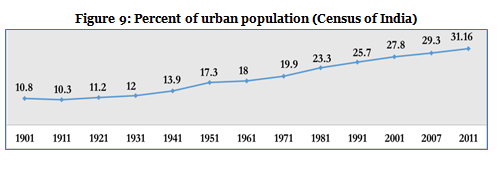
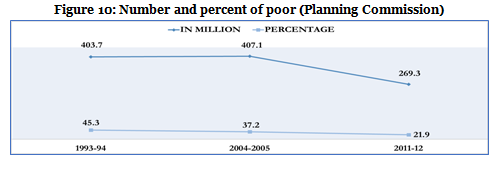
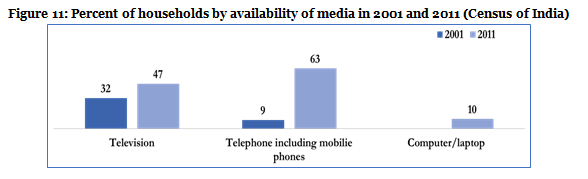
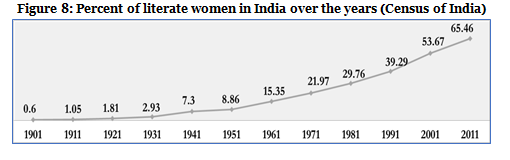
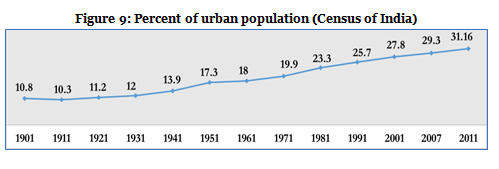
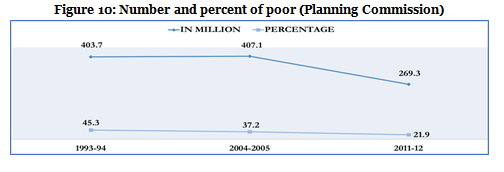
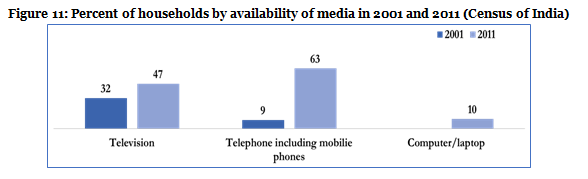
India is changing rapidly with respect to the classical (economic) development indicators such as the increase in female literacy and urbanization, decrease in family size and poverty, and the rising adoption of media and technology (see figures 8-11).


Figure 8-percent of literate women in India over the years

Figure 9-Percent of Urban Population

Figure 10-Number and percent of poor


Figure 11-Percent of households by availability of media-2001 & 2011


Female literacy has increased from a mere 0.6% in 1901 to 65% in 2011. One in three Indians, lives in urban areas and the proportion of poor households has reportedly declined by half in the last 2 decades. Availability of media in India households has increased in the last 10 years, with almost 80% of urban households reporting access to televisions and telephones. Nearly 81% of Indians use mobiles phones, of which 10% use smartphones. As of June 2015, a total of 213 million mobile internet users have been recorded in the country (IMRB 2015).


These data highlight that while some of the classic indicators of development are in place – including greater access to and the use of technology, media and education of women – it is actually creating a paradoxical effect of increasing sex-selective abortions.


Education (especially of women), higher income for families, and easy availability of technology are the holy trinity of all traditional (economic) development initiatives. With greater numbers of educated or literate females, who have increased access to media and digital technology, it is assumed that attitudes toward women would change in a more modern direction and that there would be greater acceptance of the girl child compared to a few decades ago.


However, technology and education seems to have had a reverse effect – whereby greater the development and education or wealth of the family, the higher is the likelihood of sex-selective abortions, as corroborated by Jha et al, 2011.


If educated and wealthier couples are engaging in the practice of sex selective abortions of girls using the technology of ultrasound, then it indicates a failure of the current economic development model in bringing about a transformative human development and ensuring rights for all humans. SSA clearly indicates a low status for the girl child in Indian society and is ultimately an issue of justice and rights in the field of public health.


Factors that determine sex-selective abortions in India

High prevalence of SSA has been found to be associated with three (3) factors (UNFPA, 2012). These 3 factors, conditions for a perfect storm of sex selective abortion of girls, are:


1. Availability of (ultrasound or other) technology (and privatization of medical care)

2. Sub-replacement fertility

3. Male (child) preference


All three factors will be discussed in detail below. A note to the reader about ‘sub-replacement fertility’ – it is a total fertility rate (TFR) or children per woman that (if sustained) leads to each new generation being less populous than the previous one in a given area.


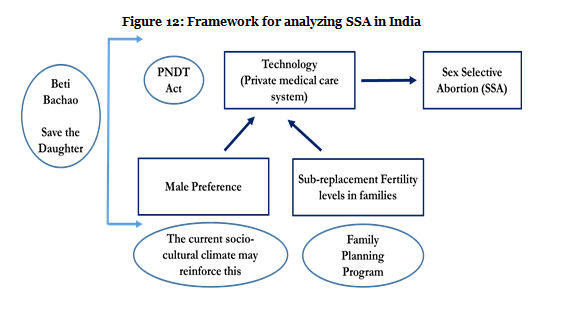
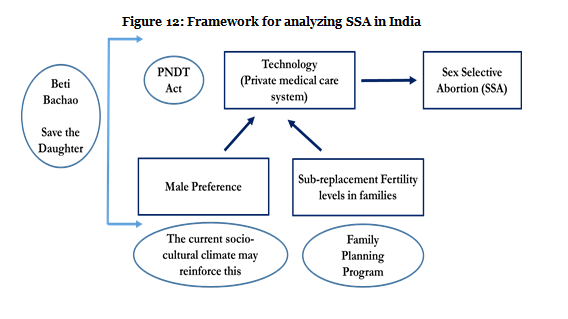
While the first two factors of access to technology and fertility cannot be controlled as access to technology will only increase and may also become affordable as in the case of mobile phones), and the desire to have fewer children is also growing and perhaps cannot be reversed. Controlling or eliminating the practice of SSA in India, will require work on the third, cultural factor of “male child preference” (see figure 12 below).


The Indian government has been addressing the first factor of “technology” and its misuse for SSA through the PCPNDT Act and associated mass media campaigns and other communication methods to inform people that there is a legal act, there are punishments and legal proceedings for misuse of ultrasound technology, and that the act is being implemented stringently across the country.


India also has a long running government program for family planning (since 1952), one of the oldest in the developing world, thereby addressing the second factor of sub-replacement fertility.


Thus, a third component, an appropriate and effective communication program for addressing the social norms, cultural preferences for male child and the attendant attitudes, beliefs and behaviors has to be created. In short, India has to be modernized in terms of its values towards the girl child and the girl child has to be treated equally as any other rightful citizen of the country. In the following segments, the essay will examine and discuss the below given framework outlining the factors and process of SSA in India.


Figure 12-Framework for analyzing SSA in india


FACTOR 1: AVAILABILITY OF TECHNOLOGY (AND PRIVATIZATION OF MEDICAL CARE)

This segment explores the growth in business of ultrasound scanners and its link to sex-selective abortions in India.

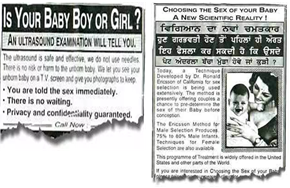
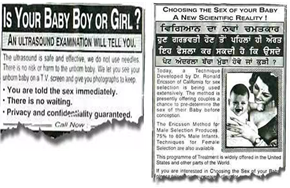
Is your baby boy or girl


The adjacent images (Puri, 2005) are newspaper advertisements for ultrasound test and sex determination of the child. Advertisements for clinics practicing sex-selection in Mumbai used to read, “Better pay Rs 500 now than Rs 50,000 later” (Desai, 1994). Rs. 50,000 refers to the dowry that the parents would need to pay when a girl is married.


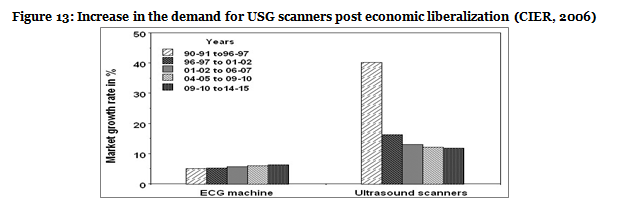
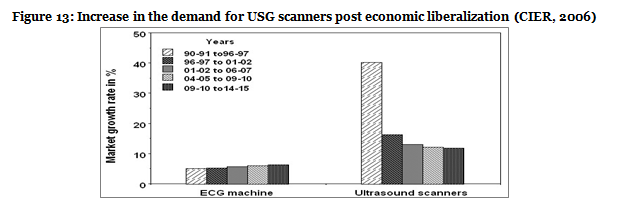
Liberalization of economic policies had varying impacts on demands for various commodities. By the late 1980s many doctors in urban India had started advising routine ultrasonographic check-up of the developing fetus at least 2-3 times during the pregnancy, and those who could afford to pay for the private medical services began to opt for this ultrasonographic scanning. A demand was created for ultrasound scanners, and with the easing of import duties and increase in indigenous manufacturing capacity, the market for these scanners soared as compared to other equipment (see figure 13).


Figure 13-Increase in the demand for USG scanners post economic liberalisation


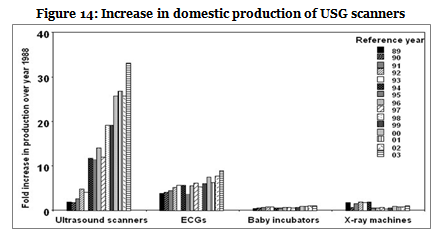
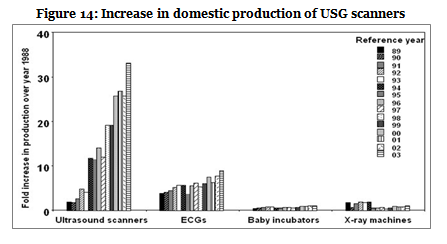
Simultaneously, domestic production of ultrasound scanners saw a dramatic increase. The graph below (Fig. 14) shows that over a period of 15 years the manufacture of ultrasound scanners has gone up 33 times whereas for the other three types of medical electronic equipment the increase has only been modest (Department of Electronics, Government of India, 2003).


Figure 14-Increase in domestic production of USG scanners


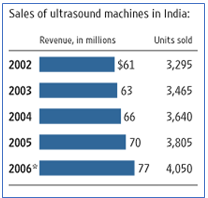
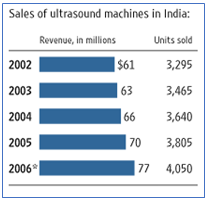
In 2001, General Electric (GE) submitted to the Indian Supreme Court the list of 6000 clinics to whom they sold ultrasound machines in the previous 5 years. The analysis of this data revealed that wherever GE had sold the most machines, those areas had the least girls born (Wonacott, 2007). The adjacent figure (sales of ultrasound machines in India) below shows the increase in sales of ultrasound machines in India, an almost 20% rise in a span of 4 years (Frost and Sullivan, 2006).


Surveys by Population Research Centres in the Indian states of Maharashtra, Punjab, Haryana, Karnataka, Uttar Pradesh, Gujarat, New Delhi Sales of ultrasound machines in indiaand Andhra Pradesh, found a direct correlation between sex ratio and the number of registered ultrasound clinics (Chandran, 2006). A case in point is Maharashtra, an Indian state in the western region with 4,345 registered ultrasound clinics, and a decline of 29 points in sex ratio from 946 in 1991 to 917 in 2001 (Mulay and Nagarajan, 2004). Districts with more than 100 sonography centers in this state had a distinctly lower child sex ratio than those with less than 100 sonography centers. The richer the area, higher the number of sonography centres. Gadchiroli, a poor district with the smallest number of sonography centres (five) had the highest female sex ratio (974) in the state. When the first ultrasound clinic opened in Punjab (a north Indian state with one of the lowest sex ratios) in 1979, there were 925 girls for every 1,000 boys younger than age 7. By 1991, it was 875, and by 2001, it had plummeted again, to 793 (Katz, 2006).


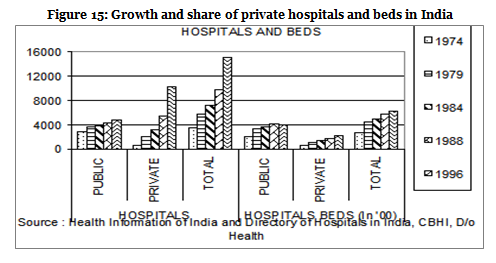
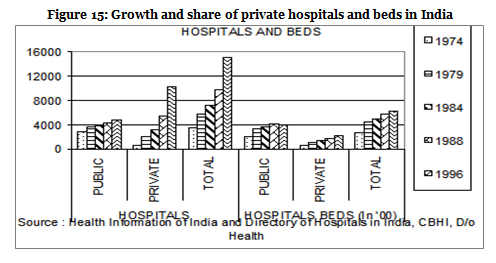
Some have argued that the privatization of medical care in India has played an equally important role in the increasing use of technology for sex determination and abortion. India initially adopted a public-sector–led model for health care provision, in which most services were to be provided free to all people. Then, the private sector’s presence was limited to individual practitioners and a few charity-run hospitals. When India became independent of British rule in 1947 the private health sector provided only 5-10% of total patient care. At first, small private clinics proliferated, but after India’s economy opened up in the early 1990s, large corporate hospital chains took hold. Today the private sector accounts for 82% of outpatient visits, 58% of inpatient expenditure, and 40% of births in institutions (Reddy 2013). Figure 15 illustrates the increasing share of private hospitals and beds in the country between 1974 and 1996. India also has one of the highest (86%) out of pocket expenses for healthcare (WHO, 2013).


Figure 15-Growth and share of private hospitals and beds in india


The cost of sex determination and selective abortion has become affordable owing to increasing access to USG technology. It has been posited that greater privatization coupled with greater availability of technology has led to greater SSA (people are paying out of pocket to detect the sex of the fetus and then get it aborted).


Indian authorities have tried to regulate the sales of USG equipments and also monitor the use of this technology. In 1994, the government brought into effect the Pre-Natal Diagnostic Techniques (Regulation and Prevention of Misuse) Act (PNDT) that banned prenatal sex determination before or after conception to prevent the misuse of technology for sex selective abortion. This act outlawed sex selection and empowered Indian authorities to search clinics and seize anything that aided this practice.


The PNDT Act (1994), was amended in 2003 to the Pre-Conception and Pre-Natal Diagnostic Techniques (Prohibition of Sex Selection) (PCPNDT) Act to improve the regulation of the technology used in sex selection. The amendment of the act brought the technique of pre-conception sex selection within the ambit of the act, included ultrasound within its ambit, empowered appropriate authorities for search, seizure and sealing equipments and passing decisions, provided for more stringent punishments, and regulated the sale of the ultrasound machines only to registered bodies. Any clinic that has an ultrasound machine must register with the local government and provide an affidavit that it will not conduct sex selection. To date, more than 30,000 ultrasound clinics have been registered in the country (Wonacott, 2007).


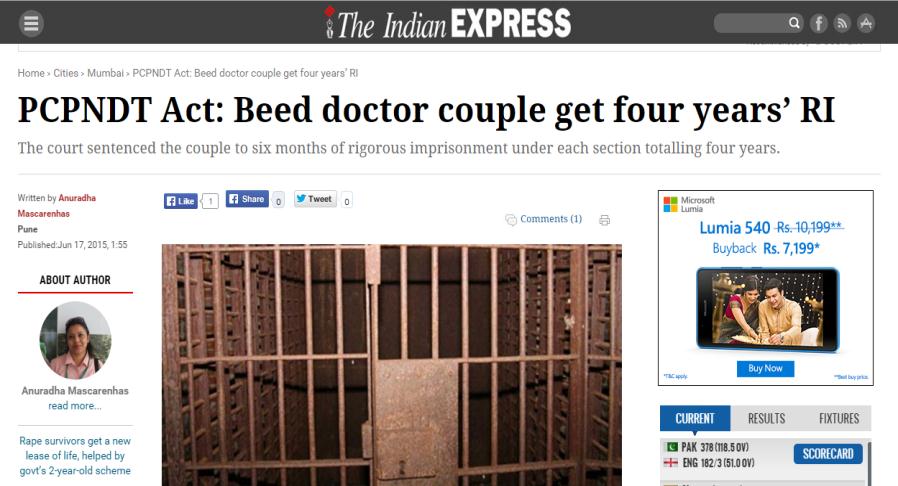
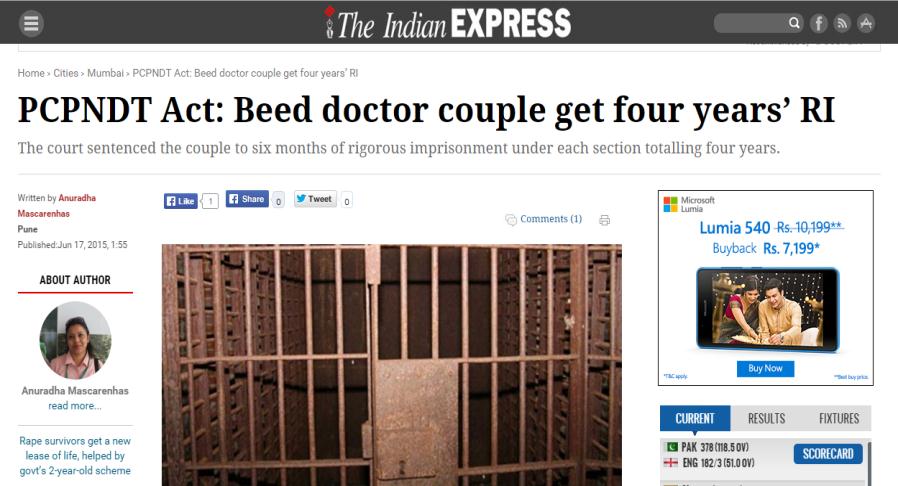
Violation of the PCPNDT Act can lead to severe fines, cancelation of medical license and imprisonment (Ministry of Health and Family Welfare, 2015). According to the Maharashtra state health department, 523 court cases have been filed against doctors for violating the PCPNDT Act, 168 cases have been decided in court and 75 doctors have been convicted. A total of 142 names had been sent to Maharashtra Medical Council (MMC), a quasi-judicial authority for taking action against the medicos. The image below is a clipping of a national daily, covering a story on violation of this act, resulting in 4 years of imprisonment for a doctor couple (Mascarenhas, 2015).

 p3


However, effective implementation of the PCPNDT Act varies from state to state. In recent years, a bench of the Supreme Court of India questioned the Ministry of Health and Family Welfare and called for evidence on the implementation of the PCPNDT Act in the last decade. In response, the Ministry furthered their communication efforts, developed a TVC or a PSA (public service advertisement) and aired it on national television – on multiple channels (see image below). This was an intensive attempt to inform and caution people about the misuse of USG technology and the punishments and legal proceedings that have been given out.

X


FACTOR 2: SUB-REPLACEMENT FERTILITY LEVEL

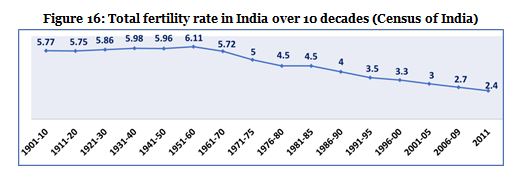
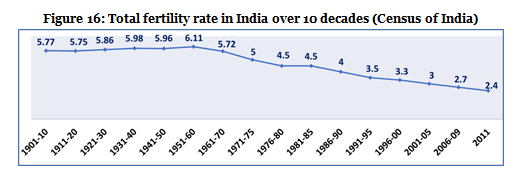
The total fertility rate (TFR), sometimes also called the fertility rate, of a population is the average number of children that would be born to a woman over her lifetime. Fertility rates, or the average number of children borne by women, have been falling in India, from 5.77 in 1901-10 to about 2.4 in 2011 (see figure 16). Although the mean total fertility rate (TFR) is still above the sub-replacement level of 2.1; few Indian states have recorded fertility rates of 1.6 (which is considered sub-replacement).


Figure 16-TFR in India over decades


The age at marriage for both men and women has increased in the last few decades; the average household size and landholdings are decreasing as families become more nuclearized (Census, 2011). Indian couples (and families), in general, are reducing the number of children they have. Some authors have argued and presented the data that fertility is declining in India primarily because of its decline among illiterate women, and they are doing so because of the diffusion of a new reproductive idea of having only a few children but investing more on their future (Bhat, 2002).


Unlike the past where children or pregnancies were considered a gift of God; today, the situation has changed. Couples are planning families. There is a quantity-quality trade-off. Couples want fewer children but have greater aspirations for the child. There is a sense of intergenerational rise of the family – the succeeding generation has to do well or be better off than the previous generations. Thus, the onus or responsibility falls on the couple or the parents to ensure that their child has a better future and therefore couples are opting for fewer children and investing in the child. One of the investments is putting the child in an English medium school (with the hope that studying in an English medium school will give the child greater opportunities in the future).


FACTOR 3: MALE CHILD PREFERENCE

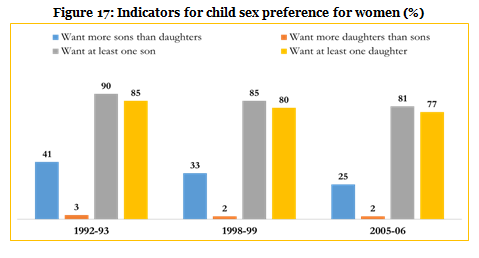
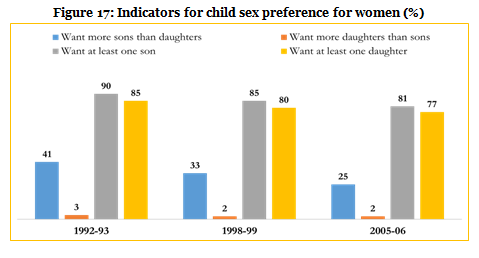
Data from the National Family Health Surveys (NFHS) in the last 2 decades shows a strong preference for at least one male child, among both men and women (see figure 17). In 2005-06, a third of all women wanted to have more sons than daughters. Over the years, a mere 2-3% of women have wanted to have more daughters than son.


Figure 17-indicators for child sex preference for women


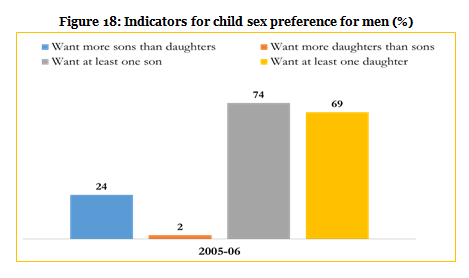
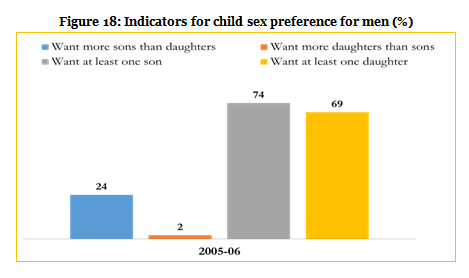
Similarly, NFHS data for men also shows stronger preference for at least one male child, and more daughters than sons.


Figure 18-Indicators of child sex preference for men


Qualitative insights on sex selective abortions (SSA) in India

In addition to a desk review of secondary data including national datasets, we also share findings from qualitative focus groups and interviews conducted with men and women in Uttar Pradesh and Haryana (2 north-Indian states with low female to male sex ratios) to examine the Indian couple and understand the key factors and decision-making processes that determine sex-selective abortions in the country.


While the Census and large datasets or macro pictures show certain trends, qualitative interviews and group discussions conducted with men and women helped to explore the micro-level dynamics, discussions, negotiations at the family and couple level and understand the practice of SSA. These qualitative discussions centered on factors that underlie this behavior. Themes that emerged from this qualitative investigation can be placed into the following 3 categories when discussing SSA: (i) Costs of the girl child; (ii) Benefits of a male child; (iii) the prosperity and continuation of the Family (or Cost-benefit calculation for the firm or organization called the family). The qualitative data shows how cost-benefit equations are used in justifying girl child SSA and the preference for male child. However, what we discovered was the underlying dominance of the notion or unit of “family” and the quest for prosperity of this unit. Although, the family unit has become increasingly nuclear in India; yet, young, educated males and females spend a lot of money on traditional weddings. Furthermore, most couples want a limited number of children (restricting family size) and are focusing on quality over quantity of children. The notion of continuation of family name (lineage) and the future success and prosperity of family (embodied by the child) is paramount in decision-making processes in the minds of couples.


1.      Cost of the girl child

The immediate response as to why couple or families resort to SSA could be categorized as “fear” of having a girl child. The fear revolved around expenses incurred for dowry (an amount of property or money brought by a bride to her husband on their marriage). Any investment in the daughter was a non-return to the family because the daughter was “paraya dhan” (another’s wealth). Given the patriarchal society structure, the daughter would marry and move to the husband’s house and any investment in her education was seen as a gain for the in-laws family. Furthermore, despite getting the daughter an educational degree, families said they still had to spend on dowry or on the wedding.


Some respondents shared that violence against women in India was another factor for SSA. Daughters get harassed when travelling outside the house. They could get raped and this affected the family’s “izzat” or honor. Families were also worried that many educated girls tend to marry husbands of their own choice – and the husband could be someone from another caste or religion (inter-caste marriage is still viewed as a taboo is most Hindu communities) and once again this was a problem to the family “izzat.”


2.     Benefit of the male child

Respondents spoke about benefits of having a male child in the family. Since the son lives with his parents even after marriage, they are guaranteed of their old age security in a country with no national welfare schemes for its senior citizens; they are supposed to be taken care of by the son and his wife.


According to Hindu religious traditions, the son is entitled to conducting the last funeral rites of his parents, ensuring them a passage to the afterlife.


Property is most often passed on the male heir of the family. A son also ensures that the family name/lineage continues.


These cost-benefit calculations with respect to having a son versus a daughter are often the first responses to be elicited when interviewing people on this topic. However, on further probing a third aspect was revealed.


3.     The prosperity and continuation of the Family (or Cost-benefit calculation for the firm or organization called the family)

Couples are calculating cost-benefits, but for what? The ultimate allegiance of Indian couples, both men and women, is for the organization called the family. The family is seen as a more dominant (and sometimes oppressive) theme running through the discussion of their own lives, having children, family, family planning and sex-selective abortion.


Deeper probing during the qualitative explorations revealed that there is an almost fatalistic belief about forming a family in the Indian context– that one is helpless – an essential belief that we have to start a family that it has to be done – “Nibhana hai” – a duty that has to be done. Young men and women shared that they were groomed from an early age to marriage as the socially acceptable path to forming a family. They were told that it was their duty to start a family; that men were providers and women were the caregivers.


Marriage as a norm was pushed on both men and women to create a family and perpetuate the family name. This was the organization – the family – that was being upheld, continued and preserved or perpetuated through the decisions about what children to have. Couples are expected to prove their fertility almost immediately after marriage. People do not like couples to walk together, hand in hand or go and watch movies together. In fact there is very little life as a couple or very little overt romance between married couples in public places in India. The child becomes the “jod” in Jodi (Jodi means a couple and Jod means bond). A child is the bond that makes a couple socially legitimate in the eyes of the community. A couple that is childless is not seen as culturally legitimate.


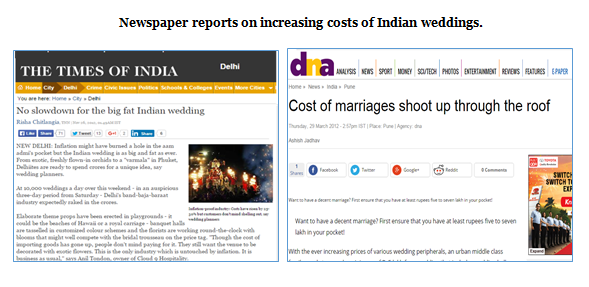
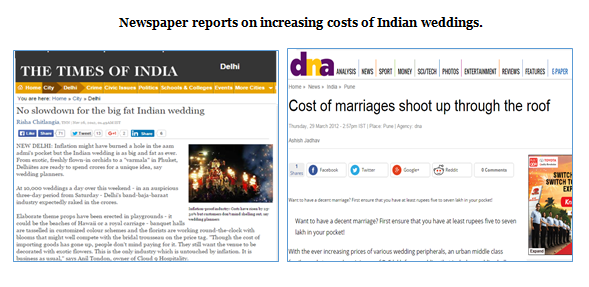
And young Indians are taking this marriage and family thing seriously and celebrating it. There is a trend towards more lavish weddings. There are many stories of farmers taking debt to get their daughters wedded and then committing suicide because they could not repay the loans.


Newspaper reports on increasing costs of Indian weddings


 Using the metaphor of an organization to understand couple-hood in India (mainly north India)

 Let us assume for a moment that the new bride entering the house of her in-laws after the wedding is akin to a new recruit in a large multinational firm. They are both trying to get a grasp of the organizational structure and culture. The structure of the traditional family is made clear to the bride as she grows up within her own family and in the entire wedding process. What is more important to her is to understand the organizational culture – both the overt and the tacit or hidden.


How does the newlywed understand the dynamics of the in-laws family and what schema or framework does she have in mind?


After the wedding the newlywed couple receives blessings from all elders of the family. These blessings, the words uttered, are a way for the young bride to understand the culture of her new organization (just like a new recruit or hire would do in a corporation). The new recruit in a corporation or bureaucracy would understand the culture by listening to the bosses and their formal and informal speech. The newly-wed bride understands her place in the organizational structure, and knows that she has to jump through some specific hoops in order to advance through it.


In the beginning, there is the probation phase akin to the recruit in the corporation. The young bride has no freedom of movement. She is always accompanied by someone, wherever she goes. The fertility (or the first birth) bestows freedom on the woman. She can now move out unaccompanied to a few places with the child in tow. Thus, in corporate terms, the new recruit has passed the probation phase and has received confirmation of position in organization.


However, the woman is looking for permanent status, and this can only be given through the birth of a male child. With the birth of a male child the position of the newly wed woman becomes entrenched and she gains more power within the organization.


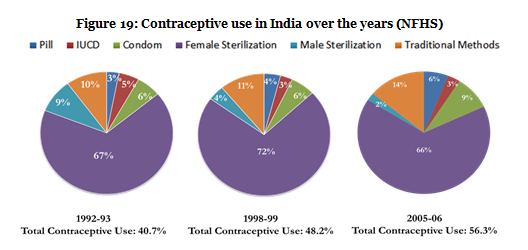
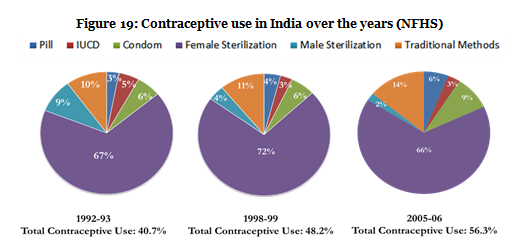
As illustrated by NFHS data in the figure 19, most of the family planning burden in India is borne by the female. This is because men view anything with the reproductive arena as the sphere of females.  Thus, all family planning burdens are passed on to women, including the responsibility of the birth of a girl or boy child. This too becomes the responsibility and burden of the woman. Female sterilization is the most commonly used form of contraception, and the mean age for women at sterilization has declined over the years. Women as young as 25 years are opting for permanent sterilization.


Figure 19-Contraceptive use in India over the years


Over the years, while the total contraceptive use has slightly increased from 41% in 1992-93 to 56% in 2005-06, female sterilization has been the most commonly used contraceptive method over time.


What does this indicate? If the woman, age 25 years, is willing to undergo permanent sterilization, then has this woman thought about divorce or having a child from a subsequent marriage? The answers are NO.


This essentially means that the young woman is looking to stay in this family where she has gotten married and solidify her position. She wants to become more powerful within the family using the cultural norms and means available at her disposal. This means having a male child if required. These family/organizational dynamics perpetuate the practice of sex selective abortions.


Did Family Planning Communication in India (since 1952) also contribute to this problem of male child preference?

In this segment we examine development communication on family planning in India over time to understand its role in perhaps shaping the preference for a small family and subsequently the preference for male child in this smaller family. Mara Hvistendahl in her book: Unnatural Selection: Choosing Boys over Girls and the Consequences of a World Full of Men (2011) explains that part of the drop in birth rates in Asia can be attributed to “a history of population control, and a dark history at that.”


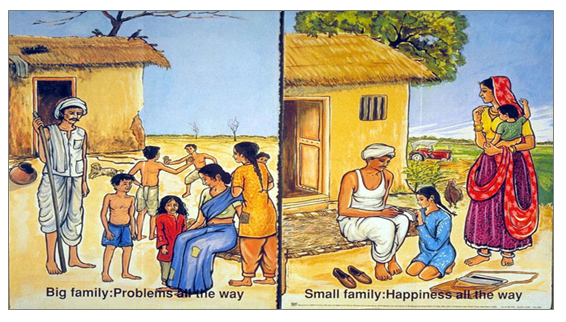
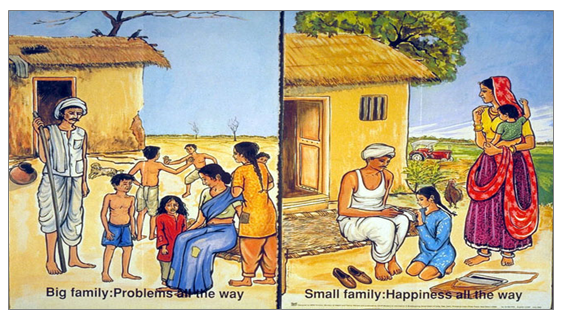
India’s family planning program is one of the oldest in the developed world. Starting in 1952, India’s family planning program widely advertised small-sized families and connected it to the family’s economic prosperity. The focus was on the target of family size. Reduce family size at all costs was the mantra – because small family means prosperity. The slogan was “Chhota parivar – Sukhi parivar” or small family = prosperous family). The large family was always associated with poverty and misery in the family planning communication.


Some clear and discernible trends in family planning communication in India since the 1950s:

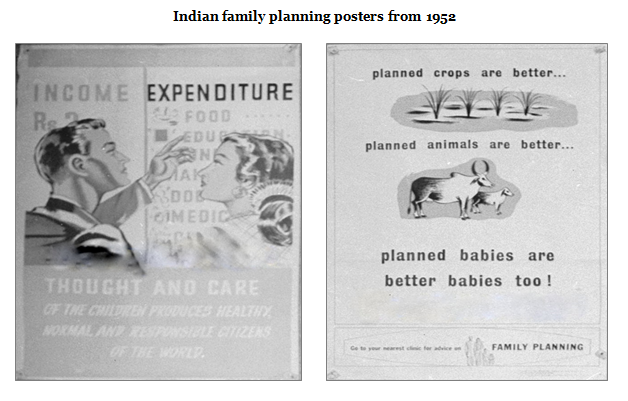
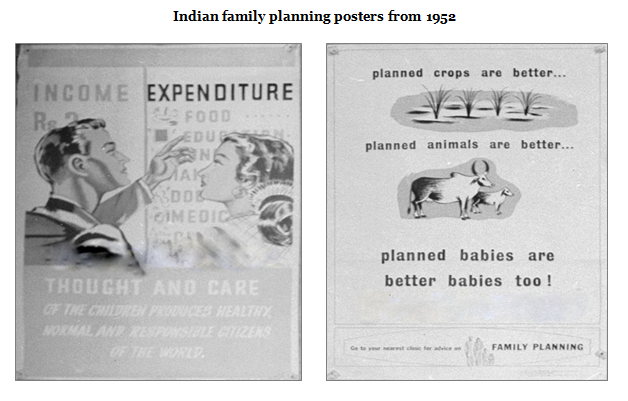
  • Focus on income and expenditure – family planning is required because it helps decrease expenses. Family planning was pushed as a pathway to material prosperity. Advertisements emphasized how much one could gain from adopting family planning. Perhaps it was the easy way to communicate about family planning.
  • Focus was on family size and not on family composition. As family planning was about material resources, gain or a cost-benefit calculus and reduction of population in connection with resource availability for the nation and the world; the focus was on the number of children. Each of the above images emphasizes two children in it because the desired family size in India (even now for some states) is 3 and it has come down to 2 for the more urban areas.

  • A closer look at the posters or postage stamps until the late 1990s shows a tacit suggestion of family composition that includes one (usually elder) daughter and one younger male son. Jha et al (2011) found that families with one daughter were more likely to practice SSA for the second birth to ensure that they had a male child. Couples are customizing their family composition to the images disseminated through the family planning program (which was based on the desired family composition in India – and paid no attention to the various possibilities that emerge when nature is left to her devices).
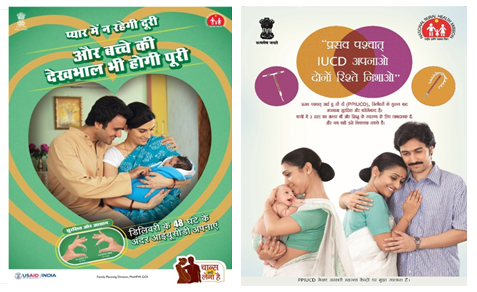
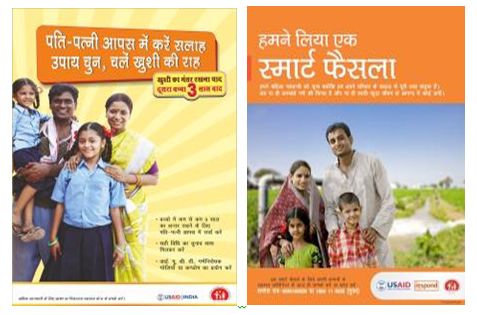
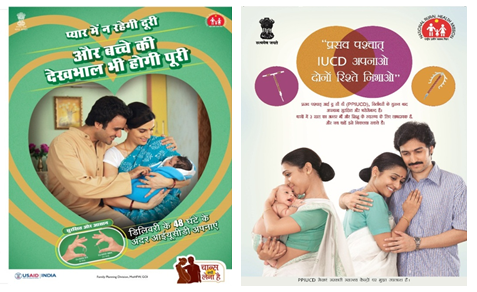
  • While there has been some shift from 1999 onwards – where posters show two children and both daughters and also include messaging on more freedom for the woman, household prosperity messages are still built into the communication. The woman is now shown as free to be both mother to her newborn and wife to her husband. Despite the message of “freedom,” the role of the woman is limited to a “mother” and “wife.”

Indian family planning posters from 1952


Both the above posters emphasize economic gains from the adoption of family planning.


The image of a poster below with the red triangle, which became the iconic symbol of family planning in India, indicates that this triangle is the brand for any family planning center. The poster also depicts the “ideal” Indian family: father, mother, and two children. On the right is an image of a man painting a family planning mural in Uttar Pradesh, the most populous state in the country, and the brand of family planning was disseminated all over the country from wall paintings, hoardings, postage stamps, to the back of trucks that traveled across the country.

Indian family planning wall images


Given below are postal stamps issued by the Government of India in the 1960s, emphasizing the ideal family size with 2 children.

Stamps on fp

Family planning communication in the 1990s continues to focus on the economic gain of limiting family size. Note that in the image below, in the ideal scenario on the right, the older child is a girl while the younger child is a son, bringing to mind one of the key findings from Jha et al (2011), that families with a first born girl were more likely to have a SSA to ensure that they had a male child.

 FP poster


Family planning communication posters from the year 2000 onwards saw a shift; emphasizing the use of temporary contraceptive methods such as intra-uterine contraceptive device to ensure that a woman could fulfill both the roles of a wife and mother. Interestingly those were the only roles for the woman – wife and mother.


FP-Modern posters-IUCD


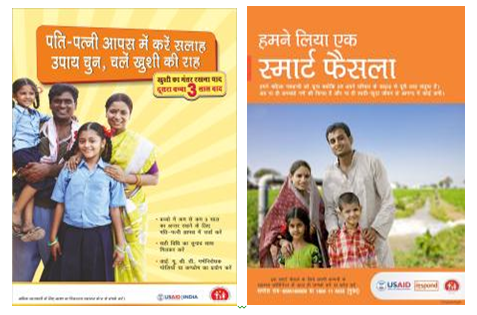
The next set of posters contains messages on birth spacing of 3 years (left image) and female sterilization (right image). Note that in the left poster, both the children are girls, a shift from the previous communication.


Modern fp posters


This assessment of widely disseminated family planning communication in India highlights an overarching emphasis on economic gain and prosperity by adopting an ideal family size, without addressing the underlying cultural factors such as male preference, status of women, dowry, and violence against women, that is now used to explain sex-selection. Policy-makers prioritized livelihoods over quality of living, substituted financial in place of social transformation, and families took the cue. With increasing and affordable access to USG technology and privatized medical care, families customized their family size to ensure that they had at least one male child, often at the cost of SSA of the girl child. This one-dimensional view of development as economic created a culture which measures all human activity against financial returns and costs.


Factors in India’s current cultural climate that will make saving the girl child challenging and difficult


Kitna deti hai (How much does it give?)

A series of television commercials (TVC) for a popular Indian car brand have the tagline: For a country obsessed with mileage…


This represents the mind-set of a country that has made materialism its slogan and calculates all effort and activity on the basis of what it will give me, the costs and benefits.


In the end of one of the TVCs in the series titled – Juno, a bunch of Indian tourists are visiting NASA in the US. The scientist demonstrates an ambitious NASA project called “Juno,” which is a spaceship built to discover the secrets of planet Jupiter. When the scientist asks if there are any questions at the end of the demonstration, an Indian male tourist asks very typically, “Kitna deti hain”, which literally translates to – how much (mileage) does it give?
&nbsp

x

Similar advertisements in the same series show a man going to buy a super-luxury yacht; a man travelling in the latest jetliner; or a representative from the army purchasing a military tank, asking the same question: how much (mileage) does it give?


x

x

 x

These series of TVCs illustrate very well the current climate of the consumerist, materially-oriented, cost-benefits type of thought process that is widely prevalent in India today. Everything is measured in terms of how much will this give me? The same perhaps holds true for having a child, or determining the sex of the child a couple plans to have.


Sex-selection has become a cultural norm in India in the most economically developed geographical states in the best economic times for the country. Indian families, analogous to a corporation, apply market principles to family-decisions as shareholders (relatives and community) pressurize for return on investment. The low-hanging fruit of cost-cutting and making economic gains has led to sacrifice of the girl-child to create a positive balance sheet. Indian families have created the first couples of the neoliberal era; measuring everything, including worth of a child’s life, in monetary terms. Ironically the country’s economic growth further justified the economic rationale for sex selection by highlighting the girl-child’s liabilities as every family wanted to join the prosperity party.


Cultural transformation seen through lens of money or economics alone

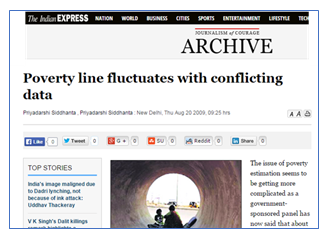
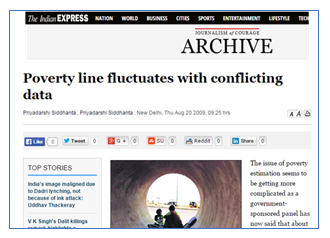
Part of this obsession with money and prosperity arises from the “poverty” mindset that exists in India even among the educated and wealthy. Bureaucrats, technocrats, public health programmers and communicators cannot seem to think beyond financial triggers or incentives for change. Bureaucrats see poverty as a singular cause of all Indian ills and seem to have become more impoverished intellectually about the processes of cultural transformation than the poorest person who is at least using its will to survive. The Janani Suraksha Yojana, a scheme that rewards mothers with a sum of Rs. 1500 (US$23) for delivery in a government health institution, is a case in point. All attempts at cultural transformation pass through the lens of economics or money. However, as money becomes the criteria for prosperity, the idea for any change translates into putting more money into people’s hands. And there is not that much money in the Exchequer’s office or the Treasury. Therefore, in recent years, Indian bureaucrats and economists have been found to be quibbling over varying poverty line estimates provided by different committees (Siddhanta, 2009).

The Indian Express-Poverty Line fluctuates with conflicting data


The problems of juxtaposing tradition with technology without passing through the lens of values of modernity, especially equality and rights for all

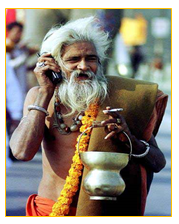
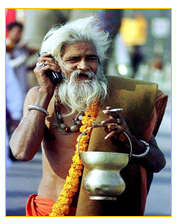
The adjacent image of a sadhu with a mobile phone is often used in the popular and global press to represent contemporary India where the old

Sadhu on a phone or traditional and the new or technological come together. Often, these types of images, said to showcase the hybrid culture that contemporary India possesses, also attracts a certain kind of tourism. It is often seen as something different from the sterile, clinical culture of many modernized and developed countries. Writers contrast the ancient temples of Benares with the modern glass towers of information technology (IT) towers in the cyber city of Bengaluru. The same writers forget to write that both Benaras and Bengaluru have congested, crowded streets, poor air quality, and probably no sewage systems.


People forget to ask: how does a combination of the old, traditional India and new, technological India contribute to the practice of sex selective abortions or even other health related problems? The unchecked use of technology, often outdated, has led an environmental health crisis in India with its extremely poor air and water quality (interestingly, the sadhu in the image is also holding a cigarette in his left hand). How does the “hybrid” mix of traditional cultural norms, the new practices of economic development (at all costs) and adoption of any and every technology impact on the status of the girl child? Does it help the girl child or hinder the equality of gender?


To some extent, the image also represents the “problematic” of the cultural change that is required for elimination of sex-selective abortion (SSA) in India. As India tries to realize its ambition of being in the group of the big players – the economy or the UN Security Council – it has to realize that some changes in its culture are necessary. It has to demonstrate that it values all life and is a country committed to the human development of all humans where each person, boy or girl, can realize their potential.


However, India has been resistant to cultural change especially with respect to gender; and has been hiding behind economic development. The sub-test operates at two levels: one is that economic development and money will solve all the problems and a second more dangerous line of thought, more apparent in the last two decades of the neoliberal economy, is that for the sake of money, no one, either from India or a foreign investor, will talk about cultural change at all. The making of India as a favored destination for investment, rather for high return on investment, will stop all talk of cultural transformation or even rights for all. Thus, India struggles to try and fit the traditional and the modern together. The Supreme Court often asks uncomfortable questions about protection of the girl child, the departments run helter-skelter trying to find cases, and the political side makes excuses or even end up tacitly or openly supporting groups that hold values tending to favor SSA. Cultural norms are not challenged by democratically elected leaders who fear losing vote-banks in the Indian political context. Today, in India many educated wealthy people look back to the ancient past of India as a treasure trove of not only wisdom but scientific knowledge and there are large scale attempts to explain all scientific discoveries or thought as having existed in India before. Everything that is significant in the world today has already happened or was already invented in ancient India.


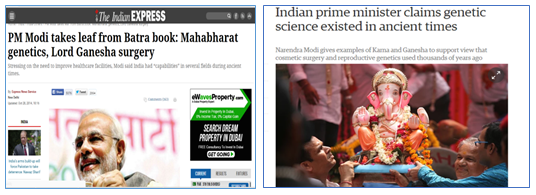
Political push for traditions as scientific

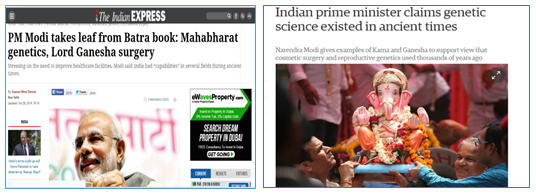
A case in point are articles from the Indian Express and the Guardian as well as various other Indian newspapers, that describes how the economically progressive, Indian Prime Minister credited the existence of plastic surgery in ancient India for explaining how the revered elephant god, Lord Ganesha, got the elephant head and also discussed the happenings and events in the epic Mahabharata crediting them to the existence of genetic sciences in ancient India.

x

Genetic science existed in ancient times


We the people… Aren’t our leaders just giving us what we want?

However politicians today are not leaders of men and women, they are often followers, who mimic and reflect popular values and aspirations. As has been said, people often deserve the leaders they elect in a democracy. The problems of democratic politics globally, be it interest groups, lobby groups, vote-banks, coalitions are also seen in the Indian context. Leaders, who emerge as popular figures, are able to accurately capture the popular mood. And one of those popular moods is reflected in the trend of “mahurat C sections.”

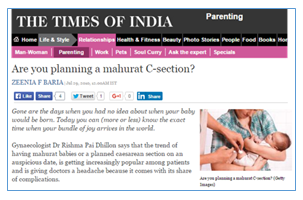
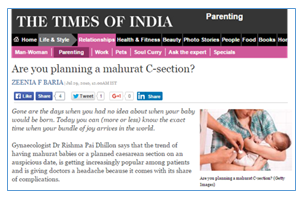
What are these mahurat C-sections?


TOI-Are you planning a mahurat c-section


Mahurat, according to the Oxford Advanced Learner’s Dictionary is an auspicious time for an enterprise to begin or for a ceremony to take place. The sentence given as an example for use of this word is: the pandit (priest) selects the best mahurat for the wedding. Cesarean delivery — also known as a C-section — is a surgical procedure used to deliver a baby through incisions in the mother’s abdomen and uterus.

The wall street journal-When the stars align, it's a good time


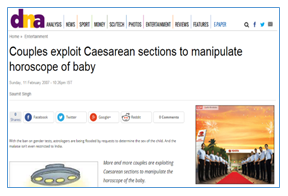
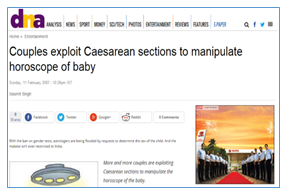
Most educated, wealthy couples in India want a limited number of children. We have already seen the reduction in fertility rates in India. Couples are restricting family size and focusing on quality over quantity of children. The notion of continuation of family name (lineage) and the future success and prosperity of family (embodied by the child) is paramount in decision-making processes in the minds of couples. And in order to ensure greater success for this future child and carrier of the family name, couples, mostly well-to-do, are having ‘Mahurat C-sections’, where astrologers are paid to determine the astrologically best or most fortunate (lucky) time of birth for this child, and couples request their doctors to plan the surgery in such a way that the child will be born at this chosen opportune time as determined by horoscopes. If the same couple has engaged in SSA, then this mahurat C-section is for the male baby, which is the only taken to the full term of pregnancy.


DNA-COuples exploit C-section

x

The hybridity of culture or strange mix of old and new is not just demonstrated through the architecture but the everyday practices of people in India. And despite the charms that hybrid cultures represent to many outsider eyes or the pride in one’s ancient culture that it represent to insider minds; often the values of the traditional and the modern do not go together very well for individual humans, especially demonstrated by the case of sex-selective abortion of females where old habits and norms of entrenched gender inequality and male preference clash with modern notions of equal rights and justice for all human beings. This makes the entire exercise and effort of changing the cultural preference for a male child extremely challenging.


Development communication, rather than changing minds, contributed to the crisis by messaging economic development as social change while disregarding cultural transformation. Factors such as male preference, status of women, dowry, violence against women, now used to explain sex-selection, were not addressed from the start. Even India’s family planning program, starting in 1951, widely advertised small-sized families (two children) connecting it to the family’s economic prosperity. Policy-makers prioritized livelihoods over quality of living, substituted financial in place of social transformation, and families took the cue. This one-dimensional view of development as economic created a culture which measures all human activity against financial returns and costs.


Indian families, analogous to a corporation, apply market principles to family-decisions and as shareholders (relatives and community) pressurize for return on investment the low-hanging cost-cutting sacrifice is the girl-child. Ironically the country’s economic growth further justified the economic rationale for sex selection by highlighting the girl-child’s liabilities as every family wanted to join the prosperity party. Sex-selection has become the cultural norm in the best economic times for India.


How do we change this situation? Traditionally, social change has always been placed on one side of the spectrum or the other – either change has been seen as a function of changes in the larger structure or individualism which attempts to explain all social phenomena in terms of individual actions. Sherry Ortner, anthropologist, builds on French theorist, Pierre Bourdieu’s work on “practice theory” – which places social change within the dialog or dialectic that occurs between the larger social structure and individual human agency working back and forth in a dynamic relationship. Sherry Ortner’s work on rules and resistance posits that rearranging roles, social institutions or even reordering the whole economic structure will not address female subordination.


Ortner states: Social transformation must also be cultural transformation or it will be nothing.


So, how do we bring about cultural transformation in India that will help reverse the skewed sex ratio?


Using ‘Betigiri’ to save the girl child in India: a communication concept and introducing a new term in the popular vocabulary

Keeping in mind the cultural difficulties and insights gained from the research, the concept and term “Betigiri” was coined by us as a communication method for large scale campaigns that reach out to the population and influence the realization of the goals of the Beti Bachao – Beti Padhao scheme (save the girl child) in India.


We suggest this new term or word (Betigiri), coined from existing words in the commonly spoken Hindi language, to influence everyday actions that then push for changes in structure. Thus, we attempt to connect everyday language with everyday actions. The language creates a language of positive action or actions to protect the girl child. It provides a language of opposition against being quiet or remaining silent on various issues and in various situations that affect the girl or daughter negatively. It is designed to enter popular lexicon and anyone – male or female – can use it.  The television campaigns (TVCs) model and encourage appropriate behaviours for community members in different situations where a daughter may be in danger (of any age group).


Betigiri (actions towards honoring, protecting, respecting the girl child)


Although we understand that this is a complex, layered, multi-dimensional issue that is difficult to address, we introduce and discuss the communication concept of “Betigiri,” which means acting and behaving in ways that protect, honor and respect the girl child and implies empathy towards the girl child. Betigiri, as a communication concept, provides an operational and do-able construct for the “Beti Bachao” (Save the girl child) program, and a handle for specific everyday practices and behaviors with respect to girls and gender.


We seek to introduce ‘Betigiri’ into the everyday lexicon, and popularize the practice of doing something on an everyday basis to help daughters in this country, thereby creating a better environment of respect, honor, pride in the girl child, which we hope will ultimately contribute to addressing obstinate gender-related cultural norms and gender inequalities that follow.


‘Betigiri’, refers to everyday actions that can help to save the girl. Beti stands for daughter in Hindi. Betigiri can be understood in relation to a similar term called ‘Gandhigiri’, which refers to the practice of the teachings of Mahatma Gandhi (including non-violence, and speaking the truth); or ‘neta-giri,’ which connotes behaving like a neta or leader. The suffix – giri – has an implied component of actions or acting towards something.


While the BBBP government scheme urges citizens to save the girl child – ‘Beti Bachao’, the use of the term “Betigiri” operationalizes this goal and shows people actions that can be used on an everyday basis to care for our girls. In tests with lay audiences, the concept and practice of “betigiri” was very well understood by them. They used the word “betigiri” not only to refer to actions that prevent SSA, but also in everyday life such as keeping a girl in school, preventing and stopping early marriages, standing up for any girl being harassed, or even acting against domestic violence. Test audiences were moved by the concept emotionally and felt that they could have thought of this simple notion earlier and done simple things in everyday life to protect daughters. The word “beti” was not interpreted as a small girl or fetus; every woman (young or old) could be seen as a beti (daughter) according to both male and female test audiences. They reported that “Betigiri” can be used in different contexts, situations and provide simple, do-able steps that everyone can take to protect our girls.


Betigiri offers a chance to every Indian to contribute and make the country a better place for girls. Practicing Betigiri will also ensure applause and support from others around.


From a communication standpoint, long-term interventions are needed that range from the mass media, to community dialog and interpersonal and social media communication. Although the concept of “Betigiri” may spark some scattered action among a small minority and that too may fade away soon, we hope to start and sustain “conversations of conscience” among people.


These very conversations (of conscience) helped reduce sex selective discrimination in South Korea – the only country that has been able to stem and reverse SSA trends. However as Eberstadt (2011) writes:


“Available evidence suggests that South Korea’s reversal was influenced less by government policy than by civil society: more specifically, by the spontaneous and largely uncoordinated congealing of a mass movement for honoring, protecting, and prizing daughters. In effect, this movement — drawing largely but by no means exclusively on the faith-based community — sparked a national conversation of conscience about the practice of female feticide. This conversation was instrumental in stigmatizing the practice, not altogether unlike the way in which nationwide conversations of conscience helped to stigmatize international slave-trading in other countries in earlier times. The best hope today in the global war against baby girls may be to carry this conversation of conscience to other lands.”


There may be hope yet for the girl child in India. It starts from everyday conversations, and everyday practices. And it is the very leaders of tradition and guardians of temples who may have to become the guardians of the girl child. They can do so by incorporating “betigiri” in their everyday vocabulary and everyday practice. Betigiri is not just about having conversations of conscience; it allows individual Indians to practice actions of conscience. And there is nothing more traditional and nothing more modern than that. It is just human.


And so is the girl child.


************


© Nilesh Chatterjee and Dharmendra Singh, 2015


 Note: A shorter version of this paper was presented at the Global Fusion Conference 2015 at Texas A&M University on Development Communication. The purpose of the Global Fusion Conference series, which began in 2000, is to promote academic excellence in global media and international communication studies. The conference is sponsored by a consortium of Universities: The University of Texas at Austin, Texas A&M University, Ohio University, Southern Illinois University, Temple University and the University of Virginia


Cover Image

A 2 year old girl in India, (2010, 4th Dec), Retrieved from: https://commons.wikimedia.org/wiki/File:A_child_in_India.jpg on 9th November, 2015


References:


http://www.the-essayist.org/wp-login.php?redirect_to=http%3A%2F%2Fthe-essayist.org%2Fwp-admin%2F&reauth=1


Tomorrow-lands; crashes with a thud and dud on Hollywood: Black-box of Hope does not tell the Truth

Released in theaters two weeks apart in the summer of 2015, one movie, Tomorrowland, about positive attempts to make the planet’s real future better failed to attract audiences; while a second movie, Jurassic World, about dinosaurs trampling each other in an unrealistic future made the fastest billion dollars at the global box office in the history of Hollywood.  Why did a cultural product that wants to make us all better humans, rather than stay dazzled with dinosaurs, push us away instead of pulling us into changing our world?


Tomorrowland, a 2015 sci-fi fantasy adventure film made by Disney Studios based on its theme-park namesake, is a cinematic attempt to instill a sense of urgency and agency about our future; a movie about reality. Hollywood has always served larger-than-life-size hope on silver screens. However, Tomorrowland tries to do this with respect to our global future; not a future that is threatened by some giant meteorite hurtling toward Earth, but a global future where environmental deterioration is irreversible, with economic crisis, looming social chaos and a dog-eat-dog world of humans.


Tomorrowland_poster1

Director, Brad Bird has said: “Somewhere along the way, in the past 30 years or so, this optimistic belief that the future was going to be better slowly gave way to the idea that the future was going to be lousy. And we just wondered why did it change?” According to George Clooney, Hollywood star and an actor in the movie: “There is such bad news out there. It’s all bad news when you turn on the TV now. It’s hard after a while. It’s hard on your soul. Tomorrowland presented an opportunity to put something that’s really entertaining and actually positive on the big screen.”  Tomorrowland, then is not only a movie about the reality of our future; it also attempts to infuse some optimism and hope into that bleak future.


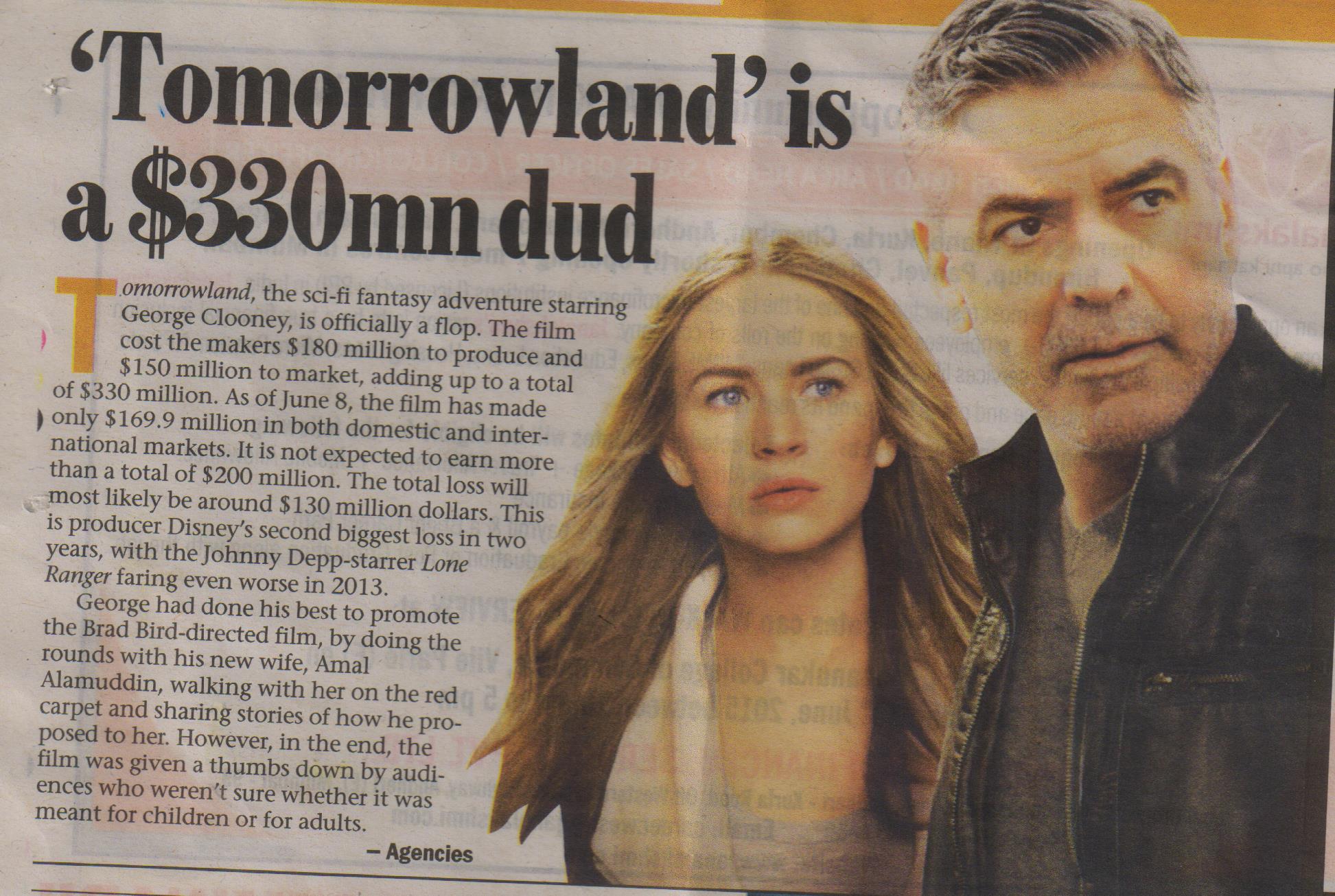
Within a couple of weeks after its release, the 330-million US dollar film was labeled by The Hollywood Reporter as a $330mn dud. It will not make half of what was spent on producing and marketing it, the analysts said. Hope about the future transmitted from ten thousand Hollywood screens did not seem to touch people’s lives, let alone ignite a spark to transform it.


Jurassic_World_posterAt around the same time, maybe two weeks later, Jurassic World – another big budget futuristic movie about dinosaurs hit theaters globally. According to industry sources, the pace at which this dinosaur blockbuster has attracted paying audiences into theaters has been faster than any other movie before it. According to the director of the film, Colin Trevorrow, the synthetic hybrid dinosaur, Indominus rex, at the center of the film’s story, is symbolic of consumer and corporate excess; meant to embody humanity’s worst tendencies which is to want more, bigger, faster, louder. He is also reported to have said: “The Indominus Rex is our greed, our desire for profit that needs to be satisfied.” Film critics have mentioned that there are parallels between the workings of the park in Jurassic World and the film and entertainment industry. Another theme in this movie that made the fastest billion is: Those who do not stop evil are supporting and encouraging it. Ironically, Tomorrowland which tells us that our actions are indeed responsible for the deterioration of the future of our children, not some dinosaur; made audiences, both adults and children, stay away.


Why did one movie that showed a realistic future and a positive attempt to make it better fail to attract audiences while another movie with an unrealistic future of dinosaurs trampling each other draw so many? Ironically the movie that is symbolic of greed (Jurassic) became a major news item when it was labeled as the fastest movie to make a billion dollars. Are we stuck with greed and profit and see no way out? Why did a film that wants us to become better humans and make a better tomorrow, instead of pulling us into that change process, manage to push us away?


Tomorrowland is 330 mil dud

Hollywood analysts said that Tomorrowland failed because audiences could not tell whether the movie is for children or for adults. Apparently audiences were confused as to who this story is meant for? One can call this a confusion of story-telling and blame the director. Given the 300 million dollar budget; surely enough focus groups were conducted to test this. Hollywood and other media companies commonly use the marketing strategy of segmenting their cultural products, including movies, for specific demographic groups; such as movies for adults and movies for children. Keeping focus groups and market segmentation aside, a story is a story. Stories, like death and taxes, are certainties across cultures and countries. A good story-teller rarely thinks of segmentation and market first. Furthermore, a story about the future, a topic that concerns both adults and children, should be of interest to all demographics. So why would audiences and families reject something that is common to and important to all?


What does the failure of Tomorrowland indicate?


“Tomorrowland,” according to New York’s David Edelstein, “… is the most enchanting reactionary cultural diatribe ever made.” When audiences reject a movie, usually one that is praised by critics, it has probably not resonated with the audience or created dissonance in their minds. People handle lack of resonance or dissonance by staying away; through avoidance. The lack of resonance could be a function of the story of Tomorrowland and how it tells the truth about the future while the dissonance has to do with the audience and how they handle their hope or despair about the future in their minds and their actions. While we can avoid something because we are unable to handle the truth, we cannot forget that we cannot escape the truth either.


For those who have not seen the movie, a summary of the story is provided below followed by a discussion of – audiences and hope and of story and truth in the context of Hollywood and our world.


*****


Tomorrowland, classified as a science-fiction mystery adventure film, is the story of two Tomorrowlandlarge2unlikely protagonists who are brought together by a robot-girl Athena to do something about the future. One is a former sparkling boy-genius (who later in the film becomes an older and shabbier Clooney) and the other, an optimistic teenage girl, who can figure out how things work and has a positive mindset. Together the three of them travel to another dimension called “Tomorrowland”, where our actions directly affect our world. A tachyon machine, invented by the boy-genius, shows images from all time dimensions — past, present, future — and has a clock which shows that the world will end in a few days. The boy-genius, now elderly Clooney, is very cynical, but, our hope-filled teenager does not accept this bleak future as it is. She believes that the world and future can be saved. Her optimism affects the machine which starts showing some positive images. The older boy-genius realizes that the future is a self-fulfilling prophecy; the bleak future seen on the machine is a direct result of our bleak thoughts. Positive thinking about the future can change it. Of course the villain called Nix (played by Hugh Laurie) nixes the idea of helping Earth recover; gets crushed under his own machines; and while dying shoots at older Clooney. The robot girl, Athena, who sees this happening in the future-prophesizing machine, sacrifices her life to save Clooney’s; and we find that her mechanical heart is actually filled with love. All of this in happens in a Tomorrow-land filled with rides, jetpacks and sci-fi gadgetry. The two protagonists then assign new robot-children the task of distributing T-shaped pins to positive people around the world who end up in Tomorrowland and refuse to give up on the future.

[Read more about the movie Tomorrowland here]


*****

You can’t handle the truth


youcanthandlethetruthlargesizeThe LA Weekly, while giving the film a B+, wrote: “Bird (the director) has made a film that every child should see. And if his million-dollar dream flops, he’ll be asking the same question as his movie: When did it become uncool to care?”


Do people not care about their future? Let us take an average adult who perhaps has one or two children. What does the future represent to this adult? His children most probably. Is this adult interested in his children? Of course this adult is. It is this same adult who is accompanying the child to Jurassic World, isn’t it? Yes. Therefore, this average adult must be interested in the happiness of the child and by default the future of the child. And for a child – what is the future? It is her or his own life. Does this child not care about her own life and by default her future? So to assume that our general movie-going public has reached that point of dark nihilism which makes them not care about anything, including their own future, is almost Kafkaesque and in a slanted way very cool indeed. Unfortunately, our general population is not that cool at all. They are a worried lot.


The future in the mind of the common man is equated with a personal future of credit card payments, job insecurities, health care, home loans and so on. However, when we talk of the collective or planetary future the average citizen immediately connects it with  the deteriorating environment. The extensive media coverage of increasingly frequent heatwaves, extreme cold, floods, un-seasonal rains, crop failures and of 36 Nobel laureates signing a new Mainau Declaration calling for urgent action on climate change, out of a mix of urgency and guilt and horrified at the prospect of what unchecked use of natural resources could do to the future, have gotten the average Joe worried to some extent.


However there is a conflict or dissonance – the way of life of the average Joe is built for comfort and convenience and urgent action for climate change requires a change in that way of life at an individual level. At a larger societal level it calls for a change in our culture of consumerism as well as a change in the excessive greed of corporations and politicians. More money for some people today means a worse future for everyone tomorrow. This is the critical  problem. Money is the god for this generation and we cannot topple the temples of money. The chase for more money is leading to a negative future, but we are willing to trade that future of millions for a few billion dollars today. We want people to consume less products, most of which are environmentally harmful, but we also want them to buy more so we can keep our economy afloat. We cannot seem to get over our relationship with an economic system that is harmful for our children’s future or even visualize that a change is possible. How do we deal with this trade-off which we know is harmful for the survival of the human species? A Norwegian philosopher with a pessimistic and fatalistic view of the human condition may have hit upon the answer.


In 1972, Arne Naess first distinguished between shallow and deep ecology by identifying two ecology movements competing for our attention. The shallow one is concerned mostly with pollution, resource depletion and the usefulness of the Earth to humans (anthropocentrism). The second one is concerned with the diversity, richness, and intrinsic value of the entire Earth. This is the Deep Ecology movement – the idea that all life has the right to exist, that no one species is more important than another. Nature does not exist to serve humans. Rather, humans are a part of nature, one species among many. All species have the right to exist for their own sake, regardless of their usefulness to humans.


It is said that Naess was influenced in some ways by the ideas of the Norwegian philosopher Peter Zapffe (1899 –1990), his student who was 12 years his senior. Zapffe wrote in an essay ‘The Last Messiah’ and later in his philosophical treatise “On the Tragic” (Om det tragiske), published in 1941, that humans do not fit into Nature’s design because they are born with an overly developed intellect which allows for greater understanding and self-knowledge. Human yearning for metaphysical purpose – for intrinsic justice and meaning in any event or matters related to life and death – is destined for frustration by the real environment because Nature and the process of life is oblivious to whatever it makes and breaks in the course of its perpetuation. Humans not only perceive their own mortality but are also reflective enough to understand that the Earth would be better off without them.


Despite this knowledge very few humans actually lose their minds because, Zapffe says, the human brain has evolved mechanisms by which most people learn to save themselves. In an obvious salute to the work of Sigmund Freud, Zapffe proposed that humans artificially limit the content of consciousness by using four principal defense mechanisms:

Isolation – dismissal from consciousness of all disturbing and destructive thought and feeling.

Anchoring – fixation of points within, or construction of walls around, the liquid fray of consciousness which provides individuals a value or an ideal that allows them to focus their attentions in a consistent manner. God, the Church, the State, morality, fate, the laws of life, the people, the future and “our way of life” are all examples of collective primary anchoring points.

Distraction – constantly and continuously enthralling it with diversionary impressions; focusing all of one’s energy on some task or idea to prevent the mind from turning in on itself.

Sublimation – conversion of anguish into uplifting aesthetic pursuits such as literature and arts; the refocusing of energy away from negative outlets toward positive ones.


 *****


The future, in both good times and bad, is a difficult topic to deal with. Most of our lives are spent trying to make the future predictable and secure. We work hard, we save, we invest, we
make our children study instead of play because we want a secure future for ourselves and loved ones. We live as if we are sure that there will be a future even though there is really no guarantee. As Neils Bohr, the well-known physicist said: “Prediction is very difficult, especially if it’s about the future.”  However, even if we know nothing about the future, even in the darkest of time, we hope for the best. Thus, while most of us may use the mechanisms of ‘Isolation’ or ‘Distraction’ as proposed by Zapffe, the concept of ‘hope’ becomes our anchoring point. In our everyday life, the future is a critical ingredient and wherever there is a future, hope always tags along.  Hollywood has understood the ubiquitous nature of hope in the common man’s life and has peddled it unabashedly. Hope is the common man’s dope against the uncertainty of an unknown future.


To understand hope better, it is important to look at its antonyms: dejection, hopelessness, despair. These are what we spend our times battling – we do not like the antonyms, so we cling to hope. Hope, then becomes an optimistic attitude of mind based on an expectation of positive outcomes related to events and circumstances in one’s life or the world at large. Psychologist Charles Snyder and colleagues came up with Hope Theory in 1991. Hope, in this psychological view, consists of two dimensions: agency and pathway.  Snyder argues that hope should be viewed as a cognitive skill that demonstrates an individual’s ability to maintain drive in the pursuit of a particular goal. An individual’s ability to be hopeful depends on two types of thinking: agency thinking and pathway thinking. Agency thinking refers to an individual’s determination to achieve their goals despite possible obstacles, while pathway thinking refers to the ways in which an individual believes they can achieve these personal goals. The person who has hope has the will and determination that goals will be achieved, and a set of different strategies at their disposal to reach their goals. Put simply: hope involves the will to get there, and different ways to get there.


Tomorrowland, in no uncertain terms and very lucid conversations among its characters, wants to address the cynicism we hold about the future and instill us with hope. As the Newark Star-Ledger reviewer wrote “Strip Tomorrowland down to its essentials, and you get an ending out of “I’d like to teach the world to sing” and a moral which boils down to: Just be positive, OK?” Perhaps this does not work so well in the scenario of our troubled future.


We are aware that our actions damage the environment, irreversibly. Yet, we do not take corrective steps. We continue to ride our cars, use air-conditioners, throw plastic and create excess, non-recyclable waste on a daily basis.  We know that every day the future deteriorates more mainly because of our way of life. But, we continue. We are addicted. We hope for a better future, we talk about it, we know the ways, but we do not act to make it happen because that would mean tackling our addiction to our present way of life. We have perhaps somewhere understood, to use Snyder’s framework, that while we know the ways, we definitely do not have the will to get there. Because the will to continue with the present lifestyle far outweighs the desire to change in the pro-environmental direction. Thus, any talk of change in behaviors with respect to the future is not the hope that the scientists / psychologists talk about, but some sort of empty rhetoric; arm-chair philosophizing in air-conditioned halls. It is like a drug addict talking of change, of giving up drugs, but not harboring any intention to do so at all. It is plain lying and manipulation.


Even the littlest kid in the darkest movie-theater, anywhere in the world, knows somewhere in the deep recesses of the primitive, reptilian part of his brain that he is living out a Greek tragedy where his own parents, through their ‘way of life’ today, are devouring his future like some mythic monsters; destroying every resource and damaging every bit of air and water that will keep the kid alive in the future. The future while being a ray of hope for each one of us today has also become our biggest villain and nemesis. If only there were no future then we would have nothing to worry about. We could draw all the resources to enjoy our hedonistic today because we are drilling into the future to pay for the excesses of today. There is a slight problem: some of us have actually created children who may have a life tomorrow and it is for these very children that Hollywood makes movies such as Tomorrowland and Jurassic World. Do we really think that our children are so dumb that they have not intuitively understood the game that is being played with their future? Or maybe we are super-confident that we can spin the truth and brainwash them through marketing hype, fantastic movies and the school system.


Forget our actions or lack of it, let us ask: What makes us think that hope will work at all – be it hope of positive thinking or hope of positive action – what makes us confident that hope will make a better future? Environmental scientists say that the climate change and many such environmental damages are essentially irreversible. Even if we stop over-consuming today, we may not be able to change the course of the deteriorating future. Will any change in our actions make a difference at all? The world has clearly experienced in the past seven years of the Obama presidency that the sheer audacity of hope is not enough to counter the negative forces of corporate greed that govern our life and everyday actions.


Stepping out from the darkness of the movie theater into the hazy light of a smoggy day in the city where tens of thousands of new cars are added every day and taking just one breath of the polluted air outside should make one realize that being positive or hopeful in thought or action about the future is just not enough. Today’s consumerism and corporatism may be just too far gone. In addition the population of the world is so huge, at more than 7 billion, that we may have crossed the point of no return a decade or two ago. Our hope will not change a thing except create a bubble of self-delusion. Influenced by Arthur Schopenhauer, Peter Zapffe also wrote that as long as humankind recklessly proceeds in the fateful delusion of being biologically fated for triumph, nothing essential will change. Mankind will get increasingly desperate. He propounded the idea of a last messiah almost like a Moses, but replaces Moses’ precept to “be fruitful, and multiply, and replenish the earth,” by saying, “Know thyself, be unfruitful (infertile), and let there be peace on earth after thy passing.”


****


You can’t escape the truth


Once Truth came to the streets of a small town as naked as the day he was born. Seeing Truth in this condition, people ran away and every house shut its door. No one would not let Truth inside. Truth sadly walked to the town square and sat on a bench. Someone who looked exactly alike came and sat next to Truth. This was Parable was dressed in splendid colorful clothes. Parable asked, "Tell me, brother, what makes you sad?" Truth replied, "Things are bad. I guess I am old. No one wants anything to do with me." Hearing that, Parable said, "People don't run away from you because you're old. I am old too. Let me tell you a secret. Everyone likes things disguised and prettied up a bit. Wear some splendid clothes like mine, and the very people who pushed you aside will invite you into their homes and ask for your company." Truth took Parable's advice and put on the colorful clothes. And from that time Truth and Parable have gone hand in hand.
 Eastern Europe tale by the Maggid of Dubno, 18th century rabbi


It has always been difficult to deliver a truth, especially if that message is not a generic aphorism such as honesty is the best policy but, some harsh truth about our reality and existence. Telling the truth directly has got many truth-sayers kicked out of royal courts, some have been exiled, some executed, some guillotined and some thrown out of towers. Not just rulers and kings, even common folk, do not want to listen. Philosophers and sages have always wondered how to tell the truth so that people listen. Parables and fables are ways of telling essential truths by cloaking them in a story. Perhaps even before the era of cave paintings, telling stories has been one of our most fundamental communication methods.


Stories are enjoyable and stories or narratives also engage us more. It seems we, rather our brains, are hard-wired for stories. As events unfold in a particular sequence of cause and effect, it seems our entire brain seems to get activated; not just the parts that process words, but parts of the brain that deal with experiences of pain, joy and other emotions. It is argued that people remember a point better when it is told in the form of a story. That may be good for selling books on marketing and management. However, there is a problem when we try to convey a message through a story. People often remember the emotional experiences but discard the kernel of truth hidden inside. And good writers, who want to change the world with their words, have to struggle with the task of telling a story while retaining the message of truth. Perhaps Aesop did it best; told a story (Aesop’s fable) using the least words in the most economical and hard-hitting manner without diluting the truth and the fun.


Aesop, they also say, was thrown off a cliff; and the divide between telling a story for sheer entertainment and telling it to educate people has widened ever since, especially in the last century with the burgeoning of an entire multi-billion industry called the film and media industry whose short-form is Hollywood. This giant conglomerate, which has replaced local film-industries in most parts of the world, has also taken the exercise of story-telling to an extremely simplistic, formulaic format to satisfy the greedy cash registers of the box office. In recent years, story-telling has moved from its simple parable origins to a complicated technological product with computer animation, 3-D, green-screens, complex visual effects, and such. Use of technology has also multiplied the cost of making a movie exponentially. The Seattle Times in its film review said: “Though the movie is made with great energy and inventiveness, there’s something ultimately muddy about Tomorrowland; it’s as if director Brad Bird got so caught up in the sets and effects and whooshing editing that the story somehow slipped away.”  Yes, we  can. Is that the reason we use all this technological gimmickry to tell a story just because we can. Because we have the technology and we believe we must use it or is it because each film-maker is trying to outdo the other in technologically glitzy story-telling, keeping up with the Joneses in their Hollywood compound. Technological gimmickry has trumped the truth-telling of parable and story.


In the history of story-telling, Hollywood has played a critical role in the last century by taking films and stories to the remotest corners of the world; making it a mass product. The rise of Hollywood and its mass appeal has also led to truth and story-telling get divorced. Stories and plots are formulaic because these products have to guarantee the studio and financers a return on investment. And films, such as the case of Jurassic World, get measured by the amount of money they make at the box office rather than their potency in delivering a critical message. In order to generate more revenue at the box office, stories became more and fantastic and escapist – like Jurassic World. And any truth inside the story is disguised, softened, and beaten down until it does not retain the hardness of the original truth anymore or mutates into something else. For instance, how many people who watched Jurassic World actually understood the point made by the director that it was about insatiable greed? For audiences the movie was about dinosaurs engaged in WWF encounters. Today we have reached a point where audiences of Hollywood do not recognize the truth in any movie because in their minds truth and Hollywood do not go together.


Hollywood, like the future of Tomorrowland, has created its own self-fulfilling prophecy. Hollywood movies are essentially fantastic and escapist – light-years away from reality; and most audiences perceive Hollywood as a land in some other dimension. And this has been reinforced by the celebrity culture, the glossy magazines, high-voltage marketing, public relations, paparazzi and so on. The makers and actors of films pretend as if they live in some other world. And although there is always some influence of movies on life and life on movies, largely people see Hollywood as escapist and that is what they have come to expect from it.  And when audiences walk into a dark theater expecting to escape, and get trapped in reality instead, they run away faster than the actors from the fake dinosaurs in Jurassic World. And this has become Hollywood’s self-fulfilling prophecy. Hollywood cannot break out of its own vice-like grip of escapism.


The issue of the bleak future, tied to our environment is a complicated story to tell in any case. Successful Hollywood movies and literary novels are good at telling stories that show humans dealing with other humans; they revel in and beautifully narrate human foibles. However, when it comes to humans dealing with their environment, story-telling becomes fuzzy and unclear. The prognosis of the world’s future is disastrous- environmentally and socially. Relationship between humans and Nature is at the worst possible. In this scenario, Tomorrowland tells us to stay positive. It uses retro-futuristic images from the science fiction of the 1950s and 60s when we embraced science and believed we could have better living with chemistry until we realized that the plastic made in the 60s is choking our oceans in the 90s. Given what we know today about the ill-effects of all that which were touted as solutions by science yesterday; perhaps audiences, including children, find that to hold positive thoughts about the future and the role of science in saving it a little too naïve and out of touch with reality.


In a sense then Tomorrowland gets trapped in the same philosophy of escapism that pervades and permeates all Hollywood production. Tomorrowland, although a great attempt to wake us, cannot escape its own nature – that of a Hollywood product; trapped in Hollywood’s own tachyon machine of escapism – a self-fulfilling prophecy where the layers of clothes – of story become everything and the truth is irrelevant. By peddling hope rather than the truth in the dire scenario of a chaotic future, Tomorrowland becomes escapist and thus stays within the strict confines of Hollywood’s iron cage of story-telling.


*****

Heroes, Hope and Hollywood


Hollywood peddles hope through its heroes; a formula based on the journey of the hero who falls down only to rise again. When the world is drowning in apocalyptic floods, there’s a hero to the rescue. And when a meteor free-falls towards Earth, it is the hero who rides into outer space on a rocket and blows it up. The heroes are policemen, detectives, ex-Marines, sports-coaches and so on. Men and women from within the system who defend this system while fighting corrupt villains who abuse this system. The system is good and it is kept good thanks to the heroes. The heroes of Hollywood do not really change the system; they simply bring balance and order to it. Hollywood has always maintained the status quo. But when it comes to the future and the environment, it is this very the status quo that is the real problem. In fact the future demands that we change our (mainstream) way of life. And can a mainstream movie ever ask mainstream people to change their mainstream way of life. How can we touch that sacred cow – our contemporary way of life?


We are looking for the hero who will change our future, and our future will not change or become better unless we change our current way of life. Yes, for the environment the villain is our current way of life. However, if there is something that the hero of Hollywood is afraid to touch, it is that contemporary way of life. Because that is what the hero of Hollywood is born to defend. How will this hero champion the new way of life unless it is some apocalyptic movie? To say this in the context of a simple, everyday movie – that is the struggle for Hollywood writers today and for the entertainment industry in general when it comes to hard, economic issues such as the environment and our future.


tomorrowland4Now let us say you were writing a story where the twists and turn took you to a place where the hero has to take it upon herself / himself to tell the truth to a paying audience: That it is you the audience. You have to straighten your act; the blame lies squarely with you, not elsewhere – your actions are causing damage to the future? You, dear audience, are the villains. Now imagine that you are the studio, not the story-teller, and you have invested 300 million dollars, obviously dependent upon ticket sales for return on investment. The audience is your customer and they will buy y the tickets. One cannot forget the cardinal rule in business: The customer is always right. And therefore, compromises have to be made.


It is hard to be Aesop when one is looking at the return on investment and the cash registers of the box office. And so that is where the convolutions start – we want to open the audience’s eyes and also sing a lullaby to anesthetize them. It is that tangled web we weave when we try to tell the truth first, and when we realize it is uncomfortable and inconvenient, we use unconvincing, convoluted story-telling because we believe the audience cannot handle the truth. We bring out the kid gloves. We soften the blow of the hard truth.


The film critic of the New York Times gave the film a negative review and rightly noted: “It’s important to note that Tomorrowland is not disappointing in the usual way. It’s not another glib, phoned-in piece of franchise mediocrity but rather a work of evident passion and conviction. What it isn’t is in any way convincing or enchanting.”


*****

Not just the financial issue, perhaps Tomorrowland ran into problems because there are some truths that just cannot be told in a story. There are some issue where you cannot both entertain and educate – the bitter pill has to be swallowed without the sugar coating. Imagine a man about to be run over by a bus, speeding in his direction. Do you tell him a story to make him aware of the bus or do you pull him out of harm’s way? Now imagine, the emotional turmoil within the man, when he realizes that this speeding bus that is a danger to his life has been created and set off by him; it is his own creation? The man in front of the bus is the human today, the bus is the damaged environment with waters rising all over the world, and the road is the planet. We have thrown ourselves in front of that metaphorical bus. It is speeding towards us and we are stranded in the middle of that road – flat on or faces as we wake up from the consumer excesses of the days and nights before. What does the man in front of the bus do? Cross his heart and hope… or like a child close his eyes and hope the danger will pass away.


Almost every human knows that the solution to this deteriorated future environment is a change in our way of life. We have all been educated of the ways and actions that will take us to a sustainable future. However, people are simply unable to convert their education and positive intention into real action. We do not seem to have the energy or enthusiasm to act on our positive intentions. What we do instead is resort to magical thinking. Since we have blind faith in technology, we ask: Is there no scientist who can create plastic that birds will eat out of our hands? That way my chemical waste will become someone else’s food? Some say: Make it all vanish – the garbage dumps, the pollution, the bad things that damage the future. Can’t someone do some magic, wave a wand and make it all disappear? And therefore we look forward eagerly to the magic of the movies – because in the those dark theaters all our problems disappear while we munch on popcorn and drink soda out of Styrofoam cups.


Yet, not just on that road, even while we are in that movie theater, we stare at that bus speeding towards us – our tomorrow. Can we face tomorrow without hope and without any story or narrative to guide us? Can we see tomorrow for what it is? Just a bus speeding toward our children today. If we are sincere about making a better world for our children, maybe it is time to face the harsh truth without the colorful clothing of parable and story; and to work for that better future rather than just hope. For all those who seek that better tomorrow, there is no time to watch any movie be it Jurassic World or Tomorrowland! There is barely time to get out of the way of the speeding bus; Jump. But jump where? Into a virtual world or somewhere outside of this planet. Maybe we can hope that technology will find a way to inhabit Mars. Now that’s a subject Hollywood is comfortable with. Forget that the majority will never have the money to buy that expensive ticket to Mars, but the last thing we can do before the bus runs us over is tweet and tell our friends on facebook that we watched the movie first. And in order to establish the truth, we can post a selfie.

 Tomorrowland 3


© Nilesh Chatterjee, June 2015


References

  • A group of Nobel Laureates have signed a declaration calling for urgent action on climate change. http://qz.com/444787/a-group-of-nobel-laureates-have-signed-a-declaration-calling-for-urgent-action-on-climate-change/
  • Nicholson, Amy. “Don’t Hate Tomorrowland for Asking Us All to Be Better”. L.A. Weekly. Retrieved 2015-05-23.
  • Stephen Whitty (2015-05-19). “‘Tomorrowland’ review: George Clooney’s sci-fi folly”. Newark Star-Ledger. Retrieved 2015-05-23.
  • A.O. Scott (2015-05-19). “Review: ‘Tomorrowland,’ Brad Bird’s Lesson in Optimism”. The New York Times. Retrieved 2015-05-23.
  • “‘Tomorrowland’ goes back to the future badly”. Star Tribune. Retrieved 2015-05-23.
  • Macdonald, Moira (2015-05-23). “‘Tomorrowland’: Exhilarating for kids, exhausting for adults”. The Seattle Times. Retrieved 2015-05-23.
  • Merry, Stephanie (2013-07-16). “Always-cool George Clooney can’t lift meandering ‘Tomorrowland’”. The Washington Post. Retrieved 2015-05-23.
  • http://variety.com/2015/film/news/jurassic-world-box-office-1-billion-international-1201524803/
  • http://www.conures.net/stories/parable.shtml


Is Every-man an Eichmann? Relating Hannah Arendt’s notion of “banality of evil” to bureaucratic human consumerism and the consequent destruction of the Ecology

“If all the insects were to disappear from the earth, within 50 years all life on earth would end. If all human beings disappeared from the earth, within 50 years all forms of life would flourish.”

― Jonas Salk (1914 – 1995)

Developed the inactivated polio vaccine in 1955


“Mercy, Mercy Me (The Ecology)“

Mercy mercy me

Things ain’t what they used to be, no no

Where did all the blue skies go?

Poison is the wind that blows from the north and south and east

Mercy, mercy me, mercy father

Things ain’t what they used to be, no no

Oil wasted on the ocean and upon our seas, fish full of mercury

Oh mercy, mercy me

Things ain’t what they used to be, no no

Radiation underground and in the sky

Animals and birds who live nearby are dying

Oh mercy, mercy me

Ah things ain’t what they used to be

What about this overcrowded land

How much more abuse from man can she stand?

My sweet Lord… No


~ Marvin Gaye

From the album: What’s Going On (1971)


This essay is written in six segments:

(1) The evidence for destruction of environment and extermination of species due to human activity;

(2) the Holocaust and the trials for justice such as Nuremberg and Eichmann trials;

(3) Hannah Arendt’s report on the Eichmann Trial and the notion of banality of evil;

(4) Bureaucratic consumerism of today and its impact on the environment; and

(5) Relating Arendt’s concept of “banality of evil” to human activities that are destroying the environment – Can the animals, plants, oceans set up their tribunal and conduct a trial to bring these Everyman Eichmanns of today to justice?

(6) Can thoughtfulness help?
Segment 1: Mercy Mercy Me – Destruction of the environment everywhere from the air to land to the sea: the evidence


Ecosystems and species that have evolved over millions of years are disappearing faster than at any time in human history. And they can never be brought back.


Humans and their activities are driving animals and plants to extinction faster than new species can evolve, warns Simon Stuart, one of the world’s experts on biodiversity and chair of the Species Survival Commission for the International Union for the Conservation of Nature (IUCN) in an article in The Guardian.


The IUCN Red List of Threatened Species, widely recognized as the most comprehensive, objective global approach for identifying those living organisms threatened with extinction and evaluating  the conservation status of plant and animal species, recently reported 42,537 extinction threats in different geographical regions, which included 28,807 animal species and 13,766 plant species. With approximately 1.75 million known species, and many millions yet to be discovered, the IUCN Red List is said to merely scratch the surface in extinction risk assessments.


The Living Planet Index Report of the World Wildlife Fund (WWF, 2014), a comprehensive study of animal populations to date, found that roughly half of the world’s non-human vertebrate animal population have been killed since 1970; that is, Planet Earth has lost half of its large wildlife in the past 40 years. From forest elephants in central Africa, where poaching rates now exceed birth rates, to the Hoolock gibbon in Bangladesh or dolphins in China, destruction of habitat has seen populations of various animal species decline drastically. Until recently many had been hoped that the rate of evolution of new species could perhaps match the rate of loss of diversity of life. But it seems that is not the case anymore. Humans are killing off species thousands of times faster than nature creates them.


According to a study published in Conservation Biology journal the current extinction rates across species are 100 to 1000 times more than the background rate or natural rate, which is determined by fossils; and which existed before human activity started to tamper with the ecosystem. Conservation experts, including previous research published in the journal Science, find the world heading towards a period of mass extinction —the “sixth great extinction.” The previous mass extinction, which wiped out the dinosaurs, happened about 65 million years ago, most likely due to a catastrophic asteroid that collided with Earth. In contrast, the looming sixth mass extinction is completely attributable to the activities of one species: humans.


Our “way of life” is a “pathway of death” for other species


Humans are the single largest contributor to the extinction of all other species on the planet. This irreparable damage to the variety of species of flora and fauna is a consequence of the way humans choose to live. From destruction of natural habitats, deforestation to climate change, hunting and fishing, pollution to wildlife consumption, humans are driving massive changes to the world’s biodiversity and ecosystem.


Simply put, our “way of life” has become a “pathway of death” for other plants and animals on this planet. Human beings just cannot co-exist or live in balance with the ecosystem – whether it is our everyday life with use of plastics that is damaging the oceanic environment, or need for more energy that is leading to mining or destruction of forests such as the Amazon, or hunting and fishing for food that is destroying the tuna, or the creation of dams, riverine waterways, industrial and residential waste or agricultural pesticide run-off that is destroying freshwater life such as river dolphins, or the creation of concrete jungles and use of wireless devices that is killing off sparrows.


Take the case of plastic use by humans and pollution of the oceans. Plastic is an integral part of the everyday lives of everyman – from wrappers to bags, to packing materials, to cups and glasses, to syringes and helmets. The question is: How do we dispose of this plastic once we unwrap our precious gift? The ocean becomes our communal trash can – as 80 percent of marine litter originates on land, and most of that is plastic.


The same plastics, an integral part of the way of life of today’s humans as they go about making Everyman’s daily life convenient, become poison when they reach the ocean waters, a threat to the animals that depend on the oceans for food. As one report says: “To a sea turtle, a floating plastic bag looks like a jellyfish. And plastic pellets–the small hard pieces of plastic from which plastic products are made–look like fish eggs to seabirds. Drifting nets entangle birds, fish and mammals, making it difficult, if not impossible to move or eat. As our consumption of plastic mounts, so too does the danger to marine life.” At least 267 different species, including seabirds, sea turtles, seals, whales, sea lions, and fish have suffered from entanglement or ingestion of marine plastic pollution and dying from choking, intestinal blockage and starvation.. Scientists are investigating the long-term impacts of toxic pollutants absorbed, transported, and consumed by fish and other marine life, including the potential effects on the food chain and on human health. Plastics often have toxins like PCBs and other pollutants on them, which fish and other marine organisms consume when they nibble on small size plastics; the fish absorb these toxins and pass them along to other predators when they eat these fish. “Plastics are like a cocktail of contaminants floating around in the aquatic habitat,” said Chelsea Rochman, a marine ecologist at the University of California, Davis. “These contaminants may be magnifying up the food chain.”


A study published in the journal PLOS One in 2014 estimated that 5.25 trillion pieces of plastic, large and small, weighing 269,000 ton, are dispersed throughout the world’s oceans. The reputed journal Science published (in 2015) the findings of a study of the coastlines of 192 countries: each year an average of eight million tons of plastic is moved from land to ocean. This is equivalent to five grocery bags filled with plastic in every foot of coastline in these countries; and the amount could rise 10-fold in the next decade. The researchers found that waste that slips past mis-managed waste management systems — including poor management practices, open dumping, and litter — is the biggest source of plastic debris in the oceans. The study found coastal countries generated close to 275 million tons of plastic waste in 2010, and that 4.8 to 12.7 million tons of that plastic made its way to the oceans; and the top 20 countries accounted for 83% of the plastic waste that could enter the ocean.
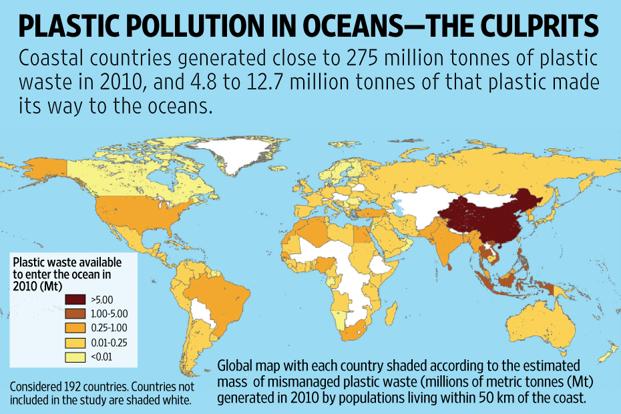
 

globe eichman


Endangered freshwater and marine animals

The fastest decline among the animal populations is found in freshwater ecosystems, where numbers have plummeted by 75% since 1970. “Rivers are the bottom of the system,” according to Dave Tickner, WWF’s chief freshwater adviser, “whatever happens on the land, it all ends up in the rivers.”


The overuse use of freshwater rivers for fishing, dams and navigation projects along with pollution and habitat destruction has led to the decline of populations of many aquatic species, most apparent in species such as river dolphins and large-bodied fish. There are now five species of freshwater dolphins left in the world, four of them living in major freshwater systems in Asia. All are critically endangered.


Marine animal populations have also fallen by 40% overall, with turtles suffering in particular. Hunting, destruction of nesting grounds and entangling in fishing nets have seen turtle numbers fall by nearly 80%.


A study in 2013 revealed that the Bluefin tuna, endangered for several years due to its misfortune as a sushi delight, suffered a catastrophic decline in stocks of more than 96% in the Northern Pacific Ocean. More than nine out of 10 of the species recently caught were too young to have reproduced, meaning they may have been the last generation of the Bluefin tuna. Driven by high demand and prices, fishermen use various techniques to catch tuna and increase the supply. This demand and supply cycle is leading to a faster disappearance and extinction of the fish. Although tuna are a source of food and livelihoods for humans, they are more than just that. In the marine food chain, the tuna are a top predator maintaining a balance in the ocean environment.


Unsustainable fishing is a major threat to marine life today. Bottom trawling, an industrial fishing method puts species at risk and also alters marine habitats. However, in addition to fishing and hunting, other human activities also put marine life at risk – hazards that include noise pollution, sea floor mining, and oil exploration and gas extraction. The development of coastal cities and a practice known as “sea-steading,” or building artificial lands in the ocean — with one such example being the United Arab Emirates famous construction of artificial islands off the coast of Dubai — also present problems to marine habitats.


The Amazon rainforest

The Amazon is a vast region. It spans eight countries: Brazil, Bolivia, Colombia, Ecuador, French Guiana, Guyana, Peru, Suriname and Venezuela. There is a clear link between the health of the Amazon and the health of the planet, as these rain forests, which contain 90-140 billion metric tons of carbon, help stabilize local and global climate.


The Brazilian Amazon, home to 40% of the world’s tropical forest, is one of the most bio-diverse regions on the planet. Around 62 square miles (160 square kilometers) of forest are cleared each year. The systematic clearance of trees from the Amazon forces wildlife into ever-smaller patches of ground. At least 15 mammal, 30 bird and 10 amphibian species are expected to die out by 2050 from around half of the Amazon. Though few species are killed off directly in forest clearances, many face a slower death sentence as their breeding rates fall and competition for food becomes more intense.


The pressure of economic development and various financial crises has led to the Brazilian government’s proposed rapid development program in the Amazon to fuel the economy and get Brazilian’s the desired contemporary “way of life.” This plan foresees the construction of more than 20 hydroelectric power plants in the Amazon basin and an extensive push deeper into the rainforest which will further accelerate the loss of species.


Dolphins in China and Sparrows in India

China and India, two countries in Asia, are home to nearly 36 percent of the global population. These countries are also two of the fastest growing economies that have completely bought into the current economic and industrial system; their middle classes are consuming more than the combined populations of various countries. Both countries are also culprits in the plastic pollution of oceans. Two instances of extinction or threat to animal species from two of these densely populated countries are provided below.


The ‘Baiji Dolphin,’ a small, nearly blind white dolphin known as the Chinese river water dolphin, dated back to 20 million years. Nicknamed “goddess of the Yangtze river” and considered a national treasure, this dolphin was declared extinct in the year 2006. China’s economic development put immense pressure on this river dolphin. With over 400 million people living in the Yangtze catchment area and river-banks lined with large, industrialized cities, waste from residences and industries flowed ceaselessly into the river making human activity the single-largest threat to the aquatic mammal.
 

baiji


Additionally, greater use of the river for fishing, transportation, hydroelectricity and waterways development led to dredged riverbeds and concrete reinforcements further affecting the dolphin’s habitat. Building of the Three Gorges Dam in the early 2000s interrupted the dolphin’s movements upstream, and eliminated access to tributaries and lakes. Parts of the Yangtze River became much shallower because of siltation from deforestation and agricultural development.


The Yangtze is also one of the world’s busiest waterways; and increased ship traffic on the river confounded the sonar that the nearly-blind dolphin used to find food. The attendant noise pollution caused these animals to collide with propellers, causing injury and deaths. Boats grew in size, and fishermen employed wider and more lethal nets. In the 1970s and 1980s, an estimated half of Baiji deaths were attributed to entanglement in fishing gear. Only a few hundred were left by 1970. Then the number dropped down to 400 by the 1980s and then to 13 in 1997, becoming extinct after an expedition late in 2006 failed to record a single individual after an extensive search of the animal’s entire range. The Baiji Dolphin was the first large aquatic mammal to have gone extinct since hunting and overfishing killed the Caribbean monk seal in the 1950s.


The loss of the dolphin is likely to cascade through the food chain and affect the ecosystem, plants and animals living in the river. This will affect humans in the long run; but how we choose to deal with it depends upon whether we see ourselves as part of the ecosystem.


Sparrow


The ‘House Sparrow’ and its subspecies are worldwide in their distribution, except in the polar region. However, in 2002, sparrows were included in the IUCN Red List of Threatened Species in the U.K. and since 2010, March 20 has been adopted as World Sparrow Day. According to one report, the sparrow population in parts of India, especially in coastal areas declined by 70 to 80 per cent. Sparrows are very sensitive and their sudden disappearance serves as sentinel warnings or as ecological indicators about impending environmental hazards.


Various causes have been cited for the decline: the general loss of greenery, grasses and vegetation in concrete urban areas leads to non-availability of tiny insects which serve as food for the hatchlings; excessive use of mosquito repellents indoors and insecticides outdoors; concrete buildings with no nesting sites for sparrows; use of air-conditioning that leaves no entry or exit points for feeding sparrow nestlings. Furthermore, the chemicals released due to use of anti-knocking agents in petrol in vehicles is said to cause damage to the sparrows. Some say that although adult sparrows eat grains, the use of chemically treated seeds and grains is harmful to them. Recent increase in electromagnetic radiations from cell phone towers outdoors and the large-scale use of wireless devices indoors is also said to have hastened the decline of this bird population. It could be the synergistic effect of all these environmental factors and pollutants that is leading to decline in the bird population.


This story of species extinction threats is not restricted to highly populated countries or rapidly developing economies alone. Destruction of environment is a global phenomenon. IUCN has listed the eleven countries with more than 900 threatened species and they range from poor to rich countries. Ecuador, in South America, tops the list with 2299 threatened species, followed by USA with 1287, Malaysia with 1236, Indonesia with 1225, Mexico with 1091, China with 995, India with 988, Tanzania with 979, Brazil with 965, Madagascar with 929 and Australia with 906 threatened species


It is clear that destruction of the environment is driven by human extraction from the planet, insatiable human consumption and the manner in which the waste products of human production and consumption are disposed.


At first it seems that we cannot co-exist with other plant and animal species. However, as the next segments shows, our history proves that we cannot co-exist with our own (other humans) as well.


We not only kill other species, we specialize in killing our own.


*****


Segment 2: Genocides, War crimes, Ethnic cleansing, Crimes against humanity and serial warfare: The Jewish Holocaust (Shoah) and the Trials for Justice


Despicable as we are in the treatment of other species, history reminds us that we have been no less barbaric toward other humans. The pages of our history books are repetitive stories of one group of people going out and killing another groups for reasons ranging from land, resources, trade, food, religion, or sheer power and domination. Senseless killing of animals, plants or other people seems to be the favorite pastime of human beings on this planet.


However there is one aspect of our history that goes beyond even the senselessness of wars – the willful extermination of one group of people: Genocide — the systematic destruction of all or a significant part of a racial, ethnic, religious or national group.  In recent times we have seen such events in Rwanda, Sudan (Darfur), or Bosnia. Historically, the Armenian massacres under Ottoman rule and the near extinction of indigenous tribes in the Americas by colonizers are also known. However, the most horrific of them all has been the holocaust perpetrated against Jews in Nazi Germany during World War II.


The Holocaust or Shoah


The Holocaust refers to one of the most horrific genocides, one of the largest in history, where the nine million people of Jewish origin living in Europe before World War 2 were systematically targeted in Germany and German-occupied territory. Approximately two-thirds or six million Jews, including approximately one million children, were deliberately and intentionally killed by the Nazi regime and its collaborators from 1941 to 1945. Some historians include the additional five million non-Jewish victims of broader Nazi crimes such as Gypsies, Poles, communists, homosexuals, Soviet prisoners of war (POWs), and the mentally and physically disabled. In total, approximately eleven million people were killed. But the primary and largest deliberate target of the Nazis remained the Jews with the intention to exterminate all of them for no other reason than that they were Jews.
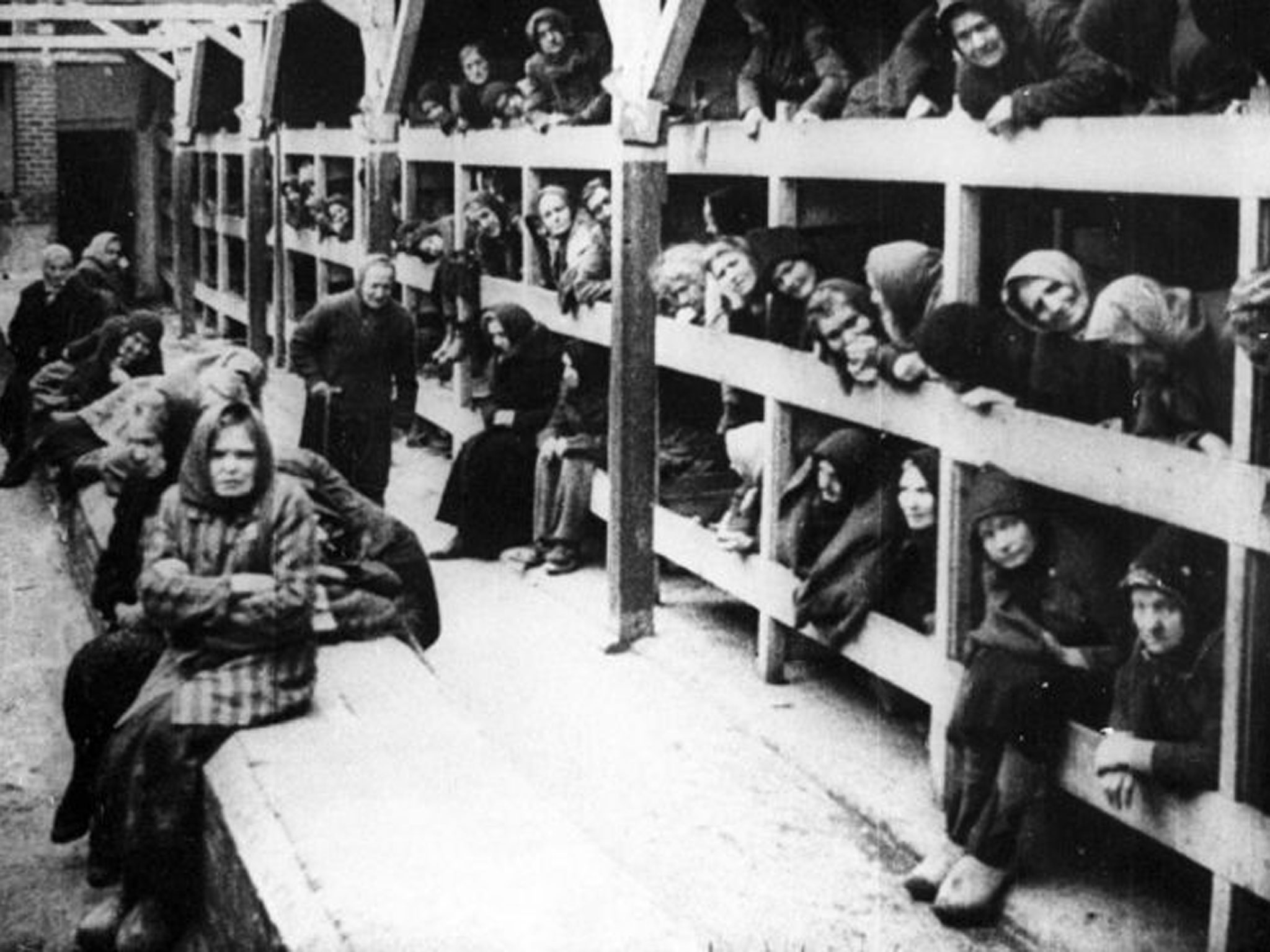
 

holocaust 2


The biblical word “shoah,” meaning calamity or catastrophe, is the Hebrew term for the Holocaust. The Nazis used a euphemistic phrase- “Final Solution to the Jewish Question” (die Endlösung der Judenfrage) as a term for this genocide. The Final Solution became Nazi Germany’s plan during World War II to systematically exterminate the Jewish population in Nazi-occupied Europe through genocide.


The genocide progressed systematically in stages. After coming to power in January 1933 until the outbreak of World War 2 in September 1939, the focus of the Nazi persecution of the Jews was on intimidation, taking their money and property, encouraging them to emigrate. Laws were passed to exclude Jews from civil society and forced into ghettos. The invasion of Poland in 1939 after the start of the 2nd World War brought the Nazis in close contact with three million Polish Jews. It marked the start of a far more savage persecution, including mass killings. Paramilitary units called Einsatzgruppen, mobile killing units of the SS and the police were dispatched to German-occupied territories to murder around two million Jews and “partisans” in German occupied territories. Around 1941, after the invasion of Soviet Russia, the Nazi government began to conceive of a plan to exterminate the Jews of Europe.
 

holocaust 1


The decision to systematically kill the Jews of Europe irrespective of geographic borders had been made by the time of the Wannsee Conference, which took place at the Wannsee Villa in Berlin, on January 20, 1942. The conference was attended by senior officials of the Nazi Party and senior representatives of ministries with responsibilities for the “Jewish question”—the Interior Ministry, the Foreign Ministry, the Justice Ministry, and Ministers for the Eastern Territories. With the decision to annihilate the entire Jewish population, extermination camps with gas chambers such as Auschwitz and Treblinka were constructed to kill large numbers of Jews in a short period of time. In this second operation, the Jewish population of central, western, south-eastern Europe were transported were transported by freight train to specially built extermination camps where they were put in gas chambers. About 42,500 facilities in Germany and German-occupied territories were used to concentrate, confine, and kill Jews and other victims.
 

holocaust 4 trains


Every arm of the Nazi German bureaucracy was said to be involved in the logistics of the genocide, turning the Third Reich into a genocidal state. It is said that anywhere between 100,000 and 500,000 people were direct participants in the planning and execution of the Holocaust. The phrase Lebensunwertes Leben (Life unworthy of life) was used to refer to the victims by the Nazis in order to justify the killings.


This systematic, planned genocide continued until the end of World War II in Europe in April -May 1945.


holocaust 3 mass grave


Post World War II – War crimes and the Nuremberg trials

After World War 2, some of those responsible for the Holocaust and war crimes were to be brought to trial. An International Military Tribunal (IMT) composed of judges from the United States, Great Britain, France and the Soviet Union was constituted. Justice Robert Jackson, US prosecutor, believed that the war crimes trials should be held in Germany.  Few German cities in 1945, however, had a standing courthouse in which a major trial could be held.  One of the few cities that did was Nuremberg, ironically the very place where Nazi leaders proclaimed the infamous Nuremberg Laws, stripping Jews of their property and basic rights. Jackson thought this was almost a karmic connection and chance for poetic justice. The Nuremberg Trials, as they came to be known, took place between 20 November 1945 and 1 October 1946.


The IMT presided over the hearings of twenty-two major Nazi criminals, prominent members of the political, military, and economic leadership of Nazi Germany, who were placed on trial for crimes against peace – participation in the planning and waging of a war of aggression in violation of numerous international treaties; war crimes – violations of the internationally agreed upon rules for waging war; and crimes against humanity – namely, murder, extermination, enslavement, deportation, and other inhumane acts committed against any civilian population, before or during the war; or persecution on political, racial, or religious grounds in execution of or in connection with any crime within the jurisdiction of the Tribunal, whether or not in violation of domestic law of the country where perpetrated.


nuremberg trials


Twelve prominent Nazis were sentenced to death. Those individuals directly involved in the killing received the most severe sentences. Other people who played key roles in the Holocaust, including high-level government officials, and business executives who used concentration camp inmates as forced laborers, received short prison sentences or no penalty at all. Most of the defendants admitted to the crimes of which they were accused, although most claimed that they were simply following the orders of a higher authority.


Adolf Hitler, highest authority of the Nazis, and the person most to blame for the Holocaust, was never tried because he had committed suicide in the final days of the war, and so had many of the senior and closest aides such as Joseph Goebbels (dead) and Martin Bormann (missing). Many more criminals were never tried. Some fled Germany to live abroad, including hundreds who came to the United States and South America. Trials of Nazis continued to take place both in Germany and many other countries. People like Simon Wiesenthal and Israeli intelligence agencies with the support of various individuals and agencies continued to track fugitive Nazi war criminals across the world.


Who was Eichmann?


Adolf Eichmann (1906 – 1962) was a German Nazi SS – Obersturmbannführer (Lieutenant Colonel). During World War 2, after the Wannsee conference (of 1942) Eichmann had coordinated and managed the logistics of mass deportation of Jews to ghettos and extermination camps in German-occupied Eastern Europe. After World War II, Adolf Eichmann fled from Austria. He settled in Argentina under the name Ricardo Klement. Israeli Security Service agents seized Eichmann in Argentina in May 1960. He was taken to Jerusalem for trial in an Israeli court. The Eichmann trial aroused international interest, bringing Nazi atrocities to the forefront of world news. Many Holocaust survivors felt able to share their experiences as the country confronted this traumatic chapter. Then Israeli attorney general, Gideon Hausner, signed a bill of indictment against Eichmann on 15 counts, including crimes against the Jewish people and crimes against humanity. Eichmann was found guilty and sentenced to death. The execution by hanging of Adolf Eichmann on June 1, 1962, perhaps is the only time that Israel has enacted a death sentence.
 

eichmann on trial in jerusalem (1) 


*****


Segment 3: Hannah Arendt and Eichmann in Jerusalem: A Report on the Banality of Evil

Hannah Arendt (1906 –1975) was a German-born political theorist. An assimilated Jew, she fled Germany after Hitler’s rise to power in 1933, was subsequently imprisoned in a concentration camp in France, and then ultimately escaped Europe in 1941 during the Holocaust and became an American citizen. She was a professor at a number of American universities, including the New School for Social Research and University of Chicago and is known for her books The Origins of Totalitarianism, The Human Condition and Eichmann in Jerusalem. Although many describe her as a philosopher, Arendt did not agree with that label to her work because according to her philosophy was concerned with “man in the singular” and instead her work centered on the fact that “men, not Man, live on the earth and inhabit the world.” Arendt’s subjects deal with the nature of power, direct democracy, authority, and totalitarianism. Therefore, Arendt described herself as a political theorist instead.

 

Hannah Arendt pic1 (1)


In 1961, Arendt was commissioned by New Yorker magazine to cover the Eichmann trials. She went to Jerusalem and wrote a series of articles for the magazine, later converted into a book: “Eichmann in Jerusalem: A Report on the Banality of Evil (1963).”


In her report on the trial of Adolf Eichmann, Arendt wrote of “the banality of evil.”  Eichmann claimed he never aspired to be a villain.  Rather, he claimed to have over-identified with the ideological cause and suffered from a lack of imagination or empathy. He was a career bureaucrat who simply wanted to belong and show his bosses that he was doing his job better than others. And couldn’t fully appreciate the human consequences of these career-motivated decisions.


Doug Linder writing about the Nuremberg trials had similar observations: “No trial provides a better basis for understanding the nature and causes of evil than do the Nuremberg trials from 1945 to 1949.  Those who come to the trials expecting to find sadistic monsters are generally disappointed.  What is shocking about Nuremberg is the ordinariness of the defendants: men who may be good fathers, kind to animals, even unassuming–yet who committed unspeakable crimes.”


Arendt coined the phrase “the banality of evil” to describe the phenomenon of people such as Eichmann. What had struck Arendt about Eichmann during his trial in Jerusalem was his banality: “his inability ever to look at anything from the other fellow’s point of view, his penchant for official sounding jargon, for stock phrases, for shallow elation, for being genuinely incapable of uttering a single sentence that was not a cliché, his empty talk. The longer one listened to him, the more obvious it became that his inability to speak was closely connected with an inability to think, namely to think from the standpoint of somebody else. No communication was possible with him, not because Eichmann lied, but because he was surrounded by the most reliable of all safeguards against the world and against the presence of others and against reality as such: an inability to think.


She raised the question of whether evil is radical or simply a function of thoughtlessness, a tendency of ordinary people to obey orders and conform to mass opinion without a critical evaluation of the consequences of their actions and inaction.

 

Eichmann_in_Jerusalem_book_cover (1)


What Hannah Arendt meant and what she was perhaps trying to highlight was the philosophical issue behind the banal nature of evil – and the barbarism and bureaucracy of the 20th century. In a letter (dated September 20, 1963) to Mary McCarthy, American author, critic and political activist, Arendt wrote: “… the very phrase “Banality of Evil” stands in contrast to the phrase I used in the totalitarianism book, “radical evil.”


In her exploration and examination of totalitarianism, Arendt had used the word radical evil to describe what went on in the terror camps of Nazi Germany. However, radical evil or “hell” becomes a theological explanation for these actions. The idea of the sinner, a depraved, corrupted individual comes to the fore. The Holocaust could not have been conducted by one such evil force. Camps had to be run with the complicity of other people. Were they all carriers of such “radical evil?” This question was perhaps on Arendt’s mind as she sat through the trials in Jerusalem. By coining the phrase “the banality of evil” and by declining to ascribe Eichmann’s deeds to the demonic or monstrous nature of the doer, Arendt knew that she was going against a tradition of Western thought that sees evil in terms of ultimate sinfulness, depravity and corruption.


Arendt wrote elsewhere: “The sad truth is that most evil is done by people who never make up their minds to be good or evil.” Using Eichmann as an example of perhaps the thousands of others who had made the Holocaust even possible through their everyday actions of running concentration camps or driving the freight trains that carried the victim, she argues that Eichmann and his ilk were perhaps not the type of evildoer found in literature, where evil is most often shown as a brilliant devil. Eichmann, according to Arendt, was completely second-rate, almost a clown. Of Germans at the time who saw figures like Eichmann as ingenious monsters, Arendt’s comment was: “They possibly understood this as a way of creating a certain alibi for themselves. If you succumb to the power of a beast from the depths, you’re naturally much less guilty than if you succumb to a completely average man.”


Arendt had, thus, challenged a tradition of philosophical thinking in the West: the sinfulness of one particularly bad evil doer versus the bottomless amoral mediocrity latent in millions.


There was an obvious emotional benefit in seeing those who perpetrate evil as monsters. It gives us hope that if there are few evil men, they can be identified, targeted and destroyed and the world can go back to its sanity. However, if we start believing that evil is banal – absolutely common and commonplace and lies in the mediocrity and thoughtlessness of many amongst us, who choose to follow orders like an everyday bureaucrat – stamping documents without thinking of their consequences, then it shatters that myth of the “evil devil” and makes life inherently uncomfortable. We have to look over our shoulder and look at our own hearts to see if we are that bureaucrat like Eichmann, whether we are doing things that perpetrate evil while we go about our lives unthinkingly.


What had become banal – and astonishingly so – was the failure to think. Indeed, at one point the failure to think is precisely the crime that Eichmann commits. Obviously, this is a scandalous way to describe his horrendous deeds that contributed to the shameful and horrific Holocaust, but for Arendt the consequence of non-thinking is genocidal, or certainly can be. That was the key lesson Arendt wanted to give when reporting on the Eichmann trial in Jerusalem.


The Controversy

“Banality of evil” became a huge controversy after it was released. The phrase itself was catchy, attention-grabbing, and forceful, but also very indicative. It made people think they knew what Arendt wanted to argue. Even those who had not read the book thought they knew what it meant. The phrase that Arendt used very intelligently actually by nature of its very directness went against her intelligent arguments. Many of the objections to her work are based on arguments that were probably never made by her.


Arendt did not argue that the evil perpetrated in the Holocaust was banal, nor did she fall prey to Eichmann’s manipulative presentation of himself as a man who was honorably obedient and just following orders nor did she say that Eichmann’s evil was the only kind of evil. Perhaps it was Arendt’s argument that she found Eichmann, the non-thinking man, who put forth his thoughtlessness as a virtue, very laughable – a buffoon almost. Perhaps it was the juxtaposition of laugh-ability with the intense and horrific atrocity of the Holocaust that made the critics angry. Furthermore, Arendt also indicated that she expected a higher moral behavior from Jews. Arendt also ended up criticizing the manner in which the trial was conducted in Israel, pointed to the political intentions of some Israeli leaders. Arendt had also been critical of the way that some Jewish leaders acted during the Holocaust. She was almost holding up Jews to a higher level of conduct and action than others. In some ways perhaps Arendt was salvaging a sense of pride. But it made some others feel that Arendt, by downplaying the evil anti-Semiticism of Eichmann and people like him,  had ended up “blaming the victims” instead.


This caused a considerable controversy and even animosity toward Arendt in the Jewish community. Many of her friends from within the Jewish community cut their relations with her. Arendt was criticized by many Jewish public figures, who charged her with coldness and lack of sympathy for the victims of the Holocaust. Because of this lingering criticism, her book has only recently been translated into Hebrew.


As Peter Baehr writes in The Portable Hannah Arendt (pg. xxvi): “Soon after Hannah Arendt’s report on the “word-and-thought defying banality of evil” was released published in February and March 1963, it became the subject of a venomous campaign. Both the phrase “banality of evil” and Arendt’s comments on the complicity of the Jewish Councils (Judenrate) in the deportation of their own people drew angry recrimination. Initially, the bitterness was greatest in the United States; former colleagues assailed her analysis; the Anti-Defamation League issued condemnatory memorandums; newspaper columns expanded in denunciation of this “self-hating Jewess…”


Almost 15 years later, in November 1977, a series of essays titled: “Thinking” written by Arendt were published in The New Yorker. Arendt was still ruminating about the Eichmann report and trial: “Behind that phrase (banality of evil) I held no thesis or doctrine, although I was dimly aware that it went counter to our tradition of thought – literary, theological, or philosophical – about the phenomenon of evil. Evil, we have learned, is something demonic. It’s incarnation is Satan….Evil men, we are told, act out of envy; this may be resentment at not having turned out well through no fault of their own…”


“However what I was confronted with (at the Eichmann trial) was utterly different and still undeniably factual: I was struck by a manifest shallowness in the doer which made it impossible to trace the incontestable evil of his deeds to any deeper level of roots or motives. The deeds were monstrous but the doer – at least, the very effective one now on trial –  was quite ordinary, commonplace, and neither monstrous nor demonic. There was no sign in him of firm ideological motives, and the only notable characteristic one could detect either in his past behavior or in his behavior during the trial and throughout the pre-trial police examination was something entirely negative: it was not stupidity but thoughtlessness.”


This thoughtlessness is at the root of the banality of evil.

*******

Segment 4: Bureaucratic consumerism and Environmental Extermination: If this isn’t a holocaust, what is?


Keeping the controversy of the book aside – let us ask if the notion of “banality of evil” applies to the human condition today?


The wanton destruction and extinction of species and ecosystems wrought by human actions on the planet – does that not constitute a holocaust? After all, the term holocaust comes from the Greek word holókauston, referring to an animal sacrifice offered to a god in which the whole (olos) animal is completely burnt (kaustos). How that definition applies to the manner in which human activity is killing off species after species today? Only, in this case, the God that we are sacrificing all other species and the planet is our way of life – of consumerism at all costs. What is this “way of life” that Everyman desires and wants everyone on the planet to have?


Consumerism is the social and economic order of the day. It is an ideology that encourages the acquisition of goods and services in ever-greater amounts. The second half of the twentieth century sees the rapid and large expansion of consumerism as a way of life and it has redefined politics, economics, society and culture. Consumerism has come to define the good life and thus indirectly our “way of life” which is a promise to bring the good life to all on the planet through the expansion of the market. In the almost complete absence of alternatives (There is No Alternative – TINA), or any other political and social narratives, consumerism has become one of the dominant global social forces. Consumerism cuts across differences of religion, social class, gender, nationality. Even sworn enemies who fight over fundamentalism or terrorism seem to be in agreement about consumerism. When it comes to consumerism even serious issue such as climate change or environmental destruction are brushed aside, and people celebrate token days such as Earth Days on one assigned day of the year where everyone stops using electrical power for about one hour.


Consumerism is also linked to the global diffusion of technology and the increased ability to mass produce items. The supply side no longer remains a problem; goods and things can be produced at the rate of hundreds per minute. What has to be created is an increased demand. Marketing rose as a discipline within the schools of management. From the early management theorists who wanted to understand and improve worker efficiency, the attention shifted to methods by which companies could persuade and manipulate people to buy more. Mass media proliferated and so did the practice of advertising, public relations and all forms of marketing and selling. Thus, the second half of the 20th century also marks a definitive shift towards materialism. For instance, in the 1990s, the top-most reason for attending college was simply to make a lot of money; this was a radical departure from the reasons of the past such as: wanting to become an authority in a field or helping others in difficulty.


Consumerism has become bureaucratic – a ritual – common everyday occurrence. A bureaucracy is a way of administratively organizing large numbers of people together and applies to any organization, not just governments- schools, hospitals, and even corporations are bureaucratic. German sociologist Max Weber in his writings argued that bureaucracy constitutes the most efficient and rational way in which one can organize human activity, and that systematic processes and organized hierarchies were necessary to maintain order, maximize efficiency and eliminate favoritism. He saw bureaucratization as the rationalizing aspect of modern western society. Rationalization was the sociological term used to signify the substitution of logically consistent rules for traditional (or illogical) rules. Thus a rational, bureaucratic (modern) society saw a move away from the kinship, favoritism and unregulated aspects of pre-modern, feudal society towards a more ordered, predictable society based on rules.


The term bureaucracy literally means “rule by desks or offices,” a definition that highlights the often impersonal character of bureaucracies. The job of a bureaucrat is to implement organizational policy, to take the laws and decisions made by the top officials and put them into practice. Thus, the laws and policies of consumerism are written elsewhere and we the bureaucrats are the practitioners – practicing it every day in our daily lives.


Robert Merton pointed out the negative aspects of bureaucracies: inefficient and inflexible, almost oligarchical – concentrating power in the hands of a small number of people and this power was unregulated. For instance, in this age of consumerism, what we should consume is often dictated by a few celebrities and fashion houses and the high priests of luxury lifestyles on their fancy TV shows and pages of newspapers dedicated to them. The corporate companies that produce the goods often use media, advertising, film industry to control and dictate trends in consumerism. Weber had also stated that those who control these bureaucracies and organizations control the quality of our lives as well.


Weber also saw unfettered bureaucracy as a threat to individual freedom, in which an increase in the bureaucratization of human life can trap individuals in an “iron cage” of rule-based control. The iron cage, a set of rules and laws that everyone is subjected to and must adhere to, then limits individual human freedom and potential instead of creating a “technological utopia” that should set us free. It’s the way of the bureaucracy or institution and the individual human does not have a choice anymore; and whether we agree or disagree, if we want to survive today we need money and we have to consume. We have become the bureaucratized consumer. We are simply following the rules; and even though it is often said that consumerism appeals to our base emotions, to the lower brain, the entire project of consumerism is organized along rational lines. The mass and the products on the shelves are systematically maintained, the décor and layout of stores are planned, the advertising campaigns are designed to manipulate, marketing research is done systematically, and credit cards are handed out and installment schemes are devised to push consumerism. It is a completely planned and regulated system that caters to our base desires.


The interesting part is the manner in which this “way of life” has been sold globally. Everyone (Everyman) wants to be a consumer today – whether in the rich countries who is habituated and often addicted to consuming, or someone in the poor countries who is aspirational and wants to mimic the consumerism he or she sees on television, films or hoardings.


And in our desire to spread consumerism to more than 7 billion on this planet as the only way towards economic growth, it becomes a primary cause of this wanton destruction of Nature and extermination of millions of species. We have inadvertently and irreversibly applied the Final Solution to nature without any discussion


It forces us to ask: Aren’t we all (Everyman) complicit in this extermination of Nature just like Eichmann was in the perpetration of the Jewish Holocaust? What would you do with an Eichmann if you were a victim of the Holocaust- obviously put him on trial?


*****


Segment 5: Relating Hannah Arendt’s banality of evil to consumerism and environmental destruction: What if the animals and plants and the oceans use our laws to put us on trial?


Genocide was first described as a crime by the UN General Assembly when it adopted the Convention on the Prevention and Punishment of the Crime of Genocide (CPPCG) in 1948. Article II of the Convention (CPPCG) defines genocide as: any of the following acts committed with intent to destroy, in whole or in part, a national, ethnical, racial or religious group, as such: (a) killing members of the group; (b) causing serious bodily or mental harm to members of the group; (c) deliberately inflicting on the group conditions of life calculated to bring about its physical destruction in whole or in part; (d) imposing measures intended to prevent births within the group; (e) forcibly transferring children of the group to another group. The Convention (CPPCG) was adopted for humanitarian and civilizing purposes. Its objectives are to safeguard the very existence of certain (human) groups and to affirm and emphasize the most elementary principles of humanity and morality. Genocide is a crime under international law regardless of whether committed in time of peace or in time of war; it is a punishable international crime.


What if we were to apply the rules of the Convention to humans and their treatment of other species on the planet?


Peter Singer, Australian moral philosopher, would perhaps agree with the right of animals to conduct a Nuremberg or Eichmann type trial over humans to seek justice against the human being’s violent and exterminatory practices against them. Singer, whose ethical ideas fall under the umbrella of biocentrism, popularized the term “speciesism” in the book, Animal Liberation: A New Ethics for Our Treatment of Animals, to describe the practice of privileging humans over other animals and the subsequent exploitative treatment of animals. He believes that there is no reason not to apply this measure of good or ethical behavior – “the greatest good of the greatest number” – to other animals. He argues that the interests of animals should be considered because of their ability to feel suffering and that the idea of rights was not necessary in order to consider them. Singer has said: “All the arguments to prove man’s superiority cannot shatter this hard fact: in suffering the animals are our equals.”


What if animals, plants and oceans were to conduct trials, such as the one at Nuremberg, to identify the war criminals in the genocide being waged against animals, plants, flora and fauna, the air, water and the earth? Who would be put on trial for human actions that are destroying other species of animals and plants as listed by IUCN?


Would it be Everyman?

What would be asked in the trial?

What would be Everyman’s defense?

I was just following the orders to consume. I was being obedient and compliant. I am simply a bureaucrat in this global game of consumerism.


Imagine you were Arendt and sitting in on the trials of Everyman, as prosecutors questioned him for perpetrating the holocaust on all other species and Earth that has already killed millions and caused extinction (the Final Solution). My question to you would be the same as Arendt asked after the Eichmann trials: Are we are all possessors of this trait called “radical evil” – are we being demons and Satan – all of us – when our actions or the human activities we engage in actually cause the extinction of other groups?


Do we appear like Satan to our children when we buy them things that are actually destroying their future habitat and making the world unlivable? Our child kisses us – and does not curse us. Being a good consumer becomes an act of love – when it is buying a gift for our spouses or children – a refrigerator for our wife and an air-conditioner for our child so that they are comfortable. Consumerism also connotes acts of success – a new car that reflects my victory in the rat races of careers and jobs.


These acts of love and acts of success are commonplace for all of us – an integral part of our very way of life – after all what is a life without love and success? Thus these acts of love and success which are defined and fructified through the practice of consumerism have become commonplace or banal and this banality has now become the enemy of millions of other species of the planet. Take the case of plastic, the toy I bought for my child, the refrigerator for my wife, the car for myself – all wrapped in plastic or consisting of plastic parts – which were carelessly, and almost without thought, disposed and dumped in the oceans – have now become the poison and means of certain death for sea turtles, whales, seals and fishes.


Don’t we all think of ourselves as normal – not evil, not barbaric, when we go about our daily lives in the 21st century- consuming and disposing and consuming and disposing in an unending cycle – without any regard for the planet or the oceans, forests, lands, rivers and the various other species of flora and fauna in it. Without realizing the ultimate destruction and death we are causing to the millions of other species on the planet and to the planet itself? If this is not a holocaust, then what is? And if we are not Eichmann – banal and nearly stupid – then who is? Most importantly what does Everyman – each one of us – need to do – in order to ensure that we are not Eichmann?


Is Everyman an Eichmann today?


Everyman in his everyday life in the 21st century, assumes that consumption and our ways of production are necessary and cannot be done without. He does not think when he goes out to buy the latest version of the phone or car. Everyman’s way of life takes for granted even without discussion or debate that various species and planetary resources have to be destroyed or sacrificed in order for human beings to continue with their current standards of living. Thus, the manner in which we go about our way of life is commonplace or banal and that is what makes it all the more dangerous. We continue to destroy all life on the planet as well as the future of our children without realizing what we are doing and without a moment of reflection. We are simply trying to be good consumers – good citizens of the consumer economy – good bureaucrats of the consumer economy – following the orders given to us by our economy and the culture it has created: our media, our advertisers, our schools, our political system, and all the neighbors that try to outdo each other by consuming more.


Our acts of love and acts of success become acts of violence for others. Acts of extermination. We perpetrate the Holocaust on all other species. As Arendt wrote: “The trouble with Eichmann was precisely that so many were like him, and that the many were neither perverted nor sadistic, that they were, and still are, terribly and terrifyingly normal. From the viewpoint of our legal institutions and of our moral standards of judgment, this normality was much more terrifying than all the atrocities put together.”


In the 1989 book Justice, Not Vengeance, Simon Wiesenthal, Jewish Austrian Holocaust survivor who became famous after World War II for his work in tracking down and gathering information on fugitive Nazi war criminals so they could be brought to justice, said of the Eichmann trial: “The world now understands the concept of a ‘desk murderer’. We know that one doesn’t need to be fanatical, sadistic, or mentally ill to murder millions; that it is enough to be a loyal follower eager to do one’s duty.”


Each one of us, thus, is an Eichmann trapped in the iron-cage of thoughtless consumerism – a way of life that necessarily harms nature through the use of products that from the time they are made to even after their disposal continue to be destructive of others.  Everyman is an Eichmann destroying other species on the planet every time he participates in his “way of life.”


Doesn’t Everyman think of himself normal – not evil, not barbaric, and definitely not the perpetrator of a Holocaust – when he goes about his daily life in the 21st century? Every time he does something that is part of his way of life: opens a plastic wrapper, freezes a fish, rides a waterway, uses electrical power generated through a dam, throws a syringe, mines for minerals, answers a wireless phone call, builds  a concrete house, switches on an air-conditioner, becomes a consumer or disposes his trash in an unending cycle – does he ever pause to think about the consequences of the actions subsumed in his “way of life” for the other animals, insects, plants, marine organisms, the air, forests, the land, the oceans or the planet. Everyman, and seven billion or more of him, goes about this “way of life” without realizing the ultimate destruction and death they are causing to the millions of other species on the planet and to the planet itself? The destruction and extinction itself constitute a holocaust?


But what does all this make Everyman? Isn’t Everyman today simply an Eichmann during the Holocaust – in the words of Hannah Arendt – Thoughtless?

 

hannah arendt for essayist main page (1)


Arendt ended the book Eichmann in Jerusalem by writing:

“Just as you [Eichmann] supported and carried out a policy of not wanting to share the earth with the Jewish people and the people of a number of other nations—as though you and your superiors had any right to determine who should and who should not inhabit the world—we find that no one, that is, no member of the human race, can be expected to want to share the earth with you. This is the reason, and the only reason, you must hang.”


Does this hold true for Everyman (all of us) today as we seem to refuse to share the planet with other species? Must we hang? Most importantly what does Everyman – each one of us – need to do – in order to ensure that we are not Eichmann?


In the essay titled “Thinking,” Arendt dug deeper into the “thoughtlessness” of Eichmann and wrote: “Clichés, stock phrases, adherence to conventional, standardized codes of expression and conduct have the socially recognized function of protecting us against reality; that is, against the claim on our thinking attention which all events and facts make by virtue of their existence. If we were responsive to this claim all the time, we would soon be exhausted; (however) Eichmann differed from the rest of us only in that clearly he knew of no such claim at all.”


According to Arendt, it was not stupidity but vacuousness, an emptiness of ideas and intelligence (or lack in content) that had enabled Eichmann to do what he did with only infrequent pangs of conscience or pity. It was this strange interdependence of thoughtlessness and evil or remoteness from reality that had shown itself capable of wreaking more havoc that all the evil instincts taken together. Does this sound similar to Everyman’s condition and state of mind and actions today?


Are we all Eichmanns in that we do not know of any such claim on our thinking made by the facts and reality of the extinction of species and destruction of our environment? Obviously not, we do have the knowledge, because we celebrate Earth Day and various Species Days and send emails with environmental factoids and photos of dead animals and oil-slicks floating on oceans to each other. But do we really think about such issues? What is thinking about something then? Does our thinking about these facts force us to redefine our acts of love and success? Doesn’t love and success imply handing over a healthy environment to our children rather than some plastic toys and phones?


If not, then we continue to be the bureaucrat Eichmann, convincing ourselves that we are simply obeying orders and complying with the diktat of some unknown higher-up. Who is that higher up who is ordering us to consume? Is that a political leader, a corporation, an advertiser or simply our neighbor – the Joneses – and we are keeping up with them? Who is this evil person amongst us who is willingly and intentionally conducting this holocaust on Nature? Are we the evil ones or are we the banal, bureaucratic, thoughtless Eichmann ticking every box in the checklist of our consumeristic way of life?


Segment 6: Will thoughtfulness help? Can we shift from our way of life to pathways of lives (and co-existence)


Can we resist all those forces that make us lead this destructive way of life that we lead today? Will being thoughtful and non-violent resistance through the act of thinking and thoughtfulness bring those extinct species to life? Perhaps not – and even if we were to recreate Jurassic parks – we can never bring the ecosystem and the balance in which they lived to life? We cannot go back in time. If our knowledge or awareness about the suffering of other species does not make us act responsibly than are we really thinking? Who or what will move us away from this thoughtlessness?


After the Holocaust, the world united behind two simple words: Never Again. These words represent a promise to past and future generations that we will do everything we can to ensure the horrors of the Holocaust are not repeated. Imagine you were a low-down bureaucrat in the Nazi Third Reich – What would you have done to ensure that the Holocaust did not take place? Would you have been able to do something about that genocide – How? Now come back to the present day – you are a bureaucrat in the holocaust against nature- what are you doing today?


One can say I am merely following orders – being the good bureaucrat – looking for my promotion within this system of consumerism. Or I can say I am powerless. After all what can I, a puny individual, do against the powerful machineries of capitalism, consumerism, corporatism, and finance and other aspects of this “way of life” which has me in its vise-like grip?


Arendt found that moral choice remains even under totalitarianism, and that this choice has political consequences even when the chooser is politically powerless:


“Under conditions of terror most people will comply but some people will not, just as the lesson of the countries to which the Final Solution was proposed is that “it could happen” in most places but it did not happen everywhere. Humanly speaking, no more is required, and no more can reasonably be asked, for this planet to remain a place fit for human habitation.


Arendt mentions, Denmark, as a case in point:


“It was not just that the people of Denmark refused to assist in implementing the Final Solution, as the peoples of so many other conquered nations had been persuaded to do (or had been eager to do) — but also, that when the Reich cracked down and decided to do the job itself it found that its own personnel in Denmark had been infected by this and were unable to overcome their human aversion with the appropriate ruthlessness, as their peers in more cooperative areas had.”


“One is tempted to recommend the story as required reading in political science for all students who wish to learn something about the enormous power potential inherent in non-violent action and in resistance to an opponent possessing vastly superior means of violence.”


Thinking and thoughtfulness can open our eyes to the consequences of our actions; and it will definitely, as Arendt argues, open our eyes to any genocide that our acts contribute to. It can also, perhaps, lead us to find avenues for alternative actions. Once the thinking starts, perhaps we will be able to think beyond the narrow, bureaucratic confines of the iron-cage consumerism of our contemporary human “way of life” and find a pathway of lives for all beings on this planet. Or maybe that is expecting too much from thought and thinking.


If at all, thoughtfulness may simply open us up to the suffering of other species. And once we are attuned to the suffering of others, we recognize that they are living, just like us. No one is superior or inferior – we are all just living. We will perhaps, then, live and let live.


And this would signal that we have matured as human beings. That we have come a long way from the days of the Jewish Holocaust. And we have truly honored those victims because we respect all life on this planet. We have learned our lesson: Never again.


© Nilesh Chatterjee, 2015


References:

International Union for the Conservation of Nature  – IUCN

http://www.iucnredlist.org/about/introduction

Humans driving extinction faster than species can evolve, say experts: http://www.theguardian.com/environment/2010/mar/07/extinction-species-evolve


Living Planet Report

WWF (2014) Living Planet Report 2014: Species and spaces, people and places. Available at: http://assets.worldwildlife.org/publications/723/files/original/WWF-LPR2014-low_res.pdf?1413912230

6th Mass Extinction? Humans Kill Species Faster Than They’re Created

http://www.livescience.com/47733-humans-destroy-earth-biodiversity.html

We’ve killed off half the world’s animals since 1970

http://www.washingtonpost.com/blogs/wonkblog/wp/2014/09/30/weve-killed-off-half-the-worlds-animals-since-1970/

Image: http://www.livemint.com/r/LiveMint/Period1/2015/02/13/Photos/g_plastic-waste_web-kRqG–621×414@LiveMint.jpg


Dolphins

EDGE of Existence. Online resource. Available at: http://www.edgeofexistence.org/mammals/species_info.php?id=1

Lovegren, S. (2006) China’s Rare River Dolphin Now Extinct, Experts Announce. National Geographic News. [online]. Available at: http://news.nationalgeographic.com/news/2006/12/061214-dolphin-extinct.html


Reeves, R.R., Smith, B.D., Wang, D. & Zhou, K. 2005. Lipotes vexillifer. In: IUCN 2006. 2006 IUCN Red List of Threatened Species.

Liu, R., Wang, D. and Zhou, K. 2000. Effects of water development on river cetaceans in China. In: R.R. Reeves, B.D. Smith, and T. Kasuya (eds)Biology and Conservation of Freshwater Cetaceans in Asia, pp. 40–42. IUCN SSC Occasional Paper No. 23. IUCN, Gland, Switzerland and Cambridge, UK.

Chen, P., Liu, R., Wang, D. and Zhang, X. 1997. Biology, Rearing and Conservation of Baiji. Science Press, Beijing. 252 pp.

Zhou, K. and Zhang, X. 1991. Baiji, the Yangtze River Dolphin and Other Endangered Animals of China. Yilin Press, Nanjing, China.


Sparrow

Raj, S. (2014). Where have the sparrows gone? The Hindu. Available at:  http://www.thehindu.com/opinion/open-page/where-have-the-sparrows-gone/article6408162.ece

Image from: http://en.wikipedia.org/wiki/House_sparrow


Amazon Rainforest

Sample, I. (2012) Amazon’s doomed species set to pay deforestation’s ‘extinction debt’. Available at: http://www.theguardian.com/environment/2012/jul/12/amazon-deforestation-species-extinction-debt

WWF (2014). Amazon. Online resource. Available at: https://www.worldwildlife.org/places/amazon


Plastic in the Oceans

Plastic Debris in the World’s Oceans

http://www.unep.org/regionalseas/marinelitter/publications/docs/plastic_ocean_report.pdf

Plastics in our Oceans

http://www.whoi.edu/science/B/people/kamaral/plasticsarticle.html

Natural resources Defense Council

http://www.nrdc.org/oceans/plastic-ocean/

Plastic choking oceans can rise 10-fold in next decade: report (Livemint)

http://www.livemint.com/Politics/1zRWdpBM89zHouPWVkeOCO/Plastic-choking-oceans-can-rise-10fold-in-next-decade-repo.html

http://www.livemint.com/Politics/VDZmnrWFTREbX2qIqZZICL/Full-scale-of-plastic-in-worlds-oceans-revealed-for-first-t.html

http://www.hindustantimes.com/india-news/india-one-of-top-countries-that-sends-plastic-waste-into-sea-study/article1-1316457.aspx


Endangered Marine Animals

Harvey, F. (2013) Overfishing causes Pacific Bluefin tuna numbers to drop 96%. The Guardian. Available at: http://www.theguardian.com/environment/2013/jan/09/overfishing-pacific-bluefin-tuna

Victor, P. (2015). Study: Ocean life faces mass extinction. Aljazeera News. Available at: http://america.aljazeera.com/articles/2015/1/16/oceans-marine-animals.html

Zimmer, C. (2015) Ocean Life Faces Mass Extinction, Broad Study Says. The New York Times. Available at: http://www.nytimes.com/2015/01/16/science/earth/study-raises-alarm-for-health-of-ocean-life.html?_r=0

United States Holocaust Memorial Museum: http://www.ushmm.org/outreach/en/article.php?ModuleId=10007722

http://neveragain.ushmm.org/page/s/never-again

 Eichmann trials

http://www.ushmm.org/wlc/en/article.php?ModuleId=10005179

Nuremberg Trials

http://law2.umkc.edu/faculty/projects/ftrials/nuremberg/nurembergACCOUNT.html

Levy, Alan (2006) [1993]. Nazi Hunter: The Wiesenthal File (Revised 2002 ed.). London: Constable & Robinson.


Hannah Arendt Books and Arendt and Eichmann Trials

Arendt, Hannah. The Origins of Totalitarianism. Books LLC. May 14, 2009. Paperback, 544 pages, Language English, ISBN: 1443239968.

Arendt, Hannah. The Human Condition. University of Chicago Press. January 1, 1958. Hardcover, 333 pages, Language English, ISBN: B0000CK2TY.

Arendt, Hannah. Eichmann in Jerusalem: A Report on the Banality of Evil. Viking Press. 1963. Hardcover, 273 pages, Language English, ISBN: B000LEXNFO.

Arendt, Hannah. On Violence. Mariner Books. March 11, 1970. Paperback, 120 pages, Language English, ISBN: 0156695006.

Hannah Arendt, Peter R. Baehr. The Portable Hannah Arendt. Penguin Books, 2003 – Philosophy – 575 pages

Seyla Benhabib. Who’s on trial? http://opinionator.blogs.nytimes.com/2014/09/21/whos-on-trial-eichmann-or-anrendt/?_r=0

Mark Lilla. Arendt & Eichmann: The New Truth. Nov 21, 2013.The New York Review of Books

http://www.nybooks.com/articles/archives/2013/nov/21/arendt-eichmann-new-truth/

Richard Wolin. Thoughtlessness Revisited: A Response to Seyla Benhabib

September 30, 2014. Jewish review of Books http://jewishreviewofbooks.com/articles/1287/in-still-not-banal-a-response-to-seyla-benhabib/

Sunday Book Review. Fifty Years Later, Why Does ‘Eichmann in Jerusalem’ Remain Contentious? The New York Times, Nov 26, 2013.

http://www.nytimes.com/2013/12/01/books/review/fifty-years-later-why-does-eichmann-in-jerusalem-remain-contentious.html
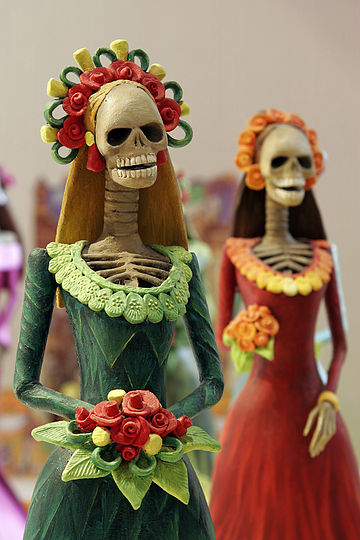
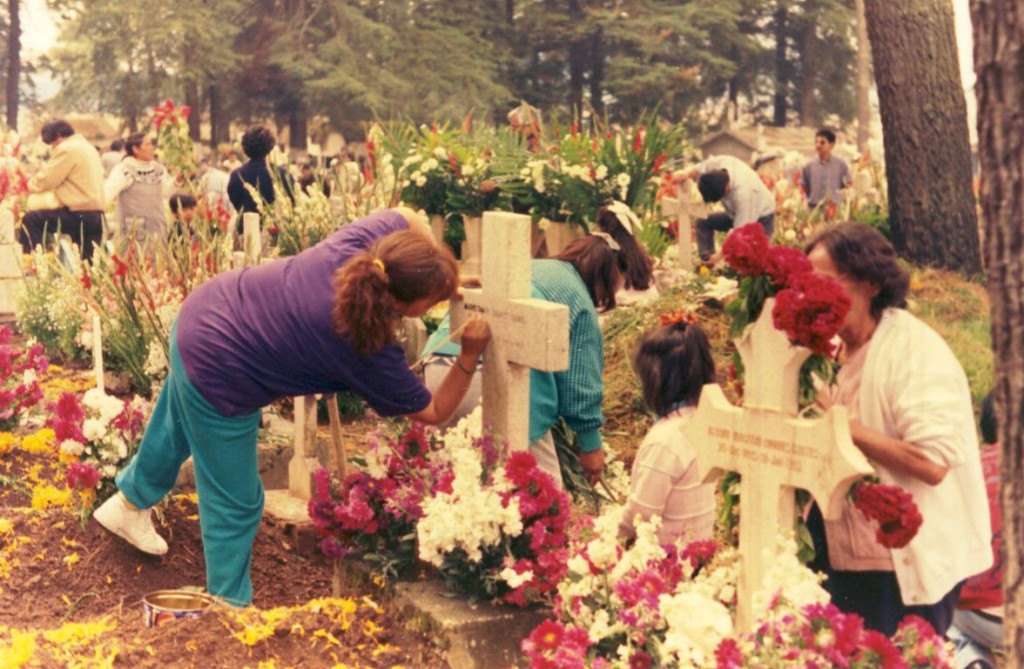


Near-Life Experience (NLE)

Near-death, but happy


A near-death experience (NDE) is a personal or subjective experience associated with what are called near-death episodes. In a near-death episode, a person has been declared clinically dead, is very near death, or is in a situation where death is impending, likely or expected. The situations where people have reported near death experiences have been accidents, military combat, childbirth, or suicide attempts. (1, 2)


The term or phrase near-death experience is said to have been first used by Dr. Raymond Moody in his book titled Life After Life published in 1975. Many researchers have since studied the situations, circumstances, contents, and consequences of NDEs. People who have experienced near death episodes say it encompasses multiple sensations including detachment from the body, feelings of levitation, serenity, security, warmth, the experience of absolute dissolution, and the presence of a light. The recurrent theme is the feeling of a strange sense of warmth and joy.


Some reports says 38%-50% of the adult population in USA who have come very close to clinical death have had a near-death experience. However, those who have had near-death experiences often criticize and disagree with the term “near-death.” They say it is incorrect because they claim they were absolutely sure that they were most certainly dead, not just near-death. (1, 2, 3, 4)


Most of us have heard or discussed the term “hear-death experience” and many have been discussed this phenomenon with friends.


However, there is an older phenomenon that many of us have not heard or even talked of although it has been around for centuries. “Near-life experience.”


*****


Near life but not quite there and very unhappy


We define Near-Life Experience (NLE) as a personal experience associated with impending life – the possibility that finally the life a person had envisioned is within his or her grasp – one is nearly alive but not quite. (5)


What do you mean by near-life, aren’t we all living? How could I talk to you, interact with you if I were not living? This was the reaction of a colleague when we brought up the phenomenon of near-life experiences.


We simply asked him: What do we mean when we tell ourselves or someone else: Get a life!


Does that mean we still do not have a life? How can we go out and get a life if we were not alive? Dead people do not just walk out of their houses (or caskets) and get a life. But we only expect people who are alive to do that – go out and get a life.


Yet we are alive; otherwise how could we be working all the time, and leading that dull, boring, routine life. For many of us caught up in the unidimensional mode of work – work and more work. Working just to pay the bills and be able to get through the day and have a roof over one’s head. But this is not the life we had in mind. So are our lives stored in our memories. But how can we recollect something that we have not experienced yet? Or is our life in our imagination? How can we imagine something that we do not comprehend? And yet, we often find ourselves telling ourselves: I need to get a life.


The expression – Get a life – is a clear vindication of our claim that all us are merely loitering from incident to incident, moving from one rite of passage to another, and engaging in near-life experiences instead of living the real life. We are all, it seems, near life; but not yet there.


Are we there yet? This does not seem to be a child’s irritating, oft-repeated question when we are travelling. Rather, it seems like a question we should be asking ourselves all the time.


A near-life experience is said to encompass multiple sensations including a sense of finally being able to leave the so-called existence one is leading and grasping the real thing; a sense or feeling that one will be finally secure, a feeling of warmth; and the presence of a light – that one cannot see but only feel its warmth in one’s heart. And one feels a strange sense of loss when that desired life fades away from ones sight or leaves ones grasp and one comes back to the so-called crappy existence one is leading.


So are there people who have had near-life experiences?


In the past when the Pareto principle applied, and 20% of the world ruled and controlled the rest of the 80% it was said that nearly 80% of people had a near life experience – they believed in magic at first and then in God and they simply kept trying.


In the last few decades 1% of the super-wealthy rule, control, and occupy the lives of the remaining 99%, it is said that only 1% have had a near-life experience. Well, some of us might think it is good news because that means the rest of us are actually living. No! The rest have simply given up.


People are either too tired or too poor to even care.


Those who have encountered near-death experiences (NDEs) report emotions that can be broadly classified into two broad categories. Some have pleasurable NDEs – which include feelings of love, joy, peace, bliss. While another group has experienced painful NDE such as feelings of terror, horror, anger, isolation, guilt.


The painful category of NDE is miniscule compared to the vast majority who say that NDEs are pleasurable; and both types report that the experience or sensation is hyper-real—sharper than what they have ever felt in their real earthly life.


In the case of near-life experiences (NLE), the painful experience in the only one experienced by most people. Many of us continue to believe that we experience life when we experience bliss. Bliss is extreme happiness. Only time people experience pleasure in a near-life experience is when they take some mind-altering substance. But then the very act of consuming a mind-altering substance makes it a not so real life experience. Experiencing life in an altered state of consciousness would not constitute living the real life, would it?


I could have been somebody OR Be all that you can be


Our research on near-life experiences have found that they differ by age group. However, both the young and the old have near-life experiences. Degeneration and the problems of aging may be the privilege of only the old; but near-life experience, like the phenomenon of death, it seems is quite egalitarian – cuts across age, caste and afflicts the poor and the middle class.  No amount of education or getting into privileged occupation can impact our near-life experience.


Thus near-life experiences can be classified differently in two people who live in the same home.


In the middle aged father or mother near life experiences can be summed up in the phrase: “I could have been somebody.”


This is the middle-aged father or mother playing the character of Marlon Brando in On the Waterfront, a 1954 film, and ruing their life choices. Complaining about all the people who never helped them to become the person they could have; about no one realizing their potential, giving them a break.


For the teenage son or daughter engrossed in a virtual war on a video game or lying on the internet in their face-book page to get more “likes” and to attract attention and interest, this is about pretending to be someone he or she is not. This approach to life has been classified in the famous US army slogan : Be all that you can be.


And in the virtual world, one can actually be anything as long as never meet the person face to face. The “Be all that you can be” near-life experiencers are constantly connected online but never connect at a human level.


Various questions come to mind: Is my life, the one I want to live, only in mind or is it real? If there is a life that I am supposed to lead then what is this life that I am actually leading or experiencing?


Is this what I really wanted? I know that is not what I thought my life would be – but then this is what I got. Should I just accept it and go along, play along as if I enjoy it or should I shout out loud and complain?


Maybe I did not want this life but this is what I have got? So is this my life now? Am I condemned to live in this slum? Or as the protagonist in the Oscar-award winning film Life is Beautiful would argue: Life is like living in a concentration camp anyway, we have to use music and philosophy and create games to make life livable and beautiful? If we are condemned to playing games in and with our life, then is playing games our real life?


Both the young and the old caught up in their own webs of near-life experiences – busy, multi-tasking, and no time to live.


*****


Can we ever eliminate the causes of Near Life Experience?


It is important not to dismiss “near-life experience” as simply the opposite of living in the moment or mindfulness. Near-life experiences are more than the phenomenon of mindfulness.


Mindfulness (the English word) is derived from the Buddhist term anapanasati. Mindfulness is commonly known as living in the moment and can be the intentional, accepting and non-judgmental focus of one’s attention on the emotions, thoughts and sensations occurring in the present moment. Many people try to gain mindfulness through training in meditational practices.


The Buddhist term originates from the word “sati” in the ancient Pali language and the Sanskrit word smṛti. However, it is important to note that the underlying meaning of both sati and smrti involves the act of recollection. Sati means, “moment to moment awareness of present events,” and “remembering to be aware of something or to do something at a designated time in the future”.


It is reported that the Abhidhammattha-sangaha, a key abhidharma text from the Theravada tradition, defines sati as follows: “The word sati derives from a root meaning ‘to remember,’ but as a mental factor it signifies presence of mind, attentiveness to the present, rather than the faculty of memory regarding the past. It has the characteristic of not wobbling, i.e. not floating away from the object. Its function is absence of confusion or non-forgetfulness.” (6)


Near-life experience cannot be completely conflated with mindfulness. While being in the moment may be an important aspect pf living. There are other components of living that are non-psychological.


Research from neuroscience explains NDEs in terms of various physiological and psychological factors, while some NDE researchers in the field of near-death studies advocate for a transcendental explanation


So what would explain our consistent encounters with near-life experience and the absence of ever experiencing life? Is the reality of life merely a psychological entity as mindfulness or other psychologists using mindfulness to treat depression and other mental disorders argue? Or is life physiological (based on matter alone) or a combination of both or is life spiritual and transcendental? As the Eastern ancients would say it is not matter or mind that explains the mystery of life, but it is consciousness (separate from both mind and matter) that gives rise to all the rest.


The answers are not straightforward nor is the pathway to the answer easy. What we suggest is that each one of us explore our own near-life situations. We think about it, share it. One can explore own consciousness individually; however, despite many underlying similarities, each life is unique and what we are looking for is benefit of knowledge for all. Therefore, a common knowledge has to be discovered and shared. This requires collective effort. It is the collective pool of experiences that will give rise to a better understanding of near-life experience and how to transform near life experiences into real life experiences.


Instead of funding more unnecessary research on disease and pharmaceuticals that only increase our near-life status; foundations should establish research agencies and universities to study in-depth the nature of near-life experiences, study the underlying explanations and determinants so why most of us are not living the life we have and continuing to have near-life experiences instead?


Why does LIFE elude the living?


Can we create a world where we eliminate the causes of near-life experiences and ensure that all of us actually live?


******


To be or not to be


Perhaps Shakespeare answered it for us all when he wrote those memorable lines which are part of the famous monologue in the play “Hamlet” and alludes to Hamlet’s suicidal intent. The revelation that Hamlet’s father, the King, was killed by his own brother (Hamlet’s uncle), who then goes on to marry the king’s wife (Hamlet’s) mother generates Oedipal impulses in Hamlet and drives him nearly insane. Hamlet wants to die, kill himself, but he also seeks revenge.


In the classic scene, he first thinks of suicide, “To die, to sleep- no more,” Then he fears that even after death, he may still not get the peace he wants. He is worried that there may be no peace even in death:


“ ‘Tis a consummation

Devoutly to be wished. To die, to sleep,

To sleep, perchance to Dream; Aye, there’s the rub,

For in that sleep of death, what dreams may come,,..”


The moral and mental pain that Hamlet’s character feels is captured by the soliloquy: “To be or not to be,” which also becomes the play’s emotional essence.


Hamlet (ofcourse Shakespeare) does touch upon two different topics which may be central to the understanding of near-life experiences (NLEs) – SLEEP and DREAM.


However, we think that although they came close, perhaps Hamlet (and Shakespeare of course) also missed the point – he may just have been another victim of Maya (the illusion of life) – a mere mortal afraid of death, caught up in the flesh and the pleasures of material living. As the next few lines show Hamlet calls death the undiscovered country from which no traveler has returned. Obviously, Hamlet (and in turn Shakespeare) was simply not aware of the phenomenon of “Near-Death Experience (NDE).” Hamlet chose to bear the drudgery of his painful near-life experience because he was afraid of death unlike the experience of hyper-real pleasure in near-death expressed by most of those who have gone through a near death experience (NDE).


“To grunt and sweat under a weary life,

But that the dread of something after death,

The undiscovered Country, from whose bourn

No Traveler returns, Puzzles the will,

And makes us rather bear those ills we have,

Than fly to others that we know not of.”


What would have happened if Hamlet had actually killed himself – embraced death rather than engaged in a monologue questioning death?


A person who has near-death experiences says: I almost kissed death and then someone pulled me back into life. Does that automatically mean that all of us who have near-life experiences have almost kissed my life and then something or someone pulled us back into this – what we have right now?


The question begs to be asked: When do I actually live? What is my life?


When I go from mind-full-ness to mind-empty-ness? What is mind-empty-ness? Is it mindless-ness because many among us are engaging in mindless acts? No, mind-empty-ness is different from mind-full-ness and from mind-less-ness. In order to define mind-empty-ness one may have to follow the analytic method of negation termed neti neti (not this, not this) advocated by the Advaita philosophers. In order to understand something one starts by trying to understand what it is not.


Perhaps I will understand mind-empty-ness when I die – because perhaps then my brain may become truly inactive. The one type of sleep when my brain is truly switched off. I will sleep and when I sleep in my death my brain will truly rest. It will no longer be active like the brain of a person alive because the brain never sleeps even when we are sleeping. (7, 8) At that moment both my recollections of my life and my dreams or imaginings of my life will become one with what my actual reality is.


Is this akin to turiya? The Mandukya Upanishad describes three psychological states of consciousness: waking, dreaming, and deep (dreamless) sleep. The waking and dreaming states are not considered true experiences of reality and truth because of the acute divide between the self and the non-self. One is aware of one’s boundaries. In dreamless sleep, one is not conscious of external or internal objects, no awareness of thoughts, yet the fact that we say that I am not conscious of anything proves that the “I” is still present. It is only the fourth (in Sanskrit language turiya means fourth) transcendental form that underlies and transcends the three common states of consciousness of waking, dreaming, and dreamless sleep which there is complete dissolution of boundaries and the experience of pure awareness or pure consciousness.


Is there, then, a continuum between life and death and if there is, then, is meditation the only way to get there? Or, for mere mortals such as us, is sleep the bridge that allows us to actually enter and be a part of that continuum? Is sleep the natural state and way to get to life? Perhaps we do not sleep because we get tired by running round all day. On the other hand we may be running around all day because sleep demands that we expend the excess energy that keeps us from sleeping?  Would that not be the correct way to describe new born babies and children? Sleep seems to be their natural way of life. They run around and scream all day only to drop down to sleep within minutes. Perhaps it is through the exploration and deeper examination of sleep that we will understand death and by doing so understand life.


I may not become one with God after my death but what will perhaps happen is my dreams or what is in my mind will become one with what I actually am – just a baby, wanting to sleep. Perhaps, for the majority of us, our near-life experience becomes real-life only after death.


“The Universe begins to look more like a great thought than like a great machine.“

Sir James Jeans (1877 – 1946)

British scientist

Author of book Physics and Philosophy (1943)


——————————————-

© Madhav Pakhare and Nilesh Chatterjee


Note: Someone asked us whether NLE was not just another attempt to re-package old wine in a new bottle? For that discussion, please wait for the next article where we have created the 2 X 2 typology of old wine / new wine and old bottle / new bottle. Assuming that the bottle represents the human existence and wine represents the idea or thought or energy; and it came out looking something like this. In box D the vessel is old, and the energy or thought is also old. In our minds this could represent the existing human condition – both a baby and the elderly. However, someone among us who ends with a higher consciousness, maybe an Einstein or a Gandhi or Bohr or Russel or Bohm may be in C because they have a fresh consciousness. The issue is with the boxes A and B because we are talking of a new bottle or vessel. Read more in the next piece.

 NLE

References

  1. International Association for Near-Death Studies: http://iands.org/about-ndes.html
  2.  Near-Death Experience Research Foundation: http://www.nderf.org/
  3.  Near-Death Experiences and the After-life: http://www.near-death.com/
  4.  Near-Death Experience: http://en.wikipedia.org/wiki/Near-death_experience
  5.  Goodlife Zen: http://goodlifezen.com/have-you-had-a-near-life-experience-5-crucial-tips-on-how-to-feel-fully-alive/
  6.  Mindfulness: http://en.wikipedia.org/wiki/Mindfulness
  7.  Brain Basics: Understanding Sleep: NIH – National Institute of Neurological Disorders and Stroke http://www.ninds.nih.gov/disorders/brain_basics/understanding_sleep.htm
  8.  While you sleep, your brain keeps working: http://psychcentral.com/blog/archives/2008/08/03/while-you-sleep-your-brain-keeps-working/


« Older posts

© 2026 THE ESSAYIST

Theme by Anders Noren — Up ↑