Month: July 2015

Tomorrow-lands; crashes with a thud and dud on Hollywood: Black-box of Hope does not tell the Truth

Released in theaters two weeks apart in the summer of 2015, one movie, Tomorrowland, about positive attempts to make the planet’s real future better failed to attract audiences; while a second movie, Jurassic World, about dinosaurs trampling each other in an unrealistic future made the fastest billion dollars at the global box office in the history of Hollywood.  Why did a cultural product that wants to make us all better humans, rather than stay dazzled with dinosaurs, push us away instead of pulling us into changing our world?


Tomorrowland, a 2015 sci-fi fantasy adventure film made by Disney Studios based on its theme-park namesake, is a cinematic attempt to instill a sense of urgency and agency about our future; a movie about reality. Hollywood has always served larger-than-life-size hope on silver screens. However, Tomorrowland tries to do this with respect to our global future; not a future that is threatened by some giant meteorite hurtling toward Earth, but a global future where environmental deterioration is irreversible, with economic crisis, looming social chaos and a dog-eat-dog world of humans.

 

Tomorrowland_poster1

Director, Brad Bird has said: “Somewhere along the way, in the past 30 years or so, this optimistic belief that the future was going to be better slowly gave way to the idea that the future was going to be lousy. And we just wondered why did it change?” According to George Clooney, Hollywood star and an actor in the movie: “There is such bad news out there. It’s all bad news when you turn on the TV now. It’s hard after a while. It’s hard on your soul. Tomorrowland presented an opportunity to put something that’s really entertaining and actually positive on the big screen.”  Tomorrowland, then is not only a movie about the reality of our future; it also attempts to infuse some optimism and hope into that bleak future.


Within a couple of weeks after its release, the 330-million US dollar film was labeled by The Hollywood Reporter as a $330mn dud. It will not make half of what was spent on producing and marketing it, the analysts said. Hope about the future transmitted from ten thousand Hollywood screens did not seem to touch people’s lives, let alone ignite a spark to transform it.
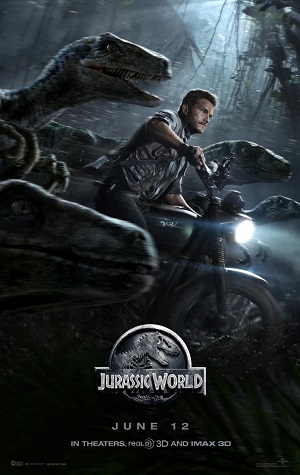
 

Jurassic_World_posterAt around the same time, maybe two weeks later, Jurassic World – another big budget futuristic movie about dinosaurs hit theaters globally. According to industry sources, the pace at which this dinosaur blockbuster has attracted paying audiences into theaters has been faster than any other movie before it. According to the director of the film, Colin Trevorrow, the synthetic hybrid dinosaur, Indominus rex, at the center of the film’s story, is symbolic of consumer and corporate excess; meant to embody humanity’s worst tendencies which is to want more, bigger, faster, louder. He is also reported to have said: “The Indominus Rex is our greed, our desire for profit that needs to be satisfied.” Film critics have mentioned that there are parallels between the workings of the park in Jurassic World and the film and entertainment industry. Another theme in this movie that made the fastest billion is: Those who do not stop evil are supporting and encouraging it. Ironically, Tomorrowland which tells us that our actions are indeed responsible for the deterioration of the future of our children, not some dinosaur; made audiences, both adults and children, stay away.


Why did one movie that showed a realistic future and a positive attempt to make it better fail to attract audiences while another movie with an unrealistic future of dinosaurs trampling each other draw so many? Ironically the movie that is symbolic of greed (Jurassic) became a major news item when it was labeled as the fastest movie to make a billion dollars. Are we stuck with greed and profit and see no way out? Why did a film that wants us to become better humans and make a better tomorrow, instead of pulling us into that change process, manage to push us away?
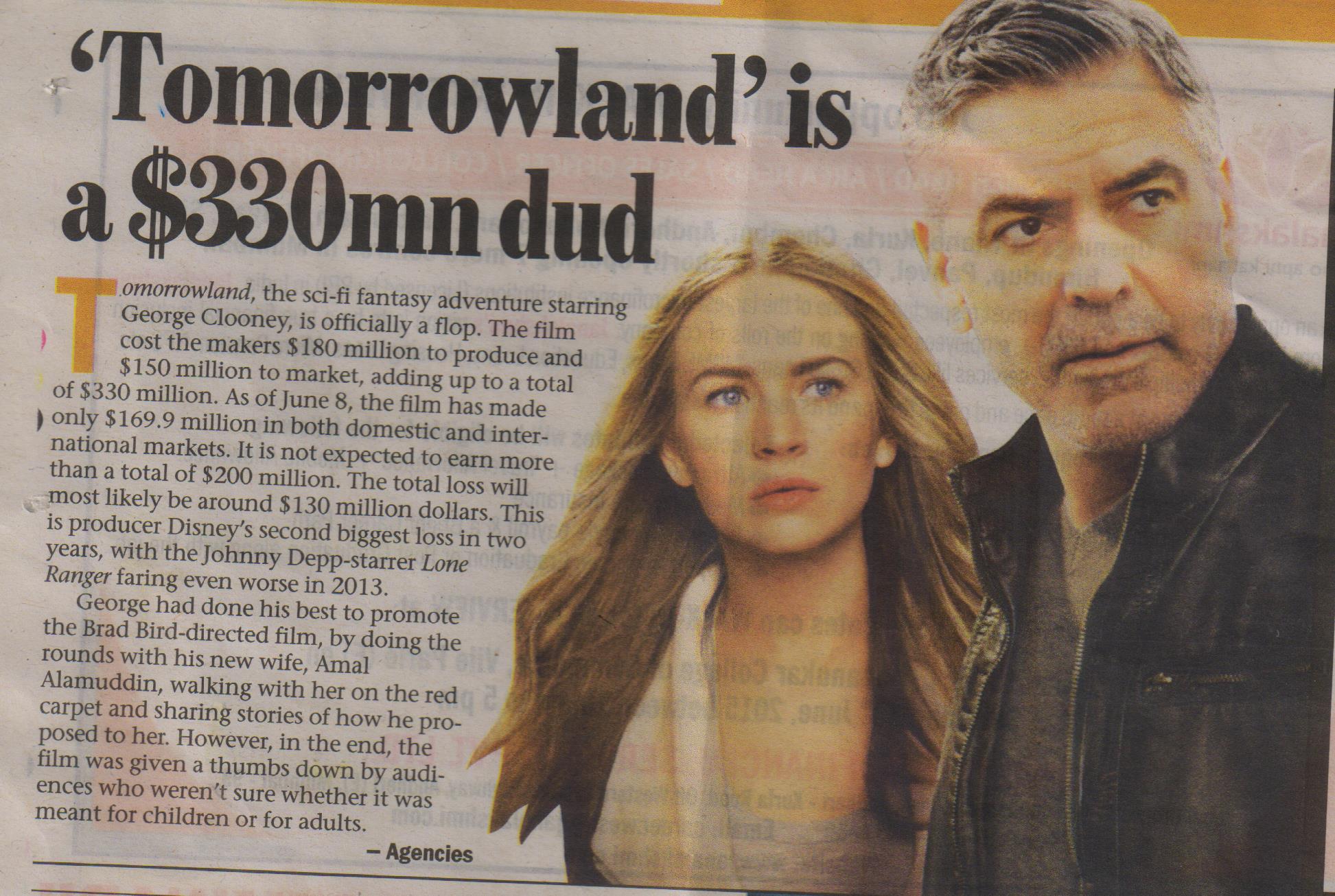
 

Tomorrowland is 330 mil dud

Hollywood analysts said that Tomorrowland failed because audiences could not tell whether the movie is for children or for adults. Apparently audiences were confused as to who this story is meant for? One can call this a confusion of story-telling and blame the director. Given the 300 million dollar budget; surely enough focus groups were conducted to test this. Hollywood and other media companies commonly use the marketing strategy of segmenting their cultural products, including movies, for specific demographic groups; such as movies for adults and movies for children. Keeping focus groups and market segmentation aside, a story is a story. Stories, like death and taxes, are certainties across cultures and countries. A good story-teller rarely thinks of segmentation and market first. Furthermore, a story about the future, a topic that concerns both adults and children, should be of interest to all demographics. So why would audiences and families reject something that is common to and important to all?


What does the failure of Tomorrowland indicate?


“Tomorrowland,” according to New York’s David Edelstein, “… is the most enchanting reactionary cultural diatribe ever made.” When audiences reject a movie, usually one that is praised by critics, it has probably not resonated with the audience or created dissonance in their minds. People handle lack of resonance or dissonance by staying away; through avoidance. The lack of resonance could be a function of the story of Tomorrowland and how it tells the truth about the future while the dissonance has to do with the audience and how they handle their hope or despair about the future in their minds and their actions. While we can avoid something because we are unable to handle the truth, we cannot forget that we cannot escape the truth either.


For those who have not seen the movie, a summary of the story is provided below followed by a discussion of – audiences and hope and of story and truth in the context of Hollywood and our world.


*****


Tomorrowland, classified as a science-fiction mystery adventure film, is the story of two Tomorrowlandlarge2unlikely protagonists who are brought together by a robot-girl Athena to do something about the future. One is a former sparkling boy-genius (who later in the film becomes an older and shabbier Clooney) and the other, an optimistic teenage girl, who can figure out how things work and has a positive mindset. Together the three of them travel to another dimension called “Tomorrowland”, where our actions directly affect our world. A tachyon machine, invented by the boy-genius, shows images from all time dimensions — past, present, future — and has a clock which shows that the world will end in a few days. The boy-genius, now elderly Clooney, is very cynical, but, our hope-filled teenager does not accept this bleak future as it is. She believes that the world and future can be saved. Her optimism affects the machine which starts showing some positive images. The older boy-genius realizes that the future is a self-fulfilling prophecy; the bleak future seen on the machine is a direct result of our bleak thoughts. Positive thinking about the future can change it. Of course the villain called Nix (played by Hugh Laurie) nixes the idea of helping Earth recover; gets crushed under his own machines; and while dying shoots at older Clooney. The robot girl, Athena, who sees this happening in the future-prophesizing machine, sacrifices her life to save Clooney’s; and we find that her mechanical heart is actually filled with love. All of this in happens in a Tomorrow-land filled with rides, jetpacks and sci-fi gadgetry. The two protagonists then assign new robot-children the task of distributing T-shaped pins to positive people around the world who end up in Tomorrowland and refuse to give up on the future.

[Read more about the movie Tomorrowland here]


*****

You can’t handle the truth
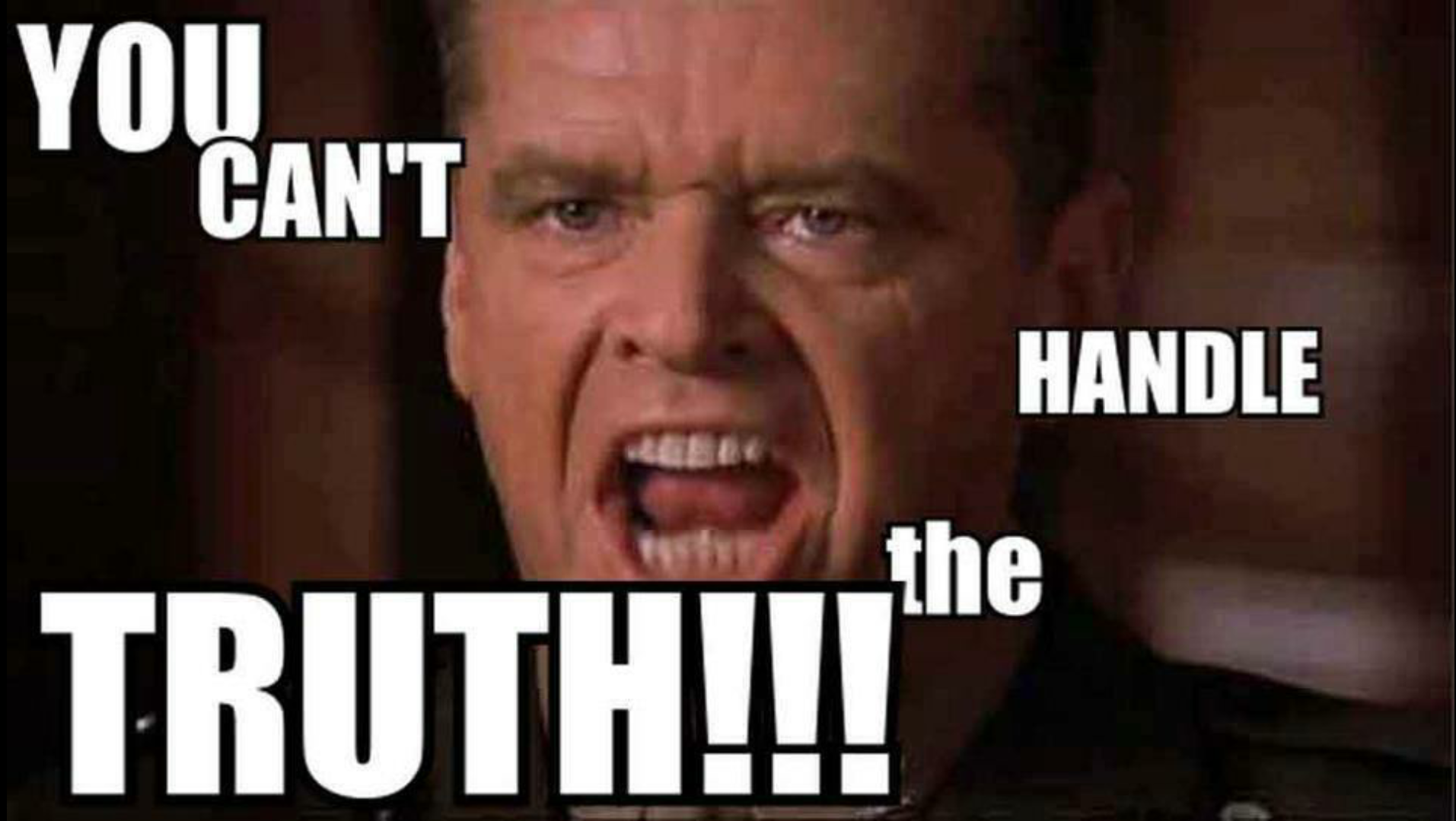
 

youcanthandlethetruthlargesizeThe LA Weekly, while giving the film a B+, wrote: “Bird (the director) has made a film that every child should see. And if his million-dollar dream flops, he’ll be asking the same question as his movie: When did it become uncool to care?”


Do people not care about their future? Let us take an average adult who perhaps has one or two children. What does the future represent to this adult? His children most probably. Is this adult interested in his children? Of course this adult is. It is this same adult who is accompanying the child to Jurassic World, isn’t it? Yes. Therefore, this average adult must be interested in the happiness of the child and by default the future of the child. And for a child – what is the future? It is her or his own life. Does this child not care about her own life and by default her future? So to assume that our general movie-going public has reached that point of dark nihilism which makes them not care about anything, including their own future, is almost Kafkaesque and in a slanted way very cool indeed. Unfortunately, our general population is not that cool at all. They are a worried lot.


The future in the mind of the common man is equated with a personal future of credit card payments, job insecurities, health care, home loans and so on. However, when we talk of the collective or planetary future the average citizen immediately connects it with  the deteriorating environment. The extensive media coverage of increasingly frequent heatwaves, extreme cold, floods, un-seasonal rains, crop failures and of 36 Nobel laureates signing a new Mainau Declaration calling for urgent action on climate change, out of a mix of urgency and guilt and horrified at the prospect of what unchecked use of natural resources could do to the future, have gotten the average Joe worried to some extent.


However there is a conflict or dissonance – the way of life of the average Joe is built for comfort and convenience and urgent action for climate change requires a change in that way of life at an individual level. At a larger societal level it calls for a change in our culture of consumerism as well as a change in the excessive greed of corporations and politicians. More money for some people today means a worse future for everyone tomorrow. This is the critical  problem. Money is the god for this generation and we cannot topple the temples of money. The chase for more money is leading to a negative future, but we are willing to trade that future of millions for a few billion dollars today. We want people to consume less products, most of which are environmentally harmful, but we also want them to buy more so we can keep our economy afloat. We cannot seem to get over our relationship with an economic system that is harmful for our children’s future or even visualize that a change is possible. How do we deal with this trade-off which we know is harmful for the survival of the human species? A Norwegian philosopher with a pessimistic and fatalistic view of the human condition may have hit upon the answer.


In 1972, Arne Naess first distinguished between shallow and deep ecology by identifying two ecology movements competing for our attention. The shallow one is concerned mostly with pollution, resource depletion and the usefulness of the Earth to humans (anthropocentrism). The second one is concerned with the diversity, richness, and intrinsic value of the entire Earth. This is the Deep Ecology movement – the idea that all life has the right to exist, that no one species is more important than another. Nature does not exist to serve humans. Rather, humans are a part of nature, one species among many. All species have the right to exist for their own sake, regardless of their usefulness to humans.


It is said that Naess was influenced in some ways by the ideas of the Norwegian philosopher Peter Zapffe (1899 –1990), his student who was 12 years his senior. Zapffe wrote in an essay ‘The Last Messiah’ and later in his philosophical treatise “On the Tragic” (Om det tragiske), published in 1941, that humans do not fit into Nature’s design because they are born with an overly developed intellect which allows for greater understanding and self-knowledge. Human yearning for metaphysical purpose – for intrinsic justice and meaning in any event or matters related to life and death – is destined for frustration by the real environment because Nature and the process of life is oblivious to whatever it makes and breaks in the course of its perpetuation. Humans not only perceive their own mortality but are also reflective enough to understand that the Earth would be better off without them.


Despite this knowledge very few humans actually lose their minds because, Zapffe says, the human brain has evolved mechanisms by which most people learn to save themselves. In an obvious salute to the work of Sigmund Freud, Zapffe proposed that humans artificially limit the content of consciousness by using four principal defense mechanisms:

Isolation – dismissal from consciousness of all disturbing and destructive thought and feeling.

Anchoring – fixation of points within, or construction of walls around, the liquid fray of consciousness which provides individuals a value or an ideal that allows them to focus their attentions in a consistent manner. God, the Church, the State, morality, fate, the laws of life, the people, the future and “our way of life” are all examples of collective primary anchoring points.

Distraction – constantly and continuously enthralling it with diversionary impressions; focusing all of one’s energy on some task or idea to prevent the mind from turning in on itself.

Sublimation – conversion of anguish into uplifting aesthetic pursuits such as literature and arts; the refocusing of energy away from negative outlets toward positive ones.


 *****


The future, in both good times and bad, is a difficult topic to deal with. Most of our lives are spent trying to make the future predictable and secure. We work hard, we save, we invest, we
make our children study instead of play because we want a secure future for ourselves and loved ones. We live as if we are sure that there will be a future even though there is really no guarantee. As Neils Bohr, the well-known physicist said: “Prediction is very difficult, especially if it’s about the future.”  However, even if we know nothing about the future, even in the darkest of time, we hope for the best. Thus, while most of us may use the mechanisms of ‘Isolation’ or ‘Distraction’ as proposed by Zapffe, the concept of ‘hope’ becomes our anchoring point. In our everyday life, the future is a critical ingredient and wherever there is a future, hope always tags along.  Hollywood has understood the ubiquitous nature of hope in the common man’s life and has peddled it unabashedly. Hope is the common man’s dope against the uncertainty of an unknown future.


To understand hope better, it is important to look at its antonyms: dejection, hopelessness, despair. These are what we spend our times battling – we do not like the antonyms, so we cling to hope. Hope, then becomes an optimistic attitude of mind based on an expectation of positive outcomes related to events and circumstances in one’s life or the world at large. Psychologist Charles Snyder and colleagues came up with Hope Theory in 1991. Hope, in this psychological view, consists of two dimensions: agency and pathway.  Snyder argues that hope should be viewed as a cognitive skill that demonstrates an individual’s ability to maintain drive in the pursuit of a particular goal. An individual’s ability to be hopeful depends on two types of thinking: agency thinking and pathway thinking. Agency thinking refers to an individual’s determination to achieve their goals despite possible obstacles, while pathway thinking refers to the ways in which an individual believes they can achieve these personal goals. The person who has hope has the will and determination that goals will be achieved, and a set of different strategies at their disposal to reach their goals. Put simply: hope involves the will to get there, and different ways to get there.


Tomorrowland, in no uncertain terms and very lucid conversations among its characters, wants to address the cynicism we hold about the future and instill us with hope. As the Newark Star-Ledger reviewer wrote “Strip Tomorrowland down to its essentials, and you get an ending out of “I’d like to teach the world to sing” and a moral which boils down to: Just be positive, OK?” Perhaps this does not work so well in the scenario of our troubled future.


We are aware that our actions damage the environment, irreversibly. Yet, we do not take corrective steps. We continue to ride our cars, use air-conditioners, throw plastic and create excess, non-recyclable waste on a daily basis.  We know that every day the future deteriorates more mainly because of our way of life. But, we continue. We are addicted. We hope for a better future, we talk about it, we know the ways, but we do not act to make it happen because that would mean tackling our addiction to our present way of life. We have perhaps somewhere understood, to use Snyder’s framework, that while we know the ways, we definitely do not have the will to get there. Because the will to continue with the present lifestyle far outweighs the desire to change in the pro-environmental direction. Thus, any talk of change in behaviors with respect to the future is not the hope that the scientists / psychologists talk about, but some sort of empty rhetoric; arm-chair philosophizing in air-conditioned halls. It is like a drug addict talking of change, of giving up drugs, but not harboring any intention to do so at all. It is plain lying and manipulation.


Even the littlest kid in the darkest movie-theater, anywhere in the world, knows somewhere in the deep recesses of the primitive, reptilian part of his brain that he is living out a Greek tragedy where his own parents, through their ‘way of life’ today, are devouring his future like some mythic monsters; destroying every resource and damaging every bit of air and water that will keep the kid alive in the future. The future while being a ray of hope for each one of us today has also become our biggest villain and nemesis. If only there were no future then we would have nothing to worry about. We could draw all the resources to enjoy our hedonistic today because we are drilling into the future to pay for the excesses of today. There is a slight problem: some of us have actually created children who may have a life tomorrow and it is for these very children that Hollywood makes movies such as Tomorrowland and Jurassic World. Do we really think that our children are so dumb that they have not intuitively understood the game that is being played with their future? Or maybe we are super-confident that we can spin the truth and brainwash them through marketing hype, fantastic movies and the school system.


Forget our actions or lack of it, let us ask: What makes us think that hope will work at all – be it hope of positive thinking or hope of positive action – what makes us confident that hope will make a better future? Environmental scientists say that the climate change and many such environmental damages are essentially irreversible. Even if we stop over-consuming today, we may not be able to change the course of the deteriorating future. Will any change in our actions make a difference at all? The world has clearly experienced in the past seven years of the Obama presidency that the sheer audacity of hope is not enough to counter the negative forces of corporate greed that govern our life and everyday actions.


Stepping out from the darkness of the movie theater into the hazy light of a smoggy day in the city where tens of thousands of new cars are added every day and taking just one breath of the polluted air outside should make one realize that being positive or hopeful in thought or action about the future is just not enough. Today’s consumerism and corporatism may be just too far gone. In addition the population of the world is so huge, at more than 7 billion, that we may have crossed the point of no return a decade or two ago. Our hope will not change a thing except create a bubble of self-delusion. Influenced by Arthur Schopenhauer, Peter Zapffe also wrote that as long as humankind recklessly proceeds in the fateful delusion of being biologically fated for triumph, nothing essential will change. Mankind will get increasingly desperate. He propounded the idea of a last messiah almost like a Moses, but replaces Moses’ precept to “be fruitful, and multiply, and replenish the earth,” by saying, “Know thyself, be unfruitful (infertile), and let there be peace on earth after thy passing.”


****


You can’t escape the truth


Once Truth came to the streets of a small town as naked as the day he was born. Seeing Truth in this condition, people ran away and every house shut its door. No one would not let Truth inside. Truth sadly walked to the town square and sat on a bench. Someone who looked exactly alike came and sat next to Truth. This was Parable was dressed in splendid colorful clothes. Parable asked, "Tell me, brother, what makes you sad?" Truth replied, "Things are bad. I guess I am old. No one wants anything to do with me." Hearing that, Parable said, "People don't run away from you because you're old. I am old too. Let me tell you a secret. Everyone likes things disguised and prettied up a bit. Wear some splendid clothes like mine, and the very people who pushed you aside will invite you into their homes and ask for your company." Truth took Parable's advice and put on the colorful clothes. And from that time Truth and Parable have gone hand in hand.
 Eastern Europe tale by the Maggid of Dubno, 18th century rabbi


It has always been difficult to deliver a truth, especially if that message is not a generic aphorism such as honesty is the best policy but, some harsh truth about our reality and existence. Telling the truth directly has got many truth-sayers kicked out of royal courts, some have been exiled, some executed, some guillotined and some thrown out of towers. Not just rulers and kings, even common folk, do not want to listen. Philosophers and sages have always wondered how to tell the truth so that people listen. Parables and fables are ways of telling essential truths by cloaking them in a story. Perhaps even before the era of cave paintings, telling stories has been one of our most fundamental communication methods.


Stories are enjoyable and stories or narratives also engage us more. It seems we, rather our brains, are hard-wired for stories. As events unfold in a particular sequence of cause and effect, it seems our entire brain seems to get activated; not just the parts that process words, but parts of the brain that deal with experiences of pain, joy and other emotions. It is argued that people remember a point better when it is told in the form of a story. That may be good for selling books on marketing and management. However, there is a problem when we try to convey a message through a story. People often remember the emotional experiences but discard the kernel of truth hidden inside. And good writers, who want to change the world with their words, have to struggle with the task of telling a story while retaining the message of truth. Perhaps Aesop did it best; told a story (Aesop’s fable) using the least words in the most economical and hard-hitting manner without diluting the truth and the fun.


Aesop, they also say, was thrown off a cliff; and the divide between telling a story for sheer entertainment and telling it to educate people has widened ever since, especially in the last century with the burgeoning of an entire multi-billion industry called the film and media industry whose short-form is Hollywood. This giant conglomerate, which has replaced local film-industries in most parts of the world, has also taken the exercise of story-telling to an extremely simplistic, formulaic format to satisfy the greedy cash registers of the box office. In recent years, story-telling has moved from its simple parable origins to a complicated technological product with computer animation, 3-D, green-screens, complex visual effects, and such. Use of technology has also multiplied the cost of making a movie exponentially. The Seattle Times in its film review said: “Though the movie is made with great energy and inventiveness, there’s something ultimately muddy about Tomorrowland; it’s as if director Brad Bird got so caught up in the sets and effects and whooshing editing that the story somehow slipped away.”  Yes, we  can. Is that the reason we use all this technological gimmickry to tell a story just because we can. Because we have the technology and we believe we must use it or is it because each film-maker is trying to outdo the other in technologically glitzy story-telling, keeping up with the Joneses in their Hollywood compound. Technological gimmickry has trumped the truth-telling of parable and story.


In the history of story-telling, Hollywood has played a critical role in the last century by taking films and stories to the remotest corners of the world; making it a mass product. The rise of Hollywood and its mass appeal has also led to truth and story-telling get divorced. Stories and plots are formulaic because these products have to guarantee the studio and financers a return on investment. And films, such as the case of Jurassic World, get measured by the amount of money they make at the box office rather than their potency in delivering a critical message. In order to generate more revenue at the box office, stories became more and fantastic and escapist – like Jurassic World. And any truth inside the story is disguised, softened, and beaten down until it does not retain the hardness of the original truth anymore or mutates into something else. For instance, how many people who watched Jurassic World actually understood the point made by the director that it was about insatiable greed? For audiences the movie was about dinosaurs engaged in WWF encounters. Today we have reached a point where audiences of Hollywood do not recognize the truth in any movie because in their minds truth and Hollywood do not go together.


Hollywood, like the future of Tomorrowland, has created its own self-fulfilling prophecy. Hollywood movies are essentially fantastic and escapist – light-years away from reality; and most audiences perceive Hollywood as a land in some other dimension. And this has been reinforced by the celebrity culture, the glossy magazines, high-voltage marketing, public relations, paparazzi and so on. The makers and actors of films pretend as if they live in some other world. And although there is always some influence of movies on life and life on movies, largely people see Hollywood as escapist and that is what they have come to expect from it.  And when audiences walk into a dark theater expecting to escape, and get trapped in reality instead, they run away faster than the actors from the fake dinosaurs in Jurassic World. And this has become Hollywood’s self-fulfilling prophecy. Hollywood cannot break out of its own vice-like grip of escapism.


The issue of the bleak future, tied to our environment is a complicated story to tell in any case. Successful Hollywood movies and literary novels are good at telling stories that show humans dealing with other humans; they revel in and beautifully narrate human foibles. However, when it comes to humans dealing with their environment, story-telling becomes fuzzy and unclear. The prognosis of the world’s future is disastrous- environmentally and socially. Relationship between humans and Nature is at the worst possible. In this scenario, Tomorrowland tells us to stay positive. It uses retro-futuristic images from the science fiction of the 1950s and 60s when we embraced science and believed we could have better living with chemistry until we realized that the plastic made in the 60s is choking our oceans in the 90s. Given what we know today about the ill-effects of all that which were touted as solutions by science yesterday; perhaps audiences, including children, find that to hold positive thoughts about the future and the role of science in saving it a little too naïve and out of touch with reality.


In a sense then Tomorrowland gets trapped in the same philosophy of escapism that pervades and permeates all Hollywood production. Tomorrowland, although a great attempt to wake us, cannot escape its own nature – that of a Hollywood product; trapped in Hollywood’s own tachyon machine of escapism – a self-fulfilling prophecy where the layers of clothes – of story become everything and the truth is irrelevant. By peddling hope rather than the truth in the dire scenario of a chaotic future, Tomorrowland becomes escapist and thus stays within the strict confines of Hollywood’s iron cage of story-telling.


*****

Heroes, Hope and Hollywood


Hollywood peddles hope through its heroes; a formula based on the journey of the hero who falls down only to rise again. When the world is drowning in apocalyptic floods, there’s a hero to the rescue. And when a meteor free-falls towards Earth, it is the hero who rides into outer space on a rocket and blows it up. The heroes are policemen, detectives, ex-Marines, sports-coaches and so on. Men and women from within the system who defend this system while fighting corrupt villains who abuse this system. The system is good and it is kept good thanks to the heroes. The heroes of Hollywood do not really change the system; they simply bring balance and order to it. Hollywood has always maintained the status quo. But when it comes to the future and the environment, it is this very the status quo that is the real problem. In fact the future demands that we change our (mainstream) way of life. And can a mainstream movie ever ask mainstream people to change their mainstream way of life. How can we touch that sacred cow – our contemporary way of life?


We are looking for the hero who will change our future, and our future will not change or become better unless we change our current way of life. Yes, for the environment the villain is our current way of life. However, if there is something that the hero of Hollywood is afraid to touch, it is that contemporary way of life. Because that is what the hero of Hollywood is born to defend. How will this hero champion the new way of life unless it is some apocalyptic movie? To say this in the context of a simple, everyday movie – that is the struggle for Hollywood writers today and for the entertainment industry in general when it comes to hard, economic issues such as the environment and our future.

 

tomorrowland4Now let us say you were writing a story where the twists and turn took you to a place where the hero has to take it upon herself / himself to tell the truth to a paying audience: That it is you the audience. You have to straighten your act; the blame lies squarely with you, not elsewhere – your actions are causing damage to the future? You, dear audience, are the villains. Now imagine that you are the studio, not the story-teller, and you have invested 300 million dollars, obviously dependent upon ticket sales for return on investment. The audience is your customer and they will buy y the tickets. One cannot forget the cardinal rule in business: The customer is always right. And therefore, compromises have to be made.


It is hard to be Aesop when one is looking at the return on investment and the cash registers of the box office. And so that is where the convolutions start – we want to open the audience’s eyes and also sing a lullaby to anesthetize them. It is that tangled web we weave when we try to tell the truth first, and when we realize it is uncomfortable and inconvenient, we use unconvincing, convoluted story-telling because we believe the audience cannot handle the truth. We bring out the kid gloves. We soften the blow of the hard truth.


The film critic of the New York Times gave the film a negative review and rightly noted: “It’s important to note that Tomorrowland is not disappointing in the usual way. It’s not another glib, phoned-in piece of franchise mediocrity but rather a work of evident passion and conviction. What it isn’t is in any way convincing or enchanting.”


*****

Not just the financial issue, perhaps Tomorrowland ran into problems because there are some truths that just cannot be told in a story. There are some issue where you cannot both entertain and educate – the bitter pill has to be swallowed without the sugar coating. Imagine a man about to be run over by a bus, speeding in his direction. Do you tell him a story to make him aware of the bus or do you pull him out of harm’s way? Now imagine, the emotional turmoil within the man, when he realizes that this speeding bus that is a danger to his life has been created and set off by him; it is his own creation? The man in front of the bus is the human today, the bus is the damaged environment with waters rising all over the world, and the road is the planet. We have thrown ourselves in front of that metaphorical bus. It is speeding towards us and we are stranded in the middle of that road – flat on or faces as we wake up from the consumer excesses of the days and nights before. What does the man in front of the bus do? Cross his heart and hope… or like a child close his eyes and hope the danger will pass away.


Almost every human knows that the solution to this deteriorated future environment is a change in our way of life. We have all been educated of the ways and actions that will take us to a sustainable future. However, people are simply unable to convert their education and positive intention into real action. We do not seem to have the energy or enthusiasm to act on our positive intentions. What we do instead is resort to magical thinking. Since we have blind faith in technology, we ask: Is there no scientist who can create plastic that birds will eat out of our hands? That way my chemical waste will become someone else’s food? Some say: Make it all vanish – the garbage dumps, the pollution, the bad things that damage the future. Can’t someone do some magic, wave a wand and make it all disappear? And therefore we look forward eagerly to the magic of the movies – because in the those dark theaters all our problems disappear while we munch on popcorn and drink soda out of Styrofoam cups.


Yet, not just on that road, even while we are in that movie theater, we stare at that bus speeding towards us – our tomorrow. Can we face tomorrow without hope and without any story or narrative to guide us? Can we see tomorrow for what it is? Just a bus speeding toward our children today. If we are sincere about making a better world for our children, maybe it is time to face the harsh truth without the colorful clothing of parable and story; and to work for that better future rather than just hope. For all those who seek that better tomorrow, there is no time to watch any movie be it Jurassic World or Tomorrowland! There is barely time to get out of the way of the speeding bus; Jump. But jump where? Into a virtual world or somewhere outside of this planet. Maybe we can hope that technology will find a way to inhabit Mars. Now that’s a subject Hollywood is comfortable with. Forget that the majority will never have the money to buy that expensive ticket to Mars, but the last thing we can do before the bus runs us over is tweet and tell our friends on facebook that we watched the movie first. And in order to establish the truth, we can post a selfie.

 Tomorrowland 3


© Nilesh Chatterjee, June 2015


References

  • A group of Nobel Laureates have signed a declaration calling for urgent action on climate change. http://qz.com/444787/a-group-of-nobel-laureates-have-signed-a-declaration-calling-for-urgent-action-on-climate-change/
  • Nicholson, Amy. “Don’t Hate Tomorrowland for Asking Us All to Be Better”. L.A. Weekly. Retrieved 2015-05-23.
  • Stephen Whitty (2015-05-19). “‘Tomorrowland’ review: George Clooney’s sci-fi folly”. Newark Star-Ledger. Retrieved 2015-05-23.
  • A.O. Scott (2015-05-19). “Review: ‘Tomorrowland,’ Brad Bird’s Lesson in Optimism”. The New York Times. Retrieved 2015-05-23.
  • “‘Tomorrowland’ goes back to the future badly”. Star Tribune. Retrieved 2015-05-23.
  • Macdonald, Moira (2015-05-23). “‘Tomorrowland’: Exhilarating for kids, exhausting for adults”. The Seattle Times. Retrieved 2015-05-23.
  • Merry, Stephanie (2013-07-16). “Always-cool George Clooney can’t lift meandering ‘Tomorrowland’”. The Washington Post. Retrieved 2015-05-23.
  • http://variety.com/2015/film/news/jurassic-world-box-office-1-billion-international-1201524803/
  • http://www.conures.net/stories/parable.shtml


Dying of Good Signs

STORY 1: Circa 575 BC, Greece

The Sick Man and the Doctor (Aesop’s Fable)


Once upon a time a man fell ill. He called a doctor for a house-visit. The Doctor asked him how he was feeling. The sick man replied: “Fairly well, Doctor, but I find that I have been sweating a lot more than usual.” “Ah,” said the Doctor, “that’s a good sign.”


The sick man did not get any better and called the doctor again. On the second visit the Doctor asked the same question, and this time the sick man replied, “As usual doctor, but I’ve been having some shivering, and leaves me cold all over.” “Ah,” said the Doctor again, “that’s a good sign too.”


line2

The sick man became worse. When the Doctor came the third time and inquired about the patient’s health, the sick man said that he was very feverish. “A, that’s a very good sign again,” said the Doctor, “you are doing very nicely indeed.”


In a few days the sick man could no longer get out of bed. He had become almost invalid. A friend came to visit and on asking the sick man how he was doing, received this reply from the patient: “My dear friend, I’m dying of good signs.”


*****

STORY 2: Circa 2015 AD, Global

The Sick Economy and the Spin Doctors of the System


Once upon a time the global economy became very sick. All the spin doctors of the world showed up by Economy’s bedside. Mistaking them for real doctors, the economy opened up and stated the sickening sensation: “Personal consumer debt is mounting. They say one in four Americans have more credit card debt than money in the bank. As of June 2015, US households had an average credit card debt of $15,706, mortgage debt of $156,333, and student loan debt of $32,953. In total, just the American consumers owe $11.85 trillion in debt; an increase of 7.1% from last year.


The spin doctors said in unison: “Ah, that’s a good sign. It means people are consuming recklessly, engaging in instant gratification and balancing the supply side. Higher consumer spending will put you on a positive track and keep your engine humming. Why are you complaining?”


Economy replied weakly: “Wages and jobs are not increasing, but personal debt is mounting. Doesn’t this mean that households are borrowing to make ends meet? What worries me is the ease with which individuals can accumulate consumer debt beyond their means to repay. How will they repay their debt? This will come back to hurt me later.”


“Mounting personal debt is a good sign. It is a sign of consumer confidence in your health – the health of the economy,” the spin doctors out-shouted each other from their respective TV news-channel screens and newspaper op-ed pieces.

 —–

 A year later, the economy got worse. On hearing this the spin doctors ran to the patient again. This time, the economy said it had just read “The Telegraph” and other newspapers and the news made him sick: “Ten million jobs are at risk from advancing technology just in a small country like the UK. There is already a recession and high unemployment in many countries. Now because of technology and automation more people are losing jobs. The research says that the poor who have low-paid, repetitive positions are most likely to go, with people earning less than £30,000 a year five times more likely to see their jobs taken over by machines than those paid £100,000.”


The spin doctors chorused: Ah, automation means more production, lesser costs, less headaches of managing labor and much more efficiency. Corporate bottom lines will improve dramatically. That’s a good sign too.”


“What about the people who lose their jobs?” asked the economy.


“Oh, they will have to apply the Madonna Method – simply reinvent themselves. They will reskill. Learn new tricks. Isn’t learning new tricks wonderful for the old brain? It will help them overcome dementia too and reduce their old-age medic al costs. God knows that UK needs to reduce its medical costs,” came the pat reply from the spin doctors.


The snake which cannot cast its skin has to die.” The spin doctors cited Friedrich Nietzsche in their overpaid sessions on the global lecture circuit.


The economy pondered endlessly about why spin doctors called jobless people snakes. This made the economy’s sickness worse.

 —–

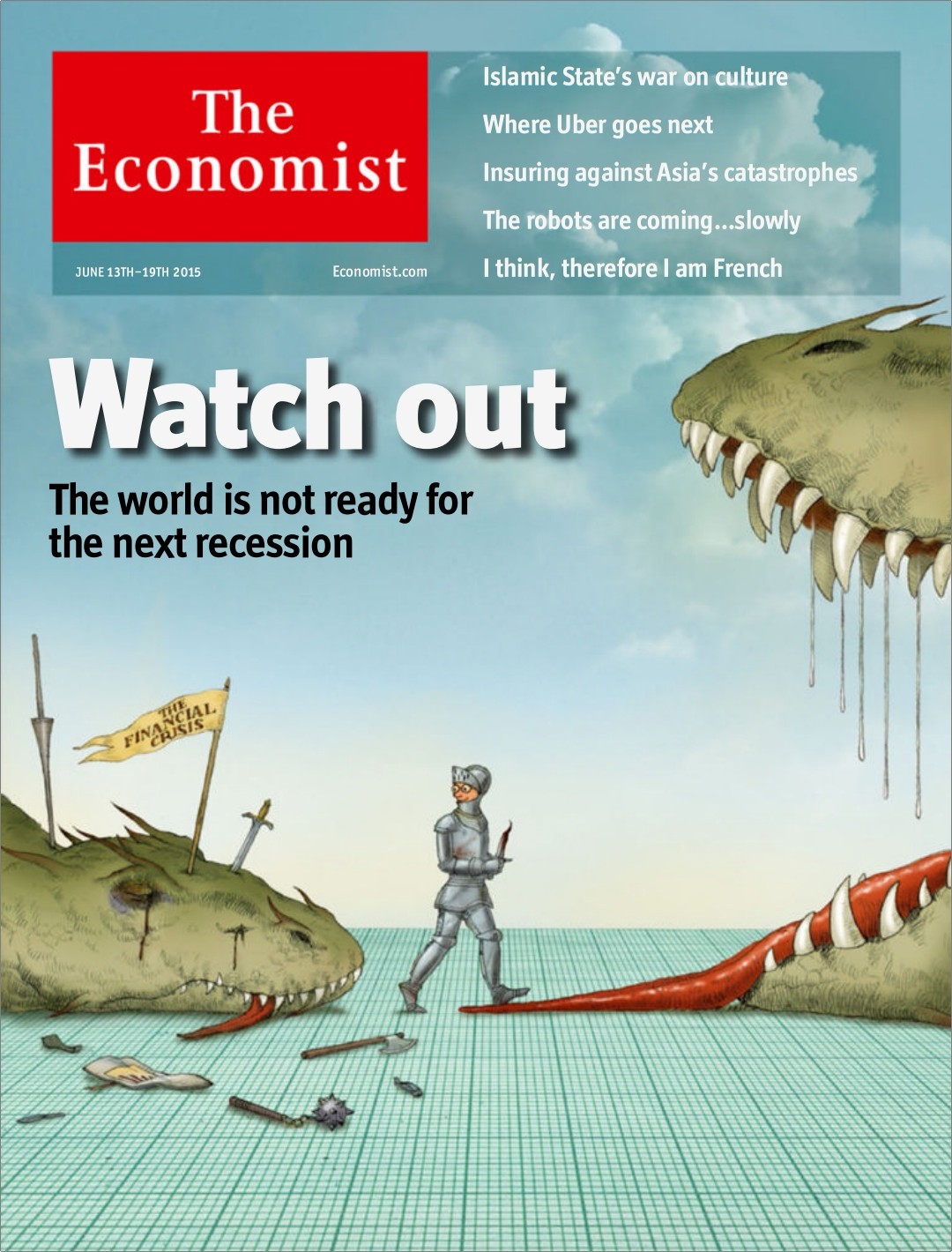
Another year went by, not a very good year for the economy. Its’ health got so worse; they had to put it a ventilator to make it breathe. The spin doctors came again. Economy could not speak because of the breathing tube in its mouth and simply pointed to the cover of a recent issue of The Economist which essentially said: Watch Out! Bigger Recession Coming.


Economist cover 13 to 17 june walking into another recession

The spin doctor jumped in joy: “Don’t you know – bigger is always better. And recession means the market is correcting its course. That’s not just a good sign. That’s a great sign.”


Economy gasped. All the machines connected to Economy’s body went into overdrive and started making all kinds of sounds that indicated the vital signs were slipping. The federal reserve doctors and nurses came rushing with the crash-carts. They instantly infused a bottle of freshly printed currency from the government mints into the Economy. Then they pumped in more freshly printed cash just to hold it up. “Don’t you have to address the structural damage. Look a lot of the blood has leaked out already,” pointed the Economy. The spin doctors sang in a chorus, “That is a good sign. Be happy you did not ‘kick the bucket’ because we just kicked the can down the road. Everything we do we do for you.”


When Economy’s friend Global Democracy came visiting and asked: How are you doing?


Economy replied: “My friend, it seems I am dying of the good signs of recovery.”


***** *****


© Parababel, 2015


References:

http://www.economist.com/printedition/covers/2015-06-11/ap-e-eu-la-me-na-uk

http://www.telegraph.co.uk/finance/newsbysector/industry/11219688/Ten-million-jobs-at-risk-from-advancing-technology.html

https://www.nerdwallet.com/blog/credit-card-data/average-credit-card-debt-household/

The IT Party is over. Now is the time to reinvent or die: http://timesofindia.indiatimes.com/home/sunday-times/all-that-matters/IT-party-is-over-Nows-the-time-to-reinvent-or-die/articleshow/47486851.cms


Kill the classics: Are the social sciences living in the past?

“In science, each of us knows that what he has accomplished will be antiquated in ten, twenty, fifty years. That is the fate to which science is subject […] Whoever wishes to serve science has to resign himself to this fact.”

– Max Weber, ‘Science as a Vocation’ (Wissenschaft als Beruf)

Lecture at Munich University, 1917


The discipline of sociology stands in an exceptional position within the sphere of the sciences – it is one of the few disciplines in which the past, as opposed to the present or the future, performs an extremely significant function and occupies a very prominent position.  What defines many sociologists, and provides an identity to them and their work, is an intimate knowledge of certain classical thinkers, and adherence to schools of thought or traditions founded in the late 19th century and early 20th century particularly in France, England and Germany later to be extended to the American continent. This obsession with the past makes sociologists, in a fashion unfamiliar to natural scientists but relatively similar to scholars within the humanities, constantly evoke and praise their founders, celebrate the classics, adhere to specific predefined canons and curricula, position themselves according to paradigms established decades ago by charismatic analysts of the days of yore and dwell in and regurgitate past academic achievements in an endless stream of new sociology books about the great classic books of the old sociology.


There is a stark difference between the cultures of the social sciences and the natural sciences. Hardly any respected researcher working within the natural sciences would today think of quoting Newton, Copernicus or Lavoisier as sources of ultimate wisdom or as defences in academic disputes. However, sociology continues to quote Marx, Durkheim, Weber and Simmel from the last couple of centuries as if they were the lasting authority on social and economic issues of today – a world that has probably changed dramatically in technology and global arrangements since these masters were alive? The reasons are to be found in the origins of sociology in the Golden Age of modernity and can be traced to the frequently discussed widespread confusion ever since in sociology pertaining to its own scientific status and identity: was the “social science” a child of the natural sciences or an offspring of the humanities? The result of this confusion was that the classics seemed the only secure, solid and unchanging point of reference and have remained so for the past 150 years in sociology. The term ‘cult’ seems appropriate to describe the way sociologists deal with their ancestors.


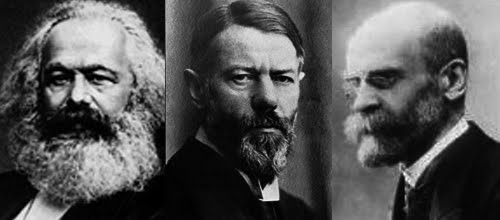
classics 3 together


According to the Oxford English Dictionary, ‘cult’ refers to reverential worshipping of or devotion to a person or thing and paying homage to their perspective or existence as done by a body of professed adherents or admirers often by way of specific rituals or ceremonies. These ceremonies or rituals in connection to the cult of the classics become obvious in the endless – some would even say mindless – use of citations, quotations and exegeses over the thoughts, lives and deeds of long-dead scholars by their devoted individual predecessors or generations of followers. The classics stand at the centre of attention, as the pioneers, legends, bigwigs and totems, in these sociological cults. And although many cults may compete internally with each other to take pole position in the discipline of sociology; the fact that many such cults of past-worshippers exist and thrive in the discipline also reinforces the hold of the past over the present. This hold of the past on the mind-set of sociologists obviously affects their way of seeing the present day world and the construction and discovery of new theoretical, methodical and thematic perspectives in sociology. Does this feature of sociology, an obsession with classics, hamper or facilitate the social sciences to move ahead the way a science should?


There is an ongoing debate within the social sciences and there are two schools of thought. One group of scholars in contemporary sociology want to rid themselves of the classical heritage, regarded as outdated and obfuscating. They argue that substantial amounts of the intellectual baggage of their discipline will necessarily have to be dumped on the historical scrapheap; that what ‘dead people’ said is not necessarily important today, and that the theory-heavy section of sociology is expanding beyond reasonable dimensions at the cost of sensible empirical research relevant to today. This group often find the classics a burdening ballast that hinders academic progress and view the excessive interest in theoretical dissection as being detrimental to empirical research.


Still others, it seems the majority, revere and embrace the classical traditions and the invaluable insights they contribute to contemporary sociology as well as to understanding today’s society. This second group dominates the academic agenda and have created a veritable cult of the classics in which identity, status, community and veracity is based on the reading, interpretation, rereading and reinterpretation of classical texts. In turn, certain academic normative and comparative reference groups, inclusive or exclusive, are developed in connection to these personalised classics – one is either a Marxian, a Weberian or a Durkheimian and so forth – but whether the one or the other, it is required that one specifically defines oneself as a sociologist by defining oneself exactly in relation to the classics.


The study of classics are also besieged by another serious contender that is external to the discipline – the pressures from new neo-liberal university reforms in many countries, including Scandinavia, demanding quantifiable bench-marking, pragmatic use-value and a mentality attuned to present needs of society instead of a re-reading of the past. In such a climate, a concern with the classics appears unacceptable and academically unrewarding. The neoliberal side questions whether the classics serve any purpose whatsoever in today’s age and time?


The Dead Sociologists’ Society


Dead_poets_societyThe book by Nancy H. Kleinbaum, which later turned into a box office success, titled The Dead Poets’ Society vividly demonstrated exactly from within the realm of the humanities how the teaching of and gathering around the classical past could create a sense of togetherness, inspiration, heightened awareness and mutual interest between the younger generation in times of radical social change, academic uncertainty and uprooting but also how this immersion in the classical tradition could equally lead to personal factions, strife and institutional conflicts. The background for the book was the literary classics such as Keats, Yeats, Shakespeare, Whitman and Lawrence but could equally illustrate how scientific, and thus also sociological, classics constitute mental monuments around which scholars and academics ceremonially and ritually gather.

 

Sociologists also have a tendency to hail their ancestors, heritage and classics and one can actually find an Internet domain titled ‘The Dead Sociologists’ Society.’ Based at Pfeiffer University in the U.S., this site is devoted to an undisguised glorification of the great sociological past. It contains links to special journals, thematic discussions, conceptual clarifications, etc. explicitly canonising the classics. Moreover, when surfing the Internet it is interesting and quite telling to note that a simple search on academic articles dealing with ‘the classics’ only lists hits from within either the social sciences or literary studies – the latter, as part of the humanities, containing by far the most hits.


Natural science journals apparently do not take a keen interest in these matters. In hardly any other scientific discipline are so many pieces published year in and year out on the past deeds and practices of the founders as in sociology or the humanities. A large proportion of the books and articles published deal with origins, the past, pedigrees, ancestry and heritage and the dissection of the life and deeds of the founders. This would never be the case within the natural sciences; books showing a scientist’s scholarly understanding of Copernicus, Newton and Galileo are seldom used as justification for one’s own current scientific practices.


shoulders of giants hawking


The leaning on the shoulders of the classics, according to Machlup, is an attempt to escape the so-called scientific ‘inferiority complex’ of the social sciences in general and sociology in particular. Some would claim that the result of this extensive scholarly research and time spent on the past paralyzes and incapacitates social scientists. However, others would quote Alvin Gouldner, and argue that the predilection for the theories and perspectives of the past show a reverence for where we are coming from in order to understand where we are going. However, it also points to deep chasms within and between different scientific cultures.


The humanities have, more than social sciences, been haunted by the classics as indispensable authorities without whose continuous invisible presence, the scientific status and legitimation of these disciplines would severely be in danger. The shadow of the past has encircled the present in these supposedly ‘softer’ sciences and sociology has to some extent also come to suffer from the same ailment. Perhaps this is due to sociology’s proximity to the humanities more than is the case of other social scientific disciplines such as economics, law studies or political science. This proximity is perhaps most obvious when looking at the style of sociological writing which often comes close to that of the humanities, or the way scientific discoveries are made and creativity is utilised, the way data is reported, and how the historical self-understanding of the practitioners of sociology is currently professed.


Robert K. Merton observed this tendency to immortalise the classics within the so-called ‘softer sciences’ such as the humanities when claiming that “firsthand acquaintance with the classics plays a small role in the work of the physical and life scientists and a very large one in the work of the humanistic scholars.” The social sciences, including sociology, stood, according to Merton, in a middle-position between the soft humanities and the hard, exact natural sciences, which meant that they imitated traits from both disciplinary ‘cultures’. Another sociologist Bennett M. Berger, writing in the same time period as Merton, commented on the hybrid nature of sociology: “It is the bastard son of the humanities, from which it gets its subject matter, and the sciences, from which it gets its methods. Fully acknowledged by neither parent, it finds itself in the role of upstart”. Yet another central figure in the sociology of the mid-20th century, C. Wright Mills described this outspoken uncertainty about its own origins, identity and unique status as a hybrid as sociology’s ‘moral and intellectual confusion’, leading to a necessity to hang on to the work of the classics in order to acquire the status of legitimised scientific discipline.


Sociology is seldom about stern principles or prediction, as for example law studies or economics, and thus the proximity to the humanities is substantial in many respects – cultural sociology being merely one of the most obvious examples of this disciplinary kinship. Moreover, sociology is unique in the sense, together with most of the other social sciences, that very few ‘scientific revolutions’ or ‘radical discoveries’ occur that entirely alters the research agenda, as is sometimes the case within the natural sciences. This means that it is seldom that the wisdom of yesteryears and erstwhile scholars are abandoned altogether; and this buttresses the position of the classics within the discipline in the long run. This is perhaps why Marx, Weber and Durkheim are discussed as vividly today in sociology as the work of, for example, Shakespeare, Goethe and Dostoyevsky appears to be recurrent themes within the humanities.


Generally speaking, one can claim that where natural sciences appear to be cumulative when it comes to the production of knowledge, the humanities and the social sciences, on the other hand seem repetitive. This repetitiveness lies at the heart of the humanities and also sociology, and as Lewis Coser, one of those scholars who himself has turned into some sort of classic, once remarked: “We neglect the classics only at our own peril. Were sociology as cumulative a discipline as, say, physics, it would hardly be necessary for the practicing sociologist to study the classics.” In Coser’s view, it is because we are repetitive, we study the classics – I would rather suggest that it is because we constantly return to the classics that we are repetitive (and not cumulative). As a consequence, sociology, to use Luhmann’s term, has become ‘self-referential’ or as Robert W. Connell suggested the social sciences have become ‘internalistic’.


The centrality of the classics in the social sciences


Ever since the debate between Alvin W. Gouldner and Alfred N. Whitehead on the classical heritage and its importance, sociologists have either opposed or supported the necessity of the central status the classics have occupied. Some see the reading and regurgitation of the classics as a pathological feature of modern thinking, others as a necessary evil and the price paid for disciplinary identification, while yet others welcome it without reservation.


classic book (1)


Niklas Luhmann made critical observations in the foreword to Social Systems on the reproductive tendency in writing and re-writing the biographies and theoretical accomplishments of the classics:


To a great extent, those interested in theory return to the classical authors. One constraint by which one earns a right to claim the title ‘theory’ is recourse to texts that already bear this title or have been treated as if they have. Then the task becomes one of dissecting, criticizing, and recombining already-existing texts […] The classical authors are classical because they are classical authors; their use today is identified by self-reference. Reliance on illustrious names and specialization in them can be proclaimed as theoretical research […] All of this is not without interest and effect. But the further the classical authors recede into the history of a discipline, the more necessary it becomes to distinguish a theoretical from a biographical, an abstract from a concrete treatment of them. If one dismembers them in this way, however, can one manage without them? (Luhmann 1995).


While Luhmann generally seems critical or sceptical of the classical control of the contemporary sociological agenda, the Journal of Classical Sociology, first published in 2001, also but on a much more positive tone takes the recent revival (or rather immortality) of the classics seriously. In the introduction to the journal, titled ‘The Fragmentation of Sociology’, the editors made it clear that “a commitment to defending classical sociology is important if contemporary sociology is to flourish without destructive fragmentation and dispersal […] Our approach to sociological theory is to avoid writing sociological theory as simply a history of ideas, or treating theory as merely a list of substantive areas […] or suggesting that sociological theory is only an exegesis of conventional texts.”


The reason behind the virtual immortality of the classics in sociology is that they fulfil, as Rune Åkvik Nilsen and Jeffrey C. Alexander, both noted, is a ‘functional need’ in the integration of the discipline or discourse, which would otherwise be in danger of becoming fragmented. Although the classics can create coherence and cohesion and function as bulwarks against a ‘decomposition of sociology’, as Irving Horowitz remarked, they can, however, also have a fragmenting and splintering impact on sociology, when their perspectives produce a myopic or paradigmatic following who are unsympathetic or hostile to the ideas or notions expressed by others.


Scholars who believe that only Weber, Marx, Durkheim, Simmel, Mead, Schütz, Goffman, Luhmann, Bauman, Bourdieu, Habermas or Giddens etc. exclusively have been able to understand, theorise or investigate society in a satisfying manner are equivalent to people trying to stand on one leg for a long time. First, their posture is obviously unstable, looks ridiculous and is for that reason often also a rather lonely activity. Second, their academic enemies will know exactly which leg to chew at to make them crumble. Finally, when their sole supportive leg is eventually undermined, which is always a matter of time, they will experience the agony and embarrassment of collapsing.


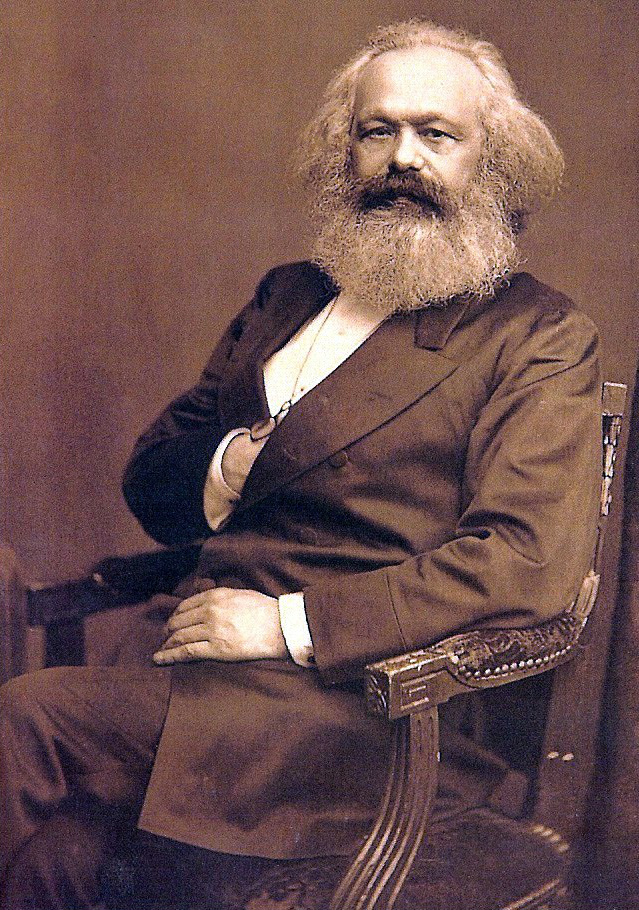
An extreme example of the cultish, paradigmatic and sometimes even sectarian cultivation of the classics, or certain flamboyant figures within this category, could be witnessed in the worshipping of Marx in many academic departments of social science in general and sociology in particular during the 1970’s. Here the excessive worshipping of and subordination to a single unified perspective, which initially appeared as a collective and united endeavour to revive an exorcised thinker, ended in bitter strife, internal fragmentation and a cutthroat mentality between structural Marxists, capital logic, and critical theorists.

 Karl_Marx_001

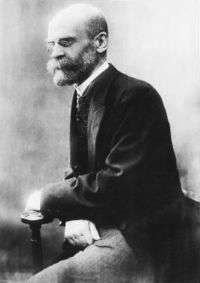
 Talking about the classics in sociology, especially and almost exclusively three names (excluding Simmel in this particular context) are often mentioned as so-called ‘paradigmatic’ figures – Marx, Durkheim and Weber. By paradigmatic is meant, in the words of respectively Kuhn (1970), Ritzer (1975) and Brante (1985) and numerous others, that they, when it comes to theoretical, methodical, analytical, historical as well as social factors such as status, prestige and relative importance, are seen as role models and have set the standards of scientific practice to be emulated by others. This means that they have been instrumental, unwittingly perhaps, in creating certain ‘disciplinary matrices’ or ‘tracks’, for later generations to follow – C. Wright Mills (1960) denoted such tracks ‘models’ serving as fertile foundations for theoretical development within many specific areas. These three central classic tracks have also had a heavy impact on how they have been regarded and evaluated by later generations of scholars; who on the basis of such tracks have been able to identify themselves and the practice of sociology they perform or adhere to.


Emile_Durkheim1


Thus, the status of the classics in sociology, as Lawrence Sherman (1974) reminds us, is bound up with the general paradigmatic view on sociology, one holds – either individually or institutionally. Sherman illustrates three possible ideal type sociological scenarios: (1) That sociologists search for and want to discover universal social laws (Durkheim), (2) that they want to interpret and understand the social world (Weber), and (3) that they want to change it (Marx). These three general views on sociology could be described respectively as a natural scientific progressive position, a hermeneutic humanistic position and a critical revolutionary position. These positions are relatively similar to Jürgen Habermas’ (1971), by now itself classic, description of empirical-analytic science, historical-hermeneutic science and critical science in that they point to how sociology is practised based on abstract ideals and concrete procedures.

 Max_Weber_1894

The first position does not ascribe a lot of status to the classics who are generally seen merely as relics from the past but nevertheless necessary building blocs in the general and relentless advancement of science – as when Newton famously stated that he was standing on the shoulders of giants allowing him to see farther than them. The classics themselves are not regarded as the apotheosis of academic achievements in this position but are viewed as the foundation or platform for a scientific take-off to more sophisticated and refined scientific discoveries ahead.


The second position, on the other hand, often believe that the sociological heritage stands as the heydays of the discipline – as a golden past which it is worthwhile remembering and the results of which we should honour and recall whenever we embark on new endeavours. Here the classical past is believed to contain the seeds from which we can still harvest and which ought to guide our search for questions as well as for answers.


The third and last position is marked by ambivalence regarding the role of the classics and is selective when it comes to ascribing value to the classical past of sociology. Often the classics are seen as reactionary or conservative figures preventing progress or standing in the way of revolutionary changes and only those classics who somehow sought to break free from their own imprisonment in time, such as Marx, and project their ideas into the future are worshipped – perhaps not because of their concrete analyses but due to the potential and potency in their line of thinking. Here Marx’ famous eleventh Feuerbach Thesis – that it is not enough to interpret the world but more important to change it – appears as the programmatic statement of the role of science in general and social science in particular. The evaluation of the classics, then, is bound up with a double bind, as it were; on the one hand the role they have played in the development and maintaining of paradigms, and on the other hand the nature of the paradigm one is working within.


Whereas most sociologists will have to be satisfied with following the principle of publish and perish, the classics, on the other hand, show a remarkable persistence and endurance within the discipline even in times marked by rapid change and academic uprooting. However, despite their persistence through paradigmatic emulation and elevation, classics are far from immortal, as those extraordinary artistic figures, e.g. Goethe, Mozart and Novalis, in Hermann Hesse’s wonderful novel The Steppenwolf, hovering well beyond the quotidian concerns of ordinary humans and surviving the test of time, and they can indeed be ritually and symbolically killed although within sociology that is a seldom occurrence. Such patricide, keeping in mind that all the classics were male, occurs if they are forgotten, by design or default, are gradually or suddenly removed from institutional canons and curricula, are devalued or discredited (for example by political leadership or committees on scientific conduct) or simply found analytically insufficient or unfitting for contemporary concerns.


Understanding and classifying something as classic


Ernan McMullin (1994), quoting Denis Sepper, who in turn was inspired by Hans-Georg Gadamer, differentiates between two broad understandings of the classics for a scientific discipline. The first type is called ‘stylistic-historiographical classics’ which is valued because it gives the reader an insight into the culture of which it is representative. This type of classic represents a particular style, mode of thinking or cultural movement that is based upon specific historical contexts. The other type is termed ‘classics of tradition’ and they, as he notes, “address us where we live; they are fecund even in the contemporary situation.” This latter type appears to be classical not because of some historical contengency but due to universality in its perspective, analyses or understandings. The line between the two types is admittedly, as McMullin contends, blurry and the terminology cumbersome. However, the distinction illustrates that classics are equally part of the lived culture of ordinary people as well as part and parcel of academic endeavours to understand quotidian life as well as abstract principles or modes of organisation.


Is there a more objective way of determining the ‘real’ classics, and differentiate them from mere pseudo or quasi classics? This is, naturally, quite difficult if not utterly impossible to determine. However, one quantifiable way to do it is to ask practising sociologists whom they consider to be the most important contributors of and to their discipline. This was exactly what ISA, The International Sociological Association, did when asking their members in 1998 during the Montreal World Conference to list the most important sociology books of the 20th century. The resulting Top-Ten, in the originally rated order, consisted of Max Weber: Economy and Society, C. Wright Mills: The Sociological Imagination, Robert K. Merton: Social Theory and Social Structure, Max Weber: The Protestant Ethic and the Spirit of Capitalism, Peter L. Berger and Thomas Luckmann: The Social Construction of Reality, Pierre Bourdieu: Distinction: A Social Critique of the Judgment of Taste, Norbert Elias: The Civilising Process, Jürgen Habermas: The Theory of Communicative Action, Talcott Parsons: The Structure of Social Action, and finally Erving Goffman: The Presentation of Self in Everyday Life. The author of eight out of the ten titles listed above is already dead.


Another, equally quantitative, way to find out the importance of the past is looking to the quantitative weight and presence of the classics in the articles and books written within the confines of the discipline. Here a simple content analysis would probably, lacking any concrete data material, reveal that the classics are still very much present and frequently quoted and debated in most of the major journals and maintained in the indexes of most books published if not occupying large proportions of them.


Another concrete way to document the importance of the classics in contemporary sociology would be to inquire about the status and importance of the classics in study programs of sociology courses around the world. Here one would probably discover that the classics still occupy the core position in most curricula whether in the North, South, East or West.


****


Robert W. Connell once asked: why is classical theory actually classical? By classical, we mean something or someone who belongs to another period of time, to a defining or fateful moment in history or to the birth of a discipline. Within the context of sociology, this period of time is the epoch we also label as ‘modernity’ – an era marked by three radical revolutions setting it apart from pre-modernity: (1) An industrial or technical revolution, (2) an intellectual revolution (the Enlightenment), and (3) a political revolution (initially in France and the U.S. but later in more reforming fashion in Germany as well as in the Scandinavian countries and elsewhere). Thus, the sociology classics are often equated with scholars during a certain period ranging from the mid-19th century to the early 20th century.


The classic scholars of sociology all wrote in this tumultuous time and commented, often critically, on it. These scholars took a keen interest in grand theorizing, materializing in their ability to and interest in erecting monolithic theoretical structures dealing with manifold aspects of modernization and its impact on society – seen in an overtly optimistic or equally pessimistic perspective. They often presented a poly-scientific understanding of the main drift of society – based on historical, psychological and social insights – with a combination of broad frameworks as well as detailed studies. These figures are, it is generally agreed, Marx, Durkheim, Weber and Simmel. They have, in and by posterity, achieved or been bestowed the status of classics – they are being read, discussed, dissected, analysed, quoted, imitated and their works are lavishly being published and republished. The classics in sociology are thus, it is generally agreed, equivalent to its founders – although it is often conveniently forgotten that the actual founders of sociology in many cases historically would be the likes of Comte, Saint-Simon and institutionally Albion Small. Today, very few articles or books, if any, within the field of sociology are written, irrespective of the topic, which refrain from lengthy discussions of or introductions and references to these four founders.


How does one, internally, within a discipline, define classicality and project it onto some person, text or tradition? Peter Baehr suggested the following understanding of the complexity involved in bestowing the label ‘classic’ to a text or person and how it can be maintained as such across temporal, cultural and geographical barriers: “In order for a text to achieve the accolade of classic, it must typically overcome a variety of cultural hurdles; while to survive as one, it must be subjected to continual critical engagement, its concepts reformulated to meet new problems and trials. Not many texts can survive, or attract, such scrutiny and productive reshaping. Those that are able to do so are quite properly described as ‘classic.’”


In short, the classics and their original formulations are capable of surviving the transformations of external social conditions as well as the changing internal scientific whims and allegiances. In line with this clarification, Danish political scientist Staffan Zetterholm, referring specifically to the work and oeuvre of Alexis de Tocqueville made the poignant observation that a classic is a person who:

is being studied by new generations, and who participates in a living intellectual tradition within as well as outside of the world of the university. In short, a classic is never out-dated but retains topicality and relevancy for our thinking, our perceptions and our interests. When we study a classic, we do it for our own sake. Within the social sciences – or more generally social thought – classics are found exactly in this understanding (Zetterholm 1988:9)[my translation].


Italian writer and fabulist Italo Calvino is a stout defender and sympathiser of the classical heritage; not as something to be addressed as awe-inspiring authorities or endlessly reproduced but as an emporium for insight, inspiration and imagination. His perspective is more oriented towards the (individual) experience the reader (especially humanities) gets when reading a classic than on the (institutional) role the classics might play for a discipline.


Calvino why read the classics


Calvino stated fourteen easily digestible suggestions for how one can understand what is a classic and the role or function they play for us today. They are recapitulated in toto below:


(1) One can characterise classics as the books about which we usually hear people say ‘I am rereading…’ and never ‘I’m reading…’. Classics, thus, are normally texts that have been processed through our mind previously and with which we are already to some extent familiar.

(2) ‘Classics’ is the appellation reserved for those books that are treasured by those who have read and loved them but those who read them for the very first time will also come to treasure them.

(3) The classics exert a peculiar influence over the lifespan of collectivities or individuals because they remain the same while our perspectives are continually and relentlessly altered allowing or urging us to view them from ever-new angles.

(4) Every rereading of a classic text is as much a virgin experience, a voyage of discovery, as the very first reading.

(5) Every classic is, per definition, a rereading – this is what ultimately earns it the designation as a classic.

(6) A classic is a book that has never finished saying what is has to say – it will continuously confront us as an inexhaustible source of insight into the past, the present as well as the future.

(7) Classics are books that come down to us bearing the traces of readings previous to ours and bringing with them in their wake the traces they themselves have once left on the embankments of the culture or cultures they have passed through.

(8) A classic text does not necessarily teach us anything new – but in it we can sometimes discover something we have always known but without knowing that this classic author said it in the first place or in some intricate or special way is associated with it.

(9) The classics are books which, upon reading them, we find even fresher, more unexpected and more marvellous than we had thought from merely hearing about them. The classics can continuously surprise us whenever we read them ourselves.

(10) We should use and reserve the term ‘classics’ to books that take the form of an equivalent to the universe; they are ‘total books’ that encompass a totality of ideas or notions, which can either be positively stated or presented as criticisms and antitheses to the perspectives offered by others.

(11) Thus, your classic author is someone you cannot feel indifferent towards and who assist you to defining yourself in relation to him/her – in sympathy or opposition.

(12) A classic is a book that comes before other classics; but anyone who has read the others first, and then reads this one, instantly recognises its place in the family tree. An archaeology or genealogy of knowledge is involved in the establishment and appreciation of classicality.

(13) A classic is something/someone that/who tends to regulate the concerns of the moment to the status of background noise, but at the same time this background noise is something we cannot do without – it directs or disrupts our attention even if and when our attention is directed elsewhere.

(14) A classic is something/someone that/who persists as a constant background noise even when the most incompatible momentary concerns are in control of the current situation. The classics permeate the present but in a subtle and mysterious manner.


These fourteen statements about the classics may appear common sense, yet they offer a refreshing examination of how classicality, as individual or intersubjective experience, is established, maintained and transferred. The critical or observant reader might claim that these statements do not capture the entire essence of sociological classicality, and I believe that they are right, but I also believe that these statements are a representative picture of how the classics generally ought to be perceived within the discipline of sociology. They should stand as sources of inspiration, stimulation and, to some extent, also emulation, however not as a blind and uncritical rehashing of past glory and achievements. Calvino simultaneously refrains from reifying or deifying the classics, thereby making them the only authoritative path to truth or scientific status, and thereby he avoids repeating the same mistake sociology made in its eagerness to earn academic accolade and acceptance.


The ‘real’ classics are thus classics because they seem to be spiritually alive, despite perhaps having been physically dead and buried for many decades or even centuries – because the provided concepts, analyses or theories that still seem poignant, precise or potent. Moreover, the classics in sociology are often classical because they were paradigmatic or have appeared to be so in the decades following their demise. It is actually in this particular respect that they distance themselves and appear superior to those thinkers who, although they also went into the annals of the discipline, remained relatively marginal figures in a paradigmatic sense of the term. This fact recently made Norwegian sociologist Rune Åkvik Nilsen denote them the ‘die hard classics’.


Problems with excessive use of classics in sociology


I believe that two of the major functions, either manifest or latent, of the classics in sociology have first and foremost been that they throughout a long period of time have helped legitimise the discipline, and second that their central position somehow has been instrumental in preserving the status quo. The problem in sociology, as I see it, is that the classics have come to occupy a position not as background noise, as Calvino recommended, but as a resounding choir of authoritative voices hindering and hampering scientific progression and innovation. Without wishing to sound excessively dramatic, sociologists are, in short, caught up in the classics and need to ask, as global society, economy and democracy are in a churn and in the throes of multiple recessions and warfare, where do we go from here?


We therefore need to be aware of what might seem to be certain problems relating to a heavy classical inclination in sociology. Anthony Giddens (1972), himself the archetypal ‘neo-classic’ sociologist, years ago called attention to what he believed the discipline regarded as four major myths of classical sociology – coherence or social order as the core concern, conservatism, a separation from the pre-scientific past and consensus-orientation – apparently standing in the way of sociological progress. Whether these myths are real or mere fallacies based on a misunderstanding of the classics, the sociological reliance on and repetition of the classics may prove to pose as a problem and an obstacle to progression and as a source of stagnation.


Peter Baehr, who provided us with a definition of ‘classicality’, also observed in Founders, Classics and Canons: “A classical legacy can both be a source of inspiration for an epoch or a crushing and stagnating burden on it […] It can both exclude potentially valuable ideas and prove capable of embracing them. It can both be a source of mindless regurgitation and of bracing intellectual challenge.” It is, in short, the sociologists’ application of the classics that imbues them with scientific or social utility, importance and value and therefore also the responsibility of sociologists to handle the classics sensibly. Left to themselves, as Collins finds, the classics are nothing but great ideas on blank sheets of paper, the mindless reproduction of which only serves to imprison the minds of students and teachers alike and stagnate intellectual innovation.


Stagnation, however, is not the only problem posed by very rigid definitions and utilisations of the classics. Selectivity, understood as inclusion and exclusion, is another pitfall dealing with who is promoted to intellectual immortality and who is relegated to immediate oblivion. Why do we read, for example, Marx, Weber, Durkheim and Simmel, but not Condorcet, Comte, Saint Simon, Spencer, de Tocqueville, Mosca, Pareto, Tarde, Michels, Lippmann, Sorokin, etc.? Why have some previous household names altogether disappeared – such as, for example, Sombart, while others have remained part of the cult of the classics? Why has exactly this trinity of thinkers, Marx, Durkheim and Weber, obtained and maintained such a prominent position within sociology on behalf of equally brilliant analysts of their contemporary societies? What has happened to the so-called socio-philosophical ‘forerunners’ of modern institutionalised sociology such as Münster, Sansovino, Bodin, Conring, Graunt, Neuman, Petty, Süssmilch, etc., who according to some chroniclers had such a heavy impact on the foundation of the discipline as far back as the 16th and 17th centuries but who today appear so unfamiliar to most of us? These important names appear to be missing from most sociological curricula today and may have been victims of what Giddens described as a desire to distance sociology from its supposedly pre-scientific origins. It goes to show how our perception of the sociological past is, indeed, based on selective perception and that such selectivity, inclusion and exclusion is mirrored in the canons and curricula we choose for the next generations of sociologists. As James Dowd remarked:


A graduate training program constitutes a type of canon. It specifies, although not always explicitly, an authoritative, approved list of courses, authors, works, and ideas […] The canon of sociology includes a set of texts written by the sociologists of the classical period, a set of procedures for conducting the research and for analyzing the data that it produces, and a set of ideas (that is concepts, generalizations, and theories) generated by empirical research […] Even given the large number of subfields within sociology, a common set of texts and procedures is acknowledged throughout the field. The ideas that are singled out for inclusion in the canon do, however, vary across subfields as well as over time (Dowd 1991:317 in Baehr & O’Brien 1994:111).


Intellectual stagnation and selective memory are thus some of the problems related to the mindless devotion to the cult of the classics in sociology.


BOOKS


Can we kill the classics – OR – Do classics perpetuate themselves?


Sociology is by its very nature a hybrid discipline, borrowing equally from the natural sciences and the humanities. From the former it finds the tendency for devaluation of the classics; from the latter it finds the tendency to worship the classics and the preoccupation with dissecting the past in its own right. Sociology is caught in the middle, which means that it is not exempt from the habit of either embracing or running away from its own past. This double-edged mentality is still present within the discipline and results in the fact that the classical past stands in an increasingly precarious or ambivalent situation which is furthermore enhanced by recent radical changes within the university systems, as mentioned above.


As some sort of conclusion on this commentary, an initial question in the article – can we kill the classics? – ought perhaps in retrospect to have been normatively rephrased as: Should we kill the classics?


My personal answer is in the negative. The reasons why the classics ought to be kept alive in the years ahead need to be clarified and critically discussed collectively among practicing sociologists. Some will claim that the classics need to be read and discussed because they can guide contemporary social action. This, I believe, is to demand too much of ideas and theories of the past. The functionality of the classics can no longer solely rely on their external power of explanation of the present situation, which is different from even the most visionary expectations of the founders. Therefore they will have to legitimise themselves internally and sui generis, as it were, and Italo Calvino also concluded his argument about the role and function of the classics by stating that the “classics ought to be read because they ‘serve any purpose’ whatever. The only reason one can possibly adduce is that to read the classics is better than not to read the classics.”


Charles Tilly noted that “the nineteenth century’s legacy to twentieth century social scientists resembles an old house inherited from a rich aunt: worn, over-decorated, cluttered, but probably salvageable.” Has this characterisation changed since the transition from the nineteenth to the twentieth century not to mention the recent transition from the twentieth to the twenty-first century? Tilly’s description could easily be recycled to describe also the present situation in sociology. The classics and their concepts still clutter the house of sociology – which is, indeed, salvageable but in desperate need of refurbishment. Norwegian sociologist Dag Østerberg, who for almost a lifetime has taken a keen interest in the classics, also recently discussed whether the classical concepts, formulated in large part in the 19th and early 20th century, are still analytically valid and still worthwhile utilising for sociologists when studying the rapidly changing social world of the 21st century. According to Østerberg, we will always have the key classical concepts of industrialism, capitalism, stratification, rationalisation, differentiation, power, community, etc. to fall back upon when the fluctuating success of fads and fashions is revealed and their analytical value or novelty wears off.


We must be careful not to forget our founders; but we must also beware not to sanctify or deify them or allow their ideas to monopolise our visions, as Danish sociologist Dominique Bouchet poignantly and recently stated: “Nothing is more dangerous than one idea, when you only have one, and nothing is more dangerous than a guru, when you similarly only have one. It is wondering, the many ideas, the many masters, the many critical perspectives that society and the sociological imagination feed on.” This not only pertains to trained scholars but equally to those being processed through the educational system and therefore we ought not to teach our students the marvels of a myopic mentality when it comes to classics. Pluralism is the best possible starting point for any education and here there should be institutional as well as individual interest in showing the broad spectrum of sociological insights offered by the classics instead of narrowing it down to one’s own favourites or heroes. It is our democratic duty to do so and the classics, collectively instead of individually, can widen our perspectives and open our eyes. As Lawrence Sherman rightly contended, “if the ascendancy of one or the other of the paradigms makes a difference in how sociology develops, or how it shapes social policy, then graduate students are morally obliged […] to give each paradigm a fair hearing. To know fully what I am doing, I need to know what I am not doing; in other words, I must know the opportunity costs. And for that, I must read the masters.”


Goethe once stated that ‘what you have inherited from your fathers, you must earn in order to possess’. The classics are an illustrative example of this insightful expression – that one must actively but also respectfully commemorate the past in order to acquire and claim the benefits and fruits associated with classical thinking. Merton, for example, summarised how the classics remain powerful presences even within contemporary thought:


Acquaintance and re-acquaintance with the classics have a variety of functions. These range from the direct pleasure of coming upon an aesthetically pleasing and more cogent version of one’s own ideas, through the satisfaction of independent confirmation of these ideas by a powerful mind, and the educative function of developing high standards of taste for sociological work to the interactive effect of developing new ideas by turning to older writings within the context of contemporary knowledge […] For that reason, sociologists in our time must continue to behave unlike their contemporaries in the physical and life sciences and devote more of themselves to close familiarity with their not-so-distant classical predecessors (Merton 1968).


Classics are indeed what Italian historian Gaetano Salvemini once termed libri fecondatori – books that are full to the brim of fertile thinking and fecundity for those who read them and whose own work is inspired by them. What I would describe as the ‘fecundity function’ of the classics cannot be neglected and it is perhaps in this somewhat informal capacity that the chances of survival, but also of a continued although latent and unobtrusive presence, for the classics is strongest and it will be here they will eventually have to find their own natural level in sociology.


Looking back at the by now long history of sociology, it makes some sense to seek to distinguish between ‘classics’, those original founders of the discipline who stand out as if marked in granite in contemporary canons and curricula, the ‘intermediary classics’, who elaborated on, transmitted, modified or criticised the classics, and the ‘neo-classics’, the latter being those grand names – Luhmann, Habermas, Giddens, Bourdieu, Bauman, Beck etc. – still alive or only recently demised and actively present in contemporary scholarly debates and developments. Neo-classics will, naturally and eventually, in time, turn out to be intermediary classics and later perhaps even become real or genuine classics when time takes its toll and their contributions are looked upon in historical hindsight. Such a threefold division and clarification of the concept of the classics also suggests that there is some sense of continuity between the different generations within sociology. Even some of those influential scholars, who themselves have now obtained the status of classic or at least intermediary classic, as Talcott Parsons (1981) provides a good example, have themselves been inspired by earlier generations of classics and been instrumental in commenting as well as building on the real classics. There is inherently, as a consequence, some circularity, but also repetition and reproduction, in the concept of the classics. This may lead to some problems primarily for scientific progress and secondarily for sociological integration – both problems can prove detrimental to scientific development and coherence.


It also seems as if the 21st century is seeing a revival of the concern with the roots, founders and classics of the discipline but also the beginning of a fragmentation where some regions, paradigms or institutional settings promote their own specific classics while other regions steadfastly support theirs. For instance, books by Alexander, Boudon and Cherkaoui illustrate the cultural or geographical contingency of the classics in that one of the volumes is exclusively devoted to American classics and the other entirely to their European counterparts in sociology. What is considered classical in the U.S. is not any longer necessarily and automatically also seen as the ‘real’ classics in Europe, what has been regarded as classics in the West may not necessarily be seen as the classics in the East, what the North defends as the central canon, the South may regard merely as ponderings at the periphery of a discipline, etc. The classics are apparently represented as classics differently according to time and space. The result is an even bigger expansion in the literature on the classics where each regional, epochal or institutional sector promotes its own canons, founders and classics. So despite the fact that the status and centrality of the classics remain as consolidated as previously, the commonness of our disciplinary heritage may be endangered in the years to come due to academic disputes over who is a classic and who is not, who is part of the canon and who is not, who should be honoured and revered as a substantial founder of the discipline of sociology and who was merely playing a subordinate or insignificant part.


scaffoldingThe classics can serve as scaffolds that can buttress sociological heritage and history but, as Erving Goffman noted, scaffolds are supposed to be dismantled once the real building has been erected. As scaffolds, the classics can assist contemporary sociologists in identifying past pedigree and can serve as a common point of reference but they cannot and should not dictate current research agendas.
 

The thin line between utilising and sanctifying the classics is indeed delicate and one must be careful not to cross it. The use of the classics must never merely be reproduction or exegesis without anchorage in contemporary concerns. The result of such fanatic reproduction may well turn out to be sociological stagnation where scientific progress, discoveries and advancements are hindered by a preoccupation with the past instead of an open orientation towards the present and the future, where a desire to legitimise previous authoritative achievements stand in the way of discovering or inventing something new.


Another danger is if the sociological imagination only turns into a repetition of past achievements. As Danish sociologist Klaus Rasborg pointed out, today we need a renewed sociological imagination based on late modern realities instead of relying on a sociological imagination that belonged to the erstwhile modern age where nation-state, the class society, industrial production, tradition-bound kinship relations and so on were the signs of the times. Although remnants of these features may still be with us, modernity has gradually but also thoroughly and relentless been transformed on almost all levels of social reality – the macro, intermediary and micro – and the interests of sociologists need to mirror these changes, document, record and analyse them. A sociological imagination worthy of its name and useful to generation after generation of students and scholars never sleeps but is continuously kept abreast by the changes in society. If one is not awake and watchful the ship of sociology can sink much like the Titanic. Therefore, the classics can be used as a navigational guide, like the stars or the compass, but a dead sociologist cannot be made the captain of the sociological ship.


*****


© Michael Jacobsen, 2015 (with inputs from The Essayist team)


For a list of the books and authors voted important of the 20th century in sociology differentiated according to the voters’ gender and age, see http://www.ucm.es/info/isa/books.

Image of 3 classic together from http://rafasociologia.blogspot.in/2011_10_01_archive.html


Readings and References

  • Alexander, Jeffrey C. (1987): “The Centrality of the Classics”, in Giddens, Anthony & Jona-than H. Turner (eds.): Social Theory Today. Stanford, CA: Stanford University Press.
  • Alexander, Jeffrey C.; Boudon, Raymond & Mohamed Cherkaoui (eds.)(1997a): The Classi-cal Tradition in Sociology: The American Tradition. London: Sage Publications.
  • Alexander, Jeffrey C.; Boudon, Raymond & Mohamed Cherkaoui (eds.)(1997b): The Classi-cal Tradition in Sociology: The European Tradition. London: Sage Publications.
  • Baehr, Peter (2003): Founders, Classics, Canons: Modern Disputes over the Origins and Ap-praisal of Sociology’s Heritage. New York: Transaction Books.
  • Baehr, Peter & Mike O’Brien (1994): “Founders, Classics and the Concept of a Canon”. Cur-rent Sociology, 42 (1):1-148.
  • Bauman, Zygmunt (1992): Intimations of Postmodernity. London: Routledge.
  • Bauman, Zygmunt (2002): Society Under Siege. Cambridge: Polity Press.
  • Berger, Bennett M. (1957): “Sociology and the Intellectual: An Analysis of a Stereotype”. Antioch Review, 17:275-290.
  • Bloom, Allan (1988): The Closing of the American Mind. New York: Simon & Schuster.
  • Bloom, Allan (1994): The Western Canon: The Books and Schools of the Ages. New York: Harcourt Brace.
  • Bottomore, Tom B. (1960): “The Ideas of the Founding Fathers”. Archives européennes de sociologie, 1 (1):33-49.
  • Bouchet, Dominique (2003): “Sociologi og marketing: Hvorfor skal sociologien interessere sig for marketing og for dens økonomiske grundlag?”, in Jacobsen, Michael H. (ed.): Sociologiske visioner – sytten bidrag fra en sociologisk brydningstid. Århus: Systime Academic.
  • Brante, Thomas (1985): “Paradigmteorin och samhällsvetenskaperna”. Häften för Kritiska Studier, 18 (3):6-28.
  • Calhoun, Craig (1996a): “Whose Classics? Which Readings? Interpretation and Cultural Dif-ference in the Canonization of Sociological Theory”, in Turner, Stephen P. (ed.): Social Theory and Sociology: The Classics and Beyond. Cambridge, MA: Blackwell.
  • Calhoun, Craig (1996b): “Editor’s Comment”. Sociological Theory, 14 (1):1-2.
  • Calvino, Italo (1986): “Why Read the Classics?”, in The Uses of Literature. New York: Har-vest Books.
  • Camic, Charles (ed.)(1997): Reclaiming the Sociological Classics: The State of the Scholarship. Oxford: Blackwell.
  • Carleheden, Mikael & Michael H. Jacobsen (eds.)(2001): The Transformation of Modernity – Aspects of the Past, Present and Future of an Era. Aldershot: Ashgate Publishers.
  • Chafetz, Janet S. (1993): “Sociological Theory: A Case of Multiple Personality Disorder”. American Sociologist, 24 (2):60-62.
  • Collins, Randall (1992): “On the Sociology of Intellectual Stagnation: The Late Twentieth Century in Perspective”. Theory, Culture & Society, 9 (1):73-96.
  • Connell, Robert W. (1997): “Why is Classical Theory Classical?”. American Journal of Sociol-ogy, 102 (6):1511-1557.
  • Coser, Lewis A. (1981): “The Uses of Classical Sociological Theory”, in Rhea, Buford (ed.): The Future of the Sociological Classics. London: Allen & Unwin.
  • Dowd, James (1991): “Revising the Canon: Graduate Training in the Two Sociologies”. Teaching Sociology, 19 (3):319-335.
  • Elmer, M. C. (1931): “Forerunners of Modern Sociology”. Journal of Educational Sociology, 4 (5):279-286.
  • Giddens, Anthony (1972): “Four Myths in the History of Social Thought”. Economy and So-ciety, 1:357-385.
  • Giddens, Anthony (1987): “Nine Theses of Social Theory”, in Social Theory and Modern So-ciology. Cambridge: Polity Press.
  • Gillispie, Charles C. (1960): The Edge of Objectivity: An Essay in the History of Scientific Ide-as. Princeton: Princeton University Press.
  • Gjertsen, Derek (1984): The Classics of Science: A Study of Twelve Enduring Scientific Works. New York: Lilian Barber Press.
  • Goffman, Erving (1959): The Presentation of Self in Everyday Life. New York: The Overlook Press.
  • Goldthorpe, John H. (1969): “Introduction”, in Raison, Timothy (ed.): The Founding Fathers of Social Science. Harmondsworth: Penguin Books.
  • Grundmann, Reiner & Nico Stehr (2001): “Why Is Werner Sombart Not Part of the Core of Classical Sociology? – From Fame to (Near) Oblivion”. Journal of Classical Sociology, 1 (2):257-287.
  • Habermas, Jürgen (1971): Knowledge and Human Interests. Boston: Beacon Press.
  • Horowitz, Irving L. (1995): The Decomposition of Sociology. New York: Oxford University Press.
  • Jacobsen, Michael H.; Carleheden, Mikael & Søren Kristiansen (eds.)(2001): Tradition og fornyelse – en problemorienteret teorihistorie for sociologien. Aalborg: Aalborg Universi-tetsforlag.
  • Jacobsen, Michael H. (1999): “The Search for Sociological Truth: A History of the Rise and Fall of the Reign of Positivism in the Social Sciences”. Sociologisk Arbejdspapir, 1 (1):1-70.
  • Jacobsen, Michael H. (2002): “Social science fiction: ‘Opfindelse’ overfor ‘opdagelse’ og ‘retfærdiggørelse’”, in Jacobsen, Michael H.; Kristiansen, Søren & Annick Prieur (red.): Liv, fortælling, tekst – Strejftog i kvalitativ sociologi. Aalborg: Aalborg Universitetsforlag.
  • Jacobsen, Michael H. (2003a): “Sociologiske visioner og visionær sociologi”, in Jacobsen, Michael H. (ed.): Sociologiske visioner – sytten bidrag fra en sociologisk brydningstid. Århus: Systime Academic.
  • Jacobsen, Michael H. (2003b): “Fremtidens sociologi: Fra sociologisk fundamentalisme og fanatisme til sociologisk fantasi”, in Jacobsen, Michael H. (ed.): Sociologiske visioner – sytten bidrag fra en sociologisk brydningstid. Århus: Systime Academic.
  • Jacobsen, Michael H. (2004): “Den sociologiske selvforståelse – om videnskabelige roller og selvidentitet i sociologien”, in Aagaard, Lars; Lystbæk Christian & Steen Brock (eds.): Videnskabsopfattelser. Århus: Philosophia [forthcoming].
  • Jones, Robert Alun (1977): “On Understanding a Sociological Classic”. American Journal of Sociology, 83 (2):279-319.
  • Journal of Classical Sociology (2001): “Editorial Introduction – The Fragmentation of Sociol-ogy”. Journal of Classical Sociology, 1 (1):5-12.
  • Keynes, John Maynard (1936): The General Theory of Employment, Interest and Money. London: Macmillan.
  • Korpi, Walter (1990): “Om undran inför sociologerna”. Sociologisk Forskning, 3:2-10.
  • Kuhn, Thomas S. (1970): The Structure of Scientific Revolutions, 2nd edition. Chicago: Uni-versity of Chicago Press.
  • Levine, Donald N. (1995): Visions of the Sociological Tradition. Chicago: University of Chi-cago Press.
  • Luhmann, Niklas (1995): Social Systems. Stanford, CA: Stanford University Press.
  • Machlup, Fritz (1956): “The Inferiority Complex of the Social Sciences”, in Sennholz, Mary (ed.): On Freedom and Free Enterprise – Essays in Honour of Ludwig von Mises. Am-sterdam: Van Nordstrand.
  • Machlup, Fritz (1963): “Are the Social Sciences Really Inferior?”, in Natanson, Maurice (ed.): Philosophy of the Social Sciences. New York: Random House.
  • McDonald, Lynn (1997): “Classical Social Theory with the Women Founders Included”, in Camic, Charles (ed.): Reclaiming the Sociological Classics: The State of the Scholarship. Oxford: Blackwell.
  • McLennan, Gregor (2003): “Sociology’s Complexity”. Sociology, 37 (3):547-564.
  • McMullin, Ernan (1994): “Scientific Classics and Their Fates”. PSA: Proceedings of the Bien-nial Meeting of the Philosophy of Science Association, 2:266-274.
  • Merton, Robert K. (1968): “History and Systematics of Social Theory”, in Social Theory and Social Structure. New York: Free Press.
  • Mills, Charles Wright (1960): Images of Man: The Classic Tradition in Sociological Thinking. New York: George Braziller Inc.
  • Nilsen, Rune Åkvik (2003): “De seiglivede klassikerne”. Sosiologisk Årbok, 1:27-56.
  • Nisbet, Robert (1970/1993): The Sociological Tradition. New York: Transaction Publishers.
  • Parsons, Talcott (1981): “Revisiting the Classics Throughout a Long Career”, in Rhea, Buford (ed.): The Future of the Sociological Classics. London: Allen & Unwin.
  • Poggi, Gianfranco (1996): “Lego Quia Inutile: An Alternative Justification for the Classics”, in Turner, Stephen P. (ed.): Social Theory and Sociology: The Classics and Beyond. Cam-bridge, MA: Blackwell.
  • Raison, Timothy (ed.)(1969): The Founding Fathers of Social Science. Harmondsworth: Penguin Books.
  • Rasborg, Klaus (2003): “Sociologien som samtidsdiagnose”, in Jacobsen, Michael H. (ed.): Sociologiske visioner – sytten bidrag fra en sociologisk brydningstid. Århus: Systime Ac-ademic.
  • Rhea, Buford (ed.)(1981): The Future of the Sociological Classics. London: Allen & Unwin.
  • Ritzer, George (1975): Sociology: A Multiple Paradigm Science. Boston: Allyn and Bacon.
  • Roth, Guenther (1992): “Interpreting and Translating Max Weber”. International Sociology, 7 (4):449-459.
  • Sherman, Lawrence W. (1974): “Uses of the Masters”. American Sociologist, 9 (4):176-181.
  • Skinner, Quentin (1995): The Return of Grand Theory in the Human Sciences. Cambridge: Cambridge University Press.
  • Snow, Charles P. (1974): The Two Cultures. Cambridge: Cambridge University Press.
  • Stinchcombe, Arthur L. (1982): “Should Sociologists Forget Their Mothers and Fathers”. American Sociologist, 17 (1):2-11.
  • Tilly, Charles (1984): Big Structures, Large Processes, Huge Comparisons. New York: Russell Sage Foundation.
  • Tucker, Kenneth H., Jr. (2002): Classical Social Theory: A Contemporary Approach. Oxford: Blackwell.
  • Turner, Stephen P. (ed.)(1996): Social Theory and Sociology: The Classics and Beyond. Cam-bridge, MA: Blackwell.
  • Weber, Max (1946): “Science as a Vocation”, in Gerth, Hans H. & Charles Wright Mills (eds.): From Max Weber: Essays in Sociology. New York: Oxford University Press.
  • Zetterholm, Staffan (ed.)(1988): Alexis de Tocqueville – seks samtaler med en klassiker. Copenhagen: Nyt fra Samfundsvidenskaberne.
  • Østerberg, Dag (2003): “Sosiologiens nøkkelbegreper – gjelder de stadig i dagens samfunn?”. Sosiologisk Årbok, 1:1-26.

Bike Shorts and Loose Crank Arms: A Cyclical love affair with a bike (The Essay)

“Lovin” up on my Bike

This is a story of how I ended my relationship with the automobile and revisited my love affair with a bicycle. Although I have ridden bicycles for their pure utilitarian application — in college, and when I lived in various resort towns — my primary obsession with the bicycle was formed through recreation and competition. Admittedly, I thought that this was a shallow relationship, but over the years it started to show signs of depth. And now that we’re both a bit older, our relationship has grown into something more authentic.


you cant buy happiness bike


The Great Big Bike Lane
When I decided to challenge America’s automobile obsession I was living in the center of America’s quintessential motor metropolis, Los Angeles (L.A.), California. A metropolitan area of over ten million, L.A. is statistically the worst city in the United States for gridlock and among the ten worst places for automobile traffic on the globe. Depending on which report you read, commuters experience between 64 and 100 hours of traffic delays annually.


Although I only drove a steel coffin (automobile) briefly, I had horrendous experiences with daily traffic. Most of my travels were in the Valley (San Bernardino Valley) traveling from Essayist July 2015Glendale to Altadena, Burbank, Eagle Rock, Silver Lake and Hollywood but immediately I was perplexed to as how long it took to travel a few miles. Interesting enough when traffic was backed up, I often made better times on my bicycle. Therefore, I reasoned if I surrender my car, traveling by bike wouldn’t be all that problematic.
 

I called the American Fargo Union (Bank) and asked at which branch do I drop the car off? They placed me on hold; and twenty minutes later a customer service manager explained it didn’t work like that. I had to continue to hold on to the car until I had defaulted on my loan. It wasn’t until after I default that they would send an “agent” to retrieve (repossess) the car.


Two months later, around 3:30 am on a Monday morning I heard a wrecking truck in the alley behind my Burbank flat. This didn’t alarm me since I had already told them where they would find the vehicle. I was expecting them earlier, but nevertheless I was glad they showed. The young dudes, who had come to repossess my car, looked a little rough around the edges, and when I came out into the alley to take a final look at my car, I startled them with my presence. The one who was verifying the VIN# dropped his flashlight. I walked around the steel coffin once; I signed some paperwork; and the car disappeared into the opaque night.


I had surrendered my car to the repo man, and the strangeness about this action is that I immediately felt liberated from the burden I had been living with. Since my career imploded and my finances went south, the once modest utilitarian vehicle morphed into an unnecessary consumer fetish. The end was near and I knew it. To try to hold on to the car would have been absurd. The car had to go just as quickly as my income did a few months prior. What’s more, except for trips to the grocery store I was rarely using it.


Bike Nerd

The bank and repo man gave me exactly the nudge that I needed. And even though, I’ve been a bicycle nerd for approximately forty years, this turned out to be a different undertaking entirely; I’ve entered a completely new genre of bike-riders. I ride slower much of the time, I no longer wear Spandex and my bicycle is much heavier. I’ve now become one of those old dudes that I use to speed by on my lightweight race bikes when I was a kid. Their bikes where usually outfitted with racks, panniers, leather Brooks saddles and they were spinning out on high touring gears. Some wore business suits but most often they wore cumbersome first generation Bell helmets and bright orange safety vests. Although English hand-made saddles have become fashionable again, the commuter aesthetic has fortunately changed immensely since the 1970’s.
While I do believe that bicycles are one solution to our many transportation problems, I am not advocating for everyone to ditch their automobiles (although I still argue “cars are coffins”). In some places and instances automobiles may be useful. However, I do believe that there are some places in the United States and around the globe that petroleum powered automobiles are likely to become relics of the past. In casual observations, it also seems that young people in particular are abandoning the automobile even in cities like Los Angeles.

 Ghost Rider 2014

Ghost Bikes and Aggressive Motorists

While my original intent was to ride in Los Angeles for a year, I wasn’t certain that I would survive the project. I was riding in excess of 200 miles a week and each day I would have multiple incidents where a vehicle would nearly collide with me. Although L.A. has a strong initiative to create more bike lanes and host a very successful Bike to Work Week, there is huge resistance to a bike friendly infrastructure.


Los Angelina’s love their automobiles and many are unwilling to give up any portion of public roads for bikes. Several cyclists claim there has been a reactionary response to increased bike lanes and bikes are viewed as an element contributing to worst traffic. I too have had cars swerve into me in the bike lanes and speed up on my rear as I try to make a left hand turn, but the most common thing that motorist do is squeeze you out of the lane.


One of the times this happened, was while I was sharing a pace line with another rider.  An aggressive driver nearly hit the other rider and it nearly turned into a physical altercation.  The driver scurried out of his car and the cyclist was off his bike. Seeing the twitch in the driver’s eye, I immediately yelled THINK! The consequences would have been high and the older driver was clearly outmatched. A violent confrontation wouldn’t benefit anyone.


Unfortunately many motorists don’t realize their multi-ton vehicles can be catastrophic for any rider. Yet over the years I have been in situations where people have used their cars as weapons. Once I was run into a ditch off the road when a car gave me a “right hook” (the act of taking away a cyclist’s right away when making a right hand turn). I’ve been hit three times by cars over the years and had a gun drawn on me in one incident. Once I survived relatively unscathed, but twice I had to visit the emergency room. Motorists of this type either want to disconcert riders or they literally want to cause bodily injury.


ghost bike photo1In addition to having near misses everyday, I was reminded of those dangers by seeing Ghost Bikes on my daily routes. Ghost Bikes are bicycles along the road painted white, usually locked to a street post and a little plague is installed with information of the fallen cyclist. Ghost Bikes initially started in St. Louis, Missouri and in 2012 there were reportedly over 630 Ghost bikes around the globe. Since 2012 accurate data hasn’t been taken.

I’ve seen Ghost Bikes in several major cities, but I didn’t pay much attention to them until I
saw them in high frequency in Southern California. I’ve seen ghost bikes in other cities, but the sight of so many on my daily rides, had a chilling effect.


In 2014 the Los Angeles Times reported on a recent study by the Governor’s Highway Association. According to the article, “If you are going to be killed by a car while riding a bicycle, there’s a good chance you are male, older than 20 and living in California or Florida.” Between 2010-2014, 338 cyclists in California and 329 cyclists in Florida were killed by motor vehicles. During that time bicycle-motor related deaths have increased by 16%.


Bike Trains

I have seen some creative ways to solve safety issues, bike trains are one of them. LA Bike bike train guradiantrains currently have ten routes and make commuting a little safer. Bike trains are a method of occupying a lane in the road with the collective power of multiple riders. It is like having collective bargaining power on the road. They form in residential neighborhoods and riders join each other for their morning commute and back. As they reach their destination they peal off, just like a train stop. They coordinate with other commuters to take the same route, same time and actually have lead ”train conductors”. . In a large group motorist tend to “behave”, but certainly this doesn’t solve the problem of the inpatient motorist.

 

 Critical Mass Cycling

critical mass cycling 2Critical Mass rides are environmental and bicycle activist that celebrate access to roads and streets with the concept of safety in numbers. It is a strategy for public awareness that bicycles are on the road and for some, a voice of dissent, often causing traffic jams and having motorist yield to the cyclists, requiring detours. Starting in Stockholm, Sweden in the 1970’s there are now 300 cities worldwide hosting Critical Mass rides. Typically they are held on the first Friday of the month during evening rush hour traffic. Probably the most notorious critical mass was in New York City during the 2004 Republican National Convention. I was a part of this spectacle and witnessed several random cyclists get beaten and arrested. There were over 260 arrests and New York City had to pay out nearly a million dollars in a civil lawsuit.


Enchanted Something or Another

It is now early summer and I’m back in New Mexico.  I’m taking refuge underneath a large dennis 2juniper tree; it is going to be a long summer. The mid-day desert sun reminds me how light-colored my skin is, unlike the Navajo or those of Conquistador ancestry. I’m riding back to Santa Fe from Eldorado on a railroad grade trail. This was my daily commute for several months and today I’m just riding from a routine medical appointment.  I was admiring the expansive panoramic view, wild flowers, bright cobalt sky when I heard a clunk! My left crank arm and pedal fell off. I stopped and opened my daypack only to discover that my multi-tool kit was at home because that morning I had switched bags and failed to put the tool-kit back. With no Allen tool I was forced to ride the remaining five miles with one crank and pedal. At first I cursed myself, just the thought of having to do this seemed formidable; but then it occurred to me that I have done this before. Why worry now?


The Affair Continues

It didn’t matter that my pedal fell off because I was with my bike. After all these years together my bike never disappoints. My affair with the bicycle has been going on for more than four decades and the positive memories abound, with just me and my bike taking on various challenges: forty-mile commutes, twenty-four hour races, blizzards, desert heat, epic rides on the backbone of the Rocky Mountains. When I feel the endorphins, everything is placid in my world.


And I still remember vividly when I was a boy and my father took the training wheels off my first bicycle. On my first-ever real bicycle ride, I rode right into my neighbors freshly painted garage door. I fell down, hurt myself. However, the thrill of riding a bike motivated me to do it again. That door could not stop me. Little did I know that one day this would become a metaphor for my life; and despite the odds, I would do it again and again and again. This would become My Cycle.


dennis 3


© Dennis Dodson, 2015


References for Images

Bike Train image from

http://www.theguardian.com/environment/bike-blog/2011/jun/10/brighton-bike-train who attribute Photograph to: www.biketrain.org


Critical Mass Cycling

http://vorg.ca/3046-Vancouver-Critical-Mass-Bike-Ride

https://en.wikipedia.org/wiki/Critical_Mass_(cycling)


For the day after tomorrow: Can the curious human brain take on technology?

TODAY


Today, we don’t have to remember anything!

Miraculous storage devices provide constant reference and retrieval.


Today we don’t have to depend on anyone for answers.

The world of search engines helps us traverse across information boundaries and beyond.


Today, we don’t have to meet people to have fun.

The world of social media sites provide the awesome delight of knowing one another better and even getting to know those (ahem) strangers.


Today we don’t go out to greet the sun in the morning.

Insta-picture options project its ethereal radiance right into our rooms through numerous screen captures.


Digital avatars enliven our world today. From fancy bots to cryptic dots, the tech world gives us more than the due share of wow moments.


The learning experience today is indeed uber-cool.

Lives have become simpler and smarter and splendid!!!

Or have they?

 shraddha1


A world of curiosity


The labyrinth of information and everything new that permeates today’s digitalized world reminds one of the classic metacognitive adventure, reversed alice inb wonderland cover 1898‘Alice in Wonderland,’ written by Charles Lutwidge Dodgson, an Oxford mathematician, under the pen name Lewis Carroll. Published by Macmillan 150 years ago in the first week of July 1865 and beautifully illustrated by Sir John Tenniel, the book Alice’s Adventures in Wonderland sold 160,000 copies, and it is rumored that the sale provided Dodgson (Carroll) with a comfortable living that he asked his college to reduce his salary. The debate is still on-going whether this tale that took a young girl to destinations hitherto unexplored is just an imaginative children’s storybook or a philosophical treatise on logic. However, that magic spell of the wondrous journey of Alice into a new world was actually the unraveling of many learning experiences. It was the demonstration of an inexplicable, young curious mind that ignites the search for a mysterious alternate existence and leads to adventures of fantastical precedence. Alice’s fall into the rabbit hole was the response of a young, impressionable brain to the fascinating stimuli of the external environment; the rise of the higher order functions of the brain that led to the enquiry, exploration and discovery of the inexplicable.


What happened in 1865 as exemplified by Carol’s stupendous articulation is indeed a living reality today. The adventures of the era we thrive in are an illustration of ‘the rabbit hole’ times;  where we are completely disheveled by the swarm of information surrounding us, absolutely engaged with the stuff of things on the internet, and totally enamored with technology intrusions. Interesting to further read in this regard, is the explanation of ‘Online Rabbit Holes’ by Kathryn Schulz in The New Yorker, where she beautifully explains its variable forms.


alice combined images national geographic


The human brain and the learning quest

‘The Secret of Millions of Minds that Stay Forever Young’ by Dragos Bratasanu, published in The Huffington Post, brings out the important element of ‘learning’ as the ‘one’ quality that gives a distinctive edge to human beings. As Dragos points out, ‘The greatest minds in human history understood the importance of learning to accelerate creativity, self-expansion and personal growth.’ It is the learning quest of the brain, its desire to explore the unknown and satiate one’s pursuit that makes human existence so unique. It is this urge for discovery that has led to voyages into ethereal spaces and inventions of unimaginable stature.


It is this ‘love for finding out’ that gives human beings a unique character making Homo sapiens, the most evolved living species. This distinction of superiority is majorly because of the human brain which is an intriguing marvel of 100 billion neurons and 100 trillion synapses.  It is difficult to fathom the tremendous communication potential and neuroplasticity of the brain that makes it adapt to new situations. But it is interesting to explore how the brain deals with ‘curiosity’.


In The Washington Post, Emma Saville points out three critical research findings on the response of the brain to curiosity. ‘First, when people are curious to learn the answer to a question they are better at learning that information – not only in the very short term but also after a 24-hour delay. There is also a greater recall of completely unrelated information made known at the same time. Secondly, when curiosity is stimulated, the research found that there is increased activity in the hippocampus, the region of the brain associated with memory. And lastly, there is increased activity in the regions of the brain associated with reward when curiosity is stimulated.’ These findings illustrate the indisputable connection of curiosity in stimulating the human brain and in making it more refined in its functions.


So with this all fascinating input, it becomes interesting to explore this further to understand the brain’s function with respect to its malleability in adopting newer technologies in today’s techno-cognitive era.


Changing times and changing identity: Will it affect our curiosity?


Curiosity is the human species’ greatest differentiator on this planet; a hallmark of the human mind. What happens when young, curious human minds get answers to their quest and search instantaneously, in no time at all? What happens to their abilities to question, to explore and enjoy the process of satiating their curiosity? What happens to the synaptic connections of the brain when everything is so easily, readily and immediately given? More importantly what will happen to this inimitable function of the brain in the long run?


susan greenfieldSusan Greenfield explains the threat of changing times to the brain in her article, ‘Modern technology is changing the way our brains work’ adapted from her book ‘The Quest for Identity in the 21st Century by Susan Greenfield’. The revelation startles as we are made to realize that, ‘…we could be sleepwalking towards a future in which neuro-chip technology blurs the line between living and non-living machines, and between our bodies and the outside world.’ Ms. Greenfield highlights the underlying impact on the brain because of the pace of dramatic change, continuous exposure to gizmos and gadgets, pressures of confused social influences and addictive pleasures, all resulting in the loss of individual identity. She shares, ‘We could be raising a hedonistic generation who live only in the thrill of the computer-generated moment, and are in distinct danger of detaching themselves from what the rest of us would consider the real world.’


ID-susan-greenfieldsusan greenfield tomorrow's people


TOMORROW

Technology and the ‘world of work’


The human mind has always been harvested in the sector of work – leading to great innovations that have enabled humans to add value to processes and products to make human lives better. However, along with the impact of this exponential change on the human faculties, especially the human brain, which might soon become subservient to technology; the ramification of this edgier reality is manifesting new challenges in the ‘world of work’. Exceptionally discerning is the mindboggling singularity of robotic control and domination over human decision-making, illustrated in extinction of various work operations. Based on a research study, Alan Tovey writes about such technology tribulations when he shares the wiping out of millions of jobs by the invasion of robots and computers. ‘The research predicts that as much as 35pc of jobs across the country will be made redundant by technical advances over the next 10 to 20 years – some 10.8m positions.’


A 2013 report by The Associated Press further illustrates how technology is irrepressibly impacting the workforce affecting a quiet annihilation, ‘millions of workers are caught in a competition they can’t win against machines that keep getting more powerful, cheaper and easier to use’. This automated gizmo world is taking a toll on the workforce, resulting in a situation that might slowly get out of the purview of humans. ‘Two-thirds of the 7.6 million middle-class jobs that vanished in Europe were the victims of technology, estimates economist Maarten Goos at Belgium’s University of Leuven.’  In these times of predicament, Ravi Venkatesan, past chairman of Microsoft India,  highlights the dilemma of ‘creative destruction’ by announcing the end of the once ‘insatiable demand of India’s IT factories’ while also sharing the admittance of leading business heads, ‘that automation can displace a third of all jobs within three years.’ He elucidates, ‘This party is coming to an end. A combination of slowing demand, rising competition and technological change means that companies will hire far fewer people. And this is not a temporary blip -this is the new normal.’ The agonizing influence of this tech-driven world reveals its indelible imprint in today’s organizations. Unimaginable changes, at an even more inconceivable pace are creating havoc in the work ecosystem suggesting the need to restructure our vision for the future. Bill Gates highlights this agonizing quandary through, ‘software substitution’ and emphasizes how, ‘Technology over time will reduce demand for jobs, particularly at the lower end of skill set. … 20 years from now, labor demand for lots of skill sets will be substantially lower.’


It is important to become cognizant of this overwhelming reality before it becomes unassailable. We might not be prescient with respect to the future, but we do have enough signs that suggest the need of an earnest preparedness for this transmutation. And therefore it is even more important for the ‘world of learning’ and the ‘world of work’ to coalesce. Learning experiences today are mostly ephemeral and superficial, a contradiction to the etymological meaning of curiosity that highlights, ‘careful attention to details’ as its essence. This needs to change.


In order to prevail, the human species shall have to devise new reasons to learn continuously and discover infinitely, sparked by the explorations of its curious brain. Intelligent technology environments need super intelligent human beings and therefore today the sprint for ‘Survival of the Smartest’ should be steered by salvaging curiosity.


harold jarcheHarold Jarche enunciates the shift in the expectations of the future world of work in, ‘Preparing for 2020’. He emphasizes the importance of tacit knowledge and the higher use of human faculties in becoming more evolved as creative, empathetic, connected beings. He articulates, ‘Any work that is routine will be automated. Jobs that only do routine work will disappear.’  Technology therefore has to be made use of for doing these routine tasks, so that the human brain becomes available to perform high order tasks and be future-ready. Harold Jarche adds, ‘Valued work, enhanced by our increased connectivity, will be based more on creativity than intelligence. The future of human work will require tacit knowledge and informal learning, and will create intangible value that cannot easily be turned into commodities.’ The excitement of the world of future has to be preempted and the world of learning has to prepare itself for it. As Harold Jarche points out,  ‘the future of work will be complex and this will be even more obvious in the next five years, as robots and software keep doing more complicated work. Just as people had to become literate to work in the 20th century workplace, now they will have to be creative, empathetic, and human: doing what machines cannot do.’


DAY AFTER TOMORROW


What came first -the chicken or the egg?

This question has long mystified mankind and resulted in no definite answer. But the question with all its validity is an inquiry into evolution that we humans have been pondering upon since we developed the faculties to think.


Astounding technological advancements are a vindication of the human spirit and exaltation of the scientific temper that made curious minds think and discover. The social milieu around any path breaking event in history has been amiable to the origination of novel opportunities. Since time immemorial humans have spiritedly adapted themselves to the changing times. Whereas today’s times are most conducive to inventiveness, the irreverent skepticism around too much dependency on technology is also not hyperbolic. This is primarily because this dependency is resulting in the abatement of the same spirit and temper that created renaissance moments in the past, possibly making human brains defunct and human beings deficient. The characteristic DNA of Homo sapiens with the curiosity to learn and the joy to discover should be reinforced by re-igniting the brain. Humans do not have a choice but to start thinking into the future. There is no denying the discerning control that technology has started establishing over the human mind and if don’t prepare ourselves for the new rising, the benedictions of technology might prove to be myopic.


What came first -the chicken or the egg? This question that perplexed our ancestors shall soon be revised. A few years from now- another question might baffle our progeny. What came first the human or the robot?- this unless we start preparing for the day after tomorrow.


robot staffed hotel

(World’s first robot staffed hotel to open in Japan)


© Shradha Kanwar, 2015


References


Images Reference and Courtesy

Curious Cat image courtesy – D E Clark, 2015

Alice in Wonderland 1898 cover: https://en.wikipedia.org/wiki/File:Alicesadventuresinwonderland1898.jpg

Alice in Wonderland adventure images: http://news.nationalgeographic.com/2015/07/150702-alice-in-wonderland-lewis-carroll-books/

Harold Jarche Image: http://stoweboyd.com/post/66386153673/socialogy-interview-with-harold-jarche

Susan Greenfield Image: https://en.wikipedia.org/wiki/Susan_Greenfield,_Baroness_Greenfield

World’s first robot-staffed hotel to open in Japan: http://indianexpress.com/article/world/asia/worlds-first-robot-staffed-hotel-to-open-in-japan/


Suspended Summer

Summer is the one season whose relationship with time is mysteriously dream-like, where leisure, idleness, pleasure and enjoyment come to the forefront, unbound by the awareness of endings, awash in sunny travel reminiscences of childhood, flooded in a sweet silent oblivion that is unaware of succession whose bright mid-day amusements secretly rise flooding the banks of the river of Heraclitus whose normally obsessive linearity becomes intercepted by a breezy dark shade and the forgetfulness of recreation that loosens the bonds of the quotidian with an insouciance that does not respond to the arbitrary movements of the sun and that gently expands as it descends into an underworld of warm endless nights.

It is the one season when time itself forgets and slowly slides down the soft humid banks into crepuscularity and remembers whether travelling or not, to take a vacation.


Paul Summer10

x

At the end of May, the reinvocation of one of Alice Cooper’s biggest hits, the annual release from the bondage of school as freeing as the release from exposition when time likewise drops off and expands into sun-drenched overgrown afternoons. The appearance of proliferations of wild lilies of the field with wide cups of the most delicate paper-like pale pink with stamens laden with the brightest yellow pollen flutters in the breeze of butterflies.


Proximity to the ocean takes on a palpable quality.


Sitting or lying on the cushions of thick grasses of endless lawns, interrupted only by a postal delivery of a long awaited book. Reading comes to the fore and transcends its seasonal focus to reveal and revel in its own hidden nature of magical evocation, becoming wavelike, projecting endless vistas of panoramic scenarios interiorly projected on seemingly random correspondences with exterior sites and places. Reminiscences arise merely to seek their own origins in time and place regardless of the current occupants.


Summer as well as the other solstice time of winter is traditionally considered as the main intensive meditation practice periods in Zen monasteries frequently with day long meditation practice periods that are strictly choreographed to include alternating periods of sitting and walking meditation practice and a midday light meal eaten in silence and meditative stylized gestures. This adds to the declension of the approaching experience of the temporal qualities when days extend to their longest that become cloud-like in motion, pendulous that seems to slow the motion of clocks almost to stopping; in an atmosphere alternating between stagnancy and the oppressive to the delightful expansion of breezes evocative of the tides.

The afternoon deliquesces into humid atmospheric manifestations and distills the season to form a subtly-sweet dripping absinthe all its own that causes images and reflections to appear in its intoxicating green pooling surface.

 Paul Summer12


The first memories of initiation into the mysteries of the sacred spaces of libraries occurs in association of memories with summer reading programs. Small paper sailboats affixed on top of the long rows of the ultimate cabinets of curiosity, numerically signifying the entirety of human knowledge cabalistically with a decimal point capable of inserting infinity in between any number. Small handles that slide out seemingly endless exquisite long wooden trays holding neatly ordered stacks with hermetically intricate records and classifications of books arranged in varying schemes of taxonomic subject classifications that cross-reference each other ad infinitum in self-contained collections seemingly independent of the books they reference. The small handles that open to the exquisitely crafted wooden trays as sarcophagi or funereal niches that hold the magically desiccated bodies of knowledge and time enwrapped in meshes of cross-references into endless stacks of cards inscribed in hieroglyphics of multivalent references and meanings, texts about texts ensconced within their own labyrinth separate in time and space. Spells and incantations for the safe passage of their referents into the underworld of posterity for protection against obscurity and anonymity, whether read or recited or not, their inscriptions alone function as a visual incantation free of the succession of time, or a cartomancy of referents of mystical prophylactic or as small morgue drawers that are only temporary repositories for the remains of texts frozen in time awaiting anonymity, obscurity and antiquation.


Paper sailboats as small trophies for the quantity of books read without determining the quality of reading, that serve as vessels for the final subterranean voyage of the tin soldier floating through the sewers of memory of childhood fables and stories ultimately to merge with the ocean….


After living underground for nearly the span of an entire generation as nymphs, the delicate empty carapaces of the cicada that appear abandoned that still cling to the bark of the tree, symbols of transformation more literal than the scarab, of a blind subterranean creature that emerges from the earth to crawl up the sides of trees, plants or of any surface to gain elevation and to split out of its own back and abandon its old body with a new one that sees, flies and that sings. The sight of the abandoned carapaces also signal the first hauntingly shrill buzzing ululation of the cicadas of the season. The moment that their sound if first heard in the late afternoon strangely coordinated into an undulating symphonic wave of shrill sound that immediately induces a subtle déjà vu in the listener of the approaching season.


The shrill oscillating spanda of the cicada is thought of as a cooling sound by the Japanese. The abandoned cicada shells are a hypallage for memory and the abandonment of the spring while the shrill tides of the encompassing cloud of their sound from their transformed airborne bodies signal a hypostasis, a breakthrough of an underlying essential nature of time that retracts itself cabalistically to make way for the creation of pleasure and enjoyment that is unbound by itself.


Paul Summer06Traditional Japanese residential architecture preserves this preference as it is considered primarily constructed for summer.   Although using humble materials, nails are rarely used in its intricate joinery construction almost like cabinetry, its deep eaves shrouding roomless living space partitioned by multiple sliding panels that can all be removed if need be as in summer without air conditioning Japan’s humidity would cause thick green mold to grow on all closed spaces. Summer in the South U.S. is hard to imagine before air conditioning as those who could afford it would cover all furniture and leave for cooler climate temporarily evacuating. Within the seasonal hieroglyphics of Japanese aesthetics, summer is represented by black, the absence of color that references seeking the value of treasured shade.  Amongst the polished verandas of cavernous darkness, wind bells are hung at the projecting corners of the eaves as another sonic strategy in order to seek a cooling effect along with the sound of running water.


Seeking the most salubrious effects of cool breezes, you resort to a variety of oblique strategies. Pleasure expands in the element of air that is maintained as Sthiti within your field of experience as active enjoyment. The vacation of normal residence towards scenarios of leisure becomes overlaid by an expanding reading list that compounds recurring recommendations that were previously neglected due to business and temporal concerns that conflates the scenes and themes with the external tableaux of the places of travel and leisure.  The bibliography of the summer has a watery and oneiric nature and regardless of the cultural references of the literary canon, should include the japanophilic The Pillow Book by Sei Shonagon of the etheric Heian court whose eponymic somnambulant reference is merely a book of lists with minimal narrative content, literary cloud-like accumulation of things that are considered elegant or inelegant replete with insights into the exquisite subjective refined tastes of the mysterious authoress as well as a literary oculus into the ethereally refined aesthetic life and expectations of the Heian court.


Paul Summer03Marcel Proust and his Japanese counterpart, the Purple Lady whose Tale of Genji written a millennium before, exude a summer-like mist enshrouded atmosphere where memory is invoked by a synesthesia of objects perceived triggers stream of consciousness narratives of events of times that have passed that had a glamour and splendor that have faded in the present and whose splendor was even more brilliant in the dream like suspended time of reminiscence. Travelling to the heart of the season in A Midsummer’s Night Dream performed in a natural amphitheatre in the park after reclining on the humid grass of the slopes with a picnic with friends as the drama unfolds at night where fairy tales of the denizens of the forest mischievously mingle with the lives of humankind with the dreamlike magic of the moon. The sense of the summer affected by breezes is that of touch. Tantric esoterica affirm that while detaching from all other senses, the Shakti remains attached and delights in that of the tactile.  Symbolic of union and erotic dalliance and pleasure it is likewise predominant in mystic union.


Floating serpentine banners of the most gossamer of silks, clouds of incense drift and float of the fullest spectrum of scent from the densest and darkest odor to the most etheric.  A Babylonian libanomancy of the formations of the trailing rising tendrils of burning incense.

The taste of summer is bittersweet.  The memories of childhood vacations or personal of your own in adulthood float by like breezy films projected on sheets strung up over the pool, its screen rippling in the cool evening breeze.  Scenarios of vacations that travelled in their own leisure, that took on a time all their own where endings were not acknowledged.  Where you were called out by name to get in the station wagon that had already been packed unknown to you and that was headed unstated on an endless adventurous drive across country into the mountains.


As spring heralds the path of positive recognition of the appearance and reappearance of new life and as autumn indicates the path of deepening appreciation, recollection and interiorization and as winter is the path of emptying and letting go, of the hesychastic path, summer through its facilitation of play, leisure and enjoyment opens up to the mysticism of creativity becoming a way to accomplish Abhinavagupta’s tantric request to “worship Siva in states of creative expansion and recognition” initiated through the refinement of awareness through the natural extension of the maintenance of pleasure and enjoyment. Gilded and bejeweled floating pleasure palaces of a lost imperial Burma featuring pagodas with flame like finials and interlocking gables whose hulls are adorned in the shape of a golden phoenix whose large pavilions features deep verandahs with billowing white silk awnings or summer palaces projecting out over inlets or lakes on elaborate piers supporting upturned bat-wing roofs with covered walkways.


Paul Summer07

Pool parties spontaneously manifest in exotically overgrown floral courtyards shaded by awnings.  The large pool whose bottom is painted turquoise and whose warm placid surface reflects the slow moving clouds drifting through the courtyard’s framed expanse of cerulean sky.  Banquets of exotic foods arrive on trays lined with banana leaves brought by kaleidoscopic groups of temporary residents, inmates of the vihara of pleasure awaiting the arrival of cooling breezes under shaded awnings and large umbrellas; their large balconies littered with a variety of tinkling wind bells and chimes that announce in a quiet cacophony the slightest movement of the air.  Inexhaustible fountains of wine, beer and every variety of liquor flow, fuelling endless conversations, memories, games and thirst for enjoyment.  Initiated by greetings and jokes, small groups of conversations form along with the free flow of music and alcohol and mix and comingle and join other groups freely and share stories and laughter.  New neighbors  gravitate towards the gathering and share their unique reasons to move into the retreat from care, and their own life stories as refugees from the outside world.  As the sun is blown across the sky by the arrival of the cool breezes, the moon makes its appearance through its reflection on the placid surface of the pool  lying in a flower strewn oblivion having slipped into the stream from a misstep in its labor of ghostly lunacy of gathering blossoms by the bank, kept afloat like Ophelia by the buoyancy of its billowing skirts and tresses as the bubbles that support her floating carelessness burst and initiate her descent into an undersea liminal realm.


Paul Summer11

x

While instinctively disliking the vulgar display of sun bathing, nevertheless the ocean holds a powerful magnetism that is unique to itself that makes it an inevitable place for a vacation as it is the flowing place where all moving bodies of water merge. A slender island south of the city arrived at for the day by street cars that no longer run, a Victorian pleasure island with huge oleander bushes down its main boulevards bordered by ornately gothic mansions, macabre in their tall shuttered windows signifying absence.  Every street is accompanied by the faint sound of the ocean and the distant cries of sea gulls.  Originally inhabited by Indians noted for cannibalism, the Spanish explorers were filled with dread at the island that was eventually named after one of their own and spoke of it disdainfully as the “island of doom” or as the “island of snakes”.


Thousands were washed out to sea in the evening victims of the hubris and positivism of one of the first turn of the century meteorologists, an island with a significant population of ghosts that roam the streets and empty lots and that interact with the living in strange and perplexing ways.  Instead the beach becomes a place of liminal contact.


A Balinese gambling temple offered in appeasement of the last hurricane.  Meditation pavilions and temples are erected to propitiate the goddess of the sea.  Sidestepping gently into the ocean counting waves not facing it directly; offerings are laid on the appropriate wave to Yemaya, the nurturing orisha of the home and family and off in the distant seascape of the horizon, lightning strikes the water.  The rising and setting of the sun and the moon take on mythic proportions in their grandeur revealing an unobstructed vanishing point of contact with a watery horizon that melts into the sky.

Paul Summer08

x

While not usually conducive to meditation, the beach, that transitioning space between land and sea, that luminal space home of Varuna, Poseidon, nagas and naginis and the Javanese goddess of the sea.  Its waves remind you of the verse of Odysseus’ long perilous homeward journey; land of the souls of the drowned and of the underworld of dark spirits and entities that tempt travelers to doom or madness, a place of taboo to dare to travel on which could threaten to dissolve the ritual purity of identity and social status through its contaminating contact with its nefarious denizens, vehicle for the misguided fleets of the Age of Discovery and its ensuing aims of colonization.


If coming on an abandoned stretch of beach under an umbrella falling into a deep meditation, the ocean more than any other place amplifies its absorption; you evoke the goddess of the sea like the mythological Javanese prince who establishes a dynasty with her favor and promises of an annual marriage rite, by your meditative trance absorbed in the beauty and gravitational pull of the ocean that dissolves the awareness of time and that spawns the interpenetration of memory and imagination with its infinite watery expanse.


She rises silently from the water aided by her retinue of spirits.  As June passes its zenith, the summer achieves it solstice and the sign of Cancer comes into its ascendency.  The first water sign of the zodiac, her waters arise from an unknown source and take on a dream-like quality.  You follow her lead like Orpheus, half in trance and her infinitely gracious movements have a slow rocking undulation and her garments and ornaments intricately crafted of all things from the sea.  She beckons you to follow her descent as you find you no longer need to breathe in air.  Like slow motion falling, her various silken banners billowing as she leads you to her underwater palace going deeper than memory you view her performers with an echoing gamelan orchestra, her dancers move intricately and weightlessly in slow rhythmic undulations appropriate to their undersea state, their eyes half rolled back as in trance.  At its inevitable conclusion you ask for initiation into the slow but more secure lunar “wet” way of alchemy.  Through a series if indirections you realize your request has been granted on the condition that you agree to listen to all the stages of the moon and all of her moods.  Its bright reflective beams lead you out of your submarine mystic epiphany and back on shore at an evening revelry in the view of glittering moonlight reflecting in the tides.


Paul Summer16

x

That baptism into watery onieric beauty is as a waking knowledge of our collective nightly voyage into which we vacate whether fully recollected or not, its metaphors curiously mixed with specifics of strangely heightened significance, that false emptiness in which we realize post hoc its dreamlessness. In an age where busyness is the only authority we forget the heightened state of poetic indirect knowledge. I anoint the mattress with the cold ashes of incense previously enjoyed and sprinkled with water blessed with mantras preparing the vehicle for its nightly voyage through the dark moonlit river of the underworld; having seen the illustrations painted in the inner-most chambers of Egyptian tombs, delineations of shadows walking backwards with their hair and their arms splayed backwards.  Seeking an onieromancy of desired secret knowledge.


The lost chapters of Thomas De Quincey’s Suspiria de Profundis one title of which “Foundering Ships” that may have been set on fire by candlelight along with portions of the author’s hair as an effect of indulgence in opium even if no longer available to read exudes the affect of the ascendency of the sign of the Moon-Child on the calendar and on the psyche as it initiates the season where dreams invade whether waking or asleep.  As the divinely heretical Abhinavagupta wrote that “dreams and reality are equally real since they both establish their being within consciousness”.


As the month of July appears and becomes established, the revelry of chasing the moon deepens, raging with the night, whose ordinary restrictions are dissolved like sand castles at high tide along with the gleaming dawn, as in July the veil thins and the borders and boundaries become permeable as clocks slow and stop of their own accord.


I remember the symbolic design of the peculiar earrings of the troupe of undersea dancing nymphs that are taller and more substantial behind the ear that they encircle and mount over the tops of than they are in front. The image of glimpsing the stable nature of the ocean through allowing the particular manifestations of the waves to settle.


The unraveling aspect of July that facilitates the recognition of the mirror beneath the waves or the person behind the ears rather than the centrifugal “I” in front, freed from the parochial constraints of school or even of its memory, as the month deepens it drifts unmoored into equivocal caliginous realms worthy of Hecate as the murder rate tends to increase along with crimes of delinquency as the passions flare and the heat begins to take on an oppressive stale stagnancy.


The realization that summer has lost its innocence is aided by the stormy effects of climate change that conflates and shifts metaphors and that threatens to erase seasonal reference altogether. Yet like Orpheus I dare to descend into the underworld of memory in search of the lost innocence of summer through the charms of language, but I fail likewise through a lack of faith and by my own curiosity to long to see it prematurely for myself before the spell of listening in the composition of description has fully taken place and I retreat silently in a cloud of forgetfulness.


As the sign of Cancer declines to its nadir and retracts, the star signaling the dog days of summer shines on the night horizon that indicates the coming of the annual inundation of the banks of the Nile, covering and fertilizing the agricultural lands with floods of thick black accumulations of silt and heralding with clanging sistrums and loud ululations the festival of the mysteries of the goddess of magic who recollected and reanimated her dismembered brother/ husband, the god of the afterlife whose black green body resurrects like sprouting seeds and the silent spreading alluvium overflowing the banks black and reflective in the moonlight, the lachrymations of the real Isis. But as July passes into August it takes on a tenebrous languor of decadence of its own as the shades of the past emerge from their subterranean portal that opens of its own accord to wander among the living in the dripping vaporous heat drawn by hungers and desires that can never be fulfilled.  Like the steam of Turkish baths of archaic splendor and worthy of Cavafy reminiscing of ancient Alexandria and fatalistic at the hoards of barbarians at the gates.


The natural decay of August utilizes the frisson of the ghostly and macabre to its advantage as the repertoire of Japanese kabuki theatre used ghost stories and plots to produce a chill in their audiences to cool them in the depths of summer.  Ghost stories of the exotic like those of Lafcadio Hearn, a transplanted hot-house anomaly himself whose Tales of Ghostly Japan or the August performance in the park of Hamlet’s ghost or the Weird Sisters of Macbeth invoke a ghostly pleasure like Lafcadio’s exquisitely jewel-like essay on incense that mentions a Chinese emperor’s funding of an incense that conjured the dead in the obsessive hope of seeing the spirit of a recently departed favorite concubine one last time, and of the tales footnote of a current Japanese cigarette brand that alluded to that legend in its name and that featured a transparent dancer that would appear on the filter as it was smoked.


Such offerings of miscellanea I offer as in the Japanese Buddhist O-Bon festival to the ghosts of the summer’s past as a gesture of compassion to assuage the unappeasable hungers of their ultimately transient state.  Yet the dreams of summer inevitably evaporate like the puddles from a passing storm in the empty parking lot of an abandoned shopping mall, the lost temple of a forgotten god.


Paul Summer14


© Paul Smith, 2015


© 2026 THE ESSAYIST

Theme by Anders Noren — Up ↑