Month: January 2015 (Page 1 of 2)

Zygmunt Bauman

Bauman, Zygmunt (1972): “Culture, Values and Science of Society”. University of Leeds Review, 15 (2):185-203.


Bauman, Zygmunt (1976a): Socialism: The Active Utopia. London: Hutchinson.


Bauman, Zygmunt (1976b): Towards a Critical Sociology – An Essay on Common Sense and Emancipation. London: Routledge and Kegan Paul.


Bauman, Zygmunt (1987): Legislators and Interpreters – On Modernity, Post-Modernity and Intellectuals. Cambridge: Polity Press.


Bauman, Zygmunt (1991a): Modernity and Ambivalence. Cambridge: Polity Press.


Bauman, Zygmunt (1991b): “Critical Theory”, in Henry Etzkowitz & Ronald Glassman (eds.): The Renascence of Critical Theory. Ithaca: F. E. Peacock Publishers, pp. 277-303.


Bauman, Zygmunt (1992): Intimations of Postmodernity. London: Routledge.


Bauman, Zygmunt (1993): Postmodern Ethics. Oxford: Blackwell.


Bauman, Zygmunt (1998a): Work, Consumerism and the New Poor. Buckingham: Open University Press.


Bauman, Zygmunt (1998b): Globalization – The Human Consequences. Cambridge: Polity Press.


Bauman, Zygmunt (1998c): “Sociological Enlightenment – For Whom, About What?”. Dansk Sociologi (Special Issue), 9:43-54.


Bauman, Zygmunt (1999a): In Search of Politics. Cambridge: Polity.


Bauman, Zygmunt (1999b): “Critique – Privatized and Disarmed”. Zeitschrift für Kritische Theorie, 9:121-131.


Bauman, Zygmunt (2000): Liquid Modernity. Cambridge: Polity Press.


Bauman, Zygmunt (2001a): Community – Seeking Safety in an Insecure World. Cambridge: Polity Press.


Bauman, Zygmunt (2001b): The Individualized Society. Cambridge: Polity Press.


Bauman, Zygmunt (2002a): Society Under Siege. Cambridge: Polity Press.


Bauman, Zygmunt (2002b): “Pierre Bourdieu; Or the Dialectics of Vita Contemplativa and Vita Activa”. Revue Internationale de Philosophie, 2 (220):179-193.


Bauman, Zygmunt (2003): Liquid Love: On the Frailty of Human Bonds. Cambridge: Polity Press.


Bauman, Zygmunt (2006): Liquid Fear. Cambridge: Polity Press.


Bauman, Zygmunt (2007a): Liquid Times: Living in an Age of Uncertainty. Cambridge: Polity Press.


Bauman, Zygmunt (2007b): Consuming Life. Cambridge: Polity Press.


Bauman, Zygmunt (2011): Collateral Damage – Social Inequalities in a Global Age. Cambridge: Polity Press.


Bauman, Zygmunt & Tim May (2001): Thinking Sociologically, 2nd Edition. Oxford: Blackwell.


Bauman, Zygmunt & Keith Tester (2001): Conversations with Zygmunt Bauman. Cambridge: Polity Press.


Bauman, Zygmunt & David Lyon (2012): Liquid Surveillance – A Conversation. Cambridge: Polity Press.


Bauman, Zygmunt, Michael Hviid Jacobsen & Keith Tester (2013): What Use Is Sociology? Cambridge: Polity Press.


Eriksen, Thomas Hylland (2001): The Tyranny of the Moment. London: Pluto Press.


Giddens, Anthony (1991): Modernity and Self-Identity – Self and Society in the Late Modern Age. Cambridge: Polity Press.


Habermas, Jürgen (1989): The New Conservatism: Cultural Criticism and the Historians’ Debate. Cambridge, Mass.: MIT Press.


Jacobsen, Michael Hviid (2004): “From Solid Modern Utopia to Liquid Modern Anti-Utopia: Tracing the Utopian Strand in the Sociology of Zygmunt Bauman”. Utopian Studies, 15 (1):63-87.


Jacobsen, Michael Hviid (2014): “All that is Solid Melts into Liquid – Zygmunt Bauman on the Liquid-Modern Challenges to Critique”, in Anders Blok & Peter Gundelach (eds.): The Elementary Forms of Sociological Knowledge: Essays in Honor of Margareta Bertilsson. Copenhagen: Sociologisk Institut, pp. 175-195.


Jacobsen, Michael Hviid (2015): “Flydende kritik – Zygmunt Bauman om kritikkens forfald i den flydende moderne konsumverden”, in Michael Hviid Jacobsen & Anders Petersen (eds.): Kritik – klassiske og kontemporære sociologiske perspektiver. Copenhagen: Hans Reitzels Forlag (in press).


Jacobsen, Michael Hviid & Keith Tester (2013): “Talking Sociology: An Interview with Zygmunt Bauman on Sociology, Celebrity and Critique”. Thesis Eleven, 114 (1):103-113.


Jacobsen, Michael Hviid, Sophia Marshman & Keith Tester (2007): Bauman Beyond Postmodernity – Critical Appraisals, Conversations and Annotated Bibliography 1989-2005. Aalborg: Aalborg University Press.


Jacoby, Russell (1999): The End of Utopia: Politics and Culture in an Age of Apathy. New York: Basic Books.


Kim, Kwang-Ki (2003): Order and Agency in Modernity: Talcott Parsons, Erving Goffman, and Harold Garfinkel. New York: State University of New York Press.


Korpi, Walter (1990): “Om undran inför sociologerna”. Sociologisk Forskning, 3:2-10.


Mazlish, Bruce (2003): “A Tale of Two Enclosures: Self and Society as Settings for Utopia”. Theory, Culture & Society, 20 (1):43-60.


Merton, Robert K. (1976): Sociological Ambivalence and Other Essays. New York: Free Press.


Mills, Charles Wright (1959): The Sociological Imagination. New York: Oxford University Press.


Musil, Robert (1953/1996): The Man Without Qualities, Volume I: 1930-1942. London: Minerva.


Nijhoff, Pieter (1998): “The Right to Inconsistency”. Theory, Culture & Society, 15 (1):87-112.


Polanyi, Karl (1944): The Great Transformation. New York: Rinehart.


Přibáñ, Jiřì (2007): “Introduction: Theorizing Liquid Modernity and Its Legal Context”, in Jiřì Přibáñ (ed.): Liquid Society and Its Law. Farnham: Ashgate, pp. 1-14.


Rosa, Hartmut & William E. Scheuerman (eds.) (2008): High-Speed Society – Social Acceleration, Power and Modernity. Philadelphia: Penn State University Press.


Willig, Rasmus (2013): Kritikkens u-vending – en diagnose af forvandlingen fra samfundskritik til selvkritik. Copenhagen: Hans Reitzels Forlag.


Žižek, Slavoj (2011): Living in the End Times. London: Verso.


Mind and its Malcontents: Gazing into a Brother’s Eyes (The Essay)

No vision haunts America’s conscience more than the sight of street people… the irrational and anguish that grip so many of those individuals leap out during any encounter, whether in Washington or Albuquerque.

Pete Domenici, Former Senator (R-NM)


It was the night before Christmas. I heard multiple loud sirens outside my window. I barely opened the blinds as flashing lights of police cruisers and ambulances blinded me. As the noise faded away, a few blocks down the road, I wondered what kind of event would call for this sort of spectacle?  Did someone fail a sobriety test? Did a customer at Walmart punch another over the last toy on the big-sale shelf? Or maybe it was a case of another teenager walking down the street while black, causing a frightened police officer to mistake a candy cane for a gun.


I threw on my jacket, hat and rolled a scarf around my neck. When I walked outside, a flurry of snow began to fall and a chill crawled down my spine. It wasn’t the cold; I was warm in my puffy jacket, but I sensed that something heartrending had happened. It didn’t take much intuition to deduce this because as I walked down the street, the movement of the silhouettes in front of the lights suggested that something was seriously wrong.  One of my new neighbors with a horrific look on her face told me that someone had died on Christmas eve.


A homeless man, known to be schizophrenic, was just struck and killed by an automobile. No one on the scene knew the dead man’s name. They only knew that he was a regular on Cerrillos Road;  always seen walking up and down that street talking to the voices inside his head. One person thought the man might have been from Albuquerque, but no one really knew. As I hypnotically walked toward the bright flashing lights, I felt a sense of sadness engulfing me when I saw the anonymous person zipped in a body bag. I wondered about this man whose journey of life had ended so abruptly on Christmas Eve.


Across the street, there was a door with a glowing neon sign that said, “Open.”  Out of that door came a large man bundled in a long coat and stocking hat and white sneakers. He had a pint bottle wrapped in a brown paper bag in his hand.  He headed straight toward the back alley behind the liquor store and I guessed, for him it was time to celebrate with his lover. Because on this side of town with used car lots, economy hotels, discount outlets and pawnshops, the holidays carry a different meaning.


Later that evening I rode my bike a few miles north toward a more affluent part of town. Passing by small casitas decorated with snowmen and elves, I crossed the railroad tracks where the homes were less modest. As I felt ice sickles forming down my beard, I envisioned what was happening inside these homes displayed eloquently with holiday garland and farolitos. I could hear my bike tires make their way through the snow as I drifted into a fantasy of families and friends sharing eggnog, exchanging gifts and telling stories of the past year. I sensed the soft ambient light coming off the fire and the aroma of frankincense and pinon filling the cozy space. I thought I heard them singing carols, “Peace on earth, good will towards men” when I was abruptly stopped by a couple who stepped in front of me on a sheet of ice. Although I slid sideways, I skidded to a halt and was able to recover. They asked for directions to Canyon Road where thousands were expected to gather for the Santa Fe Farolito Walk. After I gave them what I thought was sufficiently adequate information they disappeared in the shadow off the ridge.


It was then that I was feeling an overwhelming sense of grief for the lonely victim, who did not get to enjoy Christmas this year. I imagined how this anonymous person frozen still on Cerrillos Road could have died so suddenly. I started to see myself in that person. It was frightening how quickly his life vanished, the kind of life I was familiar with, one of displacement, bane and utter estrangement.


*****


There are conflicting reports on the percentages of the psychiatrically ill that are also homeless. Just as there are as many conflicting studies of the homeless population in general. This is something I discovered as a graduate student doing an enumeration study of the homeless in Baltimore. What is problematic with most of these studies is that researchers make the mistake of relying on quantitative methodology to count each and every person that fits into our research’s operational criteria. Chronic homeless populations are difficult to operationalize and quantify because many are elusive and they do not use traditional support services.


However for the purpose of illustrating the magnitude of the problem, I’m going to use the rather conservative numbers used by the U.S. Department of Housing and Urban Development (HUD). According to report released in January 2014 report, there are 578,424 people homeless on any given night in America. It is estimated that 216,000 are families and 362,000 are individuals; and children are out pacing adults in actual growth. In a 2012 HUD study, nearly 40 percent of the homeless population had serious mental illness or conditions related to substance abuse. Since the Reagan years (1980s) there has been a national trend of removing the mentally ill from institutions and dumping then on the streets (called de-institutionalization); the underlying logic is that this will save money by creating a diminished mental health delivery system. However, overall costs have actually burdened tax payers more by warehousing the deinstitutionalized in more expensive for-profit jails and prisons, a numbing concept called transinstitutionalization.


I felt an odd kinship with this anonymous person who died on Christmas Eve. If it wasn’t for a compassionate group of people I could have been very easily sleeping out on the streets right now. Since the beginning of last year, I was couch surfing, but there were several nights I did sleep outside. In October, I ran out of places; I was also in a deep state of melancholy at the time. The despair was so heavy, I wasn’t sure I would survive. It appeared inevitable that I would be sleeping outside for the winter, however at least initially; it didn’t seem like a bad idea. I figured I could go on a long camping trip. I could even ride buses, hitch hike and hop trains across the country like I did in my youth.


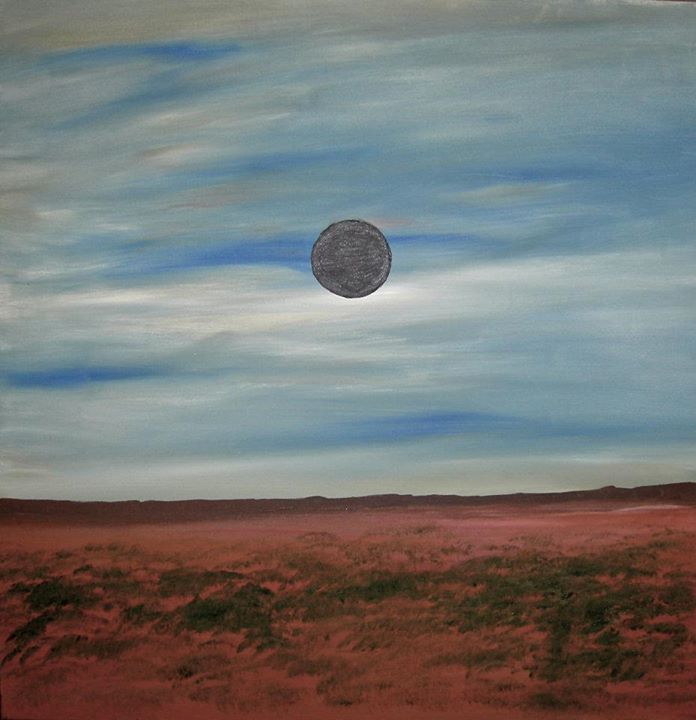
artwork mind and its malcontents jan 2015 dennis

 x

It seemed like a romantic idea until I recalled some of those experiences – of waking up to torrential rains in the middle of the night in a drenched sleeping bag and experiencing hypothermia. Once when I was hitchhiking across the United States, I was forced to hunker down during a Colorado blizzard that dropped 48 inches of snow in twenty four hours. It is not just the weather that bothers a homeless man.


Police, junkies, prostitutes and vigilantes have all harassed me while homeless. At least on one occasion I had everything stolen and had to defend myself against a brutal attack. For food, I would mark select restaurants and wait for them to throw food out at the end of the shift. I would attempt to panhandle with creative signs, but I wasn’t very good at it. Neither was I in the best mental state at the time. I recall having hallucinations, and also the delusion that I could predict the future.


After recollecting my dismal state of being during long stretches of homelessness it was obvious that I had to come up with another plan this time around. My situation seemed daunting. Going into a shelter wasn’t an option because I knew it would trigger the dehumanizing experience I had in psychiatric hospitals. The same reason I refused to go to the emergency room, even though I was in the middle of a crisis. I knew I could be hauled off to a psychiatric wing somewhere, sedated and treated like an animal by incompetent and heartless psychiatric support staff.


After receiving Medicaid, I was assigned a new therapist and when faced with my new dilemma, she asked if I would consider living in a supportive housing community. I agreed to explore the idea. She contacted my case manager and asked me to visit the facility. An appointment was made; I met the staff, along with some of the residents. It appeared to be a good fit. I was admitted and moved in two weeks later.


My crisis turned out to be a silver lining. I am one of the recipients of a grant supported by HUD that offers a stipend for housing. The support team is very compassionate and I am able to engage in a variety of therapeutic programs. Initially I had moments of self-deprecation, wondering how I managed to end up in this situation, but each day I began to have more appreciation that I wasn’t out on the street.


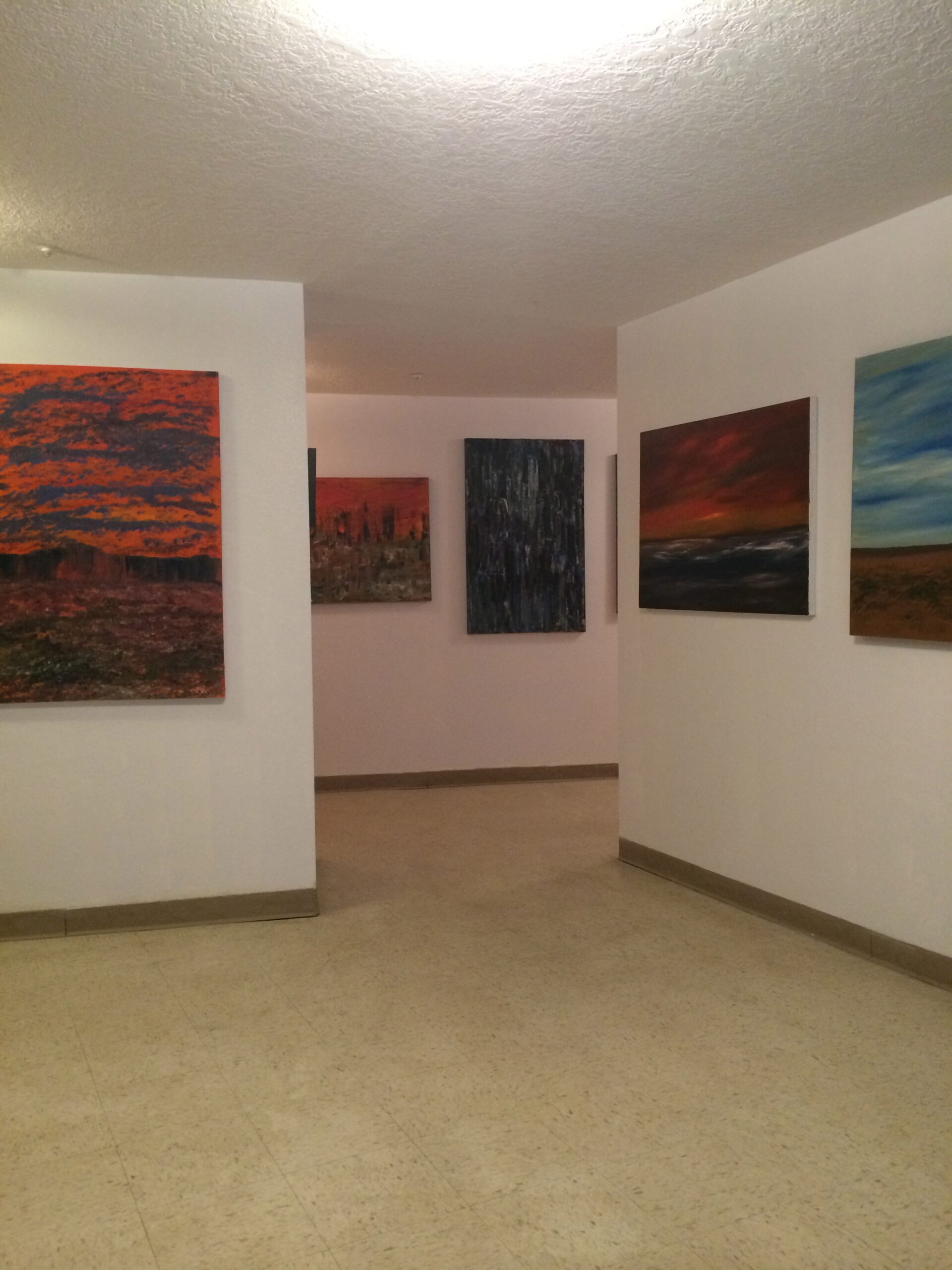
After being here only a month, I had my first art opening in three years. When I moved in, I immediately noticed the beautiful wall space in the studio. Instantaneously, it gave me the idea to host a salon style opening. As expected, once hung, the paintings showed particularly well in the space, so I pitched the idea to the powers that be. They were very supportive of the idea and agreed that it would be a good thing for the community. I had less then three weeks to plan, so I worked like a “maniac” to assure a successful event.

 IMG_1951


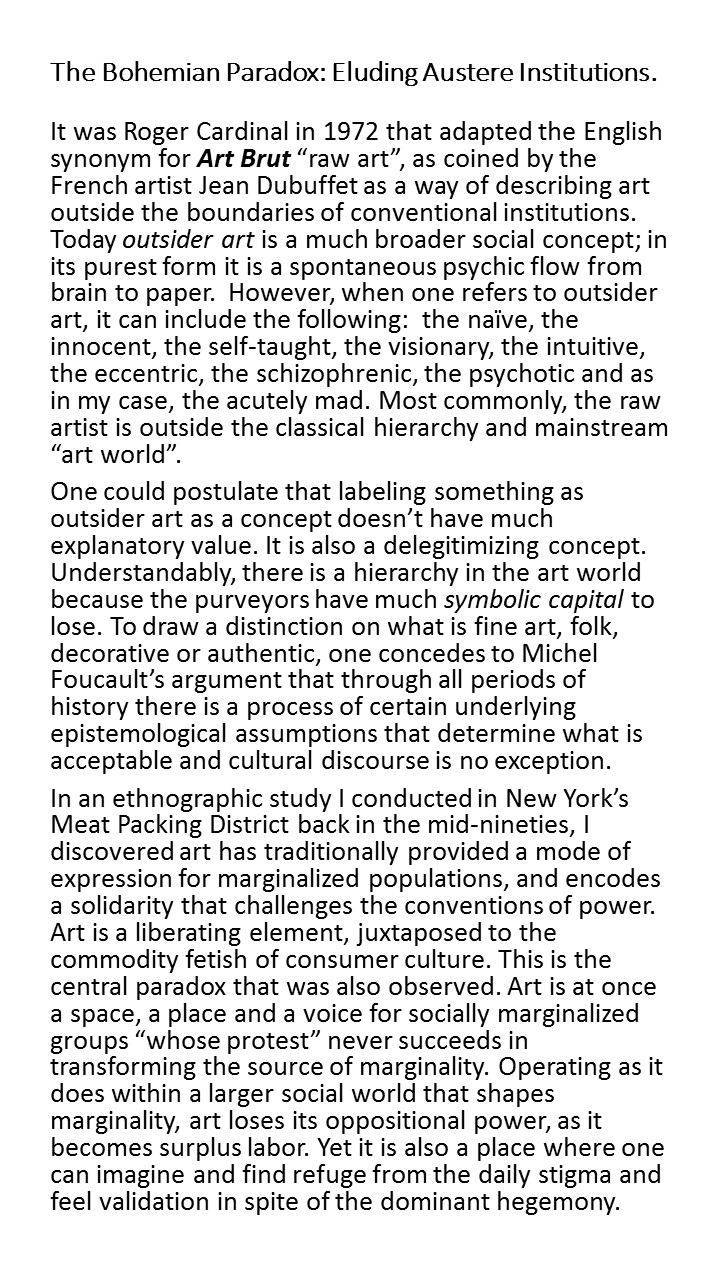
I thought the show should also include performance and should provoke.  I wanted to challenge the art establishment on some of its basic cultural conventions. In my edited Dilettante Statement, I critiqued the cultural assumptions of what is considered outsider art and I use their language to create a faux thesis:

The Bohemian Paradox

 Also, I wanted the show to be wholly accessible. Art openings are generally elitist events. Although I wanted the gatekeepers of the art world to see my work and performance, I also wanted the therapeutic community to know that the show was for them as well.


The food I served was also a commentary on the reactionary discourse that would only allow the indigent to consume food out of a can or dried packaged foods. Therefore, I served an assortment of food found in poor neighborhoods. Usually in corner bodegas, gas stations and convenience stores. No fresh produce can be found in these places, only products that could survive a nuclear blast. The food is ghastly and if eaten on a daily basis would most certainly cause heart disease, diabetes or cancer.


Yet, the Supplemental Nutrition Assistance Program (SNAP) approves these packaged items that one would have difficulty calling food. A hot cup of soup or fresh steamed vegetables at the hot food bar are not on the approved list. However for people who get their information from conservative media, recipients of food stamps are living high on filet mignon, Swiss truffles and caviar.


I have attended many art openings over the years and one of the things that would always prompt my curiosity is the predictable gastronomic staple of wine, cheese and hor d’oeuvres. I thought it would be an interesting experiment to change it up a bit. In lieu of the highbrow offerings that one commonly finds at bourgeois openings, I’ve decided to present a palette that is more typical of the habitus of  “the other cultural”.


The main performance addressed recognition, vulnerability and stigma. Specifically, I wanted the public to have a chance to gaze into the soul of the marginalized. Given my experience as “the other “ I wanted to push people out of their comfort zones and have them face their vulnerability. People are often afraid of someone they meet living on the streets or in shelters.  My hope in Gazing into your Brother’s Eyes is to incite more awareness that our most vulnerable members in our community are connected to us all. I wanted the participants to leave with more empathy and maybe see the people they encounter each day with more empathetic understanding.

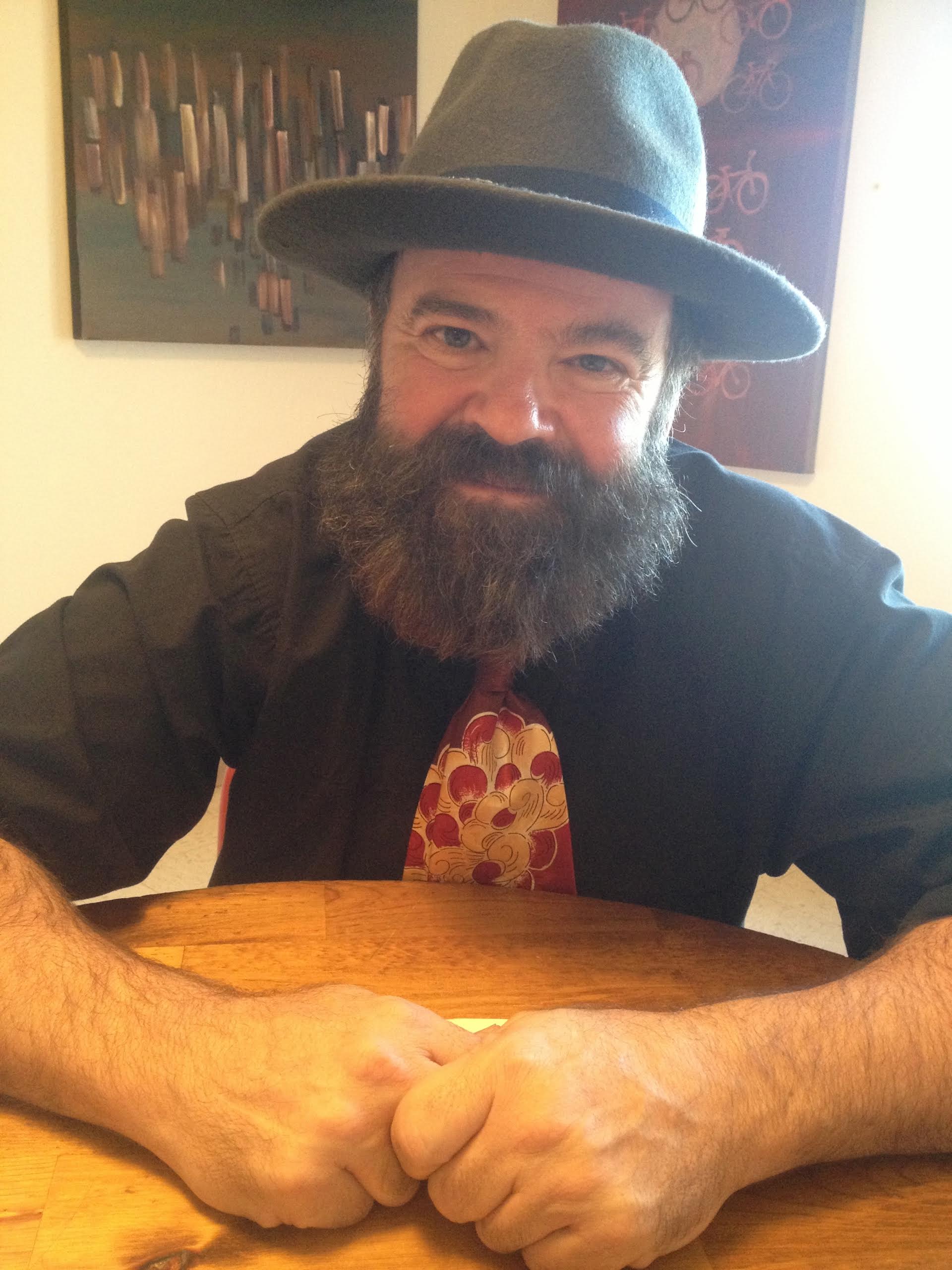
 image janb 2015 gazing


Gaze into your Brother’s Eyes


 In America a whole class of people has been thrown away like tattered bundles along with broken TV’s, toaster ovens and cheap plastic toys from China. They are disposed, stigmatized and devalued in a society that places a price tag on everything.


The person in front of you has experienced enough trauma and dislocation to find safety and compassion in this therapeutic community. The specifics are unimportant, but know this; mental illness doesn’t discriminate even though the people who suffer from it are often discriminated.


If you are reading this I am going to assume that you are sitting in front of me. You may feel vulnerable, but when you are done reading, look into my eyes and take a moment to gaze straight into me as long as you are comfortable. For the demographic for whom, I am among, gazing into the eyes of another can be a rare occurrence due to a general culture of fear.


I would encourage you to participate in this without a word. It is through our vulnerability that we can share in a human experience.  Take as much time as you need, but be aware that others might want to participate.


I don’t know what to expect from this or how long I’ll endure, but I am hoping that this experience will help us make better eye contact with the person that we see every day that may not be functioning as well; yet we see them not as another used commodity to be thrown away, but as someone that is an extension of our collective selves.


December 2014


For me, the gaze was powerful yet emotionally exhausting. I had people cry and showed me that they understood. At moments I felt my own tears forming.  In their eyes I could see anguish, loss and trauma, but I could also see joy, appreciation and love. I had a sense that I had an impact on most people who risked sitting in front of me. It seemed to enable what I was looking for.


As far as the nameless man (John Doe), who died on Christmas Eve, it is most likely that no one looked into his eyes. He was invisible for most and a health hazard to others, but like all of us he had a story. Like us, he was once young. Like us he had dreams. Like us, he experienced pain. And like us he was once loved.


He seemed like us, because he was one of us.


*****


© Dennis Dodson, 2015


Near-Life Experience (NLE)

Near-death, but happy


A near-death experience (NDE) is a personal or subjective experience associated with what are called near-death episodes. In a near-death episode, a person has been declared clinically dead, is very near death, or is in a situation where death is impending, likely or expected. The situations where people have reported near death experiences have been accidents, military combat, childbirth, or suicide attempts. (1, 2)


The term or phrase near-death experience is said to have been first used by Dr. Raymond Moody in his book titled Life After Life published in 1975. Many researchers have since studied the situations, circumstances, contents, and consequences of NDEs. People who have experienced near death episodes say it encompasses multiple sensations including detachment from the body, feelings of levitation, serenity, security, warmth, the experience of absolute dissolution, and the presence of a light. The recurrent theme is the feeling of a strange sense of warmth and joy.


Some reports says 38%-50% of the adult population in USA who have come very close to clinical death have had a near-death experience. However, those who have had near-death experiences often criticize and disagree with the term “near-death.” They say it is incorrect because they claim they were absolutely sure that they were most certainly dead, not just near-death. (1, 2, 3, 4)


Most of us have heard or discussed the term “hear-death experience” and many have been discussed this phenomenon with friends.


However, there is an older phenomenon that many of us have not heard or even talked of although it has been around for centuries. “Near-life experience.”


*****


Near life but not quite there and very unhappy


We define Near-Life Experience (NLE) as a personal experience associated with impending life – the possibility that finally the life a person had envisioned is within his or her grasp – one is nearly alive but not quite. (5)


What do you mean by near-life, aren’t we all living? How could I talk to you, interact with you if I were not living? This was the reaction of a colleague when we brought up the phenomenon of near-life experiences.


We simply asked him: What do we mean when we tell ourselves or someone else: Get a life!


Does that mean we still do not have a life? How can we go out and get a life if we were not alive? Dead people do not just walk out of their houses (or caskets) and get a life. But we only expect people who are alive to do that – go out and get a life.


Yet we are alive; otherwise how could we be working all the time, and leading that dull, boring, routine life. For many of us caught up in the unidimensional mode of work – work and more work. Working just to pay the bills and be able to get through the day and have a roof over one’s head. But this is not the life we had in mind. So are our lives stored in our memories. But how can we recollect something that we have not experienced yet? Or is our life in our imagination? How can we imagine something that we do not comprehend? And yet, we often find ourselves telling ourselves: I need to get a life.


The expression – Get a life – is a clear vindication of our claim that all us are merely loitering from incident to incident, moving from one rite of passage to another, and engaging in near-life experiences instead of living the real life. We are all, it seems, near life; but not yet there.


Are we there yet? This does not seem to be a child’s irritating, oft-repeated question when we are travelling. Rather, it seems like a question we should be asking ourselves all the time.


A near-life experience is said to encompass multiple sensations including a sense of finally being able to leave the so-called existence one is leading and grasping the real thing; a sense or feeling that one will be finally secure, a feeling of warmth; and the presence of a light – that one cannot see but only feel its warmth in one’s heart. And one feels a strange sense of loss when that desired life fades away from ones sight or leaves ones grasp and one comes back to the so-called crappy existence one is leading.


So are there people who have had near-life experiences?


In the past when the Pareto principle applied, and 20% of the world ruled and controlled the rest of the 80% it was said that nearly 80% of people had a near life experience – they believed in magic at first and then in God and they simply kept trying.


In the last few decades 1% of the super-wealthy rule, control, and occupy the lives of the remaining 99%, it is said that only 1% have had a near-life experience. Well, some of us might think it is good news because that means the rest of us are actually living. No! The rest have simply given up.


People are either too tired or too poor to even care.


Those who have encountered near-death experiences (NDEs) report emotions that can be broadly classified into two broad categories. Some have pleasurable NDEs – which include feelings of love, joy, peace, bliss. While another group has experienced painful NDE such as feelings of terror, horror, anger, isolation, guilt.


The painful category of NDE is miniscule compared to the vast majority who say that NDEs are pleasurable; and both types report that the experience or sensation is hyper-real—sharper than what they have ever felt in their real earthly life.


In the case of near-life experiences (NLE), the painful experience in the only one experienced by most people. Many of us continue to believe that we experience life when we experience bliss. Bliss is extreme happiness. Only time people experience pleasure in a near-life experience is when they take some mind-altering substance. But then the very act of consuming a mind-altering substance makes it a not so real life experience. Experiencing life in an altered state of consciousness would not constitute living the real life, would it?


I could have been somebody OR Be all that you can be


Our research on near-life experiences have found that they differ by age group. However, both the young and the old have near-life experiences. Degeneration and the problems of aging may be the privilege of only the old; but near-life experience, like the phenomenon of death, it seems is quite egalitarian – cuts across age, caste and afflicts the poor and the middle class.  No amount of education or getting into privileged occupation can impact our near-life experience.


Thus near-life experiences can be classified differently in two people who live in the same home.


In the middle aged father or mother near life experiences can be summed up in the phrase: “I could have been somebody.”


This is the middle-aged father or mother playing the character of Marlon Brando in On the Waterfront, a 1954 film, and ruing their life choices. Complaining about all the people who never helped them to become the person they could have; about no one realizing their potential, giving them a break.


For the teenage son or daughter engrossed in a virtual war on a video game or lying on the internet in their face-book page to get more “likes” and to attract attention and interest, this is about pretending to be someone he or she is not. This approach to life has been classified in the famous US army slogan : Be all that you can be.


And in the virtual world, one can actually be anything as long as never meet the person face to face. The “Be all that you can be” near-life experiencers are constantly connected online but never connect at a human level.


Various questions come to mind: Is my life, the one I want to live, only in mind or is it real? If there is a life that I am supposed to lead then what is this life that I am actually leading or experiencing?


Is this what I really wanted? I know that is not what I thought my life would be – but then this is what I got. Should I just accept it and go along, play along as if I enjoy it or should I shout out loud and complain?


Maybe I did not want this life but this is what I have got? So is this my life now? Am I condemned to live in this slum? Or as the protagonist in the Oscar-award winning film Life is Beautiful would argue: Life is like living in a concentration camp anyway, we have to use music and philosophy and create games to make life livable and beautiful? If we are condemned to playing games in and with our life, then is playing games our real life?


Both the young and the old caught up in their own webs of near-life experiences – busy, multi-tasking, and no time to live.


*****


Can we ever eliminate the causes of Near Life Experience?


It is important not to dismiss “near-life experience” as simply the opposite of living in the moment or mindfulness. Near-life experiences are more than the phenomenon of mindfulness.


Mindfulness (the English word) is derived from the Buddhist term anapanasati. Mindfulness is commonly known as living in the moment and can be the intentional, accepting and non-judgmental focus of one’s attention on the emotions, thoughts and sensations occurring in the present moment. Many people try to gain mindfulness through training in meditational practices.


The Buddhist term originates from the word “sati” in the ancient Pali language and the Sanskrit word smṛti. However, it is important to note that the underlying meaning of both sati and smrti involves the act of recollection. Sati means, “moment to moment awareness of present events,” and “remembering to be aware of something or to do something at a designated time in the future”.


It is reported that the Abhidhammattha-sangaha, a key abhidharma text from the Theravada tradition, defines sati as follows: “The word sati derives from a root meaning ‘to remember,’ but as a mental factor it signifies presence of mind, attentiveness to the present, rather than the faculty of memory regarding the past. It has the characteristic of not wobbling, i.e. not floating away from the object. Its function is absence of confusion or non-forgetfulness.” (6)


Near-life experience cannot be completely conflated with mindfulness. While being in the moment may be an important aspect pf living. There are other components of living that are non-psychological.


Research from neuroscience explains NDEs in terms of various physiological and psychological factors, while some NDE researchers in the field of near-death studies advocate for a transcendental explanation


So what would explain our consistent encounters with near-life experience and the absence of ever experiencing life? Is the reality of life merely a psychological entity as mindfulness or other psychologists using mindfulness to treat depression and other mental disorders argue? Or is life physiological (based on matter alone) or a combination of both or is life spiritual and transcendental? As the Eastern ancients would say it is not matter or mind that explains the mystery of life, but it is consciousness (separate from both mind and matter) that gives rise to all the rest.


The answers are not straightforward nor is the pathway to the answer easy. What we suggest is that each one of us explore our own near-life situations. We think about it, share it. One can explore own consciousness individually; however, despite many underlying similarities, each life is unique and what we are looking for is benefit of knowledge for all. Therefore, a common knowledge has to be discovered and shared. This requires collective effort. It is the collective pool of experiences that will give rise to a better understanding of near-life experience and how to transform near life experiences into real life experiences.


Instead of funding more unnecessary research on disease and pharmaceuticals that only increase our near-life status; foundations should establish research agencies and universities to study in-depth the nature of near-life experiences, study the underlying explanations and determinants so why most of us are not living the life we have and continuing to have near-life experiences instead?


Why does LIFE elude the living?


Can we create a world where we eliminate the causes of near-life experiences and ensure that all of us actually live?


******


To be or not to be


Perhaps Shakespeare answered it for us all when he wrote those memorable lines which are part of the famous monologue in the play “Hamlet” and alludes to Hamlet’s suicidal intent. The revelation that Hamlet’s father, the King, was killed by his own brother (Hamlet’s uncle), who then goes on to marry the king’s wife (Hamlet’s) mother generates Oedipal impulses in Hamlet and drives him nearly insane. Hamlet wants to die, kill himself, but he also seeks revenge.


In the classic scene, he first thinks of suicide, “To die, to sleep- no more,” Then he fears that even after death, he may still not get the peace he wants. He is worried that there may be no peace even in death:


“ ‘Tis a consummation

Devoutly to be wished. To die, to sleep,

To sleep, perchance to Dream; Aye, there’s the rub,

For in that sleep of death, what dreams may come,,..”


The moral and mental pain that Hamlet’s character feels is captured by the soliloquy: “To be or not to be,” which also becomes the play’s emotional essence.


Hamlet (ofcourse Shakespeare) does touch upon two different topics which may be central to the understanding of near-life experiences (NLEs) – SLEEP and DREAM.


However, we think that although they came close, perhaps Hamlet (and Shakespeare of course) also missed the point – he may just have been another victim of Maya (the illusion of life) – a mere mortal afraid of death, caught up in the flesh and the pleasures of material living. As the next few lines show Hamlet calls death the undiscovered country from which no traveler has returned. Obviously, Hamlet (and in turn Shakespeare) was simply not aware of the phenomenon of “Near-Death Experience (NDE).” Hamlet chose to bear the drudgery of his painful near-life experience because he was afraid of death unlike the experience of hyper-real pleasure in near-death expressed by most of those who have gone through a near death experience (NDE).


“To grunt and sweat under a weary life,

But that the dread of something after death,

The undiscovered Country, from whose bourn

No Traveler returns, Puzzles the will,

And makes us rather bear those ills we have,

Than fly to others that we know not of.”


What would have happened if Hamlet had actually killed himself – embraced death rather than engaged in a monologue questioning death?


A person who has near-death experiences says: I almost kissed death and then someone pulled me back into life. Does that automatically mean that all of us who have near-life experiences have almost kissed my life and then something or someone pulled us back into this – what we have right now?


The question begs to be asked: When do I actually live? What is my life?


When I go from mind-full-ness to mind-empty-ness? What is mind-empty-ness? Is it mindless-ness because many among us are engaging in mindless acts? No, mind-empty-ness is different from mind-full-ness and from mind-less-ness. In order to define mind-empty-ness one may have to follow the analytic method of negation termed neti neti (not this, not this) advocated by the Advaita philosophers. In order to understand something one starts by trying to understand what it is not.


Perhaps I will understand mind-empty-ness when I die – because perhaps then my brain may become truly inactive. The one type of sleep when my brain is truly switched off. I will sleep and when I sleep in my death my brain will truly rest. It will no longer be active like the brain of a person alive because the brain never sleeps even when we are sleeping. (7, 8) At that moment both my recollections of my life and my dreams or imaginings of my life will become one with what my actual reality is.


Is this akin to turiya? The Mandukya Upanishad describes three psychological states of consciousness: waking, dreaming, and deep (dreamless) sleep. The waking and dreaming states are not considered true experiences of reality and truth because of the acute divide between the self and the non-self. One is aware of one’s boundaries. In dreamless sleep, one is not conscious of external or internal objects, no awareness of thoughts, yet the fact that we say that I am not conscious of anything proves that the “I” is still present. It is only the fourth (in Sanskrit language turiya means fourth) transcendental form that underlies and transcends the three common states of consciousness of waking, dreaming, and dreamless sleep which there is complete dissolution of boundaries and the experience of pure awareness or pure consciousness.


Is there, then, a continuum between life and death and if there is, then, is meditation the only way to get there? Or, for mere mortals such as us, is sleep the bridge that allows us to actually enter and be a part of that continuum? Is sleep the natural state and way to get to life? Perhaps we do not sleep because we get tired by running round all day. On the other hand we may be running around all day because sleep demands that we expend the excess energy that keeps us from sleeping?  Would that not be the correct way to describe new born babies and children? Sleep seems to be their natural way of life. They run around and scream all day only to drop down to sleep within minutes. Perhaps it is through the exploration and deeper examination of sleep that we will understand death and by doing so understand life.


I may not become one with God after my death but what will perhaps happen is my dreams or what is in my mind will become one with what I actually am – just a baby, wanting to sleep. Perhaps, for the majority of us, our near-life experience becomes real-life only after death.


“The Universe begins to look more like a great thought than like a great machine.“

Sir James Jeans (1877 – 1946)

British scientist

Author of book Physics and Philosophy (1943)


——————————————-

© Madhav Pakhare and Nilesh Chatterjee


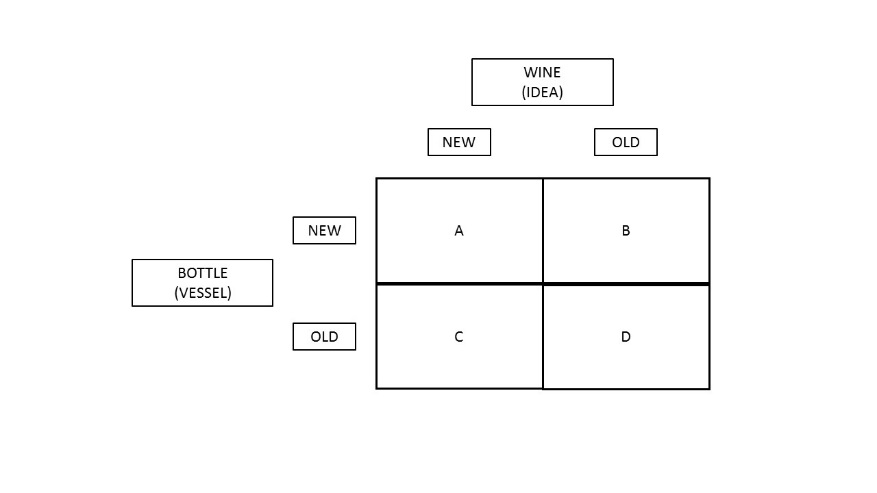
Note: Someone asked us whether NLE was not just another attempt to re-package old wine in a new bottle? For that discussion, please wait for the next article where we have created the 2 X 2 typology of old wine / new wine and old bottle / new bottle. Assuming that the bottle represents the human existence and wine represents the idea or thought or energy; and it came out looking something like this. In box D the vessel is old, and the energy or thought is also old. In our minds this could represent the existing human condition – both a baby and the elderly. However, someone among us who ends with a higher consciousness, maybe an Einstein or a Gandhi or Bohr or Russel or Bohm may be in C because they have a fresh consciousness. The issue is with the boxes A and B because we are talking of a new bottle or vessel. Read more in the next piece.

 NLE

References

  1. International Association for Near-Death Studies: http://iands.org/about-ndes.html
  2.  Near-Death Experience Research Foundation: http://www.nderf.org/
  3.  Near-Death Experiences and the After-life: http://www.near-death.com/
  4.  Near-Death Experience: http://en.wikipedia.org/wiki/Near-death_experience
  5.  Goodlife Zen: http://goodlifezen.com/have-you-had-a-near-life-experience-5-crucial-tips-on-how-to-feel-fully-alive/
  6.  Mindfulness: http://en.wikipedia.org/wiki/Mindfulness
  7.  Brain Basics: Understanding Sleep: NIH – National Institute of Neurological Disorders and Stroke http://www.ninds.nih.gov/disorders/brain_basics/understanding_sleep.htm
  8.  While you sleep, your brain keeps working: http://psychcentral.com/blog/archives/2008/08/03/while-you-sleep-your-brain-keeps-working/


The Alchemy of Seeking the Aesthetic in the Everyday

By the time this appears in print, the wistfully evocative season of autumn will have faded to Winter and the year will have changed. Autumn is considered the most aesthetic of the seasons in the scheme of traditional Japanese aesthetics and the natural languishing of organic energies signals the recollection of experience and the withdrawal of the experience of sense data within signaled in the power of vimarshana which is key to the authentic appreciation of any potential aesthetic experience.  Autumn will have passed along with its slow inevitable descent into the Americanized arch-holiday of consumerism, Christmas, that translates the desire towards peace, generosity, goodwill to all mankind and spirituality into a frenzy of desire for material goods, most of which did not previously exist, in the form of gifts seen as obligation along with a distinctly juvenile, maudlin sentimentality that is eagerly anticipated as a vital part of the national economy along with the frenzied hoards of shoppers appearing during the ominously named Black Friday.

Numerologically the new year will be the number 8 that is associated with Shiva and is reflected in the Major Arcana (that is often referred to as the fool’s journey) of the Tarot deck, which is referred to as the Book of Thoth by the first widely known professional tarot reader Jean-Baptiste Alliette or “Etteilla” in 18th century France, by the card of Justice which aside from its literal interpretation represents the alchemical aspect of “Disposition” that represents the proper weighing and rebalancing of the elements of fire and water or of the pranic energies of the channels of the Sun and the Moon or the nadis of the Ida and Pingala.


Entrance to Karnak temple 001


The origins of Western esotericism often trace themselves back to ancient Egypt with the mythic Ptolemaic Alexandrian figure of Hermes Trismegistus, a syncretic form of the Egyptian god Thoth who was thought to be the inventor of writing, architecture, science, magic and alchemy. It is said that the ancient Egyptians used the same hieroglyph to represent the concepts of science, art and magic.  The culture, lore, artwork and world-view of alchemy in the Middle East and Europe, tended to preserve this conceptual unity of the Egyptians as well as an enchanted and mythic view of the world, the cosmos and of the transformational abilities of matter.  The scholar Francis Yates spent much of her professional works in showing how much the alchemical and specifically the Hermetic traditions actively shaped European cultural traditions such as the Renaissance.  The explosion of artwork illustrating the philosophy and lore of alchemy in highly visually coded engravings that were facilitated by the printing press up to the 18th century clearly preserve the enchanted view of the world and matter as well as the Egyptian conceptual unities of science, art & magic that today are strictly segregated, alienated and hegemonized in strict exclusion of the mythic and the magical to prevent the contamination of the pristinely scientific world view.

But you may ask yourselves what are the ultimate effects of such a strictly compartmentalized worldview that is stripped and sanitized of the superstition and non-logical antiquated notions of the mythic and the magical that comes naturally to the child, but that are kept alive yet veiled and sequestered into a yearly holiday, forced into hidden conscription used to manipulate the unwary public to create desires that did not previously exist for consumer goods and to fuel the obligation to shop.  More importantly, what are the effects of sequestering “art” and the aesthetic from the relevance and cultural hegemony of science as well as from the enchanted world view of magic and myth?


Winter is the season when nature itself gives clues to the values of letting go and of introversion and introspection.  Alchemically it represents the stage of Nigredo of blackening as the Winter solstice signals the period when there is more of the blackness of night than of day.  It represents the power of vilaya of concealment and of the “via negative” or hesychastic approach to spirituality of “emptying” oneself of thoughts and images associated in the West with Pseudo-Dionysius and with the practices of the Vijnana Bhairava in India.


I delight in the practice of seeking correspondences, which is a common trait of all esoteric traditions, and I especially enjoy seeking correspondences with Trika Shaivist elements as it is said in tantric lore that Shakti reveals herself in the specificities of time and place.  Seeking correspondences is a delightful way to embed the extra-ordinary of myth into the ordinary of everyday life, and the mythic needs no justification as it is its own.


Octavio Paz quoted Baltasar Gracian, the Spanish Jesuit priest and poet and founder of the Spanish Baroque literary style “conceptismo”, in his biographic masterpiece on the enigmatic Mexican poet nun and prodigy, Sor Juana Inez de la Cruz, on the notion of the Baroque concept of the “conceit” which is “…an act of comprehension that expresses the correspondences that exist among objects”.  Gracian reveals his hidden strategy of aesthetic invention at the heart of the awe- inspiring profuseness of the Baroque imagination which is but a continuation, elaboration and refinement of the esoteric strategies of alchemy and the Hermetic tradition revealed in the mythic Emerald Tablet that states “That which is above is as That which is Below”, and is a further continuation of the aesthetic interpretation of the esoteric practice of the interpenetration of the macrocosm with the microcosm which inspired the artists of the Renaissance and the Baroque to embed and interpenetrate the iconography of their works with the marvelous of the myths and symbolisms of the pagan past within the mundane of Christian themes or of contemporary life that featured man frequently as the center of the subject matter that is mirrored in Pico della Mirandola’s historic Oration On The Dignity of Man that was inspired by Hermetic doctrine that placed man squarely in the center of the cosmos and who was most able to reflect the Divine will through his own abilities to accomplish all through his own will.


This enchanted view of aesthetics of an enchanted cosmos where matter itself held soul along with the power to transform based ultimately on texts claiming ancient Egyptian origins led also to such historical characters of Baroque anomaly as Athanasius Kircher, the German Jesuit who was an enthusiastic student of ancient Egyptian hieroglyphs before Champollion translated them with the Rosetta Stone, who was convinced they held emblematic symbolism of esoteric  significance of the various elements of the world and who created Rome’s first cabinets of wonder or wunderkammer, that contained such fantastic collections and elaborate microcosms of the world itself as hieroglyph. What would the implications be if our own religious and political figures and leaders were also poets and aesthetic and esoteric visionaries of the marvelous? Or what would archeologists say about the values of American culture today if they were to discover artifacts of it in the future?


Deity with erect phallus 001


Jaideva Singh’s translation of Abhinavagupta’s commentary in his Paratrishika Vivarana states flatly, “If there is complete absence of delight, it only spells insentiency”.


I often take great pleasure in viewing the unique manifestations of the sky close to where I live in a suburban surrounding town outside of Houston, that is completely unobstructed from any multi-storied buildings and that displays itself in seemingly endless panoramic vistas that simply do not occur within the city limits of Houston. I enjoy driving along the long flat multi-laned road that calls itself a highway and that follows a strict East/ West axis and listening to the local classical music station on my radio that is free of charge and viewing the often breathtaking formations of the sky that appear above and on the horizons lines uncontaminated by the visual cacophony of the criss-crossing strings of above-ground power lines and the riotous commercial visual pollution of signage for often abandoned malls or small businesses and strip malls with often wildly contrasting types of businesses. I am struck by amazement one recent late afternoon on leaving the grocery store parking lot to see a panoramic sky at twilight that is half day light at one horizon line and half early evening on the other with broad strokes of crimson stretching along the underneath of long altostratus cloud formations that blend and fade effortlessly into a rich cerulean of a cloudless blue sky.

 125 rainbow1

x

It may be interesting at this point to examine the hidden connotations and our reactions to the term aesthetics itself.  What comes to your mind now when you see or hear that word – an effetely precious art movement of the late 19th century, elitism, archaic and outmoded traditions and definitions of beauty, an antiquated division of classical philosophy, or actual hegemonic manifestations that exclusively extol the culture and values of the particular ruling elite of a time and place?  It will be necessary to uncover the full range of current connotations that are associated with the aesthetic before discussing its almost palpable absence in contemporary discourse and in particular in terms of our daily lives.  That is if anything comes to mind at all as evidenced by Oscar Wilde’s 1880’s lecture which he gave on his US tour, The English Renaissance of Art, where he praised the concrete expression of the aesthetic, “If you ask nine-tenths of the British public what is the meaning of the word aesthetics, they will tell you it is the French for affectation or German for a dado”.


In her essay/ lecture Composition As Explanation which essentially was an apologist argument for the radical iconoclastic techniques of modernist artists who went beyond aesthetics per se, Gertrude Stein argues that truly creative artists are never ahead of their time, that instead they are the most sensitive members of their society who are able to accurately reflect the actual composition of the life of their time.  She begins her essay by writing that the only thing that really changes in any time period in human history is really just the composition of daily life as everything else in human life is essentially the same as in any other period.  This to me is a fascinating insight that is in need of particular emphasis today as an entire generation feels that they are living in an age that is historically incomparable simply because of the Internet and their abilities to play videos of their mobile devices or the ability to “text” which is essentially no different than the telegraph.  Yet it is undeniable that the digital revolution has changed the “composition” of the daily life of the 21st century.

It is also important to emphasize that “virtuality” is in essence not something new, and has always been a prominent factor in all of the “analog” arts and culture especially in the main defining trait and “technology” of the human phenomenon of “civilization” – writing and reading, and it remains, what could be more virtual, the phenomena of looking at and interpreting stylized hieroglyphs that literally can engage all of the senses in distinct yet inexplicable ways like hearing silent whispers or of waking daydreams in much like Abhinavagupta’s Kaula dictum of “each thing being an epitome of all things for all people”.  On the other hand another characteristic trait of “civilization” that is more immediate and visceral yet is still extremely virtual is the habit of eating and the artificial technology of cooking which like reading also has the abilities to engage all the senses simultaneously and there is the relevant usage of the word taste in English which also has the implications of aesthetic sensitivity.


Gertrude Stein also wrote her cryptic pronouncement in her Autobiography of Alice B. Toklas, much like those of Abhinavagupta which were replete with inversions of expected or conventional meaning, yet in Stein’s case was limited to her own obsessive notions of an ontological and aesthetic Manifest Destiny of America, that “… America having begun the creation of the twentieth century in the sixties of the nineteenth century is now the oldest country in the world”.  Aside from having a certain ring of truth to it in America’s post-industrial decaying urban landscapes and infrastructures, as well as its obsession now with its own past, it also is indicative of the twentieth century’s own destructive side of modernism by defining its own obsession with the new through the need to destroy the past.  Likewise a large part of the twentieth century’s creativity has been through the dismantling of the perceived constraints of the “aesthetic” which has also survived into post-modernism. Yet America itself may have always held a deep mistrust and uneasiness towards the aesthetic, from its Puritan origins to its Federalist suspicions of anything evoking monarchic or religious patronage or power to its fully formed period of national self-consciousness in the early modern age of the 1920’s with Calvin Collidge’s popularly quoted remark, “the chief business of the American people is business”.  Ironically Oscar Wilde, the self-publicized public spectacle arch-aesthete, gave a successful US lecture tour promoting the aesthetic movement in art and the aesthetic in daily life and promoted resistance to passive consumption of industrial goods in favor of interior design and dress that would highlight the indigenous beauty found in America.  He lectured and toured widely from New York to San Francisco arousing notoriety and controversy wherever he went from offending blue-blood critics in Boston to impressing a group of miners in Colorado by drinking them all under the table and he even lectured at the opera house in Galveston TX, an island on the coast some 40 minutes from Houston, where reportedly guns were shot off in the audience.


Oscar_Wilde__by_Hills_&_Saunder_Oxford_3_april_1876

Much of Wilde’s mature work, particularly in The Picture of Dorian Gray, revolves around the ironies and distinctions of art and reality and using the strategy of the Decadents to invert the distinctions between the artificialities and virtualities of art over the “reality” of life remarking with one of his many famous epigrams, “Art should not be more popular, the public should become more artistic” and frequently privileging the aesthetic manner of living and pursuit of pleasure over the actual production of art to the point of almost praising in later essays the mediocre artist for the artistry of their lives since he felt that they almost always placed more of their artistic energy and consequently led more interesting lives than superior artists.  Wilde himself exhibited similar traits and in many ways became one of the last great manifestations and created a Decadent version of that quintessential proto-Romantic and enigmatic urban phenomenon beginning with Beau Brummel which was also to obsess the young Charles Baudelaire – the Dandy.  At once symbol and signifier detached from all conventional web of signification, the dandy was the classless aristocrat of taste, the first conspicuous consumer and phenomenon of social spectacle who defined himself in and on his own terms simply through his appearance.  Walking fashion plate yet detached and scornful of popular taste, the dandy was the supremely independent arbiter of taste armed only with the anomaly of his own fantastic appearance and an endless supply of quippish cavalier pronouncements and epigrammic bon mots.  Wilde infused the phenomenon of the dandy with the profuse aestheticism of Walter Pater and the anti-Industrialist scorn of mass production of John Ruskin, he carefully constructed the social theatrics of his own public persona, armed with his high-ranking Oxford education in Classics and his first book of poetry, he sought to do battle with the forces of vulgarity and ugliness and unmask the hypocrisies of the Victorian Age and promote the new aestheticism in the arts and in society.


As a staunch supporter of “Art for Art’s Sake”, Wilde as self-appointed figure head of the Aesthetic movement which sought to dissolve the conventional moralistic justification of the arts through didacticism to emphasize that aesthetic effect alone is justification enough for the arts.  It is interesting that this initial detachment from subject matter didacticism of the Aesthetic, Symbolist and Decadent movements many art historians agree led to the free independent iconoclastic experimentation of modernism that sought to define itself through the dismantling of the aesthetic most notably with Dadaism.  Theoretically the continuation of the dissolution of the aesthetic was given new impetus through the late 20th century movements of post-modernism, post-structuralism and deconstruction where the very concepts of the aesthetic were dismantled to become an endless series of self deflecting and deferring self-contradictory and self-undermining labyrinths of signifiers without signification which has led to a flattening and deconstructing not only of aesthetics but also of modernism’s obsessive drive for the “new” and has led to a destruction of art for art’s sake but only leading to art for “theory’s” sake.  Yet the 1967 work of Guy Debord, The Society of The Spectacle has only proved all too prophetic in the 21st century in his dystopic vision of the degradation of the essential quality of life through the manipulation, fetishization and commodification of images or the mere representations or simulacra of life where the “commodity completes its colonization of social life”.  Such “society of the spectacle” tactics have only become much more diffuse and perfectly suited to the digital age and are equally if not more effective means of social control as the ancient Roman strategy of “bread and circuses” where every free and spontaneously generated social trend is tracked and predicted and is mined solely for marketing and potential profit.  Yet it was Debord’s insight that the commodification of simulacra and spectacle has the insidious effects of inducing “passive assent” and of “impeding critical thought and accurate perception”.  Needless to say that ultimately this commodified society of spectacle also undermines any opportunity or ability for authentic aesthetic response or experience.  The artificial self-conscious phenomenon of self definition through an individual’s pattern of consumption that has only become uncritically accepted as normal and wholeheartedly embraced in the digital age, has led to such generational social manifestations as the “hipster”.


At once unwitting victim and half-hearted unstrategic rebel seeking to disrupt the omnipresent digitally marketed simulacra-commodity, Douglas Haddow’s iconic 2008 cover essay for Adbusters, “Hipster: The Dead End of Western Civilization” the subtitle of which reveals it all, “Counterculture has mutated into a self-obsessed aesthetic vacuum, stripped of its subversion and originality”.  Yet consumerism has filled this aesthetic vacuum as a ready-made and indeed as an ersatz aesthetic.  Contrasting these two fundamentally conflicting approaches will only help to clarify the full implications of their possibly ultimately varying paths and consequences.


What is consumerism anyway and specifically in what ways is it different from aestheticism?  One of the biggest illusions of consumerism is its necessity or of its inevitability.  In her article for Vanity Fair in the thirties, “And Now: And so the time comes when I can tell the story of my life”, Gertrude Stein affirmed that writing was her greatest pleasure, “I like it even better than spending money although there is no pleasure so sweet as the pleasure of spending money but the pleasure of writing is longer”.  Stein admitted that she succumbed to the pleasure of shopping when her Autobiography of Alice B. Toklas became a best seller after years of writing in obscurity.  Shopping and consumerism does offer instant gratification yet it is a pleasure that fades just as quickly like smoking cigarettes which makes it a pursuit equally prone to develop into an addiction. I see consumerism as an essentially passive activity that has little to no opportunities to essentially change the consumer, and offers little opportunity for refinement or self-awareness.  When in fact, consumerism discourages self awareness or self change as its goal is to create and market self dissatisfaction and create desire for external goods.  It is deeply uncreative even though it disguises itself in the camouflage of creative activity through promising individuality and ready-made identity and status in the most parasitic of means.  It leads to the creation of inner poverty.  It is fuelled and is dependent on the creation of external validation and envy and it is deeply reductivist, reducing the complexities of life and experience into materialism, acquisition and money.

 IMG_2507

x

While my intention is not to set up any rhetorical illusions of false dichotomy, I would like to suggest an alternative to the “aesthetic vacuum” of consumerism in the 21st century that depends on an expanded alternative definition of the aesthetic based on Jaideva Singh’s interpretation of the title of the Vijnana Bhairava as The Yoga of delight, Wonder and Astonishment that fundamental and open-ended ability to be moved by experience both sensual and mental in inexplicable, unexpected and marvelous ways.  It is deeply personal and authentic, it is indiscriminant in terms of “high” or “low” culture.  While it is also fundamentally ephemeral, I view it as essentially as an active state in that the emphasis is on apprehension and appreciation over acquisition.  It leads away from the materialism of the object to a path of refinement for the subject, leading away from the habitual inner poverty of consumerism to developing the state of inner richness of the subject through emphasizing satiation and satisfaction.  It is deeply spiritual yet it dissolves the compartmentalized views of religion and spirituality that coaxes out and dissolves the boundaries between deep contemplative and spiritual experience and the authentic sensual, emotional and mental experience along with the boundaries between everyday life and the extraordinary.


While popular culture and fashion have their place, it is essentially resistant to both.  It is not dictated by mere popular taste nor is it dictated by the hieratic tastes of the art world or of the cannons of academia.  It is essentially empirical and deeply personal, experiential and contemplative leading to self awareness, refinement and the development of increased sensitivity and empathy that is not defined by external validation or materialism.  I recommend nothing short of a revolution of taste for the individual consumer that like the esoteric practice of alchemy, has tremendous potential for personal, social and environmental transformation.  Like alchemy, it requires a personal commitment to slow patient evolution and refinement with an essentially empirical and intuitive approach that is willing to patiently repeat an experiment innumerable times in order to learn and to understand all of its implications instead of taking a merely linear, goal-oriented or cerebral approach.  This alchemical aesthetics is a path to “return to our senses” and like alchemy it is ultimately a non-dual and a holistic approach that excludes nothing and includes everything, and in its mature practice it has the potential to transform the energies of negativity and various poisons into positive service for the transformation of the practitioner who in turn has the potential to change his own environment and all who have contact with him.  But such broad ranging practice begins at home and involves our time and energy.


This alchemical aesthetics is also based on ayurvedic medicine which likewise is based on the indigenous alchemical tradition of India, rasayana.  Ayurveda also uses an alchemical holistic model and realizes that we “eat” much more than food and expands that model to include all sensual, emotional and mental experience which has the potential to affect us negatively or positively with an emphasis not necessarily on discrimination and exclusion, but on processing and of the “digestion” of that experience.  It is the first medical model pre-psychology to recognize the negative overall health effects of repressed and “unprocessed” negative emotion such as anger.  Ayurveda also recognizes the healing effects of meditation that effectively “digests” and processes residual mental and emotional activity. Ayurveda ultimately is consistent with Trika Saivist non-dual spiritual praxis that includes rather than excludes.  Abhinavagupta was the first Trika teacher and philosopher to incorporate aesthetics into a central place in his vision of spiritual practice and as the ultimate metaphor in his radical revisionist theology.  Abhina mutually impenetrates and encodes his theology with rich aesthetics terms such as camatkara and rasadhvani and his aesthetics with the ultimacy of his theology by claiming that aesthetic rapture or camatkara of the responsive and self aware aesthete is the closest experience to mystical self realization.  In his magnum opus of the Tantraloka he concludes in a beautiful ecstatic prayer-like passage to the Shakti that those who ultimately desire self-realization, the highest possible offering or sacrifice is the rasa or aesthetic experience from things that “bring joy, bliss and pleasure to the Heart” and that also “exist at the heart of all things and all experiences”.  Abhina took a radical and revisionist approach to spirituality and aesthetics that was essentially anti-ascetic, but he recommended a programmic practice for his students to cultivate deeply reverential, mindful and contemplative appreciation of things and experiences that bring expansive and deeply satisfying states of joy and bliss to the “heart”, which very likely may have set the religious/ cultural framework for the bhakti movement that was to shortly blossom in India and to affect Islamic culture through Sufism and to affect European medieval culture and arts.  Yet Abhina’s programmic recommendations are not a mere advocacy for hedonism or self indulgence or sentimentality nor did he encourage his students to be content with staying with easily palatable subject content and experiences, but encouraged them to move on to increasingly difficult and challenging subjects and experiences to be able to coax out and realize the underlying blissful aesthetic response that is potentially inherent in all things and experiences and realize the unobstructed vision and taste of freedom and unity that Abhina mentions in that same prayer to the ultimate realization in Paul Muller-Ortega’s translation in his The Triadic Heart of Siva, “The essence of consciousness is freedom and of that the essence is a mass of bliss”.


058


I recommend that he aesthetic yogi take an active role in the use of his or her time or environment and not to settle passively with what programs are mere available on the television or media, but to take an active choice in how we spend our leisure time and energies and realize that we take in or “eat” everything that we experience and that we also take an active role in filling our own personal environments with images and objects that inspire us, that fill us with wonder, that “bring joy to the heart” and that deeply nourish us and that bring balance to our own unique temperaments.  A large part of ayurvedic regimes based on an analysis of an individual’s unique dosha combination frequently involve many other life aspects besides diet and exercise that take into account the whole person that include colors or qualities and an individual’s environment and emotions, examples of which include the recommendations for the Pitta type who in order to balance their often inflammatory personality and constitution should seek to avoid getting overheated and avoid situations leading to emotional conflict and confrontation and should seek out cooling and calming environments that include reflection pools to reflect moonlight and access to evening breezes and should surround themselves with cooling and calming colors and images.


The implications for the alchemical aesthete is to actively develop their own unique personal “taste”, first to use ayurvedic models to seek out the activities, images and experiences of objects that would authentically balance, stabilize and nourish their particular temperaments, taking into consideration the changing qualities of the movement of time with the seasons and incorporating correspondences with directions on the awareness of placement, and to test and refine this effect empirically without relying on external influence or convention or preconception.  Next to extend one’s search and exploration outside of the ayurvedic medicinal and balancing metaphor to Abhina’s Trika model of searching and testing without preconception or sentimentality for those experiences and culture, balancing the man-made with the natural phenomenon, that “give joy to the Heart”. This phrase I will leave unexplained and should be answered by your whole being.  The emphasis should be on meditatively savoring these experiences and taking them and their fullest enjoyment deeply into your being and finally offering with reverence your full enjoyment and experience to the Shakti (or to your own most intimate concept of the Divine) in your heart center.  This combination of enjoyment and the sacred was indispensible for Abhinavagupta in order to experience the transformative effects of this practice and approach.


Lest you think that this merely ends in a reverent self-indulgence, the yogi is urged to seek out more and more challenging subjects and material that extend to material that the yogi doesn’t even particularly like and even to material and subjects that are repulsive or disturbing.  Using advanced dharanis such as khecari samata which is at the heart of Abhina’s Paratrishikavivarana, the yogi is urged to extend and to expand his awareness of Divine consciousness in all states in close union to the energies of life and experience.  But also I would add that while this approach may seem to undermine conventional ethics and morality, it does lead to a heightened sensitization rather than a desensitization of the subject, that develops a sense of empathy and develops a sense of compassion through enlarging the heart with Abhina’s concept of aesthetic response or sahrdaya that instills a sense that sees injustice and imbalance as deeply unaesthetic and that is moved to response in the manner of the limitless and creative means of the Bodhisattva as there is evidence that Abhina upheld the ideal of the bodhisattva in his works on aesthetics and by the unusual fact that he was schooled in Mahayana theory by a Buddhist guru.


While Abhina’s ideas were deeply imbued with the concepts of aesthetic response, they were also deeply non-dualistic that undermined traditional conventions of religion and spirituality that identified the sense of compartmentalization, separateness and hypocrisy of experience as spiritual or non-spiritual as the very cause of spiritual ignorance and bondage and as khecari  vaisamya or the disparateness or discontinuity of the khecari energy of Divine consciousness with the mundane, while khecari samata or sameness and continuity, a very difficult position to maintain, in his system leads to an alchemical transformation of the entire person and to liberation.


While today it seems we are more and more obsessed with physical health and simply by eliminating more and more things from our diets or exposure such as becoming “gluten free” we will be quaranteed of being physically liberated from innumerable conditions, Abhinavagupta believed that a full and varied diet of aesthetic and actual experience had positive effects of the physiology of the yogi.  I am moved by the story of Jaideva Singh’s translation of Abhinavagupta’s Paratrishika-Vivarana in his nineties as his last work of translation of Trika and of his conviction that it was the most profound work of Abhina and of the whole Trika tradition, and the fact that a scholar in his nineties translated openly and expounded on Abhina’s theories concerning sexuality and spirituality and almost placed it in an erotics of aesthetics and Gnostic realization. Just as his revisionist tantric theology undercut the effectiveness or validity of the dualistic asceticism of celibacy, he undercut the ayurvedic theory of virya as being narrowly defined by the puritanical emphasis on the retention of semen by redefining its vitalizing origins as not from the reduction of bodily fluids distilled into semen in the testicles but in a non-gendered approach to emphasize the alchemical vessel of transformation in the body in the spinal column that absorbs the energies from all sensual and mental experience and like an alchemical alembic distills the energy of the experience of all the senses and mind into ojas that is then transformed into the vivifying essence of virya  that is circulated throughout the body and is not specifically localized in the genitals.  This produces a circular distilling system that is responsible for the creation of energy in the body that as it is used produces more sensual and mental experiences that is further developed and used and which also in his interpretation leads physiologically to greater sensitivity and to the ability to be moved or become passionate by experience and aesthetics. This spinal alembic is also the site of Shakti within the human body as well as the site for kundalini. Abhinavagupta also believed that meditation had a cumulative effect on the yogi’s psyche but that it yielded better results in practice by alternating with enjoyment. A passage from Jaideva Singh’s translation of Abhinavagupta’s Paratrishika-Vivaran which he subtitled as The Secret of Tantric Mysticism is worth quoting in relation to the sahrdayata, “Engrossment in a profuse delight alone excites the seminal energy [virya] and that alone signifies a taste for beautiful things (sahrdayata). Excessive delight is possible only to those whose heart is expanded by seminal energy which has the boundless capacity to strengthen sensibility and which is established in them by repeated association with objects of enjoyment”. 


Where does this lead to, hopefully to an engaged aesthetic appreciation of life itself that is transformative and that leads through refinement and sensitivity to satisfaction, enlightened action and liberation.


I am only reminded of the last Tweet of the great late Mexican author Carlos Fuentes, “There must be something beyond slaughter and barbarism to support the existence of mankind and we must all help search for it”.


© Paul Smith, 2015


Making a connection versus Having a conversation: Can on-line, virtual communities help us regain health?

“What technology makes easy is not always what nurtures the human spirit.”

Sherry Turkle


Does membership and participation in an online community on the social media truly benefit an individual who may be affected by a (health) problem that affects his or her own sense of self? Social media sites virtually connect millions of people around the world erasing the notion of geographic boundaries, and online communities are also being used to promote health and wellbeing. Although the evidence on the benefit of using solely online communities for health promotion is scarce and the research inconclusive, these spaces of interpersonal connection and support are still sought out by people with specific health interests and issues.


Sherry Turkle, Professor of the Social Studies of Science and Technology at MIT  (Massachusetts Institute of Technology) and the founder and director of the MIT Initiative on Technology and Self, has been studying how technology changes not only what we do but who we are; and  how the Internet provides new possibilities for exploring identity. In her 2011 book, Alone Together: Why We Expect More From Technology and Less From Each Other, Turkle describes that the social media draws us in by providing an illusion of companionship without the demands of friendship and attendant hassles of intimacy; and we confuse postings and online sharing with authentic communication. Turkle states that these technologies propose themselves “as the architect of our intimacies.”  She argues that today more people are connected than ever before, yet they still feel alone and uncomfortable with intimacy. Turkle warns that social interactions and face-to-face conversations may be demanding but they are also emotionally enriching, and bemoans the preference for texting over talking.

 PikiWiki_Israel_32304_The_Internet_Messenger_by_Buky_Schwartz

x

My personal concern has been with the use of social media by those who may be suffering from health problems, especially mental health or other such issues, where there is stigma, fear of disclosure and social barriers that prevent the sufferers from opening up with their near and dear ones.  I have what is called “lived” experience of mental illness and using mental health services, and I aim to contribute to breaking the stigma about mental illness by sharing my story and hope that it encourages others to do the same. In this essay I discuss my personal use of one social media site and my involvement in the eating disorder recovery community on that platform.


When I analyzed my experience, I found three distinct ‘phases’ in the process of using social media communities for aiding mental health promotion. Some of my experiences match with the observations of Turkle (2011), who interviewed hundreds of children and adults about their use of technology and their interpersonal relationships for her book. Although the research does not seem to stand firm behind health-related communities on social media, I discus some reasons why they still might be useful if the individual understands how to use them appropriately.


********


Looking over at the clock, the digital green numbers read just after 4 am. Unfazed by this number, I turn back to my screen and reblog the next post I see.


erin article image 1

(Original poster’s URL has been removed)


Perhaps that is a bit of an exaggeration, but what else do you expect from tumblr, a social media platform, and the haven of late night bloggers. So I smile tiredly to myself, scroll on, and stay awake on my laptop for a little while longer. When it comes to technology and the Internet I am probably your stereotypical 23-year old; the biggest chunk of my time on the phone or computer is spent on social media sites: Facebook, Twitter, and tumblr. I actually enjoy being a part of online communities of people, where I can stay in touch with friends across the oceans, share images, text, and videos that are amusing.


I also actively participate in online communities of information sharing and support for dealing with my mental health. Now this bit does not seem to be part of the ‘usual’ use of social media by stereotypical 23-year olds. However, it is true that social media sites are increasingly being used for health purposes.


Using online communities for health provides a 24/7 connection to people with similar health concerns, can fill the many gaps in professional face-to-face healthcare, and simply provide opportunities for personal connection through shared experiences, information and resource sharing, and general support. It is generally agreed (and seen as common wisdom) that online support has the potential to address issues that are not being addressed by other means, and they have, to an extent, the potential to extend across geographic and socioeconomic boundaries and engage hard-to-reach populations (may not be the socioeconomically disadvantaged  but those who are geographically inaccessible).


********


Health-related online communities are ‘a group of individuals with similar or common health related interests and predominantly non-professional backgrounds (patients, health consumers, or informal caregivers) who interact and communicate publicly through a computer communication network…allowing social networks to build over distance’ (as defined by Eysenbach et al, 2004).

 opte.png

Internet Map: Visualization from the Opte Project of the various routes through a portion of the Internet (Barrett Lyon).


As an avid user of these types of social media sites, I would say I personally agree with the statement that an online group is indeed a community, despite the general debate as to what extent online connections can actually create a community. The main problem with defining social media groups as communities is that most often it stays online, and is difficult to translate into a physical community. I have indeed experienced some benefits such as talking to people across geographic boundaries and the potential to include limitless numbers of people in these groups; however, the type of communication and support that I have experienced in this community context has only been virtual. Realizing that the friends I have made and the connections I have formed are confined to a website is difficult, particularly when there comes a point when I need more than just a block of text in response to my reaching out for help and support.


The fact that online or virtual communities are more commonly used, however, does seem to say something about the nature of actual physical communities. It suggests, to me, that perhaps there is something about an actual real community, perhaps there are things that cannot be said in those physical environments, some embarrassment about sharing in an actual physical group which drives people like me to the anonymity and the seclusion of online groups. Perhaps virtual online allows one to hide while at the same time share, and thus provides some sense of feeling safe.


Online groups of people connecting over mental illness usually involves the sharing of experiences and the opportunity to reveal portions of the self that are hidden, particularly considering many mental illnesses still carry stigma, guilt, embarrassment, and fear of others’ judgment. Specifically related to mental health and wellbeing, the use of communities of individuals on social media has been conceptualized as a created space where the ‘invisibility’ of a mental health problem can be made ‘visible’ (see Hendry, 2014).  Indeed, these are primary reasons why I started to use the ‘recovery’ tags on my preferred social media site. Scared of speaking to friends and family about needing help, confused about who even to turn to, and nervous about the expense of accessing professional forms of treatment or care, I engaged with others like myself, and shared my own thoughts and concerns while also reading others’.


I felt like I wasn’t alone.

erin article image 2


However, despite the perceived and seemingly logical benefits of social media groups’ use for mental health, the actual research on the effects of these communities on mental health or recovery from mental illness is generally inconclusive. Research on online communities for health issues has not provided a base of evidence that these groups necessarily result in any positive improvement in health outcomes.


Online communities are nevertheless still perceived as a valuable tool for social and mental health support. The use of online communities for other health issues, such as weight loss, smoking cessation, and diabetes management, yield just as grey results as studies on these groups’ influence on depression—there are very few studies that look directly and before- and after-support data alone, and the ones that do show positive and negative outcomes to their use (Eysenbach et al, 2004).


I am unsure of how many people specifically use social media for mental health issues—that in itself would be a difficult number to accurately track—but it is suggested that using the internet and online communities is becoming increasingly important in day-to-day life, particularly for young people (see Project 99, 2014). These communities and interactions are extremely difficult to study considering they are usually used in collaboration with other forms of treatment for health concerns.


At the same time, it cannot be denied that people are using social media groups for support and information, and researchers continue to recommend the utilization of online sources, including social media, in addressing issues in mental health (Project 99, 2014). But if conclusions to analyzing the use of social media for health promotion still lead to the recommendation of accepting online communities as a component of support for mental health, what exactly are the varying experiences of people that use these communities that make actual data so grey and inconclusive? This is where my story comes in…


********


Each person’s use of social media communities is usually unique, and in the next few paragraphs I will outline my personal journey through the process of recovering from an eating disorder, and my use of the tumblr recovery tags throughout that process. As I analyzed my personal experiences of using social media, I found three ‘stages’ or ‘phases’ and in each one I experienced very different reactions to the community I was (and still am) a part of. By looking at my own experience, it might become clear why online groups can be great or detrimental in the context of using them for mental illness. And maybe shed some light as to why research is unable to definitively review the benefits and setbacks of peoples’ engagement with these communities.


erin article image 3


I’ve had problems with chronic depression and major depression since I was around twelve or thirteen years old. It was also the foundation for developing an eating disorder at the age of eighteen. Fresh from finishing my first year at university, the end of spring saw a mental decline. Fast-forward to the winter of that year, when I was nineteen and the lowest weight I’d ever been at my full height, I had started looking like the stereotypical skeletal anorexic.


Not solely based on food or eating, and often a symptom or extension of other issues or causes, eating disorders are illnesses of the mind that manifest through eating disturbances. They are many and varied, from the more well-known diagnoses of restricting anorexia and purging bulimia to non-purging bulimia, eating disorder not otherwise specified (EDNOS—changed to ‘other specified feeding and eating disorders under the DSM V), binge eating disorder, binge-purge anorexia among others. The statistics on people with eating disorders show that people with anorexia have a mortality rate six times higher than the average person, with common causes of death including starvation, suicide, drug and alcohol overdoses, and even higher risks of dying by chronic disease.


For my initial case of restricting anorexia, I experienced a disease that caused eating to be equated with weakness, loss of control, and fear, and I used strict calorie counting and manipulation of my own intake and output through what I ate (or didn’t eat). Until Christmas day one year, I just snapped—it was like a switch had been flicked and all of a sudden I was aware of my mortality.


I first used tumblr’s recovery tags when I tried to re-feed myself from seven months of restricting anorexia nervosa—which, in the most basic terms, means I severely limited my caloric intake and compulsively exercised, losing fat, muscle mass, and bone density until my body mass index (BMI) dropped into the underweight category.


Convinced I could pull myself out of this death trap, I ate more cookies that I probably should have that Christmas, and, at nineteen years old, used my personal blog to find this online informal group of people whom I could relate to, and might be able to connect to in my own journey.


“The feeling that ‘no one is listening to me’ make us want to spend time with machines that seem to care about us.”

Sherry Turkle

Connected, but alone?

TED 2012


Experiencing the first phase: Feels good to connect but beware of minefields as you reach out


My use of the social media platform -tumblr- in this first ‘phase’ was a desperate need to know I was not alone. I wanted to get my life back. I wanted to know that I could get my life back by looking at what had happened to other people like me. I wanted to get advice about how I could silence the disordered voices in my mind that led me to anxiety around food, eating, mirrors, clothing…


I used the site and consumed a virtual diet of inspirational quotes, posts about positive recovery experiences, images of meals fit for recovery purposes and meal plans, and a sense that there were others out there striving to do what I was doing, and if they could do it, then I could too.


erin article image 4


But at the same time, I was also feeding on posts of relapse, images of too-small meals, continued calorie counts and logs about exercise, entries of self-hatred, self-harm, and the not-so-glamorous side of recovery.


During this time, there were plenty of posts that had a negative effect on me, but since this community was the only connection I felt I was able to have—being a nursing student really puts you off to admitting to on-campus professionals the extent of the problem—I kept returning to it.


I saw pictures of before-and-after recovery shots where the ‘before’ picture makes me feel like I wasn’t ‘skinny enough’ or ‘sick enough’ to start my own recovery, and where ‘after’ pictures were still so very small compared to my own body. There were filtered images of perfectly prepared meals and documented intakes that seem like so little food compared to what I was trying to get myself to eat, posts about relapse and disordered behaviors that were not tagged with trigger warnings (labels that identified posts that could inspire or encourage relapsing behavior), and often times the same bloggers returned month after month after month with continued episodes of major relapse and reports of inpatient referrals.


In the end, knowing very little about what eating disorder recovery was or the risks involved—both mentally and physically—my daily diet of the more difficult and negative ‘recovery’ posts had a larger impact on me than the positive ones, mostly because they were more relatable to myself in my struggles to eat, in my confusion, and in my feelings of desperation, loneliness, and desire for something familiar…such as the routine and control that my eating disorder had given me. Though initially motivated and excited to find a virtual group of people around the world with similar goals to me, people with whom I could openly type my disordered past and recovery journey, my solo progression into recovery, without medical aid and with limited face-to-face support, melted into a whole new problem and my second ‘phase’ of this tumblr use.


“We expect more from technology and less from each other.”

Sherry Turkle

Connected, but alone?

TED 2012


Experiencing the second phase: Complicated, Confused, Conflicted


In the spring of the following year, still nineteen, my use of tumblr’s recovery tags became more complex, for I wasn’t simply battling the stereotypical anorexic thoughts and behaviors anymore. Overwhelmed by confusion and a lack of additional coping mechanisms to handle the physical and psychological stress of refeeding and gaining weight from a lengthy period of starvation, I was using bulimic behaviors as well as attempting to get control of my desire to control my intake. A potentially more dangerous starving-bingeing-purging cycle that added to my body’s physical stress, I had become terrified of how complex and wrong my first attempt at recovering had gone, and was desperate to find someone to help that wouldn’t pull me out of my course, send me to inpatient treatment, or, and this was my biggest fear, judge me for my struggles with the even-more-stigmatized bulimia. So I kept using tumblr’s recovery tags, hoping that maybe I can get something out of it that I just hadn’t quite seen before.


erin article image 5


(Original poster’s URL has been removed)


The issues with tumblr that I’d experienced before still remained, but with new conflicting thoughts and feelings: I felt justified and empowered by certain posts of people eating pints of ice cream to meet minimum calorie requirements for their physician-set meal plans, and used tumblr bloggers’ successes to be able to eat. At the same time, the images I saw, the untagged triggering posts, and my own disordered sense of guilt around eating contributed to the overwhelming anxiety and guilt around food and contributed to self-induced vomiting, over-exercise, and fasting.


And then I would simply go online, find out someone else had had a relapse, see posts saying ‘tomorrow is a new day’, and use that mentality to supposedly ‘forgive’ myself for my lapse, and intend to do better the next day—only to repeat the whole cycle. This cycle was exaggerated by the limit of the recovery community’s scope of information: with plenty of users recovering from restricting anorexia, the potential for connections based on illness was technically stronger in my first phase.


With the added bulimic tendencies now, it should have been obvious that there were fewer people in these communities to relate to, for even amongst ED communities bulimia is seen as the more disgusting and shameful illness. The path to recovery for an anorexic and a bulimic will differ, and the mental struggle is definitely distinct between the two. Since I was mentally fighting both restricting (stereotypically ‘anorexic’) and binge-purge (stereotypically ‘bulimic’) thoughts, I see now that I was limited in what the tumblr recovery community could give me in terms of support. I became delusional in the idea that having those people I could virtually connect with would be enough to push my diseased mind into ‘actual’ recovery, and stayed stagnant in this second-phase cycle of disordered eating, despite wanting desperately to recover.


erin article image 6

x

“What technology makes easy is not always what nurtures the human spirit.”

Sherry Turkle


Experiencing the third phase: Positive when combined with hospital care


My final use of the tumblr recovery community occurred when I was twenty-one, and in general I am still in this phase today. It reflects the more positive aspects of online support, but I attribute this effect to the fact that this last surge of online connection comes after my time in hospital.


My attempts at self-recovery had failed for far too long, and combined with a major depressive episode that lasted over six months, I found myself cornered into inpatient hospital treatment for suicidal intentions and disordered eating. I will never forget the face of the nurse who referred me to Sheppard Pratt Center for Eating Disorders, in Maryland, because I fully believe that her suggestion and encouragement helped save my body from continued years of damage and my mind from further decline into disease.


There was no social media use in the unit where I was hospitalized. I was an inpatient for thirteen days, and a day patient for twenty, before leaving treatment on my birthday in August. I returned to my use of the tumblr community warily a month after leaving hospital, and found that my perspective on it had completely changed.


With additional coping mechanisms under my belt, I found my scrolling through the recovery tag became a critical exercise, where I was able to analyze posts and pictures not only for their relation to reality—for by this point, after extensive therapy and reflection in hospital on my past attempts at recovery, I was aware that recovery that is revealed online is drastically different from the daily truth—but also in their applicability to myself.


The content of the posts had not changed: mixture of untagged triggering materials, cheesy inspirational quotes, intakes, stories of struggling, they all remained. But what had changed was my mental state. I was now able to manage all these experiences within this online community. I had the mental resources that allowed me to un-follow people who consistently struggled or posted triggering material, ignore posts from people whose illness was drastically different from mine, and strategically communicate with individuals in my geographic area, with my specific concerns, and with stories that aligned more with my own. I had developed not just literacy about eating disorders and recovery, but a very specific type of Internet literacy related to social media consumption in the context of mental health, and could filtering out what did not help me.


erin article image 7

(A blog entry I’d written after leaving hospital)


In this third phase of my use of the tumblr community for recovery from an eating disorder, I’d recognized my previous use of this group as unhealthy, and I’d recognized that the mentality of using these groups as a primary crutch could be potentially dangerous. Most importantly, I’d realized my past engagement with this community was certainly not healthy for me, at least not in the stand-alone way I was using it.


The posts did not change. I had.


Now I was able to read triggering posts and analyze what they meant to me, and think if I’d ever felt or thought that way, and what I could do about it if I did again. I could see intakes and gain ideas for new foods or recipes to try, or identify remaining feelings of anxiety about certain foods, using this information to actively challenge ‘leftover’ disordered thoughts. I could look at peoples’ before and after pictures and separate my own physical recovery from that of other users, now able to congratulate them on their progress while refraining from critiquing my own. I was finally experiencing the positive give-and-take of positive support and connection that it seems like social media’s relation to mental health is supposed to give.


Looking back on my first use of tumblr’s recovery community, I did find that was my first time openly revealing and identifying my eating disorder, making my invisible internal reality—beyond just my physical symptoms—visible to others who could understand me. But in doing so, I also experienced others’ hidden realities, which, like mine, were far from perfect.


Making the mental illness visible on the online platform also affected my own recovery, first negatively through others’ revealed poor or relapsing experiences, and finally in a healthy way as a means of collaborative support from the position of a much healthier mind. Indeed this online community provided me with the means of connecting and interacting with people of similar concerns, but only to an extent: posts abounded related to restricting anorexia, but were generally absent or hidden regarding other eating disorders, suggesting that social media communities for health issues may be limited to the amount of people using them with that specific health problem. Where there is no representation, there is no community, and as a result, little relevant support. And as I’d discovered, substituting support from a similar problem did not address my personal struggle, as demonstrated in my second ‘phase’. It wasn’t until I’d been cornered into accepting additional help that my use of social media in eating disorder recovery changed for the better.


I find that my personal story reflects the beginning of this article, in that my experience aligns not only with perceptions of online communities’ potential but with ultimate research findings too. I did make connections but I was yet to find true emotional connection and the kind of support I really needed.


On one hand, I did indeed find a safe space and was able to reveal an inner portion of my hidden identity. I was able to find people to connect with, and was able to access this support at any point in the day (or more often, any point in the wee hours of the morning). I had used social media as a way to talk about something that was stigmatized and that I was ashamed of. And I was able to gain and give peer support and resources to others in this community.


On the other hand, my story is also ambiguous in the actual help that this community provided. I’ve experienced the harm of this community through an unhealthy mind, comparing myself to others and ultimately fueling disordered thoughts. I’ve also experienced the task of trying again and again, unsuccessfully, to gain some benefit from this community when at the time it was not relevant to my problem and did not add anything to my recovery. And I’ve also experienced the positive influence of these communities, but only after establishing a healthy frame of mind with which to contemplate the posts I was still endlessly scrolling through.


My experience may be inconclusive for those looking for a definitive answer to the question of the effect of social media communities on promoting mental health. However, my experience may be also reflective of the larger human experience with this new technology and medium: Internet. Mobile phones and social media.


Online communities as a medium for help in mental health problems can be so complex and bound to an individual user’s reality at the time of using them, and as a result can change based on other factors outside the actual online group. In my case, I found that online social media communities, like the eating disorder recovery community on tumblr, are not enough in themselves in recovering from a mental illness. I needed something else, a stronger foundation of information, resources, coping skills, and self-awareness before I could experience the positive benefits of this online community.


In addition, I briefly mentioned the separation of these online communities with those of the physical world. I personally believe that the disconnection between the connections I got online and what I could do in the physical world was extreme considering the amount of help I needed. When it comes to an issue like mental illness, or really any type of issue in which one is continually at risk of serious harm, having communities that exist mainly in a virtual space can be potentially dangerous, as what is online tends to stay online, and what is in the physical world—face-to-face interactions with friends, family, physicians, etc.—rarely crosses over to see what exactly people are consuming and engaging with on social media communities.


In my time on tumblr, I have only seen one consistent blogger who has clearly stated on her recovery posts that her therapists has her blog URL and is monitoring her intakes and entries. Otherwise, the online community and platform I was part of is very private and separate their online lives from their physical space. Considering the often shocking, disturbing, or concerning nature that posts can take, this separation seems to reflect a wider problem of not only stigma around mental health in the physical world, but a possible general difficulty of social media users in establishing and maintaining satisfying, genuine, and safe real-life communities for our specific problems. The fact that our blogs are often private and not shared with anyone who may have an influence on our physical lives is testament to that intentional separation almost as a form of protection.


I still continue to be a supporter of using online communities for this purpose, but not saying it is an expected standard for people to use social media in mental health or recovery or any health matter, really. As an individual, my experience of different phases and reactions to one specific online community can hardly be extrapolated to any sort of general audience. But I would indeed argue that when it comes to using social media in relation to support in mental health problems, that having had professionally-guided help and a firmer grip on my illness, needs, and recovery goals made the most significant difference in how I experienced the online recovery community on tumblr.


I have personally come to believe that simple virtual connections are not enough for recovery from a mental health problem, and that they probably aren’t enough by themselves for influencing modifiable behaviors for physical illnesses as well (as previously mentioned in reference to weight loss, smoking cessation, etc.).


However, it cannot be denied that these communities are out there and are being used by many people as a resource for health and wellbeing. As I write this piece and you read it, probably hundreds, if not thousands of patients and families suffering from some form of illness have searched online for help in dealing with their physical, emotional, occupational or financial distress arising from disease.


As such, then online platforms need to be considered in relation to treatment, support, and recovery, as they can certainly be used as an adjunct to more formal care. Even today there are diseases that physical communities and families are unable to deal with or discuss openly. And if social media communities for health, and specifically mental health, are going to be around and continue to be used by members of society, there’s no point in ignoring or rejecting them as unfounded. More needs to be understood about what these communities individually can bring to the table to improve a person’s health. I don’t see why we can’t still be optimistic about what they can potentially contribute to what we already have. Also, I am sure the nature of online platforms will also keep changing over time. Maybe making a connection is only the beginning to starting and having a conversation.


© Erin Royer, 2015


Note: Images are taken from my personal blogs: from my homepage (‘dashboard’) or from posts I had personally written or reblogged, all of which are on the public domain.


References:

  • Eysenbach, G., Powell, J., Englesakis, M., Rizo, C., and Stern, A.  (2004).  Health related virtual communities and electronic support groups: systematic review of the effects of online peer to peer interactions. BMJ, 328(2004). [Online].
  • Hendry, N.  (2014).  Selfies as pedagogy: Young people x mental illness x social media.  [Blog]  Dancing With Theory.  Available at: http://nataliehendry.com/selfies-narcissism-and-stigma/ [Accessed 26 Dec. 2014].
  • National Eating Disorders Association (NEDA).   Mortality and Eating Disorders. Available from: https://www.nationaleatingdisorders.org/mortality-and-eating-disorders. [Accessed 2 January 2015].
  • Project 99: Exploring internet based approaches to support youth mental health in Greater Glasgow & Clyde.  (2014).  Available at: http://www.wegot99.com/.  [Accessed: 2 January 2015].
  • White, M. and Dorman, S. M.  (2001).  Receiving social support online: Implications for health education.  Health Education Research: Theory & Practice, 16(6), p.693-707.
  • Turkle, Shelly. (2012). Sherry Turkle, TED Talk. Connected, but alone?, TED2012 https://www.ted.com/speakers/sherry_turkle
  • Turkle, Shelly. (2011). Alone Together: Why We Expect More from Technology and Less from Each Other. Basic Books.
  • The Internet Messenger by Buky Schwatrz. Accessed from http://commons.wikimedia.org/wiki/File:PikiWiki_Israel_32304_The_Internet_Messenger_by_Buky_Schwartz.JPG
  • Internet Map by Barrett Lyon. Accessed from: http://en.wikipedia.org/wiki/File:Internet_map_1024.jpg


Cuenca: What is love?

With only 24 hours left to spend in Ecuador, I arrived in Cuenca.  Landing at the airport, I was beginning to wonder if I had made a mistake in wanting to explore a city 3-4 hours away from my departure airport, Guayaquil, with no logistics of getting back to Guayaquil. The taxi made its way to my hotel near the city center hitting the cobble stoned narrow streets. I left my bag at the hotel, got a general direction to the Plaza and headed out.  Within a block of walking, I started noticing the French and Spanish colonial style buildings. These were magnificent buildings with detailed art work. I made my way to the city center and noted that a band was playing next to the church. The opera singer was excellent and played a couple of pieces. I was surprised to find few people in the audience.  Where was everyone? I kept walking towards the Central Plaza Abdon Calderon. All along, the beautiful building left me spell bound and shutter happy. It seemed for a while that I was taking pictures of every building I saw. The combination of the artistic building, the cobble stoned streets and perfect weather was making me fall in love with the city. It was like I was being drawn into exploring a lady who is revealing some with suggestions that there is more to explore. I was getting breathless but not from the 2500 meters of elevation above the sea-level but by the breath-taking charm of this city. I had been in the city for less than two hours and I was feeling this way. Was this love at first sight? I was getting hungry with the delicious aroma from the restaurants but I did not want to lose time eating and so I continued to wander towards the Plaza.


jignesh 3


While walking towards the Plaza, I started noticing the thickening crowd and a beautiful symphony playing.  Talk about a welcoming reception: the city symphony was playing in the plaza! It happened to be the 15th anniversary of the recognition of the city as the UNESCO World Heritage Trust Site.  I now stood along with a crowd of 500 people in the Plaza enjoying the city symphony giving voice to the city’s pride. Only when they stopped, did I notice the magnificent cathedral, Catedral Metropolitana de la Inmaculada Concepción. The splendidly  decorated doors were 15 feet tall and the sodium vapor city lighting made it appear golden. Even while I was not able to make out the details of the stained glass windows, they appear to be perfectly positioned to add to the beauty of the church.The next performance of the festivities started and it an Ecuadorian group Quimera with the vocalist and guitarists.While the guitarists plucked away at the strings, the sensual vocalist, her voice, her style and the lyrics plucked at the heart of the audience. How many artists can hold attention of teenagers and seniors alike? There were people in suits and expensive dresses, mixed with the street vendors all mesmerized by the beauty of the performance. Most of all, I was enjoying every moment in this city.  She was like a lover who knew how to draw you in with all your senses: the exquisite smell of food, the beautiful sights and the sensual music…..how did she know what I liked, or did I like it since she is offering it. Is that love?


jig 4


Once the hypnotist artista concluded her performance and the celebrations, I realized I cannot continue to walk the city since hunger was taking over my mind. Frustrated at my lack of caloric reserve, I conceded to eat quickly so as to continue roaming this city late into the night. After a perfect snack of papas fritas at Raymibamba, I was back on the streets. I kept turning from one corner to another, here the Moor influenced Spanish style building, there the French style balcony with house plants, there in the distance was another beautiful church, the walk to which impeded by more beautiful buildings and the desire to take a picture. The city was like a woman that I wanted to know everything about. (I see why the Spanish language considers a city feminine gender).

 jig 12


I was wandering around the city enjoying one great view after another. I realized that the  French style colonial buildings, the magnificent and numerous churches, the cobbled stone streets, the hubbub of the plaza and the sing-song Spanish of the locals all were joining forces to overwhelm me with awe for the city.  I was like a lover who wants to spend the whole night conversing and exploring the mysteries of his love.  But then again, I wanted to fall asleep so that I can wake up early and know this beauty in the day time, exploring more, knowing more…. doesn’t every lover face this dilemma?


When I went to the hotel, I wanted to know this city’s past.  The Incas had captured this Canari city and had constructed it magnificently.  Legends about this city mired in its golden temples and other such wonders. Hence the Spaniards came here looking for El Dorado, the city of gold.  They renamed it Cuenca, after the Viceroy’s hometown in Spain.

After falling asleep at midnight, I woke up at 5 am, and got ready to explore the city at sunrise. However, once awake, I wondered if yesterday was a dream or was it a delusion. I was worried that in the daylight the city would not stand up to the expectations build up from yesterday. The daylight will melt the delusion and it will be just another city.  Thankfully, it was not so. The ministrations of the city continued. I realized that last evening was not a dream but a reality only half viewed.  Now, I saw the details hidden at night.


The Cathedral with its magnificent towers, the blue cupolas reaching for the skies, the old church with its decorated walls all continuing to tell me that I had made the correct choice of coming here, even if only for a few hours.  Even the small flowers growing in the cracks between the cobble stones, the weed growing in its nooks and crannies appeared to give it character. At 7am, the church doors opened, and people of faith flocked in. I was told that the cathedral was built with the goal of befitting the big faith of the locals and so here we have the largest cathedral in South America. The city’s numerous churches, all conducting services each had large congregation at 7 am on Tuesday morning. Once again, I saw the young and old, rich and poor, gathering for the morning service. Being a part of such a ritual, enjoying the sound, sight and smell of the services in a new city was magical.  Once out of the church, I continued to wander around the city.  There was a mystery at every corner, every curve of this city left me wanting to enjoy the sight in front of me but also the yearning to explore further since I did not want to miss what else the city offered.


jig5

x

I continued to walk away from the churches and found the river. The river Tomebamba runs through the city center and divides it into the colonial half and the residential area, where modern office buildings, hospitals, museums are located. Walking along the riverside, one comes across numerous Inca artifacts, bearing witness to the historic turmoil of this old city: the Canaris, taken over by the Incas and then the Spaniards, quite befitting the many suitors of a beauty. Walking back, I saw a humming bird, working to spread the pollen of the flowers, like I spread the message of this wonderful city.

 jig 6


Next, I got on the bus to travel 30 minutes outside the El Cajas National Park.  Even while leaving the city, I was making plans of what I wanted to do when I returned.  The north part where there was another church I noted in the distance and then there was another tower, and I have not yet been to the other side of the river…. like a lover making plans of what to do when he meets his love again. At the national park, I was transported to a different world.  The beautiful mountains, surrounding the lagoons and lakes, the movement of the clouds in and around the mountains was magical. A short hike brought me to the paper tree (Polyepsis) forest, the only tree that can grow above 10000 feet.  The dense paper tree forest was like a scene out of “The Hobbit”.

 jig 7


After sometime hiking, I wanted to return to the city, see more, learn more for 1 hour before I had a take the bus to bring me to the airport.  I returned and continued to walk the city.  I was trying hard to memorize these sights, these structures since I knew that the pictures will not recreate the image of the city my eyes behold.  I yearned to store as much in my mind’s eyes as I could. Two more charming plazas, three more ancient churches and numerous beautiful buildings later it was time to leave. But, my heart kept screaming, “May be one more church, may be that other plaza, another park, right on the way to bus stop…..” I remembered parting from my girlfriend, one last kiss, another hug……


I made my way to the airport and eventually got onto the airplane. The airport seemed to be full of helpful staff and interesting people.  I was gliding through the security and onto the terminal.  The security lines, the scrutiny, the frisking…..none of it bothered me.  I had a nice window seat… perfect. Partly sad to be leaving the place but partly thrilled to have found a city to love, I was lost in this emotional turmoil. But once the plane took off, I fell asleep and was in and out of that semi-awake state where neural connections are made and creativity blossoms.  After sometime of the smooth flight, the turbulence kept waking me up.  Flashes of other beautiful places that I have visited started flashing before my eyes.Grand Canyon, Cuzco, Alps, ….did I feel the same way?  This seemed different, but was it so or was it just my distorted memory?  In Cuenca. I was so relaxed, so comfortable, …..so at peace with everything. Everything seemed great, nothing was bothersome, nothing out of place. I had reached the town with a certain uncommon and unique tranquility. Was it a surprise that Cuenca seemed so wonderful. Could any other place encountered at that time been equally enchanting?


John Paul Young sings:

“ Love is in the air

Every sight and every sound”


Every sight, every sound, every breeze seemed wonderful in that moment.  The walk past churches, the sounds of sermon, chirping of the birds, the whiff of coffee being roasted, I had encountered these in my routine life.  I had even encountered similar external charm on other occasions but had walked through them untouched and without getting entangled in their energy.  But when I landed in Cuenca, in a peaceful, copasetic state, the same routines had turned magical.  The same breeze, the trees, the cobble-stone streets… all were enchanting….


“Love is in the air
In the whisper of the trees
Love is in the air
In the thunder of the sea”


So, was it on the outside or was it the within that I was enjoying? Was I in a state of mind where everything would have been charming and just right?  And then when I am out of that frame of mind, reality will hit!  I remember going home after falling in love with places and then reviewing the pictures.The pictures were beautiful but did not create the magic back again. The pictures had served to be reminders of the city, the marker of the event, but not creator of the magic.  May be because the magic was never in the outside, it was within. The pictures capture the outside and then we keep wondering why it does not have the same impact?  “Oh, I am telling you it was much more majestic than this. Pictures just don’t capture it” I remember once telling a friend when viewing the pictures of Grand Canyon.  It is probably because the internal magic is lacking when we are viewing the pictures of these wonderful places. The pictures capture the sight not the mind.

 jig 11

x

And when we are in that serene state of mind, being charmed we superimpose the feeling within on the outside to maintain a cognitive congruity as to why one is suddenly in love with everything around. It is a sense of pleasure, a dopamine release that occurs within and this makes one prone to be in love with everything around.  In that state of mind, one can be in love with place, person, object. Anyone could walk in and that time and one would fall in love with that person. Could it be that all of love is like that?  Is that what they mean, when they say, “You will find someone, when the time is right”. The release of oxytocin in our brain will makes us fall in love with anyone at that point in time and our brain will makes us believe that it is the charm of that person that we are falling for.  Is that the reality or is our brain trying to maintain a cognitive congruity and façade of rationality about falling in love with someone. The magic is within but the object without.   If so, I want to be in that situation as much as I can.  But of course, there is a possibility of falling head over heels….making long term decisions, based on that feeling, like moving to a new city, getting married……that may be another issue altogether.


Love is in the air
Every sight and every sound
And I don’t know if I’m being foolish
Don’t know if I’m being wise.


Choose your parents wisely! If not, choose your world wisely! Prognosing the lives of the yet unborn

Looking back at 2014, four events told the story of our world’s public health: 1) scientists blacklisted the phrase “Nature versus Nurture;” 2) release of the English version of Capital in the 21st century; 3) booming business of cord blood banks; and 4) Sustainable Development Goals (SDGs) of the United Nations. I wondered what the yet unborn children were contemplating about their world on January 1, 2015.


 ******

We do not inherit the land from our ancestors; we borrow it from our children.

                                                                                                                                                                                                     African saying


I never met Reuel Stallones. An outstanding epidemiologist in the area of genetics and cardiovascular disease and founding dean of the University of Texas School of Public health (UTSPH) whose architectural design reflected the curricular structure, which was multidisciplinary and modular, and said to be built on the principles of learning put forth by renowned humanist psychologist, Carl Rogers.


I attended UTSPH more than a decade after Dr. Reuel Stallones (1923 – 1986) had passed away. I wish I had met him because the pithy aphorism: Choose your parents wisely is attributed to Stallones’ “Ten Rules of Perfect Health” lecture which included his precepts for a long, health and productive life (see Schull and Labarthe, 1986).


In fact I never heard Stallones talk about these rules because I never met him. However, I heard this story from a couple of professors at UTSPH who talked about how. Stallones (Stony) would advertise his lecture in the notice boards. The lecture hall would fill up with eager public health and medical students wanting to hear the guru of ischemic heart disease epidemiology expound on how to be healthy. Stallones would theatrically pick up a piece of chalk, and, with a flourish, write on the board: Rule Number 1: Choose your parents wisely.


Stony would then pause for that dramatic effect that every lecturer aspires to master.


I heard a story about a diligent student who was taking notes on how to be healthy. When Stony paused for drama, there was silence for a few seconds, and this student looked up and asked with a lot of enthusiasm and curiosity: What about Rule Number Two? They say Stallones’ calm, almost stoic, reply was: First go and fulfil Rule Number One and then ask me about the other nine rules.


What are those nine rules? Will we ever know?


****


As I sit in Mumbai in 2015, looking back at 2014, far away from the university in Houston and the time when Stony’s lectures were abuzz with debates on health, I wondered what Stallones meant when he said: Choose your parents wisely.


I looked back at the events of 2014 from a public health or health policy perspective, and four separate occurrences stood out. One was the finding from a survey with a group of scientists at the start of the year which showed agreement in the scientific community that the phrase “Nature versus Nurture” and all that it represented should be permanently deleted from our intellectual hard drive. The second was the release in April 2014 of the English edition of Thomas Piketty’s book Capital in the 21st century. The third was the general rise in the business of umbilical cord blood. And the fourth was on 19 July 2014 when the United Nations (UN) General Assembly’s Open Working Group on Sustainable Development Goals (SDGs) forwarded to the Assembly its proposal for a set of SDGs for the world.


I looked at each of these four events to understand: Choose your parents wisely.


Stallones was a genetic epidemiologist and so he must have meant the effect of genes on health. As he used to say: One of the strongest predictors of health and longevity is a family history of long lived parents and grand-parents. However, Stallones was also a social epidemiologist and he knew the data on how poor families are likely to have disproportionate burden of disease and death as compared to their wealthy counterparts. Stallones believed that a child in Mississippi should have the equal opportunity for survival, health, and education as a child in Connecticut.


The public imagination, including popular culture films and books, has always been taken by the nature versus nurture debate: genes or the environment. Expressions such as – The apple does not fall far from the tree; Cut from the same cloth; A chip from the old block; Like father like son – are used very often in everyday conversation. Or as Sophocles said: From a bad crow, a bad egg. However, from a public-policy perspective, nature has always been taken as a given. Individuals can influence the genes their children inherit by choosing the right partner, but the state is concerned only with how children are nurtured.


From Nature versus Nurture to nature AND nurture


Choose your parents wisely. The use of this phrase invariably brings to mind the Nature versus Nurture dispute. One of the oldest arguments in psychology and popular debate about human actions; it tries to answer the question: What makes a person himself or herself? And what causes the differences in physical or behavioural features of individuals? Is the person’s development determined by her genes or is it determined by the environment in which she grew up, the upbringing and attendant life experiences.


Every year “www.edge.org” asks a group of scientists and thinkers to respond to a single question. In 2014, the question was: Which scientific ideas should be retired? Most scientists agreed that the familiar distinction between nature and nurture has outlived its usefulness, and should be retired.


Credit with coining of the phrase Nature and Nurture goes to Francis Galton (1822 – 1911), a distant cousin of naturalist Charles Darwin and independent scientist in his own right.
 Francis_Galton_1850s pic1


The phrase ‘nature and nurture’ is a convenient jingle of words, for it separates under two distinct heads the innumerable elements of which personality is composed. Nature is all that a man brings with himself into the world; nurture is every influence without that affects him after his birth.

— Sir Francis Galton

English Men of Science: Their Nature and Nurture (1874), 12.


It is said that Galton was one of the early scientists to try to examine and discuss the importance and causes of individual differences. Prior to Galton the phenomenon of individual differences had not been considered a subject for serious study in psychology.


I have no patience with the hypothesis occasionally expressed, and often implied, especially in tales written to teach children to be good, that babies are born pretty much alike, and that the sole agencies in creating differences between boy and boy, and man and man, are steady application and moral effort. It is in the most unqualified manner that I object to pretensions of natural equality. The experiences of the nursery, the school, the University, and of professional careers, are a chain of proofs to the contrary.

—  Francis Galton, Hereditary Genius


However, Galton was fighting against the ideas of a heavyweight in the field, who had already positioned “nurture” as the manner by which all humans acquired their behavioural traits. Regarded as one of the most influential of Enlightenment thinkers, English philosopher and physician John Locke (1632 -1704) predated Francis Galton (1832 – 1911). Locke had already proposed his theory of the tabula rasa (“blank slate”) that no child had any innate ideas at birth. Locke was also challenging the ideas of Rene Descartes before him. Locke argued that all knowledge was gained or acquired from experience and through the sense perceptions following his strong leaning towards empiricism, in the tradition of Sir Francis Bacon. Locke’s theory of mind, cited as the origin of modern conceptions of identity and the self, figured prominently in the work of later philosophers such as Hume, Rousseau, and Kant.


The publication of Darwin’s book The Origin of Species greatly influenced and galvanized Galton.
 Charles_Darwin pci1


The publication in 1859 of the Origin of Species by Charles Darwin made a marked epoch in my own mental development, as it did in that of human thought generally. Its effect was to demolish a multitude of dogmatic barriers by a single stroke, and to arouse a spirit of rebellion against all ancient authorities whose positive and unauthenticated statements were contradicted by modern science.

— Sir Francis Galton

Memories of My Life (1908), 287.


Galton became highly interested in the new theory and went about applying the evolution theories to his study of individual differences. It was not just the evolution of physical characteristics, but the evolution of mental characteristics that caught his attention. Galton developed his own theories on inherited traits. He studied identical twins, and worked on the first intelligence test in his exploration of the roles of “nature and nurture.” Galton devised some of the first tests of mental ability; it is said that he initiated the whole idea of mental tests. He used questionnaires to get a glimpse of people’s minds, devised the first tests to measure the association between ideas in a subject’s mind. Based on the assumption that intelligence could be measured in terms of one’s level of sensory capacity – the higher the intelligence, the higher the level of sensory discrimination. He devised a number of such instruments to measure the senses.


According to some sources, Galton also coined the term “eugenics,” a controversial field of study about selective breeding in humans to produce preferred traits. Galton’s ultimate interest was in encouraging the productivity of the more eminent or fit, and discouraging the birth rate of the unfit. By using the science of eugenics, the human strain, like livestock, could be improved by artificial selection. Galton believed that if men and women of considerable talents were selected and mated generation after generation, a highly gifted race of people would be the eventual result.


One of the effects of civilization is to diminish the rigour of the application of the law of natural selection. It preserves weakly lives that would have perished in barbarous lands.

“Hereditary Talent and Character” in MacMillan’s Magazine Vol. XII (May – October 1865), p. 326.


Nature and nurture seem to be two diametrically opposed realms and the use of oppositional ideas to advance debate and discussion has a long history in our way of thinking. In recent years, Ferdinand de Saussure (1966), argued that concepts have no meanings in themselves but derive their meanings from being in systems or networks of relationships. Their meanings are differential, and not defined by positive content but negatively, by their relationship with other concepts. Thus, one sees the same elements of oppositions being used in one of the foundational works in modern sociology The Elementary Forms of the Religious Life by one of the founding fathers Emile Durkheim (1967), a classic study of religious thought and its relation to the social order. Durkheim explains how religious thought divided the world into two distinct spheres – the sacred and the profane. Thus the sacred cannot exist without the profane, and vice versa (see Berger, 1995).


However, today Nature versus Nurture is reported as a meaningless debate. It is considered an obvious fact that both nature and nurture play important roles in human development as many of the scientists participating in the Edge survey pointed out. Recent scientific advances have made the very idea of these distinctions facile.


The growth of knowledge in the field of epigenetics tells us there is a long and circuitous route, with many feedback loops, from a particular set of genes to a feature of the adult organism. Epigenetics explores ways on which different environments shape this complex process of expression of a gene, including whether a gene is expressed at all. In their article titled: Beyond Nature vs. Nurture, Darlene Francis and Daniela Kaufer write that researchers studying differences in how individuals respond to stress are finding that genes are malleable and environments can be deterministic. “The “nature vs. nurture” conundrum was reinvigorated when genes were identified as the units of heredity, containing information that directs and influences development. When the human genome was sequenced in 2001, the hope was that all such questions would be answered. In the intervening decade, it has become apparent that there are many more questions than before.”


In a study conducted with pairs of identical and fraternal twins at Stanford University, a team of researchers led by Mark Davis, found that the environment may have played a larger role than genes in determining the response of the immune system. Examining blood samples, drawn from these twins at three different times, the researchers studied 200 distinct immune system components, and found that in almost 75% of these measurements, non-heritable influences such as exposure to toxic substances, vaccinations, diet, dental hygiene accounted for larger share of differences among twins as compared to heritable factors genes). Davis and his team concluded that: “While genomic variation clearly plays a role in some diseases, the immune system has to be adaptable to cope with infection and injury.” As Francis and Kaufer wrote in their article mentioned above: “We’ve reached a point where most people are savvy enough to know that the correct response isn’t “nature” or “nurture,” but some combination of the two.”


Frameworks to explain how the human mind develops have portrayed the process as some mix of genes and environment, innate structure and learning, evolution and culture. But the Nature versus nurture debate made it seem that we could actually study and assess the contribution of each of these causal factors independently.


In order to distinguish genetic and environmental contributions to the expression of adult behaviour in mice, Darlene Francis and her colleagues at Emory University investigated the effects of prenatal (embryo transfer) and postnatal (cross-fostering) environments in two strains of inbred mice with profound and reliable differences in behaviour. They published the results in an article in the journal Nature Neuroscience. Inbred mouse strains are normally used to search for genes associated with behavioural traits, including emotionality. One strain was “timid or anxious” in entering new environments or had difficulty learning during a stressful task compared to the other strain which could be called more “relaxed.” Evidence had shown that in the relaxed strain the mothers licked and groomed their babies more than in the anxious strain. This worried the people on the “Nature” side of the debate because it seemed that mothering style or nurture affected the behaviour. However, when relaxed strain mice pups were raised by the anxious strain mums, they grew up to be relaxed rather than timid. This finding, in turn, relaxed those arguing for genetics and “nature” to explain the differences between individuals.


Darlene Francis and her team then went further; using the techniques of in-vitro fertilization, they cross-fostered mice as embryos. Relaxed strain eggs that were fertilized were implanted into the anxious or timid strain females, who then carried this pregnancy to term. After birth some of these babies who were born out of the cross-fertilization were divided among mothers of both strains: some baby mice were raised by the “anxious” mothers and some by the “relaxed” mothers. The result: When the genetically “relaxed” strain baby mice underwent both their foetal stage and early stage of life with “anxious” strain mothers, they became as anxious as any other mice in that anxious strain. So were the mice’s abilities innate or learned? Was it the result of nature or nurture? Genes or environment?  It seems that environmental influences do not begin at or after birth; the environment seems to affect us even when we are in the womb – maybe the nutrition or stress levels of the mother affect the foetus. Also, relaxed strain mice are not relaxed only because of their genes but also because of their environment and nurturing practices that they are exposed to. Robert Sapolsky writes about this and other such studies that show the intertwining of genetics and environment in his book Monkeyluv: And Other Lessons in Our Lives as Animals.


Despite the retirement of “Nature versus Nurture,” both nature and nurture seem to conflate in some weird way in our parents. Choosing our parents wisely can either give us the benefit of both good genes and good environment or at least compensate for the deficiency of one. The worst is when I have parents with poor genes who also happen to be at the bottom of the socio-economic ladder. Galton would have called me the eugenic disaster. However, now that I am born, do I not deserve an opportunity to make good? This is what public health focuses on: to improve the circumstances of living for all, irrespective of their genes at birth. Perhaps Stallones was focusing our attention on the raison d’etre for public health when he said: Choose your parents wisely.


When it comes to Nature versus Nurture, an elementary error that we make in interpreting the effects of genes versus those of the environment is to assume that we can actually separate one from the other. The concept embodied in the phrase – Nature versus Nurture – has been criticized for its extreme simplification of very tightly interwoven parameters, as for example an environment of wealth, education, and social privilege are often historically passed to genetic offspring, even though wealth, education, and social privilege are not part of the human biological system, and so cannot be directly attributed to genetics.


However, most children inherit from their parents not only genes but also their environment. And it is our parents unfortunately who hold the key to both; majority of us are raised by the same parents who gave birth to us; very few are taken from their parents of birth and raised by someone else. So if I am born to poor parents, then I will obviously be raised in a poor environment too.


Parents from poor families not only have less money, less time and live in a poor stimulation environment, they also lack the necessary skills that will help them raise kids who can survive in a knowledge economy which demands very specific skill-sets of its employees. The findings of an interesting study conducted by researchers at the University of Kansas in the mid-1990s showed that children from higher income families had heard almost four times the number of words (2100) compared to children from low income families (600 words) even before they had joined the education system. Compared to children lower down the hierarchy, the ones from rich families get much more of a head-start?


My research on adoption of healthy lifestyle choices in eating and physical activity among families in Dallas found that low income parents were less likely to have changed undesirable, unhealthy behaviors. When asked why, the low-income families said they had the knowledge; they just did not have the time that is required for buying and cooking fresh food or for playing with children because all of them had two jobs. They needed two jobs because they could barely pay the rent or buy food with the income from one job. They ate fast food because with the very limited time they had for themselves, the food they ate had to be either cooked fast or made fast. Because most of their time is spent between workplaces, parents are tired when they return home, and have no time to engage with children, and are more likely to passively sit in front of a television than play with a child.


Far away from the shiny buildings in the city of Dallas with its wide open spaces to the urban slums of Mumbai with its traffic congestion and unclean clutter we found the same story repeating itself – in another language. “Eat less – Sleep less – Work more” – that is how a group of women from low income families in Mumbai described their daily lives in a study we conducted on food security among the urban poor.


Some people would then blame my poor upbringing on the poverty of my parents, the poor environment in which I grew up with minimal mental stimulation, some would blame it all on the poor genes and some would blame my continuing poverty on the poor parenting skills. Most of the times we get all this mixed up and we confuse income poverty with poor genes. Although the scientific argument against wealth  being seen as a biological attribute has been building up compared to  the days of Galton (when he may have mistaken wealth ownership as a sign of inheritable difference between people) – it seems that the tide has been turning in the past few decades. It seems we are going back to the days of Galton and eugenics. The more we have progressed in technology we have also regressed as a world. We have actually gone back to feudal times whereby wealth today has become an attribute of a very small percentage of people – the world is becoming one of widening and deepening inequality. It seems there is immense merit and wealth in store for us only if we choose our parents wisely; although these rich parents we would like to choose make up only 1% of the population.


The second event of 2014 that grabbed my attention was the English version of the book by Thomas Piketty


Inequality as a way of life – get used to it and stop protesting


Thomas Piketty, French economist and academician, published his nearly 700 page book Capital in the 21st century in 2013; however the English version hit the stands somewhere around the middle of 2014 and rapidly became a very important book. Despite the criticisms about his data and some of his conclusions, Piketty has ably re-ignited the debate about inequality in our time and also directed our collective attention to the lop-sided distribution of income and wealth. After extensively looking at data on wealth concentrations and distribution over the past 250 years, the book argues that the rate of returns to capital in developed countries is persistently greater than the rate of economic growth in those countries and this is leading to excess inequality. The benefit of returns to capital accrue to those who own that capital; higher economic growth may benefit to many other than those who started the economic or entrepreneurial initiative such as workers and smaller vendors due to rise in wages and greater distribution of wealth.
 Capital_in_the_Twenty-First_Century_(front_cover)


Europe was extremely unequal at the beginning of the industrial revolution in the 18th and 19th centuries. Few rich families had cornered most of the wealth; this often exceeded national income, and there was a rigid class structure. Despite the growth of industrialization contributing to increased wages of workers the form of inequality continued until the disruptive events of the two World Wars and the Great Depression. However, there was a brief period in which the growth of welfare states in Europe impacted wealth. There was a period of egalitarian distribution of wealth. However, in the past two to three decades of capitalism are seeing a regression; wealth is getting more concentrated in the hands of a few, according to Piketty, approaching the levels last seen before the world wars with rise in inequalities.


According to Piketty the general rule is that wealth grows faster than economic output. However, rapid economic growth can reduce the importance of wealth in a society, whereas slower growth allows wealth to dominate. Economic growth has slowed down in many European countries and stimuli for growth such as rising population or technological innovation do not seem to be around the corner. The consequence is the current wealth inequality. Piketty warns that our continuation with the status quo approach to economics and wealth will continue to see increased inequality in the future and its attendant political and economic upheavals. In order to address this problem, he proposes redistribution through a progressive global tax on wealth.


However, while being acclaimed as an economic classic, in my mind Piketty’s book may also be an example of a thought following a set of practices – rather than the other way around. People were already protesting – even before Capital was published – no one believed them. Only when Piketty published his book that experts said the protestors may be right. The book made the protestor’s valid. We seem to have drifted far away from Locke’s empirical school where experience told us everything we knew about the world. Piketty’s book and the attendant hoopla demonstrates that we, or at least our so called experts, no longer seem to believe in our people’s experiences. So much for the success of democracy, at least in the expert’s opinion.


Occupy Wall Street in New York City began on 17 September 2011 and was the first one to receive widespread attention was. By end of that year and before the release of the book Capital, Occupy protests had taken place in over 951 cities across 82 countries.


The Occupy movement protests against social and economic inequality around the world, its primary goal being to make the economic and political relations in all societies less vertically hierarchical and more flatly distributed. Local groups often have different focuses, but among the movement’s prime concerns deal with how large corporations and the global financial system control the world in a way that disproportionately benefits a minority, undermines democracy, and is unstable. It is part of what Manfred Steger has called the global justice movement.


We are the 99% is a political slogan widely used by the Occupy movement. The phrase directly refers to the concentration of income and wealth among the top earning 1%, and reflects an opinion that the “99%” are paying the price for the mistakes of a tiny minority within the upper class.


Inequality and health


That inequality is harmful for health has been known for some time. Some well-known researchers from United Kingdom such as Richard Wilkinson and Michael Marmot have been working on the social class distribution of disease and health as well as the effects of inequality on health (See Richard Wilkinson interview in The Essayist).


In 2009, Richard Wilkinson co-authored a book with Kate Pickett titled: The Spirit Level: Why More Equal Societies Almost Always Do Better. The book used data to demonstrate the toxic and unhealthy effects of inequality on societies including the erosion of trust, increased anxiety, illness, and encouraging excessive consumption. It demonstrated that those countries which had greater inequality (compared to those that had less) performed significantly poorly on each of eleven different health and social problems: physical health, mental health, drug abuse, education, imprisonment, obesity, social mobility, trust and community life, violence, teenage pregnancies, and child well-being, outcomes. Despite the criticisms, Wilkinson says that the evidence is there and we have to simply examine it dispassionately, In order to change society, one of the first things that has to happen is a change in our mind-set: We have to understand that we do not need inequality to thrive. We have to change the belief that we can grow only at the expense of others.


In an earlier book “Unhealthy Societies: The Afflictions of Inequality Wilkinson presented a body of evidence demonstrating that life expectancy is dramatically improved in countries where income differences are smaller and societies are more socially cohesive. Furthermore, the evidence, according to Wilkinson, was that social factors, rather than material ones, were the limiting component in quality of life in developed countries. The evidence suggested that what mattered within societies is not so much the direct health effects of absolute material living standards so much as the effects of social relativities. Health is powerfully affected by social position and by the scale of social and economic differences among the population. In terms of income, the relationship is with relative rather than absolute income levels. Wilkinson stated that the critical evidence for this relationship between relative income differences and health comes from strong international relationship between income distribution and national mortality rates. In the developed countries, it is not the richest countries that have the best health, but the most egalitarian.


There is a history to the study of inequalities on health in the United Kingdom. In 1977 the Research Working Group on Inequalities in Health was convened by David Ennals, Secretary of State for Social Services to study the relationship between social inequalities and health. The working group was chaired by Sir Douglas Black, president of the Royal College of Physicians; and hence the report that came from the working group’s findings was named the Black Report.


The central finding of the working group’s report (or Black report) was that there were large differences in mortality and disease between the social classes and these favoured the higher social classes; and most importantly these differences were not being redressed by health or social services. The Report showed the extent to which ill-health and death were unequally distributed among the population of Britain. It also suggested that inequalities were widening, rather than reducing, since the establishment of the National Health Service (NHS) in 1948. The Report concluded that these inequalities were not just due to problems with the health service (NHS), but due to various social differences influencing health such as inequalities in income, education, housing, diet, employment, and conditions of work.


The Black Report recommended various social policy measures to combat inequalities in health. However, these findings and recommendations were virtually disowned by the then Secretary of State for Social Services, very few copies of the Black Report were printed, and few people had the opportunity to read it.  However, the Whitehead Report published in 1987, Acheson Report in 1998, and the Marmot Review in 2010 came to the same conclusions as the Black report.


The Whitehall study findings also showed a clear link between income and health. The first Whitehall Study (Whitehall I) examined cardiovascular health outcomes in over 18,000 male civil servants, and was conducted over a period of ten years, beginning in 1967. It compared mortality of people in the highly stratified environment of the British Civil Service and found that mortality was higher among those in the lower grade when compared to the higher grade. The more senior one was in the employment hierarchy, the longer one might expect to live compared to people in lower employment grades.
 Edi 10_Richa N


Twenty years later, the Whitehall II study examined the health of 10,308 civil servants aged 35 to 55, of whom two thirds were men and one third women; and documented a similar gradient in morbidity in women as well as men. The Whitehall cohort studies consistently found a strong association between grade levels of civil servant employment and mortality rates from a range of causes. Men in the lowest grade (messengers, doorkeepers) had a mortality rate three times higher than that of men in the highest grade (administrators). While Whitehall I had focused on heart disease, the Whitehall II study revealed this social gradient for a range of different diseases: heart disease, some cancers, chronic lung disease, gastrointestinal disease, depression, suicide, sickness absence, back pain and general feelings of ill-health. A major challenge, and a reason for the importance of these studies, was to understand the causes of this kind of social distribution of so many disorders. Whitehall II also found that the way work is organised, the work climate, social influences outside work, influences from early life, and health behaviours all contribute to the social gradient in health.


So if inequality is getting institutionalized and entrenched in society, as Piketty argues, then what are the chances of a child who happens to choose poor parents? They are extremely poor because it seems that not only do people lower down in the socioeconomic hierarchy die earlier, and need help with their health, they also need help with parenting. Poor families are spiraling downward in a vicious cycle – less money, less resources – more work – less time – less understanding of what the economy demands – less skills imparted to children – children continue to stay lower down in the hierarchy – more inequality.


Can inequality and its effects on health be addressed by choosing one’s parents wisely? In a world of growing inequality, all the unborn children would want to choose the top 1% of the population. No way out.


History teaches us nothing. It simply recycles power.


“People with advantages are loath to believe that they just happen to be people with advantages.” 
― C. Wright Mills


If the only history we have are nothing but the biographies of famous people – rich people – the winners, then we have a history that erases the existence of billions. We have a history that behaves as if the so-called losers do not exist. The losers are invisible when in reality the losers make up the multitudes. Only one in a million becomes a king or a billionaire or a military general. We read about Napoleon and JP Morgan and Steve Jobs? What about the peasant who was forced to fight a war to fulfil Napoleon’s desire to be an Emperor or the accountant who lost his family life and did not get to enjoy his children’s childhood because JP Morgan willed himself into the richest man in the world.


Biographies are positioned as works of non-fiction, which means that the writer or the publishing company or the powers-that-be are trying to say that “This is the truth. This is what happened, believe me because I am rich and famous.” And we believe him? We do not ask, what made you rich and famous in the first place


Professor Hermione Lee who has written extensively on women writers and is author of a collection of essays on biography and autobiography: Body Parts: Essays on Life-Writing (2005) argues that all history is seen through a perspective that is the product of our contemporary society and as a result biographical truths are constantly shifting. So the history biographers write about will not be the way that it happened; it will be the way they remembered it.


How does a person remember something? Is his or her memory not coloured with their own subjective biases? Now that makes history and the truth a product of how a person perceived it? History, then, in reality becomes perception and not the fact it is sold to be. History becomes a vehicle to re-cycle the notion of power and advantage – to continue with the same old idea that you have to be born with great talent in order to become great. There are certain kinds of people who write their biographies.


In 1936, Carl Sandburg published a book of verses titled The People, Yes. A small piece from that artfully uncovers the assumptions underlying property and power.


“Get off my estate.”

“What for?”


“Because it’s mine.”

“Where did you get it?”


“From my father.”

“Where did he get it?”


“From his father.”

“And where did he get it?”


“He fought for it.”

“Well, I’ll fight you for it.”


Benjamin Barber cites this Carl Sandburg poem in his 2004 book “Strong Democracy: Participatory Politics for a New Age” to demonstrate the underlying similarity between claim and force. Barber argues that property and its acquisition is simply the logical culmination of power-seeking. He sees no difference between property and power; rather that property is simply the long-term avatar of power. He argues:


Property is a form of cumulative power, an authoritative variety of institutionalized aggression, by which the claims of individuals to adequate means are given a permanent and logical home. Raw power provides temporary control while property possession lends to coercion over time enhancing the effect of power by diminishing the need for its perpetual exercise.


All of us take our resources from the environment. Those who do not own property or land have to beg borrow, buy whereas those who own land only have to protect and use and at much less risk. Property provides the sense of certainty over the much needed resources that humans need for their daily life and survival. Land ownership and its use takes away the edge of daily survival and the constant battle that the poor wage against their own needs and the economy and society that controls it. Because of this it seems that those with property, the wealthy are not really fighting this daily battle for survival. They seem like the winners and they seem like the fittest in the human species because they are perceived as being above the laws of survival.


However, little do these arguments recognize that wealth is not a biological attribute of the species. Wealth is temporary when seen in terms of timeline of the human species.  And many times wealth has been claimed by brute force. The colonization of many parts of the world – Asia, Africa, Latin America is a case in point where those with guns outnumbered those with spears and claimed moral and intellectual racial superiority just because they were more willing to exercise violence than the subjugated races. The oppressor and the violent wrote the history of evolution and its theories.


Wealth is not a differentiator of inherited differences between people; beneath the so called superiority of property and wealth lies the dark history of brute force. As Carl Sandburg reminds us that even if we were to choose parents who are wealthy we may lose it all to the brute force of someone wielding greater raw power than us. It may get stolen or taken from us.


*****

Pushing the thought of choosing one’s parents wisely further and thinking of biographies as history, what would be the content of the biography of a child to be born in 2015. How many children born in 2015 would say that they chose their parents wisely? And how many would say the opposite?  I wondered what an unborn child would wonder as she looked at our world, especially events three and four of 2014: the rise in the market and business of cord blood and the UN sustainable development goals –


Cord Blood: The baby saves the parents


In November 2014, Research and Markets announced the release of the “Complete 2015-16 Global Cord Blood Banking Industry Report.” The global stem cell market is currently dominating the healthcare industry; current market for cord blood therapeutics accounts for US$ 6.5 billion, and expected to grow at 33.4% year over year from 2013-2020 (although some argue that growth rates will be lower). Research on stem cells continues to advance knowledge about how an organism develops from a single cell and how healthy cells replace damaged cells in adult organisms. Stem cell research has become both a fascinating area of research for contemporary biology, and also the new frontier for medical technology and marketing the magic of medicine (through a renewed focus on regenerative therapies). Everyone wants to live forever…and the umbilical cord seems to be the way to get there.


The baby is connected to the mother’s womb through the placenta; which allows the baby to absorb nutrients from the mother, eliminate waste products and also exchange gases. The placenta is the life support system for the foetus in the womb.  After the delivery or birth of a baby, the placenta, also known as after-birth, is expelled by the mother’s body usually within 15 to 30 minutes. However, some blood remains in the blood vessels of the placenta and the portion of the umbilical cord that remains attached to it. This blood is called placental blood, umbilical cord blood or popularly known as “cord blood.” In addition to the usual components of blood such as red blood cells, white blood cells and platelets, cord blood is rich in hematopoietic (blood-forming) stem cells, similar to those found in bone marrow. It is the presence of these stem cells that have made umbilical cord blood a business commodity and given a boost to the regenerative medicine industry as well.


When a stem cell divides, each new cell has the potential either to remain a stem cell or become another type of cell with a more specialized function, such as a muscle cell, a red blood cell, or a brain cell. Stem cells have the potential to develop into many different cell types in the body during early life and growth. In addition, in many tissues they serve as a sort of internal repair system, dividing essentially without limit to replenish other cells as long as the person or animal is alive. The presence of these stem cells makes cord blood useful. Cord blood is being used increasingly on an experimental basis as a source of stem cells, and as an alternative to bone marrow. Most cord blood transplants have been performed in patients with blood and immune system diseases; and for some patients with genetic or metabolic diseases.


According to the National Institutes of Health (NIH) perhaps the most important potential application of human stem cells is the generation of cells and tissues that could be used for cell-based therapies. Today, donated organs and tissues are often used to replace diseased or destroyed tissue, but the need for transplant (tissues and organs) is much higher than what is available today. Encouraging people to donate organs, while alive or after death, is one way of reducing this gap. However, stem cells, directed to differentiate into specific cell types, offer the possibility of a renewable source of replacement cells and tissues to treat diseases including macular degeneration, spinal cord injury, stroke, burns, heart disease, diabetes, osteoarthritis, and rheumatoid arthritis. Scientists are investigating the possibility that stem cells in cord blood may be able to replace cells of other tissues such as nerve or heart cells.

Thus, given the volume of business and expected growth of the market as mentioned above, private cord blood companies and banks have mushroomed. According to a report on the industry released in 2010, the cord blood bank market is divided into two segments, public and private: “Public banks receive donations for the benefit of all and once a donation is deposited in the bank the specimen loses its identity and is not attributed to the donor. On the other hand, in private family banks process is being paid for by the family and the cord blood unit collected belongs to the baby for its own use, or for applications in family members if needed. In terms of cord blood currently in storage, there are approximately 3 million cord blood units currently stored with over 80% in private banks.”


The sales-persons for these cord blood companies (and banks) approach the pregnant woman / couple asking them to save cord blood in their company banks for a certain period of time; and of course for a substantial fee. These companies sell the benefits of cord blood for the future health of the child (they can fight any disease) as well as for other family members, who may become sick and need stem cell therapies.


Often these commercial cord blood companies and banks offer personal storage of cord blood to families with no known genetic risk of disease. There may not even be the history of genetic conditions that can be treated with stem cell (cord blood) given our state of current knowledge. Parents who buy the cord blood promise buy it because they are now given an option or imagine possibility – what if there is an event that a child of such a family spontaneously develops a medical condition that might be treated using cord blood? What will you do then? Why not save it now for a small fee than undergo the guilt and shame later? Be a wise parent they are told. Choose the option of buying a refrigerator space for your cord blood (even though none of your family members have a history of genetic disease).

thank you mom for securing my life


They are even sold the idea that the saved cord blood and the stem cells within can help other family members if they develop a disease.


In July 2006, the Royal College of Obstetricians and Gynecologists (RCOG) released a report on the uses and the potential perils of umbilical cord blood collection. The findings of the RCOG report led them to conclude that directed cord blood donation in low‐risk families is at present likely to be of little use, and that the probability of using a directed donation is sufficiently low to fail to justify the procedure’s expense. Although they support public funding for non‐directed donation as a community health resource and for directed donation where indicated by genetic risk factors, their view is that directed donation in the case of families who are not at risk is of dubious utility and should not be funded. The practice of commercial cord blood banking for directed storage is therefore not recommended, although (as opposed to policy in some countries) they advise that it should be permitted as a matter of choice.


Since the 1990s, many countries have established national bioethics committees or commissions. The opinions from the different Committees are fundamentally unanimous in their evaluations: Private, single family based cord blood storage is of low or no value.

 protect your family cord blood cordlife


The French Comité Consultatif National d’Éthique pour les Sciences de la Vie et de la Santé finds that such banks disguise a mercantile project using assistance to children as a screen. However, they say the gravest danger is for society in so far as setting up such banks is likely to contradict the principle of solidarity, without which no society can survive. These banks jeopardize justice and equity. If any reasonable indications existed, then the offer should be systematic, organised, managed, and supervised by public authorities; cost and broadness of scale then enter the picture. The disproportionate, and for the time being useless, cost of generalised autologous storage is in total contradiction with the obligation to provide public health based on solidarity and awareness of priorities. Management by the private sector may be seen as discrimination based on wealth. However, this would hardly be exceptional in the healthcare sector, and those who use these programmes cannot be blamed for their ingenuousness.


Parents hang on to the idea that they should do everything they can for the benefit of their children. They do not want to miss any tree in the forest of ‘what can be done’ when it comes to giving their children a better life. However, in looking at each tree that will bring happiness in their child’s life, many parents miss out on the forest. While each parent is focused on individual things that can be done, the environment in which their children will live in the future is being decimated. Parents are not looking at the world while trying to ensure their child has the best that this world has to offer. They are busy looking at the offerings on display without realizing that the ground they stand on is becoming inhospitable for human life each day. When someone says: The world may not have a clean air and water to offer soon. The parents reply: But we have saved cord blood instead?


Maybe we cannot choose our parents wisely or choose them at all; however, we can choose the world we choose to live in, wisely!


The state of our world and planet demands that we make a choice about what kind of world we inhabit. We have to change our habits in order to make this world a habitable place again.


UN Sustainable Development Goals (SDGs)


The UN Open Working Group on Sustainable Development Goals submitted their proposal for SGD goals to the UN Assembly sometime in the mid of 2014. The proposal contains 17 goals with 169 targets covering a broad range of sustainable development issues, including making cities more sustainable, combating climate change, and protecting oceans and forests


This was one of the outcomes of the Rio+20 Conference in 2012 (hosted in Rio de Janeiro, Brazil) which saw participation from 192 UN member states — including 57 Heads of State and 31 Heads of Government, private sector companies, NGOs and other groups.


Member States agreed to launch a process to develop a set of Sustainable Development Goals (SDGs), through the Rio+20 outcome document, “The Future We Want”, which also called for the goals to be integrated into the UN’s post-2015 Development Agenda.


In 1992, the first United Nations Conference on Environment and Development (UNCED), referred to as the Rio Conference or Earth Summit, succeeded in raising public awareness of the need to integrate environment and development. Ten years later, Earth Summit 2002, informally termed Rio+10 was held in Johannesburg, South Africa with the goal of bringing the world together to create a green economy. At Rio+10, sustainable development was recognized as an overarching goal for institutions at the national, regional and international levels. Rio+20 was a 20-year follow-up to the 1992 Earth Summit. Green economy roadmap discussions were pushed aside for sustainable development goals with focus on the economy more than the environment. The word sustainable is used politically to mask the lack of an all-out effort to go completely green.


The current development agenda, until 2015, is centred on the Millennium Development Goals (MDGs) that were officially established following the Millennium Summit of the United Nations (UN) in 2000. The MDGs encapsulate eight globally agreed goals in the areas of poverty alleviation, education, gender equality and empowerment of women, child and maternal health, reducing HIV/AIDS and communicable diseases. Environmental sustainability was one among eight. The difference in the SDG is that almost all the 17 goals talk about sustainable practices, mentioned income inequality eradication as a goal and almost 13 of the 17 (working) goals have use the word sustainable, climate change, quality of environment have all found mentions. Although removal of poverty remains the central preoccupation, the word environment is not mentioned, however some environmental concerns are addressed with greater mention using the term – sustainability or under the catch-all notion of – health. The UN still shies away from directly tacking air pollution – one of the biggest problems facing human kind and a major contributor to disease and mortality. It subsumes air quality under heath goals rather than making air quality the goal.

 

air pollution


On June 13, 2014, the Global Alliance on Health and Pollution (GAHP) released a report, whose analysis was based on new data from the World Health Organization (WHO) and others. It clearly blamed pollution as the cause of more than 8.4 million deaths (annually) in the developing world – of which 7.4 million deaths were due to pollution sources from air, water, sanitation and hygiene.  WHO figures released in May 2014 counted deaths from outdoor and indoor air pollution at 6.58 million; water contamination, lack of sanitation and hygiene at 842,000. An additional 1 million deaths were attributed to toxic chemical and industrial wastes from large and small producers in formal and informal sectors of developing economies.


Despite pollution being the largest contributor to diseases and deaths, it still remains low priority in the current draft of the Sustainable Development Goals (SDG), In fact, pollution was said to cause causes almost three times more deaths than malaria, HIV/AIDS and tuberculosis combined (1.5 million deaths from HIV; 600,000 from malaria; and 900,000 from tuberculosis).


If we do not have air to breathe, how will we have the life to see growth and prosperity in our nations? It seems that the UN is so desperately trying to fight poverty, that it has become impoverished in its own thinking. The truth is that the UN does not want to displease anyone – neither the poor nations nor the rich and especially the masters who pay for having conferences in exotic places and hotels – the corporations. The economy of our society is just a euphemistic word for our slothfulness of thinking and inability to conceive of change (see article in this isssue: Is There No Alternative?). If a United Nations declaration reflects the state of our world and our collective thought process, then it shows an absolute inability to think. It seems all this poor quality air and water has also affected the brains of our global experts. Or is this the affliction of our time – the inability to think of an alternative way of life?


What would the unborn children think as they looked at our world? Here are our future parents, who are happily paying money to store cord blood in banks so that we can fight disease, degeneration,  live long lives while being mute spectators to the complete devastation of the very air we will breathe when we cry for the first time?  Perhaps, our unborn children will stop crying…what is they point, they ask?


Now…Choose your world wisely – Resolve our relational issues


Choose your parents wisely – the statement by Reuel Stallones then become a lens to look at our world and to analyse and frame the problem of health and highlights how it is disproportionately distributed in society. However it does not provide an easily approachable springboard for action. The levers of change in choosing parents seem to either be huge government actions in terms of supporting the dispossessed, or it puts a disproportionate share of the responsibility on parents and parenting, especially those in the lower rungs who are already ill-equipped.


How do we create a better world – an enlightened world – better still, a wise world?


Choose your parents wisely – definitely helps to highlight the issue of injustice wrought on (wo)man – whether by Nature or by her own Society. Rule number 1: Choose your parents wisely brings us to a certain point in our understanding of the world and perhaps then pushes us to look for avenues of action. It forces me to think of Rule number 2, perhaps something that Stallones had in mind: Choose your world wisely.


Looking forward (from 2015) into the evolution of our world, there seems to be two major relational issues that need resolution. Not only is there a rot in the way we relate to each other, diseases or problems seem to be distributed disproportionately among those lower down in the social hierarchy and inequalities are becoming entrenched; but also a rupture in the way we relate to our environment, as seen in the rapid deterioration of air quality.


How do we resolve this? How do we get better health for all as a sign that our society is indeed civilized? There are two aspects: one is a better appreciation of social justice and action on injustice, and re-frame the notion of choice.


There is injustice all around us.


Although everyone understands injustice, especially when it is perceived as happening to themselves, and popular culture and film thrives on the whole idea of redress of injustice; very few actually know how to ensure justice in society.


Justice is an abstract concept. Every group distributes or imposes its share of benefits and burdens on the members. Justice, in shorthand, is the correct and proper allocation of the fair share of collective burdens and benefits to all members of a group or society. The benefits to be distributed usually include income, education, opportunities, social status, or even happiness. The burdens usually mean taxation, social reservations or even certain restrictions on certain individual actions. Fairness in the distribution of benefits and burdens is justice. On the other hand, injustices are reported when some individuals are denied a particular benefit or when some individuals feel that they a burden is being imposed unduly on their shoulders. If access to health services or even being healthy or living long is considered to be a benefit (or if poor health is considered to be a burden), then the linkage between the concept of justice and the practice of public health become clear.


It is clear that poor genes may affect a person poorly and we think that we cannot do anything about Nature. So we decide to fight against this perceived injustice of Nature – which gave us bad genes – by storing cord blood and ensuring that this cord blood, thanks to expected advances in medical technology, can be used in the future to rectify this individual injustice. However, health policy, which often considers Nature to be a given, should be more concerned in doing something at a larger population or social level. Therefore, it turns to Nurture. Can we somehow eliminate those factors that create inequalities and are social or cultural in origin?


This is in contrast to the eugenics of the time of Francis Galton, which tried to propose practices to improve the genetic quality of the human population, and became a social philosophy that strongly advocated promotion of higher reproduction of people with desired traits (positive eugenics) and reduced reproduction of people with undesired traits (negative eugenics) for overall improvement in the pool of human genetic traits. Post-World war 2, eugenics became obviously unpopular.


Joshua Lederberg, winner of the 1958 Nobel prize in Physiology or Medicine when he was just 33 years old, coined the term eu-phenics, to differentiate the practice from eugenics, and to highlight that genetic manipulations could work on the phenotype rather than the genotype. Ledeeberg argued that one could more positively change an individual’s genetics rather than attempt to change the course of evolution as eugenics proposed. A positive form of genetic engineering that is used extensively by the medical and health policy community to refer to methods of affecting a genetic condition in a positive manner through diet, lifestyle or environment, such as the use of insulin to control diabetes or installation of a pacemaker to offset a heart defect. The 1970s saw one of publicized application of the notion of euphenics when folic acid was given to pregnant women to combat neural-tube deficiencies such as spina bifida in the babies.


Thus, saving cord blood for future use may be one hopeful method for a parent to demonstrate to their child that her or his parents were thoughtful; to reassure the child that you chose your parents wisely. However, like any individual method at rectifying greater problems that we face as a society, it falls terribly short. If the air quality continues to deteriorate at this pace, then no amount of cord blood will be able to save our children.  We are ultimately part of our environment and it is our environment that determines our health. By acting on our individual bodies we can only advance to a limited extent and help a limited number of people. However, acting on the environment greatly improves the chances and opportunities to be healthy for a much greater number of people.


Social justice is said to be a foundation of public health and also the underpinning of the rights-based approach to health, food, clean air and many other essential aspects of human survival. What does it mean then to argue on the basis of social justice?


Social justice proponents argue that significant factors within a society impede the fair distribution of benefits and burdens. Examples of impediments include poverty, lack of educational opportunities, gender, age, social class distinctions, racism, caste, and ethnic differences.


The social justice argument sees public health as a public matter. The results of public actions such as death rates, disease occurrences, health, and well-being are said to reflect the decisions and actions that a society makes. For instance, high rates of maternal deaths in some countries, which are death rates among women in their fertile years, can be seen as a gender issue. On the other hand, that maternal mortality rates may be higher among low income groups that middle- or high-income groups becomes a social class issue. The goal of extending the benefits of the fruits of medical and behavioral sciences to all groups in the society, especially when the burden of disease and ill health within that society is unequally distributed, is largely based on the principles of social justice.


It is clear that many modern public health (and other public policy) problems disproportionately affect some groups, usually a minority of the population, more than others. As a result, their resolution requires collective actions in which those less affected take on greater burdens, while not commensurately benefiting from those actions. When the necessary collective actions are not taken, even the most important public policy problems remain unsolved, despite periodically becoming highly visible.


A critical challenge for public health as a social enterprise lies in overcoming the social and ethical barriers that prevent us from doing more with tools already available to us (see Beauchamp, 1976). Extending the frontiers of science and knowledge may not be as useful for improving public health as shifting the collective values of our society to act on what we already know. Recent public health successes, such as reduced smoking in both public and private locations and in episodes of drunk-driving provide supportive evidence for this school of thought. It was not a newer, bigger invention or technology that changed practice and reduced mortality rates drastically; rather it was mere change in our social norms. And how we collectively saw it as a problem worthy of our attention, our time and our desire for action?


Perhaps what will help the UN reach the desired sustainable development goals are simple changes in ideation – the way we think, our social norms, our consumer and daily habits, how we relate to the environment and what we do every day that will make the biggest difference in the improved environmental quality.


Choosing the right choice – Choosing a world wisely

We live in a box of limitless possibilities… all of which are greatly limiting our ability to continue to live on the planet.


“Freedom is not merely the opportunity to do as one pleases; neither is it merely the opportunity to choose between set alternatives. Freedom is, first of all, the chance to formulate the available choices, to argue over them — and then, the opportunity to choose.”

― C. Wright Mills


Many of us may not completely agree with the statement: Greed is good. This seems especially true today given the recent recession and that more of us are aware and somewhat angry that the super-rich 1% controls the lives of the rest of us in the 99%.


But despite all the protesting, at the end of the day, almost all of us agree that: Choice is good.


We live in a world where the word ‘choice’ has become synonymous with our time. It is our way of life. Everyone needs choices. It is now considered a basic human need like air, water, shelter. No choice is considered restrictive and a sign that either the individual does not have enough freedom or the society is not developed (or civilized) enough. On the other hand, what we also experience at a personal level is the availability of too many choices. How many times have we stood paralyzed in front a fast food counter – unable to make a choice as to what we want to order to eat or drink? What kind of coffee, what do we want on the side and so on? How many accessories to buy with our clothes?


Choice is defined in the dictionary as a noun which means simply the act of choosing between two possibilities. Choice implies action. However choice essentially means first arriving at a decision. When one makes a choice, one judges the merits of multiple options and selects one of them (sometimes more than one).


Bill Simon, eminent sociologist, intellectual, friend and mentor who co-authored (with John Gagnon) the book, Sexual Conduct: The Social Sources of Human Conduct which pioneered the theory of sexual scripting, used to comment: At no other time in human history did a human being wake up in the morning, open his closet, look at his wardrobe which consists of thousands of apparel, and ask himself or herself the question: What do I choose to be today? The choice of objects and consumer goods had extended itself into the consciousness. We are making so many choices that we even choose our personality for the day or sometime for a particular time of the day. I will be conscientious co-worker who looks like a librarian and in the evening I will morph into sexy siren. All in a day’s work. What am I? I am not sure so I will keep choosing and I am sure I will find out soon.


Many choices may seem simple. On a day to day basis city dwellers constantly make choices: what do I eat for lunch today? There are many choices in the food court? Or which route do I take to work today – the bus, subway, taxi or walk? Complex choices such as choosing a partner or a career path can lead to making choices between imagined options (what would happen if …?) followed by the corresponding action. In these complex situations, making a choice may mean the mixing up of cognition, instinct and emotion.


Complex choices are also often associated with regret, of the alternatives not taken, the road not taken, the partner not chosen. The blame of making a choice that did not work out in our favour often leads to self-blame. Making a choice of an object or of a course of action can also lead to an illusion that we can control that object or course of action. The best example we have right now are two paths chosen by our world and us collectively because we participate in it every day: one is the capitalist path towards development and progress where money and the making of more money has become the supreme choice; and the path of using environmental resources for human comfort and convenience.


Capitalism is one among many historical methods of running a planet. It was one choice among many; considered the better among many options to create and distribute wealth. However, the presence of 99% of young and old protestors in almost all parts of the world from New York to Hong Kong shouting against the tyranny of a world where youth continue to be unemployed so that !% of the owners of corporations can remain rich and powerful.


On the other hand the recognition by United Nations that improving air and water quality is the most important goal for the planet is also a recognition of the magnitude of what we have done to our planet. We made some choices as a society. We chose to give our personal and planetary destiny into the hands of few corporations and now it seems our choices have spiralled out of our control and now perhaps seek to destroy us, yet we continue to behave as if it is business as usual.


The realization that choice does not necessarily mean control can cause mental distress. And so we do not want to accept this realization; we continue to build stories of how our choice will ultimately lead to control and a better world. We continue to live in denial. And our experts in the popular media help maintain it. We are exhorted to continue to party.


Our choices are restricted to choosing attire at a mall or a partner from a dating site. We forget that we are given a box, limited in size, and then the illusion of unending choices within that box. They tell us: You live in a box of limitless possibilities. We are so happy searching for choices within that box that we never look up or outside. We forget that we are in a box that is part of a set of increasingly larger sized boxes, one outside the other. In terms of choice we are happy to make choices within our box or at best happy to reach out into the box that is at the next level. However we rarely look at the world from the outside in and see that in terms of our lifestyle we really do not have any choice except to be part of this system that worships money and desecrates the planet. In that sense, we are boxed in.  So we have to keep choosing. We do not have the choice to NOT make any choices.


“O con noi o contro di noi”

(You’re either with us or against us.)

attributed to Benito Mussolini in speeches across fascist Italy


Zygmunt Bauman in his book Liquid Times: Living in an Age of Uncertainty (2007) argues that in our age (which he calls the age of liquid modernity) all the burdens of benefits of one’s own life, its successes and failures, its victories and misfortunes, now falls back upon the individual who has no one else to blame than himself or herself. Society no longer takes any responsibility – it is now all up to you. He laments the dissolution of ‘society’ and ‘the social’, which is now increasingly deregulated, privatized and individualized. Bauman comments that living in a liquid-modern society is like being on board a flight where all the passengers are painfully aware that the pilot – those in control – has long since evacuated the cockpit and that the plane is set on a crash course.  (also see article titled ‘ Is there No Alternative? by Michael Jacobsen in The Essayist). So, in such a society, if you cannot choose your parents wisely, then it’s all your fault. In a culture where impossible has become “i’m possible,” it will be no wonder if soon we see billboards screaming from rooftops: Go ahead, choose your parents. Just do it.


“Our society has stopped questioning itself – where it comes from, how it got to where it is now, how it may become different from what it currently is and where it is headed? One of the paradoxical consequences of all the progress and rapid changes of the past is that today society seems more and more resistant to change or self-critique. This situation has made Zygmunt Bauman proclaim the prevalence of the so-called ‘TINA Syndrome’. TINA is the acronym for: ‘There Is No Alternative’ (originally attributed to British Prime Minister Margaret Thatcher). Bauman finds that the world today has altogether forgotten that it can be made and re-made in another way by men and women and therefore people live their lives as if this is the only world possible. Such a world thinks of itself as the best of all possible worlds:


‘Our form of life’ has once and for all proved both its viability and its superiority over any other real or imaginable form, our mixture of individual freedom and consumer market has emerged as the necessary and sufficient, truly universal principle of social organization, there will be no more traumatic turns in history, indeed no history to speak of. For ‘our way of life’ the world has become a safe place.”

–          Zygmunt Bauman


No one wants to change a ‘safe place.’ Now this assumption becomes especially dangerous given that our environmental quality is rapidly deteriorating. The United Nations has acknowledged this but we have not because society seems to be hurtling down the same old path. The quality of air is so poor in some places that the babies of tomorrow will refuse to cry when they are born.


But a world whose thinking is ruled by the “TINA” Syndrome refuses to talk about an alternative future. It refuses to acknowledge that we may need to choose a different way of living. In a world of limitless choices we seem to be unable to make that one important choice that will determine our future and the future of all our babies. A choice that will make these babies proud that they indeed chose their parents wisely because the parents decided to – Choose their world wisely.


Aren’t we creatures with agency? We can act. We can choose. We can act in different ways – some make the world a better place for our children and some do not. Today we stand at that intersection. We have to make that choice, howsoever heard that choice may be. A choice that may tear us apart, take away some of our comforts and most of our conveniences. However, we do have to go back to Galton and Darwin and think about the future of the species. Parents are the ones who give birth to the next generation of the species. So it is for all those who are parents or want to be parents to think, act, and make that choice: Do I want my child to say: I chose my parents wisely? And not because I was clever and put away some cord blood in a freezer or money in a bank. But, because I made the choices which demonstrate that I chose my world wisely. I made it safer to breathe, drink, eat and walk in; I ensured that every child had opportunity.


However, imagine that yet unborn child, wherever she is right now, and see the world from her perspective. For her, the chances of  choosing parents wisely seems more realistic than the chance of choosing a world that is wise.


In that sense the events of 2014 and the teaching technique of Reuel Stallones should make us all into the best public health practitioners. We do not need a degree to practice it. We do so by virtue of being a person of this planet, who makes informed choices. We choose to think.


“Let every man be his own methodologist, let every man be his own theorist.”

― C. Wright Mills, The Sociological Imagination


*****

© Nilesh Chatterjee, 2015


Bibliography:


Reuel Stallones

  • William J. Schull and Darwin R. Labarthe (1986). Reuel A. Stallones: In Memoriam. Genetic Epidemiology 3:381-384 (1986).


Francis Galton and Nature vs Nurture

  • http://galton.org/start.html
  • http://www.todayinsci.com/G/Galton_Francis/GaltonFrancis-Quotations.htm
  • http://www.brainsturbator.com/posts/197/the-wit-and-wisdom-of-sir-francis-galton
  • http://en.wikiquote.org/wiki/Francis_Galton
  • Image of Sir Francis galton: http://en.wikiquote.org/wiki/File:Francis_Galton_1850s.jpg
  • Image of Charles Darwin: http://en.wikiquote.org/wiki/File:Charles_Darwin.jpg


Beyond Nature and Nurture

  • Darlene D. Francis, Kathleen Szegda, Gregory Campbell, W. David Martin & Thomas R. Insel. Epigenetic sources of behavioral differences in mice. Nature Neuroscience 6, 445 – 446 (2003). Published online: 31 March 2003 | doi:10.1038/nn1038
  • Darlene Francis and Daniela Kaufer. Beyond Nature vs. Nurture. The Scientist. October 1, 2011. http://www.the-scientist.com/?articles.view/articleNo/31233/title/Beyond-Nature-vs–Nurture/
  • Robert M Sapolsky. Monkeyluv: And Other Lessons in Our Lives as Animals.  Vintage Books, 2006.


Edge.org

  • John Brockman (editor) (2015). This Idea Must Die: Scientific Theories that Are Blocking Progress. Harper Perennial (February 17, 2015)
  • http://edge.org/annual-question/what-scientific-idea-is-ready-for-retirement
  • http://edge.org/response-detail/25365
  • Luci Gutiérrez. Time to Retire The Simplicity of Nature vs. Nurture. http://www.wsj.com/articles/SB10001424052702304302704579334954138196792


Using oppositions

  • Berger AA. Cultural Criticism: A Primer of Key Concepts. London:Sage, 1995.
  • Durkheim E. The elementary forms of religious life. New York:Free Press, 1967.
  • Saussure F de. A course in general linguistics (W. Baskin, Trans).


Inequality and Health

  • Kate Pickett and Richard Wilkinson. The Spirit Level: Why Equality is Better for Everyone. Penguin (November 4, 2010).
  • Richard Wilkinson. Unhealthy Societies: The Afflictions of Inequality. Routledge; 1 edition (November 21, 1996).


Cord blood and Stem cells

  • Amnon Pelz. Stem Cell Preservation and Insurance Coverage: Combining Business Leverage for the Stem Cell Industry and New Opportunities in Biobanking. World Stem Cell Report 2009. Genetics Policy Institute  2010 World Stem Cell Summit, Detroit, MI, Oct 4-6, 2010, www.worldstemcellsummit.com  • www.genpol.org
  • http://stemcells.nih.gov/info/basics/pages/basics1.aspx
  • http://stemcells.nih.gov/info/basics/pages/basics6.aspx
  • Global Stem Cell Umbilical Cord Blood (UCB) Market (Storage Service, Therapeutics, Application, Geography) – Size, Share, Global Trends, Analysis, Opportunities, Growth, Intelligence and Forecast, 2012 – 2020
  • http://www.marketwatch.com/story/global-stem-cell-umbilical-cord-blood-ucb-market-storage-service-therapeutics-application-geography-size-share-global-trends-analysis-opportunities-growth-intelligence-and-forecast-2012-2020-2014-04-23
  •  MarketResearch.com: Cord Blood Industry 2015-16 Report Reveals Changing Industry Dynamics http://www.cnbc.com/id/102312691#.
  •  National Cord Blood Program – http://www.nationalcordbloodprogram.org/qa/
  •  Royal College of Obstetricians and Gynaecologists (RCOG) Umbilical cord blood banking: Scientific Advisory Committee opinion, Paper 2. London: Royal College of Obstetricians and Gynaecologists, 2006
  •  S Chan. Cord blood banking: what are the real issues? J Med Ethics. Nov 2006; 32(11): 621–622.
  •  Comité Consultatif National d’Éthique pour les Sciences de la Vie et de la Santé (CCNE): Avis 74 – Les banques de sang de cordon ombilical en vue d’une utilisation autologue ou en recherche. 12 December 2002. www.ccne-ethique.fr/docs/fr/avis074.pdf (Accessed: 15 November 2009).
  •  Cameron L Stewart, Lorena C Aparicio and Ian H Kerridge. Ethical and legal issues raised by cord blood banking — the challenges of the new bioeconomy. Medical Journal of Australia 2013; 199 (4): 290-292.
  • Research and Markets.”Complete 2015-16 Global Cord Blood Banking Industry Report.”  http://www.researchandmarkets.com/research/qw8d5p/complete_20151


Sustainable Development

  • Open Working group on Sustainable Development Goals https://sustainabledevelopment.un.org/?menu=1300
  • Open Working Group proposal for Sustainable development Goals https://drive.google.com/viewerng/viewer?url=http://sustainabledevelopment.un.org/content/documents/1579SDGs+Proposal.pdf&embedded=true
  •  Global Alliance on health and Pollution – http://www.gahp.net/new/press-release-sdgs/


Social Justice

  • Afifi, AA and L Breslow. The maturing paradigm of public health. Annual Review of Public Health, 1994, 15, 223-235.
  • Beachamp, DE. Public health as social justice. Inquiry, 1976, 13, 1, 3-14.
  • Bunker, JP, HS Frazier, and F. Mosteller. Improving health: Measuring effects of medical care. Milbank Quarterly, 1994, 72, 225-258.
  • Harris polls. Public Opinion about Public Health, United States. 1999.
  • Susser, M. Health as a human right: An epidemiologist’s perspective on public health. American Journal of Public Health, 1993, 83, 418-426.
  • Turnock, BJ. Public Health: What It Is and How It Works. Second edition. Gaithersburg, Maryland:Aspen, 2001.
  •  Bauman, Zygmunt (2007): Liquid Times: Living in an Age of Uncertainty. Cambridge: Polity Press.


Image Credits

Old Playhouse Close, Edinburgh by Richa Narvekar
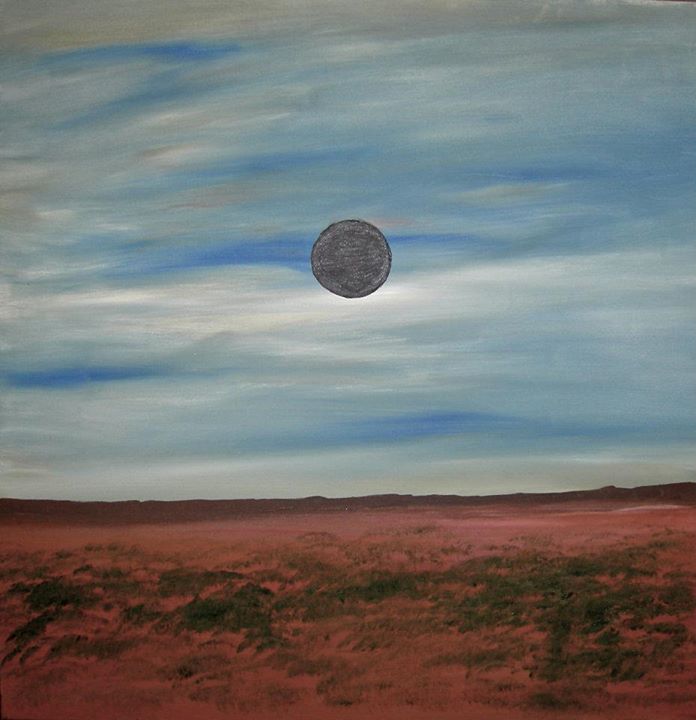


Learning from the Pain of Love

Why is it that we humans learn from pain so much better than from love? Or better yet, why do we learn from the pain of love rather than love itself? Perhaps the pain initially pushes us into survival mode, then potentially, we begin to grow, to thrive, stimulating invention and creativity.


All was well. Or so I thought…


And then, one autumn day, I was given the gift of the perfect storm. A lover whose anguish turned to anger during conversation about our potential break up. He said to me, “You’re not allowed out.”


That simple statement sent me into an emotional spiral, down, down, and I landed in a whirlpool of intense emotions and pain. I scratched and clawed my way to freedom, but to no avail. My flailing only caused more anxiety, more panic, more fears of “no way out, I’m not safe, trapped”. I was overwhelmed, drowning in my own pain and suffering. Shaking and panicked,I managed to breathe and with help, calm myself.


When I became more centered, I shared my experience with others, and realized what had happened.


I was experiencing memories. Of a physically and verbally abusive childhood. Firmly suppressed in the dark reaches of a closeted unconscious where they thrived as a deep soul wound. Given the right circumstances, that wound, comprised of painful impressions, would awaken. An alert alarm would go off, signaling danger and I would react according to an old pattern of behavior. An adult acting out like a terrified adolescent in those stressful situations.

 DSC_2311


I didn’t know it was there, at least not consciously. It didn’t leave a gaping hole in my skin, or a scab, or any physical pain.


No, it was more insidious then that. It laid low in the cellar of my unconscious mind, activating whenever it was threatened. Whenever it felt unsafe, trapped, or terrorized.


Then it would rear its’ ugly head in defensive rebellion, an attempt to create safety. And every time it rose up, I would succumb to its bite.


I decided I needed to understand this wound better,this energy that had been propelling me through life, forcing me to exhibit certain behaviors when activated. I went there again, face to face, and realized it was a wound I’ve been carrying around for decades, since childhood. It was terrifying. I kept telling myself, wherever self was, to breathe. Deeply.


After the initial shock of introduction, I settled in and allowed the wound to show me its’ contents. The years of situations and experiences that created it. The terror, fear, pain, shame, were all there. After being with the wound for some time, I came to at least not fear it. I could be with it, in its’ presence and not run.


“How strange that we should ordinarily feel compelled to hide our wounds when we are all wounded! Community requires the ability to expose our wounds and weaknesses to our fellow creatures. It also requires the ability to be affected by the wounds of others… But even more important is the love that arises among us when we share, both ways, our woundedness.” (1-Scott Peck)


Why is it that we humans learn from pain so much better than from love? Or better yet, why do we learn from the pain of love rather than love itself? Perhaps the pain initially pushes us into survival mode, then potentially, we begin to grow, to thrive, stimulating invention and creativity.


“Pain is a pesky part of being human, I’ve learned it feels like a stab wound to the heart, something I wish we could all do without, in our lives here. Pain is a sudden hurt that can’t be escaped. But then I have also learned that because of pain, I can feel the beauty, tenderness, and freedom of healing…” (2 – JoyBell)

 DSC_2300


Author Henry Miller muses about pain and to actually trust it, “The key word is trust.  Trust everything that happens in life, even those experiences that cause pain will serve you in the end. It’s easy to lose the inner vision, the greater truths, in the face of tragedy. There really is no such thing as suffering simply for the sake of suffering. Along with developing a basic trust in the rhyme and reason of life itself, I advise you to trust your intuition. It is a far better guide in the long run than your intellect.” (3 – Henry Miller)


Ayya Khema writes in the book titled Being Nobody, Going Nowhere, that:

“Suffering is our best teacher because it hangs onto us and keeps us in its grip until we have learnt that particular lesson. Only then does suffering let go. If we haven’t learnt our lesson, we can be quite sure that the same lessons going to come again, because life is nothing but an adult education class. If we don’t pass in any of the subjects, we just have to sit the examination again. Whatever less we have missed, we will get it again. That is why we find ourselves reacting to similar situations in similar ways many times.” (4 – Khema)


Besides Henry Miller, what about other great artists: musicians, painters, dancers, the list goes on. Weren’t most of those artists in some kind of emotional and/or psychological pain?  Weren’t the creation of great works of art emerging from some unknown suffering – some wounds?


Vincent Van Gough was a great artistic talent and at times, was in extreme emotional, mental, and physical fatigue and pain. Here he communicates his state of being to his brother Theo, “Dear Theo: I had a fit after waking but then fell into yet another terrible strange delusion in which my unfortunate paintings had now been assembled in some vast marble mausoleum.  Thousands of people swarmed and shoved and jostled each other before them. I want my pictures to touch people, but I never conceived they would cause so many people to touch each other! Can you imagine? I need to rest. I hear there’s a nice place at St. Re’my…  (5 – Van Gogh/ Kimmelman)


Rod MacIver, poet, artist has this to say about his view of the human condition:

“We build our own walls around ourselves, our own prisons, out of preconceptions we have about life and about other people. The walls are designed to protect us, but they limit us. I seem to have a deep need to prove that the rules most people live their lives by are unnecessary – that I don’t need to live my life by those rules. Illusion bumping against illusion.”


*****

When the wound was activated, I spiraled into an illusion, and was bumping against illusions. I could not see clearly – trapped in a dark house of mirrors. Now, the light of awareness has touched this place in me. I am conscious of this wound inside me, and it’s become a teacher, rather than a friend.


Mr. MacIver continues, “The beauty of people is in their flaws as in their integrity and courage.  It is this – our humanness, the learning of big lessons over and over again – that gives our journey its sacredness.  And we are each on a sacred journey, the destination: Peace and Balance. Harmony between people depends upon the honoring of another’s journey – pain, learning, wisdom and fears.The world is what it is, and I may have no idea what is really going on. It is my choice what I build my life around. I want to celebrate rather than criticize or alienate.” (6 – MacIver)


On further introspection, perhaps it’s a combination of the pain of love, with the deeper, larger love of humanity and the unshakeable belief in the human condition.


I agree with Mr. MacIver. I choose to celebrate rather than alienate my pain. It most likely will take much patience, love, and time to unravel all the mysteries of my wound, and how it has shaped my behaviors and life. How it has forced me to run and hide from anger and rage, yet at the same time, to seek it out. Strange, isn’t it? We seek what we know. We will also attract into our life those people and situations who will help us to heal, and at times, force us to look at our wounds. This has happened to me. I can no longer run and hide. With the courage it took to face, process and heal this emotional wound,I have opened up to a whole new level of love, for myself and subsequently, others.


Henry Miller said once, “Next on my list is to learn what love is. Love is complete and utter surrender. That’s a big word, surrender. It doesn’t mean letting people walk all over you. It’s when we surrender control, let go of our egos, that all the love in the world is there waiting for us. Love is not a game, it’s a state of being.” (3 – Henry Miller)


Surrender to love. That’s a dilemma for the ego because it wants love yet wants to stay in control. The potential result? Conflict and Pain, for to become deeply intimate with another, to experience the love we all crave, control must be released or at least, subdued. I see the spiritual journey as the gentle surrender of control, manipulation and fears to trust, acceptance and love. This is accomplished according to one’s level of comfort. To surrender one’s ego, let go of control and simply be. Sounds easy? Maybe, however again, according to our level of comfort around surrendering, it can be a convoluted trek.


Perhaps we are all tortured souls looking for a respite in the arms of love and acceptance.


I went down into my depths and sat with what I thought was an enemy,a torturer, who turned out to be an old friend and teacher…pain. Presently, I am discovering what is reality…and real.

 DSC_2319


What is REAL?” asked the Rabbit one day…”Does it happen all at once, or bit by bit?”


“it doesn’t happen all at once,”said the Skin Horse.  “You become.  It takes a long time.  That’s why it doesn’t often happen to people who break easily or have sharp edges,  or have to be carefully kept.  Generally, by the time you are Real, most of your hair has been loved off, and your eyes drop out and you get loose in the joints and very shabby.  But these don’t matter at all, because you are Real , you can’t be ugly, except to people who don’t understand.” (7 – Williams, The Velveteen Rabbit)


By the time I am an old woman, I sincerely hope that my “hair will be loved off, my eyes dropped out (and useless) and loose in the joints and very shabby”. For then, I will have endured all that the pain of love has to offer and hopefully, will have become REAL.


*****

© Brooke Becker, 2015


References

1. M. Scott Peck, “The Road Less Traveled”, Touchstone Publishing, 1988

2. C. JoyBell C., Poet and Author, “All Things Dance Like Dragonflies”

3. Henry Miller, American author,from “Reflections”, edited by Twinka Thiebault

4. Ayya Khema, “Being Nobody, Going Nowhere”, Wisdom Publications, 1987

5.Vincent Van Gogh, from “Beauty and the Blockbuster,” by Michael Kimmelman, New York Times Art Review, 1998.

6. Roderick MacIver, artist and publisher, “The Heron Dance Book of Love and Gratitude”,Heron dance Press, 2005

7. Margery Williams, “The Velveteen Rabbit”, Ariel Books, Andrews and McMeel,  1922


Images: Glencoe, Scottish Highlands by Edel Monteiro


Cash for Gold: Mixed Martial Arts

Click anywhere on image to view show in a new tab or window


cfg-mma1


Fraser Stables is a Scottish artist, based in the USA. Stables has exhibited internationally in solo and group exhibitions in Europe, Japan, Canada, and USA. He is a co-director of Atopia Projects and teaches at Smith College in the USA. His artwork is available through Georgia Scherman Projects in Toronto, Canada.

x

Originally from Houston, Texas, Brett Davidson is a poet and songwriter who lives in Switzerland. He is the author of Undertaker Please Drive Slow (Horse Law Press, 2008).  His most recent book is Glass House (Atopia Projects 2010), a meditation on the life and work of architect Philip Johnson. He also writes for and records with Captain Ludd and The Jesus Taco.


© Fraser Stables and Brett Davidson, 2015


« Older posts

© 2026 THE ESSAYIST

Theme by Anders Noren — Up ↑