Month: October 2014

What I say and what you see? A tragedy of errors (mis-reading) in public communication from Mauritius to Monrovia

And in the naked light I saw

Ten thousand people, maybe more.

People talking without speaking,

People hearing without listening,

People writing songs that voices never share

And no one dared disturb…


“The Sound of Silence” – a song by Simon & Garfunkel from the debut studio album: Wednesday Morning, 3 AM (1964).

 

le morne 2


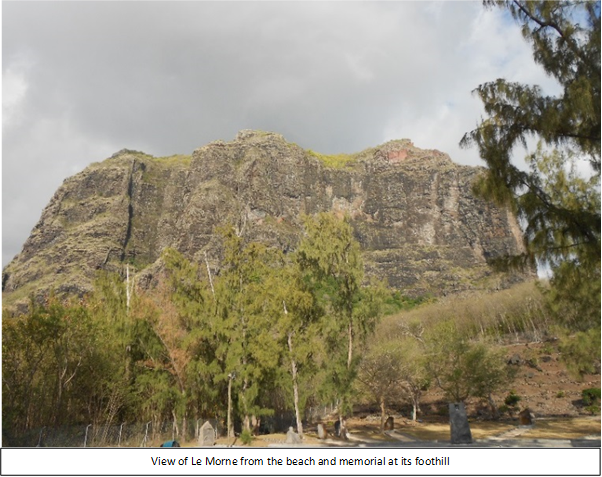
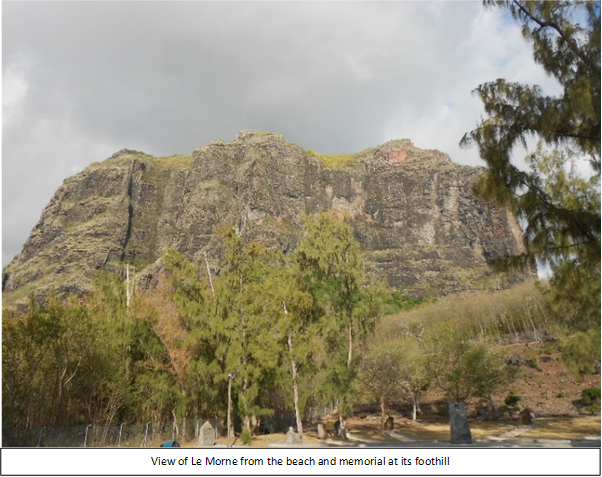
This iconic and stunning rocky crag, located at the south-western tip of the island of Mauritius, juts out into the Indian Ocean and gives the scenic peninsula its name – Le Morne. It has some of the best beaches and is a popular tourist destination. However, Le Morne is a place of immense historical importance. It was  an important node on the slave route in the Indian Ocean. It was witness to a tragic, yet heroic, story of how a group of people chose the glory of freedom and death over an enslaved life. It also provides an important lesson in communication.


Le Morne, as it is popularly known, or Le Morne Brabant or in UNESCO’s book as Le Morne Cultural Landscape, is a hill or crag that is perhaps only 556 meters or roughly 1,800 feet above sea level with many caves and overhangs on the steep slopes. The summit area is about 12 hectares or 30 acres. However, Le Morne holds a special place in the hisrory of the island on which it is located.


Mauritius has a unique multicultural history. It is said that the Arabs discovered the island in the 9th century and then the island has been taken advantage of by various colonizers from the Portuguese who made brief stopovers but never stayed; the Dutch who were responsible for the extinction of the Dodo bird; the French who amassed wealth from plantations by using slaves from Africa; and then the British who brought indentured labor from India to run the sugarcane plantations in the interior of the island after slavery was abolished in 1835, and most of the African slaves (after abolition) abandoned agriculture and moved to the coastal areas.


However, even before the official abolition of slavery in 1835, history (including the UNESCO website) has it that Le Morne was commonly used as a shelter by runaway slaves in the 18th and early part of the 19th century. These runaway slaves were known as maroons. The UNESCO website states that Mauritius was an important stopover in the eastern slave trade and it came to be known as the “Maroon republic” because of the large number of escaped slaves who lived on Le Morne.


Le Morne was isolated, wooded and had almost inaccessible steep cliffs. The runaway, escaped slaves felt protected by Le Morne and formed small settlements in the caves and on the summit. The oral traditions associated with the maroons, have made Le Morne a symbol of the slaves’ fight for freedom, their suffering, and their sacrifice, all of which have relevance to the countries from which the slaves came – the African mainland, Madagascar, India, and South-east Asia (UNESCO).
 le morne


However, the tragedy of slavery is matched by a greater tragedy that struck Le Morne and its inhabitants AFTER the abolition of slavery in Mauritius on 1 February 1835. It is said that a battalion of policemen started climbing the hill. Their intent: Merely inform the runaway slaves that they had actually been freed. They did not have to live in fear or as runaways anymore.


However, the runaway families misunderstood or mis-read the expedition. They did not trust the authorities – their previous captors. They thought that the police battalion had come to re-capture them.


They chose death over recapture. Person after person leapt to their deaths from the steep cliffs. Men jumped to their death, women jumped because the police team was not far behind. Even mothers leapt with their babies.


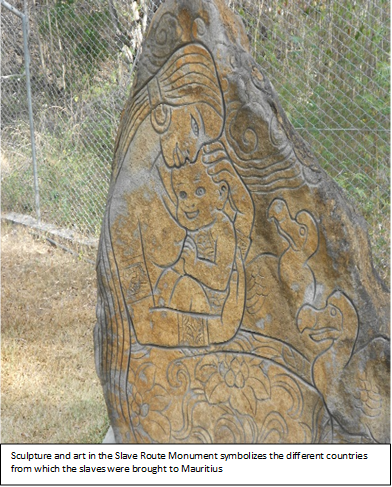
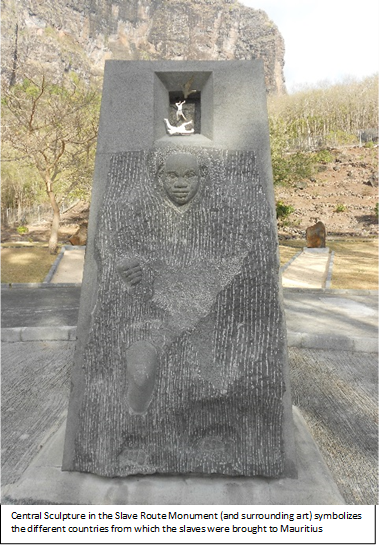
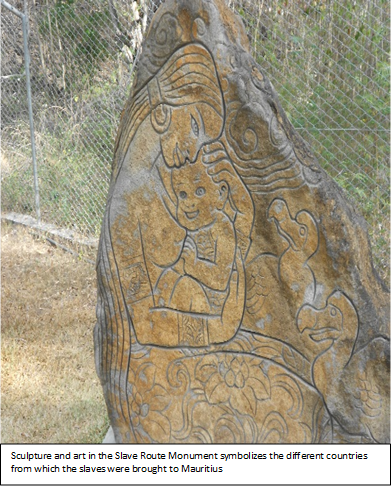
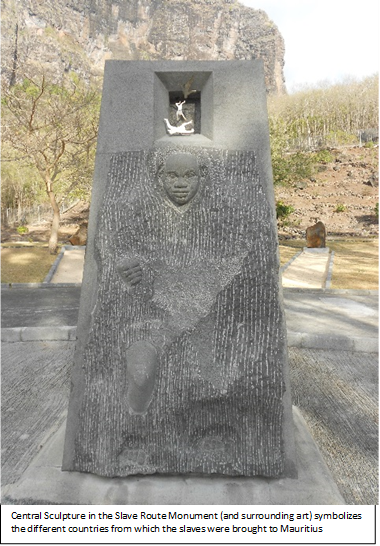
The locals told us that even today the bones of those who jumped from the cliff-top are discovered periodically. Why did they jump? Why did the men jump, why did the women jump? Why did mothers jump with their babies? Because they had tasted freedom and did not want their children to be enslaved. The so-called slaves showed their humanity to their captors because they chose to die rather than lose their freedom. Since then the date is celebrated as the Annual Commemoration of the Abolition of Slavery. The Slave Route Monument, at the foot of Le Morne mountain and right across the public beach, has been created as a symbol of peace through cultural dialogue and as a reminder of the importance of freedom in our lives. The Slave Route Monument was inaugurated on the 1st of February 2009, which happened to be the 174th anniversary of the Abolition of Slavery in Mauritius. A central sculpture (shown below) and the surrounding art (shown alongside) symbolizes and represents the various countries from where slaves were taken to either work in Mauritius or kept during the transit because Mauritius was part of the slave route of the Indian Ocean. Existing sculptures and art represent the countries of Mozambique, Madagascar, India, China, Malaysia, Haïti & Réunion island.
 

le morne 3


However, despite the power of this tragic event to rally all those working against enslavement in any form; what happened at Le Morne was completely avoidable. Or as we tend to call it in public health – the deaths at Le Morne were completely preventable deaths. Le Morne is not just a tragedy in the history of slavery; it is also a public health tragedy. A tragedy caused by poor communication!


Many things could have been done differently. The police could have sent just one person to convey the news; the administration could have sent other people that the runaways knew. They could have made announcements in other ways; celebrated the abolition in the plains and then let the news filter slowly to the hilltops. There are thousand different things that could have been done to save all those lives – avert a tragedy. In the end the Le Morne incident remains a blunder in public communication – an example of how well thought out communication saves lives and poorly thought out communication can take lives.
 

le morne 4


***********


 What lesson does Le Morne hold for communication?


Of course it tells us that even those we dehumanize can bring us to face our own humanity or lack of it. It can tell us that human beings often choose freedom over life itself. However, from a communication perspective this is about ‘reading‘. Almost all communication experts have propagated this concept, talked about this term; but very few of us actually practice it.


What do we mean by ‘reading.‘ It is a very simple concept-


Communication works best if it is said in a manner in which the audience wants to hear/see/feel. Not in the manner that I as a communicator wish to tell them (however noble or good my intentions may be) but rather in the manner in which the audience will perceive it. Therefore, the true test of good communication is whether it has put itself in the shoes of the audience or the reader. Good communication is all about empathy. And communication that is built on empathy also pays attention to the context in which something is being said, the history, the past relationship between communicator and the audience.


Essentially “reading” is basically understanding how different audiences will perceive, read the messages we put out as communicators and ensuring that they read it in a manner that does not push them to jump off a cliff.  Sounds simple, but as we will see, we have still not mastered the art and science of communicating something to someone in a way that it is interpreted in the correct manner. The handling of the recent Ebola outbreak in West Africa (discussed later) demonstrates the lessons not learned.


**********


In the book “The Tipping Point: How little things can make a big difference,” the author Malcolm Gladwell finds three things that help a particular trend or idea to “tip” into popular acceptance and success. Essentially Gladwell’s book discusses what factors cause consonance between what the person who owns or is pushing the idea wants to tell or sell and how the audience reads that sales pitch. Gladwell calls these three factors: the Law of the Few, the Stickiness Factor, and the Power of Context.


The Law of the Few talks about the critical role of a champion or a messenger in pushing an idea or product into the general stream. There are different types of messengers: those who are well networked, those who can persuade others to buy into an idea, and those who can sell an idea. Having these kinds of messengers helps the new idea connect with people and make it popular.


What Gladwell means by the Stickiness Factor is the quality of the message or idea which moves people to pay close attention to the new concept. Thus, the quality of the message or how the message is put across to the people is critically important.


Finally, Gladwell mentions that the most powerful of the three factors is the Power of Context which implies that even minor changes in the environment of a community or the composition of social groups can cause a new idea to tip into acceptance by the majority.


Thus, if Gladwell’s three laws are now examined in the light of “reading” of communication by audiences, then communicators have three tools to play with: the message, the messenger and the context. If Gladwell’s factors are applied to Le Morne, then the idea of Abolition of Slavery was a powerful and positive one for the runaway residents of that hill. The message was sticky; however the administrators chose to ignore the law of sending the right messenger and the power of context, which included their history and past experience as slaves as well as Mauritius being an important node on the slave route on the Indian Ocean.


Since we all see meaning in what we read differently based on our own life experiences and current circumstances, it is only natural that we will have different and sometimes perhaps quite contradictory interpretations to the same message or text and to the intentions of the person sending the message – the author of the message.


Sometimes the same person may have different interpretations of the same text or message at different times in his or her life. For instance, a ten year old was seen re-reading the Percy Jackson book series that he had read about two years ago. When asked why he was re-reading the books the child said that he understands some things better, is able to relate to things differently, and it is “making more sense now.” If he ever chooses to revisit the books again at another time his sense-making of the text may be different.  Similarly one of the authors recently re-read the book “Tuesdays with Morrie” – a book the author had already read more than 15 years ago when life circumstances were very different. Now with a lot of elderly, ailing members in the family the author’s engagement with the book was quite different.


Is it not valid then for all readers and viewers to have a very different interpretation of the material and aren’t all interpretations valid?


Sometimes when we read a text or watch a movie we realize that the writer or story-teller is trying to influence us to think in a particular way, feel a particular emotion for the theme of the film or the main character. While the reader is completely engaged with the text and suddenly apprehends this reality that the writer is consciously trying to influence or brainwash the reader then the reaction could be one of contempt and distrust in everything that the writer or producer creates. For instance, the propaganda films and books. However, does any artist ever create anything without a sub-text? Without layering the text or art form with their own meanings, however subconscious those layers of meaning may be? So who controls the reading: the author or the audience?


****************


In the field of literary theory, many schools of thought traditionally focused their attention mainly on the author, the content and the form of the literary work. Theories of formalism and New Criticism emphasized that which was within a text was part of the meaning of a text and the reader’s role or psychology in re-creating literary works was almost negated or denied.


However, in the 1960s and 70s, there was a growth in the popularity of the “reader-response criticism,” a school of literary theory that focused on the reader (or the audience) and the reader’s experience of a literary work. Reader-response theory recognized the reader as an active agent who completed a text or work’s meaning through his or her interpretation. Literature was seen as a performance art in which each reader created their own, possibly unique, text-related performance. This was quite contrary to previous thought in the field.


Roland Barthes, French theorist and literary critic, in a 1967 essay titled: “The Death of the Author” (French: La mort de l’auteur) argued against traditional literary criticism’s practice of incorporating the intention and biographical context of an author in the interpretation of a text.  Instead he argued that writing and creator are unrelated. Barthes reasoned that “to give a text an author” and assign a single, corresponding interpretation to it “is to impose a limit on that text.” This method of reading that flows from an authorial perspective may be apparently tidy and convenient but it is actually sloppy and flawed.


Barthes urged readers to separate a literary work from its creator in order to liberate the text from interpretive tyranny. Each piece of writing contains multiple layers and meanings. The essential meaning of a work then depends on the impressions of the reader, rather than the “passions” of the writer. According to Barthes the unity of any text does not lie in its origins or its creator, but in its destination – which is its audience.


Barthes expressed that the author is just a “scriptor”. The scriptor exists to produce but not to explain the work.  He used the word scriptor intentionally in order to disrupt the traditional continuity of power between the terms “author” and “authority”. For Barthes, every work is “eternally written here and now,” with each re-reading, because the “origin” of meaning lies exclusively in “language itself” and its impressions on the reader.


However, many in public communication still continue to connect the author and authority. Thus, there exists a tendency in public communication to simply state what the authority wants us to tell the audience without thinking of the audience or the context. So we sell hygiene, hand-washing, toilets for the poor without thinking of how the poor, who have no access to drinking water, will interpret a message about practices such as washing hands with soap and water or flushing a toilet that requires many liters of water. And this attempt to focus on the author and authority rather than the audience or reader provides us many examples of mis-reading in public service communication.


Just like the Le Morne episode the audience does not know the intentions (of the author -communicator), they simply read it in the context. This reading is guided by past experiences and knowledge, and their current circumstances. Past experience in Le Morne had warned people about the police; the families were deemed runaways by the people in power and the police were seen as the captor’s instruments. There was no way out for the slaves in their own minds when they saw the police battalion climbing up that hill except to confront the armed police and get captured or to choose freedom and jump to death from the cliff.


The concept of ‘reading‘ is also demonstrated in case of a surrender – raised hands, white flag. There are some signs and communication messaging that are almost universal. A battle is fought between two sides. It is the fiercest of battles and one side (considered the enemy by the other side) comes out with a white flag or their hands raised in the air. The immediate reaction of the winning side is to accept the surrender and not use the opportunity to kill the enemy troops. If some of the soldiers on the winning side fired at the surrendering soldiers it would be construed as betrayal of the very code of a warrior.


Perhaps this can be called universal ‘visual literacy.’ Most international travelers, who do not “read” or understand the language written in foreign airports, can still locate the washrooms, the coffee shops, the automatic money machines and the meeting place. They can locate their boarding gates thanks to the numbers. Numbers are also a universal communication that has little ambiguity.


This ‘reading‘ also underlies the phenomenon called ‘positioning’ in management or marketing terms.


Reading and positioning: Cheap cars or cars that seem cheap


India suffers from the highest number of deaths – around 1,05,000 in absolute terms annually- due to road accidents in the world owing to poor infrastructure and dangerous driving habits, a World Health Organization report claimed. Poor road infrastructure, failure to comply with speed limits, growing drinking and driving habits, and refusal to use proper motorcycle helmets and child car seats, are among the main factors contributing to deaths from road crashes. Around 13 per cent of the victims from road-related deaths are pedestrians in India as compared to 15 per cent of accidents from passenger cars and taxis and 27 per cent of riders of motorized two-or-three wheelers.


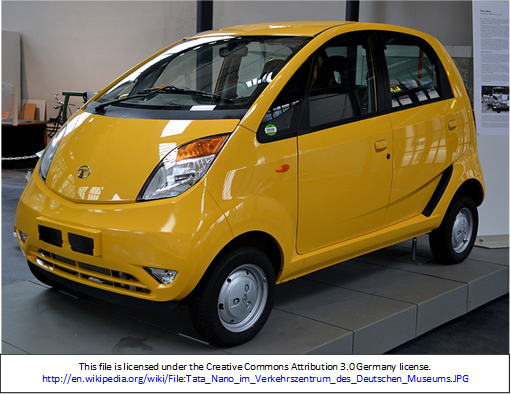
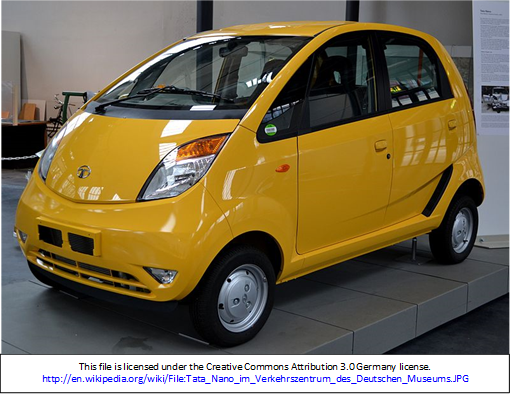
Just a couple of years before the WHO report came out, on March 23, 2009, Tata, a well known company in India had launched the Nano car. Ratan Tata, the director of the company said this at the launch: “Ladies and Gentleman, thank you for being with us on this memorable occasion. There are no celebrities at this function nor any dance routines. The center of attraction for this morning’s event is the new Tata car (Nano) which we are unveiling… Today’s story started some years ago when I observed families riding on two wheelers, the father driving a scooter, his young kid standing in front of him, his wife sitting behind him holding a baby and I asked myself whether one could conceive of a safe, affordable, all weather form of transport for such a family. A vehicle that could be affordable and low cost enough to be within everyone’s reach, a people’s car, built to meet all safety standards, designed to meet or exceed emission norms and be low in pollution and high in fuel efficiency. This then was the dream we set ourselves to achieve.”
 

tata


Thus, the Nano car priced at three thousand dollars or less was perfectly placed to save India from many preventable deaths – deaths that can be averted. It was indeed a dream come true for transportation of millions of families in small towns and rural India.


However, on October 14, 2013, Wall Street Journal headlined an article titled: Why the World’s Cheapest Car Flopped?


It turned out that those climbing into India’s aspirational middle class did want cheap cars, but they did not want cars that seem cheap. The people were willing to travel on their dangerous motorbikes until they had enough money to pay (more than Tata reckoned) for a vehicle that has a more upmarket image. Now, Nano is trying remake the “people’s car,” into the “cool people’s car.” It has given the car itself a face-lift, adding a stereo, hubcaps and chrome trim, raised the price and started a new marketing campaign to give it more cachet.


The car Nano was intended to be positioned as the cheapest car. It bombed as the audience read it as ‘a poor man’s car’.


*********


Reading from experience: Government services


Public health messages that talk of health services offered by government centers and staff are most often read as ‘dubious’ by the public owing to horrendous experiences in the past or horror stories of bad public service from neighbors or newspapers. Rather than a public communication that government centers offer great services, a message such as ‘we are a public center and we may not be as prompt or good as the private sector, but we are trying our best’ will perhaps elicit a better response from the public because it will be read as ‘honest’.


If we consider examples of other public health communication (messages), they can be either informative or instructive. Those that are informative are ‘read’ based on the felt need of the person. If there is a felt need in the person reading it, then it encourages positive thinking in the reader; if there is no need, it is mostly ignored. For instance the message smoking causes cancer may be ignored by a non-smoker. However the instructive sign: No smoking in this restaurant may be acted upon by the non-smoker if she / he finds someone to be smoking in that place.


The messages or communication that are instructive are mostly read as part of somebody’s responsibility to make that message public. So, ‘Don’t drink and drive’ is an instruction on the road that is read as ‘Traffic police is supposed to ensure___’. The same goes with the “No smoking” in the restaurant sign. The non-smoker may not confront the smoker directly but complain to the manager of the restaurant or do nothing if the manager does nothing.


There is a great difference (in how it is read) between instructional messages such as: ‘Say No to Accidents’ (Instruction) versus ‘Sharp turn ahead’ (Information). Signs that inform: ‘Accident prone area’ may often have a better effect on the reader than signs such as: ‘Drive slow’. Because if the reader reads a sign that says: Drive slowly – and then sees the car next to it speed up, the automatic reaction is to speed up rather than drive slow. However, if the same driver / reader had seen the sign: Accident prone turn ahead” – the driver or reader would have labeled the driver in the next car as irresponsible.


The signs such as drive slow – now only do not elicit the required behavior, they also evoke anger at the authorities for not being able to control irresponsible behaviors.


And the poorly thought out communication show goes on…

 

le morne 5


The Ebola virus disease (EVD) epidemic is still on-going in some of the poorest countries in West Africa. The WHO website says: “This week (of September 22, 2014) marks 6 months since WHO was notified of an outbreak of Ebola virus disease in Guinea. This outbreak has since evolved into the largest, most severe and most complex outbreak in the history of the disease. The 3 most-affected countries – Guinea, Liberia and Sierra Leone – face enormous challenges in stopping transmission and providing care for all patients.”


As of 20 September 2014, the World Health Organization (WHO), the United States Centers for Disease Control and Prevention (CDC) and local governments reported a total of 6,185 suspected cases and 2,909 deaths (3,424 cases and 1,705 deaths having been laboratory confirmed).


The Director-General of the WHO, Margaret Chan, called the outbreak “the largest, most complex and most severe we’ve ever seen” and said that it “is racing ahead of control efforts. In the three hardest hit countries, Guinea, Liberia and Sierra Leone, the number of new cases is moving far faster than the capacity to manage them in the Ebola-specific treatment centers. Today, (Sept 12) there is not one single bed available for the treatment of an Ebola patient in the entire country of Liberia.”


Experts believe the current official numbers of dead substantially understate the size of the outbreak, due in part to community resistance to reporting cases, a lack of personnel and equipment to investigate reports of the disease, and the lack of beds in treatment centers to treat the high numbers of people needing hospital care.


Ebola has always been known as a fatal disease; that is why most health experts are worried about Ebola outbreaks. While previous outbreaks have seen death in almost 90% of those infected, early WHO reports suggested a considerably lower overall case fatality rate (CFR) of 53% in the 2014 West African outbreak. But on 23 September, WHO released a revised overall CFR estimate of 70% derived using data from patients with definitive clinical outcomes.


Affected countries, which are among the poorest in the world, have encountered many difficulties in their control efforts. In some areas, people have become suspicious of both the government and hospitals. Some hospitals lack basic supplies and are understaffed. This has increased the chance of the health staff getting infected. In August, the WHO reported that ten percent of the dead have been health care workers.


Some hospitals and treatment centers have been attacked by angry protestors who believe that the disease is a hoax or that the hospitals are responsible for the disease. Many of the affected areas have extreme poverty, without even running water or soap to help control the spread of disease.


Reading from context


Liberia is one of the affected countries in West Africa. Bordered by Sierra Leone to its west, Guinea to its north and Ivory Coast to its east, Liberia is home to about 4 million people. English is the official language, with over thirty indigenous languages also spoken in the country.


Liberia is the only country in Africa founded by United States colonization while occupied by native Africans. In 1820, this region was colonized by African Americans (who later become known as Americo-Liberians) most of whom were freed slaves. With the help of the American Colonization Society, the Americo-Liberians established a new country.


In 1847 a new government modeled on that of the United States was established in the republic of Liberia. The capital city was named Monrovia after James Monroe, fifth president of the United States who had supported the colonization. The Americo-Liberians led the political, social, cultural and economic sectors of the country and governed the nation for over 130 years as a dominant minority. However a military coup in 1980 overthrew the Americo-Liberian rule, marking a downslide in Liberia that led to great economic instability and two successive civil wars. Between 250,000 and 520,000 people are said to have died and the country’s economy lay in ruins. Peace agreements were signed in 2003 after international pressure and a domestic protest movement called Women of Liberia Mass Action for Peace. Democratic elections were held in 2005. As of date, Liberia is still recovering from the effects of the civil wars and subsequent economic upheaval; and 85% of the population continue to live below the international poverty line.


On 27 July, 2014, after Ebola outbreak had been announced, democratically elected President Ellen Johnson Sirleaf announced that Liberia would close its borders and the worst-affected areas would be placed under quarantine. Football events were banned because large gatherings and the contact nature of football could increase transmission risks. Three days after the closure of borders, the president announced that all schools across the nation and the University of Liberia were to be closed, and that a few communities would be quarantined. President Sirleaf declared a state of emergency on 6 August, partly because the disease’s weakening of the health care system has the potential to reduce the system’s ability to treat routine diseases such as malaria; she noted that the state of emergency might require the suspension of certain rights and privileges.


In the absence of a proper health system to address the issue and breakdown of the structure quarantine was used as the method of controlling spread of the disease. Quarantine is a state of enforced isolation or separation and restriction of movement of people.


The word “quarantine” comes from the Venetian dialect form of the Italian quaranta giorni, meaning ‘forty days’. This was the number of days ships entering the city of Dubrovnik in Dalmatia (Croatia) were required to be isolated before passengers and crew could enter the land during the Black Death plague epidemic. In ten years, between 1348 and 1359, this epidemic killed an estimated 30% of Europe’s population, and a significant percentage of Asia’s population. According to the original document from 1377 kept in the Archives of Dubrovnik, before entering the city, newcomers had to spend 30 days (a trentine) in a restricted place (originally nearby islands) waiting to see whether the symptoms of Black Death would develop. Subsequently, the isolation period was prolonged to 40 days and was called quarantine.


Quarantine as a preventive measure was practiced for other diseases such as leprosy; those afflicted with leprosy were historically isolated from society. Similar measures were attempted to check the invasion of syphilis in northern Europe in about 1490, the advent of yellow fever in Spain at the beginning of the 19th century, and the arrival of Asiatic cholera in 1831.

Quarantine has always been seen as an infringement of civil rights and when entire communities are forced to stay inside their own neighborhoods, especially places that have no running water or electricity, it can be inhuman and force people to make violent decisions. West Point, one of the poorest slums in Monrovia, the capital of Liberia is where it all boiled over on 18 August.


Angry residents rushed into an Ebola holding center that night and assaulted 17 patients housed there. These patients were suspected of Ebola and they were not from that community. Residents complained that they were already poor, their neighborhood was a mess and that they had not received any information about the facility and to add insult to their perceived injury people from outside their neighborhood were being brought in. They screamed at the patients, telling them to leave, threatened the caretakers, and looted the clinic of its supplies, including bloodstained bed sheets and mattresses.


This created a whole chain of actions and reactions – each subsequent one poorly thought out than the prior. The government read this angry reaction as a sign that many residents of West Point who had forcefully entered the treatment location may have caught the virus themselves when they had physically touched the patients. Even police and aid workers expressed fear that this act would lead to mass infections of Ebola in the Monrovian slum.


Fearing that this might start a fresh wave of transmission of Ebola, on 19 August the government quarantined the entire densely populated West Point neighborhood in the next two days. Around 70,000 residents woke up in the morning to find themselves blocked in by checkpoints and a buffer zone. The quarantine is intended to stay in place for 21 days — the maximum time it takes for new infections to become apparent.


And then the police did another thing that was “read” by the residents as another major transgression. The police escorted a government minister into the neighborhood because her children live in West Point and she wanted to bring them out. And the reading of that action – what it communicated became a trigger for a large scale riot, with a final breakout of violence on 22 August after the military fired on protesting crowds.


The Ebola outbreak and the social crisis that it sparked is a clear case of communication that did not take into consideration the context of people’s lives.


How to read the reader


When residents of Liberia, Guinea, and Sierra Leone see their own friends and relatives go to the health centers and hospitals, get admitted, and never return (not even their body returns), there is a perception or “reading” that going to the hospital means a death sentence.  In addition, news of the rising death toll due to Ebola also causes people to think and “read” the situation as one where if someone has the infection then they are certain to die.  And so after this “reading” of the situation many make the decision that rather than die alone in a hospital far from home, it is better to stay quietly at home and die in the company of their loved ones. They do not realize that 1) their chances of survival can be increased if they recognize the symptoms early and seek care early, 2) hydration and proper care at a medical facility improves prospects of survival and 3) if they are sick and in contact with their loved ones at home they are spreading the infection to ones they love the most.


Instead misunderstanding and mistrust that arises from their “reading” of the situation could be actively contributing to the rapid spread of the Ebola virus.


The shutting down of certain parts of town such as what happened in Monrovia and the forced isolation of whole communities speaks louder than words, louder than any communication. These actions make it look like we are just locking them up and leaving them to die. It is no surprise then that the reaction will be anger, mistrust and hostility. Honest communication requires mutual understanding and respect. If not then no matter what is being said it will be construed as being evasive, dishonest, self-preserving and not credible. There is a rule in communication that most people pay attention to body language, movements, actions and very little attention is given to the actual words.


Open and honest communication conveyed through credible community members who have had similar experiences as members of their community, is likely to be trusted. We’ve also seen in West Africa that certain funeral customs and traditions such as washing and touching of the dead body has contributed to the rapid spread of the virus. All the more important why the situation calls for local, trustworthy community voices to actively engage in the communication.


Just as Ebola is testing our communication skills now, there will be other emergencies and crisis in the future as well that present a unique situation and demand a rethink on how we communicate with people.  Just “telling” or “showing” people what to do and what not to do is going to be  grossly inadequate and could be counter-productive to what communicators are trying to convey. We have to understand how the audience will “read” whatever we put out there. We have to truly place ourselves in our audience’s shoes and walk with them.


The problem of poorly thought out communication escalated Ebola into a scary phenomenon. Ebola outbreaks have occurred in the past and it is a disease (despite having no cure) which has been controlled in the past with strict medical and public health measures. However, the 2014 outbreak of Ebola converted it from a severe medical disease into a social calamity and chaos. The people of West Africa still continue to suffer while the apathy of the world sends a strong signal to them. What do our West African brothers and sisters “read” in our inaction and alibis for inaction that we are sending out regularly? How do all of us “read” a situation where an alliance of developed nations and mid-eastern countries, despite a promise not to engage in unnecessary warfare, instantly sends troops to fight terror in the Middle-East while ignoring the call for military style logistical support to fight Ebola in West Africa?


The problem for our world is: How do we align our communication and our actions?

Communi-Action – understanding that our actions speak louder than our words and that when we communicate the audience or the reader sees our words and actions in its complete context – geographical and historical. Perhaps thinking of communication as communi-action will help us eliminate the gap between what we say and what we do. Once we eliminate the say-do hypocrisy we believe that we will live in a world where our word does mean something and we do what our word intends – what I say will be what you see.


****** Not The End ******

© The Essayist, 2014


About the authors:

Nilesh Chatterjee, Dharmendra Singh and Sanjanthi Velu work in the area of health communication. Sanjanthi Velu is with Johns Hopkins University Center for Communication Programs (JHUCCP), Baltimore, USA. Dharmendra Singh is with the Improving Healthy Behaviours Project (IHBP) of Family Health International 360 (FHI 360), India office. Nilesh Chatterjee, worked with JHUCCP previously, is now an independent public health consultant who works on public health projects.


All photographs of Le Morne are taken by Sanjanthi Velu (except aerial shot of peninsula).

We thank Mr. R Venkatesh for comments on an earlier draft of this article.


References:


What I say and what you see? A tragedy of errors (mis-reading) in public communication from Mauritius to Monrovia

And in the naked light I saw

Ten thousand people, maybe more.

People talking without speaking,

People hearing without listening,

People writing songs that voices never share

And no one dared disturb…


“The Sound of Silence” – a song by Simon & Garfunkel from the debut studio album: Wednesday Morning, 3 AM (1964).


le morne 2


This iconic and stunning rocky crag, located at the south-western tip of the island of Mauritius, juts out into the Indian Ocean and gives the scenic peninsula its name – Le Morne. It has some of the best beaches and is a popular tourist destination. However, Le Morne is a place of immense historical importance. It was  an important node on the slave route in the Indian Ocean. It was witness to a tragic, yet heroic, story of how a group of people chose the glory of freedom and death over an enslaved life. It also provides an important lesson in communication.


Le Morne, as it is popularly known, or Le Morne Brabant or in UNESCO’s book as Le Morne Cultural Landscape, is a hill or crag that is perhaps only 556 meters or roughly 1,800 feet above sea level with many caves and overhangs on the steep slopes. The summit area is about 12 hectares or 30 acres. However, Le Morne holds a special place in the hisrory of the island on which it is located.


Mauritius has a unique multicultural history. It is said that the Arabs discovered the island in the 9th century and then the island has been taken advantage of by various colonizers from the Portuguese who made brief stopovers but never stayed; the Dutch who were responsible for the extinction of the Dodo bird; the French who amassed wealth from plantations by using slaves from Africa; and then the British who brought indentured labor from India to run the sugarcane plantations in the interior of the island after slavery was abolished in 1835, and most of the African slaves (after abolition) abandoned agriculture and moved to the coastal areas.


However, even before the official abolition of slavery in 1835, history (including the UNESCO website) has it that Le Morne was commonly used as a shelter by runaway slaves in the 18th and early part of the 19th century. These runaway slaves were known as maroons. The UNESCO website states that Mauritius was an important stopover in the eastern slave trade and it came to be known as the “Maroon republic” because of the large number of escaped slaves who lived on Le Morne.


Le Morne was isolated, wooded and had almost inaccessible steep cliffs. The runaway, escaped slaves felt protected by Le Morne and formed small settlements in the caves and on the summit. The oral traditions associated with the maroons, have made Le Morne a symbol of the slaves’ fight for freedom, their suffering, and their sacrifice, all of which have relevance to the countries from which the slaves came – the African mainland, Madagascar, India, and South-east Asia (UNESCO).

 le morne


However, the tragedy of slavery is matched by a greater tragedy that struck Le Morne and its inhabitants AFTER the abolition of slavery in Mauritius on 1 February 1835. It is said that a battalion of policemen started climbing the hill. Their intent: Merely inform the runaway slaves that they had actually been freed. They did not have to live in fear or as runaways anymore.


However, the runaway families misunderstood or mis-read the expedition. They did not trust the authorities – their previous captors. They thought that the police battalion had come to re-capture them.


They chose death over recapture. Person after person leapt to their deaths from the steep cliffs. Men jumped to their death, women jumped because the police team was not far behind. Even mothers leapt with their babies.


The locals told us that even today the bones of those who jumped from the cliff-top are discovered periodically. Why did they jump? Why did the men jump, why did the women jump? Why did mothers jump with their babies? Because they had tasted freedom and did not want their children to be enslaved. The so-called slaves showed their humanity to their captors because they chose to die rather than lose their freedom. Since then the date is celebrated as the Annual Commemoration of the Abolition of Slavery. The Slave Route Monument, at the foot of Le Morne mountain and right across the public beach, has been created as a symbol of peace through cultural dialogue and as a reminder of the importance of freedom in our lives. The Slave Route Monument was inaugurated on the 1st of February 2009, which happened to be the 174th anniversary of the Abolition of Slavery in Mauritius. A central sculpture (shown below) and the surrounding art (shown alongside) symbolizes and represents the various countries from where slaves were taken to either work in Mauritius or kept during the transit because Mauritius was part of the slave route of the Indian Ocean. Existing sculptures and art represent the countries of Mozambique, Madagascar, India, China, Malaysia, Haïti & Réunion island.


le morne 3


However, despite the power of this tragic event to rally all those working against enslavement in any form; what happened at Le Morne was completely avoidable. Or as we tend to call it in public health – the deaths at Le Morne were completely preventable deaths. Le Morne is not just a tragedy in the history of slavery; it is also a public health tragedy. A tragedy caused by poor communication!


Many things could have been done differently. The police could have sent just one person to convey the news; the administration could have sent other people that the runaways knew. They could have made announcements in other ways; celebrated the abolition in the plains and then let the news filter slowly to the hilltops. There are thousand different things that could have been done to save all those lives – avert a tragedy. In the end the Le Morne incident remains a blunder in public communication – an example of how well thought out communication saves lives and poorly thought out communication can take lives.


le morne 4


***********


 What lesson does Le Morne hold for communication?


Of course it tells us that even those we dehumanize can bring us to face our own humanity or lack of it. It can tell us that human beings often choose freedom over life itself. However, from a communication perspective this is about ‘reading‘. Almost all communication experts have propagated this concept, talked about this term; but very few of us actually practice it.


What do we mean by ‘reading.‘ It is a very simple concept-


Communication works best if it is said in a manner in which the audience wants to hear/see/feel. Not in the manner that I as a communicator wish to tell them (however noble or good my intentions may be) but rather in the manner in which the audience will perceive it. Therefore, the true test of good communication is whether it has put itself in the shoes of the audience or the reader. Good communication is all about empathy. And communication that is built on empathy also pays attention to the context in which something is being said, the history, the past relationship between communicator and the audience.


Essentially “reading” is basically understanding how different audiences will perceive, read the messages we put out as communicators and ensuring that they read it in a manner that does not push them to jump off a cliff.  Sounds simple, but as we will see, we have still not mastered the art and science of communicating something to someone in a way that it is interpreted in the correct manner. The handling of the recent Ebola outbreak in West Africa (discussed later) demonstrates the lessons not learned.


**********


In the book “The Tipping Point: How little things can make a big difference,” the author Malcolm Gladwell finds three things that help a particular trend or idea to “tip” into popular acceptance and success. Essentially Gladwell’s book discusses what factors cause consonance between what the person who owns or is pushing the idea wants to tell or sell and how the audience reads that sales pitch. Gladwell calls these three factors: the Law of the Few, the Stickiness Factor, and the Power of Context.


The Law of the Few talks about the critical role of a champion or a messenger in pushing an idea or product into the general stream. There are different types of messengers: those who are well networked, those who can persuade others to buy into an idea, and those who can sell an idea. Having these kinds of messengers helps the new idea connect with people and make it popular.


What Gladwell means by the Stickiness Factor is the quality of the message or idea which moves people to pay close attention to the new concept. Thus, the quality of the message or how the message is put across to the people is critically important.


Finally, Gladwell mentions that the most powerful of the three factors is the Power of Context which implies that even minor changes in the environment of a community or the composition of social groups can cause a new idea to tip into acceptance by the majority.


Thus, if Gladwell’s three laws are now examined in the light of “reading” of communication by audiences, then communicators have three tools to play with: the message, the messenger and the context. If Gladwell’s factors are applied to Le Morne, then the idea of Abolition of Slavery was a powerful and positive one for the runaway residents of that hill. The message was sticky; however the administrators chose to ignore the law of sending the right messenger and the power of context, which included their history and past experience as slaves as well as Mauritius being an important node on the slave route on the Indian Ocean.


Since we all see meaning in what we read differently based on our own life experiences and current circumstances, it is only natural that we will have different and sometimes perhaps quite contradictory interpretations to the same message or text and to the intentions of the person sending the message – the author of the message.


Sometimes the same person may have different interpretations of the same text or message at different times in his or her life. For instance, a ten year old was seen re-reading the Percy Jackson book series that he had read about two years ago. When asked why he was re-reading the books the child said that he understands some things better, is able to relate to things differently, and it is “making more sense now.” If he ever chooses to revisit the books again at another time his sense-making of the text may be different.  Similarly one of the authors recently re-read the book “Tuesdays with Morrie” – a book the author had already read more than 15 years ago when life circumstances were very different. Now with a lot of elderly, ailing members in the family the author’s engagement with the book was quite different.


Is it not valid then for all readers and viewers to have a very different interpretation of the material and aren’t all interpretations valid?


Sometimes when we read a text or watch a movie we realize that the writer or story-teller is trying to influence us to think in a particular way, feel a particular emotion for the theme of the film or the main character. While the reader is completely engaged with the text and suddenly apprehends this reality that the writer is consciously trying to influence or brainwash the reader then the reaction could be one of contempt and distrust in everything that the writer or producer creates. For instance, the propaganda films and books. However, does any artist ever create anything without a sub-text? Without layering the text or art form with their own meanings, however subconscious those layers of meaning may be? So who controls the reading: the author or the audience?


****************


In the field of literary theory, many schools of thought traditionally focused their attention mainly on the author, the content and the form of the literary work. Theories of formalism and New Criticism emphasized that which was within a text was part of the meaning of a text and the reader’s role or psychology in re-creating literary works was almost negated or denied.


However, in the 1960s and 70s, there was a growth in the popularity of the “reader-response criticism,” a school of literary theory that focused on the reader (or the audience) and the reader’s experience of a literary work. Reader-response theory recognized the reader as an active agent who completed a text or work’s meaning through his or her interpretation. Literature was seen as a performance art in which each reader created their own, possibly unique, text-related performance. This was quite contrary to previous thought in the field.


Roland Barthes, French theorist and literary critic, in a 1967 essay titled: “The Death of the Author” (French: La mort de l’auteur) argued against traditional literary criticism’s practice of incorporating the intention and biographical context of an author in the interpretation of a text.  Instead he argued that writing and creator are unrelated. Barthes reasoned that “to give a text an author” and assign a single, corresponding interpretation to it “is to impose a limit on that text.” This method of reading that flows from an authorial perspective may be apparently tidy and convenient but it is actually sloppy and flawed.


Barthes urged readers to separate a literary work from its creator in order to liberate the text from interpretive tyranny. Each piece of writing contains multiple layers and meanings. The essential meaning of a work then depends on the impressions of the reader, rather than the “passions” of the writer. According to Barthes the unity of any text does not lie in its origins or its creator, but in its destination – which is its audience.


Barthes expressed that the author is just a “scriptor”. The scriptor exists to produce but not to explain the work.  He used the word scriptor intentionally in order to disrupt the traditional continuity of power between the terms “author” and “authority”. For Barthes, every work is “eternally written here and now,” with each re-reading, because the “origin” of meaning lies exclusively in “language itself” and its impressions on the reader.


However, many in public communication still continue to connect the author and authority. Thus, there exists a tendency in public communication to simply state what the authority wants us to tell the audience without thinking of the audience or the context. So we sell hygiene, hand-washing, toilets for the poor without thinking of how the poor, who have no access to drinking water, will interpret a message about practices such as washing hands with soap and water or flushing a toilet that requires many liters of water. And this attempt to focus on the author and authority rather than the audience or reader provides us many examples of mis-reading in public service communication.


Just like the Le Morne episode the audience does not know the intentions (of the author -communicator), they simply read it in the context. This reading is guided by past experiences and knowledge, and their current circumstances. Past experience in Le Morne had warned people about the police; the families were deemed runaways by the people in power and the police were seen as the captor’s instruments. There was no way out for the slaves in their own minds when they saw the police battalion climbing up that hill except to confront the armed police and get captured or to choose freedom and jump to death from the cliff.


The concept of ‘reading‘ is also demonstrated in case of a surrender – raised hands, white flag. There are some signs and communication messaging that are almost universal. A battle is fought between two sides. It is the fiercest of battles and one side (considered the enemy by the other side) comes out with a white flag or their hands raised in the air. The immediate reaction of the winning side is to accept the surrender and not use the opportunity to kill the enemy troops. If some of the soldiers on the winning side fired at the surrendering soldiers it would be construed as betrayal of the very code of a warrior.


Perhaps this can be called universal ‘visual literacy.’ Most international travelers, who do not “read” or understand the language written in foreign airports, can still locate the washrooms, the coffee shops, the automatic money machines and the meeting place. They can locate their boarding gates thanks to the numbers. Numbers are also a universal communication that has little ambiguity.


This ‘reading‘ also underlies the phenomenon called ‘positioning’ in management or marketing terms.


Reading and positioning: Cheap cars or cars that seem cheap


India suffers from the highest number of deaths – around 1,05,000 in absolute terms annually- due to road accidents in the world owing to poor infrastructure and dangerous driving habits, a World Health Organization report claimed. Poor road infrastructure, failure to comply with speed limits, growing drinking and driving habits, and refusal to use proper motorcycle helmets and child car seats, are among the main factors contributing to deaths from road crashes. Around 13 per cent of the victims from road-related deaths are pedestrians in India as compared to 15 per cent of accidents from passenger cars and taxis and 27 per cent of riders of motorized two-or-three wheelers.


Just a couple of years before the WHO report came out, on March 23, 2009, Tata, a well known company in India had launched the Nano car. Ratan Tata, the director of the company said this at the launch: “Ladies and Gentleman, thank you for being with us on this memorable occasion. There are no celebrities at this function nor any dance routines. The center of attraction for this morning’s event is the new Tata car (Nano) which we are unveiling… Today’s story started some years ago when I observed families riding on two wheelers, the father driving a scooter, his young kid standing in front of him, his wife sitting behind him holding a baby and I asked myself whether one could conceive of a safe, affordable, all weather form of transport for such a family. A vehicle that could be affordable and low cost enough to be within everyone’s reach, a people’s car, built to meet all safety standards, designed to meet or exceed emission norms and be low in pollution and high in fuel efficiency. This then was the dream we set ourselves to achieve.”


tata


Thus, the Nano car priced at three thousand dollars or less was perfectly placed to save India from many preventable deaths – deaths that can be averted. It was indeed a dream come true for transportation of millions of families in small towns and rural India.


However, on October 14, 2013, Wall Street Journal headlined an article titled: Why the World’s Cheapest Car Flopped?


It turned out that those climbing into India’s aspirational middle class did want cheap cars, but they did not want cars that seem cheap. The people were willing to travel on their dangerous motorbikes until they had enough money to pay (more than Tata reckoned) for a vehicle that has a more upmarket image. Now, Nano is trying remake the “people’s car,” into the “cool people’s car.” It has given the car itself a face-lift, adding a stereo, hubcaps and chrome trim, raised the price and started a new marketing campaign to give it more cachet.


The car Nano was intended to be positioned as the cheapest car. It bombed as the audience read it as ‘a poor man’s car’.


*********


Reading from experience: Government services


Public health messages that talk of health services offered by government centers and staff are most often read as ‘dubious’ by the public owing to horrendous experiences in the past or horror stories of bad public service from neighbors or newspapers. Rather than a public communication that government centers offer great services, a message such as ‘we are a public center and we may not be as prompt or good as the private sector, but we are trying our best’ will perhaps elicit a better response from the public because it will be read as ‘honest’.


If we consider examples of other public health communication (messages), they can be either informative or instructive. Those that are informative are ‘read’ based on the felt need of the person. If there is a felt need in the person reading it, then it encourages positive thinking in the reader; if there is no need, it is mostly ignored. For instance the message smoking causes cancer may be ignored by a non-smoker. However the instructive sign: No smoking in this restaurant may be acted upon by the non-smoker if she / he finds someone to be smoking in that place.


The messages or communication that are instructive are mostly read as part of somebody’s responsibility to make that message public. So, ‘Don’t drink and drive’ is an instruction on the road that is read as ‘Traffic police is supposed to ensure___’. The same goes with the “No smoking” in the restaurant sign. The non-smoker may not confront the smoker directly but complain to the manager of the restaurant or do nothing if the manager does nothing.


There is a great difference (in how it is read) between instructional messages such as: ‘Say No to Accidents’ (Instruction) versus ‘Sharp turn ahead’ (Information). Signs that inform: ‘Accident prone area’ may often have a better effect on the reader than signs such as: ‘Drive slow’. Because if the reader reads a sign that says: Drive slowly – and then sees the car next to it speed up, the automatic reaction is to speed up rather than drive slow. However, if the same driver / reader had seen the sign: Accident prone turn ahead” – the driver or reader would have labeled the driver in the next car as irresponsible.


The signs such as drive slow – now only do not elicit the required behavior, they also evoke anger at the authorities for not being able to control irresponsible behaviors.


And the poorly thought out communication show goes on…


le morne 5


The Ebola virus disease (EVD) epidemic is still on-going in some of the poorest countries in West Africa. The WHO website says: “This week (of September 22, 2014) marks 6 months since WHO was notified of an outbreak of Ebola virus disease in Guinea. This outbreak has since evolved into the largest, most severe and most complex outbreak in the history of the disease. The 3 most-affected countries – Guinea, Liberia and Sierra Leone – face enormous challenges in stopping transmission and providing care for all patients.”


As of 20 September 2014, the World Health Organization (WHO), the United States Centers for Disease Control and Prevention (CDC) and local governments reported a total of 6,185 suspected cases and 2,909 deaths (3,424 cases and 1,705 deaths having been laboratory confirmed).


The Director-General of the WHO, Margaret Chan, called the outbreak “the largest, most complex and most severe we’ve ever seen” and said that it “is racing ahead of control efforts. In the three hardest hit countries, Guinea, Liberia and Sierra Leone, the number of new cases is moving far faster than the capacity to manage them in the Ebola-specific treatment centers. Today, (Sept 12) there is not one single bed available for the treatment of an Ebola patient in the entire country of Liberia.”


Experts believe the current official numbers of dead substantially understate the size of the outbreak, due in part to community resistance to reporting cases, a lack of personnel and equipment to investigate reports of the disease, and the lack of beds in treatment centers to treat the high numbers of people needing hospital care.


Ebola has always been known as a fatal disease; that is why most health experts are worried about Ebola outbreaks. While previous outbreaks have seen death in almost 90% of those infected, early WHO reports suggested a considerably lower overall case fatality rate (CFR) of 53% in the 2014 West African outbreak. But on 23 September, WHO released a revised overall CFR estimate of 70% derived using data from patients with definitive clinical outcomes.


Affected countries, which are among the poorest in the world, have encountered many difficulties in their control efforts. In some areas, people have become suspicious of both the government and hospitals. Some hospitals lack basic supplies and are understaffed. This has increased the chance of the health staff getting infected. In August, the WHO reported that ten percent of the dead have been health care workers.


Some hospitals and treatment centers have been attacked by angry protestors who believe that the disease is a hoax or that the hospitals are responsible for the disease. Many of the affected areas have extreme poverty, without even running water or soap to help control the spread of disease.


Reading from context


Liberia is one of the affected countries in West Africa. Bordered by Sierra Leone to its west, Guinea to its north and Ivory Coast to its east, Liberia is home to about 4 million people. English is the official language, with over thirty indigenous languages also spoken in the country.


Liberia is the only country in Africa founded by United States colonization while occupied by native Africans. In 1820, this region was colonized by African Americans (who later become known as Americo-Liberians) most of whom were freed slaves. With the help of the American Colonization Society, the Americo-Liberians established a new country.


In 1847 a new government modeled on that of the United States was established in the republic of Liberia. The capital city was named Monrovia after James Monroe, fifth president of the United States who had supported the colonization. The Americo-Liberians led the political, social, cultural and economic sectors of the country and governed the nation for over 130 years as a dominant minority. However a military coup in 1980 overthrew the Americo-Liberian rule, marking a downslide in Liberia that led to great economic instability and two successive civil wars. Between 250,000 and 520,000 people are said to have died and the country’s economy lay in ruins. Peace agreements were signed in 2003 after international pressure and a domestic protest movement called Women of Liberia Mass Action for Peace. Democratic elections were held in 2005. As of date, Liberia is still recovering from the effects of the civil wars and subsequent economic upheaval; and 85% of the population continue to live below the international poverty line.


On 27 July, 2014, after Ebola outbreak had been announced, democratically elected President Ellen Johnson Sirleaf announced that Liberia would close its borders and the worst-affected areas would be placed under quarantine. Football events were banned because large gatherings and the contact nature of football could increase transmission risks. Three days after the closure of borders, the president announced that all schools across the nation and the University of Liberia were to be closed, and that a few communities would be quarantined. President Sirleaf declared a state of emergency on 6 August, partly because the disease’s weakening of the health care system has the potential to reduce the system’s ability to treat routine diseases such as malaria; she noted that the state of emergency might require the suspension of certain rights and privileges.


In the absence of a proper health system to address the issue and breakdown of the structure quarantine was used as the method of controlling spread of the disease. Quarantine is a state of enforced isolation or separation and restriction of movement of people.


The word “quarantine” comes from the Venetian dialect form of the Italian quaranta giorni, meaning ‘forty days’. This was the number of days ships entering the city of Dubrovnik in Dalmatia (Croatia) were required to be isolated before passengers and crew could enter the land during the Black Death plague epidemic. In ten years, between 1348 and 1359, this epidemic killed an estimated 30% of Europe’s population, and a significant percentage of Asia’s population. According to the original document from 1377 kept in the Archives of Dubrovnik, before entering the city, newcomers had to spend 30 days (a trentine) in a restricted place (originally nearby islands) waiting to see whether the symptoms of Black Death would develop. Subsequently, the isolation period was prolonged to 40 days and was called quarantine.


Quarantine as a preventive measure was practiced for other diseases such as leprosy; those afflicted with leprosy were historically isolated from society. Similar measures were attempted to check the invasion of syphilis in northern Europe in about 1490, the advent of yellow fever in Spain at the beginning of the 19th century, and the arrival of Asiatic cholera in 1831.

Quarantine has always been seen as an infringement of civil rights and when entire communities are forced to stay inside their own neighborhoods, especially places that have no running water or electricity, it can be inhuman and force people to make violent decisions. West Point, one of the poorest slums in Monrovia, the capital of Liberia is where it all boiled over on 18 August.


Angry residents rushed into an Ebola holding center that night and assaulted 17 patients housed there. These patients were suspected of Ebola and they were not from that community. Residents complained that they were already poor, their neighborhood was a mess and that they had not received any information about the facility and to add insult to their perceived injury people from outside their neighborhood were being brought in. They screamed at the patients, telling them to leave, threatened the caretakers, and looted the clinic of its supplies, including bloodstained bed sheets and mattresses.


This created a whole chain of actions and reactions – each subsequent one poorly thought out than the prior. The government read this angry reaction as a sign that many residents of West Point who had forcefully entered the treatment location may have caught the virus themselves when they had physically touched the patients. Even police and aid workers expressed fear that this act would lead to mass infections of Ebola in the Monrovian slum.


Fearing that this might start a fresh wave of transmission of Ebola, on 19 August the government quarantined the entire densely populated West Point neighborhood in the next two days. Around 70,000 residents woke up in the morning to find themselves blocked in by checkpoints and a buffer zone. The quarantine is intended to stay in place for 21 days — the maximum time it takes for new infections to become apparent.


And then the police did another thing that was “read” by the residents as another major transgression. The police escorted a government minister into the neighborhood because her children live in West Point and she wanted to bring them out. And the reading of that action – what it communicated became a trigger for a large scale riot, with a final breakout of violence on 22 August after the military fired on protesting crowds.


The Ebola outbreak and the social crisis that it sparked is a clear case of communication that did not take into consideration the context of people’s lives.


How to read the reader


When residents of Liberia, Guinea, and Sierra Leone see their own friends and relatives go to the health centers and hospitals, get admitted, and never return (not even their body returns), there is a perception or “reading” that going to the hospital means a death sentence.  In addition, news of the rising death toll due to Ebola also causes people to think and “read” the situation as one where if someone has the infection then they are certain to die.  And so after this “reading” of the situation many make the decision that rather than die alone in a hospital far from home, it is better to stay quietly at home and die in the company of their loved ones. They do not realize that 1) their chances of survival can be increased if they recognize the symptoms early and seek care early, 2) hydration and proper care at a medical facility improves prospects of survival and 3) if they are sick and in contact with their loved ones at home they are spreading the infection to ones they love the most.


Instead misunderstanding and mistrust that arises from their “reading” of the situation could be actively contributing to the rapid spread of the Ebola virus.


The shutting down of certain parts of town such as what happened in Monrovia and the forced isolation of whole communities speaks louder than words, louder than any communication. These actions make it look like we are just locking them up and leaving them to die. It is no surprise then that the reaction will be anger, mistrust and hostility. Honest communication requires mutual understanding and respect. If not then no matter what is being said it will be construed as being evasive, dishonest, self-preserving and not credible. There is a rule in communication that most people pay attention to body language, movements, actions and very little attention is given to the actual words.


Open and honest communication conveyed through credible community members who have had similar experiences as members of their community, is likely to be trusted. We’ve also seen in West Africa that certain funeral customs and traditions such as washing and touching of the dead body has contributed to the rapid spread of the virus. All the more important why the situation calls for local, trustworthy community voices to actively engage in the communication.


Just as Ebola is testing our communication skills now, there will be other emergencies and crisis in the future as well that present a unique situation and demand a rethink on how we communicate with people.  Just “telling” or “showing” people what to do and what not to do is going to be  grossly inadequate and could be counter-productive to what communicators are trying to convey. We have to understand how the audience will “read” whatever we put out there. We have to truly place ourselves in our audience’s shoes and walk with them.


The problem of poorly thought out communication escalated Ebola into a scary phenomenon. Ebola outbreaks have occurred in the past and it is a disease (despite having no cure) which has been controlled in the past with strict medical and public health measures. However, the 2014 outbreak of Ebola converted it from a severe medical disease into a social calamity and chaos. The people of West Africa still continue to suffer while the apathy of the world sends a strong signal to them. What do our West African brothers and sisters “read” in our inaction and alibis for inaction that we are sending out regularly? How do all of us “read” a situation where an alliance of developed nations and mid-eastern countries, despite a promise not to engage in unnecessary warfare, instantly sends troops to fight terror in the Middle-East while ignoring the call for military style logistical support to fight Ebola in West Africa?


The problem for our world is: How do we align our communication and our actions?

Communi-Action – understanding that our actions speak louder than our words and that when we communicate the audience or the reader sees our words and actions in its complete context – geographical and historical. Perhaps thinking of communication as communi-action will help us eliminate the gap between what we say and what we do. Once we eliminate the say-do hypocrisy we believe that we will live in a world where our word does mean something and we do what our word intends – what I say will be what you see.


****** Not The End ******

© The Essayist, 2014


About the authors:

Nilesh Chatterjee, Dharmendra Singh and Sanjanthi Velu work in the area of health communication. Sanjanthi Velu is with Johns Hopkins University Center for Communication Programs (JHUCCP), Baltimore, USA. Dharmendra Singh is with the Improving Healthy Behaviours Project (IHBP) of Family Health International 360 (FHI 360), India office. Nilesh Chatterjee, worked with JHUCCP previously, is now an independent public health consultant who works on public health projects.


All photographs of Le Morne are taken by Sanjanthi Velu (except aerial shot of peninsula).

We thank Mr. R Venkatesh for comments on an earlier draft of this article.


References:


How to battle the inequality threat: Stop respecting greed (Interview with Richard Wilkinson)

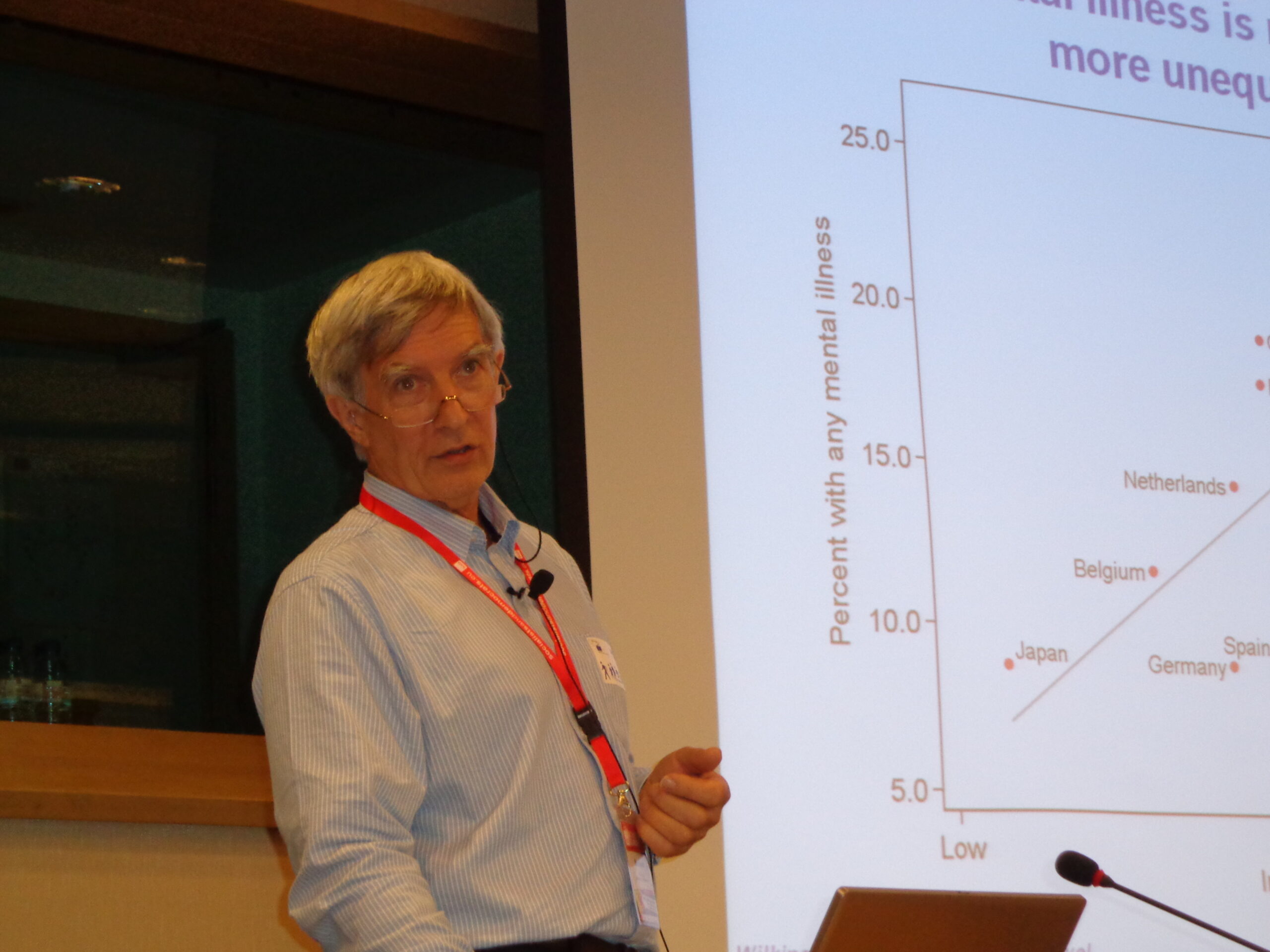
Professor Richard Wilkinson, author of The Spirit Level and one of the world’s foremost researchers on health and income inequality met with Genevie Fernandes, representing The Essayist, to discuss the nature and significance of inequality and understand the ways in which we can create a movement towards equal societies. This is Part 2 of a two-part interview; the first part is The Age of Inequality


Richard_G_Wilkinson_2013


One of the world’s foremost researchers on the social determinants of health and on the societal effects of income inequality; Richard Wilkinson is the author of various books including the best-selling “The Spirit Level.”  An advocate for healthier, more equal societies, Richard Wilkinson is also a co-founder of The Equality Trust, a not for profit organization that provides resources and works with numerous affiliated local groups in the UK and across the world, carrying out awareness-raising and campaigning to reduce economic inequality.


He is also Professor Emeritus of Social Epidemiology at the University of Nottingham Medical School, Honorary Professor at UCL and a Visiting Professor at the University of York. He studied economic history at the London School of Economics (LSE) before training in epidemiology.


Read Part 1: The Age of Inequality here


RW = Richard Wilkinson; TE = The Essayist


TE: How do people from deprived communities view inequality? How do they think about it or react to it?


RW: There is definitely annoyance at the bonus culture, particularly when cuts are being made, and public sector wages are held down. But the consciousness of these issues is not there anymore; the consciousness that a generation of socialists developed from the early 20th century onwards, now that’s largely gone.


About two years ago, riots broke out simultaneously in the poorest areas in a lot of cities in England. A  black man was shot in London, but there were riots all over the country which weren’t really to do about race. The rioters were poor, it was looting, and they were stealing status goods, clothes with the right labels, electronics. What was significant in a way was that it was oppositional and it was against the system and yet it had no political consciousness at all. I think in countries like Greece, Spain and Portugal, there has been slightly more politicised opposition, and not just rioting. And that’s a sign of how political consciousness is almost evaporated.


north_texas_car_in_ground


I think we have got to rebuild it.


TE: How do we rebuild this consciousness?


RW: You know there are few bankers and major business people who have started not to take as much as they can get. And that is because they know they won’t be respected for it, and we have got to increase that. We must get to a point where people taking these huge salaries know that they will be regarded as greedy and selfish, and not respected for it.


One has to change greed from being a source of status to being a source of disrespect.


TE: How do we change? How can we create a movement towards equal societies?


RW: There is a professor of politics and philosophy who used to teach at Princeton University, called Anthony Appiah. He wrote a book called ‘The 1011-HoweHonor Code’, and in it he looks historically at the changes in the number of social practices. One of them is the ending of foot binding in Chinese women. Another is the decline in honour killings. He also examined when the English Aristocracy stopped fighting duels with each other. And in each case he says that the change happens and these practices are given up when they cease to be sources of honour and respect. So that is what people are after. And we have to change what they feel they get respect from. Today many of our successful people think that they survive and do well at the expense of others.


We don’t need inequality to thrive.


TE: If we have to create a culture where greed is not honourable anymore then don’t we have to start in the places where greed is bred and allowed to thrive – Wall Street and the modern corporations?


RW: The big corporations are where the income differences are the largest and they have widened dramatically since the 1970s. In multinational corporations in the 1970’s, the CEO’s used to get 20 or 30 times as much as the junior workers, but it is now 200, 300 or even 400 times higher.


But if you look at the army, the police, the health services, the local authorities, universities, you find that the ratio of the salary between the head and the junior employee is usually between 10 to 1 and 20 to 1.


In the Mondragon Cooperatives in Northern Spain, which is a group of companies that employs 80,000 people, the differences between the CEO and junior employees are about 1 to 5 or sometimes 1 to 9. And so, I think one has to regard large corporations as having two quite separate functions, one is producing the goods and services we all need, and the other is to concentrate wealth and power at the top, in totally undemocratic ways. And these companies have the power to run circles and rings round the political elite. They pretty much dictate terms with national governments and so that’s the problem we have got to deal with. And I do think that means democratizing.


TE: Democratizing means more power to people for making decisions that impact their lives. However, is it not one of the important aspects of modern-day economic systems that it demeans people; makes them irrelevant to decision-making? How do we get out of this trap?


RW: I think we cannot do without a large measure of the market; you need tax and benefit systems, and constraints on pre-tax income differences within companies. I think we have to campaign for the democratization of the economy. Democracy is about power and extending it into the economy is about changing who has power, and this has to be done with employee representations on company boards, with incentives to grow employee earned companies and cooperatives. I think that has to be our vision of the future.


Modern production is a cooperative effort and increasingly, the value of a company is the value of the people it brings together. No longer is it a matter of the plant and the building and the equipment and so on. What matters is the assembled skills and knowledge of a group of people. So buying and selling companies is basically buying and selling a group of people, which is really anachronistic.

 stop occupy


At one point I suggested, in a talk, that maybe companies should have to pass two percent of their shares each year into an employee earned trust, which would mean after 25 years employees would be majority shareholders. There was a time when companies’ shareholders were people who kept shares for a long time, had a genuine interest and knowledge of a particular company they invested in. But now, of course, the financial dealing is done in finance houses, employees who buy and sell shares with computer programs that trigger it. The average length of shareholding I believe is about four months. These finance houses own shares in thousands of companies and probably know very little about them. They say it is very difficult for the company to discover who its owners are and so the system of earning and controlling companies has become increasingly short term, and the vast majority of the shareowners don’t turn up to company board meeting.


There is now more evidence that more democratic models where pay differences are much smaller are more efficient, and productivity is much higher. I think, increasingly employee representation on company boards is moving up the agenda.  About half the member countries of the European Union have some legislation for employee representatives on company boards, although it is usually pretty weak. But in a few countries like Germany it is quite strong.  There are different rules about employee representation for different sizes of companies. You have to have some representatives when you have 500 employees, but when you get to 2000 employees, half of the members on the remuneration committee have to be employees. There is evidence which shows that companies with employee representatives on the management board have smaller income differences.


We have to spread this economic culture.


TE: Do you think more and more policymakers and people in general are discussing and getting concerned about inequality? Are there actions that match this concern?


I think these issues are moving up the agenda, to the extent that inequality is moving up the agenda. I mean when we were writing our book in 2007, there was no concern with inequality and no mention of it in the media. But about a month ago, OECD got the agreement of a number of major tax havens including Switzerland, that they would share information on bank accounts with tax authorities in other countries. You cannot put out top tax rates when the rich can hide their money so easily. So you have to deal with the tax havens first and that’s an important step first. I read yesterday, that in California, in the legislature, they had narrowly lost a vote to implement a sliding scale of corporation tax, which meant that if you have very big pay differences in your company you would pay more corporation tax. That vote was lost but only narrowly. Switzerland had a referendum on whether there should be a pay ratio for companies of 1:12, it was lost, but 35% of the people voted in favour of it, and that was late last year. So these things are coming up the agenda pretty fast.


At the city level, the ‘Fairness Commissions’ have been a good idea in that they raise consciousness. They were set up by local city governments and by now, fifteen or sixteen cities in the UK have instituted these commissions.  The most important thing that they have done is commit the local governments to paying the living wage rather than the minimum living wage at the bottom. They have led to substantial increases in income to tens of thousands of people. This is an idea that they should try and spread to the rest of the public sector and into the private sector as well. There are a few big private employers that have started to do that but I suppose it is a largely a public relations move. But still…it’s a start.

 rw2


Some people are even asking their suppliers about wage ratios in the companies they buy things from. These interventions are important for raising consciousness, but as it is labour controlled, it is bound to feed into changes in thinking in the labour party nationally. I think that’s important. I think I have spoken to almost all of them and quite a few say that they were stimulated by the Spirit Level, but off course they don’t have the power to change income distribution even in their own cities very dramatically. They don’t have legal power over companies.


TE: In one of your best-selling books, ‘The Spirit Level: Why Equality is Better for Everyone’ (2009) which you co-authored with Kate Pickett, you present a battery of evidence to show that the countries with the biggest gap (inequality) between the rich and the poor also have the highest level of health and social problems?


RW: Inequality has dire consequences on our health and well-being. Economic growth no longer seems to be an indicator of a better quality of life. What the evidence made us emphasize is the vital importance of social relationships to human health and well-being and we found that higher levels of income inequality damage the social fabric that contributes so much to healthy societies. Our key argument is that we do better when we are equal and therefore we should work towards reducing inequality and subsequently improving the psychosocial wellbeing of the whole society. Our social status seems to be at the heart of many of our society’s health problems.


We examined available data from richer, more developed countries because we wanted to write a very simple accessible book. Because things that we were looking at are unrelated to GNP per capita that one does not need to control for it. The other reason for looking at rich countries is that we could get more comparable data. We don’t produce our own data; we just download it from OECD or WHO.

The-Spirit-Level


What we found in our analysis is that so many things are influenced by one factor: income inequality.


How can all these different problems be influenced just by income inequality? But the key is that they are all problems that are more common at the bottom of the social ladder. Although there is depression, ill health and mental illness at the top of the social ladder, they are all much more common at the bottom. And it is those multiple problems which are all related to income inequality.


We did a formal test of that in a research paper in the American Journal of Public Health. We looked at causes of deaths with steep social gradients and ones like breast cancer and prostate cancer which have little or no social gradient. What we found was that steeper the social gradient the more strongly is it related to inequality. So basically all we are saying is something extremely simple: Problems that are related to social status get worse when you increase status differences.


The surprising thing is that they don’t just get worse among the poor; they get worse amongst the whole population, because inequality changes the whole social fabric. They lead to changes in social relations, and social evaluative threat increases throughout the population. It is clear that the damaging effects of inequality are the largest at the bottom of the society but even higher up the social ladder there seems to be some benefit of greater equality.


To explain why the US has the highest obesity, the highest violence, highest prison populations, and amongst the lowest life expectancy and so on, and why the Scandinavian countries do quite well on those indicators across different populations, one is trying to explain these common patterns in quite different problems but in problems related to social status which have social gradients. So as researchers we have to seek or think of something very deep seated in society, enough to influence so many outcomes. This is what makes social status more important. And it is pretty hard to think of any other explanation.


TE: While ‘The Spirit Level’ is a bestseller and has won the support of many, it has also garnered criticisms such as picking and choosing of data. How do you respond to critics?


RW: While I was a student at LSE, I did courses in the philosophy of science with Karl Popper. And off course, he always said that the best test of a good theory is whether it can make novel predictions which can then be verified.


And this relationship with inequality has been tested just so many times, and although there are papers where people manage to control it out, there are small minority of them, and they are usually controlling for things that are I think are on the causal pathway, such as things to do with class and so on. But people don’t realise that the first research papers on income inequality and health came out 35 years ago, this story has been building up over a long period, and you probably know our research paper in 2006 reviewing 169 studies, and yet they treat it as if we were the first people to have made this daft suggestion.


Some critics accuse us of picking and choosing our data. We have an absolute rule that if our source agency such as OECD, WHO or UN has data for one of the countries we’re looking at, it goes in. We make no judgements of whether the data is comparable. We leave that to WHO, OECD or UN, or whatever the data source is. One cannot say I don’t like the position of the country, and so I can leave it out of my analyses.


We have replied to our critics and I think now we have got better perspective and we have probably done better replies. And talking about it as much as we have, you come slowly to understand it better.


If all the countries are not shown in the analysis, for instance in the case of mental health, then that is because WHO hadn’t produced comparable data for other countries, and there is data that we are suspicious about, but we include it because it is there. For instance, Singapore is the country with the lowest infant mortality according to WHO, but it also has the highest inequality in our dataset.  And I never believed that data, but it goes in because that’s the data that the WHO has.


I was invited to give some lectures in Singapore, and one of the reasons why they have low infant mortality is because they are a little city-state. They don’t want people to gain Singaporean nationality, they don’t want population expanding. About 25% of their labour forces are migrant workers. They are not allowed to get married nor have children. They get a health check every six months and if they get pregnant or married they get sent home. And off course they are the poorest 25% of your labour force, so what you are doing is removing from the figures the section of the population where you’d expect infant mortality to be the highest.


Some critics argue that the relationships we have found between income inequality and poor health are spurious because they firmly believe that if you add in a few countries or take out some select countries, then one can make the relationships disappear. That is silly because there are analyses with over 100 countries. And of course the attacks have come from the far right.


There was a lot of controversy in epidemiology but it was less about whether there was a relation; they agreed there was a relationship but they argued mainly about the causes of the relationships, it. So there was the neo-materialist hypothesis, which is basically saying that material things mattered beyond the old public health issues of food, safety, and sanitary conditions.


It was really a fight against the growing recognition of the importance of psychosocial factors in health which works through the pathway and mechanism of chronic stress. And it was also motivated by people on the far left, whose fear was that if the causal mechanisms were presented as psychosocial then governments would say that we needn’t worry about low incomes, just get the poor to be nice to each other, and the problem will be solved.


But what seemed important to me was something different. As we showed more and more factors in our lives were related to income inequality, then we were basically demonstrating that income inequality was even more important to us than we had ever imagined.


TE: So what can we expect as we go into the future?


I would say, we need to paint a picture of future society where the quality of work is transformed by democratization of the work place and income redistribution, where community life is strengthened, where leisure is increased, and you get a higher quality of life through that. You know what I call the convenient truth as opposed to Al Gore’s inconvenient truth is that in the rich countries it is no longer material life that drives the quality of life; it is the quality of social connections. So in order to create a better future we have to stop worrying about our economic needs and start dealing with our social needs. Greed will not be good in that future.


************END OF INTERVIEW*************


We thank Prof Richard Wilkinson for giving his time so freely.


If you want to take action to help address inequality then please visit The Equality Trust website at www.equalitytrust.org.uk


Watch Richard Wilkinson talk about how economic inequality harms societies in a TED Global Conference filmed in 2011.


If after reading this article you would like to learn more about social inequality and its impact on health and human development, click here for a further reading list.


Open Access Article

© Genevie Fernandes (2014). Inequality: Interview with Richard Wilkinson. The Essayist, July 2014. http://www.the-essayist.org/


This is an open-access article distributed under the terms of the Creative Commons Attribution License, which permits unrestricted use, distribution, and reproduction in any medium, provided the original author and source are properly cited. To view a copy of this license, visit http://creativecommons.org/licenses/by/3.0/


The Essayist is a strong advocate of the “no-plagiarism” policy.


Image Reference:

  • Richard Wikinson Image accessed from Wikimedia Commons: http://commons.wikimedia.org/wiki/File:Richard_G_Wilkinson_2013.jpg
  • Car and Street Images by Dennis Dodson
  • The Honor Code: http://books.google.co.uk/books/about/The_Honor_Code_How_Moral_Revolutions_Hap.html?id=P368fFhdvEwC&redir_esc=y
  • The Spirit Level: http://www.futureeconomics.org/2012/07/beyond-the-spirit-level/


How to improve LEARNING in the education system? Applying research in classrooms

Communicating research on learning allows teachers to make reasoned and informed decisions about classroom practices and how best to support children’s learning.  Dr.Sarah McGeown, Lecturer in the School of Education at the University of Edinburgh, says that evidence generated through rigorous research is a tool that allows teachers to make effective decisions about what is likely to work best for their students. Sarah McGeown shared her ideas on how to improve learning outcomes in schools and in the education system with The Essayist.


Sarah McGeown photo


SM = Sarah McGeown; TE = The Essayist


TE: Could you tell us about your work in the area of learning and education?


SM: Most of my research has focused on children’s reading development – I am specifically interested in identifying the most effective ways to support and develop children’s reading skills. Reading is a crucial skill; one that is important for educational success but is also necessary in a literate society. As most school based subjects rely on children’s ability to read and understand what they have read, my research focuses on reading, in the hope that it will support children’s learning across the whole school curriculum.


My other research interest concerns children’s motivation and engagement at school. Within the UK, particularly in reading research, there is a strong focus on supporting and developing aspects of children’s cognition. However, fostering positive attitudes towards learning and motivation to learn is crucial. This is an area where I hope to carry out more research in the future.


TE: So has the education system or school system adopted the lessons you have learned through your research?


SM: Within the UK, research by my former PhD supervisor and now collaborator had a significant impact on the teaching of reading in schools: the UK Government recommended an approach to reading known as synthetic phonics, on the basis, primarily, of this research. This government recommendation has had a considerable impact for all children learning to read in England.


PHOTO 2


TE: Do you find that the use of research to inform and improve school education is widely practiced?


SM: I have genuinely been surprised by the emphasis on ideology over research evidence to guide educational policy and curriculum based decisions. I have been attending a number of education/education policy conferences recently and am struck by lack of engagement with research to guide decision making processes.


To me, the use of research to inform and improve school education should be widely appealing. However, there is clearly a debate within education regarding the value of research to inform educational policy and practice. This debate perhaps reflects the obstacles and challenges in place which prevent research from being used optimally within education. Alternatively, it may also reflect the belief, among some, that research serves no purpose in improving children’s educational outcomes. Of course, teachers are often champions of using research evidence themselves and so I am optimistic that there is support for it.


TE: So what are some of the obstacles and challenges involved in using research within education?


SM: I would say that there are, at present, poor structures to initiate and support communication between researchers and those with responsibility and power to change educational policy and practice (e.g., teachers, policy makers). Indeed, systems or structures aimed at accruing research evidence on topics of importance to teachers and policy makers are lacking. For example, most applications for research grant funding in education originate from researchers, often with little or no communication with teachers or policy makers from the outset. Therefore there is very little truly collaborative research work among researchers, teachers and policy makers. By involving all parties from the beginning, researchers will be in a better position to study topics that matter most to teachers and policy makers.


TE: Do you think researchers have a responsibility to ensure their work is understood by teachers?


SM: Absolutely. It is our responsibility, as researchers, to ensure that research evidence is shared in an unbiased, informative and accessible manner to those who wish to use it. Researchers certainly need to identify ways to better communicate good quality research to those working in education. However there are a number of obstacles in place that need to be overcome to do this.


First, there is an overwhelming volume of research that exists already. Collating that, improving teacher’s access to it and providing them with the time and support necessary to identify research that is directly relevant to their needs is crucial. Lack of time is an issue consistently cited by teachers, who may be keen to use evidence to inform their practices, but do not have the time to spend navigating and studying the literature. In addition, access is problematic – academic research papers published in journals are not available to all, although notably there is a move towards more open access. John Hattie has done an incredible job of collating research evidence on children’s learning and presenting it in a useful and accessible manner (I’d recommend his book called Visible Learning).

 PHOTO 4


Access issues aside however, there is still a skill or capability issue. We need to train teachers to be able to identify relevant research suited to their needs and context, and appreciate difference in research quality. I think Universities have a responsibility within their initial teacher education programmes to support and develop this skill among new teachers.


In addition, as researchers, we need to consider how best to communicate the educational implications of our research. Research papers are typically written for academic peers and are not written in the most accessible manner for teachers. We need to consider a broader audience when writing for academic journals and also start considering alternative routes to share our research. Social media provides an excellent platform to do this, a platform which has not been available until relatively recently, but which can provide more immediate and up-to-date information for teachers.


In terms of my own research, I have recently written a minibook for teachers, which was designed to share the results from ~60 peer reviewed papers on the area of children’s motivation to read. I wrote this to be informative and useful to teachers, rich in research content but easily accessible to those working in the classroom. I’ve also recently started a Blog (entitled ‘Using Research in Education’) where I plan to share academic research and have also created Summaries for Teachers (1 page posters designed to summarise my academic papers).


TE: Is there any resistance from the teacher in the classroom – the end user of the research?


SM: There can be. I know that some teachers believe that research removes their autonomy and/or professional judgement. However, I think this is symptomatic of the way that research is often presented to teachers. Research shouldn’t be perceived this way; teachers with greater knowledge and understanding of research evidence in a specific area should be more able, and confident, to exercise their professional judgement.


Communicating research well allows teachers to make reasoned and informed decisions about their practices and how best to support children’s learning. Therefore it is not a prescriptive approach to education that is promoted; instead it is the use of research evidence to allow teachers to make effective decisions about what is likely to work best for their students.


TE: Thank you for your time. We look forward to more discussions with you in the future on the topic of education and learning.


© Sarah McGeown, 2014


Dr. Sarah McGeown is a Lecturer in the School of Education at the University of Edinburgh. For more information, see:  http://www.ed.ac.uk/education/sarah-mcgeown


Please see her academia page for access to Summaries for Teachers (1 page documents for each research paper): https://edinburgh.academia.edu/SarahMcGeown/Summaries-for-teachers.  Her blog is available here: http://www.drsarahmcgeown.blogspot.co.uk/


© 2026 THE ESSAYIST

Theme by Anders Noren — Up ↑