Month: April 2014 (Page 1 of 2)

Relationship – A Journey through Chaos and Order

I was fine.


I had my habits, my haunts, my tastes, my decor, my food, even my tangle of exercise equipment on the living room floor.


There was order.


The boat of my life sailed on an even keel, same routines and rhythm. There was something to be said for the comfort of sameness. I felt satiated.


I enjoyed being single.


sailing-at-sunset


Life was perfect……until he came along.


You know, him!


The one who upsets the apple cart, puts a wrench into a woman’s finely tuned scheduled works, the one she falls in love with and who always brings chaos into a woman’s life of order.


Damn him, damn love, damn this woman’s neediness… for him, for Love… for both.


*****

My life turned upside down, inside out, and got tossed around all over the place like a boat torn to shreds by a storm. In very short order, I had no idea who I was or what I was doing.


Love as usual had successfully rattled my brain and turned me into a slave. My routines, my order that had been built over the years, all dissipated within moments of love finding me.


My wake up time (5:30 am) was the first to go out the window as Mr. Now was occupying my bed. And don’t we all know how difficult it is to leave a cozy warm bed shared with another for what…the early morning exercise routine? Yea, riiiight.


My discipline went south…foods that were on the “don’t even think about them” were now not only thought about, but eaten because he ate them – yikes!


Meditation was intermittent; exercise was when I could grab it, besides aren’t a lot of calories burned during sex…that’s exercise, right?  Or so I told myself.


Author Jackie Collins describes the chaotic feelings of falling in love as …”like getting hit by a truck and yet not being mortally wounded, just sick to your stomach, high one minute, low the next. Starving hungry but unable to eat. hot, cold,… full of hope and enthusiasm, with momentary depressions that wipe you out.” (1)


When beloved meets beloved, all hell breaks loose (or chaos) in both lives until the duo reaches a still point, finds their rhythms as a couple, and as individuals within the context of being a couple.


Ms. Collins goes on to say, “Love does not appear with any warning signs. You fall into it as if pushed from a high diving board. No time to think about what’s happening. It’s inevitable. An event you can’t control. A crazy, heart-stopping, roller-coaster ride that just has to take its course.” (2)


Should one expect chaos at the beginning of a relationship and not attempt to hold onto “self” and the “single” order of life? To be open and receptive to what the other brings, and also to the chaos that is created with the coming together of the two energies?  Ah, the collision…the creation of a great fire, and as most have experienced, an ultimate high at the beginning of a relationship.


June Carter Cash remarked about her falling in love with Johnny Cash, “One morning, about four o’clock, I was driving my car just about as fast as I could. I thought, ‘Why am I out on the highway this time of night?’ I was miserable, and it all came to me: ‘I’m falling in love with somebody I have no right to fall in love with. I can’t fall in love with this man, but it’s just like a ring of fire.” (3)


So, how do we not go crazy while spending time with Mr. Now and the chaos his presence creates?


How do we journey through this stage to find some balance?


Interestingly enough, Nietzsche once wrote “You need chaos in your soul to give birth to a dancing star.”(4)


For me, he is saying chaos is needed to give birth to something greater than self…which would be the relationship. I think and feel that the chaos eventually subsides to allow a natural rhythm to develop between the two, a dance if you will, and that dance has order to it.


Nur Chapmans Peak Cape Town South Africa


The routines and habits begin to take shape within the context of being a couple and eventually order rises to balance and quiet the chaos.


The chaos, however, doesn’t die. It is merely in a resting place, ready to break out at a moment’s notice. And it happens. We all have chaos and order within us. When we have a lot of chaos, we crave order. Too much sameness, and we need some spice.


Chaos is needed to bring forth change. When energy remains the same for too long, it stagnates. Chaos shakes energy up, creating space for release and attraction.


Frankly, I think chaos has a negative connotation in our society. I think it is suppressed, swept under the carpet, hidden. Guess what happens when energy is ignored for too long? It erupts, and that can look like an emotional or mental breakdown.


I wasn’t looking for Mr. Now, who then became Mr. Right as we dated. I needed to shift energy, release old concepts that were no longer serving me, bring in some new, more supportive beliefs. I wasn’t going to change without a fight, or least a major amount of complaining. So the universe was kind and brought in another human being to help me along on my journey. I kicked and screamed as the comfort of my old life slowly disintegrated. I clung steadfast to those old tenets. But I knew deep in my soul they had to shift, and leave.


I had to notice that I was happier, healthier, more peaceful and balanced than I ever was being single. A flower needs to blossom and that only happens with change. The flower has to allow change to happen to herself.


“Why do we mortals wonder if it is through ‘human chaos’ or through ‘divine perfection’ when the world guides us to some magical event? In either case, is not the result the same? Is the result not ‘divine perfection?” (5)


Well, in divine perfection, Mr. Right became Mr. Forever, or at least Mr. For This Lifetime.


And me? Oh, I still think about my single life and the perceived simplicity and order of it. However, I realize that something greater was in store for me – chaos and what emerged from it – The Dancing Star.


For me, the dancing star is the couple. Chaos is needed. It is the fuel to create the dance and as T.S. Elliot said: “There is only the dance.”(6)


THE DANCE


Is the wave aware that

It will die at the shore?

Does it know that

The end is near?

So much force, so much life

Driving toward land,

The violence of the water

The peace of the shore

Opposites meet –

Water struggles, wanting to maintain its’ identity,

Sand maintains its’ stoic calm.

They merge –

A still point is reached

Neither advancing

Nor retreating

A oneness occurs

As the elements blend

No separation, no duality

The wave realizing its’ true nature

In it’s death.

Ah, a small gift for a hero’s sacrifice

it quietly recedes in to the

Vastness of the ocean

To be reborn

Once again


Beach by Rajesh Vyas


References

1. Jackie Collins, from “Lucky”, Simon & Schuster Publishing, 1985.

2. Jackie Collins, from “Lucky”, Simon & Schuster Publishing, 1985.

3. June Carter Cash, singer, author.

4. Friedrich Nietzsche, “Thus Spoke Zarathustra”, Walter Kaufmann translation, 1887.

5. T.S. Elliot,”Burnt Norton”, The Four Quartets, Hardcourt Publishing,1943.

6. Roman Payne,“The Wanderess”, Aesthete Press,2013.


Images Courtesy:

Beach by Rajesh Vyas

Zanzibar (sailboat) and Chapmans peak, Capetown by Nuruddin Lakhani


Gandhi versus Gandhi

Imagine a young college graduate who has volunteered as a teacher in an extremely poor school in urban Mumbai. She is trying to inspire precocious 10-year olds with stories of leaders from their country’s great history. She decides to teach lessons on Gandhi – the non-violent Mahatma.


The children had just come out of their hell-hole houses in the underbelly of Mumbai. They are all malnourished and have various skin ailments because in addition to lack of nutrition they are also deprived of proper sanitation. They live in an area that is better known for its illicit spirit – moonshine or hooch – rather than the so-called undying spirit of Mumbai. In fact the hooch-producers sell the excess liquor to the children every morning.  So many of them are drunk on bad quality alcohol when they walk into their classrooms.  Don’t be shocked or surprised!


Selling addictive substances to children is standard operating procedure for drug peddlers all over the world. And why drug peddlers, all sorts on unhealthy food, junk food, drinks, and games are sold to children by legitimate blue chip companies and marketing managers with degrees form Ivy-League universities.  Drug peddlers are only following the management textbooks – do not waste, run efficient waste management systems while creating new customers – be it the northern border of Mexico or a slum in Mumbai; countries along the Andes or the Afghan-Pakistan border – or be it cocaine, moonshine, tobacco, junk food, fast food or games.


Children are the best customers. They are easy to intoxicate and drug; they pester their parents for more; and they have many more years of consumption left in them. The products make them feel  cool and adult-like. Furthermore, they are young, so they can find work and pay for their addiction. In the worst cases, the children, who cannot pay directly, can help run the illegal organization and pay through their labour if not cash. Doesn’t it seem like the drug peddlers have trained in the best management colleges? They are effective and efficient like the managers at the best run private companies and yet practice equitable (public) distribution of their goods. These drug-peddlers reach the poor and the last mile while our governments and corporations cannot.


Many of these boys from that urban slum in Mumbai attended school in an intoxicated state. One of them was once caught saying that it was the only state in which he could tolerate the teachers and the textbooks.


Now imagine again – a young teacher-volunteer on a sunny morning caught in the crossfires of poverty, addiction, anomie, hopelessness and a managerially efficient drug-peddling system talking about Gandhi to a congested classroom half-full of intoxicated ten-year old boys.


Putting aside the smell of liquor and filth, disregarding the fact that many of the children were sleeping, and the air was dank, hot and humid, the young teacher raves on about Gandhi. She explains his non-violent exploits and his greatness; his Ahimsa and Satyagraha (struggle for and with truth), his law school education in England; his fight against apartheid in Africa and then the return to the homeland – India. How Gandhi was so moved by the poverty he saw that he gave up his western clothes and dressed like the poor in homespun khadi. The young teacher went on about Gandhi’s steadfastness to the principles of non-violence and truth and how for perhaps the only time in the history of the world a non-violent struggle led to the freedom of an entire nation; and how this example inspired Dr. Martin Luther King in the United States. The teacher knew her Gandhi and she could have sung his stories for much more time but the school bell rang to announce the end of the session. The teacher was perspiring at the brows but she looked happy. She seemed to be congratulating herself in her own mind. The boys has been quiet.


But being young she did not know when to stop. She did not want to leave the lecture at just that. She wanted her students to continue thinking about Gandhi. So she announced that each of them would write an essay on Gandhi and submit it the next day. She wrote it out on the board: A 500-word essay on Gandhi to be submitted tomorrow.


A lone hand went up. The teacher smiled, she thought she had inspired at least one of them. The malnourished boy stood up and asked: “Ma’am, which Gandhi do you want us to write about?”


The young teacher was perplexed. Her spirit sank (maybe she could have benefited from a shot of moonshine herself) and she replied: “But, didn’t you hear a word of what I said in the class?” Theatrically, the teacher opened the history textbook and showed a picture of Gandhi from the book.


The young boy was not one to give up so easily. He pulled out a crumpled five hundred-rupee (currency) note from his pocket, kept it in the desk and pressed it flat with his hands. He then raised the currency note dramatically and a picture of Gandhi stared at everyone.


The boy said:

“Teacher, there are two Gandhis in my world. The Gandhi whose picture you showed in the history book and this Gandhi who is on the currency note. This Gandhi on the currency note elicits very different behaviours from the Gandhi in the book. The Gandhi in the book is all that you said. The 500-rupee note Gandhi brings out the worst in people –  the opposite: people are mean, cruel, uncaring, punishing and extremely violent in their quest to get more of the 500-rupees.”


And pointing to the note again continued:

“People kill their own mothers for this one. And this is the Gandhi we see and learn from every day – this one on the currency note.


So which Gandhi do you want me to write about?”


The other boys, oblivious to the dialogue between teacher and student, had started talking and throwing paper missiles at each other.


Before our young, idealistic, volunteer-teacher could ay anything the head-master walked into the classroom and started thrashing some of the boys for disturbing the peace in the school.


“The greatness of a nation and its moral progress can be judged by the way its animals are treated.”

 Mahatma Gandhi


Absurd, isn’t it?


© The Absurdist @ The Essayist


‘… by living we learn’ – The life of Patrick Geddes and his quest to re-connect man with nature in the new urban spaces

“This is a green world, with animals comparatively few and small, and all dependent on the leaves. By leaves we live. Some people have strange ideas that they live by money. They think energy is generated by the circulation of coins. Whereas the world is mainly a vast leaf colony, growing on and forming a leafy soil, not a mere mineral mass: and we live not by the jingling of our coins, but by the fullness of our harvests.”

Patrick Geddes (1888)

0

Edinburgh, the capital city of Scotland, was at the heart of the 18th century Scottish Enlightenment that witnessed great intellectual and scientific achievements. This progressive city was home to some of the greatest thinkers – philosopher David Hume, economist Adam Smith, and the geologist James Hutton. Author Arthur Conan Doyle, creator of the legendary detective Sherlock Holmes, and actor Sean Connery, who played the dashing Cold War spy James Bond, were also born in this city. However, there was another great thinker from this city, who made his influence felt far outside his national boundaries with ideas that were far ahead of his time.


It all began on a sociological tour of the city buildings organized by the University of Edinburgh.
 

Outlook TowerA modest group of 15, mostly international students, followed the tour guide – a professor of Sociology at the university, as she walked from one iconic structure to another, explaining along the way the historical significance of each structure and ideologies of the time in which they were built. While most of the structures were used as spaces for residence or conventional formal occupation such as the college, hospital, theatre, and the museum, there was one structure that took us by surprise – the Outlook Tower (white building in the adjacent image). Our guide described this building as a civic museum that was developed by Patrick Geddes, a biologist and town planner, who wanted to provide the residents of Edinburgh a view of their own city. By standing atop the Outlook Tower residents could observe the good and not-so-good features of their own city; visible to the resident’s eyes as they stood next to each other. Patrick Geddes wanted these observations to increase the residents’ awareness of their place and surroundings and inspire actions to improve the city.


It is said that Geddes would conduct tours of the city in the 1800s; he would rush visitors to the top of Outlook Tower (in those days) and ask them to view the city through a camera obscura (an optical device that projects an image of its surroundings on a screen) and then make them sit in a darkened meditation room – the “Inlook room” – to internalise what they had learned, and make the observations their own. Geddes dreamed of making Edinburgh a city of cultural, educational and spiritual superstructure, where people of different classes and groups lived together in harmony, instead of cities that were arranged into functional zones.


Our tour guide moved on to the nearby buildings, but my mind was stuck on the tower. I had never come across such a structure that functioned as a live sociological laboratory and meditation room for all city residents. An idea that was much needed in today’s world – which is increasingly urbanized. Today’s congested conurbations (apparently a word coined by Geddes) such as Mexico City or Jakarta or Mumbai desperately need such living laboratories and reflection rooms.


The walking tour had left me thinking about Patrick Geddes and his idea of urbanization – involving people in observations of their own surroundings and moving from observation to action. I read that Geddes had turned down a knighthood the first time for democratic reasons stating that he was a ‘man of the people.’


I decided to explore and find out more about Geddes. I thought I would do so by using his espoused method of observation.


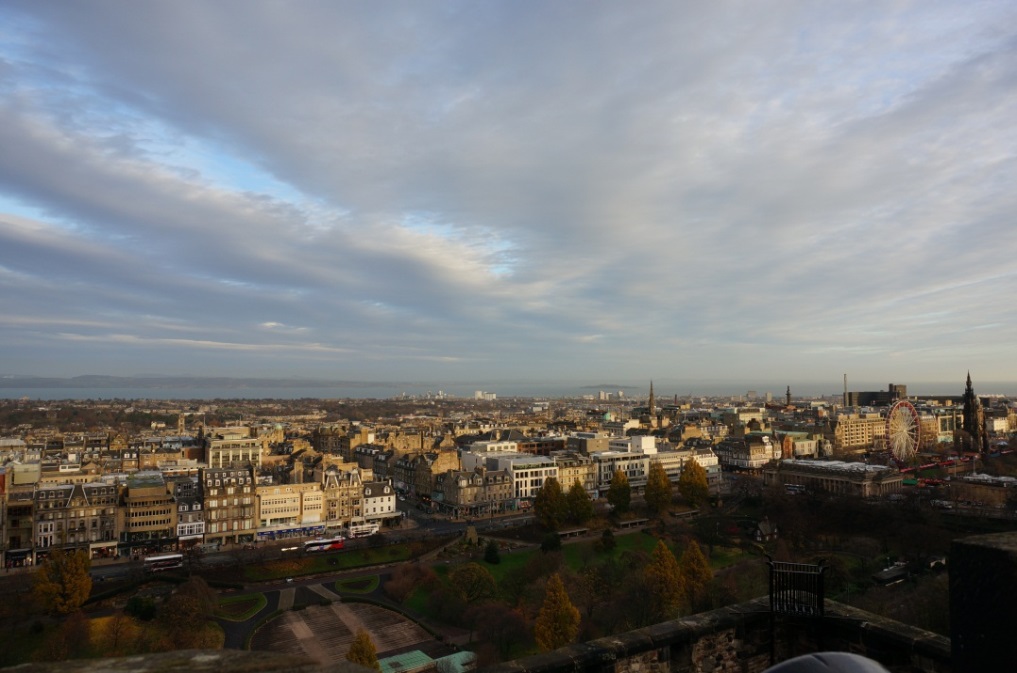
The next day I walked around the streets of Edinburgh (this time alone) and observed buildings in the Old Town that Geddes had helped revive and restore, through civic participation. Squalid and uninhabitable at one point in time, these buildings have now become a thriving part of the city with residents and international tourists alike, all thanks to Geddes’ vision and philanthropy. I visited the Outlook Tower and looked at the city from several vantage points. Standing on the Tower’s rooftop, I could see the city below me: bustling city streets with people walking by, green spaces that separated the buildings, the mountains and the sea beyond the urban sprawl. I could hear the sounds of the birds flying above mixed with the sounds of the bagpipe being played somewhere below along with the background hum of the city.
 

view edi outlook tower

View of the city of Edinburgh from the Outlook Tower


I had been in Edinburgh for almost two months but had never experienced it this way. Even though I had walked around the city before, never had I observed and sensed so much of this place, like I had while standing on the Tower’s rooftop. The view had heightened my senses – changed my outlook of the city.
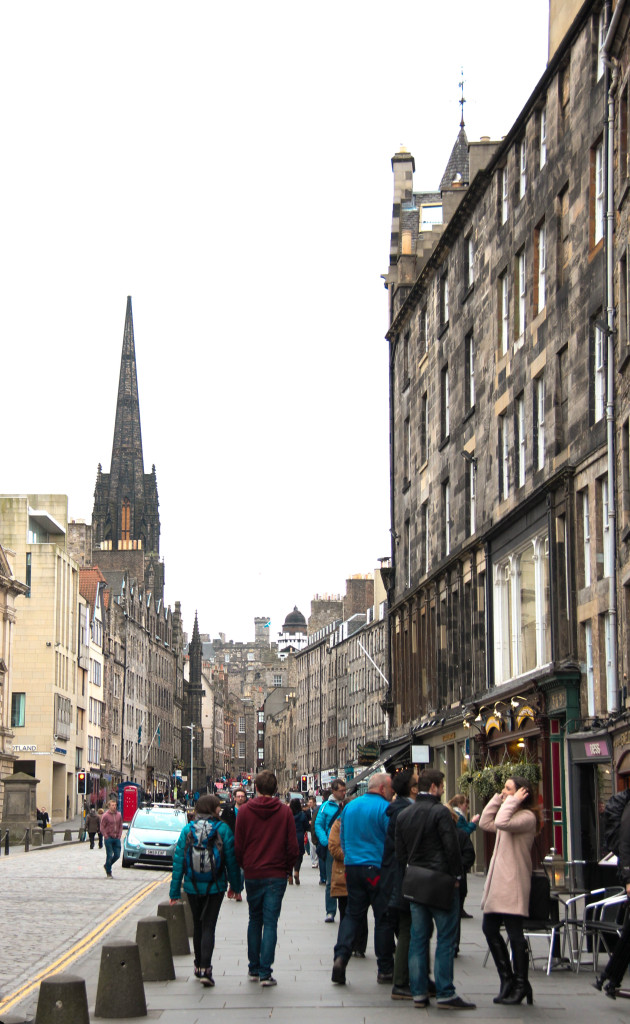
 

IMG_4698-2I came down unwillingly and strolled through a network of gardens that Geddes had designed. Every time I sat to relax in these green spaces, I sensed immense tranquillity, and right there in the middle of a modern city I felt one with nature. This is exactly how Geddes had envisioned his city to be; a flourishing and nourishing space where people could live, work, love and be connected to their environment. The idea of urban gardens and gardening was also tried by Geddes and he not only tried to bring children and adults closer to nature but also attempted to bring the different social classes together.


This man had practically shaped the city of Edinburgh in the 19th century. However, his pioneering work in urban planning and education in Edinburgh also took him across the world to India, Palestine and France. Although, his ideas were original, ground breaking and beyond his time, but never did he enjoy the recognition due to him. Even today he is little known in Scotland (his place of birth) or even in India (his place of work) where he spent a decade trying to introduce holistic principles of urban planning and education and set up the sociology department at the University of Bombay. Perhaps Geddes believed in letting his work speak rather than his publications – a man believed in the walk rather than the talk – and encouraged others to walk in their own spaces and experience life first.


As we continue to drift from financial and environmental crises, and look for solutions to overcome these, the significance of Geddes’ generalist view could not be clearer. Throughout his life and career, he made a constant effort to help people to think for themselves, and to think around the whole circle, not in scraps and bits. He knew that ‘watertight compartments are useful only to a sinking ship, and traversed all the boundaries of separate subjects’ (1).


By reflecting on his life and work, and even possibly putting to use some of his evergreen ideas, perhaps we can try to give this great thinker the rightful appreciation that he deserves.


Who was Patrick Geddes?

patrick-geddes_imagelargeSir Patrick Geddes (1854-1932) was a ‘polymath’— a man of many parts. He was a biologist by training, a pioneering town planner who influenced various generations of urban planners, a sociologist and an educator throughout his life. A powerhouse of intellect and energy, Geddes blazed his course from project to project at home in Scotland and around the world for half a century. Instead of a becoming a specialist, he was happy being a ‘generalist’, who held a holistic view that in order to live we must be able to see the intertwined link between the natural and social sciences.


Geddes had a lifelong contempt for examinations and never took a university degree. Yet, he held the position of Chair of Botany at University of Dundee (1888 to 1919), and Chair of Sociology at the University of Bombay (1919 to 1924). His teaching style was conversational and involved out of class learning through regular excursions and observational visits. He urged his students to practice this world view where life was a learning process and one could learn more by doing.


Geddes’ work was based on his fundamental principle of ‘Place, Work and People’ as he believed that geography; economics and anthropology were related, yielding a single chord of social life. He saw sociology as a quintessentially interdisciplinary subject that was essentially the science of man’s interaction with a natural environment, and improved urban planning was one of the key applications of sociology.  Geddes revived the Old Town of Edinburgh using his ground breaking concepts of ‘diagnostic surveys’ and ‘conservative surgery’, which he went on to implement in town planning projects across Scotland, India and the Middle East. In fact, Tel Aviv is a city whose core was entirely built around Geddes’ plan. He also introduced the concept of ‘region’ to architecture and planning and coined the term ‘conurbation’.


Many have been influenced by his work, including urban theorists such as Lewis Mumford. Geddes also set the foundation for future urban thinkers such as Jane Jacobs and the New Urbanism movement which focuses on walkable neighbourhoods, variety of housing and occupation types.


Yet very few people know of the name Patrick Geddes, including in the University where I obtained my master’s degree in Sociology, located in the city of Bombay (now called Mumbai) which desperately needs massive amounts of urban planning to make it hospitable for man and nature alike. At first I thought it was sad that almost no one from my own department knew of this man. Yet, on further reflection I saw this as a refreshing change from the celebrity academic culture of today where many academics brandish their publications, yet have very little substance or no effect on the world.


A true learner, Geddes believed that one learned not by sitting in ivory towers but by being in the world, by walking in the world, by observing and asking and listening to people and incorporating their ways of life and their natural environment into the design of sustainable solutions.


Early life and influences:

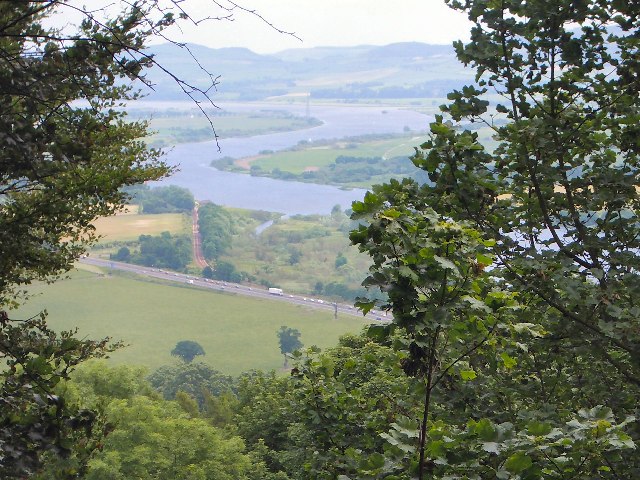
Born in October 1854 at Ballater in West Aberdeen, Scotland, Patrick Geddes was raised and educated in the countryside of Perth. His was a childhood spent gardening with his father, conducting science experiments in the shed, exploring the nearby woods and cliffs; and these experiences taught Geddes deep lessons in ecology, inspiring his personality and career (2,3).


A_glimpse_of_the_Tay_valley_-_geograph.org.uk_-_23502

View from Kinnoull Hill near the Tay Valley in Perth, where Geddes spent a lot of time as a young boy.


As mentioned earlier Geddes had a lifelong contempt for examinations and never took a university degree. After a period of private study, he chose to study Botany at the University of Edinburgh (1874), but left after one week. He then went on to study Botany and Zoology with individual teachers and mentors in London and Paris (4). In London, he trained at the Royal College of Mines, under the great biologist and evolutionist of the time, Thomas Huxley, whose influence on Geddes is said to have been profound (2). Being a student of Huxley opened doors for him to study in France, and he subsequently trained at the Sorbonne University (5). From then on and for the rest of his life, he was an ardent Francophile, enjoying an empathy with France and French intellectual ideas which greatly influenced his thinking. It was during this time that Geddes came into contact with some of Europe’s progressive and radical thinkers.


“Quite a lot of Geddes’ thinking comes from Anarchists. Anarchy did not mean throwing bombs or anything. Anarchist means without government…..it means government by the people. From Geddes’ point of view, well informed individuals, with the certainty of what they are doing and fully participating….that was anarchy for him.”

Sophia Leonard

Trustee, Sir Patrick Geddes Memorial Trust (3)


‘Place, Work and People’

Geddes was impressed by August Comte’s positivist philosophy and was especially attracted to Herbert Spencer’s idea of applying the concept of evolution to society. But the biggest ideological influence for Geddes was Frederic Le Play’s method of survey. It was in Le Play’s work that Geddes found an inter-link between several sciences, and this interdisciplinary approach became his worldview for life.


Le Play’s [in image] survey method was based on the postulate that the three key units for the study of le playsociety were ‘lieu’, ‘travail’, ‘famille’ (place, work and family). ‘Place’ implied geographical locality which presents the environmental pressures (needs) and the possibilities (resources) and in turn determine the nature of the work. ‘Work’, determines the organisation of the family which is the biological unit of human society. Conversely, the needs and potentialities of the family shape the character of the work, which in turn progressively modifies the environment (6). Geddes replaced the unit of ‘famille’ (family) in Le Play’s work, by ‘people’ or ‘folk’, and believed that this approach synthesised knowledge from different disciplines and would help him develop his own evolutionary approach to social sciences. Place, work and people, in his scheme, have not to be “separately analysed as into geomorphology, the market economics and the cranial anthropology which still go on, in necessary detachment from each other…Within the single chord of social life all three combine” (7). Geddes argued that geography, economics and anthropology were so closely related that their union within sociology was sure to yield rich results (2).
 

Social Experiments in Edinburgh:

From 1880 onwards, Geddes began teaching Zoology at the University of Edinburgh. It was in this decade that he would take up some of his most celebrated social experiments – reviving the Old Town in Edinburgh, setting up student halls of residence and developing the Outlook Tower.


In 1886, Geddes along with his newly married bride, Anna Morton, moved from Edinburgh’s modern and welloldtown3 planned New Town to the decayed Old Town [image] that was plagued by poverty, overcrowding, squalor and disease (2). The Old Town, and its inhabitants, were increasingly marginalised and ignored by the affluent New Town dwellers; and these two parts of the city highlighted an unequal duality that led to an increased social separation of classes. The Chambers Improvement Act for Edinburgh, passed in 1867, further widened this divide between the two, by getting rid of ‘unhealthy houses’ and thereby clearing away the poor people (8). Geddes was a strong critic of this act and saw slums and its inhabitants as an integral living part of the city. With the view that a city is the superstructure erected on the basis of place, work, and folk, he set out to transform Edinburgh’s Old Town.
 

His strategy was to attack the problems from all directions. Geddes purchased a row of slum tenements in James Court, in the Old Town, making it into a single dwelling. In terms of ‘Place’, he advocated ‘conservative surgery’ which meant weeding out the worst of the houses that surrounded them, widening the narrow closes (lanes) into courtyards and thus improving sunlight and airflow. The best of the houses were kept and restored. Geddes believed that this approach was both more economical and more humane (9). Based on the principle of work, he galvanised the folk – the local resident community, local architects and artists to bring about the Old Town’s regeneration and preserve their locality, without waiting for government action.


“Geddes was massively culturally informed and opportunistic. If he saw a gap, there goes a garden. If there was an area that was at the risk of becoming dilapidated, then perhaps he would clear something out, do a bit of renovation, and a bit of conservation.”

Murdo MacDonald

Professor in the History of Scottish Art, University of Dundee (3)


In 1884, Geddes established the Environment Society (later the Edinburgh Social Union) to encourage local residents to survey, plan, and improve the local environment (4). In its first year, the Union grew from six to over fifty members, and these included a number of influential churchmen. Funds were collectively raised; and beginning with two properties in 1885, the Union was responsible for maintaining 23 properties housing 450 families by 1897 (8). Geddes supported the mixing of class groups and wanted them to inhabit common spaces. He saw gardens and gardening as one way of engaging people especially children and connecting them with their living space. He encouraged young students from the Castlehill School, to cultivate small plots of land in a nearby garden and learn about nature by direct experience. This garden – the ‘Johnston Terrace Garden’ exists till date, and is now a wildlife garden administered by World Wildlife Fund (14).
 

johston old new

 To the left is the image of Geddes’ young students from the Castlehill School conducting practical work in the Johnston Terrace Garden, and to the right is the same garden today.


In 1887, Geddes took over a few tenements in Lawnmarket in the Old Town and converted them into halls of residence for the students of the University of Edinburgh. Geddes’s innovation, (quite unorthodox for its time) was to separate the academic environment from the living space, and let the students govern themselves in a community of co-operative living for learning and intellectual inter-action (10). These buildings now collectively known as Milne’s Court [image below] was also the first student hall of residence in Scotland. Milne’s Court is currently managed by the University of Edinburgh, and is also one of the most famed students’ accommodation sites owing to its historical significance.

 800px-Milne's_Court,_Lawnmarket_Edinburgh_wiki commons


Geddes conducted yet another social experiment by setting up the Outlook Tower in 1892. He acquired another tenement in the Old Town and rechristened it the ‘Outlook Tower’ because he wanted to change people’s outlook of the city they lived in, and educate them to understand their region and the larger environment in all its complexity and from all possible viewpoints (11).


As described earlier, Geddes would rush the visitors to the top of the tower and show them the view of the Outlook-Towercity through the camera obscura (an optical device that projects an image of its surroundings on a screen) and a direct view from the terrace. After seeing the Camera Obscura, visitors sat in a darkened meditation room – the “Inlook room” – to internalise what they had learned, making it their own (11). Geddes wanted people to view the city without any preconceived notions by reading any literature beforehand. After building their own perceptions of the city, the theoretical exploration, cultural and ecological experiences, would follow floor-by-floor below, in rooms devoted to Edinburgh, Scotland, English-speaking nations, Europe and the world [illustrated in the adjacent image].
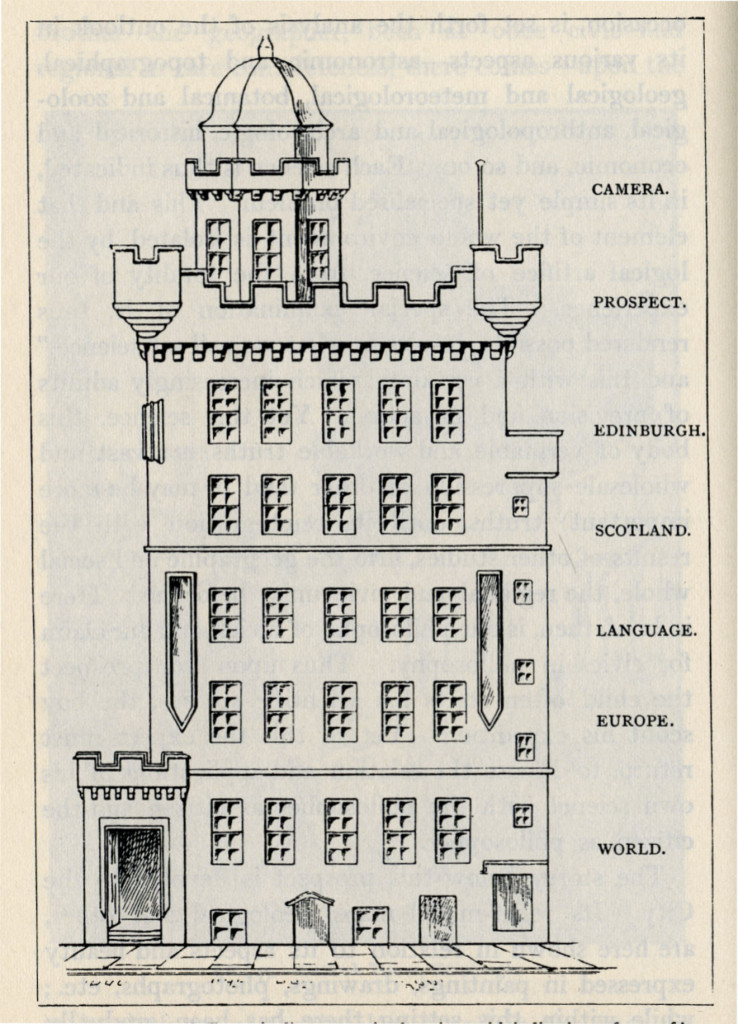
 

Geddes ensured that the starting point in the Outlook Tower was the direct perception of a real city not an idea of it, and this perception was the basis for any further exploration (12). Geddes’ emphasised that the local context (down to the level of individual perception) must be the basis for the understanding of the regional, the national and the global. He wanted to change the citizens’ attitudes towards the city and encourage informed participation in civic life. The Outlook Tower was one of the most developed examples of Geddes’ thinking, and still retains much of the spirit of its late nineteenth- and early twentieth-century usage.


Today these key structures in the Old Town, that were developed and restored by Geddes, are inhabited by Edinburgh locals, international students and visitors. Because of his efforts, this place has thrived for decades and has also been given a heritage status. These structures continue to stand strong as the living legacy of Patrick Geddes.


edinburgh

 City View from the Edinburgh Castle


His approach towards reviving the Old Town was utopian but only in a more pragmatic sense. To Geddes, Utopia really meant making the best of each place “in actual and possible fitness and beauty” (13). Throughout the 1880’s and 90’s, Geddes was responsible for projects that led to the improvement of Edinburgh’s Old Town and also involved in the development of the famed Royal Botanic Gardens, the Edinburgh Zoo, the Water of Leith and the Roseburn development (14). He basically started a movement in urban planning and civics that emphasised meditating upon the historical and cultural context of the region and involving local people as informed participants in development, maintaining and restoring their city. Edinburgh was the starting point of this movement, where he implemented pioneering concepts that would be acknowledged and adopted by urban planners and architects across the world, only much after his death.


Urban Planning and Sociological Action in India:

Geddes’ next big project brought him to India in 1915. After having heard of his successful urban experiments in Edinburgh, Lord Pentland, the then governor of the Madras Province, invited him to exhibit his work on urban planning in the country. Through Lord Pentland, Geddes also found admirers in Lords Willingdon and Carmichael, governors of the provinces of Bombay and Bengal respectively (2). He spent the next eight years preparing nearly 40 town planning reports for both the colonial government and the rulers of princely states in India, describing the nature of urban problems and solutions (15). These reports represent the first major contribution to the development of modern town planning in India on a fairly large scale (2).


‘Town-planning is not mere place-planning, nor even work-planning. If it is to be successful it must be folk-planning. This means that [the task of town-planning] is not to coerce people into new places against their associations, wishes and interest – as we find bad schemes trying to do. Instead its task is to find the right places for each sort of people; places where they will really flourish. To give people in fact the same care that we give when transplanting flowers, instead of harsh evictions and arbitrary instructions to “move on”, delivered in the manner of officious amateur policemen.’

 Patrick Geddes (9)

0

During his ten year long stay in India, Geddes travelled extensively, but his work in the city of Indore [image:pg in indore 1919 Geddes in Indore] is remembered as a classic example of his holistic approach in town planning. The Maharaja of Indore invited Geddes to Indore in 1918 to improve the malaria and plague infested conditions of the city (2). After spending eight months of thorough field investigation and consultations, he prepared a detailed report on the problem and its determinants, and suggested the establishment of a University that would train students for civic reconstruction in Indore and elsewhere. More importantly, Geddes conducted another social experiment in the city that not only helped to free the city from plague but also instilled in the residents enthusiasm to participate in cleaning and maintaining their neighbourhoods and the city.


Geddes went to the ruling prince of Indore and asked to be made the Maharaja for a day, giving him the authority to pursue his plans. He then made announcements that there would be a grand procession on Diwali Day (a religious festival that also calls for cleaning of homes and keeping living spaces tidy) and that this procession would neither follow the traditional Hindu or Muslim route through the city, but along the one on which most houses had been repaired and cleaned. This announcement motivated the people to start cleaning and repairing their homes and neighbourhoods, and inspired communal action, as everyone wanted the procession to pass along their street.


On the Diwali Day, a grand procession with cavalry and infantry marched through the city, followed by elephants, rich merchants, and figures of the Goddess Laxmi (symbol of prosperity). This was followed by an enactment of scenes of poverty, with giant models of dirt and rats, crying and wailing. After a brief break came cheerful music heading the long line of sweepers in spotless white, with new brooms and freshly painted carts.


indoreBehind the sweepers marched a civic procession of labourers, firemen and police, officials, mayor and Maharaja Geddes himself, and after them, enthroned on a stately car, a new goddess evoked for the occasion, the Indore city. Her banner bore the name of the city on the one side, and on the other, the city plan showing proposed changes to be made. Finally thousands of pots with seedlings of the Tulsi plant to be distributed among the households of Indore. This novel procession passed through almost every part of the city, finally ending at midnight in a public park where the giant of dirt and plague rats were burned in a great bonfire. After the symbolic destruction of the enemies, the festival was brought to a close with a grand display of fireworks. The effect of the exercise was immediately apparent. A new wave of confidence spread among the people to be clean and beautify their homes and the surroundings. Above all, the plague came to an end. Geddes was of the view that people are capable of improvements but it is for the government and municipalities to realise what improvements are needed and desired.


In 1914-15, Geddes was invited to deliver a series of four public lectures on the study of Bombay which are said to have been a great success (2). Subsequently, he was offered the post of professor and chair of the department of sociology at the University of Bombay (1919), which was the first institute in the country and the second in Asia to start a department in this discipline (16).


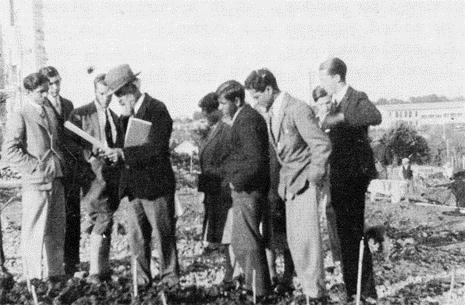
Characteristically, Geddes gave his daily lectures in the form of conversations and seminar (a style which his successors tried but with little success), and every Saturday was devoted to excursions to various parts of Bombay and neighbouring villages, and whenever possible, to more distant places (17).


Bombay Uni

Geddes with his students at the University of Bombay


Geddes emphasised practical work and through his teachings at the University encouraged social action. He sent his students to conduct field work in different parts of India. For him, the sociologist should be a sort of flaneur: ‘the productive sociologist should thus be of all investigators a wandering student par excellence; in the first place, as far as possible, a literal tourist and traveller’ (18). One of his students, Govind Sadashiv Ghurye (eminent Indian sociologist), who was given a scholarship to pursue doctoral studies at Cambridge University, also went on to succeed his teacher as the head of the department of sociology at the University of Bombay. Despite being ahead of his time in education, Geddes’ radical style of teaching sociology did not find supporters in Bombay, and by the end of his five year contract, his health had suffered greatly and so did his ability to enthuse his students with his unconventional courses (2).


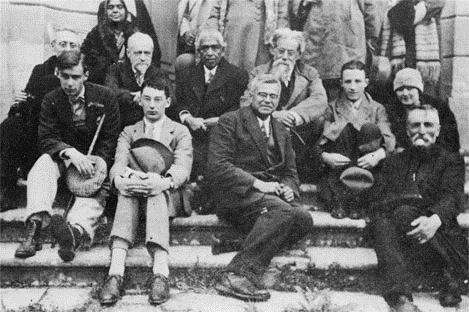
Geddes’ deepest support came from the great Indian scientist – Sir Jagadish Chandra (19) [seen sitting in the image below, seated in the center of the front row, and PG sitting third from left in the top row]. JC Bose pioneered the investigation of radio and microwave optics, made very significant contributions to plant science, and laid the foundations of experimental science in the Indian subcontinent. Banerjee (20) writes that Jagadish Chandra Bose’s interest in plant physiology may have been prompted by his growing intimacy with the European neo-vitalists, like Geddes, who formulated a new kind of science that refused to submit to the mechanistic interpretation of the world and spoke for a spiritual kinship with nature. Geddes also went on to become Bose’s first biographer despite being much older than him.


PG JC Bose


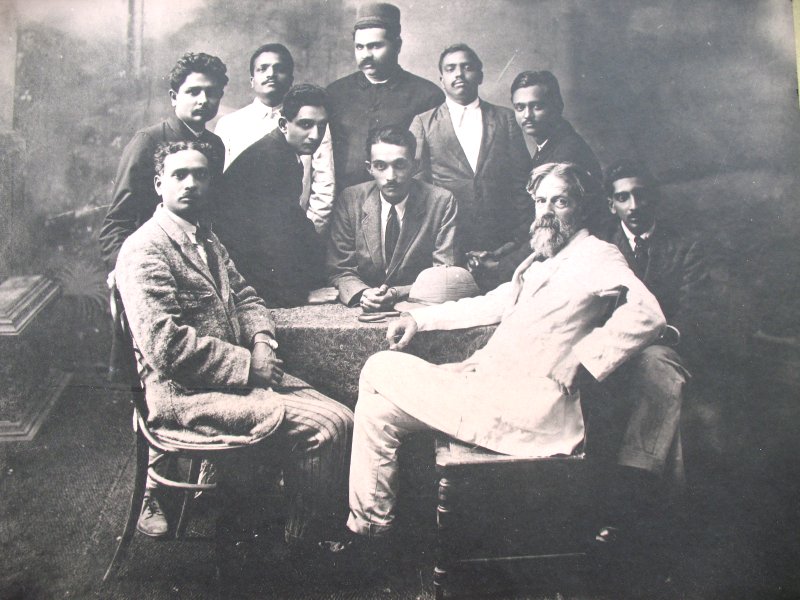
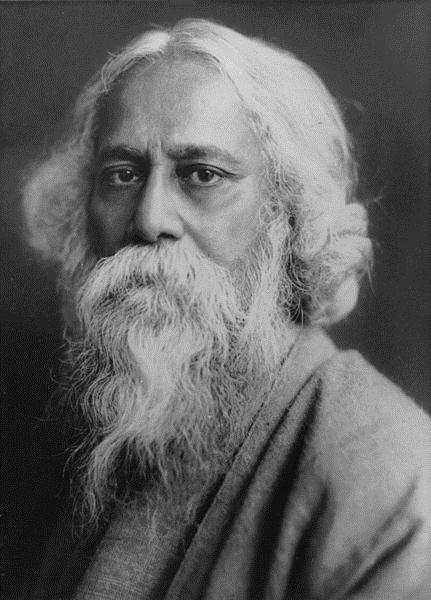
Another strong friendship that has been recorded in literature (21) was the one shared with Rabindranath Tagore [image to the right], the Indian polymath, poet, novelist, educator, and Nobel Laureate.


Both these R Tagoregreat minds shared similar ideas on education and the environment and co-operated on plans for an international university in India ‘to bring East and West together for the benefit of humanity’ (22). While Tagore showed deep interest in Geddes’ triad Place-Work-Folk, Geddes, in turn, appreciated Tagore’s vision of learning and the arts, of native, national and international life and despite their erratic friendship with long periods of intermittent silences they collaborated closely over their separate dreams of an international learning center. Geddes went on to start the Scots Montpellier in France, and Tagore established Santiniketan in Bengal.
 

Geddes final contribution – Scots College in France:

Geddes suffered greatly after the death of his wife Anna and their son Alasdair in 1917. Anna fell ill with typhoid fever and died, not knowing that their son Alasdair had been killed in action in France. She was cremated in India. It was the urban planning project in Palestine (1919) that gave Geddes the much needed break and took him to design the city of Tel Aviv (23). In 1924, Geddes conducted his final experiment of setting up an unofficial student residence in Montpellier, an ancient university town in the south of France. He hoped that this institute would go on to become a Scots College (the Collège des Ecossais) for wandering students, creating unity among scholars who saw a wholeness in their studies and in where they lived with others from other lands (5). While this institute no longer runs as was initially envisaged, it has been integrated into the University of Montpellier, and a part of this structure serves as a center for professional development of teachers and administrators of the institute (24).


PG Scots

Geddes with Scots College Students


Disappointed by the Victorian models of education of his time, Geddes had actually started practicing initial forms of his teaching method right here in Edinburgh itself.


“We see millions of young people leaving school and thousands leaving college without any grip of the history of their race, without live knowledge of the world in which they are going to live, and without even an elementary realisation of the laws of health and happiness. To the biologist these appear to be radical defects in education. They were not tolerated in tribal days, nor even old rural ones – nor can they be much longer.”

Patrick Geddes (25)

0

Instead of the existing model of rote learning and the emphasis on the three R’s – Reading, Riting and Rithmetic, Geddes taught young students based on the three H’s – the vital education of Heart that would engage the students’ curiosity, Hand that would touch, feel and work directly with the subject, and Head for the conceptualisation and internalisation of ideas derived from experience and reflection. In collaboration with teachers from the Old Town and the Castlehill School, Geddes ensured that students spent their mornings in the classroom, and in the afternoons, he himself would take them out for practical work in the nearby inner city gardens that he had created.


C DarwinThroughout his life, Geddes tried hard to implement his progressive ideas of holistic and experiential learning with the appreciation of both natural and social sciences, in Edinburgh, India and finally in France. Even though he was unable to realise his dream of finalising the Scots College, he gained appreciation from other great men of his time, including Charles Darwin and Albert Einstein. In a letter to Geddes, Darwin [in image] wrote:


“I have read several of your biological papers with very great interest, and I have formed, if you will permit me to say so, a high opinion of your abilities. I can entertain no doubt that you will continue to do excellent service in advancing our knowledge in several branches of science. Therefore I believe that you are well fitted to occupy any chair of natural history, for I am convinced that example is fully important as precept to students.

Yours faithfully,

Charles Darwin (26)


Having once turned down a knighthood for democratic reasons as he was a ‘man of the people’ and also, noting less seriously, that the title would ‘increase his hotel bills along the way’ – Geddes assented to becoming a knight shortly before his death in 1932, in Montpellier (27).


Today, half of the world’s population lives in urban cities (28); and both developed and developing countries are faced with the problem of managing rapid urbanization and overcrowded cities;  and climate change along with depleting natural resources, food, water and energy crisis. These challenges are interrelated and interdependent, and cannot be addressed in isolation of each other. They are transnational in nature, interdisciplinary, and trans-institutional. Their solutions call for collaborative efforts, and therefore it is now more than ever that we should reflect upon Patrick Geddes’ ideas and approaches in order to find sustainable solutions for preserving life.


Geddes pioneered urban planning methods such as diagnostic surveys and conservative surgery, in Scotland and around the world. But his core approach of ‘Place-Work-People’ remains relevant to current debates on growing urban cities, community regeneration, sustainable development and social inclusion. Can we re-organise and re-energise cities based on Geddes’ fundamental principle of ‘Place-Work-People’?


Yes, we can.


We can inform ourselves about the spaces we live in, galvanising others around us to understand their spaces in their historical, socio-economic and environmental context, and most importantly regaining a sense of ownership of our world through the spaces we live, play and work in. Geddes emphasized the strategic role of a citizen or a ‘civic person’ in urban planning and restoring processes, and in a way, suggested a new model of participatory urban governance, by providing people with knowledge and the power to act, irrespective of their social or economic class. Urban municipalities and townships could follow this approach of ‘Place-Work-People,’ by conducting comprehensive diagnostic surveys in partnership with their citizens, and implementing participatory civic initiatives in order to address the actual needs of growing cities, and sustain urban life, as Geddes would say, ‘in its fitness and beauty’ (13). Examples of such collaborations between urban municipal governments and citizens could include conservation of residential areas, monitoring and supervision of sustainable water and sanitation interventions, setting up local food cooperatives, maintenance of public spaces, and even encouraging local industries to sustain gainful employment.


It was through his teaching experiments and initiatives in Edinburgh, the University of Bombay and the Scots College in France, that Geddes propagated a pragmatic approach of learning: observe and reflect. Geddes wanted us to learn from our past and our present, by observing and experiencing life around us, and constructing our individual perceptions after reflecting on these experiences. It is through such an organic process that we are able to see the interconnectedness of the several institutions in society and how they could work together in harmony.


How often do we encourage our students and our children to explore beyond the boundaries of their books and leap into the environment outside, to broaden their understanding and deepen their knowledge? Do we teach students to discern between the several pieces of information that they are exposed to in this current age of social media explosion, and form their own perceptions and outlook? Educationists can learn a lot from Geddes’ method of teaching and learning, and influence a generation of socially and environmentally conscious citizen-scientists.


Geddes’ life teaches us to be aware of our history and the present alternatives, listen to people, be culturally sensitive, stir public engagement and long-term involvement, and look for sustainable solutions, whether cultural or ecological, and most importantly see human life and human growth as intertwined with all human institutions and most of all with the environment.


Patrick Geddes did not merely intend to create sustainable urban spaces; he wanted us to constantly learn, improve and achieve our potential as a society. Throughout his life and work, Geddes demonstrated that our observations, experiences, and reflections help us to construct and reconstruct our ideas and behaviour.


“Vivendo discimus” (By living we learn).


© Genevie Fernandes, 2014


References:

  • MacDiarmid, H (1966). The company I’ve kept. London: Hutchinson.
  • Munshi, I (2000).  Patrick Geddes: Sociologist, Environmentalist and Town Planner. Economic and Political Weekly, 35, p. 485—91.
  • Pullman, J (2011). A Man of Our Times: The Living Legacy of Patrick Geddes. Documentary Film commissioned by the Scottish education Department. Available at: https://www.youtube.com/watch?v=hiz5xYN39Cw
  • National Library of Scotland (2014).  Patrick Geddes. Available at: http://www.nls.uk/learning-zone/politics-and-society/patrick-geddes
  • Ballater Geddes Project (2004). SIR PATRICK GEDDES: 1854 – 1932. Available at: http://metagraphies.org/Sir-Patrick-Geddes/university-militant/geddesexhib04web.pdf
  • Mairet, P (1957). Pioneer of Sociology: The Life and Letters of Patrick Geddes. London: Lund Humphries.
  • Abrams, P (1968). The Origins of British Sociology: 1834-1914. Chicago: The University of Chicago Press.
  • Urquhart, G (2003). Patrick Geddes and the Edinburgh Social Union: Planning, poverty, philanthropy. Available at: http://hodgers.com/mike/patrickgeddes/feature_six.html
  • Tyrwhitt, J (1947). Patrick Geddes in India. London: Lund Humphries, London.
  • Patrick Geddes Trust (2000). Patrick Geddes Heritage Trail, Edinburgh. Available at: http://www.patrickgeddestrust.co.uk/pghtedinburgh.htm
  • Camera Obscura (2014). History of the Outlook Tower. Available at: http://camera-obscura.co.uk/camera_obscura/camera_history_attraction.asp
  • MacDonald, M (2009). Sir Patrick Geddes and the Scottish Generalist Tradition. Sir Patrick Geddes Commemorative Lecture, Royal Town Planning Institute and Saltire Society, Scotland. Available at: http://www.kosmoid.net/planning/geddeslectures.
  • Branford, V and Geddes, P (1919). Our Social Inheritance: The Making of the Future Series. London: Williams and Norgate.
  • Leonard, S (2007). Patrick Geddes’ and the network of gardens in the Old Town of Edinburgh. Available at: http://www.patrickgeddestrust.co.uk/articlespapers.htm.
  • Khan, N (2011). Geddes in India: town planning, plant sentience, and cooperative evolution. Environmental and Planning: Society and Space, 29, p. 840—56.
  • Momin, A (1996). Sociology at the University of Bombay. International Institute for Asian Studies, 60. Available at: http://iias.asia/iiasn/10/Regional/10CBCC06.html
  • Ferreira, J.V. and Jha, S (1976). The Outlook Tower Essays on Urbanisation in Memory of Patrick Geddes. Mumbai: Popular Prakashan.
  • Geddes, P (1906). ‘Civics: as Concrete and Applied Sociology’, Sociological Papers, 2: 58-119. Reprinted in H. E. Meller, ed., The Ideal City. Leicester: Leicester University Press, 123-183.
  • Meller, Helen (1990). Patrick Geddes Social Evolutionist and City Planner. London: Routledge.
  • Banerjee, B (2010). The Scientist and the Poet: Acharya Jagadish Chandra Bose and Rabindranath Tagore. Rupkatha Journal on Interdisciplinary Studies in Humanities, 2, p. 471—480.
  • Fraser, B (2005). A meeting of two minds: Geddes-Tagore Letters. Edinburgh: Word Power Books.
  • Visvanathan, S (2013). The Dreams of Reason: Rabindranath Tagore and the Invention of Science in India. Economic and Political Weekly, 47, p. 43—49.
  • Welter VM, (2009). The 1925 Master Plan for Tel-Aviv by Patrick Geddes. Israel Studies, 14, p. 94—119.
  • Clout, H and Stephenson, I (2005). The Collège des Ecossais in Montpellier: A postscript. Scottish Geographical Journal, 121, p. 119—20.
  • Geddes, P and Thompson, J (1889). The Evolution of Sex. London: Walter Scott.
  • National Library of Scotland (2009). A Man of All Reason. Available at:  http://www.nls.uk/about-us/publications/discover-nls/2009/patrick-geddes
  • The Scotsman (2005). Sir Patrick Geddes. Available at: http://www.scotsman.com/news/sir-patrick-geddes-1-465991
  • United Nations (2011). World Urbanization Prospects, the 2011 Revision. United Nations, Department of Economic and Social Affairs. Available at: http://esa.un.org/unup/CD-ROM/Urban-Rural-Population.htm


Edinburgh City Images Courtesy:

Bridget Zhang

Angeena Barua

Genevie Fernandes


Other Images References:


How to buy happiness: Purchasing experiences or products?

you cant buy happiness bike


“How to buy happiness?” – Laura stared at the lonely flyer on the office notice-board.

Laura was offered one workshop a year as a part of her benefits package and although there were plenty of offerings all year long, she had been too picky or neglectful and now her boss was asking her to attend any workshop soon or lose the money. She had clearly run out of time and the only one available was a happiness workshop. A couple of colleagues passing by teased her just for staring at the happiness flyer. She was squeamish about choosing this corny sounding workshop but she wanted to get away from work. Either this or forfeit the benefit and just stay in the office! She had no money to go on vacation and her relationship was not going great either. Unable to make up her mind, she stood still staring at the noticeboard. She was shaken out of her daze by the beeping sound of a text message. Her enthusiasm was further dampened when she read her colleague’s text message: “Let us know if they suggest a boy-toy or a great cocktail in this “How to buy happiness?” workshop.”  Word spreads fast around this office, Laura thought; but it also helped make up her mind.  At least I get to be away from work and my office colleagues, she thought.

********

Laura was the last to arrive at the workshop, but settled down quickly.


“How to buy happiness” – we will get there later. First I want us to introduce ourselves.  I’ll go first. I am Jay, I’ll be conducting this workshop and I have been doing for the past 6 years.  I have a Master’s degree in positive psychology from University of P____ and have conducted more than hundred workshops around the country.  I enjoy hiking and swimming”.  They went around the room introducing themselves.  Laura realized that everyone in the room were at the senior manager or higher level.  She wondered why they need to buy happiness; they are all making a lot of money – six figures or more: isn’t that keeping them happy?  Once the introductions were done, Jay asked everyone to go around talking about what has made them happy in the last 7 days.


“I went running with my wife on the lake shore on Wednesday.  This was our first outdoor run after 5 months of grueling winter.  It was fun” said John, the chief operating officer.  “I spent Friday evening with my old buddies chatting about the camping trip we had during college.  The evening turned into night and we left in the wee hours of the morning but it was fantastic” Michael, the Vice president of Technology said.  Maya, the Chief Financial officer shared: “I went hiking in the Adirondacks with my outdoors group.  We hiked 8 miles in 3 hours, it pushed my limits but it was wild.”  “Laura, what about you?,” asked Jay. Laura was lost in her thoughts listening to the others. “Yes, yes, I took my mother for dinner at her favorite restaurant on Thursday.  We actually had a great time” Laura shared.


After the group had gone through their activities, Jay asked, “Did we find anything is common in all these happiness generating activities?”  “Yes, that’s what I was wondering when I heard each one of us speak. Our happy moments were anywhere but here at the work-place” Laura joked.   “That’s good, but what else?”  Jay asked.  Eventually, it became clear that everyone had talked about experiences that they had.  No one talked about their fancy gadgets and gizmos, their big houses, their fancy cars, their possessions… when asked about what made them happy each one had spoken only about their experiences.  Jay summarized, “So, it is fair to say that what you have enjoyed are experiences.


“A jug of wine and a book of poetry, half a loaf of bread to eat, and you and I seated in a deserted spot, then I will have more wealth than a Sultan’s realm…” 

Omar Khayyam


Mall Window 1_BZ


Is that true?  Think back to all the times you have spent trying to get the best gadgets, the best car, a perfect house and none of that has come up for any of you none”.  He had Laura’s attention now, he was talking to her it seems.  All the time belaboring over the right shoes, the perfect dress and all that had amounted to nothing.  Jay then went on to describe studies that noted similar findings among even larger groups of people.  After a thirty minute discussion on this, he concluded: “So, next time you are in the market to buy something, think about the experiences you will have with it.  It will facilitate an experience you will enjoy, go for it.  If not, maybe it’s not worth a second look”.  Bingo! Laura had been trying to choose between upgrading her current TV with the latest 3D TV or a cruise with her family.  The cruise will definitely be a better experience than the TV.  A nice new mirror vs dinner with friends, an extra table lamp vs hiking trip….


Decisions and choices seemed much easier, thought Laura.


Jay explained further: Several scientific studies have explored the issue. In one study, college students were asked to describe the most recent purchase they had made for more than $100. They were then asked to rate their level of happiness with the purchase.  The researchers classified their purchase into two types: an experiential purchase and a material purchase.  They observed that compared to those who made a material purchase, the students who had mentioned an experiential purchase reported increased happiness with their purchase. This group thought that they got better value for their money and that their purchase contributed more to their happiness in life.  Also, fewer experiential buyers believed that their money could have been spent better elsewhere. 


In yet another study among students at San Francisco University, the happiness level derived from experiential purchases was greater than material possession at an average spending of about $70-76 in each category.  Smaller purchases such as dining were equally rewarding compared to bigger purchases such as travel. 


dinner jignesh shah


John, the Chief Operating Officer retorted: But these studies have been done with college students? My life is far removed from that of a college student?


Jay continued: Before we dismiss what college students think and say, it seems like we are all a little bit like these undergraduates. In a nationwide survey, 1,279 Americans were asked to recall an experiential or a material purchase they had made in the past.  When asked, which of these was making them happier years later, substantially more number of people who recalled an experiential purchase reported being happy with their purchase compared to those who recalled a material purchase.  It has been further demonstrated that even when some material possession led to lasting happiness, for eg.   a CD, it did so only when it served the purpose of providing entertaining experiences (rather than possession of “pride” or “complete collection”).  So even these material purchases worked only in these contexts of experiences.


Remember, these findings cut across age groups, gender, education level and even income levels.  Wealthy as well as poor people reported greater happiness with their experiential purchase compared to material purchase.  The results of these studies have been reproduced by other investigators in various cultures and countries.


Laura asked: It appears that the key is choosing experiences rather than material possessions. WHY does this happen?


People shopping in Mall_BZ


Jay replied: Your observation is correct. Experiences generally take place in social settings, with friends and family. It makes us feel more connected to others.  It builds stronger bonds during the experience and also the memories of the experience continue to enhance these bonds.  Such social interactions build a better story for our memories. At a later point in our life when we are narrating these stories, at times when we go down memory lane these experiences are what we recall best; we may even embellish these experiences.  


Studies have shown that people frequently regret buying things that they mistakenly assumed will make them happy.  For e.g. I buy a new TV and it is enjoyable for a week, then it becomes my norm.  Then, after some time I stop deriving happiness from it because the memory of the old TV is lost and all the comparative pleasure from the old TV is gone.  The happiness from the new TV also fades.  Soon, there is comparison to someone else’s TV.  Someone, somewhere always has a better gadget, better gizmo, better TV than I.  Such comparisons leads to unhappiness.  However, experiences are unique.  It is difficult to compare one’s hiking experience to that of someone else.  It is unique and hence rarely fades in terms of the emotions it elicits. 


Maya the Chief Financial officer asked: I am someone who works with numbers. I am having a bit of difficulty in understanding why experiences continue to stay with us? And why are we more satisfied with experiential purchases?


Jay replied: We understand ourselves and others by stories.  A complex series of 7 experiments was designed to explore the reasons behind the increased satisfaction with experiential purchases among people from all walks of life.  The results demonstrated that we tend to associate ourselves closely with our experiential purchases compared to our material possessions.  So, thinking of ourselves as the sun and our various experiences and possessions revolving around like our planets.  In this analogy, experiences are like Mercury, Venus and Earth but material possessions are like Saturn, Uranus and Neptune. Hence, experiential purchases are more likely to be mentioned in our life story than our possessions. We believe that people who understand our experiences know us better. This does make sense, since we would rate that our friends and family (who know much more about our experiences) know us better than our chartered accountant (who know much more about our possessions and worth). 


Experiences and related stories get better with time.  One reminisces about good and bad times very fondly.  Seneca once said “Things that were hard to bear are sweet to remember”.  Who doesn’t remember their college days of financial struggles with fondness? This phenomenon has been well studied.  For eg. A study was designed to understand how people think of their experiences before (in anticipation), during and after an experience.  Typically people felt very excited about the experience weeks in advance.  However, during the experience, (for eg. A cruise) they went through the ebb and  flow of individual events during the experience.  Regardless, as time went on, their memory distorted the events during the experience and brings it more in alignment with their anticipation.  Hence, experiences were mostly remembered as being positive and people were happier and more satisfied with it.  This process of mental reconstruction of memory has been well studies and the positive bias in such reconstruction  in favour of experiences has been well documented.    


John, the Chief Operating Officer, asked: But there must be some aspect of personality that underlies this? Aren’t some people more inclined to gather experiences while some are more inclined towards material goods? I have seen that with many of my colleagues and staff members? Different strokes for different folks – that’s what works in operations?


Jay said: Based on several well conducted studies, experiences do much more than just making us happy (though that by itself is no small task).  In a well conducted investigation, 3,149 adults consisting of students at two American universities and other volunteers filled out well-validated questionnaires designed to assess their experiential vs material purchasing tendency, emotional state, subjective well-being and satisfaction with life.   Based on an in-depth analysis of the data, the authors concluded that respondents with higher experiential purchasing tendency were more extravert, demonstrated openness and empathic concern for others.  They further benefited from having their psychological needs met leading to increased subjective well-being. 


Interestingly, scientists as well as marketers have been interested in the opposite phenomenon.  Materialism and materialistic tendencies have held equal intrigue.  Since 1985, this group has assessed the impact of materialistic tendencies on people’s health.  By way of various published studies over these decades, it has become clear that those who value material possession are less satisfied with life and report less well-being.  For example, in a study published in 1993, students with higher financial aspirations had less self-actualization and vitality.  Such students were noted to have more anxiety and depression. Experts explain this by positing that those with higher financial success aspiration ignore tendencies related to personality growth and well-being. 


Michael, Vice-President of Technology asked: Nowadays I have been reading about various neurological experiments that attempt to find biological basis for such behaviours, including our buying or purchasing behaviours?


Jay: Interestingly, functional MRI studies have demonstrated that extraverts have increased amygdala pleasure response to happy faces compared to introverts (and perhaps therefore likely to have increased experiential purchasing tendencies as reported in the previous studies).  Although such fMRI findings hint at differences in brain structures of materialists, no direct evidence of this exists currently.


We have come to the end of our time for this session. Maybe I can take one last question.


Laura was quick to raise her hand. She was making notes and requested Jay to summarize the session: “Can you tell us in short, HOW do experiences bring us happiness? I want to share this secret with my colleagues… They were teasing me about enrolling for this workshop…”


Jay: Oh, don’t worry about that. I have been teased for conducting this workshop but I persist because it does bring me happiness to share what I have learned.


Remember that spending money on experiences results in happiness during the event.  Creating experiences with others will create stronger bonds with them.  It will build a memory capital that will look great in the rear-view mirror.  It gives us something to talk about and that conversation usually generates more happiness and goodwill. It is little wonder that a vast majority of people tend to fondly recall their valuable experiential purchase much later after the event.


And maybe I can give you a list of experiences that have been found to generate happiness. Although this list is by no means comprehensive: Dinner, hiking, running, bicycling trips, cruises, camping trips, canoeing, kayaking, Road trip across the state/ country, watching movies – and all this with friends, family, colleagues.


And I urge you to find and create your own experiences that create happiness for you and your friends, family and colleagues.


© Jignesh Shah, 2014


domin


References:

  • Kashdan, T.B., & Breen, W.E. (2007). Materialism and diminished well-being: Experiential avoidance as a mediating mechanism. Journal of Social and Clinical Psychology, 26, 521–539.
  • Ryan T. Howell and Graham Hill. The mediators of experiential purchases: Determining the impact of psychological needs satisfaction and social comparison The Journal of Positive Psychology Vol. 4, No. 6, November 2009, 511–522
  • Ryan T. Howella, Paulina Pchelina and Ravi Iyer The preference for experiences over possessions: Measurement and construct validation of the Experiential Buying Tendency Scale The Journal of Positive Psychology Vol. 7, No. 1, January 2012, 57–71
  • Leaf Van Boven, Thomas Gilovich   To Do or to Have? That Is the Question. Journal of Personality and Social Psychology2003, Vol. 85, No. 6, 1193–1202
  • Leaf Van Boven .  Experientialism, Materialism, and the Pursuit of Happiness Review of General Psychology 2005, Vol. 9, No. 2, 132–142
  • Thomas DeLiere and Ariel Kalil.  Does Consumption buy happiness? Evidence from the Unites States.  International Review of Economics 57 (2) 163-78
  • Carter TJ, Gilovich T I am what I do, not what I have: the differential centrality of experiential and material purchases to the self. J Pers Soc Psychol. 2012 Jun;102(6):1304-17.
  • Emily Rosenzweig and Thomas Gilovich.  Buyer’s Remorse or Missed Opportunity? Differential Regrets for Material and Experiential Purchases.  Journal of Personality and Social Psychology, 2012, Vol. 102, No. 2, 215–223
  • Terence R. Mitchell, Leigh Thompson, Erika Peterson, Randy Cronk.  Temporal Adjustments in the Evaluation of Events: The ‘‘Rosy View’’ J of Experimental Social Psychology  33, 421–448 (1997)
  • Travis J. Carter and Thomas Gilovich  The Relative Relativity of Material and Experiential Purchases Journal of Personality and Social Psychology 2010, Vol. 98 (1) 146–159


Images courtesy of:

Bike and Happiness Caption – Dennis Dodson

Family Dinner and Two friends playing a board game – Jignesh Shah

Shopping Mall – Bridget Zhang


Where did the American Dream disappear? Hunger and non-Anger: The Reality of the New Under-class

“The old American Dream . . . was the dream of the Puritans, of Benjamin Franklin’s “Poor Richard” . . . of men and women content to accumulate their modest fortunes a little at a time, year by year by year. The new dream was the dream of instant wealth, won in a twinkling by audacity and good luck. [This] golden dream . . . became a prominent part of the American psyche only after Sutter’s Mill.”

Historian H. W. Brands in The Age of Gold: The California Gold Rush and the New American Dream, 2002,


I had been wondering about the mysterious disappearance of the American Dream when I arrived to work that day. I swiped my card and the Clinical Director of the substance abuse treatment center said he wanted to speak to me immediately. I hadn’t had much interaction with him before this so I knew this was serious and that something likely was about to go down. He said, in his observations I appear to be introverted and that my role at the facility requires a personality that can “fill the room.” He went on to state that they were now being dictated to by the insurance industry and therefore shifting to a new treatment milieu and had to fulfill their accreditation commitments. In other words, they were shifting from a nonprofit fee-for-service model to a for-profit model that involves accepting insurance plans and requiring only licensed clinicians. I believe he even went as far to say my dismissal had something to do with Obama-Care. Ironic turn of events?


The Pandora’s box opened further, as I also witnessed three other colleagues get fired for vague, ambiguous reasons. I learned the person I had replaced in the room I could not fill was also fired. I learned that all staff was expendable and that there was absolutely no job security. Most of my colleagues were employed less than a year and one always got the impression that they always seemed to walk on eggshells in the office.


One colleague had a mental breakdown and another suffered a stroke. My initial reaction was physical too. After all I was a bit blindsided with the suddenness of it all. I had the sensation of being kicked in the gut, followed by fear and then anger. However I was luckier than my colleagues. My negative emotions soon turned into a sense of relief, because during my short tenure, it had become apparent to me that the company was soulless. I had realized this workplace would soon suck my soul out of me.

Dennis Decline of neocolonialism


No one else seemed angry. In fact there was this cloud of non-anger that hung over the center that day.


As I walked away from the center, I thought of the absurdity of why I was being fired and it occurred to me that the director had already demonstrated himself as someone who could not face or tell the truth and it was likely that I’ll never know why I was being let go. I had agreed to an hourly wage when I was accepted on board; yet after I received my first pay stub I noticed that I was on a set salary. In a two-week pay period I worked twenty hours of overtime and therefore, I would not be compensated for those hours. The person that trained me and one who frequently worked seventy hours a week, stated that the company offered compensation time but very rarely was anyone able to take it. It was obvious that I would not be paid for those hours. I never received a job description or a contract. I quizzed my colleagues and discovered they didn’t have job descriptions either.


Although New Mexico isn’t a misnomer “Right to Work State” during the initial probationary period, an employer can fire a worker for any reason. Although I believe and try, in general, to keep my deep-seated convictions about equality on the down low in these times of economic downturn, it is conceivable that I was “outed” for sharing with my colleagues the lofty thoughts and forgotten practices of collective bargaining power and mentioning the illegality of the company’s labor practices.


It was an environment where people were afraid. It IS an environment where people are afraid. The company, like many others around it, had a keen understanding that jobs were in short supply and finding one that pays a livable wage is nearly impossible. The company used this knowledge of difficult times to keep people down – rub their spirit in the ground. It was painful to the soul to see how afraid my colleagues were and to watch them be exploited openly.


There seems to be this non-anger in the air in America. Has America always been like this? Or is the first time that we are facing inequality and corporate bullying on such as massive scale? And people are bucking in, giving in to the pressure? Where are the wild horses of the prairies? Has our education system and culture tamed us into manageable and mild beasts of burden? I wondered.

One can only imagine a person with a couple of young children to feed. Does he or she have the time to dream the American Dream? Can this person in today’s America muster the audacity to dream the American Dream?


********************

Unemployed now, economic hardship is a reality. The American Dream will have to wait. Assuming that I could collect unemployment insurance benefits I went in that direction. Little did I know I would be caught up in an uphill bureaucratic appeals process? The director who fired me had claimed that I quit my job. This wasn’t surprising, now knowing of his general lack of integrity. What can you expect from a corporate man who kicks a fallen worker in the teeth? However, despite my sociologically rambunctious nature, I decided that it would not be in my best interest to fight them on this. Looking at it from the perspective of a cost-benefit analysis, going through a long appeal would be time consuming and would not be incumbent upon me. A wise person told me once, that I must choose my battles and with so many challenges ahead, this hilltop is not strategically important. I realized that my defeatist attitude is perhaps common many of my ilk and that unscrupulous employers and corporate men rely on this defeat-ism frequently to win the battle of the balance sheets.


But for now this will have to be someone else’s battle. I was all out of the social-consciousness steam. I was also entering the state of non-anger. I was hungry.

 man horse museum


Applying for food stamps is always a consideration for the hungry in America. I walked into a human service office and waited three hours and was never seen. I believe if I were willing, I could have spent the whole day and part of the next undergoing more scrutiny to determine whether I am among the deserving poor or not. The humiliation and thought of navigating through another bureaucratic system on an empty stomach was daunting, so I abandoned that idea.


It makes me wonder if the system inefficiency is deliberate. I have to chuckle over my growling stomach when I think how conservatives and some so-called moderates rant over alleged systemic welfare fraud. Although countless studies have dispelled the myth that “those poor people are cheating”, reactionary politicians continue to beat the dead horse. They continue to scream: the poor are cheats; the poor are looting America. And as attributed to Hitler and his public relations team in Nazi Germany: You say a lie a thousand times and it becomes the truth.


My position after this experience is that if anyone is clever enough to manipulate these bureaucratic welfare systems, then he or she deserves it, because they are capable of performing incredible magic feats. I have been chastised by this experience. The naked reality of America stares at me. Can I afford to dream?


I know if I lived in a just world this wouldn’t happen. I have always felt or argued for the poor in a bookish way. However, now I am feeling more compassion for people that have known poverty their entire lives. Even before this experience I have often longed for revolution; in the comfortable confines of my college classroom or my art studio I have argued fervently for change and for character and for standing up to exploitation and fighting injustice. But now I know I will most likely accept the first job that rolls down the pike. Like my international comrades from south of the border, I will become part of the mob that waits outside the day labor pool if I must.


supply


The experts talk about the changing face of poverty in United States. According to the U.S. Census Bureau the number of Americans living in poverty in 2013 edged up to 46.5 million in 2013 even though the economy has shown signs of recovery from the 2007 “recession”.


This also marks fifty years after President Johnson’s War on Poverty State of the Union Address. Since then many of the programs that reduced the rate of poverty have been gutted and programs like Social Security, which has prevented millions of older Americans from falling in abject poverty, are under constant attack. The income gap is now wider then it has been in over a century.


Although majority of the poor are still disproportionally people of color, women and children, but increasing in the ranks of the poor are those people who have previously experienced the middle-class rites of passage – they have tasted education, career, homeownership, and savings. They have watched their quality of life erode after the mortgage meltdown.


For the millions of people who are either out of work or underemployed, the American Dream is a nightmare of stagnant wages, wage theft (by unscrupulous employers), foreclosures, joblessness, homelessness, criminalization of the poor and a pseudo-science that makes claims of a culture of poverty.


For a change my experience matched the numerical data. The Census Bureau’s findings coincided with my own observations and personal experience. I realized I had become one of the numbers. And I had been treated like one – from the time I was fired to the unsuccessful attempts at getting the government to help me through its legitimate programs. I had thought America does not treat its people well. Now I realized they do not even treat their numbers well, except of course if those numbers are the incomes and earnings of the top 1%.


Last week I volunteered at a food pantry in a very affluent community in Colorado. I was dumbfounded by the number of people lining up around the Health and Human Services Building; all of whom apparently qualified for a free bag of groceries.


The demographics were not exactly what I expected. About one- third was Latino, two thirds were White and none were Black. The gender was an equal split between male and female. I learned that most of the people had jobs, some were homeless and that many had been a part of the community for at least a decade. Only one person I spoke to was transient.


The first person I engaged with was unloading a truck from the Colorado Food Bank. He was a tall white man and likely an old ski bum with weathered skin who looked to be at least 60 years old. I recognized him as a project supervisor from a job I was on years back installing art for a large multimillion-dollar home. He told me the company he worked for went belly-up and it resulted in him losing his house, car and eventually his wife. He claimed even though he had over forty years experience, he was too old to get hired to do construction. He told me for a while he turned to a bottle for comfort but it was only temporary. He is now living in a local homeless shelter.


I also met several young Latina women who were all housekeepers for the Ritz Carlton Hotel. One of them told me they had multiple jobs and although they worked seven days a week none of them earned enough to make ends meet. I also spoke to a middle-aged white male who said he held a finance degree from Tulane University. He foreclosed on his house and now has been branded as someone with bad credit. He continued to say because his credit was poor he cannot get a job in a bank, even as a teller. He said he has been trying to get other jobs but hasn’t had any success. He’s also homeless.


The stories are endless. A friend, aware of my situation, shared that her friend had to foreclose on her home because the nonprofit where she worked at for twelve years folded. This is a person with advanced degrees from two Ivy-League Universities. Even with her high credentials, she wasn’t earning enough to pay for a house that has zero equity.


My immediate situation isn’t what I consider to be ideal, but I have become resilient. I have adapted to a lifestyle of voluntarily simplicity. Aside from books, bicycles and art supplies, I don’t own much personal property. Most of what I have I can store in a 5’x 5’ storage locker.


I lost my studio, and I’ve spent a few nights outside. Even with hard work the American Dream is something that has eluded many others and myself. However I am intent on believing that humanity will not fail us. I still hold on to the youthful idealism of: “A better world is possible”. I dream of a world where there is less suffering, less greed, and one where humanity is regarded before profit.


One cannot argue enough for why we need a global paradigm shift. The reasons stare at us in the face; they growl at us from our empty stomachs of children and families; from the lines outside food distribution centers; from crowded shelters. It is crystal clear that the current means of production is not sustainable for the economy, the nation, the planet, or the future. We ask for bread. And what do we get instead? Obama-care; which ironically was the reason given for downsizing some more people from the health care industry including myself.


“Why don’t you go on west to California? There’s work there, and it never gets cold. Why, you can reach out anywhere and pick an orange. Why, there’s always some kind of crop to work in. Why don’t you go there?”

― John Steinbeck, The Grapes of Wrath, 1939


In a few days, I plan to leave for Los Angeles, where I will be exploring a new California Dream that deviates from the 19th Century dream of gold and prosperity. However, my ambition is no less humble. I am dreaming of a new world. I will begin with myself, with one less automobile. I will be exploring the global city on my bicycle.


And then I wondered: Had the American Dream really disappeared?


The Dream Continues…


Crossing the Southwestern desert hearing the fervent moans, as battalions of tumbleweed assault my chrome bumper.


Narrow road, hypnotic gaze, This dream, have been here before.

Romanticizing the great American tale, grasping prosperous visions, bright vermillion, desert mesas, ocean ahead.


Blinded by uranium clay, clutching violently, Historical Route 66.

Salt in Red skin, white knuckles, musk odor- fixed-gear bicycle.


Dreaming of prosperous visions on the left-side horizon, on the road again, vagabond.


© Dennis Dodson, 2014


Photographs and painting , courtesy Dennis Dodson, 2013


Patrick Geddes

Reading List for Patrick Geddes

  • MacDiarmid, H (1966). The company I’ve kept. London: Hutchinson.
  • Munshi, I (2000).  Patrick Geddes: Sociologist, Environmentalist and Town Planner. Economic and Political Weekly, 35, p. 485—91.
  • Pullman, J (2011). A Man of Our Times: The Living Legacy of Patrick Geddes. Documentary Film commissioned by the Scottish education Department. Available at: https://www.youtube.com/watch?v=hiz5xYN39Cw
  • National Library of Scotland (2014).  Patrick Geddes. Available at: http://www.nls.uk/learning-zone/politics-and-society/patrick-geddes
  • Ballater Geddes Project (2004). SIR PATRICK GEDDES: 1854 – 1932. Available at: http://metagraphies.org/Sir-Patrick-Geddes/university-militant/geddesexhib04web.pdf
  • Mairet, P (1957). Pioneer of Sociology: The Life and Letters of Patrick Geddes. London: Lund Humphries.
  • Abrams, P (1968). The Origins of British Sociology: 1834-1914. Chicago: The University of Chicago Press.
  • Urquhart, G (2003). Patrick Geddes and the Edinburgh Social Union: Planning, poverty, philanthropy. Available at: http://hodgers.com/mike/patrickgeddes/feature_six.html
  • Tyrwhitt, J (1947). Patrick Geddes in India. London: Lund Humphries, London.
  • Patrick Geddes Trust (2000). Patrick Geddes Heritage Trail, Edinburgh. Available at: http://www.patrickgeddestrust.co.uk/pghtedinburgh.htm
  • Camera Obscura (2014). History of the Outlook Tower. Available at: http://camera-obscura.co.uk/camera_obscura/camera_history_attraction.asp
  • MacDonald, M (2009). Sir Patrick Geddes and the Scottish Generalist Tradition. Sir Patrick Geddes Commemorative Lecture, Royal Town Planning Institute and Saltire Society, Scotland. Available at: http://www.kosmoid.net/planning/geddeslectures.
  • Branford, V and Geddes, P (1919). Our Social Inheritance: The Making of the Future Series. London: Williams and Norgate.
  • Leonard, S (2007). Patrick Geddes’ and the network of gardens in the Old Town of Edinburgh. Available at: http://www.patrickgeddestrust.co.uk/articlespapers.htm.
  • Khan, N (2011). Geddes in India: town planning, plant sentience, and cooperative evolution. Environmental and Planning: Society and Space, 29, p. 840—56.
  • Momin, A (1996). Sociology at the University of Bombay. International Institute for Asian Studies, 60. Available at: http://iias.asia/iiasn/10/Regional/10CBCC06.html
  • Ferreira, J.V. and Jha, S (1976). The Outlook Tower Essays on Urbanisation in Memory of Patrick Geddes. Mumbai: Popular Prakashan.
  • Geddes, P (1906). ‘Civics: as Concrete and Applied Sociology’, Sociological Papers, 2: 58-119. Reprinted in H. E. Meller, ed., The Ideal City. Leicester: Leicester University Press, 123-183.
  • Meller, Helen (1990). Patrick Geddes Social Evolutionist and City Planner. London: Routledge.
  • Banerjee, B (2010). The Scientist and the Poet: Acharya Jagadish Chandra Bose and Rabindranath Tagore. Rupkatha Journal on Interdisciplinary Studies in Humanities, 2, p. 471—480.
  • Fraser, B (2005). A meeting of two minds: Geddes-Tagore Letters. Edinburgh: Word Power Books.
  • Visvanathan, S (2013). The Dreams of Reason: Rabindranath Tagore and the Invention of Science in India. Economic and Political Weekly, 47, p. 43—49.
  • Welter VM, (2009). The 1925 Master Plan for Tel-Aviv by Patrick Geddes. Israel Studies, 14, p. 94—119.
  • Clout, H and Stephenson, I (2005). The Collège des Ecossais in Montpellier: A postscript. Scottish Geographical Journal, 121, p. 119—20.
  • Geddes, P and Thompson, J (1889). The Evolution of Sex. London: Walter Scott.
  • National Library of Scotland (2009). A Man of All Reason. Available at:  http://www.nls.uk/about-us/publications/discover-nls/2009/patrick-geddes
  • The Scotsman (2005). Sir Patrick Geddes. Available at: http://www.scotsman.com/news/sir-patrick-geddes-1-465991
  • United Nations (2011). World Urbanization Prospects, the 2011 Revision. United Nations, Department of Economic and Social Affairs. Available at: http://esa.un.org/unup/CD-ROM/Urban-Rural-Population.htm

The Lion with a Refrigerator and the Deer with Life Insurance

Einstein and Tagore continue imagining a better world with their continued conversations on life, human nature and human culture.


Einstein Image and Tagore image


(E = Albert Einstein and T = Rabindranath Tagore; Dated: Between the years 1922 and 1931)


E: You are an enthusiastic global citizen and believe in the true alliance between nations.


T: Not an alliance to wage wars, rather an alliance of the hearts and minds.


E: Obviously you do you believe what one author has said about the East is East and West is West and never the twain shall meet…


T: In response to that comment of the west and east never being able to meet, I had written to many fellow thinkers in the West. I believe in the true meeting of the East and the West.


E: An alliance of civilizations. Not the clash of civilizations.


T: Absolutely! I think nationalism poses a danger for all of us. At the same time globalization can also be equally dangerous if one does not think it through and does not pay attention to the needs of people. Nothing would give me greater happiness than to see the people of the West and the East march in a common crusade against all that which robs the human spirit of its significance.


E: You believe there is something common underlying the western and eastern: the human spirit. What about human nature?  There is this world that man has created – the world in which we have technology, art and music and all of this comes under the umbrella of culture. But there is also this part of the human that Nature has created or that which comes under the mechanisms of nature?


T: By plucking the petals of a flower, one does not gather the flower’s beauty or smell. The methods that Man uses to understand the world is one of analysis – Man breaks things into parts; looks at the parts and then thinks he understands everything.


E: Reality is merely an illusion, albeit a very persistent one. Man has created an idea of the world based on his senses and sensibilities. These senses may be limited and have inherent limitations.


T: And man may be getting a very limited view of the world.


E: Compare just one Man’s senses such as his eyes and his ability to see colour compared to other animals which see their world in black and white or grey. So what are the true colours of the world?


T: I am also amazed by Man’s taste buds and his indulgence of those taste buds. Man cooks the food he finds and also adds spices. I do not think any other animal cooks food or adds spices to food.


E: Much of eastern food has have taken spices to another level. To me the eastern kitchen is like the palette of a painter. The way perhaps an eastern cook mixes spices is almost the same way a painter mixes colours. The taste of the food item often changes completely because of the spices.


T: If one has to characterize the east, especially India, one need only look at its kitchens and the jars of spices. With the use of spices the eastern kitchen challenges what Nature has given us. It takes a bland food item and makes it palatable to the senses.


E: However, it is these very spices that also led to our downfall. The entire colonization of the East started with the quest for spices because there was such a huge demand for spices and it is said that in the 1600s traders made profits of more than 400 to 4000 percent on spice sales. Spicing food was an expensive act. Talking of wealth, it is said that the paces and wealth of Genoa and Venice were made on the spice trade. So was the grandeur of Lisbon and Amsterdam. And their wealth inspired other kingdoms and countries to follow in that same economic activity of sending ships and armies to conquer and plunder.


T: That’s interesting.


E: In fact it is also noted by some historians that at one point in time the cost of the spice exceeded that of the food on which it was being used.


T: I did not know that. You mean to say that if I were putting spices on lamb or fish, the cost of the spice that I used was much higher than that of the actual fish or lamb.


E: Exactly. And especially pepper, they say, was in demand. The European sea-traders faced a lot of dangers in getting the spices form the east to Europe – pirates, plunderers, bad weather, storms, damage to the commodity and so on.


T: What Man will do (or will not do) for that little bit of taste in food? For the taste buds on his tongue?


E: And also the destruction that this indulgence in taste wrought upon this world. It was also about money of course. These traders were also ruthless in the way they went about acquiring these spices from the eastern countries. Slaves harvested and often rowed the boats that carried the spice cargo. People were cheated of their lands. The entire thing was essentially about economic greed.


T: Man is attached to his senses and these senses dictate Man’s view of the world. Man indulges the sense as this brings him closer to pleasure. The world of Man is created on man’s indulgence of his senses. The satisfaction of these senses then shapes man’s values.


E: In that case the world of Nature is based on nature’s values?


T: What are nature’s values? That is what Man has to understand. Man may impose some great values on Nature but these are again Man’s values. I think poets like me do that. We often impose our values on nature and other objects.


E: Mr Darwin gives us some insights into the values of Nature when he talks about the struggle for existence as being a hallmark of nature in his book The Origin of the Species. However, Mr. Darwin says that despite this struggle for existence there is a complex set of checks and relations of all plants and animals to each other. He cites the example of a barren heath and a similar heath with plantation of the Scotch fir tree. The plantation shows multiple varieties of plants which lead to an increase in the variety of insects and this leads to an increase in varieties of birds that feed on these insects; each one balancing the other.


T: From what little we know – we can say that Nature’s world is created on BALANCE and man’s world created on “imbalance.” Indulging in senses and wanting more pleasure or gratification leads to this imbalance. Man gets something, likes it or makes profit from it and then he wants more. Nature tries to curtail that inherent greed with checks and balances.


E: Nature has created her world based on her sensibilities which are obviously based on checks and balances. Mr Darwin goes on to talk about predators – animals from another species that are dangerous and life-threatening to one species.


T: In the case of man there do not seem to be predators? Man seems to have killed all possible predators such as lions or tigers or bears or driven them far inside the forests and woods.


E: Except of course tiny germs and viruses that seem to be plaguing Man. Remember the 1917 flu pandemic that killed millions across the world.


E: Mr. Darwin also talks of competitors or rivals who are animals or plants from the same species. Mr. Darwin observes that the struggle for life can be most severe among individuals or varieties of the same species.


T: Of course. However, based on Mr. Darwin’s categorization of predators and competitors or rivals, Man seems to have more rivals.


E: Why not see the entire human species as categorized into some predators and some rivals. Maybe man has become a predator towards other men?


T: This is what has happened with colonization. Some countries have dominated and subjected others to severe oppression – taking their lands and farms and mines and utilizing it for the gain of the west.


E: The entire west or a select few. I daresay that a select few in the west have benefited from this oppression.


T: I agree. The poor everywhere are in chains.  However, further to the observation you made about our predators and competitors being amongst us humans, we may have fallen into the trap that has been laid for us by those who compare human social life to nature’s biological realities.


E: How do you mean?


T: Well if we argue for a second that human society is about a struggle for existence just like the natural world, then we are saying that it is okay for some of us to eat up the others because some us are lions and the other are gazelle or deer.


E: I see where you are going with that argument. You are saying that human social life is supposed to be human. And the HUMAN is different from that picture of nature’s struggle for existence that is drawn by many scientists. Furthermore, men routinely destroy other men by waging wars against them – sometimes the wars are economic wars. But when have we seen a group of lions waging wars against other loons or oppressing them economically?


T: Yes. I think nature’s struggle for existence just cannot be applied to human social life. There are checks and balances in nature but Man does not respect any checks and balances. Man over-rides the checks and balances by using power and brute force.


E: I have heard many such people who compare human social life to their idea of the harsh realities of nature. They stand in board rooms of companies and classrooms and colleges and show pictures of the lions and deer in Africa. They say we are the deer and every morning we wake up we have to run faster than the lion so that we are not eaten up in this fierce competition of modern life.


T: Do you think people actually believe them?


E: Well the books and lecture halls are full. And then nowadays some of these gurus have gone one step ahead. They say you do not have to outrun the lion; you just have to outrun the other deer. Let the other deer be sacrificed so you can yourself and not only survive but thrive. What use of creating institutions of modern life if we cannot protect our own?


T: But I do not buy this analogy at all?


E: Why?


T: Well, show me one lion who owns a refrigerator. And one deer that has purchased life insurance or pays regular premiums for medical insurance. And if you can show me that, I will buy this argument that we have to outrun each other to save ourselves. The whole idea of the human being is to protect each other – care for each other.


E (laughs): So, it is about Man’s greed then as I argued earlier that has led to the downfall of man. Man’s indulgence in his senses that has led to this current state of the world. If lion’s were to buy refrigerators, I wonder what would happen to all the animals on the Savannah. And if the deer were to buy life insurance then…(laughs)…I can barely imagine…


T: The lion or the deer respect Nature’s laws and values and live by it.


E: Man does not. He tries to get anything he wants and then after he gets some of it, Man tries to hoard and get more of it. Man wants to control everything. And if Man does not get what he wants through straightforward means he uses all types of power – brute force, lying, cheating, deception – to get what he wants. Man overrides and disrespects all checks and relations that Mr Darwin points out as existing in Nature.


T: It seems that Nature’s world and Man’s world is very different indeed.


E (laughs): Never the twain shall meet…


T: I had indeed disagreed with Mr. Kipling’s statement (never the east and west shall meet) and said he represents the group that wants to keep man away from man. But that was about man and man. This is about nature and man. I do want nature and man to meet – that is the essence of my poetry but I am disheartened by what I see around me.


E: Can Nature and Man ever meet and find common ground. Or will Man always fight against Nature?


T: Man can try to be like nature. Can a part behave like the whole of which it is a part? It should, right?


E: In this case the part has broken away from the whole? Man seems to have contradicted his own Nature.


T: Man does not behave like he is a part of the whole. Man behaves as if he is independent of the whole. Therein lies the problem.


© The Essayist, 2014


References

Darwin Charles. Natural Selection from The Origin of the Species. 1859.

Dutta, Krishna, and Andrew Robinson. Rabindranath Tagore: An Anthology. New York: St. Martin’s, 1997.


Image references

Einstein playing violin from: http://en.wikipedia.org/wiki/File:Albert_Einstein_violin.jpg

Tagore Writing 1

http://www.oldindianphotos.in/2013/07/two-photographs-of-rabindranath-tagore.html


Bauman before ‘Bauman’ – A Conversation between Zygmunt Bauman, Michael Hviid Jacobsen and Keith Tester (Part 1)

This is Part 1 of a larger conversation which examines the decade of the 1980s and various issues form commodification of intellectual work, the role of culture in changing the future, the dilemma(s) of post-modernity, nuclear weaponry, and whether Russia is European?


Born in Poland, eminent sociologist Zygmunt Bauman has been writing since 1960 when he published his first book. However Bauman became the man we know since the 1990s. After moving to University of Leeds Bauman published extensively in the English language; and his reputation has grown globally.


In the late 1980s and early 1990s Bauman wrote about modernity, bureaucracy, rationality and social Zygmunt Bauman final t use 2014exclusion. Bauman said that modernity sought to address the uncertainties of life by creating rules and regulations, hierarchies and bureaucracies and essentially exert control over nature. The attempt to make chaotic human life ordered and systematic led to increased control over human society and categorisation. Thus, we exchanged our individual freedoms with our need for security. Bauman also argued that such efforts to impose order and create manageable categories also led to social exclusion and used the concept of the “stranger” to illustrate the ill-effects of such ordered categories.


In the mid-to-late 1990s, Bauman wrote on postmodernity and consumerism. Bauman noted a change from a society of producers into a society of consumers. The need for security was exchanged for the freedom to consume. Bauman wrote of this shift as being a shift from modernity to post-modernity. However, due to the mis-understanding of the term postmodernity, Bauman started using metaphors of “liquid” and “solid” modernity.


This conversation examines the man and his life and thoughts before he became Bauman. It starts with the 1980s and takes a cinematic flashback or “walk backwards” approach as we follow the man before Bauman from the 1980s to the 1960s when he started publishing his sociological writings.


michael-hviid-jacobsen keith-tester bauman-Octaedrajpg
MHJ: Michael Hviid Jacobsen (MHJ) Professor of Sociology,
Aalborg University, Denmark
KT: Keith Tester (KT) Professor of Sociology,
University of Hull, United Kingdom
ZB: Zygmunt Bauman  (ZB) Emeritus Professor of Sociology, Leeds & Warsaw


The 1980s

MHJ/KT: Since the end of the 1980s (early to mid-1990s) you have been a ‘big name’ sociologist and thinker- The Zygmunt Bauman, who travels internationally and whose books have become widely publicised. Does this mean that your own work has been commodified and, if it has, can it still be critical?


ZB: I would gladly exchange the doubtful honours of being a ‘big name’ for a bit more effectiveness of critical efforts. To take a hint from Daniel Boorstin: a ‘big name’ is a person who is known for being well-known, and that sad foible of our times puts a yet sadder meaning into Wittgenstein’s already sad conclusion that ‘philosophy leaves everything as it is’.

But your worry is accurately directed. I share the feeling that my work ‘has been commodified’ and I fully agree with your view that commodity markets are not the best sites from which to launch a critical reassessment of reality, let alone the fight to save or recover certain aspects of human togetherness from commodification.

I have been breaking my head in vain to find a way out of the quandary. The agora of our times is filled to the brim with market stalls and admits only the buyers and sellers of commodities. Information travels only when it is commodified, only when it is sold and bought. And if you wish to repair that sorry state of the agora, you must first gain an entry. You have to be listened to if you wish to be heard. Gaining entry to the market stalls is anything but the guarantee of being heard. But it is, alas, its unavoidable preliminary condition.


MHJ/KT: In 1987 you published Legislators and Interpreters, a book which contained a theme about the relationship of cultural production to the market. Can culture still be a ‘knife pressed against the future’ if it has been commodified? As a subsidiary question, where are the really sharp knives nowadays?


ZB: To start from the end, almost all of the sharp knives, as well as the blunt ones, have been confiscated by the security guards (barring a few carried by genuine terrorists).


That remark is only partly intended as a joke. Safety concerns (this is how the worries misnamed as ‘securitarian’ ought to be properly called) prompt retrenchment reflexes. They point to the past, to the good old times without Al Qaeda, asylum seekers and GM foods, and into an altogether different future, an unlike-anything-you-know future. These concerns can be and are expressed under any banner, a conservative one no less than a revolutionary one. What culture leaves behind is never exactly like what it found, even if its job has been done in the name of preservation or retreat to the old.


But I understand why you may doubt whether Santayana’s metaphor of the ‘knife pressed against the future’ is still applicable. First, the trope suggests the application of a steady force, and secondly it tacitly suggests that but one knife is in operation (if there were many knives, the ‘future’ would be cut into pieces rather than opened up, as the metaphor implies). Neither of these two assumptions sounds sensible today. There are so many knives around, each pointing in a different direction, and none keeping sharp for long. All the knives tend to be abandoned before they have the time to do their jobs. Knives cancel out each other’s effects and make the ‘future’ more like a bag of flour than a body pliable to carving. Perhaps the ‘culturalist turn’ in social thought followed the habit of Minerva’s owl and noted the future-carving function of culture when that function has been already played out and forsaken?


However, I am inclined to think that it is culture’s, and perhaps also the future’s, rather than the knife’s part in Santayana’s aphorism that makes us feel uneasy these days. Since the beginning of its presence in modern idiom, ‘culture’ implied a more or less cohesive totality and unity of purpose. And so did the future. It was a whole that could be handled in its entirety, rather than like flour, needing to be carried in a bag. And the future was a whole with a pointer, so that it might be turned one way but not the other. Nowadays such images are awfully difficult to uphold. They are challenged by daily experience. Can you apply a knife, sharp or blunt, to a liquid? And if you did, would the liquid show the cut?


Among the most fateful consequences of the liquid modern condition is that of the fragmentation of human aggregates and of time. The first is known under the name of ‘individualization’, the second has been recorded variously as the demise of the ‘long term’, as episodicity, or as the cité par projets… The outcome of individualization (beware though, this is a treacherous term, absorbing more meanings that it can carry) is that all forms of association, from the most formal to the most radically informal, evolve nowadays towards swarms (aggregates with no structure, hierarchy, command centre and lines of command – yet notorious for their astonishing similarity and synchrony of moves; see Bauman 2001a). The outcome of short-termism is that the swarm drifts aimlessly, with little rhyme or reason, from one meadow to another, hardly ever stopping for long. It is pushed by accumulating waste and tedium as well as diminishing returns, rather than pulled by fresh fragrances and guided by the discoverers’ curiosity. This is, I guess, why the metaphor that speaks of culture, future and the knife-cutting feels out-of-joint with the Lebenswelt. It was meant to answer a question few if any people are today inclined to ask…


MHJ/KT: Starting with the publication of Legislators and Interpreters in 1987, you wrote a series of books that played a very significant part in making postmodernity a key part of sociological discourse. But if your approach to the matter is compared with that of others, it is possible to identify a very distinctive way of thinking. For many people the question of postmodernity was conflated with postmodernism, and so there was a turn by sociologists to aesthetics, architecture, social geography and so on; all of this might be summed up in the phrase you just used, ‘the cultural turn’. Meanwhile your approach focused on questions of morality and ethics. Did you ever feel part of a wider debate, or was it more like writing in hope of finding readers?


ZB: If I ever took a ‘cultural turn’, it must have been in early 1960s, and it was Antonio Gramsci and his Prison Notebooks, hardly a postmodern or even a proto-postmodern tract, that took me along that path. Culture versus Society marked the breakthrough. I wrote it just after the publication in 1964 of my Introduction to Marxist Sociology, which was still a very orthodox piece by both Marxist and Parsonian standards. The Introduction presented society as a sort of recycling contraption, a mechanism that bribes or forces ordinary humans to do willingly what they must do, and which discharges fully ‘patterned’ humans at the far end of the assembly line and then uses that recycled product to go on reproducing itself so that further recycling may be done endlessly. Between the two diametrically different books stood my discovery of Gramsci.


From Gramsci I learned about culture being a thorn in the side of ‘society’ rather than a handmaiden of its monotonous order-reproducing routine; an adamantly and indefatigably mutinous agent, culture as propulsion to oppose and disrupt, a sharp edge pressed obstinately against what-already-is. Culture became shorthand for the human propensity to set apart the ‘is’ from ‘can be’, the ‘ought’ from the ‘is’, and for the inclination to rebel against the ‘is’ in the name of the ‘can be’ and/or ‘ought’. The concept of ‘culture’ refers to the lifting of the human mode of being-in-the world above and beyond the site which ‘society’ tried and goes on trying to ensconce and fence off. I came to Britain with such a view fully formed and operational. It was a time when the notion of culture, despite Mathew Arnold’s Herculean efforts, was only beginning to be recalled from its protracted exile, thanks mostly to Stuart Hall’s pioneering, formidable labours.


To cut a long story short: your guess is correct. I seem to have entered the ‘postmodernist’ discourse through a different door than most of its other participants. Well before the word ‘postmodernity’ was coined and much before it became the badge of belonging to an exclusive company of the chattering classes, I desperately sought a generic name for a large set of intuitions: that despite modern ambitions the war against human waywardness and historical contingency is unwinnable, that the resistance of human modality to logic and rule is here to stay, and that the modern crusade against ambivalence and the ‘messiness’ of human reality only multiplies the targets it aims to destroy. ‘Postmodernity’ fit the bill nicely. I first spotted the term in the context of architecture, where Charles Jencks put it. That helped me to invest all my concerns in it and so adopt the term in good conscience. After all, architecture was the very epitome, simultaneously, of the modern pilgrimage to finitude and the war of attrition which modernity waged against contingency. When applied to architecture, ‘postmodernity’ suggested most vividly a castrated modernity admitting its own impotence, a disempowered modernity, stripped of the confidence that the end is round the next corner or the corner after the next. ‘Postmodernity’ also seemed noncommittal and open-ended. It spoke about what no longer could be held to be true, but it wisely refrained from any alternative syntheses, which would be inevitably premature and half-baked.


Or at least this is what seemed to me to be the case at the time. Alas, I should have known better. Entering a discourse bent to become the talk of the town (of the urban salons, to be precise) meant giving hostages to fate from the start. Soon all my efforts to protect the intended meaning turned out to be hopeless. I had been ‘filed away’, and having read the label on the file’s cover, who would care to contemplate the possible subtleties inside?


MHJ/KT: Certainly, if we look at publishers’ catalogues, it is immediately clear that in the early to mid 1990s piles of books were published with the word ‘postmodernity’ in their title, but that around 1997 or so the tide started to turn. Nowadays postmodernity almost has become a love that dare not speak its name. There are three obvious reasons why the debate might be in the past rather than the present tense: First, perhaps the social world stopped being amenable to analysis as postmodern. Second, the debate might not have disappeared at all. Rather it has now seeped out to cover everything, so that now the word ‘postmodernity’ is obsolete – we are all postmodernists nowadays. Third, it was a publishing phenomenon and the academic publishers pulled the plug on titles with the word because the profit margin could not be guaranteed.


ZB: All three of your hypotheses have a lot going for them. I guess that the third hypothesis offers a hint to what has indeed happened. Consumer society works through excess and currently favoured targets tend to be overshot. But I trust the publishers to have learned (if only the hard way) when to pull the plug. They have by now become good judges of the admittedly shifty consumer moods, and above all they are well aware of the brevity of the consumers’ attention span. Boredom is the sequel and consequence of any hype, and seasoned publishers, like prudent generals, do not commence any action without an exit scenario. The trick is to spot in time when the hype has reached its limit, targets are no longer met and the time to dismantle the unused missiles or remainder (or shred) the unsold books has arrived.


Boredom was bound to come. We get tired of buzzwords. To this general factor add a specific one: the purely negative function of the ‘postmodernity’ concept. It said what social reality was no longer but it kept silent or sounded neutral about what it was instead. How long can you go on listing the has-been traits? The term ‘cleared the site’, but once ground-clearing jobs are done the bulldozers need to be removed lest they block the start of building works (by the way, in my view this applies to other contemporary and apparently alternative terms as well, notably ‘late’ and ‘second’ modernity’). It is high time to arrive at more ‘positive’ concepts, referring to what our realities are, instead to what they have ceased to be. For me, liquid modernity is such a concept.


The postmodernity debate may have been a ‘fleeting affair’, but in its time it was indispensable. Like many other good intentions, it went astray (see Bauman 2004b, 2005). The earth that was taken away from the future building site was dumped over the rocks on which the foundations of the new building should have rested. Or, to paraphrase the cliché, the baby has been drowned in the muddy bathwater…


MHJ/KT: For us, at least, one of the most important consequences of the postmodernity debate was that it raised in a contemporary way questions about the responsibility of intellectuals. And yet it is hard not to conclude from the debate as it worked itself out that intellectuals are more likely to be attracted by abstract questions rather than by any desire to enter into a dialogue with men and women in the world. Quite simply: Was the postmodernity debate a feast in the time of locusts?


ZB: Or I may say ‘fiddling when Rome is burning’ since I have already resorted to clichés. ‘Postmodernism’ was for a time a darling of the ‘Left’ or whatever part of it scrambled out of the debris of the Berlin Wall. The timing was perfect – bereaved minds on one side, an all-smiling chirpy toddler yelling for adoption on the other. The toddler’s vocabulary was colourful and naturally limited, and the few words it mastered were yet to be composed into meaningful sentences. For the would-be foster parents, the adoption was like being born again. The toddler’s babbling that politics is a sham, even though everything is political, was particularly endearing. It was exactly the kind of soothing balm that fingers singed to the bone in hot, fiery and yet shamefully lost political battles badly needed.


I thought I spotted a potential for lifting critical theory to the level of the new challenges in what I had provisionally called the ‘postmodern condition’. That was one thing. The ‘really existing postmodernism’ (that is, talking about the postmodern condition) was something else. The latter developed as a wholesale absolution for the critics bereaved of a vision of the ‘good society’ and as a consolation for the intellectuals, wardens deserted by their wards. Richard Rorty noted a number of years ago that nobody was “setting up a programme in unemployed studies, homeless studies, or trailer-park studies, because the unemployed, the homeless, and residents of trailer parks are not ‘other’ in the relevant sense”, in the sense relevant for the postmodern academic Left.


MHJ/KT: The 1980s were topped and tailed by events in Central and Eastern Europe. The decade started in Poland with Solidarity followed by martial law. It ended symbolically in November 1989 with the fall of the Berlin Wall. Was this the defeat of what Norberto Bobbio called the ‘upturned utopias’ of the East, or was it simply that the West won the Cold War?


ZB: I suppose archivists will go on quarrelling about ‘what it was’. They will not revise ‘what actually did happen’, as Ranke wanted historians to do, but they will try to develop the received wisdom, the one ‘historical truth’ of a reality that stoutly refuses to admit an ‘ultimate’, ‘last word’ interpretation. They are after the ‘one and only’ interpretation that would make all further interpretative effort redundant. I am inclined to grant the ostensibly competing versions – all of them or at any rate most of them – the virtue of complementarity, rather than the vice of exclusivity. That applies as well to the dilemma you’ve presented: it would benefit from ‘and-and’ instead of the ‘either-or’ treatment.


Right away, I would add to your two ‘complementary alternatives’ a few more. And I repeat: these are additions, not substitutes. They are but reports of my own mental turbulences at the time, the lessons which the collapse of the Berlin Wall seemed to me to contain.


First came the refutation of one more of Karl Marx’s ‘historical laws’, this time the ‘law’ that societies do not posit themselves tasks unless they are capable of fulfilling them. ‘Really existing socialism’ collapsed under the burden of the tasks it undertook, while being incapable of fulfilling them; to put it more simply, it crumbled under the load of its own unfulfilled promises. Its defeat was to no small extent the ‘unanticipated consequence’ of its success in arousing and prodding dreams and ambitions. It occurred to me that such bizarre and ultimately suicidal dialectics could be a wider phenomenon. Perhaps the tendency to set unfulfillable tasks comes closer to grasping ‘how history really works’ than Marx’s proposition. If that surmise was correct, it would go some way towards explaining all those frequent changes of regimes, political formulae, political agendas and ‘redemptive strategies’, none of which left the scene having completed its job, having resigned or been dismissed in the middle of its career.


Second, there was the collapse of the ‘logic of history’, of ‘progress’, of the preordained sequence of forms, and indeed of the whole set of tacit assumptions underpinning the evolutionary conception of human history. The Marxist evolutionary schema was a member of a big family of ‘natural sequences’, each implying a different, but similarly strict, succession of stages one after another riding into history on the backs of their immediate ancestors, while condemning their mounts to the abattoir or to an exile with no right to return. In that family of ‘natural sequences’, the Marxist schema was perhaps the most elegant, allowing each known form of human togetherness its rightful place in the temporal order of things – but only that one place and no other (remember ‘late Marx’ struggling desperately, though in vain, with the possibility of a ‘shortcut’ from the Russian rural commune straight to the socialist society; this was an illegitimate irruption and irresolvable mystery when set against his predetermined evolutionary sequence). All of that aesthetically pleasing order has been buried, though, under the debris of the Berlin Wall.


A third meaning of the Berlin Wall’s collapse: Since the communist venture was a plot to whip up sluggish history into an accelerated gallop towards the fulfilment of the modern dream of the perfect order, a fulfilment held back elsewhere because of insufficient concentration on the main task, the failure of the communist adventure could be seen as the resounding refutation of the viability of modern ambition as such. It said volumes about the value of the idea of the ‘perfect order’, the idea that was the cornerstone of all modernity and its principal moving spirit. I would say that for me precisely that lesson was one of the main reasons to explore the ‘postmodernity’ hypothesis: namely, that the pursuit of a ‘perfect order’ that would bring history to its natural end (the hope/anticipation that the communists borrowed after all from the prophets and advocates of modernity) is neither viable nor any longer plausible.


MHJ/KT: A question that often emerged in the wake of Soviet clampdowns in Central and Eastern Europe was one about whether or not Russia is European. Kundera is pretty sure that Russia is outside of Europe, while Gorbachev used to talk about the admittance of Russia to the ‘common European home’. Is Russia European, or is it an outsider?


ZB: Norman Davies, who is arguably the most ‘synthetic’ among the recent historians of Europe, is quite emphatic on that point, and I tend to agree with his opinion: Europe was anything but a geographical definable entity, as its borders were at all times contentious and no one quite managed to draw them clearly, un-contentiously and above all durably. When asked to describe the most conspicuous characteristics of ‘the European’, Alexander Wat (a Polish, yet much travelled and shuffled around avant-garde poet, at some points in his life a revolutionary and at others a victim of the revolution), listed the kinds of virtues that were of crucial, and of literally life-and-death, importance to the concentration camp prisoners. And then, having rummaged his capacious memory, he offered an exemplar of this European character: ‘I knew one such person. He was an Armenian’.


I guess you are not asking about ‘Europe’ as a geographic notion. If you were, you would have rather consulted the first handy atlas of the world, where conventional land divisions have been recorded. I gather instead that you ask about ‘Europe’ as an idea, as a notion that is always a step away from political, military and all other earthly realities. To make the quandary trickier yet, and to make this instance of Whitehead’s ‘essential contest’ yet more rabid, the idea in question departs from reality in more than one direction. Ideas, after all, reside in that nowhere place called ‘future’, the natural home for all disagreements and of the hope for their resolution; and in a nowhere place, all is similarly plausible and all similarly improvable. Unlike reality, imagination – the future’s sole tenant – has no limits except those it sets itself (until further notice, as it were).


Only quite recently, a mere half century ago, an authority was established that claimed the exclusive right to set those limits (that is, the limits to permissible and acceptable imagining) and so made the bid to confine the scattered works of imagination in the framework of politico-military-economic realities. This authority is of course the European Union, and with its establishment the kind of question you ask would be directed to ‘an appropriate department’ entitled to answer it in a no-appeal-allowed way. But having been so re-directed, it would no longer be the question you asked.


‘Europe’ stood and stands for the only way of life that presented (imposed?) itself as a pattern for universal emulation, and which was sometimes willingly, at other times resentfully, accepted as such, even while it staunchly refused to imitate any other form of life and was angry and disdainful when it was suggested that it do so. No wonder then that Europe (as an idea, a phantom, a Shangri La) is a magnet of enormous attractive power, a constant provocation to be joined. It is for that reason that the outer borderlines of the geographic, and now also ‘unionised’ Europe, are like an elastic band; push and pull forces join in stretching it, the pull taking over once the push runs out of energy and staving off the prospect of the ‘unionised’ Europe succeeding in its (half-hearted and in fact unconfident) efforts to fall upon itself.


I said that Europe is a magnet. But it is a curious magnet, since the further away from it that the iron filings are spilled, the stronger its attraction. Imagination, unlike reality, gains in vividness with the growth of spatial or temporal distance. I suppose that unlike the Russians, the Georgians and the Azerbaijanis, or for that matter the Kazakhs, wouldn’t think twice were they to be asked to join the EU. And I guess as well that there would be fewer doubts in Brussels about their eligibility than would arise in the case of Russia.


MHJ/KT: An important political theme in the 1980s was nuclear weaponry and nuclear power. In the early 1980s there was a widespread carnivalesque politics against the weapons and in 1985 Chernobyl blew up. Yet, unlike some social thinkers, none of this features terribly greatly in your work. Why not? What was your view on the ‘nuclear question’?


ZB: In the eighties the Moscow nukes, and today the (address unknown) Al-Qaeda terrorists, served or serve as a basket to locate (dislocate) the fears emanating from and saturating the human condition. The basket has changed now, though the warehouses are as full of nukes, if not fuller now, than they were in the eighties, and the nukes are still stocked as close to the major conflagration points of the globe as they were then. The function assigned to the basket (and, haltingly, performed by it) has not changed though. There was then, as there is now, a good deal of trickery or even downright swindle in the expedient of shuffling human anxieties away from the places where they could condense into domestic troubles. This is a convenient stratagem indeed, and one that is used whenever the powers-that-be wish to be seen as the protective shield and the warrant of security, even as they blatantly or surreptitiously add to the fears from which their subjects crave to be protected.


I know from Bakhtin that this is exactly what should be expected from the powers-that-be of the day, of any day. But to see the ‘thinking classes’ settling with relief and relish inside the comfort of the agenda set by the power-holders, and then to see the ‘thinking classes’ parroting and endorsing the official definitions of human problems and their solutions, should make our eyebrows rise.


(to be continued…)


Important Note: This interview is an extract from the book Bauman Before Postmodernity. Aalborg: Aalborg University Press (2005).


Someone to kiss our boo-boos away!

I have always hated lawyers’ jokes.

J

I have been the butt of lawyer jokes since the day I began law school. Some smartass has always found it funny to tell me a joke about lawyers that diminishes the profession and assumes all lawyers are crooks, heartless, or just plain corrupt and soul-less. To my astonishment, the people who tell me these jokes always feel insulted when I don’t laugh at their cruel jokes and just give them a blank stare in response. They usually just say something that sounds like: “Lighten up!” or “I don’t mean YOU” or “Oh come on, it is funny.”

To me these jokes have never been funny; they are insulting and I will never like them because if you are a good lawyer, then you are firm and seem dispassionate because you cannot and do not let your feelings come in the way while arguing or defending cases that could cost many people their jobs. Being emotional sometimes makes us lose sight of the key issues that can help win cases for the very people who make jokes about lawyers.

o
One of the worst comparisons I’ve ever heard about lawyers is that we are like dogs, mostly trained dogs. While I despise the comparison, it does give me a perfect example to make a point about lawyers’ jokes and the fact that people perceive us as cruel or compassionless. What is the main difference between a pet and a trained dog? Well, the pet dog is a companion and the trained dog -while also being a companion- knows and has been trained to defend the owner (or the owner’s properties). They are both dogs, cute furry animals who like to play and be loved, one would bark at the presence of an intruder or any sign of danger to the master, the other would stand up for his master and defend him. Both dogs are decent creatures; both with the same instinct, one trained to defend, that is all. If you had an intruder at night in your house, who would you rather have, the cute little Pug or the trained Rottweiler? The trained dog looks better, right?

0
So, having the training that lets a person hold his nerves, put his feelings aside and think of the better position for his client is not so terrible. We do not use these lawyer skills in all aspects of our life, just when we defend our clients, so why do we have to put up with the insulting jokes? And why, why do we have to be branded as compassionless human beings? And worse, can “compassionless” human beings ever teach their children to be compassionate? This thought haunted me ever since I got pregnant.

y

When I was pregnant with my first child I wondered if I could ever teach her to be a good person. I guess all parents wonder the same thing at some point. Can I raise a good person – someone who cares enough about other people to take care of them when they are feeling down? Because, let’s be honest, providing for a child to grow healthy and educated is hard enough; but raising a decent, caring human being is another level of work altogether.

p

I am sure that many people who we now consider as jerks grew up healthy, had good education and (some) even have proper manners, but they somehow missed that part of being a good and decent human being. I always wondered, being a lawyer, if I could teach my daughter to be compassionate and care for other people’s lives and feelings. I wondered whether having a mom in the legal profession would have a profound (negative) impact on her. If looking up to a mom who has to remove compassion from her everyday life in order to survive among the corporate sharks, would prevent my child from seeing the compassion that was within me. While my husband reassured me time and time again that my girl would be a good person, the fear still lingered in the back of my mind.

o
As my daughter grew older and I went back to the law firm, the fear dissipated and I saw a gentle happy child growing up, that is until I was pulled in to the deal from hell. The deal from hell took about 7 months and sucked dry all the passion I had for my profession. Everything seemed to take a turn for the worse every single week and I started working crazy hours, running from the office to our home at late hours of the evening just to kiss my little girl good night and put her to bed and then immediately fire up my laptop at home or drive back to the office; and all this while trying to keep myself healthy because I was pregnant with my second girl. Even some of the people involved with the deal were terrible, I had never dealt with people as crude and as vicious as some of them. I felt the hours drag every day; exhaustion set in and I would stare at the calendar wishing the closing date would arrive soon.

o
I missed my daughter terribly and cursed under my breath every time the meeting would stretch longer than scheduled. I felt they were robbing me of my precious time with her; time that would never come back. Nevertheless, I soldiered on as the lawyer in me blocked the emotions and tiredness and I threw myself with all the energy I could gather into the piles of documents, meetings and conference calls with my best poker face. I used all the training I knew and shot down any kindness in me in order to get the deal closed. At home I tried to turn the lawyer off, but it was hard. If I let the guard down, all the stress and craziness at the office would come tumbling down and I would break, and I just could not afford to break…or could I? In the meantime, the feeling that I was teaching my child to be a cold, calculating human being crept up from the back of my mind and kept me awake. I tried my best to be nice at home, but the stress and pressure of the deal would always make my plan to relax and just be myself and her mom at home, backfire. I grew cold and would not enjoy her little progress and baby antics fully, I was always preoccupied and I hated myself for missing her play time.

l
The answer came in the manner of a crashing server on the due date of my part of the deal. I woke up the morning of the due date feeling like I was going to leave prison. I even took time and didn’t rush out from home that morning. When I arrived to the office I put in the last touches to my document and was getting ready to send it. While trying to attach the documents, the server of the firm crashed hard! I did not panic at first, since I had seen the server crash and come back to life within a few minutes. I thought maybe this would give me some time to review the documents one last time and send them calmly. And then time started passing. First it was an hour, then two, then the IT guy told me it could take all morning…still no panic, I had until 6 p.m. to send the document. At 6 it was clear that the server was beyond repair and I was without access to the documents. The IT guy gave me a pained look and told me it would not be possible to retrieve the documents until the next morning. I thanked him and left his office, I felt my cheeks hot and the tears pooling in my eyes, I felt defeated, even when I had nothing to do with the crashing of the server. I swallowed hard and call the client to let them know that I could not deliver. In all honesty, the client was more than understanding and reassured me that it was all good and next morning was just fine. Still the feeling of defeat, the anger at failure made me pick up my stuff and head home.

i
I held the tears on the ride back home and promised myself I would not shed a tear for something so insignificant. But here’s the thing, it was significant. I had invested so many hours, sacrificed the time with my daughter, husband, family, friends to get it done in time. All the time in front of the computer and all the effort gone to hell due to a technical failure that had nothing to do with me. The frustration, exhaustion and bottled up feelings started running amok inside me. Even my unborn baby began to move furiously as I reached the door to our apartment. I sat in the couch and let all the tears out, my daughter was already asleep (or so I thought) and my husband had not arrived yet.

i
I was crying when I heard my girl’s voice: “Mommy you are good?”

o
I looked up and found myself in front of the little bright-eyed face with a mess of curls looking at me. “Yes honey, Mommy is good”

0
“You cry!”

o
“I’m ok,” I replied.

0
“Did you hit you?”

0
“Something like it sweetie, don’t worry”

o
“Tell me where, and I kiss your boo boo.”

o
That was it – that tender loving kiss of caring. With that simple gesture a wave of relief washed over me. I hugged her with all my love and let her give me kiss on my finger where she had decided my boo boo was located.

0
I carried her back to bed, tucked her in and read her stories until she was fast asleep.

9
As I left her room, I realized my fears about my child had been completely unfounded. My child was a compassionate and decent human being. She understood that everyone, even those who we think will never break, sometimes need someone to kiss their boo-boos away.


Bauman before ‘Bauman’ – A Conversation between Zygmunt Bauman, Michael Hviid Jacobsen and Keith Tester (Part 1)

This is Part 1 of a larger conversation which examines the decade of the 1980s and various issues form commodification of intellectual work, the role of culture in changing the future, the dilemma(s) of post-modernity, nuclear weaponry, and whether Russia is European?


Born in Poland, eminent sociologist Zygmunt Bauman has been writing since 1960 when he published his first book. However Bauman became the man we know since the 1990s. After moving to University of Leeds Bauman published extensively in the English language; and his reputation has grown globally.


In the late 1980s and early 1990s Bauman wrote about modernity, bureaucracy, rationality and social Zygmunt Bauman final t use 2014exclusion. Bauman said that modernity sought to address the uncertainties of life by creating rules and regulations, hierarchies and bureaucracies and essentially exert control over nature. The attempt to make chaotic human life ordered and systematic led to increased control over human society and categorisation. Thus, we exchanged our individual freedoms with our need for security. Bauman also argued that such efforts to impose order and create manageable categories also led to social exclusion and used the concept of the “stranger” to illustrate the ill-effects of such ordered categories.


In the mid-to-late 1990s, Bauman wrote on postmodernity and consumerism. Bauman noted a change from a society of producers into a society of consumers. The need for security was exchanged for the freedom to consume. Bauman wrote of this shift as being a shift from modernity to post-modernity. However, due to the mis-understanding of the term postmodernity, Bauman started using metaphors of “liquid” and “solid” modernity.


This conversation examines the man and his life and thoughts before he became Bauman. It starts with the 1980s and takes a cinematic flashback or “walk backwards” approach as we follow the man before Bauman from the 1980s to the 1960s when he started publishing his sociological writings.


michael-hviid-jacobsen keith-tester bauman-Octaedrajpg
MHJ: Michael Hviid Jacobsen (MHJ) Professor of Sociology,
Aalborg University, Denmark
KT: Keith Tester (KT) Professor of Sociology,
University of Hull, United Kingdom
ZB: Zygmunt Bauman  (ZB) Emeritus Professor of Sociology, Leeds & Warsaw


The 1980s

MHJ/KT: Since the end of the 1980s (early to mid-1990s) you have been a ‘big name’ sociologist and thinker- The Zygmunt Bauman, who travels internationally and whose books have become widely publicised. Does this mean that your own work has been commodified and, if it has, can it still be critical?


ZB: I would gladly exchange the doubtful honours of being a ‘big name’ for a bit more effectiveness of critical efforts. To take a hint from Daniel Boorstin: a ‘big name’ is a person who is known for being well-known, and that sad foible of our times puts a yet sadder meaning into Wittgenstein’s already sad conclusion that ‘philosophy leaves everything as it is’.

But your worry is accurately directed. I share the feeling that my work ‘has been commodified’ and I fully agree with your view that commodity markets are not the best sites from which to launch a critical reassessment of reality, let alone the fight to save or recover certain aspects of human togetherness from commodification.

I have been breaking my head in vain to find a way out of the quandary. The agora of our times is filled to the brim with market stalls and admits only the buyers and sellers of commodities. Information travels only when it is commodified, only when it is sold and bought. And if you wish to repair that sorry state of the agora, you must first gain an entry. You have to be listened to if you wish to be heard. Gaining entry to the market stalls is anything but the guarantee of being heard. But it is, alas, its unavoidable preliminary condition.


MHJ/KT: In 1987 you published Legislators and Interpreters, a book which contained a theme about the relationship of cultural production to the market. Can culture still be a ‘knife pressed against the future’ if it has been commodified? As a subsidiary question, where are the really sharp knives nowadays?


ZB: To start from the end, almost all of the sharp knives, as well as the blunt ones, have been confiscated by the security guards (barring a few carried by genuine terrorists).


That remark is only partly intended as a joke. Safety concerns (this is how the worries misnamed as ‘securitarian’ ought to be properly called) prompt retrenchment reflexes. They point to the past, to the good old times without Al Qaeda, asylum seekers and GM foods, and into an altogether different future, an unlike-anything-you-know future. These concerns can be and are expressed under any banner, a conservative one no less than a revolutionary one. What culture leaves behind is never exactly like what it found, even if its job has been done in the name of preservation or retreat to the old.


But I understand why you may doubt whether Santayana’s metaphor of the ‘knife pressed against the future’ is still applicable. First, the trope suggests the application of a steady force, and secondly it tacitly suggests that but one knife is in operation (if there were many knives, the ‘future’ would be cut into pieces rather than opened up, as the metaphor implies). Neither of these two assumptions sounds sensible today. There are so many knives around, each pointing in a different direction, and none keeping sharp for long. All the knives tend to be abandoned before they have the time to do their jobs. Knives cancel out each other’s effects and make the ‘future’ more like a bag of flour than a body pliable to carving. Perhaps the ‘culturalist turn’ in social thought followed the habit of Minerva’s owl and noted the future-carving function of culture when that function has been already played out and forsaken?


However, I am inclined to think that it is culture’s, and perhaps also the future’s, rather than the knife’s part in Santayana’s aphorism that makes us feel uneasy these days. Since the beginning of its presence in modern idiom, ‘culture’ implied a more or less cohesive totality and unity of purpose. And so did the future. It was a whole that could be handled in its entirety, rather than like flour, needing to be carried in a bag. And the future was a whole with a pointer, so that it might be turned one way but not the other. Nowadays such images are awfully difficult to uphold. They are challenged by daily experience. Can you apply a knife, sharp or blunt, to a liquid? And if you did, would the liquid show the cut?


Among the most fateful consequences of the liquid modern condition is that of the fragmentation of human aggregates and of time. The first is known under the name of ‘individualization’, the second has been recorded variously as the demise of the ‘long term’, as episodicity, or as the cité par projets… The outcome of individualization (beware though, this is a treacherous term, absorbing more meanings that it can carry) is that all forms of association, from the most formal to the most radically informal, evolve nowadays towards swarms (aggregates with no structure, hierarchy, command centre and lines of command – yet notorious for their astonishing similarity and synchrony of moves; see Bauman 2001a). The outcome of short-termism is that the swarm drifts aimlessly, with little rhyme or reason, from one meadow to another, hardly ever stopping for long. It is pushed by accumulating waste and tedium as well as diminishing returns, rather than pulled by fresh fragrances and guided by the discoverers’ curiosity. This is, I guess, why the metaphor that speaks of culture, future and the knife-cutting feels out-of-joint with the Lebenswelt. It was meant to answer a question few if any people are today inclined to ask…


MHJ/KT: Starting with the publication of Legislators and Interpreters in 1987, you wrote a series of books that played a very significant part in making postmodernity a key part of sociological discourse. But if your approach to the matter is compared with that of others, it is possible to identify a very distinctive way of thinking. For many people the question of postmodernity was conflated with postmodernism, and so there was a turn by sociologists to aesthetics, architecture, social geography and so on; all of this might be summed up in the phrase you just used, ‘the cultural turn’. Meanwhile your approach focused on questions of morality and ethics. Did you ever feel part of a wider debate, or was it more like writing in hope of finding readers?


ZB: If I ever took a ‘cultural turn’, it must have been in early 1960s, and it was Antonio Gramsci and his Prison Notebooks, hardly a postmodern or even a proto-postmodern tract, that took me along that path. Culture versus Society marked the breakthrough. I wrote it just after the publication in 1964 of my Introduction to Marxist Sociology, which was still a very orthodox piece by both Marxist and Parsonian standards. The Introduction presented society as a sort of recycling contraption, a mechanism that bribes or forces ordinary humans to do willingly what they must do, and which discharges fully ‘patterned’ humans at the far end of the assembly line and then uses that recycled product to go on reproducing itself so that further recycling may be done endlessly. Between the two diametrically different books stood my discovery of Gramsci.


From Gramsci I learned about culture being a thorn in the side of ‘society’ rather than a handmaiden of its monotonous order-reproducing routine; an adamantly and indefatigably mutinous agent, culture as propulsion to oppose and disrupt, a sharp edge pressed obstinately against what-already-is. Culture became shorthand for the human propensity to set apart the ‘is’ from ‘can be’, the ‘ought’ from the ‘is’, and for the inclination to rebel against the ‘is’ in the name of the ‘can be’ and/or ‘ought’. The concept of ‘culture’ refers to the lifting of the human mode of being-in-the world above and beyond the site which ‘society’ tried and goes on trying to ensconce and fence off. I came to Britain with such a view fully formed and operational. It was a time when the notion of culture, despite Mathew Arnold’s Herculean efforts, was only beginning to be recalled from its protracted exile, thanks mostly to Stuart Hall’s pioneering, formidable labours.


To cut a long story short: your guess is correct. I seem to have entered the ‘postmodernist’ discourse through a different door than most of its other participants. Well before the word ‘postmodernity’ was coined and much before it became the badge of belonging to an exclusive company of the chattering classes, I desperately sought a generic name for a large set of intuitions: that despite modern ambitions the war against human waywardness and historical contingency is unwinnable, that the resistance of human modality to logic and rule is here to stay, and that the modern crusade against ambivalence and the ‘messiness’ of human reality only multiplies the targets it aims to destroy. ‘Postmodernity’ fit the bill nicely. I first spotted the term in the context of architecture, where Charles Jencks put it. That helped me to invest all my concerns in it and so adopt the term in good conscience. After all, architecture was the very epitome, simultaneously, of the modern pilgrimage to finitude and the war of attrition which modernity waged against contingency. When applied to architecture, ‘postmodernity’ suggested most vividly a castrated modernity admitting its own impotence, a disempowered modernity, stripped of the confidence that the end is round the next corner or the corner after the next. ‘Postmodernity’ also seemed noncommittal and open-ended. It spoke about what no longer could be held to be true, but it wisely refrained from any alternative syntheses, which would be inevitably premature and half-baked.


Or at least this is what seemed to me to be the case at the time. Alas, I should have known better. Entering a discourse bent to become the talk of the town (of the urban salons, to be precise) meant giving hostages to fate from the start. Soon all my efforts to protect the intended meaning turned out to be hopeless. I had been ‘filed away’, and having read the label on the file’s cover, who would care to contemplate the possible subtleties inside?


MHJ/KT: Certainly, if we look at publishers’ catalogues, it is immediately clear that in the early to mid 1990s piles of books were published with the word ‘postmodernity’ in their title, but that around 1997 or so the tide started to turn. Nowadays postmodernity almost has become a love that dare not speak its name. There are three obvious reasons why the debate might be in the past rather than the present tense: First, perhaps the social world stopped being amenable to analysis as postmodern. Second, the debate might not have disappeared at all. Rather it has now seeped out to cover everything, so that now the word ‘postmodernity’ is obsolete – we are all postmodernists nowadays. Third, it was a publishing phenomenon and the academic publishers pulled the plug on titles with the word because the profit margin could not be guaranteed.


ZB: All three of your hypotheses have a lot going for them. I guess that the third hypothesis offers a hint to what has indeed happened. Consumer society works through excess and currently favoured targets tend to be overshot. But I trust the publishers to have learned (if only the hard way) when to pull the plug. They have by now become good judges of the admittedly shifty consumer moods, and above all they are well aware of the brevity of the consumers’ attention span. Boredom is the sequel and consequence of any hype, and seasoned publishers, like prudent generals, do not commence any action without an exit scenario. The trick is to spot in time when the hype has reached its limit, targets are no longer met and the time to dismantle the unused missiles or remainder (or shred) the unsold books has arrived.


Boredom was bound to come. We get tired of buzzwords. To this general factor add a specific one: the purely negative function of the ‘postmodernity’ concept. It said what social reality was no longer but it kept silent or sounded neutral about what it was instead. How long can you go on listing the has-been traits? The term ‘cleared the site’, but once ground-clearing jobs are done the bulldozers need to be removed lest they block the start of building works (by the way, in my view this applies to other contemporary and apparently alternative terms as well, notably ‘late’ and ‘second’ modernity’). It is high time to arrive at more ‘positive’ concepts, referring to what our realities are, instead to what they have ceased to be. For me, liquid modernity is such a concept.


The postmodernity debate may have been a ‘fleeting affair’, but in its time it was indispensable. Like many other good intentions, it went astray (see Bauman 2004b, 2005). The earth that was taken away from the future building site was dumped over the rocks on which the foundations of the new building should have rested. Or, to paraphrase the cliché, the baby has been drowned in the muddy bathwater…


MHJ/KT: For us, at least, one of the most important consequences of the postmodernity debate was that it raised in a contemporary way questions about the responsibility of intellectuals. And yet it is hard not to conclude from the debate as it worked itself out that intellectuals are more likely to be attracted by abstract questions rather than by any desire to enter into a dialogue with men and women in the world. Quite simply: Was the postmodernity debate a feast in the time of locusts?


ZB: Or I may say ‘fiddling when Rome is burning’ since I have already resorted to clichés. ‘Postmodernism’ was for a time a darling of the ‘Left’ or whatever part of it scrambled out of the debris of the Berlin Wall. The timing was perfect – bereaved minds on one side, an all-smiling chirpy toddler yelling for adoption on the other. The toddler’s vocabulary was colourful and naturally limited, and the few words it mastered were yet to be composed into meaningful sentences. For the would-be foster parents, the adoption was like being born again. The toddler’s babbling that politics is a sham, even though everything is political, was particularly endearing. It was exactly the kind of soothing balm that fingers singed to the bone in hot, fiery and yet shamefully lost political battles badly needed.


I thought I spotted a potential for lifting critical theory to the level of the new challenges in what I had provisionally called the ‘postmodern condition’. That was one thing. The ‘really existing postmodernism’ (that is, talking about the postmodern condition) was something else. The latter developed as a wholesale absolution for the critics bereaved of a vision of the ‘good society’ and as a consolation for the intellectuals, wardens deserted by their wards. Richard Rorty noted a number of years ago that nobody was “setting up a programme in unemployed studies, homeless studies, or trailer-park studies, because the unemployed, the homeless, and residents of trailer parks are not ‘other’ in the relevant sense”, in the sense relevant for the postmodern academic Left.


MHJ/KT: The 1980s were topped and tailed by events in Central and Eastern Europe. The decade started in Poland with Solidarity followed by martial law. It ended symbolically in November 1989 with the fall of the Berlin Wall. Was this the defeat of what Norberto Bobbio called the ‘upturned utopias’ of the East, or was it simply that the West won the Cold War?


ZB: I suppose archivists will go on quarrelling about ‘what it was’. They will not revise ‘what actually did happen’, as Ranke wanted historians to do, but they will try to develop the received wisdom, the one ‘historical truth’ of a reality that stoutly refuses to admit an ‘ultimate’, ‘last word’ interpretation. They are after the ‘one and only’ interpretation that would make all further interpretative effort redundant. I am inclined to grant the ostensibly competing versions – all of them or at any rate most of them – the virtue of complementarity, rather than the vice of exclusivity. That applies as well to the dilemma you’ve presented: it would benefit from ‘and-and’ instead of the ‘either-or’ treatment.


Right away, I would add to your two ‘complementary alternatives’ a few more. And I repeat: these are additions, not substitutes. They are but reports of my own mental turbulences at the time, the lessons which the collapse of the Berlin Wall seemed to me to contain.


First came the refutation of one more of Karl Marx’s ‘historical laws’, this time the ‘law’ that societies do not posit themselves tasks unless they are capable of fulfilling them. ‘Really existing socialism’ collapsed under the burden of the tasks it undertook, while being incapable of fulfilling them; to put it more simply, it crumbled under the load of its own unfulfilled promises. Its defeat was to no small extent the ‘unanticipated consequence’ of its success in arousing and prodding dreams and ambitions. It occurred to me that such bizarre and ultimately suicidal dialectics could be a wider phenomenon. Perhaps the tendency to set unfulfillable tasks comes closer to grasping ‘how history really works’ than Marx’s proposition. If that surmise was correct, it would go some way towards explaining all those frequent changes of regimes, political formulae, political agendas and ‘redemptive strategies’, none of which left the scene having completed its job, having resigned or been dismissed in the middle of its career.


Second, there was the collapse of the ‘logic of history’, of ‘progress’, of the preordained sequence of forms, and indeed of the whole set of tacit assumptions underpinning the evolutionary conception of human history. The Marxist evolutionary schema was a member of a big family of ‘natural sequences’, each implying a different, but similarly strict, succession of stages one after another riding into history on the backs of their immediate ancestors, while condemning their mounts to the abattoir or to an exile with no right to return. In that family of ‘natural sequences’, the Marxist schema was perhaps the most elegant, allowing each known form of human togetherness its rightful place in the temporal order of things – but only that one place and no other (remember ‘late Marx’ struggling desperately, though in vain, with the possibility of a ‘shortcut’ from the Russian rural commune straight to the socialist society; this was an illegitimate irruption and irresolvable mystery when set against his predetermined evolutionary sequence). All of that aesthetically pleasing order has been buried, though, under the debris of the Berlin Wall.


A third meaning of the Berlin Wall’s collapse: Since the communist venture was a plot to whip up sluggish history into an accelerated gallop towards the fulfilment of the modern dream of the perfect order, a fulfilment held back elsewhere because of insufficient concentration on the main task, the failure of the communist adventure could be seen as the resounding refutation of the viability of modern ambition as such. It said volumes about the value of the idea of the ‘perfect order’, the idea that was the cornerstone of all modernity and its principal moving spirit. I would say that for me precisely that lesson was one of the main reasons to explore the ‘postmodernity’ hypothesis: namely, that the pursuit of a ‘perfect order’ that would bring history to its natural end (the hope/anticipation that the communists borrowed after all from the prophets and advocates of modernity) is neither viable nor any longer plausible.


MHJ/KT: A question that often emerged in the wake of Soviet clampdowns in Central and Eastern Europe was one about whether or not Russia is European. Kundera is pretty sure that Russia is outside of Europe, while Gorbachev used to talk about the admittance of Russia to the ‘common European home’. Is Russia European, or is it an outsider?


ZB: Norman Davies, who is arguably the most ‘synthetic’ among the recent historians of Europe, is quite emphatic on that point, and I tend to agree with his opinion: Europe was anything but a geographical definable entity, as its borders were at all times contentious and no one quite managed to draw them clearly, un-contentiously and above all durably. When asked to describe the most conspicuous characteristics of ‘the European’, Alexander Wat (a Polish, yet much travelled and shuffled around avant-garde poet, at some points in his life a revolutionary and at others a victim of the revolution), listed the kinds of virtues that were of crucial, and of literally life-and-death, importance to the concentration camp prisoners. And then, having rummaged his capacious memory, he offered an exemplar of this European character: ‘I knew one such person. He was an Armenian’.


I guess you are not asking about ‘Europe’ as a geographic notion. If you were, you would have rather consulted the first handy atlas of the world, where conventional land divisions have been recorded. I gather instead that you ask about ‘Europe’ as an idea, as a notion that is always a step away from political, military and all other earthly realities. To make the quandary trickier yet, and to make this instance of Whitehead’s ‘essential contest’ yet more rabid, the idea in question departs from reality in more than one direction. Ideas, after all, reside in that nowhere place called ‘future’, the natural home for all disagreements and of the hope for their resolution; and in a nowhere place, all is similarly plausible and all similarly improvable. Unlike reality, imagination – the future’s sole tenant – has no limits except those it sets itself (until further notice, as it were).


Only quite recently, a mere half century ago, an authority was established that claimed the exclusive right to set those limits (that is, the limits to permissible and acceptable imagining) and so made the bid to confine the scattered works of imagination in the framework of politico-military-economic realities. This authority is of course the European Union, and with its establishment the kind of question you ask would be directed to ‘an appropriate department’ entitled to answer it in a no-appeal-allowed way. But having been so re-directed, it would no longer be the question you asked.


‘Europe’ stood and stands for the only way of life that presented (imposed?) itself as a pattern for universal emulation, and which was sometimes willingly, at other times resentfully, accepted as such, even while it staunchly refused to imitate any other form of life and was angry and disdainful when it was suggested that it do so. No wonder then that Europe (as an idea, a phantom, a Shangri La) is a magnet of enormous attractive power, a constant provocation to be joined. It is for that reason that the outer borderlines of the geographic, and now also ‘unionised’ Europe, are like an elastic band; push and pull forces join in stretching it, the pull taking over once the push runs out of energy and staving off the prospect of the ‘unionised’ Europe succeeding in its (half-hearted and in fact unconfident) efforts to fall upon itself.


I said that Europe is a magnet. But it is a curious magnet, since the further away from it that the iron filings are spilled, the stronger its attraction. Imagination, unlike reality, gains in vividness with the growth of spatial or temporal distance. I suppose that unlike the Russians, the Georgians and the Azerbaijanis, or for that matter the Kazakhs, wouldn’t think twice were they to be asked to join the EU. And I guess as well that there would be fewer doubts in Brussels about their eligibility than would arise in the case of Russia.


MHJ/KT: An important political theme in the 1980s was nuclear weaponry and nuclear power. In the early 1980s there was a widespread carnivalesque politics against the weapons and in 1985 Chernobyl blew up. Yet, unlike some social thinkers, none of this features terribly greatly in your work. Why not? What was your view on the ‘nuclear question’?


ZB: In the eighties the Moscow nukes, and today the (address unknown) Al-Qaeda terrorists, served or serve as a basket to locate (dislocate) the fears emanating from and saturating the human condition. The basket has changed now, though the warehouses are as full of nukes, if not fuller now, than they were in the eighties, and the nukes are still stocked as close to the major conflagration points of the globe as they were then. The function assigned to the basket (and, haltingly, performed by it) has not changed though. There was then, as there is now, a good deal of trickery or even downright swindle in the expedient of shuffling human anxieties away from the places where they could condense into domestic troubles. This is a convenient stratagem indeed, and one that is used whenever the powers-that-be wish to be seen as the protective shield and the warrant of security, even as they blatantly or surreptitiously add to the fears from which their subjects crave to be protected.


I know from Bakhtin that this is exactly what should be expected from the powers-that-be of the day, of any day. But to see the ‘thinking classes’ settling with relief and relish inside the comfort of the agenda set by the power-holders, and then to see the ‘thinking classes’ parroting and endorsing the official definitions of human problems and their solutions, should make our eyebrows rise.


(to be continued…)


Important Note: This interview is an extract from the book Bauman Before Postmodernity. Aalborg: Aalborg University Press (2005).


« Older posts

© 2026 THE ESSAYIST

Theme by Anders Noren — Up ↑