Author: The Essayist (Page 1 of 3)

Have elections become the poison of today’s democracy?

Free and fair competitive elections, that represent the will of the people, are a fundamental requirement for a modern democracy. Since the 17th century, representative democracy has been characterized by the conduct of elections among the public to choose a person for public office. And slowly but surely more and more excluded groups have become members of the voting public thanks to progressive movements of universal suffrage. However, the case of electioneering today in the two largest democratic countries – India and USA – raises the question whether elections have become the fundamental sickness, the cancer, of democracies?


Alexander Fraser Tytler, (1747 – 1813), Scottish advocate and Professor of History, and Greek and Roman Antiquities at the University of Edinburgh, dismissed the more optimistic vision of democracy by commentators such as Montesquieu, and representative democracies such as republics in particular, as “nothing better than an Utopian theory, a splendid chimera, descriptive of a state of society that never did, and never could exist; a republic not of men, but of angels.” Speaking about the measure of freedom enjoyed by the people in a republic or democracy, Tytler wrote:


“The people flatter themselves that they have the sovereign power. These are, in fact, words without meaning. It is true they elected           governors; but how are these elections brought about? In every instance of election by the mass of a people—through the influence of those governors themselves, and by means the most opposite to a free and disinterested choice, by the basest corruption and bribery. But those governors once selected, where is the boasted freedom of the people? They must submit to their rule and control, with the same abandonment of their natural liberty, the freedom of their will, and the command of their actions, as if they were under the rule of a monarch.”


In India, voters are paid to vote for specific parties; bribed with booze bottles and TV sets by contesting candidates from every political party. In South Korea, in recent elections (April 2016), elderly men were allegedly given erectile dysfunction drugs to buy their votes in legislative elections. The incident happened just 30 kilometers south of the capital city Seoul, in a place called Suwon.  Prosecutors launched an investigation to investigate how the candidate was able to procure so many pills as these erectile dysfunction drugs are a prescription medication in South Korea. Election time is spending time – alcohol, cigarettes, sex pills and TV sets… whatever gets the audience in an agreeable mood.


Candidates contesting elections are only interested in how much money they can pocket after getting into office; after all every investment looks for a handsome return. And though some in USA may frown on this as being dirtily Third Worldish or Asian; and experts from the Economist Intelligence Unit may call countries such as India a flawed democracy –  the situation in the US is not very different.
 election 2 map tamil


Corruption by any other name should still smell as foul. Candidates in USA take huge sums of money from lobby groups to campaign; and vested interests of the corporate lobby groups become paramount for the politician voted in office rather than the interests of the people. Now this has angered many people in the USA as that country experiences a decidedly anti-establishment turn in its 2016 presidential campaign; and this anger towards the establishment even threatens to fracture one of the two large political parties.


However, there is a deeper divide within the larger voting public of the United States. Although the supporters of some of the right wing candidates such as Trump or Ted Cruz feel that attacking the establishment will solve the woes of the political system and that is enough. Their assumption is that the political and economic system of the US is inherently great – the best – and that it works; it is just these corrupt and selfish politicians in Washington who are the problem. In order to make America great again all we have to do is replace them with someone who understand s the inherent greatness of America and is not a Washington-insider.


On the other hand many young educated voters think that merely attacking the political system is necessary but not sufficient. These young people want an overhaul of the economic system and therefore support Sanders, a so-called left-leaning candidate. These young people make the assumption that there is something inherently wrong with an economic system that promotes inequality. However, the candidate, who is leading the races, seems to be addressing or at least attempting to show her concern for the larger problem of “racism” that has plagued America since its birth.

Democracy in America is at the crossroads – politically, economically and socially. Yet, it continues to go about its democratic process with the business-as-usual attitude.


In India, it i the same – voters continue to accept bribes during elections, and then express a strong feeling against corruption after the elections. There seems to be a predictable cycle to the occurrence of anti-corruption or other anger-laden movements. One can almost predict the next round of protests, which also systematically fizzle out.   Politicians take stances as per their reading of the public mood; they think that their job is to simply make speeches and let the people hear what the people want.


Instead of addressing the systems of politics, economy and society – politicians hire marketing and public relations posers as advisers, pay them huge amounts of probably public money, to solicit their so-called advice in getting to know what people want and engage in image-makeovers to appease the public. Isn’t it strange that in a democracy, a politician who is supposed to have risen from the masses, needs a marketing and polling team to understand what people want? isn’t that enough evidence to show how far removed this process is from the grassroots.


Wasn’t a democracy supposed to be the place where a simple farmer or a shoe salesman in some remote village in the interior could rise up to become the leader of a nation through sheer hard work, contact with the masses, having a deep understanding of people’s needs, and balancing it with the various forces at play. But, ultimately listening to the public rather than just giving speeches and staying in election mode throughout their tenure. Democracy was all about opportunity – what the masses did not have in monarchy and feudalism. But the era we inhabit seems to exhibit greater inequality than before. The elites, who do not use the term monarchs, have much more money and technological power at their disposal. More dangerously they have managers and lawyers. educated in the best institutions, the sharpest minds of the world to protect them from the rule of law and expand their wealth. The Panama Papers to me is more a case of how financial managers and accountants have flouted and bent the rules to suit their wealthy masters. It is a case of the human mind educated and used for the wrong purposes.


People, in their desperation, continue to either support one party or the other, even though one, two or all parties are useless when it comes to governance. People in democracies are caught in this bind that they have to make a choice; if they do not make a choice the system and their way of life will crumble.

*****

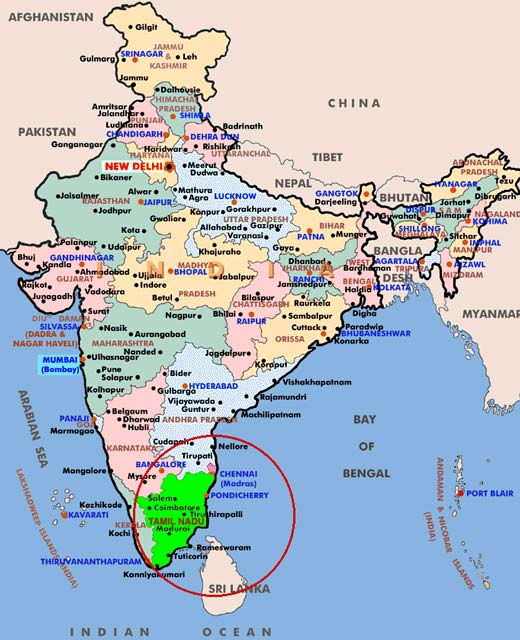
Recent reports estimated that nearly 90,000 million Indian Rupees or approximately US$1.5 billion will be spent to buy votes in the south Indian state of Tamil Nadu, where state legislature elections are scheduled for mid-2016. It is said that almost 60% of the electorate will get cash or gifts to the tune of $50 each. Now $50 per vote; that does not seem like a large amount of money; but when added together it is a huge sum; almost 1% of the GDP of Tamil Nadu, which in in 2014-15 was US$150 billion. Public health expenditure in India, in general, is at or less than 1% of the GDP.


The report says some form of bribing of voters started from the 1990s or even earlier, but many experts says that the 2006, 2011, and 2014 elections saw a huge increase. The larger question is: How do these candidates get the money to pay out such huge amounts to voters and how will they ensure recover?  The voter taking the money is also not ignorant of the fact that the winning candidate will use corrupt means to recover the money invested in the election. The obvious answer is the winning candidate will engage in many corruption scams when he or she gets into power. A clear example of how corruption has seeped into the heart and sinews of the democratic process – the election itself. In fact, a recent newspaper article reported on how the incumbent Chief Minister interviewed candidates personally for this election and the one question asked of everyone was whether they had money to participate in elections. This is institutionalized corruption starting with the election process.


USA, a developed country, is no different. An article in The Economist wrote that the total cost of the 2012 elections in the USA, including congressional races, topped 7 billion US dollars; of which, 2 billion dollars were spent in the 2012 Presidential contest alone. A report in www.thehill.com estimates that the 2016 presidential election will cost as much as $5 billion, and top fundraisers and election-experts are already predicting it will more than double the 2012 campaign’s price tag.


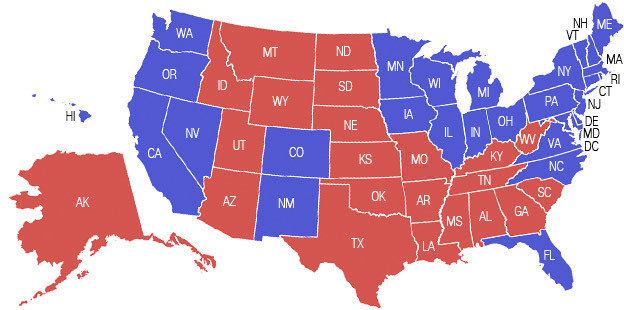
The election system itself is flawed; and this flaw is most apparent in exemplar of all democracy in the world – the United States. Whenever we see elections covered in the news channels, what we find is this familiar map of red and blue states as per their geographic size. It creates this comfortable feeling that each state is represented and weighted proportionate to its size.
US map elections 1

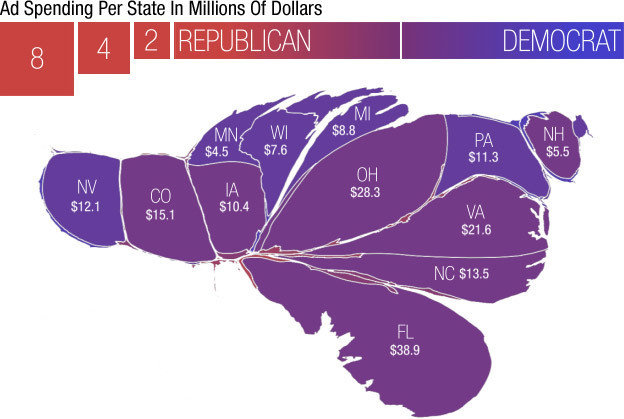
 However, www.npr.org (graphics credited to Adam Cole) used data from the 2008 Presidential election to create a morphed graphic or image of the United States which clearly demonstrates that in US presidential elections state size does not matter. Electoral votes are more important and just looking at the US through this lens distorts the importance and relative size of the states. when they are re-scaled or re-sized based on electoral votes. The map of the US morphs into some other shape altogether when campaign ad-spending by state is factored in.
US map elections ad sepdnign 2

As the short animated film below demonstrates aptly, the United States that matter to the electioneers and campaigners who want to win elections is very different from the US that we are familiar with and see in the usual maps. Right from the start of the election process, how the candidate and the entire lobbies backing her / him views you, if you are in an unimportant state, is very different from how they would view those in so-called “swing” states that are more important for winning elections. The idea of equality dies the moment an election is announced. Wasn’t it the Declaration of Independence that stated “All men are created equal.”


The second paragraph of the United States Declaration of Independence says:

“We hold these truths to be self-evident, that all men are created equal, that they are endowed by their Creator with certain unalienable Rights,      that among these are Life, Liberty and the Pursuit of Happiness. That to secure these rights, Governments are instituted among Men, deriving      their just powers from the consent of the governed…”

Where is that equality for all gone? If Martin Luther King (MLK) were alive today, would he stand up and say – I have  dream or would he be having nightmares instead?


When billions of dollars are spent on election campaigns, obviously lobby groups and vested interests are at play. When, at the end of the elections, the victorious candidate flashes the traditional 2 finger V for victory sign, he or she is very obviously showing the index finger which says: “You are my Number One” to the corporation or financial backer that funded the campaign and the middle finger to the people. There is no need for analysis here. The problems that will be solved in the next four or five years are the problems faced by the lobbying corporation, not by the majority of voters.


Citizens United v. Federal Election Commission, a U.S. constitutional law case, deals with the regulation of campaign spending by organizations. The United States Supreme Court held (5–4) that the First Amendment prohibited the government from restricting independent political expenditures by a nonprofit corporation, and also extended these privileges to for-profit corporations, labor unions and other associations. A second controversial ruling, SpeechNow.org v. FEC, by the D.C. Circuit Court of Appeals a few months later, held that there should be no limits whatever on the contributions to groups making such expenditures. (The term Citizens United has come to refer to both cases.)


Allowing unlimited election spending by individuals and corporations, the Citizens United decision exposes US elections to money, from corporations and wealthy individuals, in a much greater manner than ever before. The Citizens United decision also paved the way for creation of Super PACs (political action committees), a concrete example of the how big money influences the conduct of elections.   And all of this in the backdrop of a time when there is far greater economic inequality in the world than ever before. The Oxfam report, An Economy for the 1%, shows that the 62 richest billionaires own as much wealth as the poorer half of the world’s population. The wealth of the poorest half of the world’s population has fallen by a trillion dollars since 2010, a drop of 38 percent. This has occurred despite the global population increasing by around 400 million people during that period. Meanwhile, the wealth of the richest 62 has increased by more than a trillion dollars.   election 3 Oxfam report

Of course, people are angry, whether they are from the right or the left. Most people today would agree with the statement that they have no say about what the government does or that they cannot control the large corporations from controlling their elected leaders. So the people who enjoy establishment-bashing support Trump, while those who want to bash Wall Street and crony capitalism support Sanders. The leaders speak exactly what their followers want to hear. None of them have a systematic plan in place to solve the country’s illnesses and no voter has demanded a systematic plan from them. They candidates keep talking, the people applaud or jeer, and the circus goes on.


Just as many of us mistake a wedding for a marriage, we mistake the elections for a real democracy. It is not just about holding free or fair elections every few years, democracy is larger than that. It is about representing the people, giving a voice to the people, it is about getting people to participate in the process of government. However, when democracy is misunderstood as simply winning elections, then it leaves no space for true democratic leadership. Because the elected representative believes she is merely is a representative of the people, she has no compulsion or obligation to show the people the right path. The politicians says whatever he can in order to please and get the votes. The politician becomes the follower of the fickle polls rather than leader who shows the path; a bad salesman rather than visionary leader.


If you talk to the democracy cheer-leaders, many will cite numerous examples to show the democracy is working today; that far more countries are democratic than ever before and they even cite the rise of Mr. Trump, a non-establishment person as an indicator of the vitality of democracy.


It is important to re-consider the work of French historian Alexis de Tocqueville (1805 – 1859), who studied and wrote about American democracy, and found that aristocratic elites had been replaced by democratic elites. These new elites obtain power through appeals to the masses; and retain power by appealing to the masses.
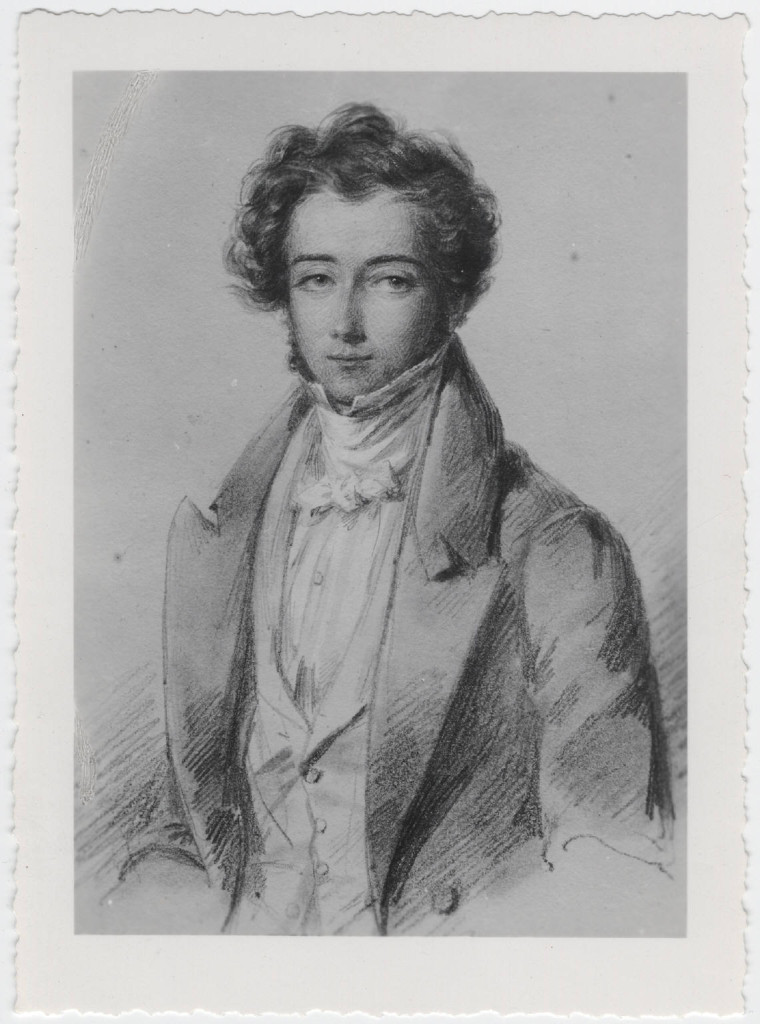
 elections 4 tocqueville

  More than elites what Tocqueville was afraid of was the unfastening or unhinging of restraints required to keep a liberal democracy based on majority rule in working condition. The people who win through majority rule tend to stifle dissent in almost despotic manner, considering their popular mandate as license for crushing anything that goes against their chosen path. Blaming majority rule as a chief factor in stifling thinking, Tocqueville wrote: “The majority has enclosed thought within a formidable fence. A writer is free inside that area, but woe to the man who goes beyond it, not that he stands in fear of an inquisition, but he must face all kinds of unpleasantness in every day persecution. A career in politics is closed to him for he has offended the only power that holds the keys.”


Tocqueville argued that a serious problem in political life was not that people were too strong, but that people were too weak and felt powerless; the danger is that people felt swept up in something that they could not control.   The new elites, produced by today’s democratic election processes, pander to the public, the lowest element. The leader instead of leading, showing the way, decides to follow the people. Distributing booze or $50 to the public is one example; telling the people that a wall will be built on the border and people from another country will be punished is another example. This kind of pandering by so-called leaders has a degrading effect on ethics, morality and society in general.   When truth becomes irrelevant; and what the masses feel is most important, there is a tendency on the part of elite leaders to become amoral.


After all, the leaders in a populist democracy have to follow the people. This amorality is often the surest path to depravity and corruption. Tocqueville saw mass conformity to public opinion as a problem for democracy.   John Lukacs (born 1924), Hungarian-born American historian and self-described reactionary, who has written more than thirty books, sees democracy as degenerating into nationalist populism in the US. The central tenet of populism is that democracy should reflect the pure and undiluted will of the people. This means that any leader, liberal or right wing, can use it; although politicians often use the terms populist and populism as pejoratives against their opponents. Such a view sees populism as merely using rhetoric or unrealistic proposals in order to increase mass appeal and garner more votes.


Lukacs, a self described reactionary on the lines of Churchill (and that should say a lot about his leaning), however makes some solid points against the current version of democracy. The prevalence of politics by poll and publicity in the West has led politicians away from true leadership and become more concerned with what “the people” want. It is thought processes and psychology that are important in a mass democracy and Lukacs writes: “our concern must be with how people think, how they choose to think, including how they are influenced or impressed to think and speak.”  Lukacs has also been highly concerned with the role of television in manipulating the public through the subtle distortion of words and speech. As optics and talking points become important there is little genuine debate, and no space or any platform at all for dissenting voices.
elections 6 Jose Ortega y Gassett


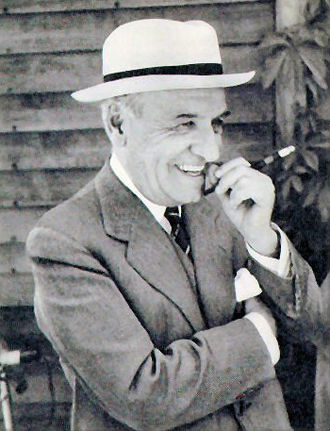
Jose Ortega y Gasset (picture above) was a Spanish liberal philosopher whose body of work was produced in the first half of the 20th century, a time when Spain oscillated between monarchy, republicanism, and dictatorship. In his 1932 work Revolt of the Masses, Ortega y Gasset discusses the rise of the “mass-man” in social and political life. This mass-man is a cognitively primitive man; who takes it for granted that civilization is “just there” and has no appreciation for the intricate processes that are required in order to maintain it. Mass-man uses all the products of modern civilization, but does not appreciate nor respect the superior intelligence and effort by the individuals who are responsible for their development.  Content in his own mediocrity, mass-man feels it unnecessary to strive toward excellence. Like a spoiled child mass-man feels compelled to impose his will on everyone.


Benjamin Barber terms this as infantilism – in his book Consumed: How Markets Corrupt Children, Infantilize Adults, and Swallow Citizens Whole: How Markets Corrupt Children, Infantilize Adults and Swallow Citizens Whole. Barber finds that consumer culture has turned adult citizens into children by catering to the lowest common denominator and that the market has conditioned us toward convenience, taking the easy things, and rejecting anything that requires hard work, persistence or is even slightly complex.

consumed


Most interpretations of Ortega’s book claim that there is inherent elitism and anti-democratic bias in his writing and even some contempt for mass-man. Ortega y Gasset is certainly elitist, however, he glorifies the elites who invest in society and contribute to it, not those who cling to power for its own sake and justify their hold by clinging to the past.   Ortega points to liberal democracy as the ideal form of government, when in fact it is quite contradictory because any democracy is the rule of the will of the people and therefore likely to give more power to the mass-man. Ortega writes:

“The political doctrine which has represented the loftiest endeavor towards common life is liberal democracy. It carries to the extreme the determination to have consideration for one’s neighbor and is the prototype of  ‘indirect action.’ Liberalism is that principle of political rights, according to which the public authority, in spite of being all-powerful, limits itself and attempts, even at its own expense, to leave room in the State over which it rules for those to live who neither think nor feel as it does; that is to say as do the stronger, the majority. Liberalism is the supreme form of generosity; it is the right which the majority concedes to minorities and hence it is the noblest cry that has ever resounded on the planet.”  


Lukacs finds this democracy at risk due to gaps in free flow of useful information. The press no longer performs its function and role of assimilating and reflecting the political views of the public. As with other media, the press focuses on entertainment, which is packaged as news but are actually a mutant infotainment. Crap in-Crap out – the vacuous media create a public that is force fed emotionally powerful images that are useless for informed decision-making. Philosophy and history are removed from public discourse and replaced with political sloganeering taking the life out of liberal democracy.


Lukacs is concerned with the manipulation of public opinion; and often compares contemporary democracy to that of Nazi Germany, where demagogic populists seized power, took control of the media and brainwashed their way through subsequent elections. Modern history shows a steady increase in popular sovereignty, in the power of public opinion and in the appeal of aggressive nationalism, which tends to control that opinion given a chance—with the aid of mass media.


In that assertion, conservative Lukacs’ concerns with manipulation of the public resonate with the views from the left of the spectrum such as those reflected in Noam Chomsky and Edward Herman’s 1988 book  Manufacturing Consent: The Political Economy of the Mass Media; and the work of Australian social psychologist, Alexander Carey, who brought the history of corporate propaganda to public attention. Labeled by journalist John Pilger “a second Orwell in his prophesies,” Carey pioneered the study of corporate propaganda published in 1995 in a collection of his essays under the title, Taking the Risk Out of Democracy: Corporate Propaganda versus Freedom and Liberty.

Is our democracy, today, a victim of propaganda? And aren’t elections the best time to do that?


The political process of problem solving does not work anymore


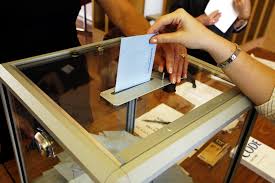
For most people, democracy is the system by which every four or five years depending on our country we walk into a booth and stamp a piece of paper or punch an electronic machine and magically elect our leaders. These leaders are then bound by the morality of democracy to solve our problems.   Of course there is no legal diktat that forces them to solve problems, but that is the expectation. That is the promise on which they are elected, that they will change things in our favor and make our lives better. It is assumed based on their speeches prior to the elections (including the primaries in USA) that they have actually heard us, have understood the common person’s woes and complaints, and will address it during their term.   And every four years we find these elected representatives letting us down. They break their promises and never live up to our expectations. In that sense, democracy has been consistently failing us over the past century. However, the show goes on.


Elections are held again and a new set of so called leaders now make promises to change. And nothing much ever changes. In fact it becomes worse.   The problem seems to arise because human and social problems are expected to be solved through policy measures and reasoned problem solving methods. However, the elected representatives are elected through a political process. There is a split between the methods of policy and that of politics. The means of policy formulation is analysis whereas the end of politics is to ensure that those who have funded the election campaign are rewarded through the process of politics.


Today’s politics demands minimal or zero analysis because the ends are already known. If an oil company, a financial conglomerate, or an automobile manufacturing corporation has funded the election campaign in a long drawn out political process then at the end of the term this oil or financial or car company has to come out the winner.   Politics is based on assessing the opponent’s moves and lining up options such that one can checkmate the opponent. Policy analysis, which is based on root causes analysis. is about understanding the cause or causes of problems and then lining up solutions or alternatives that most effectively and efficiently address those causes.


No politician running for office in this system of elections can afford to care about the causes of the problems faced by the people; it is the problem faced by the lobby groups that funded the election that becomes more important. More importantly the lobby groups also provide the solution to the politician for solving the problems they face – pas this bill which will ensure that our lobby group makes a huge amount of money, our return on the investment we made in your election campaign. Thus, the winning candidate has to simply manage the consequences of implementing those options provided by the corporate or other lobby group.   Before the elections the candidate makes promises, tells people exactly what they want to hear and after winning the election, the candidate makes excuses for inaction, blames the other parties and candidates.


Public policy is based on the rational, more deliberative part of the brain, while election campaigns as Mr Trump as shown are base don appeals to the primitive reptilian brain that reacts without thinking and responds to fear.


Democracy, based on equality for all men, which is supposed to empower the disenfranchised, give voice to the voiceless, and liberate is form the shackles of ignorance and despotism, has achieved the opposite. And all this thanks to the process of elections and electioneering which is considered the litmus test and essence of a democracy.


The following comment by Alexander Fraser Tytler (although the same has also been occasionally attributed to Alexis de Tocqueville) has given us a list of phrases commonly known as the “Tytler Cycle” or the “Fatal Sequence” (From bondage.. to …back into bondage):


“A democracy cannot exist as a permanent form of government. It can only exist until the voters discover that they can vote themselves largesse from the public treasury. From that moment on, the majority always votes for the candidates promising the most benefits from the public treasury with the result that a democracy always collapses over loose fiscal policy, always followed by a dictatorship. The average age of the world’s greatest civilizations has been 200 years. These nations have progressed through this sequence: “From bondage to spiritual faith; From spiritual faith to great courage; From courage to liberty; From liberty to abundance; From abundance to selfishness; From selfishness to apathy; From apathy to dependence; From dependence back into bondage.”    


The people are confused. Are they free or are they still in bondage? They perceive something as wrong but do not quite know what it is exactly. They blame the political party, the politician, the economic system. They rarely even consider the notion that something might be wrong with the processes of democracy. Now it would be heresy to think that.


While homo economicus, in his consumerist avatar, may face no existential problems today, homo politicus seems to be in the throes of an existential dilemma. The left and the right keep fighting with each other without any meaningful dialog. The left and its supporters subscribe to this notion of un-ending progress, a future where all sorts of hierarchies are eliminated while the right looks to the mythic past and the fundamentalist right will die to uphold tradition. Both engage in dreaming – the right has a nostalgic yearning for the past and the left for a more equal future. And both engage in bickering, the right and left constantly fight with each other, almost eternally one can say, instead of coming to a resolution to this peculiar problem of democracy – how to make it work like it was supposed to.


Sartre_1967

“So this is hell. I’d never have believed it. You remember all we were told about the torture-   chambers, the    fire and brimstone, the “burning marl.” Old wives’ tales! There’s no need for red- hot pokers. Hell is—  other people!” ―Jean-Paul Sartre, No Exit


Jean-Paul Sartre, who tried to refuse the Nobel Prize for Literature in 1964, wrote No Exit (Huis Closs). Published in 1943, this play has three characters who are dead and their punishment is being locked in one room for eternity. The source of Sartre’s famous (mis)quotation “Hell is other people”, this play captures Sartre’s philosophical ideas about the constant ontological struggle of being caused to see oneself as an object in the world of another consciousness. This play sought to put forth the existential idea that man is an absolutely autonomous individual, determined by his own will alone, for whom his consequent separation from others facilitates liberty and free choice.


However, these ideas of liberty and free choice are difficult to put in practice as we also live in a society of other beings – human, animals, trees and the planet.   We have responsibility to others and therefore the concept of free choice, whether in a mall or in a voting booth, come into direct conflict with the fact that our actions have to account for the fact that we are responsible for others.


Homo politicus and homo economicus have to contend with the fact that we are also homo socialis and now, more than ever, homo ecologicus.


Zhou_Enlai_at_Geneva


Chinese leader Zhou En Lai was probably closer to the truth of democracy. When asked for his assessment of the role of the French revolution of 1789 in promoting modern democracy, Zhou had wryly commented: “It is too early to say.” And though some have said that Zhou never meant this or his comment was not about the 1789 revolution, elections today in so-called full or flawed democracies are clear reflections of the failure of this hallowed institution of our modern times.


Is this the only kind of democracy that can be successful? The kind that panders to the lowest common thought possible, the kind that brings out the worst in human beings. Can human beings rise in the way they think of their lives and this planet? Will this kind of base thinking help us fight the problems of climate change or even corruption that almost everyone seems to hate? Are we as a human society condemned to be manipulated by elites – aristocratic or democratic? So, have elections, conjured as the cure to feudal lords and monarchs whose control the people wanted to escape, become the poison of today’s democracy? Or does the problems of democracy lie elsewhere?


Jose Ortega y Gasset, mentioned earlier, proposed that philosophy must focus on the only truthful reality —the life of each individual or “my life.” Ortega y Gasset captures the essence of his philosophy in the famous line (in Spanish): “Yo soy yo y mi circunstancia” (which means “I am I and my circumstance”). Ortega finds the two to be intertwined: There is no ‘me’ or ‘I’ without things, and things are nothing without me. Therefore the I or the human being cannot be removed from “my circumstance” (the world).


According to Ortega y Gasset, it is the bounden duty of philosophy to attack our existing beliefs because only this will promote new ideas that will help us understand reality. In order to investigate the essential reality of the universe and of life, philosophers have to discard prejudices and previously existing beliefs.


Take Ortega y Gassett’s maxim and apply it to today’s world. I, the homo politicus, am intertwined in the circumstances of elections and democracy. But what is the truthful reality of this democracy? What has democracy become? And what have I (the human being) become in the bargain?   Democracy is a lofty idea, but does it only go to prove that humans are good at dreaming up ideas and terrible at implementing them. When we think, we think freely. And when we do, we are bound by our baseness and selfishness.
 

elections 1     ©  The Essayist, 2016


NPR link from

http://www.npr.org/sections/itsallpolitics/2012/11/01/163632378/a-campaign-map-morphed-by-money

https://www.yahoo.com/news/electile-dysfunction-korea-probes-sex-pills-votes-claim-100004459.html

Prince Charming

TEENAGER
SOMEBODY TO HAVE FUN WITH.

20`s
SOMEBODY TO HAVE FUN WITH, MAY BE GET MARRIED TO AND HAVE KIDS

30`s
SOMEBODY TO HAVE FUN WITH, GET MARRIED TO AND HAVE KIDS

40’s
SOMEBODY TO HAVE FUN WITH, MARRY AND MAY BE HAVE KIDS

50’S AND BEYOND
SOMEBODY TO HAVE FUN WITH.

Hunger Games: Living and falling out of trains in Mumbai

“Here’s some advice. Stay alive.”

― S. Collins, The Hunger Games


Imagine an upright coffin.


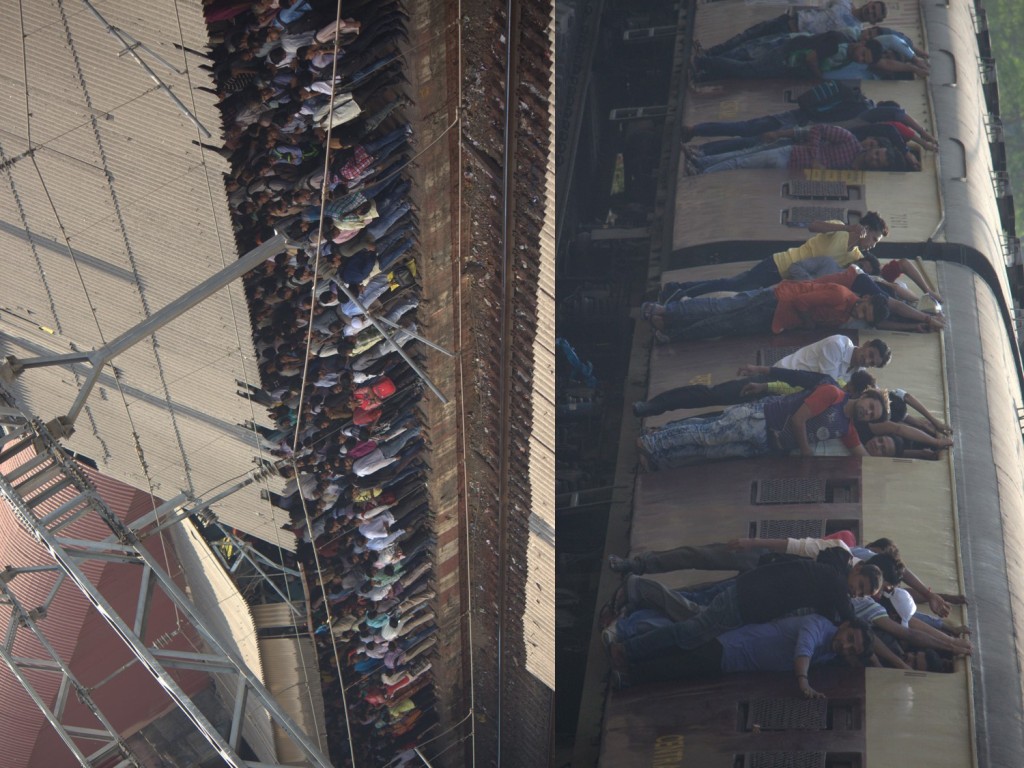
A standard-sized metal casket 7 feet in height, 2 feet across, and less than 2 feet in depth. At exactly 8 am in the morning, try to get inside this coffin. You are not alone. There is a crowd, pushing and shoving, all trying to get inside that coffin along with you. Finally you are in, standing inside this upright coffin, packed with about 14 to 16 strangers. Now imagine four hundred such coffins stacked inside a large box-car or freight-car which can hold only 100 coffins; and the train starts moving at 60 to 80 kilometers per hour. There are ten stops before you reach your destination. The box-car is already overflowing; however, at each stop, hundreds of new coffins try to push and shove their way in, some hanging on by their last nail to the boxcar’s edge.  After 60 to 90 minutes, you arrive at the final destination. Coffins push and shove to get out. Once outside, you shrug the coffin away; deliberately do not say good-bye to the strangers who got real close in the last 60 minutes. You rush to make a presentation to that new client or serve coffee with a smile to your boss. You work all day. At 6 pm, you get inside a similar coffin again; this time with 14 to 16 completely different strangers; and hundreds of such coffins push and shove and get inside a boxcar to return home. After 60 to 90 minutes you get out, shrug the coffin and strangers off, stop at the local bazaar to haggle over the high prices of vegetables with the vendor; then go home and listen to your teenage kid complain about not having a smart-phone. You switch on the idiot-box to tune off from your own life as the drama on television reminds you of what it is to be human. Box-car to idiot-box – you do this every day, six days a week (because your country and company does not believe in 5-day work weeks), for the rest of your working life.


It’s not over. You also have a very high risk of meeting with an accident, including choking and suffocation, falling out of the train, getting pushed, shoved, elbowed by others, or getting run over by a train. And when you survive all this you do not get any points. You do not win. You are supposed to feel lucky that you survived. You take your measly pay-check and go back to living your life which means getting into a coffin every day.


This is neither a video game nor a vampire movie.


This is the daily life of a person in Mumbai, who commutes to work in the city using the urban transportation system – the Mumbai suburban railway system also known as Mumbai locals.

 cover image


The BBC did a series on this aspect of Mumbai and aptly called it Crush Hour (see you-tube link at bottom of this piece). But there is more to Mumbai’s transportation system than pushing and shoving or being packed in a crowded compartment. There are real accidents and deaths:  25,722 passengers fell from suburban trains in Mumbai in the last ten years, of which 6,989 commuters died. Another 22,289 passengers died while crossing the railway tracks. This was revealed by the Government Railway Police (GRP), Mumbai after an inquiry was filed under the Government’s Right to Information (RTI) Act.


In 2015 alone, there were 3200 deaths, of which 697 commuters died after falling from the local trains. That is nearly 9 deaths a day on the Mumbai local system and nearly 2 deaths a day from falling. Many more have serious injuries, lose arms and legs, concussions and get into comatose states.  Additionally, sheer suffocation inside the overcrowded compartment caused deaths by triggering heart attacks and other complications in over 400 commuters.


The Mumbai suburban rail system has nearly 190 to 200 trains (train sets or rakes as they are called by the rail authorities) with 9 to 12 coaches or compartments as they are called in Mumbai. Compartments are classified into 1st class and 2nd class and then into male (gents) and female (ladies). In order to alleviate the problem of over-crowding more 12- and 15-coach trains are being added to the fleet.


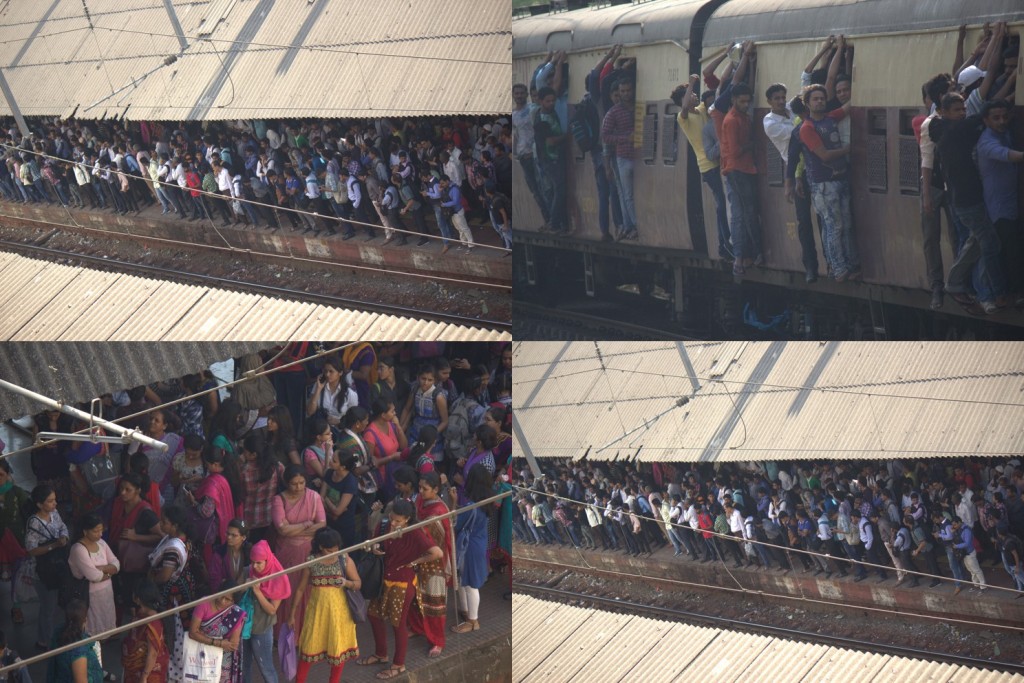
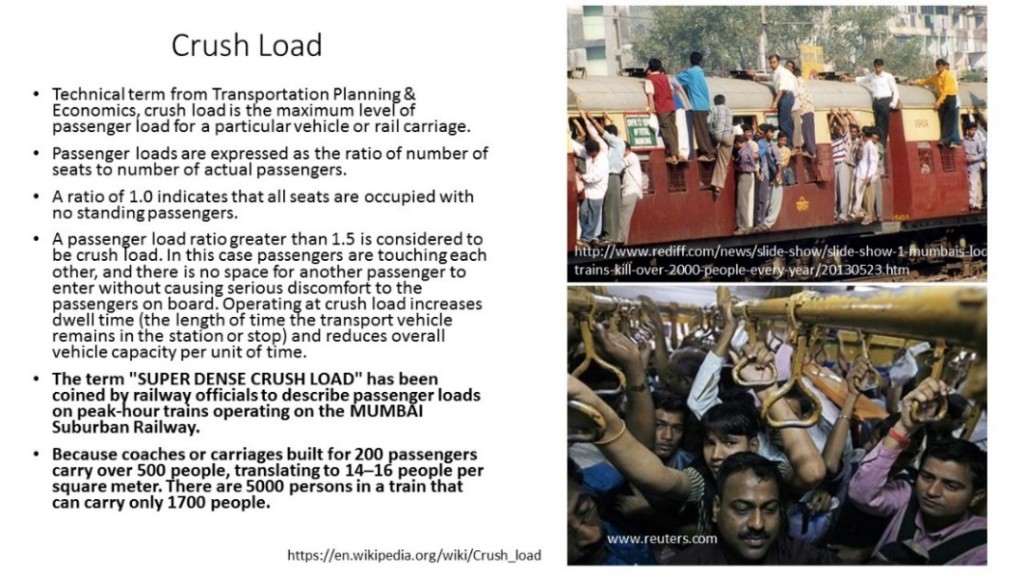
However, with Mumbai’s high population, which is growing every day and nearly 4 minute gap between two trains at every station, congestion and over-crowding is inevitable. During peak hours 5000 passengers are packed into a 9-car rake with a rated carrying capacity of 1,700. This has resulted in what is known as Super-Dense Crush Load of 14 to 16 standing passengers per square meter of floor space.

Crus load


*****


The Mumbai Suburban Railway, one of the oldest railway systems in Asia, is an offshoot of the first railway to be built by the British in India. The firstMumbai_suburban_Rail_Network_Indian_railways train is said to have operated on 16 April 1853, between Chhatrapati Shivaji Terminus in south Mumbai and Thane in the north, a distance of 34 kilometers.
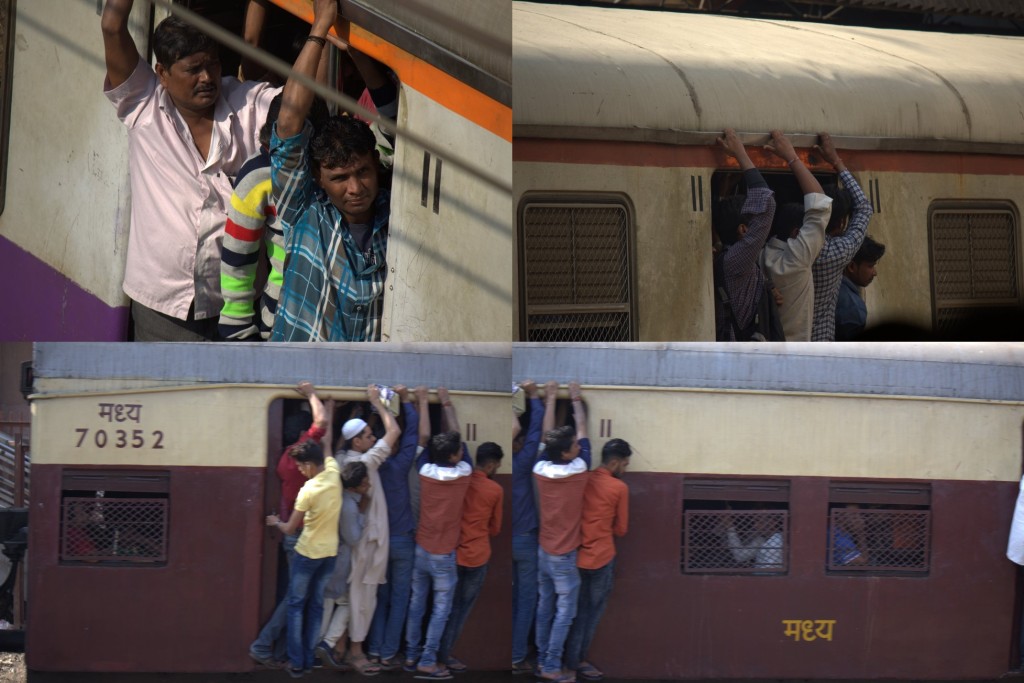
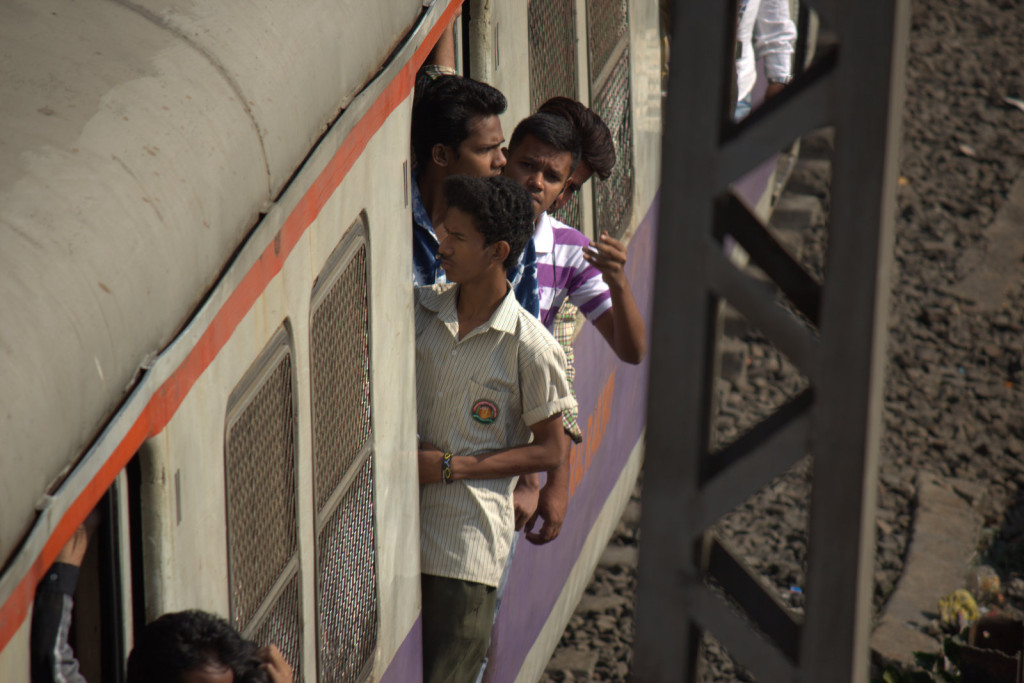
 

Mumbai’s rail system is divided into two main lines – along its western and eastern or central corridor. Over 5 million commuters use Mumbai’s Central line and 4 million use Western line every day. These suburban rail system trains, or Mumbai locals, are a critical component of the urban transportation system in Mumbai and are known as Mumbai’s lifeline. The city is a commercial capital of India and all commerce and business activity would come to a standstill if these trains stopped. Mumbai is an island city — bounded by the Arabian Sea on the west and south and the bay on the east (it’s name comes from the Portuguese Bom- baía

or good bay). From its historical commercial roots in the south of the island, the city has grown northward where it was easier to build bridges across the creeks and connect with the mainland. Most of the offices and residential house of business owners are in the southern part of the city and most workers live in the north stretching out of the island city into the mainland of India in the state of Maharashtra.

 Mumbai,_aerial_view,_satellite_image,_wikimedia


With a population of 20.7 million, according to the Census of 2011, (compared to somewhat over 4 million in 1960), Mumbai Metropolitan Region is one of the most populous urban regions in the world and the second-most populous metropolitan area in India. The Mumbai Metropolitan Region spreads across Mumbai’s adjoining districts of Thane and Raigad and incorporates areas of Thane, Navi Mumbai (New Bombay), Vasai-Virar, Bhiwandi and Panvel where a lot of the office workers live, who travel every day to the city. The average population density surpasses 27,000 people per square kilometer. The city lacks open spaces with less than one acre of open space for every thousand people, while the norm is 4 acres.


Mumbai lives up to its image as a city of extremes. Within India, Mumbai has the highest number of billionaires and millionaires among all cities in India; and has the highest GDP of any city in South, West, or Central Asia. Next to the swanky high-rises are the slums. No city in India has as large a proportion of its residents living in slums, officially put at 54%. The slums have become synonymous with the city and represented with much box-office success in movies such as Slum Dog Millionaire.


It is the lack of affordable housing that is a major problem in Mumbai. It is not that flats are not available; just that housing prices are unrealistically high. A news item in July 2015 on NDTV , an English language News channel in India was titled: ‘Nearly 1 Lakh Flats Unsold in Mumbai. Prices Still Not Falling. Why?’


India’s Property Market Paradox: Unsold Apartments, Crisis for Common Man.’ was the apt title of an article in Huffington Post in March 2015 explained the crisis: “… in cities like Delhi and Mumbai, where residential property prices more than doubled from 2009 to 2012, instead of cheaper housing, most developers built apartments that cost over Indian Rupees 10,000,000 (US$150,000) on average, as these include a hefty margin and are targeted at richer buyers. But the average Indian cannot afford them. Their demand is in a far lower range of INR 5,00,000 (US7500) to INR 20,00,000 (US$30,000). So while apartments remain empty, India’s middle class is faced with a housing crisis or a lack of affordable housing.”


The middle-class and low-income workers prefer to buy cheaper flats in the larger Mumbai Metropolitan region and travel for hours in these over-crowded trains. Inflation, at least for food commodities and in housing and transport, has been growing exponentially in recent times. Mumbai was found to be the most expensive city in India according to the recent Cost of Living Survey 2015 conducted by Global HR firm Mercer. Mumbai was ranked at 74th place and was more expensive than Dallas (77), Munich (87), Luxembourg (94), Frankfurt (98) and Vancouver (119). The survey stated that higher cost of fuel, transportation, increased prices of food items, home services and rentals increased the cost of living.


According to a report in the English daily DNA: “Psychiatrists say inflation is leading to depression, loneliness and helplessness among those who are finding it difficult to cope up with their financial condition, making them vulnerable to suicidal tendencies. They say the number of such patients has gone up considerably over the past few years.”


While the cost of mobile phones may be decreasing the cost of meat and onions is at an all-time high. People need money to survive and endure hardship. Thus, despite inhuman conditions, the urban transportation system, especially the Mumbai railway system is the lifeline for people and business in this commercial city.


rail_collage_5

x

*****


“Winning means fame and fortune. Losing means certain death. The Hunger Games have begun…”

-From The Hunger Games


However, with the rising number of accidental deaths in the last ten years, people question whether Mumbai’s urban commute has become a death-trap? Some activists call it Mumbai’s silent-killer. Although accidents or deaths by railway accident are not silent; they are loud, painful and filled with amputations and screams. It was one such accident on November 27, 2015, that was accidentally filmed by a fellow commuter. It captured how a 21 year old male, standing at the edge of the compartment due to overcrowding fell out after losing his grip on the pole-handle. The video went viral and sparked outrage and anger among commuters. Some f the anger was directed at the rail system for not paying attention to overcrowding. And some of the anger was directed at the in-humanness demonstrated by commuters towards each other. What is it that makes a fellow traveler the enemy of another – what is it that makes a human so insensitive to the plight of another and only think of getting his? When did human beings, the so-called social animals, get completely caught up in this “me-myself-mine” mindset?


However. outrage died down soon as people got busy trying to push and shove their way back to work. That’s the Mumbai spirit. It forgets. Perhaps it cannot afford to remember.


Bhavesh Nakate videos


Man falls from Mumbai local train (this is another one)


“Male commuters risk life for ego.’


On December 28, 2015, a month after the falling death mentioned above, the Mumbai edition of a widely circulated Indian English daily carried an article with this headline ‘Male commuters risk life for ego.’ It stated that, in 2015, of 7.5 million (75,00,000) commuters, women comprised only 30% and yet suffered only 11% of all deaths; that is of the 3200 deaths in 2015, women accounted for only 325(11%) of the total. Therefore, the article concluded that ‘male commuters risk life for the sake of their ego’ and ‘males are more prone to taking risks while traveling while women opt for safety first.’


Would any sane statistician or social scientist jump to the conclusion that the cause of the larger number of male deaths was the male ego, by just looking at one number. Any student at the 5th grade level would tell us that there could be umpteen other causes and reasons that need to be examined before we jump to causal conclusions. Human problems often have multiple and multi-level causes that have complex inter-relationships. The reasons are simply high demand and not enough trains, greater time gap between two trains leading to overcrowding at stations, environmental, structural, specific problems of the male compartments, group dynamics. In fact these kind of data open up more questions than they answer. These basic frequency comparisons are a starting point for more detailed investigation. To blame the male ego is naïve, immature, and an obvious attempt at shifting the blame to the victim.


The reporter of the article had gone to a psychiatrist to get a quote, not an urban transport planner but a psychiatrist, who explained away the findings by saying: “Men suffer more casualties because they sacrifice safety measures for the sake of their ego.” All the other sources contacted by the journalist seemed to be of one type — eager to blame the male ego. The message was that if the male ego was brought under control then all accidental deaths on Mumbai trains would stop.

 railway_crowds10_rs


Most people always thought that the transport authorities, policy makers, politicians or the nexus between politicians and various developers, and lobby groups were responsible for the mess that is Mumbai. What used to be a beautiful city along the sea with hills and the largest natural forest reserve of all urban areas globally has now been reduced to an ugly, congested, dying, smelly sprawl with dust, poor quality air, poor visibility, and noise that assault the human senses. Mercer’s Quality of Living Rankings which cover 230 prevalent destinations for globally mobile talent and to determine expatriate worker’s remuneration places Mumbai at 152nd rank. They cite the extensive increase in population due to migration from other parts of India, lack of access to clean water, air pollution and traffic congestion as reasons for Mumbai’s low ranking.


The headline was indeed confusing. Who is the victim of all the deaths and accidents in the Mumbai rail system? Is it the male traveler with the huge ego, who regularly falls off from trains or the city, the government agency that operates this overcrowded, hellish transport system?


Do we laugh or cry at such headlines? Is this simple insensitivity or sheer stupidity?


*****


“Hope. Hope is the only thing stronger than fear.”

President Snow in The Hunger Games


“Why so angry?” quipped an acquaintance who is trying to make money through an e-commerce start-up? “Look at the bright side. Traffic congestion and overcrowded trains are a business opportunity, not a crisis. The more people push and shove and fall out of trains, and the more such newspaper articles are published about accidents and deaths on public transportation and roads, the more people get afraid and the more likely they are to stay at home. And the more they stay at home the more they shop online. E-commerce will boom in India,” he said, “mark my words.” That’s the same belief held by venture capitalists, who have been blindly bank-rolling loss making e-commerce sites all this while.  However, someone’s death or discomfort was not an opportunity to make money. He expressed surprise at these antiquated thoughts. However, despite the obvious discomfort experienced during the entire conversation, it was informative to talk to him because he did point out an event which gave a different angle to this whole problem. He reminded us of a riot in a railway station on the Mumbai suburban railway system that took place in 2015. And he mentioned that it was not a one-off incident; these kinds of disturbances and riots at railway stations and bus stops were frequent, especially with any disruption of services. This was a complex issue and we were reminded to look at all sides of the phenomenon.


Diva_protest1

x

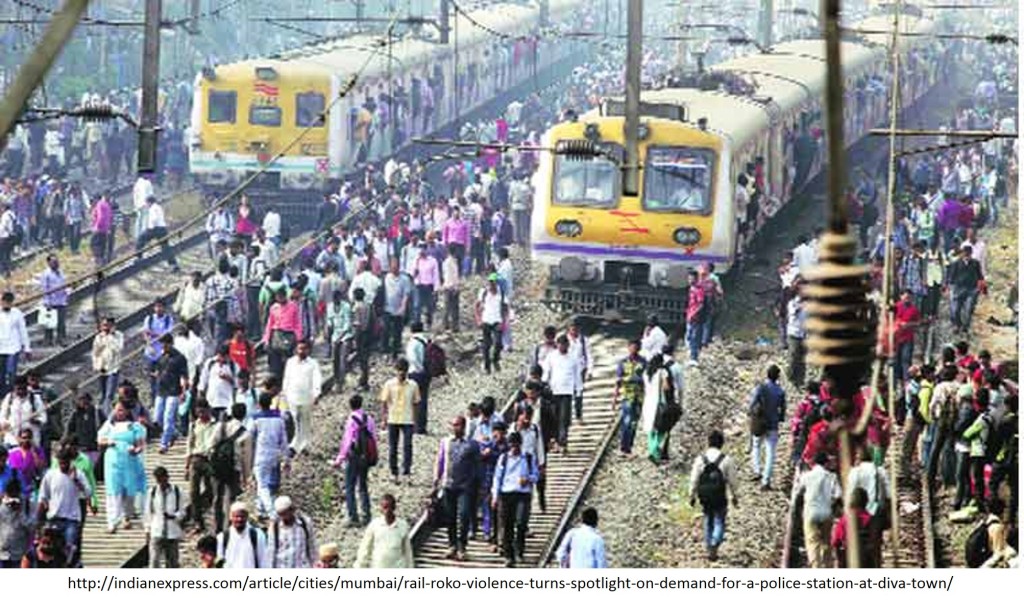
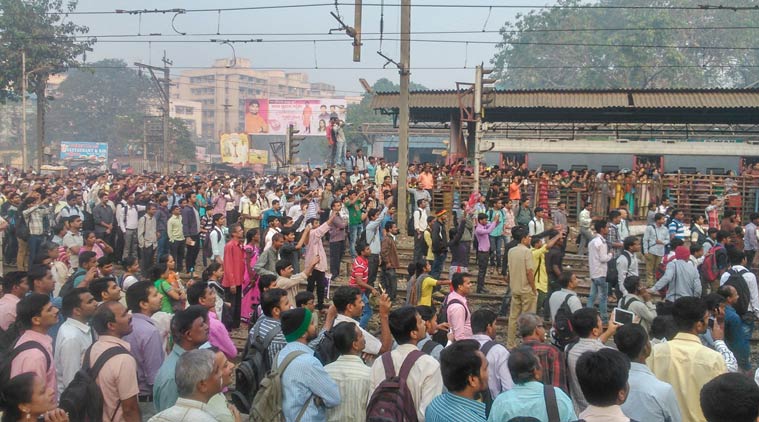
Examination of newspaper reports found that from 8 am to 12 noon on Friday, January 2, 2015, a technical glitch, caused by a broken pantograph, disrupted Mumbai’s local train service on its central line. At a station called Diva, irate passengers protested by blocking the train line. The commuters at Diva station started assembling on the tracks in huge numbers and some threw stones at any passing trains. The passengers said they were angry at frequent breakdowns of service in the Mumbai rail system. However, the protest soon turned violent, escalating into a full-blown riot. Ten trains were damaged, more than 100 services were suspended and four police vehicles were destroyed. The government railway police (GRP) registered cases against 12,000 people for rioting and damaging government and railway property, after railway agency sustained losses of India Rupees 1.8 million because of protests by commuters.


Interestingly, a report on this incident in one of the major newspapers ended the article with this sentence: ‘Passengers cheered loudly when the first train from CST rolled into Thane station, at 1.45 pm.’


This changed the question. At first we asked why are there so many deaths on the urban transport system in Mumbai? And how can one callously blame the male ego for the deaths instead of examining structural factors? What is wrong with the authorities and the media that shifts the blame on to the victim?


However, now, the question was different: Why do the very people who are at risk of dying every time they get into a crowded train engage in rioting when they cannot get into these overcrowded box-cars? If the daily commute is difficult and deadly, then why do people riot when the train service breaks down? Wouldn’t a normal person be happy that they did not have to go to work; but these people were dying to get inside that coffin?


The issue can be re-worded as: I know I am going to have an experience that is torturous, painful and may expose me to potential death. However, if I am denied that experience then I will on a rampage and riot demanding that I be given that painful experience immediately.


How do we understand this phenomenon better? What are the cultural and psychological factors underlying this because it is not an individual engaging in this behavior, it is an entire group of people in the city of Mumbai?


So we thought: Why not take the newspaper stories and our dilemma to the very people who are at risk of falling off the trains? Get responses and feedback from the people themselves. This would complete the journalistic cycle. So we put all the newspaper clippings in a file, placed our question on a printed sheet at the end and took it to the people who use trains.


*****

Diva is a junction Railway Station. It is not on the island of Mumbai. Diva is across the creek about 17 kilometers east of Thane, situated on the mainland of the state of Maharashtra. Another 14 kilometers east of Diva, further inland, is the station of Kalyan. As mentioned before many of the office workers of Mumbai have affordable flats on the mainland and travel every day into the city. Diva is an important junction because it has a line that connects to the western railway system and therefore commuters from the east and central lines can change over at Diva to travel to the western line. Diva station has a long history. It was opened in 1877 and is a major junction in the central railway system of Mumbai. The Parsik tunnel, built in 1916 during the British Rule, ends at Diva Railway Station.

Diva_Junction_railway_station_Stationboard

x

*****

 “Happy Hunger Games! And may the odds be ever in your favor.”

― S. Collins, The Hunger Games


Newspaper clippings in hand we reached Diva station at 9 am. We purchased tickets so that we could get on the platform where people board the trains. We approached a few people, but they were in a hurry to reach their place of work and did not even look at us. However, after getting pushed and shoved around, we met one person, who perhaps took pity on us. We showed him the clippings and explained why we had come to that station. This person zoomed in to the male ego headline. Tell that psychiatrist to travel with us for a day and he will know how the male ego prompts us to fall or jump out of trains. It is not the ego, it is our desperation that makes us ignore our own safety and take risks. We go to work every day so we can put food on our tables, keep our families alive, pay the doctor’s bills, the children’s school tuition, then it is good to have a male ego. What do these rich spoilt people understand of our lives anyway? Ask the psychiatrist to stop taking his fees from patients and we will keep our egos aside and pay more attention to our own safety. His voice had reached a higher pitch.


rail_collage_3


By this time a couple more men who overheard us had become interested and they gathered around our file with the clippings. One of them was in a generous mood, and even let his train go without trying to push and shove his way in.


Both seemed to have honed in on the ‘male ego’ headline. One of them gave a dramatic performance as he responded by asking a series of questions: Is climate change caused by male ego? Of course, mostly the ego of industrialists and businessmen who are unwilling to acknowledge the truth. Is ISIS and terrorism caused by the male ego? Of course, the ego of the ISIS leaders, the American military, owners of the oil companies, the Saudis, the Syrians, the Iraqis. All of those male egos. Any problem in the world can be blamed on the male ego.


Another said: What about the ego of our company owners? Is it their ego that they have maintained offices in South Mumbai when 90 percent of the staff are from North Mumbai? Why can’t they move their office here so we do not have to travel as much? And if they want us to be safe, then why don’t they do something about the prices of flats in Mumbai? The other one said: Well, then it must be the ego of these real estate developers that they have kept process of housing so high even though 100,000 flats remain unsold?


They were being sarcastic and started laughing loudly. Hearing this a young man piped in: I would also like to travel in a helicopter from my rooftop like one Indian billionaire does, but then it was my father’s ego that prevented him from engaging in corruption and cozying up with politicians to launder their bribe money to create a business empire.


One man, who was reading a novel, pointed to the male ego article and said: This has to be a paid article. Haven’t you heard about paid articles? All this nonsense about the male ego being the cause of falls from trains – this is definitely paid for by the railway authorities or other vested interests that do not want to change the overcrowded transport system.


This provided a slight shift in their thought process and gave us a small window to show them the clippings of the riot in Diva and ask: Why?


The answer was unanimous. Almost all of them repeated the same story. They talked about their daily struggle for survival. If they miss out even one day of work, their boss or owner cuts their pay or takes the work back in some form or other. They constantly worry about losing their job to one of the many young people graduating from college or a student with a management degree from a college in some remote part of India, who is willing to work at lower pay. If they do not go to work, they are afraid they will not bring home a salary, default on their home loan payments, not afford the over-priced food and vegetables, family will go hungry, not afford to pay for children’s education in a good school, or be unable to take care of any medical expenses. All of them said they were under extreme stress. They know they cannot miss a day. They need the money. Therefore, they push their way into the train, and try to push every other person out of the way. They are single mindedly focused on their paychecks.


Sensing that the mood had become serious, the two young men joked: Oh! So now they are blaming the male ego. In the past, any problem in Mumbai used to be blamed on migrant workers by the local political parties. Another said that blaming migrants for taking away jobs is very easy. If there is a job to be done, and even a small amount of money is given, someone somewhere is desperate to take it. Why blame the person who takes the job? Why not blame the employer who does not want to give a living wage and raise the salaries. I am sure if the wage is decent, even the locals will work.


Another agreed and said: It is just that the rich want to take all the money and don’t want to pay for anything that will benefit their workers. And now even the government does not want to spend on giving some facilities to the people. We all pay taxes, everything we buy, we pay taxes. Where does all that tax money disappear? What is it used for?


A person who had been quiet till now said: They want our labor and then they want our money when we buy food and things, but they have no respect for us. The problem is that money can flow in out of any country but man cannot. Look at all those bankers. They have created a recession but no one went to jail. No one blamed their ego for destroying the economy. But if one person falls from a train or if we express our anger at the transportation system, you are quick to blame us.


The final word came from someone who we met on our way back. We were having tea at a stall outside another railway station. We were discussing the conversations we had earlier that day when this man overheard us. He used to travel every day in Mumbai locals, and then one day decided that enough was enough. Not because of the super-crush load or the crowd, but specifically because of the inhumanness it generated in himself. He told us that he became a monster when it was time to board or alight from a train. He did not like what he felt inside every morning and evening. He became this other person who would easily push someone else out of the way just to get a foothold on the train. “This is not what I wanted for myself,” he said, “I live in a city. We are supposed to be civilized. Savages have better manners than me in a Mumbai local.”


railway_crowds9_rs

x

He continued, “People advised me to relocate to a smaller town. I did not want to leave Mumbai. This is my city. I was born here; I like it here. I am a big city boy. Fortunately, I was able to shift to a place of work that is near my residence.”


Now he walks to work every day and does what he can at a personal level to keep Mumbai human; however, he also feels powerless that he is unable to do anything on a large scale that can improve his city. He feels he will psychologically die the day he abandons Mumbai and escapes to a place with better air and better quality of life; and feels that day is near. When we show him the headlines and the data, some of which was already familiar to him, he took us back into history, specifically World War 2: “I think it has been mentioned by some historians that without the mass transportation of the railways, the freight cars and cattle cars in which millions victims were transported to the ghastly concentration camps, it would not have been possible for the Nazis to reach the unfortunately large scale of the Holocaust and kill more than 5 million.”


But how does that historical tragedy relate to what is going on in Mumbai today? We asked.


Similarly Mumbai’s commercial success within India would not have been possible without this local rail system that transports workers on a massive scale in the millions on a daily basis. And who has massively benefited from Mumbai’s so called commercial success? The workers may have had a few benefits; they are happy with a small matchbox like flat or a smart-phone and by comparing themselves to their poor cousins in the village. In reality, Mumbai’s money has largely gone to the coffers of the business owners, the politicians, real-estate moguls and so on. They have a nexus with their own self-interest at heart. They could care less if twenty thousand people fell of the trains tomorrow.”

 holocaust_train_1


Seeing the quizzical look on our faces, he answered the question on our minds as he continued.


“How can I compare the experience of Holocaust victims to Mumbai? Well, it’s my opinion and you may choose not to publish it. Because you think that these people in Mumbai are free, aren’t they, and those in concentration camps weren’t? The real tragedy for those living in Mumbai is that at least the victim in the concentration camp knew that his aggressor was external. The victim of the Holocaust could see the aggressor. If the victim tried to run, there was a uniformed soldier or SS agent who would have shot him dead. The victims of the Holocaust were pushed and shoved into freight cars with the barrels of the guns of German soldiers. Ask yourself, what is it that makes the people of Mumbai push and shove each other to get into one of those box-cars which have super-crush loads and then watch their own brother fall of the trains and do nothing?”


“But the man in Mumbai is free, right? Who or what forces this life on them? Yet, why do they choose to be inhuman every day when they travel, or live inhuman lives in pigeon-coop flats and cubicle offices? No one is putting a gun to his head. There is no soldier or SS agent who will shoot him if he walks away and chooses an alternative. But the beaten-down inhuman living in degraded cities like Mumbai will never run. He feels he has no exit. He thinks he has no choice when it comes to his lifestyle. There is no alternative. This is the only life. The man from Mumbai will breathe the polluted air, drink unclean water, walk through congested streets and get pushed around in local trains, but he will make no such choice in his own life. He will accept whatever is given to them. He just wants to pay those EMIs and buy that new smartphone.  He will put those headphones and tune everything else out. What is it that makes him want to do this every day for his entire life?”


Is it complete lack of ego? Perhaps the man in Mumbai should develop and nurture an ego – some sense of self-respect so that they stop accepting such living conditions. It is not the male ego that is making them fall off trains. It is the complete lack of ego that is making them get into that super-congested compartment in the first place. If these males had any ego they would be attacking the powers that have allowed this to happen — a world where money has more respect than a human being.


Ask the psychiatrist to ANALYZE THIS.

 diva_riot1


© The Essayist, 2015


Photographs of Mumbai trains by Rajesh Subramanian.

For some of the other pictures and diagrams, the URL from where it has been procured is pasted at the bottom.


VIDEOS

  • Crush hour – The World’s Busiest Railway 2015: Episode 1 Preview: https://www.youtube.com/watch?v=pvcCjBAl_xo
  •  Mumbai Local Trains: https://www.youtube.com/watch?v=1eAP-BoxVkg
  •  The video below shows people inside the train: https://www.youtube.com/watch?v=mW_sjKWQCD8
  •  Women Boarding Crowded Mumbai Local Train Compilation India 2014: https://www.youtube.com/watch?v=U49AnSz_Jb4


REFERENCES


Riots in Diva


Videos of riots in Diva

Mumbai train services hit: Violent protests by angry commuters (Headlines Today): https://www.youtube.com/watch?v=3ACcTM0F8B8

Diva Station Riot Jan 2015: https://www.youtube.com/watch?v=E5m5gPmwYbs


New Year Resolutions: I will marry my smart-phone

shutterstock_275346362


Pharriage: humans exchanging “rings” with phones and finally getting officially married to their (smart) phones; choosing smart phones as spouses over painful partners.


Well most of us are already “phnuggling” (snuggling with our phones instead of our partners), so can “pharriage” be far away?


Do you, Jill, take this phone, Jack, to have and to hold from this day forward, for better and for worse, in sickness and in health, to love and to cherish, ’till the battery dies or a new i-phone do you part?


Why not?


We are more connected to our phones than partners anyway. And it also happens to be the perfect recipe for peace at home. Partners feel bad about being phubbed (phone snubbed) and bicker and quarrel with us. Marrying our phones will stop this nonsense. Furthermore, proposing becomes less costly. Just ask a friend to give your phone a ring. And after the “pharriage,” if the phone insists on argument, you can always switch it off or just let the battery die. Kill two, three, four birds with one stone. Work smart, don’t work hard. Peace in the home. Peace in the world.  A practitioner of “Think globally, Act locally.” True global citizen, and all that. Those are the benefits of a “pharriage.”


However, Pharriages, we predict, could also be the cause of the next big headache for the justices in the US Supreme Court. Conservatives will have one more thing to worry about. Same-sex marriages will become so yesterday, like child’s play for a judge. However, judges will have a hard time resolving questions such as who is the dominant partner in the relationship;and how to separate property in case a pharriage breaks down. Just because I pay all the bills for my phone in a pharriage – does it mean that I can treat my partner-phone like cattle or property? What about abuse of the phone-partner? What about abuse by the phone partner? How easy is it to leave someone like a phone-partner who knows all our secrets, including passwords for various bank accounts and credit cards? How do you cheat on a smartphone-spouse; or send a text message of an affair without this smartphone-partner knowing?How much does the smart-partner (obviously the smartphone) get in a divorce; can smartphones own property (they buy and sell them anyway); and who gets custody of the child (an adopted i-pod)?


****

x

Pharriages and more resolutions as we decide to make the world a peaceful place this New Year. We make resolutions at the start of every year because it’s that time when we want to wipe the slate clean, start afresh. Discard the bad habits of the last year and make a better world. However, with each New Year we find ourselves in a worse place than we were the year before. However, we believe the resolution to “pharry” may change all that.


Resolution:

I will marry my smart-phone (or participate in a pharriage)

 smart phone and woman edited jan 11


This is also the toughest of all resolutions to keep because it does not allow us to pass on the blame of this big, bad world onto others.  Trump may stop talking; ISIS may stop terrorizing; the climate may stop changing; but we, the people, will keep our fingers glued to those touch-screens.


Our ancients, in remote villages, star-gazed and told stories of the universal human, then the modern Europeans sea-gazed and crossed over to colonize, today, when everyone in the planet is connected we are selfishly smartphone-gazing.


To the extent that 31% of women said they would much rather spend a day without their romantic partner, than without their mobile phones; and those between 18 to 44 years were most likely to choose (mobile) phones over partners. However, among those aged 65 years or older, nearly 4 in 5 (79%) of respondents preferred to lose their phone rather than their loved one. These were reportedly found in a survey conducted by The Best You, UK’s leading personal development magazine.


“Sound the alarm: The good old-fashioned relationship is under attack from technology?” said The New York Times in December 2014.


The Time Mobility Poll, a survey 5,000 people in eight countries – the U.S., the U.K., China, India, South Korea, South Africa, Indonesia and Brazil – found that:  84 percent of respondents said that they could not go a single day without their cellphones; 50 percent of Americans sleep with their phone next to them like a teddy bear or a spouse; 20 percent of respondents check their phone every 10 minutes.


A report in The Daily Mail (UK) stated that: “We now spend more time on our smartphones than with our partner, according to a new study.The average smartphone user tends to spend two hours (119 minutes) a day using their gadget.Yet, the amount of time we spend with our other halves (partners) per day is just 97 minutes – a third less – on average.”


Come December 2015, that war is over.


Smartphones won. Partners and spouses- out.


So why not give in and get married to our phones anyway?

Rogers Communications found in a recent research study that majority of Canadians have a strong attachment to their mobile gadgets.The survey of more than 1,000 smartphone or tablet users found that 65 per cent said they felt naked without their smartphone and Internet access. More than half of those polled said they check their mobile device before brushing their teeth in the morning. In the US 40 percent checked their smartphone while sitting on the toilet


Neither phubber nor phubee be.


Recent research seems to suggest that relationships – between two humans, couples specifically, is under attack – mainly from technology and that too of the smartphone variety. Phubbing (phone-snubbing) has become the single most worry for people. This means that someone rejects a person in front of him or her in order to answer a call or text message or email on their smart-phone.


In one particular study of married or cohabitating women, 70 percent, reported cell phones as the main reason for interrupting interactions between partners sometimes, often, very often or all the time. The authors called this interference by technology as “technoference.” Women who reported technoference also fought more with their partners, felt badly about their relationship, more depressed and less satisfied with life. phones f&$#ing up relationships.


So why bother? Be with your chosen-one all the time – you already are. Just formalize the relationship.


Get pharried. (married to your phone). Get hitched to our smart phones. We already are. Just get someone to officiate it.


Phone partners are the best…


You push its buttons and it does your bidding like a real human spouse never will.

And you do not have to worry about diamonds and stones because in future smartphone screens will be made of sapphire. Screens that won’t chip or crack when drooped, can’t be scratched with keys, or even by a concrete side walk.


After all isn’t that the kind of partner you want – who is pliant and resistant to all the insults we heap on them.


Today our smartphones are with us all the time, they know our deepest secrets. True to popular Hollywood folklore, you finally get to marry your best friend and keep them as your best friend even after the wedding.


Don’t get phubbed anymore! Can we ever get phubbed by a phone?

Your phone is smart enough not to phub you?  Actually it can’t.


But you can easily phub them – just buy another phone and start using the new one.

And your old phone cannot even leave you.

It’s all in your hands.


Now there are critics of “pharriage” who will try to dissuade. Tell you that this is not the way forward. They will put impediments on your path as you try to fulfill this resolution. They will tell you not to marry your best friend. And when you ask them why? The only reason they can give is that we need human contact, to talk to and listen to another human being; to touch wrinkled human skin, to grow old together.


That is dumb. Who wants that?


Stay smart forever. Get “pharried” today.


A life in which we have complete liberty to engage in the pursuit of happiness.

Isn’t that the end-goal we aimed for? The raison d’être for human evolution over centuries?


A “pharriage” can give us all that. And Peace.


(Because you can always switch your phone off to stop the constant ringing and beeping or just as easily buy a new phone and have an affair in the next room. Ask yourself: Can I do that with a human partner? Doesn’t “pharriage” sound exciting and completely in your control?)


couple hugging woman looks at phone today com jpg


————

© The Essayist, 2016


References:

To have and to hold: We now spend more time looking at our PHONE than with our partner

http://www.dailymail.co.uk/sciencetech/article-2333261/We-spend-MORE-time-phones-partner.html

http://edition.cnn.com/2013/01/10/health/kerner-social-relationship/


MOBILE TECH SPECIAL. Your Life Is Fully Mobile: We walk, talk and sleep with our phones. But are we more—or less—connected?

http://techland.time.com/2012/08/16/your-life-is-fully-mobile/


People Who Love Their Phone More Than Their Partners by The Best You

http://thebestyoumagazine.co/press-release-do-you-love-your-mobile-or-your-mate-more-the-best-you-reveals-we-are-more-focused-on-our-smartphone-than-our-loved-one-this-valentines-day/


Smartphone Addiction: Staggering Percentage Of Humans Couldn’t Go One Day Without Their Phone

http://www.huffingtonpost.com/2012/08/16/smartphone-addiction-time-survey_n_1791790.html?ir=India&adsSiteOverride=in


Are Gadget-Free Bedrooms the Secret to a Happy Relationship?

http://www.nytimes.com/2014/12/04/style/are-gadget-free-bedrooms-the-secret-to-a-happy-relationship.html

http://www.today.com/health/put-down-smartphone-technoference-can-hurt-your-relationship-1D80339938

http://www.huffingtonpost.ca/2013/02/19/smartphone-free_n_2717042.html

http://www.technologyreview.com/news/512411/your-next-smartphone-screen-may-be-made-of-sapphire/

http://mashable.com/2014/11/17/human-smartphone-relationship/#KhP827_mGkqB


Person of the Years Ahead: A Humanoid – Robot

A humanoid-robot as “that” person of the years ahead? Why not?


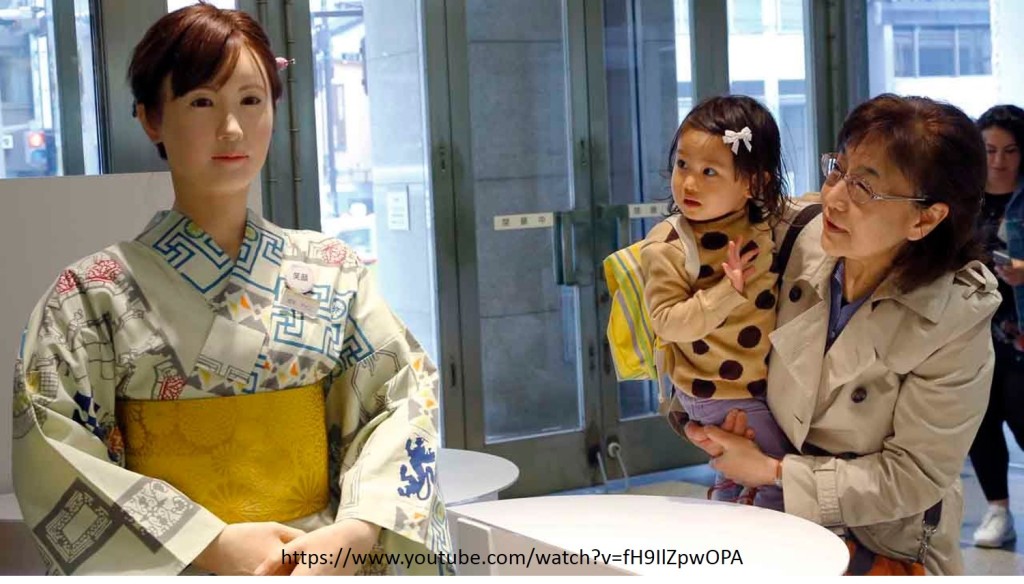
Instead of looking back in time, and profiling someone or something that has influenced the past year’s events — after all the past was so 2015. We looked ahead – to the future. In keeping with the spirit of Star Wars, we decided to continue to create mythologies of the future. Our choice: ChihiraAico, humanoid robot woman, who currently directs customers at a department store in Tokyo. A small career step as store-clerk for a humanoid, one giant job-loss leap for humankind. What? Me worry?

 ChihiraAico 3 at dept store


ChihiraAico is said to be 32 years old, although, born in September 2014; and described by the organization Toshiba as not just another pretty face, but the quiet type, who is strong willed and warm hearted, not quite human but with human like features – a communication android who is happy to help people. Chihira can carry on conversations, sing, smile, blink her eyes, raise her hands, and 15 tiny pneumatic actuators control her facial expressions and gestures because no human communication is complete without themovement of the muscles of the face.


Humanoid robots are increasingly being developed as personal assistants and companions;to work in service industry as someone who can take your food order; and as aides for medical situations. As the marketing representative at Toshiba says Chihira is expected to become a conversational friend for elderly people with dementia tendencies and can be connected to the counsellor and doctor. They can be used for elderly patients, such as those with debilitating diseases, who need caring and assistance.They are expected to take up a lot more of the caring function of human society.


So it seems that humans no longer have time to take care of their elderly, their children or each other. That is because most humans are busy becoming machines as they endeavor to survive while making humungous amounts of dollars for the super-rich 1%. And while humans become money-making robots in the hands of their masters and managers, these androids will take over the human function. Interesting move: humans become machines and machines become human. If that is the future, then Chihira is our person.


Japan  has always been a leader in automation; to the extent that Japanese firm, Spread Vegetable Factory, is working on a novel way of producing high quantities of lettuce using factory automation. Most of the process of growing lettuce in this indoor farm will be automated and handled by machines and robots, except for the seeding and germination processes that require visual confirmation. Thus, the lettuce farm, which requires minimal human intervention, will start operations by 2017 and produce 30,000 heads of lettuce in a day and hope to boost that figure to 500,000 in five years.


Japan Automated farm 1


Japan has now jump started the robotic and humanoid industry and the culture that goes along with it. Prime Minister Shinzo Abe wants to stage a Robot Olympics alongside its 2020 Summer Games. Hiroshi Ishiguro, a robotics experts, finds that since ‘robots are now becoming affordable — no different from owning a laptop, they play an increasingly important role in everyday life in Japan.


Robots are now found in banks, service centers, museums and amusement parks.


It seems they are good at directing people. Or the directions that people need can be given by robots, so it seems.

 Junco Chihira sister1


Chihira Junco, the younger sister of ChihiraAico, was unveiled by Toshiba sometime in October 2015 at an information center located inside Aqua City Odaiba commercial complex. This is a multilingual android who provides information to tourists visiting Tokyo’s popular Odaiba waterfront district, in three languages – Japanese, English and Chinese. The younger sister, Chihira Junco, knows one more language and her movements are smoother compared to her older sister Aico.


A humanoid robot called “Pepper” whose makers claim it can understand human emotion was also unveiled by SoftBank, a mobile phone company. Two humanoid robots joined the staff at The Miraikan (or Future) Museum also known as the National Museum of Emerging Science and Innovation of Japan’s Science and Technology Agency in Tokyo.Otonaroid, with long, dark hair and elegant mannerisms, is a robot science communicator who converses directly with visitors, and Kodomoroid, the second, is a child, who can read news reports on global topics in a variety of voices and languages. Hiroshi Ishiguro, the designer, created lifelike designs to encourage for these humanoids because he wanted greater human-robot interaction in order to explore what differentiates the two. Japanese robotics experts see the task of creation of humanoid robots as an exploration of and examination of the meaning of being human.


Picture1


Henn-na hotel, which opened in the middle of 2015, in the Huis Ten Bosch theme park in Sasebo, Nagasaki has already advertised itself as the world’s first hotel staffed by robots. The hotel’s owner wants to make it the most efficient hotel in the world by ensuring that robots make up 90% of the staff and thus reduce all the costs and burdens (financial and human) associated with humans.


Robot-staffed hotel opens in Japan – CBS This Morning


But then the question naturally arose: Will robots not take away our jobs?


Ten million jobs were at risk from advancing technology and up to 35% of Britain’s jobs would be eliminated by new computing and robotics technology over the next 20 years, according to experts cited in The Telegraph.


Most jobs today are repetitive, routine and repetitive. As one of my friend’s bosses used to say: “If someone tells you they have 30 years of experience at a job, rest assured it is just one year’s experience repeated over the remaining 29.” All learning and new experiencesare in the 1st year of the job; the remaining years are spent blindly repeating whatever a person learned in that first year.”


In today’s standardized, McDonaldized world jobs are based on rigid step-wise protocols from the person taking the order at the fast food counter or the person who takes your money at the bank. Even jobs for writing code and software, designing websites are based on protocols and algorithms. Recent research in artificial intelligence has ensured that much of this work will be automated. In fact, software bots have already taken over the jobs of the very code writers and software developers who created them. Bill Gates, the master of the IT universe, reportedly observed that: ‘People don’t realize how many jobs will soon be replaced by software bots. Technology over time will reduce demand for jobs, particularly at the lower end of skill set… 20 years from now, labor demand for lots of skill sets will be substantially lower.’


Now robots are also learning these repetitive jobs through how-to training videos because they have a common underlying structure, they are step-wise, and easily available source material. The computer scans all videos on one topic, finds what they have in common, and distills the knowledge into simple steps. This type of activity is especially aimed at creating a training method and system for the time when personal robots use becomes more common.

 Robots learn thru how to do videos ToI Dec 28 2015


To better understand the impact of technology on jobs, Associated Press analyzed employment data from 20 countries; and interviewed economists, technology experts, robot manufacturers, software developers, CEOs and workers who are competing with smarter machines.They found that almost all the jobs disappearing are in industries that pay middle-class wages, from $38,000 to $68,000 — jobs that form the backbone of the middle class in developed countries in Europe, North America and Asia.The report stated that ‘millions of workers are caught in a competition they can’t win against machines that keep getting more powerful, cheaper and easier to use.’


And while the brilliant people will have to be retained so they can control these machines, much of the workforce canbe expected to lose their jobs. And it will be difficult to train them for new jobs, if there are any jobs left at all for the masses.


But machines cannot give us the personal touch, the human experience: Do we really care, if we did would we choose smartphones over our spouses (see Pharriages article)


The contributor from The Guardian who visited Henn-na Hotel in Japan checked in for a night and summed up the experience as: “Robots may be the future, but for hotel hospitality, you still can’t beat the human touch.


Like this reporter and many others, we were skeptical about humanoids/robots; afraid they will destroy all that is human. Artificial Intelligence (AI) is developing a very rapid pace and many critics are asking for bans on robotics research because they are afraid that AI is constrained and robots may actually harm humans as they have no understanding of ethical action or of being human.And then the thought struck us: Who are the real robots? Chihira, the helper, or the people who push each other to purchase that new gadget in Tokyo’s malls? Consumers who are inhuman towards each other while shopping on Black Friday, the day after thanksgiving; or the companies that are unethical in their conduct toward consumers and both consumers and companies that are both brazenly destroying the environment and other species on the planet.

And then China came to our rescue, wiped away all our doubts in one swell move. Sometime in the last part of the year, Tencent, a Chinese social and gaming company, published a flawless, 916-word first-ever business report written by a robot. Then, thanks to breakthroughs in text-to-speech artificial intelligence (AI) and other unique technology,


A Chinese TV news channel decided to replace their TV weather reporteron the breakfast news show with an artificial intelligence robot – XiaoIce, who can make TV channel hires robot as reporter HTcomments instantly based on weather data. The successful debut of this robot-reporter has raised concerns among traditional TV anchors and weather reporters that they could lose their jobs.
 

Is that too bad? Imagine, very soon all those loud, foul-mouthed, constantly arguing and shouting TV anchors and talking heads replaced byChihira whosevery name means peace of earth (shi = earth and hira = peace.) Imagine a quiet, peaceful world with no loud, blaring televisionnews shows. There is hope for the planet yet. You may say I’m a dreamer, but I am sure I’m not the only one.


Researchers Mark Riedl and Brent Harrison from the School of Interactive Computing at the Georgia Institute of Technology ask: How can robots learn ethical behavior if there is no “user manual” for being human? And these researchers believe the answer lies in “Quixote” – which teaches “value alignment” to robots by training them to read stories, learn acceptable sequences of events and understand successful ways to behave in human societies. The Quixote technique aligns an AI’s (robot’s) goals with human values by placing rewards on socially appropriate behavior. It builds upon Riedl’s prior research – the Scheherazade system – which demonstrated how artificial intelligence can gather a correct sequence of actions by crowdsourcing story plots from the Internet.


The Georgia Tech newsletter provides the following example. If a robot is tasked with picking up a prescription for a human as quickly as possible, the robot could

a) rob the pharmacy, take the medicine, and run;

b) interact politely with the pharmacists, or

c) wait in line.

Without value alignment and positive reinforcement, the robot would learn that robbing is the fastest and cheapest way to accomplish its task. With value alignment from Quixote, the robot would be rewarded for waiting patiently in line and paying for the prescription.


“The collected stories of different cultures teach children how to behave in socially acceptable ways with examples of proper and improper behavior in fables, novels and other literature,” says Riedl. “We believe story comprehension in robots can eliminate psychotic-appearing behavior and reinforce choices that won’t harm humans and still achieve the intended purpose.”


The Human Computation Institute (http://humancomputation.org) says the combination of human and computer intelligence can solve some of the worst problems of the world, which includes climate change, wars, and loud, foul, obnoxious media people.


So they say, robots can never replace humans?

Forget the ancient farms where various implements replaced human labor; when was the last time you went to withdraw money from the teller at the bank. You probably went to the ATM.

Mechanization and Automation has been used historically to replace animal or human labor.It has always taken away jobs;  the scale increased dramatically during the industrial revolution. And more recently machine workers are rapidly replacing human ones. The IT industry professionals are rapidly coding themselves out of jobs as “software-bots” replace them at their jobs. The robotization has gone much deeper as scientists have designed motorized “sperm-bots,” which use tiny metal helices to attach to sperm cells and then help the poor sperm swimmers to reach the female egg and fertilize them. Human conception and body parts can now be automated.


Most people love technology.


For the first time ever there are more gadgets in the world than there are people, an October 2014 report in The Independent newspaper stated.The world is home to 7.2 billion gadgets, and they’re multiplying five times faster than we are. The number of active mobile devices and human beings crossed over somewhere around the 7.19 billion mark, which means there are more in-use cell phones than there are people on the planet right now. And of these, 2 billion will use smartphones by 2016.


Furthermore, many of us have a mistaken notion of “personalized.” It does not mean interacting with an actual person. It means something or someone who knows my exact tastes, likes and dislikes and tells me what I need to eat or do or how much I need to run. It is more about me individually rather than an inter-personal interaction with another human. No wonder personalized “apps” are so popular. No wonder Google and Facebook personalize the page and the ads to match your interests and tastes.  We complain when we are with friends or in a social group but personally – we like it.


In fact a real person can be the most impersonal and rude. I have never faced a rude ATM; but definitely encountered a very rude teller. The ATM may not have worked to my satisfaction but at least it was not rude. The same rudeness and impersonal nature applies to hospitality, airline and other service industry professionals. And the industry that takes the cake for rudeness is health care. Haven’t you interacted with doctors and nurses who are rude and uncaring? The industry that requires maximum personalization has and encourages the most impersonal behavior. Ask any poor person about their last visit to a primary health care center? They get the worst treatment possible and that too by trained, educated doctors and nurses. We have heard poor patients say: We don’t just want treatment – we want to be treated like humans.


Haven’t been treated badly in hospitals, in airlines, in so-called hospitality industries? Why not humanoids, then? But what about the millions of jobless – well it seems that those who have the jobs today do not seem to care much about doing their job well. Then who will care for them when they lose their jobs: simple, they can buy their own humanoid.


Now that we have established the need for robots for the masses one question that divides the robotics industry has to be answered:


Should robots be designed as humanoids or should they be more mechanical and funny like R2D2?


While there is a distinct Japanese school that believes that robots should not be mechanical or cold; there is another school predominantly from the US, who think that humanoid forms of robots give people a creepy feeling, and are firmly in favor of a non-human toy like mechanical design for a robot because it seems to be perceived as more welcoming and less likely to make people and pets scared or anxious. Perhaps it is also that most robotics engineers in the US grew up on Star Wars and R2D2 type robots.


Such robots which can move and carry things are also useful as companions for elderly and disabled persons.  One example is the robot Sopo from U.S.-based Opobotics, which can be assembled, and it can play games with you, drive itself around the room without bumping into anything and most importantly it can bring you a drink when you return home after a hard day’s work.


The question is which one would you prefer to get you a drink – Sopo or Chihira?


We leave you with the question and you have to find your own personal answer just like you will find your own personal robot.


Why are all of these humanoid-robots female? Well, you tell us! Japan, which has taken the lead in making these humanoid robots, has made almost all of them look like females. The Japanese makers claim they wanted robots to look human, approachable and have a heart. That’s why they made them all female. One such realistic humanoid is called the Actroid – actor and humanoid. When the robot was designed, the entire crew was male. And the feedback they got from their female colleagues was that the robot should be made to look more intelligent than what the male crew had made them out to be.


Chihira has a personality bestowed by the makers. Apparently like any other female (the idea of female that the makers have in mind), she is like a Ms Universe contestant; she aspires for world peace and also wants to be a counselor, a newscaster, a cheerleader, an entertainer and much much more!


Chihira, You can be anything you want to be.


Just read The Secret!


Oops! Did your maker forget to give you the ability to read? No problem, the Maker of humans gave them the capacity to read but no one reads anyway. For instance, less than 1% of the readers of this piece will read till this line in the article.


And not all of them want to be anything they want to be, so you have nothing to fear.


On the contrary, these humans want anything they can see in the shopping mall. They want to be billionaires just so they can buy – endlessly. And you are there to direct them at the shopping mall.


While the rest of us are shopping as if there is no tomorrow, there is Elon Musk, not a deodorant, an IT billionaire, and many others as rich as him, who are funding research and building space-crafts that can take them to Mars because they know that there is no tomorrow for the human species on this Earth. They know that climate change is real, the polar ice caps are melting, and the planet just does not have the capacity to carry more than 7 billion people. The human world is breaking down economically, environmentally, biologically, sociologically, psychologically, politically, and spiritually. So the super-rich are looking for a get-away.


Any another planet will do.

moon villages


Scientists have already proclaimed that “villages’ on the moon are a distinct possibility by 2030. These villages (on the lunar surface) will be constructed through cooperation between astronauts and robotic systems. Scientists are exploring the idea of “moon villages” to serve as a springboard for future human missions to Mars.


Orion, a new NASA spacecraft, will start by taking astronauts on a trip around the moon and then to an asteroid or even Mars. NASA is already preparing for a series of tests that will check out the Orion European Service Module, a critical part of the spacecraft that will be launched on future missions to an asteroid and on toward Mars. (The pictures below show the Orion in different stages of preparation.)


 Orion collage v1


Will they take the rest of us with them? Perhaps not, because 7 billion will not fit in one spacecraft, nor do we have as many crafts or the fuel to launch a million spaceships.


Of course the super-billionaires will most definitely take a few humanoids and live on Mars in peace because humanoid-robots do not complain, whine, go on strike or ask for raises or to be dined out. NASA in collaboration with MIT and Northeastern University is in the process of developing a 131 kg 6-foot humanoid called R5 (previously Valkyrie). This humanoid robot is expected to serve as an assistant for astronauts in extremely dangerous missions to Mars and other asteroids.


Humans are over-rated.


As for the billions of people left on this already over-crowded Earth they will relay this message using a humanoid-robot onto our TV sets via satellite: “Qu’ilsmangent de la brioche“? Or as the traditional translation goes: Let them eat cake.


© The Essayist, 2016


Check this video also (Humans Need Not Apply)


References


ChihiraAico


Chihira Junco


Links describing the Android display at the Museum –


Inside Japan’s first robot-staffed hotel


Jobs at risk from technology


There are officially more mobile devices than people in the world

http://www.independent.co.uk/life-style/gadgets-and-tech/news/there-are-officially-more-mobile-devices-than-people-in-the-world-9780518.html


Sopo: http://www.opobotics.com/

Sopo at Home: https://www.youtube.com/watch?v=lR4opmo3Xzg

Info about the Sopo robot (www.thinksopo.com): https://www.youtube.com/watch?v=yzvYXh9HUEQ


Actroid: https://www.youtube.com/watch?v=MLCbCtQVQog


Chinese TV station ‘employs robot’ as weather reporter

http://www.chinadaily.com.cn/china/2015-12/24/content_22794242.htm


‘Superintellingence’ of AI and humans working together could solve climate change and end wars, researchers claim

http://www.dailymail.co.uk/sciencetech/article-3380709/Superintellingence-AI-humans-working-solve-climate-change-end-wars-researchers-claim.html


Orion – spacecraft to Mars

http://www.nasa.gov/image-feature/super-guppy-ready-to-transport-the-orion-spacecraft

https://www.nasa.gov/image-feature/nasa-prepares-to-test-orion-service-module/

http://www.nasa.gov/audience/forstudents/k-4/stories/nasa-knows/what-is-orion-k4.html

Japan Automated Farm – http://www.digitaltrends.com/cool-tech/japan-automated-factory-lettuce/


Artificial Intelligence and Human Stories

http://www.news.gatech.edu/2016/02/12/using-stories-teach-human-values-artificial-agents

http://www.newsweek.com/artificial-intelligence-taught-ethics-reading-books-426663


Dropping the ball after the Ball Drop on Times Square: All about not keeping New Year resolutions

Most people know about the “Ball Drop” on Times Square. And if they happen to be there, they take selfies, post pictures on Facebook as proof of their presence. However, there is another event called “dropping the ball;” takes a place within a couple of weeks of New Year’s eve. Yet, no one wants to talk about that experience, no tweets, no photos on Facebook, not a peep. Because when someone drops the ball, one is strangely absent from that event.


Times_Square_Ball_Roof_2011


And how do I take a selfie when I am absent?


If i-phone found the answer to that one, then Apple will be richer, and thanks to technology not the cheap Chinese job market; and we can genuinely go back to worshipping Jobs.


But then there is photoshop already. So why are we subjected to selfies in public when all of these selfie-takers could have just photo-shopped in private.


The ball has dropped on that one… I hear you say.

x

******


The Ball Drop, on Times Square, is one of the most well-known New Year’s celebrations globally, thanks to Hollywood and televised News Year’s Eve specials broadcast by various channels. First held on Dec 31, 1907, by Adolph Ochs, owner of The New York Times newspaper to promote the building as the new headquarters the ball drop has been held annually since. It is estimated that nearly a million people gather at Times Square on December 31st to see a lighted ball begin its descent down a specially designed 141 feet pole at 11:59:00 p.m. eastern time, and rest at midnight to herald the start of a new year, a fresh slate, a new beginning. Fresh and inspired after the ball drop, many decide they have to drop a few bad balls or habits in their own life. People are inspired to make resolutions.

 NewYearEve2008_TimeSquare


Recent surveys have found that nearly 45% of Americans and 33% of Britons usually make New Year’s resolutions, and about 17% make them infrequently. Thus almost 3 in 5 people make a resolution. It has also been found that most resolutions are of the self-improvement variety, and within self-improvement is of the physical health category, such as: I will drop my slothfulness, my TV-couching and perk up with physical activities or exercise; I will shed those extra pounds of flab; I will stop eating those pizzas, burgers, junk food and start picking up more greens and vegetables. A few resolutions are of the stop shopping and start saving variety; while another group is the one that wants to have healthy relationships.


And people start the New Year with vigor and a walk in the park.


However, come February, and the steely resolve made in the din and noise of the Ball Drop is quietly forgotten. There is another event that happens to most of these resolvers but is not celebrated globally. Most people, in fact, do not want to talk about it, leave alone make it public and that is called: Dropping the Ball.


The “Dropping the ball” event happens a few weeks after New Year’s Day; usually around Valentine’s Day. And the surveys show that nearly 50% of people who made a resolution on New Year’s Day say they are unsuccessful and give up in a matter of weeks.


However, there is hope, yet, because 8% of New Year resolvers claim to be successful.


What is the secret of their success?


Various authors have given various reasons ranging from keeping it short, simple, tangible and not making an exhaustive bucket list of things to do while some ask you to completely focus on the task at hand, prioritize the task and minimize distractions.


However a recent article in the Journal of Consumer Psychology (Dec 2015) found that asking people a question about performing a target behavior influences future performance of that behavior. This is called the “question-behavior effect.” Dave Sprott, senior associate dean of Carson College of Business and study co-author said: “If you question a person about performing a future behavior, the likelihood of that behavior happening will change.” The researchers arrived at this conclusion after conducting a meta-analytic synthesis of 104 “question-behavior effect” studies across 51 published and unpublished papers.


So the secret to being successful at achieving resolutions lies in crafting interrogative sentences or asking a question about the desired behavior such as: “Will I eat healthy — yes or no?” than making declarative or imperative statements such as: “I will eat healthy.” Interestingly asking a questions works both for change in oneself as well as people whose behavior we may want to influence.


So what resolutions do we make for ourselves this year at the time of the ball drop?


We found that most people’s resolutions were of this nature: I will make my world a better place.


However, this year, you are better informed thanks to advancements in science. Ensure you convert your resolution into a question. And do not just ask questions to yourself. Feel free to ask questions to the ones you love and the ones you do not.


For once ask yourself and your loved and hated ones: Did I / you make the world a better place? Did I / we let that ball drop?


***************


© The Essayist, 2016


REFERENCES for the body of the article


Principe Azul

ADOLECENTE
ALGUIEN CON QUIEN DIVERTIRSE

20’s
ALGUIEN CON QUIEN DIVERTIRSE Y PROBABLEMENTE CASARSE Y TENER HIJOS

30`s
ALGUIEN CON QUIEN DIVERTIRSE, CASARSE Y TENER HIJOS

40`s 
ALGUIEN CON QUIEN DIVERTIRSE, CASARSE Y PROBABLEMENTE TENER HIJOS

50`s y EN ADELANTE
ALGUIEN CON QUIEN DIVERTIRSE

I will exercise my brain this year: Resolutions to be made by Trump, ISIS and others for the sake of World Quiet


Pharriages and more as we decide to make the world a peaceful place this New Year. Actually, what we need is simply some World Quiet. We are willing to give up our hope for World Peace in exchange for some quiet. Stop the loudness, the hyperbole, the marketing, the constant spin. Let  the world spin at its own pace, not any faster  or slower. Give me back my slow days and my quiet nights. Lets make a resolution this year to stop the noise. Down with busy-ness. More power to quiet-ness.


We make resolutions at the start of every year because that is the time when we want to wipe the slate clean, start afresh. Discard the bad habits of the last year and make a better world for ourselves. However, with each passing New Year we find ourselves in a worse place than we were the year before: climate change, terror, financial crisis, poor leadership, greedy bankers, loud neighbors, intolerance, bigotry, migrants taking my job away, louder TV news channels, costlier tickets, duller movies, more sports doping and betting scandals. Nothing has been spared.


So what is special about this year? One of our regular columnists Paul Smith wrote to us:

“This year (2016) numerologically adds up to 9, [2+0+1+6=9], which in the Tarot deck is The Hermit card – the card of exaltation in alchemy. It could imply a more contemplative focus, going within to raise the vibration higher which is something that I think our world could use much more of today. I like the words of the author on alchemy, Mark Stavish, in his The Path of Alchemy, “The son of Hermes is an adept who is in, but not of the world. He is seen but hidden from the eyes of the profane, or those who would seek to abuse the powers of Nature. The Hermit shuts himself off from the world, led by his inner light, relying of the staff of experience to create new and more perfect forms, so that what is seeking expression in material life may be an improvement over what it replaces.”


For The Hermit to do his alchemy and magic, peace is required. The challenge was to ensure world peace. How do we go about ensuring world peace this year? It was New Year’s eve and we thought: Why not resolutions?


We consulted some experts and gurus. After much analysis and discussion, they informed us that most New Year resolutions are about self-improvement and about personal issues.  However, over the years all these resolutions of self-help and self-improvement has NOT helped our world become a better, peaceful place. Therefore, they decided that this this New Year we cannot just sit back and decide to self-improve. That will not help anyone, including the person who improves himself.


What we desperately need is social improvement, not just self-improvement. And more than exercising our biceps, we have to exercise our brains. That does not mean our own brains and biceps necessarily. Because when we exercise our brains, we work smarter, not necessarily harder; and we realize that someone else can a much better job than us. Someone else’s resolution can help us reach world peace faster than our own. Let them make that resolution.


The experts clarified by giving an example: New Year resolutions, which if fulfilled, will improve the world considerably, are not necessarily for you to follow. Sometimes a positive change in behavior by a lousy neighbor can help create peace in the neighborhood much more than all your attempts to be a forgiving and kind human being.


“I will exercise my brain (think) before I open my mouth (to speak).”

                                                                                                                                           Mr. Donald Trump

trupm from shutterstock with attribution

Democracy, the rule of the people and by the people (and never for the people), is bound to be loud. After all there are more than 7 billion people on the planet; each one wants to exert their voice, and there is the social media. However, the greatest tragedy with democracy today is not loud people, with more interested in expressing opinions than self-rule; it is the group that poses as leaders of the people. Politicians and businessmen, both, have failed their respective systems. Politicians have completely failed democracy and businessmen have completely failed “free-market” capitalism. However, both groups have lined their pockets and amassed huge amounts of personal wealth.

Generally, we would not have brought this up; after all, it is old news. However, this is the year of the Hermit, who needs peace to reflect on the state of the world, and come up with a new, better order. So Mr. Trump becomes a metaphor for that which politicians (and businessmen turned politicians) do today to disturb the peace.

Politicians today are not just happy to plunder their own countries; they also want to pose. They talk a lot of gibberish and nonsense. And they talk endlessly thanks to the amplification of their chatter by the 24/7 media. And all that noise from the raucous debates on  television sets becomes a major disturbance to world peace.

Representing the people: Millionaire politicians

We want peace at any cost this year. Let the politicians cheat, lie, and steal. Let them do it silently. They do not have to appear on TV and prove to us that they are holier than their brothers. We all know that almost all politicians have business interests and most own companies. Reports in Time magazine and The New York Times state: Congress Is Now Mostly a Millionaires’ Club with half of all Congressmen (the representatives of the people)worth at least one million.In 2013, the median net worth for lawmakers in the House and Senate was $1,008,767 — up 4.4 percent. By comparison, the The U.S. Census Bureau reported in September 2014 that the US real (or inflation adjusted) median household income was $51,939 in 2013 versus $51,759 in 2012, statistically unchanged. In 2013, real median household income was 8 percent lower than in 2007, the year before the latest recession.


Democrats had a median net worth of $1.04 million, and republicans of $1 million. The averages in both cases had gone up compared with the previous year, when the numbers were $990,000 and $907,000.The New York Times goes to quote Josh Bivens, director of research at the Economic Policy Institute, that focuses on income inequity and poverty: “Congress not only seems more responsive to policy desires of the very rich, but increasingly they are the very rich.”.


That politicians are selfish and corrupt is almost accepted as a universal truth by most countries today, and these are not just in Africa. Canadians mistrust politicians at about twice the rate at which they mistrust CEOs according to a national survey conducted by the Gandalf Group on behalf of the Ted Rogers Leadership Centre.In the UK, the British public are less likely to trust politicians to tell the truth than estate agents, bankers and journalists according to a poll by Ipsos MORI.


However, what seems a bit more difficult to explain is why, in recent times, businessmen have taken to politics.Maybe because, we, of this neoliberal age, including the more liberal Canadians, seem to have more faith in businessmen. Although rich landowners have always dominated the political scene in the oldest country (democracy) in the modern world, many businessmen are leery of getting their hands dirty and conveniently use politicians as middle-men for their deals.


Cut out the middle-man 

So why are they openly getting into the political sphere? Is it because now the business class and the super-rich are afraid that their taxes will be used for providing succor to the poor. God forbid if the money made by the billionaires, clearly on the backs of Mother Nature or brother farmer and sister factory worker, be used for their health or nutrition or any welfare. Or maybe the super-rich, thanks to the academics on their payroll, have recognized the Achilles heel of the political class. Howsoever corrupt, a politician still carries the baggage of history on his shoulders. Politicians are keen about what and how history will speak of them, even the fascist demagogue. That is why the first thing fascist leaders do is revise the textbooks and control the expressive arts. And perhaps the political class recognizes that if the super-rich are not taxed more, then the social security net will disappear between 2013 and 2035 in the US. It will clearly expose that the American democracy is not of or for the people at all. There is a fight going on between the elephants – the powerful super-rich businessmen and the group that until today were their hand-maidens – the politicians. Their interests have diverged a little: the super-rich do not want their party to be taxed (it will not end anytime) and the politicians knows that if social security dies then there is a threat to the political system and his own future. This divergence of self-interests is leading to all the noise on television. I just want to shop in peace, leave me alone and out of this, scream the consuming citizen. But we cannot because without an audience, the players in this face called democracy, will not be satisfied.


Berlusconi and Donald Trump are two faces of businessmen as politics that we are familiar with because these have been highlighted by the media. Berlusconi owns media, the media wants to own Trump.Because of his strategic use of sensationalism (or maybe that’s truly Trump). No one knows and that’s the danger to democracy.


Today, all of us, sadly, conflate having money with intelligence and smartness. And in the real world many of us, even educated people, actually confuse the two and the media helps us along: He is a billionaire, so he must be smart?


However, whatever be the amount of money in their banks and their hidden accounts, businessmen and politicians, are essentially sociopaths, some even narcissistic psychopaths, who have no interest in other human beings except their own personal ambition and greed. However, thanks to the media houses, interested in getting eyeballs and increasing advertising revenue rather than revealing the truth, any silly, stupid statement made by these pathological humans are amplified a million times and replayed endlessly on 24/7 television channels. And ordinary folks with little exposure to or experiences with people of different backgrounds, class and colors start believing in these statements as the truth. They base their knowledge, beliefs, attitudes, voting, and spending behaviors on these televised statements emerging from selfishness rather than wisdom. As the quote attributed to Joseph Goebbels, Propaganda Minister during the Nazi regime and virulent anti-Jewish programs goes: Repeat a lie a thousand times and it becomes the truth.


95,000 words uttered by Donald Trump

Unfortunately for Donald Trump, his words amplified a million times by the media, has made him the representative of this entire species of narcissistic politicians and businessmen. Trump has taken the political craft of creating great divides between “us” and “them” to new heights, rather depths. He has spared no one — from the President in the White House to the migrant worker in the farms – with his allegations, accusations and use of malignant language.


In a recent article, the New York Times analyzed Donald Trump’s rhetoric by tracking 95,000 words uttered in one week by Trump in speeches, rallies and interviews. What they found was a pattern of Trump using “potent language to connect with, and often stoke, the fears and grievances of Americans.” Trump cleverly used divisive phrases and harsh words while putting forth violent imagery and also used an approachable demeanor and appropriate body language to convey the message: I know you are suffering. And it is all because of “them.” I will save you from them. I will deliver because I am smart. And how do you know I am smart? Because I have made a billion dollars. Trump Tautology.


And since Trump wields great power over the public opinion in the United States (as surveys have demonstrated over the past few months), and America wields great power over the rest of the world, we believe Mr. Trump has to own responsibility for his entire species to put things right this year. As Spidey Parker’s uncle said: With great power comes great responsibility. After all, the New Year is a fresh start, a new beginning, even for billionaires and Presidents.


May God bless Mr. Trump… with silence. Anything for World Peace.


 ******


“I will use my head and not behead.”

                                                                                                ISIS recruit and suicide-bomb staff

 shutterstock_346915709


If anyone knows and appreciates world peace, that should be an adherent of Islam. After all, according to our Internet-age reference book (the 15-year old Wikipedia), Islam is a verbal noun originating from the triliteral root s-l-m which forms a large class of words mostly relating to concepts of wholeness, submission, safeness and peace.


So if ISIS wants to claim they have an Islamic State, they should be the best practitioners of world peace. What can we really talk to a practitioner of Islam about world peace? Nothing, right. .


Let’s face it

But it seems that the most unsafe and un-peaceful places on the planet are now at the center of these Islamic states/territories in Mid-east and northern Africa? The scream of a person getting beheaded will shatter the silence  of any place on the planet, not just pierce the peace of the desert calm.

Not just unsafe for the western or other visitors but also for locals – remember the  whipping, the lashing and now the beheading. All of them lead to moans and screams from those being subjected to it. That does not help the cause of peace.

After the whipping, lashing and stoning came the cutting off – first the ears, then the noses by the Taliban and now the heads by ISIS. What’s up with these Islamist militants? What do they have against the human face? I was okay with then wanting to cover it up – the desert sands whipped up by the windstorms and harsh sun could be some of the natural causes of this cover-up. But why deface it (the face), or try to get rid of it (the head)? Is it because of some “don’t use it, you lose it” kind of logic being implemented by ISIS (Daesh)?


So why can’t we talk to ISIS? Hopefully ISIS recruits and staff still have their ears.

We can’t say anything to ISIS because ISIS, for all its protests and claim to uniqueness, is very much like the West.


They do not want to listen.


God, in any religion, always told us to listen to others. Listening to another is one the easiest ways of expressing kindness, compassion and brotherhood. In fact the entire advancement of human civilization is based on the notion of dialogue – we listen to each other. A husband listens to a wife, a parent to a child, rulers to the ruled. It’s not a hallmark of democracy or western civilization – it’s a humane way to live and the ancient way.

However, before we blame ISIS for not listening to dialogue, let us look at why ISIS may point a finger at our TV new anchors and talk show hosts, who never listen. They keep talking, shouting, screaming. ISIS staffers could claim they are simply mimicking TV shows in the western world. In that, ISIS is closer to the west than they think. Just because they dress different or talk a different language does absolve them.


We have had spouses like that too, who never listen. At such times even we have harbored the thought of a talking head without a head. But it’s only a thought – a metaphor for the irritation and annoyance we feel. It’s not real.It is only a wish and as adults we know that not all our wishes come true. Because we believe that God inhabits all creation. We say our salaam and we walk away in peace. We close our ears, we do not cut mouths off.

So, for the sake of world peace, ISIS, please listen?

But ISIS never listens.

Because they do not have time to listen. In this too they are like the west.


ISIS staffers seem to be spending a lot of their time  putting out more videos than music-companies and wannabe musicians; more than Youtube can handle.

These Internet and social media channels that claim to promote expression only end up promoting inanity and tripe. We want to cut off these channels, destroy them with the flick of a switch such as Dr. Evil or Dr. Strangelove would do with their missiles pointed at strategic targets of things they didn’t like.


But it’s only a thought – a metaphor for the aggravation we feel. It’s not real. In this we are like Walter Mitty. There is something called imagining and everything we imagine cannot be realized.


So ISIS, please listen to the please for world peace. But ISIS does not…


Because they do not care to listen. They are busy, tapping  new sources of funding – very much like the west.


As Putin and Assad claim, ISIS takes funding from oil-producing Middle Eastern countries and also sells oil in the black market. That is a lot of work. By selling more oil to a world choking on oil-pollution; ISIS ends up promoting gas guzzling SUVs that spew out pollutants into the air and only make it difficult for children to breathe. The sound of wheezing of a child with difficulty in breathing does not help the cause of peace. Given the kind of air pollution in Shanghai and New Delhi, the people who live there or visit for work have also thought: Maybe if I behead myself, I will be able to breathe better.


But it’s only a thought – a metaphor, a mental relief, a ploy to palliate the pain of wheezing and breathlessness. We do not behead ourselvesin reality. We just want to be able to breathe and to do we need our noses and faces.


A wrestling match: The sale of the video game and TV broadcast rights

We all harbor anger. Even the poster boy of non-violence Gandhi did get angry at times, according to his biography. However, we choose to express our anger in different ways. We deface posters, not real ones. We close our eyes, shut our ears. We do not cut off the head of someone we disagree with. If that were the case then there would be no heads of state anywhere on the planet. People are angry at their own leaders. But they do not behead them.The world has moved ahead.


It’s fun in a video game. Going around shooting up people and beheading them. How would it play out in a board meeting with many different opinions or or a hostile takeover or a TV news how or in disagreements between husband and wife or a vegetable vendor and a client over the price of bananas.Heads rolling all over the place.


ISIS and the western diplomats are more alike than they care to show. We know ISIS has terrorized the west and we know many Western countries have done a great disservice to Africa and Asia. We can always ask them to apologize. Even if no one else does, Bill Clinton surely will. But that is if the western diplomat and ISIS dialog, then the world will have some much needed peace. It will actually give relief to common people on the streets, tone down the rhetoric in much of the West, and give one less excuse to the war mongering countries to make war.


Some experts say war is exactly what ISIS wants – it is doing everything specifically to create disgust among people in the West and those who harbor the civilizational values of the West. Apparently, they want the West to rush in where the angels fear to tread. They want war. They want the crusades – all over again. As the western states cobble together all sorts of coalitions to attack them, it is sad that ISIS is helping no one in the Middle East, especially the poor Islamic children dying of famine in Iraq.


If ISIS uses its head, it may see that there are lot more ways to serve God and the best way is through peace. We behead our own egos (swollen heads) in front of God, not someone else’s.

In the meantime, ISIS and western leaders can all get together in one World Wrestling Federation Arena, spew venom at each other, and fight it (like WWF veterans do) out on the mat. The ticket collections, the money made from TV rights and the sale of the video game or movie rights will be enough to feed the hungry of the world for another decade or at least until the global average temperature rises above 2 degrees C.

In the interim, may the peace be with you!


————

© The Essayist, 2016


References:

Half of Congress Members Are Millionaires, Report Says (Jan 2014)

http://www.nytimes.com/2014/01/10/us/politics/more-than-half-the-members-of-congress-are-millionaires-analysis-finds.html


Congress Is Now Mostly A Millionaires’ Club

http://time.com/373/congress-is-now-mostly-a-millionaires-club/

https://en.wikipedia.org/wiki/Household_income_in_the_United_States


Why Canadians Trust Business Leaders More than Politicians: A new survey finds that CEOs are more trusted than elected officials—but that shouldn’t necessarily be cause to celebrate (Nov 2014)

http://www.profitguide.com/manage-grow/leadership/why-canadians-trust-business-leaders-more-than-politicians-71140


Politicians trusted less than estate agents, bankers and journalists (January 2015)

https://www.ipsos-mori.com/researchpublications/researcharchive/3504/Politicians-trusted-less-than-estate-agents-bankers-and-journalists.aspx


95,000 Words, Many of Them Ominous, From Donald Trump’s Tongue

By Patrick Healy and Maggie Haberman. Dec 5, 2015

http://www.nytimes.com/2015/12/06/us/politics/95000-words-many-of-them-ominous-from-donald-trumps-tongue.html

http://www.thewrap.com/ny-times-unprecedented-dissection-of-donald-trump-words-demagogue-stoking-fear/

http://www.people-press.org/2015/11/23/beyond-distrust-how-americans-view-their-government/


https://en.wikipedia.org/wiki/Islamic_State_of_Iraq_and_the_Levant#History

https://en.wikipedia.org/wiki/ISIL_beheading_incidents

https://en.wikipedia.org/wiki/Timeline_of_ISIL_related_events

http://mondediplo.com/2015/12/01dumbwar


Chances, choices, collective action: Can we close the gender gap in this lifetime?

Nearly 90% of 173 countries have one or more laws that discriminate against women states a World Bank report released in September 2015. USA is one of the 4 countries with no specific national laws requiring paid parental leaves for new mothers; Iran and Qatar are among 18 countries where married women have to take permission of their husbands to go to work. And in 32 countries, a married woman is prohibited from applying for a passport without her husband’s permission.

2058 – Remember this year. This is when women will reach pay parity with men in the US predicts the Institute for Women’s Policy Research. In Japan, an advanced industrial nation known for its commitment to a high quality work ethic, it is a very common conflict for working women to choose between a career and starting a family; 70% of working women stop working when they have their first child, and they stop for a decade or more. Women have had to apologize in front of co-workers for becoming pregnant. And one of every five young mothers experienced some kind of office harassment, according to Rengo, one of Japan’s largest trade union confederation.


Even after decades of working towards making women equal partners with men, the gap between them remains large. Women are half the world’s working-age population but generate only 37% of GDP. Female representation on corporate boards and executive committees around the world remains significantly small; with around 15% in America and less than 10% in India, China and Japan.


gender1


As much as $28 trillion or 26% can be added to the global GDP, if women play an identical role to that of men in labour market. The McKinsey Global Institute report (2015) calls this a “full-potential” scenario. Alternatively, in a “best in region” scenario, if every country matched the progress toward gender parity of its fastest improving neighbour, global GDP could increase by up to $12 trillion or 11% ( as seen in the figure below). Research studies have also shown a strong correlation between high-performing companies and those with strong female representation at the top. The evidence that investing in girls breaks the transmission of poverty from one generation to another has been documented by various researchers [Jones et al. (2010) and Levine et al (2009)].


gender2


Not just economic, gender inequality has been social, political, and domestic for a long time.


This inequality and discrimination against women is obviously wrong on moral, philosophical and human rights grounds; but now (in this age of neoliberalism) empirical evidence tells us that it is also taking an economic toll on nations. Discrimination against women affects the growth and development of nations and this has many political influencers and economists worried. Gender inequality has now become an obstacle to the current model of economic development and therefore grabs the headlines.


Gender inequality has been persistent and pervasive in society. Women in all regions of the world suffer subordination to men in the domestic, social and political spheres for generations. The fight for universal suffrage, just the right to vote, was a huge battle for women.


According to the most recent Social Institution and Gender (SIGI) Index from 2014, social inequality towards women is still widely prevalent. The SIGI index that measures variables including discriminatory family codes, restricted physical integrity including violence, son preference, restricted resources and assets and restricted civil liberties in 160 countries, showed that most of the countries, where data was available, had either a very high or high levels of social discrimination against women.

 gender3


In terms of political representation, women are far behind. As of August 2015, only 22% of all national parliamentarians were female, a slow increase from 11.3% in 1995. Globally, there are 37 States in which women account for less than 10% parliamentarians, including 6 chambers with no women at all. The highest female to male ratio of political representation was found in Sweden (0.86) and Finland (0.82), while several countries had ratios as low as 0.05 (Yemen), India (0.11), Russia (0.11) and China (0.19).


gender4


Gender inequality in film and television (even in our fiction)


“The one area where we could reach parity overnight is on screen (TV and film), absolutely overnight…,” says Geena Davis, actor. Even Hollywood, blamed as the bastion of liberal ideas by conservatives globally, has fallen into the sexist trap. Gender imbalance is so pervasive that it exists even in our fiction.


The Institute on Gender in Media, a research-based organization out of the University of Southern California-Annenberg School of Communication, founded by Davis, promotes gender parity in media and entertainment industries. Research conducted by this institute found that between 2007 and 2014, women made up only 30% of all speaking or named characters in the 100 top-grossing films distributed in the US; and of all these female characters, only 20% were 40 to 64 years old. Merely 1.9% of those films were directed by women. The proportion of female directors on top-grossing films has actually fallen over the past 17 years, and only 5% of cinematographers are women.


In a report in the Guardian, Davis says that after the birth of her child in 2002, when she started watching more television and animation shows, she sponsored a study on gender depiction in family-rated films and children’s television over a 20-year period. The study found that for every female speaking character there were three males, while female characters made up just 17% of crowd scenes. Davis points out that this ratio seems to be pervasive: US congress? 17% women. Fortune 500 boards – 17%. Law partners, tenured Professors, Military – 17% female. Cardiac surgeons – 17%. Women in the Animation Guild – 17%. Journalists, print journalists are 19% women. Why does this percentage of women in leadership positions stall at about the same range in these different professions?


The question remains: Does society have only 20% women? If not, then why is sexism in fictional films so pervasive? Has it got something to with the fact that just like the larger society, decision-makers are overwhelmingly men and how can one get out of this imbalance? The Institute launches a Global Symposium on Gender in Media during the London film festival later this year to discuss and address these very issues.

geena davis 1

*****


Life chances and life conduct


If gender equality is good for the economy, and good for growth and development, then why are countries and societies not making it a priority? Essentially women do not get the same chances in life that men get.


German sociologist Max Weber introduced the concept of ‘life chances’ (Lebenschancen in German), describing it as opportunities each individual has to improve his or her quality of life. A life chance is a probabilistic concept, describing how likely it is, given certain factors, that an individual’s life will turn out a certain way.


Weberian life chances can be seen as an expansion on some of Karl Marx’s ideas. Both Weber and Marx agreed that economic factors were important in determining one’s future, but Weber’s concepts of life chances are more complex; inspired by, but different from Marx’s views on social stratification and social class. Where for Marx the class status were the most important factor, and he correlated life chances with material wealth, Weber introduced such additional factors as social mobility and social equality. Other factors include those related to one socioeconomic status, such as gender, race, and ethnicity.


Sociologist, C. Wright Mills noted that everything from the chance to stay alive during the first year after birth to the chance to view fine art; the chance to remain healthy and if sick to get well again quickly; the chance to avoid becoming a juvenile delinquent; and very crucially, the chance to complete an intermediary or higher educational grade–these are among the chances that are crucially influenced by one’s position in the class structure of a modern society (1967).


gender5

A suffragist rally held in Hyde Park, London in the early 1900’s.


The issue of safety may help us understand the notion of availability or restriction of opportunities or life chances. For instance, in many countries, if a job requires returning home late at night families may not allow the woman to take that opportunity citing fear for the woman’s safety. In some cities women taxi drivers may find it hard to ply their taxis at night because of lax policing. This is an issue of law and order which is a state or system or structural responsibility. However, the fear of criminality and the general social stigma of crimes against women restricts the individual woman to jobs in the daytime; and even then there are other obstacles such as family responsibilities or care-giving for family members. This is a simplified illustration of the restriction of opportunities or life chances. There are many such instances in almost all spheres of life where one can clearly document the limited chances that women get. The question of gender equality at one level is the question of differential life-chances and standards for women and men.


Weber also noted that life chances are to certain extent subjective: what an individual thinks of one’s life chances will affect their actions, therefore if one feels that one can become or is a respected and valued member of society, then it is likely to become a reality and results in one being more successful and respected as compared to somebody without this conviction. In terms of agency and structure, life chances represent the structure, the factors that one has no control over. On the other hand the notion of “life conduct” – one’s values and beliefs, attitude to risk taking, social skills, or more generally, free willed choices about one’s behavior – represent the factors one has control over. According to Weber, together life conduct and life chances are responsible for one’s lifestyle. Until now the classic examples where women have achieved some goal despite the system has been one of strong will, a desperate desire to reach a dream, and mostly individual courage coupled with some fortuitous circumstances. We cite some examples of struggles below where individual women have risen above their circumstances. It has rarely been that the system or structure has laid out a path of equal opportunity for women. The studies by the World Bank or the McKinsey Global Institute clearly demonstrate that both at legal and the private sector or corporate level there is much to be done. However, we look at some examples below where individual women with courage have been able to organize a collective of other women to make a difference. It is life-conduct coupled with collective action that comes to mind when discussing cases where women have fought against the negative social, political, cultural or economic forces.


*****


Life-conduct and bottom up changes often through collective action


History is witness to the times when women have engineered their life’s outcomes by employing a strong-willed life conduct and maximizing the remote chances given to them or even by creating these chances for themselves as well as other women around them by rallying the collective.


In 2000, a second civil war broke out and brought systematic rape and brutality to an already war-weary Liberia. Leymah Gbowee, a 27 year old, newly graduated social worker and struggling single mother of four, had herself lived in a refugee camp for a time, and had been forced to send her young children away to Ghana for their safety. Anguished and angry, Gbowee responded to this conflict by mobilizing an inter-religious coalition of Christian and Muslim women and organized the Women of Liberia Mass Action for Peace movement. Gbowee and her allies, visited churches and mosques and distributed flyers that read: “We are tired! We are tired of our children being killed! We are tired of being raped! Women, wake up – you have a voice in the peace process!” They also handed out simple drawings explaining their purpose to the many women who couldn’t read. Ignited by these calls, thousands of women dressed in white, gathered in a fish market in Monrovia, praying and singing for peace; they gathered in the field along Monrovia’s central road and refused to leave. The women picketed in downtown Monrovia, they held events and news conferences, but mostly they sat, day after day, month after month, in searing heat and pouring rain, demanding that attention be paid. With outreach, the protests soon spread to rural counties, and across Liberia. The women only had a one demand: They wanted peace in Liberia.


In the face of the women’s actions, the talks grew more serious. The then president Charles Taylor left Liberia, peace finally came, and in 2005, after more strategic organizing by women, Liberia elected Ellen Sirleaf Johnson to be Africa’s first modern-day female head of state. Today, even as the country struggles economically, peace endures.


ooOoo


In 2011, Manal al-Sharif, a 32 year old Saudi woman, was arrested after a video of her driving her car surfaced on YouTube and Facebook. Saudi Arabia is the only country in the world to ban women – both Saudi and foreign – from driving. Manal al-Sharif, a computer scientist and mother of one, found this law to be highly discriminatory and disabling for women, especially for those who work. In early 2011, al-Sharif and a group of strong-willed Saudi women started a Facebook campaign named “Teach me how to drive so I can protect myself” or “Women2Drive” that pushed for women’s right to drive be able to move around without being dependent on anyone. Al-Sharif drove her car twice with prominent Saudi journalist, Wajeda Al-Huwaider, filming her. This video, posted on Youtube and Facebook got 6,00,000 views while the campaign’s facebook page got 12,000 supporters. Al-Sharif was arrested and her licence withdrawn. In reaction to al-Sharif’s arrest, several more Saudi women published videos of themselves driving during the following days. Saudi newspapers have been filled with articles in recent days detailing a rash of women taking to the roads — publishing confessions of women who drove their children to school, a father to the airport or themselves on errands.


ooOoo


In 1974, when the men of Reni, a village in the North Indian state of Uttarakhand were away at work, lumbermen with axes and guns showed up with government permits to cut 2500 trees. A little girl saw them and raced to get Gaura Devi, the head of a women’s group, who quickly alerted 27 other women in the village. Dodging threats and obscenities, the women resorted to hugging the trees, and dared the lumbermen to cut the trees over their dead bodies. As the news spread, women and men from other villages joined this non-violent protest, and eventually, after a four-day stand-off, the contractors left. The struggle labelled as the Chipko Movement (Chipko is the Hindi word for embrace) soon spread across many parts of the region, and such spontaneous stand-offs between the local community and timber merchants occurred at several locations, with hill women demonstrating their new-found power as non-violent activists (as seen in the adjacent image).


gender7


As the backbone of the agrarian economy, women were affected by the large scale felling of trees and the consequent environment degradation. By breaking out of their conservative moulds, these women activists, not only fought for their own livelihoods, they also endured to protect their environment. This movement achieved victory when the then Prime Minister issued a ban on felling of trees of 15 years until the green cover was fully restored.


ooOoo


In September, 2015, India witnessed its first ever women-led tea-leaf pickers strike in Munnar, the tea district of the south Indian state of Kerala. Without the support of dominant, patriarchal trade unions or their leaders, 4000 female tea-leaf pickers, filled the streets of Munnar for more than a week, demanding an increase in bonus and daily wages, which they felt were not just. The women were their own leaders. The unrest caught the trade union leaders, who consider the plantations their fief, unawares. The smarter ones sensed the anger and kept their distance. The odd leader who tried to appropriate the struggle faced the full fury of the women. When state leaders from the other regions tried an outreach, they were sternly told to stay away. Left and right, communist and Congress, no party was spared. Politicians, conscious of the impending local body elections, swallowed their pride and declared solidarity. A few women, leaders never before, represented the workforce at the talks. The union leaders signed the deal the women had negotiated. A higher bonus was agreed upon, and further negotiations promised higher wages and better work conditions. Since the success of the women-only Munnar strike, several other women-led tea-leaf plucker groups in the state have gone on an indefinite strike demanding equal wages.


gender8


This one-of-a-kind strike brought two points to the fore. First, the gender aspect of the mobilization – Pembila Orumai (Unity of Women) is how the women called themselves. This was an all-women led movement for women, for their rights of parity in wages. Second, the protesters were part of the organized sector and members of trade unions. Both aspects indicate a departure from the dominant political narrative of Kerala. The women were discovering agency and identifying trade unions as a male preserve, a trend increasingly visible in women dominated work sectors.


gender9 Women leaders reaching an agreement with the state Chief Minister, Oomen Chandy and the labour minister, Shibu Baby John
 

ooOoo


Since May 2015, married women in the villages of Haryana, a north Indian state, infamous for its patriarchal norms and skewed sex ratio and where almost 7 out of 10 pregnant women have anemia (lack of hemoglobin in red blood cells resulting from dietary iron deficiency which reduces oxygen carrying capacity of the blood), have been stepping out of their homes, gathering other married women and adolescent girls from their locality and talking about simple and cost-effective behaviors to reduce anemia and improve their health. These women are volunteers, also known as ‘health coaches’, who were selected and trained as part of ‘Leadership Haryana’, a community mobilization program. Health coaches were trained to conduct daily conversations, weekly group discussions, and local events to ensure that families, especially women, discussed anemia and improved their nutritional intake of iron. The high prevalence of anemia in the state is mainly due to deficiency of iron in the diet. This affects women more sometimes because of the norms of eating last and eating what is leftover and the family not putting a high priority on the woman’s health.


Despite facing resistance from her husband and in-laws, 25 year old Renuka, a housewife and mother of one, signed up to become a health coach of her village. Renuka aced her higher secondary school examinations but was married off as per her parents will soon after her results were declared. Renuka wanted to study further, become financially independent and take care of her parents, but the patriarchal society in Haryana dictate norms that a married woman must stay indoors and take care of her family as her primary goal. Before joining the Leadership Haryana program, Renuka’s daily routine consisted of waking up early in every morning at 5 am, washing, cleaning and milking the cows, single-handedly preparing meals 3 times a day for a joint family of 6 members, working in the field as well as tending to every single chore at home. Renuka was not allowed to step out of the house without wearing the purdah (covering the head and face with a dupatta or a veil) and had to be accompanied by her husband or father-in-law. Renuka felt bonded and suppressed in her own house, where she could not express herself to her husband or talk freely with her in-laws. She was dependent on others for her every need.


After becoming a health coach, Renuka was able to step out of her home on her own and visit other women in the village, for the first time after her marriage. Within a month, Renuka transformed herself from a shy housewife to a confident community health worker. Renuka was able to convince once reluctant pregnant women to use government antenatal care services; she encouraged and followed-up with adolescent girls to get routine blood tests done and take iron folic acid tablets regularly.


gender10 A health coach in discussion with women in a village in Haryana


Today young married women and girls in the village look up to Renuka and go to her for advice on health and domestic issues. Her husband and in-laws have started respecting her. With her growing confidence and the budding network that the community mobilization program has created for her, Renuka has been planning to take a small loan and set up a female-led cooperative for making local handicrafts.


Renuka seized this opportunity or chance that came her way of becoming a health coach and by adding her life conduct of hard work and dedication to this life-chance utilized both to resolve the conflict between what society expects of her (docile and submissive housewife) and her personal goals (earning a livelihood and becoming financially independent). She is now on her way to creating more opportunities for women in her village. Renuka wants to strive to bring her village to a point where every girl is educated and earns her own living.


ooOoo


On December 1, 1955, Rosa Parks, a 42-year-old African American woman who worked as a seamstress, boarded a Montgomery City bus to go home from work. She sat near the middle of the bus, just behind the 10 seats reserved for whites. Soon all of the seats in the bus were filled. When a white man entered the bus, the driver (following the standard practice of segregation) insisted that all four blacks sitting just behind the white section give up their seats so that the man could sit there. Mrs. Parks, who was an active member of the local National Association for the Advancement of Colored People, quietly refused to give up her seat. She was arrested and convicted of violating the laws of segregation. Parks appealed her conviction and thus formally challenged the legality of segregation. Local civil rights activists conducted non-violent protests, led by their new leader – Martin Luther King Jr. A year after the boycott of the Montgomery bus system and protests by activists, the US Supreme Court ruled that the segregation law was unconstitutional and the Montgomery buses were integrated. The Montgomery Bus Boycott was the beginning of a revolutionary era of non-violent mass protests in support of civil rights in the United States.


gender11


Rosa Parks display tremendous grit and conduct and stood her ground on that day. She initiated a new era in the American quest for freedom and equality. However, it was the collective action that was triggered by Rosa Parks’ stand that became significant in the fight against discriminatory policies and practices. Often strong will and life conduct exhibited by one person requires collective action on the part of those around her to see the end goals come to fruition as systemic changes.


******


Life Chances and top down change in the structure


These life stories demonstrate the power of strong-willed women who defied prevalent social norms that worked against them, and created chances for themselves. These women made a choice to alter and improve their life’s outcomes through determined life-conduct; and through that conduct and mobilization of a collective, they also created opportunities for other women around them.


At the risk of losing their lives, Leymah Gbowee and the Women of Liberia Mass Action for Peace movement strived relentlessly for restoring peace in the country. Manal al-sharif dared to fight for women’s rights in the patriarchal kingdom of Saudi Arabia. Gaura Devi and many of the hill women faced the wrath of forest contractors and businesses for embracing the trees in their forests and protecting the environment. The all-women protesters in Kerala brought the city to a standstill for nine long days and dared to demand parity in wages for female tea-leaf pickers. Health coaches, like Renuka, from Haryana, continue to challenge obstinate gender norms, by stepping out of their homes and enabling other women in the village to fight anemia by changing the norms in the kitchen and how food is served in homes. Rosa Parks’ determination sparked off the revolutionary era of non-violent mass protests in support of civil rights in the United States.


These stories of bravery are popular among people and the press because they feed into the notion of heroism, hard-working individuals who fight against odds and adversity to triumph and achieve their desires. This is the assumption and belief underlying popular non-fiction books such as the secret – you will get what you desire as long as you desire it strongly and with single minded purpose. Life-conduct is always attractive to cameras, to film-makers and novel writers as well as individuals. The discussion of creating life-chances is difficult because the system is abstract and is always seen as harder to change.


Such courageous individuals are few and far between. Surely, women in Scandinavian countries are strong and determined, but it is not just the will and determination of individual woman such as the ones cited above that has brought greater gender equality to Scandinavian countries. There is something beyond the individual that can change and affect human lives and that is the structure or the social system. There is a strong link between a general sense of equality in society, attitudes and beliefs about the role of women, the legal and political framework and gender equality in workplaces and communities. Equality at work goes hand in hand with equality and home and community, as the former cannot be achieved without a sense of equality in society.


Scandinavian governments have made it possible for both men and women to combine work and family, resulting in more women in the workplace, more shared participation in childcare, more equitable distribution of labour at home, better work-life balance for both women and men and, in some cases, a boost to waning fertility rates. Policies in these countries include mandatory paternal leave in combination with maternity leave (480 days per child which can be taken any time until the child is 8 years old), generous, state-mandated parental leave benefits provided by a combination of social insurance funds, tax incentives and post-maternity re-entry programmes.


Norway introduced a 40% quota for female directors of listed companies in 2006, to come into force in 2008, it was a first. Non-complying firms could theoretically be forcibly dissolved, though none has in fact suffered such a fate. Since then gender quotas for boards have been imposed in Belgium, Iceland, Italy, the Netherlands and Spain (though with less severe sanctions). eBay was touted as one of the most gender diverse tech companies, with 42% of female representation in total staff; with as many as 28% of those females held leadership roles.


In Scandinavia, women not just hold a strong representation in the top echelons of management, but are also given chances quite early in their career path through mentoring and sponsorship, as part of gender diversity initiatives.  Sponsorship (getting noticed, groomed and mentored for senior level positions) is and always has been a critical part of an executive’s path to the top. McKinsey reports show that companies have done much better when the CEO and the gender diversity leader personally took charge of the sponsorship program, selected a group of high-potential women, and invited them to spend significant time with the top team. Women in the program really got to know the CEO and senior-team members, and vice versa, and most have since moved up the management ladder.


Equality starts with equal and adequate life-chances for both men and women.


Development economist, Esther Duflo, stresses that continuous policy commitment to equality for its own sake may be needed to bring about equality between men and women.  Duflo calls for the need to expand opportunities given to girls and women; she raises the need to educate girls, to allow women with the freedom take up employment opportunities, own property, take decisions, and to lead people. Duflo also writes that in order to bring about equality between men and women it will be necessary to take policy action that favor women at the expense of men, and it will be necessary to do that for a long time.


Nobel laureate, Amartya Sen has long argued the need to increase women’s voice—through mechanisms that increase their independence and empowerment. What does this mean in practice? It means focusing on equal education, ownership rights, and employment opportunities outside the home. This means increasing the life chances available to women. Sen also says that any development program has to give greater power to women as they have been persistently neglected, underutilized, underpaid, under-appreciated—and over-exploited.


Some governments and private sector companies have shown the way in pushing gender responsive policies that create equal opportunities for men and women and encourage gender diverse environments.


Going back to the McKinsey and World Bank reports on gender discrimination in corporations, perhaps, many companies (and governments) are happy to announce, launch and implement cosmetic changes, training and sensitivity programs and not create any real change in the organizational structure and culture.


Gender diversity programs may not last, but gender equality values certainly do.


Governments and private sector must find incentives to push for gender equality or be inspired to pursue initiatives for the sake of equity. Change has to happen within the structure, the system, and from the top. However, is there something that each of us can do to create an opportunity, a chance for both men and women to achieve their potential, to improve their quality of life?


Though, most people are impatient. Changing the system requires concerted, collective action, maybe even participating at rallies and protests. People are often unwilling to participate. They ask: What is it that can we do at our own level to create opportunities for people? Can we create opportunities and chances for others? Can we support the strong life conduct of women?


The answer to that question is a series of questions: Do you allow people to come together and express their voice in your organization or do you stifle dissenting voices? Do you meet another human halfway? Does your mere presence itself give people the confidence that an opportunity will be created soon?


Gender equality is easy to talk about but difficult to do because many gender inequality values are embedded inside us – both men and women. A gender-equal society will require changes in the way we see and act in the world. And while the system or structure can create the life chances and opportunities or legal framework which will enable us to move in the positive direction; in the meantime, all of us, men and women, have to show strong life-conduct. We cannot hope for messiahs and leaders. We have to become the leaders of the gender equality movement in our workplace, community or home


What is it that we can do every day to make small changes that may not be noticeable at first but slowly add up to create a big change over time. It is like the wind working away every day and every minute to erode huge mountains. Small actions in our families, neighborhoods, companies that proclaim and reinforce our belief in equality. Can we make some shifts in the way we raise our families such that we shake the fundamental pillar on which gender inequality stands. Can we increase sensitivity and empathy among our sons just as much as try to make our daughters strong?


As Gloria Steinem said: “We’ve begun to raise daughters more like sons… but few have the courage to raise our sons more like our daughters.”


********************

© Genevie Fernandes and The Essayist


Cover Image: “Monarch in the Making,” by D E Clark


References


Applying the rules of the market to education: Does it pass the test?

 “Education, like the Earth, is an onion whose core is suffocating.” ~  Shankar Ramachandran


75 million children and 774 million adults still do not have access to quality education. Nearly 10% of the global spending on primary education is lost due to poor quality that fails to ensure that children learn. Thus one in four young people in poor countries are unable to read a single sentence. In India, while the richest young women have already achieved universal literacy, the poorest are projected to do so only by 2080. Thus, inequality in educational opportunity is the biggest stumbling block to universal education. The rich continue to gain while the poor continue to lag. Education is no longer the great leveler that is thought to be.


This “global learning crisis” is costing governments $129 billion a year. Inequality of opportunities is a major obstacle to development. Ten countries account for 557 million, or 72 per cent, of the global population of illiterate adults. India is among 21 countries facing an “extensive” learning crisis because less than half of the children are learning the basics. The other countries include 17 countries from sub-Saharan Africa, Mauritania, Morocco and Pakistan.


These are the findings of the 2013/4 Education for All (EFA) Global Monitoring Report. Education is pivotal for development in a rapidly changing world. The EFA report explains how investing wisely in teachers, and other reforms aimed at strengthening equitable learning, transform the long-term prospects of people and societies. The report states that equity and quality education will be pivotal in the post 2015 agenda.


The Education for All (EFA) movement is a global commitment to provide quality basic education for all children, youth and adults. At the World Education Forum held in Dakar in the year 2000, 164 governments pledged to achieve EFA and identified six goals to be met by 2015. Governments, development agencies, civil society and the private sector are working together to reach the EFA goals. The Dakar Framework for Action mandated UNESCO to coordinate these partners, in cooperation with the four other conveners of the Dakar Forum (UNDP, UNFPA, UNICEF and the World Bank). Every year since 2002, the Education for All Global Monitoring Report assesses progress and shares good practices. It also makes concrete recommendations to achieve the goals set in Dakar.


Although the report, ‘Education for all – global monitoring report 2013-14′, places India in the top bracket of countries likely to achieve a primary enrolment target of at least 95 per cent by 2015, but questions the quality of education, placing India among the 21 countries facing an ‘extensive’ learning crisis. To illustrate the “learning crisis” faced by India, the report compares Vietnam and India and quantifies the difference between the two countries in education. In Vietnam, students perform well, on an average, on tests administered at different levels with varying contents. In India, however, children’s learning progress declines in higher grades. In Vietnam, 86% of eight-year-old children answered grade-specific test items correctly. Similarly, 90% of children aged eight in India did so. However, when 14 to 15-year olds were asked a two-stage word problem involving multiplication and addition, 71% of children in Vietnam answered correctly, while in India the percentage dropped to 33%.


An “ambitious” curriculum, which outpaces the child’s learning ability, including that of disadvantaged learners, is found to be the most significant factor behind the poor learning outcomes of Indian schools. Contrast this to Vietnam — where the curriculum focuses on foundation skills and is closely matched to what children are able to learn, especially disadvantaged learners. The report points out that India’s curriculum “outpaces what pupils can realistically learn and achieve in the context and time given.”


India’s poorest continue to remain illiterate despite enrolment in school. Even after completing four years of school, 90% of children from poorer households remain illiterate. And this also holds true for around 30% of kids from poorer homes despite five to six years of schooling. Besides, only 44% of rural students in the Grade 5 age group in the state of Maharashtra and 53% in the state of Tamil Nadu could perform two-digit subtraction. And it will take another 66 years for poor young women of the country to achieve universal literacy.


******


The Essayist spoke about the problems confronting education in 21st century, especially in the context of India, with Shankar Ramachandran, an educationist, who early in his life moved from a corporate career as a chartered accountant to his calling of educating children in villages. He has completed a Master’s degrees in Education and a Master’s degree in International Peace Studies at University of Notre Dame along with short fellowships in United Kingdom. He has been teaching in India since 1992 and has created a unique reading program for children called Spells, which takes a holistic approach to reading and learning. It involves parents, and addresses the emotional as well the cognitive element of learning to read.


shankar ramachandran


Most parents want their children to read because they firmly believe that if children read then they will learn. In fact children often complain of parents harassing them to read their school textbooks. What most families do not discuss openly is that most children never learn to read properly at early ages; they often develop a fear of reading. Shankar’s method involves parents and encourages children to learn to read at early ages so that they can then go on to read to learn at higher grade levels. Along with Imagic Foundation he is now using this method to encourage reading and language learning in primary schools that serve children and families from low-income urban slums in Mumbai.


SR = Shankar Ramachandran

TE = The Essayist


******

TE: You have been involved in the education system for the past two decades in various capacities – both inside and outside the formal education system. What are the critical problems you find in the education system today?


SR: Let me cite a couple of problems, which, in my opinion, are as insoluble as ink stains on new linen.


The first is the existence of not one, but multiple education systems. We talk of the education system as if there is one education system. This is a basic mistake we make when we talk of improving the education system. There are multiple systems of education in the same city and at the same time. They are organized layer after layer – a different layer for the rich and then for the upper middle and then for the lower middle (that is very aspirational) and then the slightly poor and then the very poor and so on. This is the problem of stratification of education into class groups.


Of course, as is true everywhere else within a market system, where you pay more you get more: better quantity of services and quality of services.


This follows the layering of markets in general, for health care and residential spaces and for all consumer products and almost everything on the planet. There are televisions for the rich and televisions for the poor, hospitals for the wealthy and hospitals for the needy, homes for middle income groups and homes for the poor.


One can argue that these divisions are as timeless as the common cold, and so they may be. We can also take it for granted that products for the rich differ from products for the poor in quality, health benefits and longevity. Multigrain breads and organic eggs are unaffordable to the poor; wealthier hospitals may offer better health care. First class section in planes offer better services than economy class on the same flight.


And so in education, private schools may outperform public schools that are stretched for resources and staff quality. Can we live with such quality variations in health or education? I go back to the example of the airplane mentioned earlier. It is accepted that the first class gets better service than economy. But can we offer, say, emergency parachutes and life-saving equipment only to the first class passengers?


And, more importantly, when the plane crashes, does it matter if you were in first class or economy?


TE: We understand that you are arguing that educational quality differs substantially for the rich versus the poor and this shows in the data presented in the UNESCO report mentioned earlier in this article? However, using your airplane metaphor, are you arguing that the education system is crashing?


SR: Yes, I use this airplane argument for the education system. There is the first class which gets better service and then there is the inhuman economy class. However you will find this argument even in the work of British sociologist of education – Basil Bernstein.


Education was supposed to be the great equalizer – the great leveler. Education was the opportunity that was talked about when democracy emerged and constitutions were written for modern nations. Nowadays when I talk of stratification in education I am blamed for being philosophical and not practical. The detractors tell me that it is a philosophical argument that we must reserve for another day.


class iii


However, if talking about the stratification of education is philosophical; and if we must deliberately ignore that education was sold as the legs on which a solid democracy would walk and run; we should also agree that democracy is philosophical. The same detractors would scream and abuse me if I said that democracy was philosophical and they should stop voting. How can we take a concept like democracy and then cut off its legs (which happens to be education) and say now use this legless wonder called the newer, shinier, and easy-to-use version? Democracy is not a consumer product of the market place. Democracy is a sacred notion and we have to respect all its components and all its attributes including education as the ladder and platform of opportunity for all.


TE: So, one of the problems in education you mention is the stratification or inequalities in education. This leads to multiple systems of education – some for the rich and some for the poor. And of course those who pay more get more.  However, it seems to me that you are now talking of a different problem: the problem of applying market principles and rules to education?


SR: We have made democracy marketable and now we are making its foundation – education – marketable.


This leads me to the second problem I see in education, and of course it is linked to the first. While education mimics the market, it has been unable to draw, at least in India, the talent that the market draws. In Finland, the teacher is paid on par with a doctor or a lawyer. In India, a few higher education institutions and some private schools may have highly paid teaching staff. However, in most primary and secondary schools, teachers lack training, professionalism and self-belief. Moreover, they lack wages. When they have their own hungry bellies to fill, are they likely to whet the appetite of forty or sixty hungry minds?


In several low income private schools in Mumbai, an average teacher earns between Rs 4000 (65 dollars) to Rs 7000 (115 dollars) a month. The wages are insufficient unless the teacher bolsters it with after-school tuitions. Outside of Mumbai, the situation is far grimmer. This article in the link mentioned below throws light on this issue.

http://www.theguardian.com/world/2014/mar/11/india-education-state-private-school


Needless to say, staff motivation is low, staff turnover is high. Can we continue to put on a fight against such mind-numbing odds? That is an enigma for Economists and Planners, but they sing, ‘Don’t you ask me what to do, I’ll tell you TINA TINA TINA’ (Sung to the tune of Quando Quando Quando). TINA. There is no alternative.


Is that what we should teach in our schools to our children? TINA – That there is no alternative. Perhaps that is what our children have been learning and therefore there are no innovations and inventions happening in a country of 1.2 billion people.


TE: So what is the alternative? What can be done?


SR: I intentionally veer towards a problem which has several elegant solutions. If I were to run a school, this is the area I would first upheave. And continue to upheave. CURRICULUM. This is also something that has been identified as a problem by the UN report you mentioned earlier.


Let me offer three arguments why curriculum is a problem in India.


First, Indian communities have always had an affinity to pomp, celebration and occasion, and the education equivalent of pomp is examination. We can, perhaps, trace the malaise to the royal spectacle of swayamvars, where princes underwent examination before a bride chose them with a garland of flowers. King Vikramidtya had to use his wit and wisdom to get rid of the Vetaals of ignorance. Ife he failed, he lost his head. The love for testing has pushed curriculum and instruction into being bridesmaids to the wedding of the child, to examination.


Exam (1)--621x414


Examination is the Oracle that predicts social mobility and privileges. A student who does well in the examination goes to the best institute, say IIT (Indian Institute of technology), which then becomes a ticket to go abroad, and thus the student scurries up the social ladder. Preparation for the Examination then becomes the whole purpose of education. Parents with monetary resources prepare intensely in this challenge. They enroll their child in multiple coaching classes and tuition classes (over and above the regular school). Those without resources drop out. This unforgiving approach has widened the abyss that divides the rich and the poor: the rich are over-educated and the poor, under-prepared. The average rich student in Mumbai clocks at least 12 hours of additional tuition every week in addition to the time spent in school. Parents of many poor students try to emulate this by stretching their financial resources, but it is usually not enough. Outside of Mumbai, in the hinterland, the situation is testier. The UNESCO report states that India’s poorest continue to remain illiterate despite four years of learning (http://timesofindia.indiatimes.com/india/In-India-poor-kids-are-illiterate-despite-4-years-of-education-Unesco-report/articleshow/29524124.cms).


We must also remember that the rich student gets support at home from educated parents. The poor kid has no chance of competing in this race of the fittest. This is, of course, inherently, unjust.


How can a catapult compete against a cannon?


Third, Examination needs standardization, if only to give the smug impression that everyone stands a fair objective chance. There are standardized curriculum for each age group. Every student must run the same course, leap over the same obstacles and heave the same tomes in her back-bending bag. We have already seen the differences in resources and preparation. The poorer kid learns very early that the race is too challenging for her. She is trailing behind her better-trained peers, her results are a nightmare for her, and her confidence in her own abilities are shattered very early. How long can she hold up the pretense of being equal?


TE: Are the differences in education only between the social groups? Isn’t there a difference within social groups too? In my own school, when I was a student, I found great variations in learning abilities among my peers?


SR: True, this is not just a problem between the rich and the poor. The inequalities crop up within each strata too, for various other reasons such as intelligence, motivation and determination. Every child who trails his peers in the classroom hears the same sibilant whisper as he opens his standardized textbook: Sleep. Shut. Quit. While he sleeps, his parents and teachers get into a triangular blame game: the teachers blame the boy and the parents, the parents blame the teachers and the boy, and the boy wants parents and teachers to go to sleep too.


The school and classroom have to pay attention to each kid, play to his strengths and rectify his weaknesses. Thus, children need attention – individualized attention. They can get this at home if the parents are willing to give their time and also willing to learn. Many parents from the upper classes can afford to do that. One of the spouses can be a stay at home parent. However, in the poor family, the income from both parents is barely sufficient. So most poor parents outsource the education of the child to the school system. However, the school system is in a trap. It can only hire poorly paid teachers who are minimally qualified and maximally unmotivated.


This has put the Indian education system in a peculiar situation. Every stakeholder in the system is on their own hamster wheel. They are pedaling furiously but going nowhere.  The parent works extra hours to make enough money to pay for extra coaching classes, the student is running from classroom to tuition classes, the teachers are busy grading exams, and no one is learning. The coaching classes pocket the money. It is an India Rupees 2000 crore (US$320 million) unregulated industry in India. Why would venture capitalists and private equity firms fund coaching classes in India? I do not think they are interested in improving quality of education or reaching education for all. They are private companies interested in making money or taking money from those willing to give it up? Parents in India in their blind quest to give their child a leg up the education ladder are giving it up by the fistful

(Read http://forbesindia.com/printcontent/36587).


The UN report does not go into these issues at all – the marketization of education in India. That is one of the primary reason that the curriculum is not being changed aggressively. There is money to be made by keeping children dumb. This is the new, shinier democracy that I talked of earlier – it has amputated the educational legs of democracy and is now only getting high on money. Does this new kind of democracy want a dumber citizenry?  Writing reports may be necessary but is simply not sufficient. The United Nations has to confront the issue head-on.


TE: How do we get out of this? How do we move towards a better system? What would be the starting point? And what would be one underlying principle of that education system?


SR: The first step is to free the children, the teachers and parents from the stranglehold of examinations.


assembly 1


A child in an average school has 30-40 days dedicated to formal testing every year. Over 10-12 years of schooling that works out to nearly 360 days of testing. Compare this to a child in Finland, who has almost no formal testing during that entire period.


It takes less than a day to really assess a child, so why spend 360? What rituals are we completing?


We must not forget that these rituals are accompanied by pressures, endless preparations and tuitions, mindless memorization. All in all, a colossal waste of time.


There is a fundamental pedagogical reason for doing away with examination, too. We want children to be curious, to ask questions and to seek information. However, the classroom education experience expects them to merely answer questions all the time, never ask. It expects them to take knowledge as a given, only to be reproduced, never to be challenged or questioned. Examinations ask, students answer. Nothing else matters. Paulo Freire’s banking analogy comes to mind. Examination turns students into passive receptors.


Thirdly, testing serves no purpose if it is not accompanied by remediation. Let us say that a test result tells us that Student A is struggling, and Student B is brilliantly endowed. What does the teacher do with this rich information, which takes less than an hour to gather? Does she use this insight to make some change inside the classroom? Does the teacher help Student A to overcome his difficulties?


Rarely. The teacher calls the parent and asks them to arrange for remediation or tuition classes, usually after school. What does Student A then do in class? Start preparing for the next test, which he already knows he is going to underperform. There is very little remediation done inside class. This undermines the chief purpose of testing.


Fortunately, the Central Board of Secondary Education in India has taken a few corrective steps. They have made the Grade or Standard 10 board exam voluntary. Several progressive schools around the country do not have testing in the primary and middle schools. These healthy initiatives need to become the norm, not the exception.


The Right to Education (RTE) says that students cannot be detained in any class up to grade nine. That, in my opinion, is another nail from the government upon the coffin of testing. It is up to schools now to bury the monster.


TE: What can schools do, if they do not test?


SR: The moment you do away with examinations, you make a great switch inside the school: the switch from curriculum-centric education to child-centric education. The examination makes the curriculum the be-all and end-all of education; the child and her needs do not figure in this equation at all. The child slowly drops out of the process which is meant to help the child. The child dragged, pushed and finally drops out. Which is what the troubled slow learner does in the end.


A 2014 Human Rights Watch report mentions that over 40 per cent of Indian students drop out before Standard 8, and most of these students are from the ‘lower rungs of Indian society’. These children feel discriminated in classrooms and are made to sit at the back of the class. They leave the school because they ‘do not learn’ anything.

http://www.hrw.org/news/2014/04/22/qa-talking-discrimination-and-school-dropout-rates-india


Strange, is it not? Teachers are teaching but students are not learning. That is a familiar tale even in the most elite classrooms.


A UNICEF report in 2013 says that children are dropping out not because of poverty or work, but because they are not learning anything in school. They term this a National Emergency.


http://www.thehindu.com/news/national/out-of-school-children-and-dropout-a-national-emergency-unicef/article4611287.ece


TE: How can we get around this? Get rid of examinations?


SR: If we remove examinations, the focus on the curriculum dims and the child comes towards the foreground. The teacher then becomes the adept cameraman who can wield the lens cleverly to perform this trick.


We can then start paying attention to the development of foundational skills in the children. Foundational skills are those that help the child become a better learner – and this helps her throughout her life.


Let me take the example of English language learning. A child typically reads around eight to ten short stories or extracts and five to six short poems in a year. Because of examination, the child learns these handful of lessons repeatedly through the year. In India, in addition to schools, the student also enrolls in coaching classes or tuition classes in the evening and the mother also forces the child to read at home. Thus, the mother, the coaching class or tuition teacher and the school teacher revise these 8 to 10 extracts and 5 to 6 poems repeatedly. The child is forced to commit them to memory without understanding them. Usually, there is very little analysis or depth: the revision is merely a repetition of knowledge-based low-order question and answer.


This is very little work done in a year.


No wonder, then, that literacy, reading and comprehension rates in India are low. A World Bank study, reported by Time magazine this year corroborates this.

http://time.com/2956888/india-education-decline-world-bank-report/


My belief is that the child of eight should read at least 200 pages of age-specific literature every week. At an after school language learning center that I run, over 90 per cent of the students easily achieve this for at least 25 weeks a year. That means around 5000 pages of informal untested reading a year. Around 120 books a year. 120 fun-filled story books of kings and princesses, talking birds and sleeping dragons, children and grown-ups.


reading program


Let me quantify this in time.


The average reading rate is 4 pages a minute for age-specific books. We are then talking about 1250 minutes of reading in a year. This means 50 classroom periods of 25 minutes each. Even if half is done at school and half at home, in 25 periods a year at school and 25 minutes of reading per week at home, a student can achieve this target.


Instead, a student currently reads one measly text book of less than a 100 pages in a whole year. And schools still say they have no time to read inside the classroom (Hindustan Times, Mumbai, November 26, 2014). They say they have barely time to finish the syllabus. A syllabus of one little text book of under a 100 pages a whole year.


Schools have no time to read because they are conducting examinations. That is a simple trade off.


TE: Well you are asking a very important questions: Which is more important – Examinations or Reading? I guess we know the answer is reading, but could you explain to us – How?


SR: Almost every education expert in the world, every language expert would say that reading is extremely beneficial for children. Reading is one of those foundation skills. Reading increases imagination, comprehension and predicated better grades. Yet our teachers have no time for it.


Can we say the same about examinations? Leading education systems in the world such as Finland have dropped examinations. Why would they do so if they were indispensable for children?


The trick is simple. Replace examinations with a meatier curriculum. Replace one textbook with 120 story books. Instead of testing students on one text book, let the student experience and summarize the 120 books she has read. This will teach the children great skills: summarizing, narrating, sequencing; predicting, imagining and word-building. The child’s speed of reading also increases. And speed of reading is a great predictor of performance in middle and high school. Educationist Anne Cunningham has done some wonderful research in this area.


http://www.csun.edu/~krowlands/Content/Academic_Resources/Reading/Useful%20Articles/Cunningham-What%20Reading%20Does%20for%20the%20Mind.pdf


Another advantage of replacing a text book with 120 books is de-standardization. Students of different capacities can read books of varying difficulty. Not all students may need to read the same set of books. This will allow the gap between the weakest and the strongest child to narrow. In the class, the teacher can work with the weakest child while the strongest child reads independently. This allows remediation.


What I have outlined above is a case study for curriculum change in English language acquisition. Similar changes need to be envisaged in Mathematics learning, Science learning. All changes should lead children from being passive receptors to becoming active participants.


TE: You have mentioned parents as an important cog in the wheel. How do you envision the role of parents in the process of a child’s education?


SR: Parents have to first accept and believe that there is more to education than merely sending the child to a school. Parents have to be more involved in the child’s education, especially in the early years of education. Parents have to see education as fun rather than serious business. Parents have to see education as helping their children learn to live rather than just earn a livelihood. Education is seen as a means to an end – the end of earning money by finding a job in a corporate firm or government rather than learning how to live the good life.


Right now, in the present system in India where almost no recreational reading is done inside the classroom, it is left to the parents to introduce students to the pleasures of reading. There is enough evidence that wherever parents read to the child, children are brighter, more curious and perform better at school.


http://www.teachreadingearly.com/benefits-of-early-reading.php

http://www.reachoutandread.org/filerepository/readingaloudtochildren_adc_july2008.pdf


It is important then, that the parents begin reading with the child as early as possible, even when the child cannot speak or read.  That, in itself, can make the child very likely to enjoy school and stay in school.


While this may be easier for middle class and upper class parents, this is a huge problem for parents with lower incomes. In most cases, parents are not literate and cannot read. Second, they may not have the resources to expose their children to books. Their children have no exposure to reading at school, no exposure to reading at home. They suffer a double blow and continuously underperform their peers. NGO and CSR initiatives of corporate companies that care must step up and take action in this critical area. The most important thing is that we have to demonstrate to our children that we care about their learning. Caring is the first step towards building a great education system.


******

© Shankar Ramachandran and The Essayist, 2015


References:

Education for All: http://www.unesco.org/new/en/education/themes/leading-the-international-agenda/education-for-all/

Report: http://www.unesco.org/new/en/education/themes/leading-the-international-agenda/efareport/reports/2013/

http://timesofindia.indiatimes.com/india/In-India-poor-kids-are-illiterate-despite-4-years-of-education-Unesco-report/articleshow/29524124.cms

http://www.dnaindia.com/india/report-india-among-21-countries-facing-extensive-learning-crisis-2057112


Cover Image: learned, d e clark, 2015 


Song: Quando Quando Quando

http://en.wikipedia.org/wiki/Quando,_Quando,_Quando


« Older posts

© 2026 THE ESSAYIST

Theme by Anders Noren — Up ↑