Author: Paul Smith

The Hermetic Path of Meditation

The season of Winter must be the most under-appreciated season of the year, yet its harsh conditions and general starkness contains unexpected beauty and lessons of the profundity of “letting go and letting be” and of the value of emptying, of the natural retreat of color, of silence and inwardness.  Like the natural seasonal references and myths of the abduction of Persephone into the underworld in the Classical Eleusinian Mystery cult, Winter, through its natural reversal of the outward focus of growth and manifestation, becomes a natural metaphor for what has come to be known as the “via negative” in Western mysticism, a concept that is even more culturally “disowned” now than Winter is as a season.  The “via negative” reminds us uncomfortably of the ultimate limitations of language and of thought itself to describe or even to grasp the big questions of life or of spirituality, yet it is not the totalizing pessimistic stance of nihilism.

x

ski against the sun


Winter is also the season, aside from summer, of intensive meditation practice in Zen monasteries.  As the trees lose their foliage and as the garden’s land is left fallow, the “via negative” has a powerful analogous metaphor in the initial “lesser work” of alchemy, the nigredo.  This stage of “blackening” replete with dark and Saturnine imagery of mortality and putrefaction, ravens, skulls and skeletons, tombs and melancholy; in the anti-intuitive inversions of alchemy, it is not the dour and scorned end of all, it is seen as a key beginning purifying preparatory stage in the alchemical “work” of transformation as alchemy professes to see nature as its teacher and to “perfect” and accelerate its processes.  Many orders of Freemasonry likewise begin with initiations that reflect much of the funereal imagery of the nigredo stage of alchemy and also many Catholic monastic ordinations require the newly ordained to cut off their hair and to assume radical face-to the-floor full prostration to symbolize the new monastic’s death to their previous life, not to mention the often malicious rumors that nuns slept in their own coffins, which may have inspired the most famous and infamous actress of the late 19th century, Sarah Bernhardt (who had actually performed here at the Galveston, Texas opera house), whose well publicized photograph of her asleep in her own dramatically festooned coffin, had incited the press by actually traveling with it while on tour.


Aside from Winter, the Catholic period of Lent and in particular the customs and public ceremonies of Holy Week in Spain are a perfect excuse to reflect on the “via negative” and the nigredo especially with the Mass of Maundy Thursday when all of the church images are draped and covered over with black or deep purple drapery.  Much like many pre-Christian mystery cults, the abduction of Persephone in the Eleusinian Mysteries or of Orpheus’ descent into the underworld or even the ancient Egyptian mysteries of Osiris and Isis which go even further into similar imagery and metaphors of the nigredo and is also thought of as the birthplace of Western alchemy (the word itself retaining its Arabic article and Greek term for the ancient Egyptian term for their own land, the “black land”).  No the myth of Christ’s torture, death and resurrection is not particularly original, yet the myth of Osiris has probably the most alchemical reference, with outright imagery from the nigredo of being tricked into getting into a leaden box by his brother Set (lead is associated with Saturn and the nigredo) being killed and dismembered by Set who scatters his pieces and his sister and wife Isis who re-collects his pieces and binds them together in mummy wrappings and resurrects his body through her love and through magic and who gives birth to his child.


osiris 1


Scholars have seen many of these death and resurrection myth themes as connected to agriculture, and while Osiris was seen as the god of the dead and of resurrection, his myths influencing much Egyptian funerary practices, his body is depicted as green in color and while visiting the Cairo museum, I noticed strange objects commonly placed in tombs that I had never read about in books before.  They were silhouettes of the stylized shape of Osiris, much like a cookie-cutter that was filled with black soil and seeds and watered where sprouting seedlings would emerge out of the shape of Osiris’ body once the tomb was sealed much like and ancient Egyptian “Chia Pet”.  I have even read a more esoteric Egyptologist’s interpretation of the mummy itself as an elaborate symbolic seed from which the spirit would emerge, which also reflects the essential resurrection or transformational theme of the nigredo stage in alchemy.


While the season of winter itself affects a natural introversion and the Catholic liturgical period of Lent is also a good excuse to look within and to reassess our lives and goals and also to learn to let go of the things that we no longer need or that no longer serve our best interests.  Since 2016 numerologically adds up to the Hermit card of the Tarot, I would like to examine a practice that is a common activity of most monastic traditions regardless of religion, meditation.  The inwards focused attention of meditation also has an alchemical comparison to going within and staying within the alchemical vessel of awareness.  It is the turning of attention onto attention itself.


meditate 001


The practice of meditation has played a significant role in my own development, spiritually and creatively.  I prefer to shape the way I write and the way I create and perform dances or “performances” to maximize the meditational experience and to allow it to become part of the creative and performative process in the hope and with a view that it will affect the reader or audience in a similar meditative capacity.


Mediation seems to be reemerging on the cultural radar again with key media figures like Anderson Cooper and another young anchor on Nightline who both recently hosted separate news segments about their respective introduction to meditation and of the role that it plays in their lives with daily practice.  There are now numerous apps related to meditation and “mindfulness” and there are more organizations currently offering regular opportunities to practice serious meditation practice with a group that are open to the public, with a majority at no cost, than there ever has been.  Yoga has become a multi-billion dollar market in the U.S. and while on the one hand, the desire for penetrating and accurate scholarship clarifying the historical context and detailed spiritual practices of various schools and movements within the development of yoga is now probably at the most sophisticated than it ever was both in India and in the West, it is equally true that it seems now that the primary draw to yoga is a reductionist desire for physical culture, the perfect body, weight and stress reduction.  Yet as the alchemist’s once knew, there is no guarantee that the exact desired results will be produced from any one particular cherished technique, operation or experiment, and that patient empirical observation is needed as much if not more than the actual technique.


It is also true that in general it is highly ironic that there is no longer a real interest, curiosity or even knowledge of mysticism which is at the heart of the theory and practice of meditation and yoga.  I would also say that the 21st century has also shown a somewhat entropic and conspicuous decline in interest in psychology as well as the “human potential” or new age thought.  While certainly continuing as an established academic discipline and as an applied science, the influence that it exerted in the late 19th century, with its almost utopian promise and also even its early occult and even metaphysical associations, the 20th century saw the development of its fullest influence as the vanguard scientifically, culturally and even artistically.  Psychology as a subject existed as a key aspect of most of the world’s earliest philosophical traditions both East and West, which included Buddhism to a large degree.  In fact, out of all major world religions, Buddhism has to be the most psychologically themed one, yet ironically its central tenet denies the existence of any underlying permanent self and attributes the major cause of suffering to the frustrated search, belief in or attempts to establish one.


Meditation has also played a central aspect in Buddhist thought and practice since its founding some five hundred years before the common era, and one of its earliest sutras is a literal practice manual in a very simple yet non-religious practice in moment to moment concentrated focus on the breath’s natural pattern and sensation.  Meditation became an “easy asceticism” that was an integral part of the Buddha’s Middle Way spiritual prescriptive recommendations between the harsh physical asceticism practiced during his time by radical Hindu yogic mendicants and of his former life of self absorbed hedonistic distracted sheltered life.  While it may be debated that the Buddha never intended that meditation be practiced outside of a mendicant monastic context and training, there is a sutra of Buddha’s request by a king to teach him how he could practice and still fulfill his duties.  More than likely that was from a later Buddhist text either of the more philosophical speculative expansionist reinterpretation of Mahayana or of the radical tantric texts.  What is sure is that two of the prescriptive Eightfold Paths of the Buddha relate and refer directly to meditation, Right Mindfulness and Right Concentration.  While Burma and Thailand have led modern movements to preserve and to promote early Buddhist meditation practices even to lay practitioners, much of early Buddhist practice or Theravada, had devolved into little opportunities for lay involvement in the religion except for patronage or sponsorship of the monastic community and the practice of generosity in order to gain merit in the promise that their next lives would be better suited to spiritual growth.


Before the turn of the last millenium there was a Time or Newsweek front page article on “America’s Fascination With Buddhism”.  While the latest survey results of the Pew Research Center on Religion and Public Life in the U.S. shows that while still the majority, Americans who identify as Christian have declined by nearly 8% since 2007 and that those who do not affiliate themselves with any religion has increased by nearly 7% and those who identify themselves with non-Christian traditions has increased at 1% with Buddhism as part of that figure lately remaining stagnant at .7%.  While Buddhism may be waning in popular interest and influence in the U.S., its historical associations range from the U.S. Army colonel from New Jersey who fought in the Civil War and later helped in Lincoln’s assassination investigation, Henry Steel Olcott, who as the co-founder and first President of the Theosophical Society became obsessed with early Buddhism and travelled to Sri Lanka in the 1880’s and became one of the first Westerners to formally and ceremonially convert to Buddhism, which while nearly disappearing from the land of its founding, Col. Olcott actually made significant contributions to its revival in Sri Lanka and founded several Buddhist colleges there and actually drafted a Buddhist catechism that is still in use today, to the popularity of the first public exposure to most Americans of both Hindu and Buddhist leaders and speakers at the World Parliament of Religion at the Chicago World’s Fair in 1893, to the growing popularity of Zen Buddhism in America in the 20th century with many teachers migrating to the U.S. and establishing practice centers to the immense popularity and cultural influence of D.T. Suzuki with the groups of American writers and poets who came to be known as the “Beats” as well as with emerging avant-garde artists and musicians such as John Cage.


There remains for me a certain romanticism to the Buddha’s story, maybe in part because I learned to meditate as a Shambala center along with a course in the basic tenets of Buddhism, or the notion that Buddha never claimed to be Divine, nor did he rely on or even accept the religious doctrines or dogma of his time nor did he insist that others follow his own teachings on his word alone, but become “lamps unto themselves”, or the simple repetitive imagery that abound in early Buddhist sutras such as stripping off the layers of a banana tree stalk and finding nothing left inside illustrating the futile search for the self, or that of the rhinoceros admiring his independence and single minded purpose as illustrated by his single horn or of the metaphor of existence as being in a burning building, or even of the historical personal conversion of the emperor Ashoka.  There is also a deep underlying sense of sanity to Buddhism that may even be seen as an ancient form of existentialism, that has never waged war against the followers of another religion nor has it ever attempted to eradicate the indigenous religious practices of the cultures where it became established


Today more than any other period in human history, meditation is a particularly transgressive act. .  Our collective addiction to multi-tasking and asynchronous communication and fractured attention pulled apart by clusters of infotainment and digital consumerism.  The act of focusing on just one thing for an extended period of time and withdrawing oneself to do so is tantamount to 21st century heresy.  Yet the way meditation is being “marketed” and practiced in the U.S, is stripped from any religious context, particularly with Buddhist Vipassana or “insight” meditation.  While I essentially agree with the radical position of Thomas Moore in his latest book A Religion of One’s Own, to take the spiritually courageous stance to reinvent the concept of religion, spirituality and spiritual practice to a highly personal and meaningful concept and practice, it is counterintuitive that he also equally stresses that it be based on a deep knowledge, understanding and respect for tradition.  While this may be considered a recipe for “cafeteria” spirituality, I would answer quoting the line of the fictional character Auntie Mame, “Life is a banquet and most poor son’s of bitches are starving to death”, and also why not?  I think that there is a danger to attempt to remove meditation from the religious and spiritual contexts, aims and intentions from which it arose.  While this seems in direct contradiction of the previous stance, it is equally Moore’s contribution to the subject of establishing a personal meaningful spirituality.  It is not a modernist “tabula rasa” approach, nor is it a recommendation to allow gurus or spiritual teachers to do your thinking for you or simply be content with their “answers”, but to be equally committed to self-study of the various traditions surrounding the spiritual practices that appeal to you, to deeply investigate the history and historical contexts and the philosophy and theory that are connected to them.


Yet I disagree with Moore in his fundamental displacement of meditation in his recommendations to establish a personal spiritual practice.  While he begrudgingly admits the students “could take a course in meditation”, he doesn’t include it in his primary recommendations.  While I feel that intensive seated meditation may not be for everyone, and especially those with psychological problems including P.T.S.D. who in particular should not attempt it without professional treatment, having said that, I also believe everyone already has developed their own forms of meditation especially those enjoyable activities where they notice the sense of time has disappeared or where they are alert but the mind relaxes. The early experimental modernist writer Gertrude Stein is still an inspiring model to me of someone who had intimately crafted a meaningful religion of her own, whose spirituality was closely shaped around her regular creative practice.  She had also developed her own unique approach to writing that broke with any expected expository linearity of language to utilize a radical moment to moment reflexivity that is normally found in the practice of meditation, that sought for a more authentically subjective translation of the relation between the linguistic signifier with the signified, pushing language to its limits.  While her writings admittedly suffer from a lack of comprehensibility and even from aesthetic richness, because of its intensely focused hermeticism, the act of reading any of her works becomes a true practice of meditation as the reader is forced to relearn how to read without being given any of the expected cues of any ordinary discursive text.  Aside from her disciplined practice of composition that sought to replicate actual processes of consciousness, she developed her own personal practice of meditation particularly when she moved to the South of France looking out over the rolling landscape from her house much like her artistic idol Cezanne, which she defined as a “continuous aiming of a thought”.  She even recommended later in her career that writers “write meditations since she felt that no one could any longer believe in fictional characters in the 20th century”.


Whether leisurely cooking and enjoying the entire process as much as the finished product where you notice your mind relaxing and your problems or obsessions melt away like the trailing steam from the bubbling pot, or the experience of getting in the “zone” when running, or in dance where the rigorous discipline of practice turns to “play” and it begins to seem effortless or like Stein, simply sitting and watching the subtle changes of a beautiful panoramic landscape.  But I do whole heartedly agree with Moore’s primary recommendations of the importance of including some form of honest and open reflexive awareness and assessment; while he recommends dream imagery awareness and even informal supportive psychological self therapy among friends, I have found that open “free writing” journaling practice an indispensable practice to compliment any spiritual practice to “ground” oneself and to practice active listening, to give yourself a safe space to notice your own feelings and thoughts.  All too often students of meditation are taught that they should repeatedly ignore, let go or even deny their own thoughts and feelings to do the “serious” work of meditation correctly.  One is able to find the results of recent studies on the Internet that are beginning to show some negative factors connected to meditation concerning dissociative disorders, dissociation and especially negative recommendations for patients with any type of P.T.S.D.


I have been a practitioner of meditation in its various forms and traditions for roughly thirty-six years and in hindsight, I will admit that I have personally experienced a full spectrum of its effects ranging from ecstatic bliss, at times as if my whole body had caught on fire with an intense rapture (which had never happened before I began to meditate), to helping me effectively deal with withdrawal symptoms of quitting smoking, to a distinct “flattening” out of emotion (which may have actually benefitted me in dealing with high school bullying  and my decision to stay and finish school), and also to the development of a mild panic disorder (which was thankfully short-lived and may have actually been caused by ignoring and not effectively dealing with anxious and stressful situations at home). Also I have rarely been able to establish a regular daily set practice time and I have never engaged in an extended or intensive meditation retreat or workshop nor have I stayed with one exclusive school or teacher of meditation, yet I have gravitated towards establishing a personal devotional approach to meditation based on my studies of Trika Saivism since around 1993, all of which I whole heartedly believe should never disqualify anyone from being considered a “serious” meditator, spiritual seeker or from being able to receive the full benefits of meditation.


stteresa 001 (2)


I prefer the advice of the obscure but influential early 16th century Spanish Franciscan friar, meditation teacher and author of the widely popular Third Spiritual Alphabet that changed the spiritual life of St Teresa of Avila, to “make all things your teacher”.  This statement is reminiscent to me of the alchemists who sought to “follow Nature as their guide”: indeed there are important Neo-Platonic influences in the rich development of the practice and of the importance of meditation in the West that is connected directly to mysticism, as well as of the practice and theory of alchemy.  Buddhism is unique in its establishment of an essentially mystical praxis and of the primacy of meditation while being non-theological and while denying the existence of a permanent unchanging self or soul; it became even more mystically oriented in the Mahayanist development of Zen which very much like the Trika Saivist Spanda school seeks to uncover the yogi’s underlying Buddha Nature or Original Self or svasvabhava as in the Spanda Karikas, one’s underlying “true nature”.  I read my first Trika text as part of Paul Reps short pithy paperback, Zen Flesh Zen Bones of the wild and crazy Zen historical anecdotes and koans or the illogical exchanges between student and teacher that sought to demonstrate their own understanding: it was an equally pithy and illogical translation by Swami Laksman Joo of the early Trika text Vijnana Bhairav which is in a classic tantric form of a dialogue between Shiva, in his radical antinomian criminal form of Bhairav and Devi that lists a mala of short delightful yet highly unconventional meditation instructions and techniques, most of which that cannot be performed in the traditional withdrawn seated posture of meditation and some of which that must be practiced in the midst and in the moment of daily life.
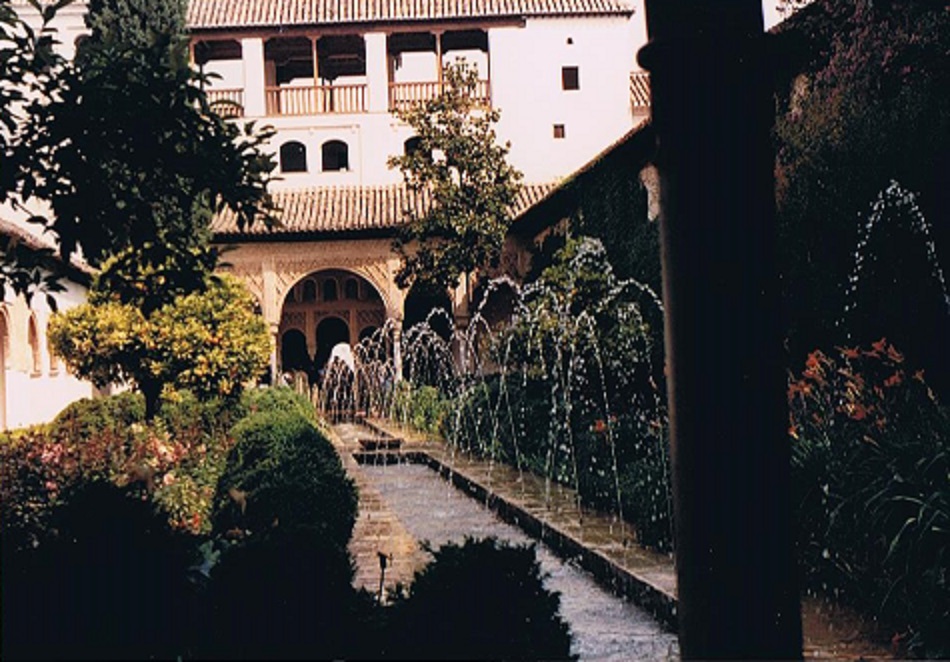
 

alhambra 001


While today mysticism as a trans-cultural phenomenon is widely dismissed scholastically as well as religiously from all the major religions of the West an Near East, it was not always so.  There is strong historical evidence to show that Neo-Platonic thought inspired significant mystical developments in Christianity Judaism and in Islam. Spain was a very fertile site for this exchange following the Muslim conquest and the establishment of the Caliphate of Cordoba in particular the second Caliph Al Hakam II amassed a library from translations of Greek and Roman works from the entire Muslim world which may have contained the works of the philosopher Al Farabi who had done much to preserve the works of Aristotle and Plato with an emphasis on Neo-Platonic thought and who in turn influenced the philosophers of multi-cultural Muslim Spain such as the Jewish Maimonides and the Cordoban Islamic philosopher Averroes.  Al Farabi sought to synthesize the philosophy of the Greeks with the mysticism of Sufism and he also wrote an early treatise on alchemy.  Spain remained a major center of exposure and translation of Greek thought, through the early medieval period, that was preserved by the Arab scholars of the Muslim Golden Age which they encountered when they conquered territories of the Hellenic World. Their translations also preserved much of the Alexandrian context of philosophy that mixed magic, mysticism and alchemy with Neo-Platonism along with Greek philosophy.  Ibn Masarra  was a very influential Sufi philosopher of Muslim Spain who based his system of thought on the works of Pseudo-Empedocles which were Neo-Platonic elaborations of the thought of Empedocles that also emphasized the unknowability of the Divine as well as the importance of love in the ascent to perfection, he also had leading Jewish followers. Spain was also the home of Moses de Leon, the attributed author of the Kabalistic work the Zohar (which scholars see parallels in its importance of love with that of Ibn Masarra’s thought) in Guadalajara which was also the later sight of the birth of the Franciscan reforming mystical practice of recogimiento or “recollection” which was heavily influenced by Neo-Platonism and even had literal “spiritual” alchemical reference in its meditative practices which emphasized collecting all the faculties within a radical interiorization as a path to mystical transformation, an affective and apophatic mystical practice of moment to moment coaxing of consciousness to enter and stay within the alembic or vessel of transformation of the heart center. There is also the Sufi practice of meditation known as Muraqaba which emphasizes “guarding or watching over the heart” which has a strong resonance with the practice of recogimiento. Southern Spain had a well developed movements of Sufism, many influenced by Ibn Masarra including the famous Gnostic and Hermetic philosopher Ibn al Arabi who was born in Murcia in Southern Spain.  Alchemy as a metaphor for spiritual practice was also widely adopted in Sufism and was considered the most noble of all the occult sciences because of its mystical implications as even evidenced by the title of Al Ghazali’s work The Alchemy of Happiness that sought to achieve an ideological truce between the factions of the role of philosophy and Sufi mysticism and the religious orthodoxy of his time while highlighting the role of personal ascetic and spiritual discipline.


I feel that there is much more gained in life in the recognition of the mystical than by its rejection or denial.  As Matthew Fox writes, “we are all naturally born mystics”, it is a deep and fundamental urge and response.  One of the most beautiful things for me about the Trika philosopher, Abhinavagupta’s thought is his privileging of a deep experiential aesthetic sense along with his profound non-dual mysticism, so much so that he believed that a deeply experienced and authentic aesthetic emotion or experience is one of the highest possible sacrifices or offering to gift back to the Divine.  While Plato denied the artist a place in his ideal Republic as he considered them as artificers and essentially dishonest deluders who traffic in fantasy and dreams, yet the essential virtuality of the aesthetic experience was itself prized by Abhinavagupta as being an easier and safer tantric synthesis of the goals of enjoyment and liberation that were free of the dangers of attachment to actual material pleasures.


Yet meditation remains an odd, unusual, unnatural (in that it is counter intuitive and against the grain of ordinary perception) practice that exists as a luminal pursuit outside of ordinary exoteric religion or even of philosophy or psychology.  This very “counter-ordinary” quality made it an essential part of yogic culture and pursuits and was considered one of Siva’s favorite pastimes, sometimes much to the consternation of Devi as almost comically depicted in several Puranas.  As such its bindings and reversals of the ordinary scattered outwards dispersed flow of consciousness and of the abilities to arrest it, suspend thought and to enter a trancelike absorption, like other physically extra-ordinary manipulations and bindings of yoga, as part of its essentially magical paradigm; these strange practices were thought to create a psychic or spiritual “heat” or tapas which could affect miraculous powers or phenomenon which were sometimes seen as proof of spiritual attainment or siddhis.  While the practices themselves may be ancient, they were codified relatively late, nearly a millennium after the historical Buddha lived, in Patanjali’s Yoga Sutras which distinguished the seated posture of meditation or dhyana from the state of psychic absorption or samadhi.  There is evidence that would strongly suggest the likelihood that Plotinous and his followers practiced an abstract and interiorized form of meditation.  Neo-Platonism has a deeply mystical theology with a positive non-dual message much like that of Trika Saivism or Zen, that man’s “original nature” is actually divine and all he need do is to “remember” it to realize it for which the practice of meditation is key to dissolve the blocks and obstacles of thought and attachments.  Neo-Platonism played a significant role in the shaping of early Christianity, certainly with the growth of Christian Gnosticism, but also significantly shaping much of the thought of many important early Church leaders to the point that it is virtually impossible to eradicate Neo-Platonism from both Roman Catholic and Orthodox history and doctrine with figures such as Origen and St. Augustine.  Meditation developed in early Christian life with the development of monasticism which grew out of the lives and habits of the Dessert Fathers, those hermits who withdrew into the deserts of Egypt to escape the religious persecution of the Roman government and of the chaos of the urban centers to live in solitude.  These hermits formed loose associations while still living independently and some even resided within the then abandoned ancient Egyptian temples, carving and painting their own icons and images over the ancient frescoes, and remnants of the soot from their cooking fires are still blackening the ceilings of many temples.


egyptceiling 001


Yet the recent discovery in the 1940’s of the cache of Gnostic and Hermetic texts hidden in large clay jars on a cave in Upper Egypt known as the Nag Hammadi library revealed that the lines of distinction between orthodoxy and heresy may not have been so distinct in early Christian monasticism.  Alexandria became an unlimited all you could think of spiritual buffet with its cosmopolitan mix of Hellenistic Greek culture, philosophy and science with Christian, Jewish and ancient Egyptian culture and religion which produced the esoteric and culturally syncretistic mythic figure of Hermes Trimegistus a figure and attributed texts that would have tremendous effects on Western esotericism, the history of alchemy and even on the Italian Renaissance.  Zosimos of Panopolis was one of the first recorded alchemists who was also Greek and a Gnostic mystic who believed that spiritual realization and mystic attainment were the real transmutations and meditation was one of the ways to achieve this.  Whereas especially after the decriminalization of Christianity in 313 A.D. aside from actively persecuting the Gnostic sects and attempting to destroy its writings, meditation became increasingly problematized and conscribed to strict definitions of active reading and thinking about scripture with active discouragement among the laity in favor of vocal prayer.


In many ways deep meditative experience in the West began to be seen to deconstruct religion and its potential for unmediated religious experience began to be seen as a threat to religious structure and orthodoxy.  Yet the strange apophatic mystical teachings of the mysterious Pseudo Dionysius the Areopagite were still accepted as authoritative in the Catholic Church at least until the 17 century.  Scholars have analyzed the text of his writings and have conjectured that he may have even been a student of the Neo-Platonist Proclus, and the emanationist implications of some of his theological writings even suggest Gnostic influence, yet St. Augustine considered him as “king of the mystics”.  Dionysius’ text on Mystical Theology contains strikingly radical terms of negative theology and imagery of the need to transcend all imagery and sense experience in order to approach the Divine, “What the Divine Gloom is” and of “being led upwards to the Super Essential Ray of Divine Darkness”.  His approach to mystic union termed apophatic or hesychastic emphasizes the radical transcendence of the Divine and was to be highly influential in the growth of various mystical practices as well as mystical reform movements within the Church from the first millennium of Meister Eckhart to St. John of the Cross in the 16th century, to the point that it may be doubtful if such mystical interpretations, writings and deep contemplative and meditative practices that advocated leaving aside conceptual and cognitive thought and imagery much like meditation came to be practiced in the East would have ever occurred without mysterious texts of the “Pseudo Dionysius” with whom Plotinus would likely have been in agreement. Such mystical movements came to be consistent with millennial prophetic, monastic and lay monastic movements that were ultimately futile attempts at Church reform in the highly political chaos and corruption of the Church throughout the medieval period which even saw up to as many as three separate warring Popes.  Yet the mystical movements in the West only ended in fuelling the growth of the Inquisition. Even today after the Catholic Church has virtually overnight lost its moral authority in the minds of much of the modern world, at the exposure of its endemic corruption of the recent extensive history of child sex abuse and cover up, it is a sad point that Pope John Paul II thought it more important to condemn meditation and Eastern meditative practices in a letter to cardinals than to condemn the sex abuse phenomenon which evidence has shown he was aware of.


As NASA’s Scott Kelly has returned to Houston after spending an entire year in space, I remember the story of one of the first U.S, astronauts, Edgar Mitchell who was very vocal about his life-changing spiritual experience of seeing the Earth from space.  He went on to found The Institute of Noetic sciences that researched the effects of meditation and consciousness studies because of his experience that he had in space.  The first space race also coincided with the unexpected forcible shove of the Catholic Church in the 20th century, Vatican II.  As with the first era of space exploration, it was also a period of great change and optimism for the Church, involvement with social justice and radical ecumenical dialogue with other religions, especially a renewed open dialogue and exchange with contemplative practices of other religious traditions, whether this was also partly the result of the popularity of Thomas Merton’s writings or the general interest in Asian religions and their various contemplative traditions. There was even the book Zen Catholicism published in 1963 by Dom Aelred Graham, a Benedictine monk: his essay “On Meditation” published in Studies in Comparative Religion Vol. 1 #1, 1965 is available online and is particularly worth reading.  Thomas Merton was a best-selling author while living in a Trappist monastery as a monk whose writing began emphasizing the similarities of contemplative experience particularly in Buddhism and Zen and in contemplative Catholic experience and was even rumored to have been contemplating converting towards the end of his life dying in a freak electrocution from a fan in his room while in Thailand lecturing and had even remarked, “he wanted to become as good a Buddhist as I can”.  It is also ironic that Merton was deeply affected in his decision to enter the monastery by the advice of a visiting Hindu sannyasi who told him that he should “explore his own culture’s religious traditions”.


hermitage 001


While I am glad to learn that the monastery that Merton joined as a young man which he wrote about his conversion and spiritual journey in his best-selling memoir, The Seven Story Mountain is still in operation in rural Kentucky and is the oldest Catholic monastery in the U.S. and is a self-sufficient institution and farm, I am overjoyed to discover it has recently hosted several week long monastic interreligious dialogues, much in the spirit of Merton, between monastic and contemplative religious leaders of various faiths including the Dalai Lama.  Yet while Pope Francis praised Merton on his recent visit to the U.S., there are no more Thomas Merton’s on the cultural radar of today within the Church who are vocal about exploring mystic common ground.  Instead the voices within the Church are more about reinforcing difference and distinction while the rates of people entering the clergy are steadily declining both in the U.S. and abroad.  Merton believed “Christianity had abandoned its own mystical traditions in favor of a Cartesian focus on the reification of concepts, idolization of the reflexive consciousness, flight from being into verbalism, mathematics and rationalization”.  While the first period of exploration of outer space also saw a profusion of popular films and media, post Vatican II, about the Church and monastic vocation from The Sound of Music, Hayley Mills in The Trouble With Angels to Sally Field’s Flying Nun, this second more internationally cooperative mission in space has seen more divisiveness and entrenchment in archaic doctrine over sexuality and has seemed to silence the path of inner exploration of mysticism which meditation is part of.


While I now have little patience with orthodoxy of any type, it is interesting that the former monk and current best-selling author, Thomas Moore, is now recommending spiritual seekers to reinvent the whole project of religion for themselves, yet paradoxically he also emphasizes the importance of studying the world’s spiritual developments and practices in their own historical contexts and traditions.  Yet meditation and contemplative practices seems to function on a totally different sphere or plane than the hard conceptual reification of doctrine or dogma.  Since the first exploration it seems the Catholic Church has succeeded in quelling and almost erasing the memory and original hopeful and exploratory spirit of Vatican II, especially its ecumenical vision of respecting and relating to non-Christian religions as it has effectively erased almost all vestiges of the very sophisticated non-discursive forms of meditation, sometimes termed “mental prayer” or recollection (which term even evokes its Neo-Platonic influence) that developed for nearly a millennium.  While their texts are still preserved such as The Cloud of Unknowing or Francisco de Osuna’s Third Spiritual Alphabet as historical works, their actual practice is discouraged and dismissed as antiquated with very much of a “Don’t try this at home” implication with the inevitable assurance that “traditional” mediated religious experience is safer.  While these practices which are very simple yet very sophisticated offer a very unmediated and direct potential for religious experience that really rivals Zen, yoga and most other Eastern non-conceptual form of meditation.  While I do believe that structured or guided meditations have a tremendous amount of value and potential therapeutic application, the unstructured and apophatic type that simply empties the contents of the consciousness of the practitioner can be very profound and offers a sense of spacious awareness as if the meditator had stepped out into space itself.


As in alchemy, this type of meditation can have a deep sense of dissolution, or of the dissolving of structure, boundaries and blocks that can be very disorienting for some people, but as in the initial stages of alchemy, it can also be a very fertile and creative process that allows for much more freedom and adds a sense of “space” to one’s awareness that can have a seemingly ironic boost to one’s sense of creativity by loosening the grip that language and time has on your psyche.  Thomas Merton also wrote the he felt “’Christianity was content-heavy yet practice attenuated”.  In strategically feigned ignorance, or more tragically actual which would indicate the triumph of historical amnesia in service of orthodoxy and of officially sanctioned self image of the Church, the near millennium of history of its development of highly sophisticated techniques of meditation have been expunged, censored and whitewashed by its self-created fictions of coherence and unity and orthodoxy; and the mouths and writings of its mystic Saints are taped shut as it reassures its flocks that their writings were not meant for the laity.  John Paul II’s letter to his cardinals and every single one of its empty slavish aped and mindlessly repeated derivative “official position” communication by the Church minions now indirectly couch the subject of meditation in the “H” word (heresy) and another one of its favorite fear-mongering strategies, demonic possession.  In blatant lies, it denies the existence of sophisticated non –conceptual meditation techniques and practices and powerful apophatic mystical thought within the Church, while now actively discouraging their practice by implied threats of it attracting possession by demons.  I feel that these are masks for a deeper fear the Church has, that its deeply personal and experiential potential would obviate the need for the Church itself, the mediation of its clergy, its rituals and of course the obligation of financial patronage. The Church’s condemnation of New Age spirituality for fear of job security is historically ironic given the fascinating figure of Joachim of Fiore, a mystic, writer and visionary connected to the Cistercian order around the first millennium whose visionary interpretations of the Book of Revelation believed and predicted that there would be soon the dawning of a new age where the Church would be unnecessary and Christians, non-Christian and non-believers would unite.  Fiore was revered as a prophet by the radical “Spiritual” Franciscans who dared to interpret St. Francis literally concerning his rule of not owning property.


joachim di fiore


Around the first great period of exploration in Spain a series of historical and cultural factors emerged during the period of Columbus’ first voyage within the Franciscan retreat houses of the Strict Observance that was to initiate an unprecedented period of inner exploration that seemed to bring to life Fiore’s millennialist vision of a new spiritual age by intensely practicing, preaching and proliferating and popularizing through public publication using the current information revolution of the printing press, of various spiritual tracts that encouraged laity to practice a variety of essentially esoteric techniques of mental prayer termed “recollection” which advocated that all are able to follow the mystical path regardless of station in life and popularized the path and techniques of recollection as a “shortcut to perfection” and much like the tantric esoteric tradition of the Spanda school, it promised that through the regular practice of its techniques and methods which essentially were a combined apophatic and devotional mysticism that advocated a radical introversion or paravittri of sensual, mental and psychic energies within the heart or crown chakras, which promised union with the Divine and that through its practice “even an unlearned woman could gain intimate knowledge of the most profound mysteries of faith and life”.  Influenced initially by the 15th century ascetic reforms of Pedro of Villacreces of the Franciscan monasteries in Spain of the Strict Observance and of the mystical writings and ideas of Jan of Ruysbroek and the radical reforming movements of the medieval Low Countries that led to the formation of devotional lay monastic communities outside the Church in reaction to its corruption and disorganization that relied heavily on the mystical theology of the Pseudo Dionysius stripped of imagery in a devotional approach that was preserved in the writings of the Flemish Franciscan mystic Hendrik Herp and of the mystic writings of Hugh of Balma through the Spanish translation, Sol de Contemplativos another highly influential text of mistaken authorship and attribution that had been attributed to Bonaventure which some have felt even inspired the author of The Cloud of Unknowing. These meditative techniques were perfected by the Franciscan retreat houses and sponsored by the powerful cardinal Cisneros, and their practices fuelled and inspired the thought, writings and practices of St. Teresa of Avila and St. John of the Cross, the last flowering of this type of “recollection” mysticism and meditation, yet it also fuelled the Spanish Inquisition and the condemnation and the placing on the Index of forbidden texts of many of the earlier authors who contributed to the recollection movement (along with its later manifestation of “Quietism” and Miguel de Molinos).  The recollection movement sought to reform the Church, a very extremely orthodox and exoteric institution through instituting and practicing an essentially esoteric system and practice within the structure just as Kabbalah and as Abhinavagupta had recommended not overturning the orthodox structure of Hindu society by “being orthodox in public and Saiva and Kaula in private”.


After seeing the Academy Award winning film Spotlight, I seriously wonder if the Catholic Church will be able to survive this scandal and elaborate cover up to ever seriously be considered in any positive ethical light, or if it is even worth reforming; and it also calls to mind the prophesy of Joachim of Fiore. While Protestantism except for the Unitarians, Quakers and Shakers, has denied any place for mystical thought or meditation, our current alternative to religion or spirituality, secularist and consumerism equally offers no validation or place for meditation in a world view dominated by identity, ego, self-absorption, money, greed, time, speed, competition and popularity; while meditation can be very disorienting as it can cause a very profound sense of dissolution of these qualities, it also thrives on qualities that are the antithesis of those that our secularist and consumerist societies thrive on.


Yet meditation of any type also seems to require a certain practical groundedness which has been a hallmark of the Zen tradition.  Likewise St. Teresa of Avila was a mystic known for her earthy forthrightness who preferred ultimately as a litmus test for any meditative or mystical practice or experience the Biblical verse “Ye shall know them by their fruits”.  While meditation does require patience and a certain amount of time to reveal its benefits, it still is a valid approach to assessment.  No matter if a person is able to sit in the full lotus posture for an entire weeklong intensive while eating, sleeping and taking walking meditation breaks following perfectly choreographed gestures of a Zen sesshin or become fully absorbed in consciousness in samadhi or achieve the highest illumination and union with the Divine, what are the fruits of these experiences in word, thought, deed, presence and interaction with others and society?  I think it is even more appropriate to extend this verse to religion itself.


The Spanda Karikas takes a radical universalist stance that even insists that “the object of meditation of all theistic schools [religions] is nothing but the Spanda principle as well as it is the underlying subjective doubt of the non-theistic schools or of atheists, and that the diversity of forms of meditation is only a reflection of the absolute freedom of the Divine”.  It reminds me of the remark of the Bengali mystic Ramakrishna on religious intollerance, “everyone keeps insisting that only their watch tells the right time”.


Matthew Fox may be the current incarnation of Joachim of Fiore’s prophesy in his 95 Theses or Articles of Faith for a Christianity for the Third Millennium, as he write in Article 11, “religion is not necessary but spirituality is”.  While I may not always be able to meditate everyday and I do not feel obligated to have to submit to grueling endurance tests of group meditation to be able to reap the benefits or even to consider myself a “meditator”, I know that it will always be at the core of my life, creativity, work, spirituality and enjoyments whatever these may be.  I still enjoy rereading Francisco de Osuna’s popular and controversial guide to the practice of “recogimiento”, written in the early part of the modern age during the first Age of Exploration that initiated a movement of inner exploration, as a guide not only of developing a deep meditative non-conceptual meditation practice with a strong devotional “prayer” aspect (that I substitute a Saiva aspect for), but also for cues on developing a life that is conducive to meditation and how to integrate it throughout the moments of my daily life as I seek to practice its admonition, “Make all things your teacher.”


© Paul Smith, 2016


Photographs by Paul Smith


Empty Palaces of Desire

In reference to the idea of doing most things, I still unashamedly answer, that frankly, “I’d rather be reading”.


As Benjamin Disraeli remarked to questions regarding his origins “I was born in a library”, I would say that my curiosity and more specifically my desire for knowledge of the world and the history of human culture was born in our family set of encyclopedias.  I remember spending hours poring over numerous entries and enjoying following the related cross-references almost as much as the initial entries themselves.  Now that those encyclopedias are gone and my desires are currently assuaged by Wikipedia, even though I have spent much of my professional instructional work with college students illustrating the differences between Wikipedia and published print sources or other online reference tools with higher levels of authority, I still like following my actual patterns of curiosity casually with Wikipedia and following the consecutive branching hyper-text entries instead of print cross-references.


Tracing and retracing the infinite branching of the web of associations of curiosity of inquiry in being encouraged to “Look it up” when posing the difficult questions of a precocious child to my mother, of following the seemingly illimitable inner promptings of sometimes fascination sometimes idle curiosity and other times an often blinding desire to know how other cultures lived in every period in history that emerged in almost cyclic and serial progression; wanting to know the culture of ancient Babylonia, learning ancient Egyptian hieroglyphics and going so far as to write to the Smithsonian when I was eleven to learn to play the favorite ancient Egyptian game of Senet. From ancient Greek daily life, Roman, ancient Persian, ancient China, Japan, India, the culture of medieval Europe, the Italy of the Renaissance, the Mayans, Phoenicians, ancient Crete, the Baroque world of Louis XIV, and the culture of court life of Versailles and of the Enlightenment and the 19th century world of the Decadents and Symbolists.  I had developed an escalating desire to know more and more and to immerse myself as much as possible into my emerging interests of the moment.  My encyclopedic historical and cultural interests led me from our encyclopedias and historical surveys, anthologies and illustrated monographs inevitably to our neighborhood public library where I was allowed to browse its card catalogues and its then labyrinths of massive and well stocked shelves unimpeded.


It was a hushed, well ordered labyrinth whose space was dominated by its mazes of tall shelving completely packed with books.  It was a sacred space of desire for me which led me to seek out the most obscure topics and cultural historical miscellanea sequestered in every nook and cranny of its tightly packed and silent contents which I sought out to devour and to listen to the often cacophonous voices of the past that like Borges haunting preface to his volume of poetry Dream Tigers or The Maker, that deserves to be quoted in full:

The sounds of the plaza fall behind [or, Leaving the babel of the plaza behind], I enter the Library.  Almost physically, I can feel the gravitational [pull] of the books, the serene atmosphere of orderliness, time magically mounted [desiccated] and preserved.  To left and right, absorbed in their waking dream, rows of reader’s momentary profiles in the light of the “scholarly lamps” as a Miltonian displacement of adjectives would have it….


That same public library now reflects the changes of many US public libraries that have cleared the majority of space of stacks of books and have utilized more of their space for computer terminals and instructional spaces and class rooms which are mainly used for computer skills training.  Whether guided by well-intentioned specific narrow analysis and appeal to the demographics of its primary user population’s anticipated needs, competing for the customers of the now only surviving major bookstore chain, results of diminishing budgets or because of the unquestioned decline in interest or desire for books, in general the public, and now some university libraries are less labyrinths of exploration and miscellanea capable of answering the endlessly branching associations of the patterns of thought and the ability to satisfy the spontaneous urges of desire for free and often random inquiry which the invisible and opaque non-structure of the Internet is now primarily relied on for.  Libraries have now sacrificed the conspicuous presence of the book for the merely mundane aspects of utility.  Libraries now are less what Alberto Manguel refers to in his paean to the now sadly culturally neglected act of reading, A Reader on Reading, the “numinous memory palaces we call libraries” and are becoming more and more like the “babel of the plaza” that Borges sought to escape.  Manguel in his youth in Argentina became an actual reader for the then nearly totally blind Borges, and his book A History of Reading is an historical masterwork yet poetic tribute to this strange habit that is the hallmark of civilization which now seems to be made to appear antiquated through the illusions of the marketing of technology.


ruin3 001 (1)


Yet nothing could better illustrate the peripatetic random pattern of inquiry than Poe’s memorable byzantine, exquisitely written passage in the opening of “The Murders in the Rue Morgue” where the protagonist, the eccentric romantic decadent with almost hermetic mythic qualities, Auguste Dupin, whose powers of “rationation” take on impossible almost preternatural aspects as he proceeds to list the exact succession of free branching unrelated thoughts of his unnamed companion, the narrator of the story, simply through careful observation of his actions and reactions to surrounding phenomenon almost like trying to remember one’s dreams after a deep sleep, as they walk silently through the streets of Paris together “enamored of the night”.  The Internet especially via hand-held devices can keep up more effectively with the random evanescent often serendipitous meanderings of the fickle desires of the imagination and the intellect than the stolid and fixed multiple indices of the library can.  The invisible spiders instantaneously retrieving the exact mention of any word desired in any recorded text seems like the dangerous consorting and manipulation of arcane spirits, the powers promised by the correct interpretation and practice of dark sorcery or of the siddhis accrued like anima from the yogic recognition of Siva’s grace.  While the end-user revolution allows anyone with access to the internet to have instant free access to free text search engines that don’t require arcane taxonomies of controlled vocabularies such as Google whose “Google Books Project” allows its key word searchers to instant access to every word on every page in an ever escalating number of books that include the entire contents of vast research libraries across the US that have been scanned into its full text databases as well as the nebulous unregulated, unedited and frequently unsubstantiated contents of the void of cyberspace.


Yet it is still true that not everything is on the Internet and even with Google’s escalating Book Project, which is now not allowing as much access to the passages cited as it did over a year ago, and only at the time of my writing this, I can now no longer access any of the cited text from my I-Phone where it only displays my option to buy the available e-book version of the text while it still pulls the citations, but I still can access the entire cited passages from any general keyword search from my computer. It is doubtful how long or even the feasibility of the complete and unimaginably total scanning of everything ever accumulated in print, or now of the future of its free accessibility due to publishing and the growing field of intellectual property rulings, and even though Google won the recent appeal of the Author’s Guild v.Google that their massive scanning project did not violate the “fair use” clause of copyright law and that Google’s project “had much cultural value in the way of preservation and access and even in promotion of sales of books”.  It is still unclear exactly what Google will do or plans to do with all of this scanned print material, and that their ultimate intentions may not all be culturally philanthropic in scope.  This also emphasizes the still essential instability and ephemerality of text in any electronic format. Digital archiving and preservation still poses hosts of problems, not the least of which is escalating obsolescence of platform formats, which leads to the still very unfashionable and unprofitable truth, that print is still the most stable format for “information” (that is excluding carved stone). While including the preservation problems of print, it is still true that if you don’t shred, submerge in water or set them on fire, they can conceivable still effectively deliver their “information” without obstacle for nearly 500 years.  While it is equally underemphasized that anything you find on the Internet may not be there tomorrow.  Aside from the many contingencies, not the least financial, in maintaining a web page, most subscription databases also have clearly defined clauses that allow them to edit, change or delete any information in their contents without having to alert their subscribers.


While Poe’s Auguste Dupin meets the narrator in what is considered the West’s first true detective story in a library in search together of the same obscure book, it is arguable if now most users of US public libraries instead go in search of free Internet access as public libraries are the only institutions in the US that not only offer free Wi-Fi, but also free terminal access as well as free classes in computer skills development.  The hand-held electronic device today is most suited for Dupin’s peripatetic rationating meditations and hypertext’s ease of access to branching textual associations and its powers to assuage spontaneous and emerging and idle curiosities and desires, does and can it compare with a well stocked library?


While the I-phone gives instant access to labyrinths of unedited and indiscriminant text rather glibly referred to as “information”, it is not suited for extended or deep reading.  E-readers and I-Pads are more suited for extended reading and have the ability to store vast amounts of e-books; it is now interesting to note the stagnancy of sales of e-books through Barnes& Noble and Amazon.  Libraries are responding and adapting to how the public likes to receive its textual materials and have settled with now seeing themselves as “hybrid” environments, part print and part electronic databases and e-books and many are actively competing with the inviting customer-service heavy environments of the remaining large book stores by offering Wi-Fi and coffee bars.


I have noticed that many new library renovations, both public and academic alike, have put more emphasis on the buildings and on empty open space which first greets and envelops the entrant usually with open seating and lounge areas and open tables meant for laptops and or banks of computer monitors, completely free of any sight, trace of familiar scent of books, of which large organized quantities of, I have come to feel are particularly intimidating for the young post-millennial public, even in academia. While I still, when visiting someone’s home or apartment for the first time, tend to feel instinctually distrustful of someone if I discover that they have no physical books, almost as if they have no identity, no matter how many electronic devices they have.


After several years of collecting data from college students, I found that they felt the least confident in their abilities to navigate a real physical library and they had little to no idea on how the books were organized and frequently assumed that they were alphabetized by the author’s last names as in a bookstore.  They in general felt much more confident in their abilities to navigate the virtual labyrinth of an electronic database but frequently had no idea that they were any different and were often surprised and confused to hear that they were different from the Internet.  While many of these traits arguably led to the development of the “information literacy” movement at the turn of the millennium, there are indications that there has been a key educational and cultural disconnect after the development of the Internet. Many academic librarians began noticing and communicating with faculty about key problems in incoming student’s abilities to use and cite published information along with the rampant temptations to simply cut and paste whole selections of text due to electronic format as well as their inabilities to locate information in libraries.   It is my opinion that post-Internet students have fallen into a key skill sets gap where they are obviously not familiar with navigating a physical library, nor are they familiar with traditional bibliographic location tools  of indexes or even online card catalogues and on the other hand their electronic database navigating skills are also lacking on the tech side, so they have become caught in between in a gap where they are losing the older bibliographic skills and also not functioning well enough in newer electronic search skills able to retrieve relevant information from databases mainly because of their overconfidence in their generally uncritical habits of Google searching.Many of us who grew up pre-Internet remember that we had little choice and had to develop library skills as there were really limited avenues to be able to access information or to satisfy our curiosity.  While many high schools across the country no longer require students to complete any substantial research projects partly because of pressures to focus on testing, the phenomenon of students unable to navigate a library is more culturally troubling to me.


There are several factors in my opinion that are contributing to this besides the Internet, such as consumerism.  I was amazed even before becoming a librarian, how many students would prefer to come to me as a bookstore clerk to ask for help with sources for their schoolwork even though the art museum had a large art research library that was open to the public.  While as an academic librarian, I was even more amazed at how many students when asked where they would go if our library did not have the sources they needed, that they would prefer to simply ask a clerk at a bookstore. I can’t help from feeling that this generation feels more comfortable and prefers to identify themselves with the privileged role of the customer rather than as a student accountable for their own independent learning, willing to cooperate with librarians and library staff whom they don’t seem to perceive to be able to relate to as customer, even though they are trained to be able to offer professional reference services.  I remember also almost getting escorted out of a large bookstore chain as the results of a library school project, where I had posed as a customer while interviewed staff on their abilities to offer research and reader’s advisory assistance to customers, which needless to say was purely subjective at best or otherwise non-existent.


Aside from this there is the issue of public spaces and retail spaces which seem to carry more status than the public spaces such as public libraries which many now identify with the homeless or indigent.  While I did hear the poet Gary Snyder talk about how great libraries were to stay warm in while you were homeless, there might also be a status or class issue in the assumption that public library spaces or services are free and therefore must be for people who can’t otherwise afford the materials and “services” of a retail bookstore or who can’t afford to buy them online.  On the other hand a recent American public library survey revealed that the top priority for young library users is now security.  This is quite understandable in the fact that aside from the recent terrorist shooting in California, you are still more likely to die of gun violence in America today as recent statistics show, than all of the domestic or European terrorism combined. And the public shootings in America do not discriminate between public and retail spaces with plenty of mall and movie theatre shootings that are not terrorist related.  While most public libraries are doing great jobs of providing great services to their users and communities and remaining relevant in the current landscape of “information”, many of these factors still serve to erode their place as places of pride and cultural and community identity, which I see eroding into the “library” as hand held device.  And aside from the issues leading to the development of the information literacy movement, there is an even more important literacy that is being eroded as print itself is becoming seen as antiquated, LeVar Burton of the once public television’s Reading Rainbow has said in a recent Forbes magazine article about the program’s new app that “one in four children in America are growing functionally illiterate”.


Yet for me, libraries of any shape, size or scope are still sacred spaces. I have always felt the words of Borges’ haunting, oneiric preface quoted earlier, almost more poetic than the works of that slim collection, “…I enter the Library.  Almost physically, I can feel the gravitational [pull] of the books….”


I think that my initiation into bibliophilia began with a precocious request for a collegiate dictionary for Christmas when I was still in grammar school.  I poured over every word even in its front matter as if it was the most engrossing story.  My bibliographic passions arose out of my love of words and language which shortly after led me to teach myself Egyptian hieroglyphics, its letter combinations and its grammar leading me to decipher a passage on a carved inscription of an Egyptian antiquity on a visit to a museum with my father when I was twelve.  This fascination with language is now amplified with my interest with Trika Saivism that uses language and grammar as one of its many metaphors for its complex multi-layered monistic theology and ontology as well as a model for Divine creativity called the “Theory of speech” or Para Vak.Yet I still feel that gravitational pull of books and no matter where I am they seem to almost fly to me by themselves and to spontaneously accumulate in piles.


Aside from being a frequent user of my local public library, loving to linger among its tall labyrinths of shelving, preferring to browse its well stocked and tightly packed contents, I preferred to discover the areas and zones of its arcane subject classifications on my own and the serendipity of finding a volume of particularly fascinating miscellanea in the neighboring crannies near my initial search.  One of my first favorite libraries aside from the local public one that became my refuge, my hermitage of wonder and cabinet of curiosities was the windowless locked room, more like a large closet that had no librarian and never in my memory had anyone else even remotely curious or bothering to use its contents except for the stray faculty who would unlock it to let me in.  Whether it was a purely random collection of books on free standing metal shelving or if it actually had some form of order without labeling, it never mattered to me.  This hermetically sealed closet of a room reminds me of one of my favorite quote about libraries or collections of books from The Arabian Nights, “The most beautiful garden is a closet full of books”.


The monotheistic religions all mention mankind’s origins as the first couple who live in a beautiful sequestered garden where they know no hardship or privation and live free of care, but their idyllic life is made conditional only that they not dare to attempt to eat the fruit of the tree of knowledge or else they will be expelled from that garden and henceforth must earn their food from the “sweat of their brow”.  Loss of innocence, bodily shame and nascent sexuality are also involved in this myth of humanity’s origins as a consequence of their transgressive curiosity and of their forced eviction from that original beautiful garden.I cannot help but sense resonances of metaphor of expulsion from “the most beautiful garden” through reading an opinion piece in the July 18th issue of Forbes magazine titled, “Close the Libraries And Buy Everyone An Amazon Kindle Unlimited Subscription”.


While the title alone is too depressing for me to bother reading the author’s attempts at argument, there is another more prurient theme that is resonant to this beautiful garden metaphor and the transgressive desire for forbidden knowledge.  While libraries used to be used by furtive adolescents to find snippets of information about sex in old medical reference volumes, the Internet now is a superhighway for freely accessible porn of every type imaginable and libraries have their computers loaded with screening software that frequently censors innocent searches in its net. Yet libraries themselves and their ironically stolid and almost sterile controlled and sensory deprived environments have the reputation of seeming to attract libidinous desire and even illicit sex.


Celsus2 001


Academic libraries apparently have the most notorious reputation for this type of clandestine activity that forces administration to hire security to patrol restrooms and study areas.  It is almost as if prolonged study and contact with the hushed asceticism of bibliographic environments can have the ironic effects of inciting concupiscence.  On a trip to Turkey in the archeological reconstruction of the ancient city of Ephesus while visiting the still impressive reconstructed elaborately designed façade with almost Baroque columned multi-tiered porches and niches holding full size sculptures of mythic and historical figures, the ancient Roman designed Celsus Library, I was surprised to see the remains of a threshold carved with the outlines of two dainty footprints which the guide said was a Roman advertisement for a large brothel that not only bordered the library, but also was reached through secret passages from the library.


brothel 001 (1)


Matthew Battles’ quiet masterpiece on the history of mankind’s habit of building and maintaining libraries, in the book’s tumble through history and all of its labyrinths of obscure miscellanea related to libraries worthy of its frequent mention of Borges, its exposition is yet written with a timelessly unhurried quality worthy of its title, Library: An Unquiet History. Battles writes about the ironic duality and contradictory phenomenon of library’s striving to provide open access to materials yet also equally restricting it through censorship or through sequestering some more controversial or salacious materials into restricted access archives or basements.  He also mentions the hidden agendas of the influential 19th century father of modern American librarianship and founder of the world’s first school for librarianship, Melvin Dewey, who felt that in particular, the immigrant populations needed to be more actively molded into cultural assimilation by the suggestions and services of librarians that emphasized certain “more practical subjects” over others such as literature or the humanities which Dewey felt to be more frivolous and less relevant to the goal of assimilation.


library an unquiet history


Yet the restrictions of free access to books and diverse thought is an unexpected outcome of libraries, not only because of librarians and administrators, sometimes censorship happens as a result of library’s staff or user’s.  On a recent visit to the San Francisco Public Library, I was struck by the unusual sculptures and wall decorations that I could see were constructed out of books.  These artworks were made out of thousands of books that had been defaced or destroyed, it turned out, by a guard working for the library who felt it was his personal mission to destroy texts that had anything to do with homosexuality or feminist issues.


Nevertheless, one of the most important points taken from my readings of Battles’ beautiful book, which I would raise to the level of literature as I enjoyed my reading experience of it even more than the “information”  I gleaned from it, are the now underemphasized points that the great libraries of the Medici sponsored Italian Renaissance and even those of the great House of Wisdom of the first millennium Bagdad, were not built because of the technology of the printing press, but primarily because of desire, an overwhelming desire for knowledge reminiscent of the title of the Middle East scholar, Robert Irwin’s, For Lust of Knowing, a defense of scholarly inquiry into the culture and literature of the Middle East against the totalizing dismissals of “orientalism” by Edward Said .  Whereas now it seems that desire is primarily directed towards the technological devices of access and delivery of what has now become “info-tainment” that are capable of taking selfies, the imagery of its essential characteristic stance of solipsism.  A desire mainly directed towards the technological medium that has eclipsed the desire for the message or of its content, which has become increasingly unstable and ephemeral that has no organization and that increasingly proliferates in the black hole of the vortex of cyberspace.


While digital access is still ruled by keyword search screens, admittedly I still find them even as a professional librarian, maddeningly frustrating, unreliable and seemingly more ruled by chaos theory than by any ultimately predictable logic.  I have settled on the best illustration for a search screen, whether for a database or for the Internet is like going shopping at the world’s largest store and being told that you are not allowed to browse or even look at what they have and being met by a single clerk who is annoyingly taciturn, laconic and literal who offers no help but who sphinx-like asks, “What is your question”? then given an endless printout of possible replies that have no seeming logical relevance to your question.  I find that search engines would more effectively qualify for Borges’ views of libraries as either heavens or hells of endless labyrinths of bureaucratic misdirection and blind alleys.


For me, libraries even today, of any size, once you can actually find the books, still embody the almost magically hushed qualities of “frozen time” that is evoked in Borges’ passage; and for me, the almost simultaneous whisperings of voices of the past as in one of my favorite scenes of a film, aside from the truly magical Gesamtkunstwerk of Peter Greenaway’s version of The Tempest, as Prospero’s Books, that gives one of the greatest tributes to libraries, Wim Wenders’ Wings of Desire, where an angel willingly suspends like a bodhisattva, his eternal state of beatitude to become embodied in the mortal state of man and to walk in his shoes for a time again and to observe them.  The scene of his obvious joy in lingering in a library and hearing the audible simultaneous whisperings of texts reciting themselves as he walks past rows of volumes or as he observes tables of silent readers still lingers in my mind when I enter any library now.


While I love the instant gratification of searching the Internet for snippets of information, to me it remains mute, there are no whisperings of “time magically preserved and ordered”, no “gravitational pull” to be felt only feverish and distractible desire, and instead it more evokes and accelerates the “babel of the plaza”.   I hear no voices through its medium, or if so, only indirectly and am always reminded of the contingencies of time.If as the Decadent poet of suggestion, Stephane Mallarme wrote that “everything in the world exists in order to end as a book”, it virtually has little to no meaning or value to say the same thing as,“…to end up on the Internet”. And I find it fascinating how we still preserve the mythic and ultimately illusory, almost Gnostic dualism inherent in the pejorative expression, “brick and mortar” with its implied contempt for materiality with its naïve digital soteriology as if we really have the option of existing without it as if the concept of architecture is also antiquated.


Does it also contain with it the implication of the removal or the antiquation of place, and of place as identity?  As shopping malls also seem to become a thing of the past, physical retail spaces and stores and bookstores seem less and less prevalent, common or even necessary.  As the US falls deeper in debt, its treasury depleted by nearly continuous war efforts and deployments overseas emphasizing its “spread of democracy” with emphasis on protecting its trade resources not unlike the late Roman Empire; internally its government, state and city public resources continue to dwindle along with its failing infrastructure.


a bonnycastle astronomy title page


Many economists predict that higher education will be the next economic bubble in the US. From Benjamin Franklin who formed one of the nation’s first lending libraries which in many ways embodied the values and ideals of the Enlightenment, that of the free and independent autodidact.  I am related through my mother to John Bonnycastle, the self-taught scholar in Georgian England who published very popular mathematics text books for the public, full of uncharacteristic romantic illustrations of personified goddesses by his close friend the artist Henry Fuseli and poetry, that were not long before were the exclusive property of universities most of which were the exclusive property of the Church or of the monarchy.  I was asked in 2010 to create a site-specific performance in Zurich as part of a very generous informal but very congenial artist fellowship organized by fellow Essayist contributor, Brett Davidson, and was encouraged to base it on Bonnycastle.  What was appropriate for Zurich was his inseparable companionship with Fuseli who was Swiss, and through Bonnycastle’s many close associations through his radical publisher, Joseph Johnson, he even became the math tutor of the young Mary Shelley and was a cherished frequent dinner guest of Byron who was also published by Johnson.  This was performed in a small intimate library in the basement of the Department of City Planning for Zurich and for me was a dream worthy of Borges.  It was dedicated to historical research and to that mysterious stage when the subject seemed to appear all at once in the mind of the researcher as a living person.  Bonnycastle was particularly interesting for an oblique view at a fascinating period in English and world history and its cultural and political foment.  It was also interesting to study an individual and cultural context where autodidacticism was so valued as part of the Enlightenment and of the burgeoning Romantic idealism.


While higher education is now almost exclusively viewed as a means to gainful employment with little to no attempt at justification for a liberal arts degree primarily because of its accelerating prohibitive costs. As colleges and university libraries across the country (including Ivy League colleges whose libraries make up a large part of their institutional identity) are laying off staff and streamlining their book holdings, many of which are some of the largest libraries in the country and the world, in desperate attempts to conserve costs in attempts to lower rising tuition costs.  Many are also resorting to online reference services in order to conserve staffing costs.  Frankly, I believe access to free higher education should be everyone’s right, regardless of even citizenship status.  Many countries are already doing this now and the Internet is making great strides in this direction with efforts such as Khan Academy or multiple training videos on YouTube.  Given US libraries’ long standing goals of “fostering life-long learning” it seems that they could also be taking more strides in realizing this goal through reclaiming their Enlightenment status as the “free university” or by reclaiming its Alexandrian status and hiring or sponsoring scholars, all of which would certainly bring more attention and patronage to them.


In such an atmosphere of today, libraries struggle to meet the needs of their users, that ever diminishing population, much less maintain a sense of primacy of the “face” or cultural identity of a people or a nation.I love reading the story in Reynaldo Arenas’ autobiography of the head librarian of the Cuban national library hiring him and allowing him to write on the job in order to support his writing.  Literature deserves such a home and fostering environment rather than remaining in the hidden warehouses of Amazon.  While the contemporary visual arts are more easily commodified into elite hyper-inflated markets of their own, the written arts are relegated to rely on an increasingly threatened market of publishing in order to manifest and survive.  A market that is increasingly democratic in its worst manifestations, that is less discriminate, less literate that demands continuous entertainment and satiation, and that is more amnesiac, where Shakespeare is forced to compete with Kim Kardashian.


I was amazed the last time I entered a phone store whose design and marketing on the interior reminded me of a high end gallery or boutique, whose hushed hermetically modern minimalism is designed to signify a hyper market of cultural significance that has transcended the utilitarian.  This was partly the case of the whole nearly empty area featuring new model I-phones displayed almost like museum pieces.


As people now continue to die in car accidents because of mindless addiction to texting or web surfing or news videos of teens screaming in agony because police have grabbed their phones that were not allowed in school and had to tackle them to do so, are these devices really being seen to antiquate libraries?  They already are changing the way we read, and not necessarily for the better, while his book is on my reading list, the title of Nicholas Carr’s The Shallows: What the Internet Is Doing To Our Brain is clear enough to me.  Just a look at the top Google searches for 2015 is flatly depressing and it also demonstrates the value and indeed obligation for a civilized society to not simply settle with giving people just what they want or only what they ask for, like children, they would more than likely never choose balanced meals if left to their own devices and only eat potato chips, but to make more proactive efforts to recognize the value, the role and obligation of curation and availability to all of the widest variety of the best of all cultures regardless of its popularity or if it is even asked for.


Given the failures of book retailers as of late, libraries may just become the only public “brick and mortar” book spaces left, which would be just fine by me, and maybe the public would begin to take more advantage of the professional services of libraries that were already available to them.


Yet there are institutions today that still inspire me with hope that fulfill the cultural potential of the mythic mission of the library and that take a culturally heroic stance like Arenas’ library boss who actively encouraged him to write on the job.  I remain amazed at the unique mission and skillful realization of a multi-media installation and exhibition at the Literaturhaus in Zurich of Tolstoy that managed to display not only biographic information and his personal artifacts, but to actually bring to life many of his memorable characters and scenes from his novels through a variety of multi-media strategies which was my first time seeing a writer and literature as the subject of a modern museum exhibition.  Another institution that fills me with hope is the Poetry House in New York that actually provides fellowships for budding writers and poets to use their library as a creative home that fulfills and honors that mythic mission of the library as the face and embodiment of the inspiration of the muse of poetry, knowledge and wisdom. While it may be true that in Latin America, poetry and literature may play a greater role in their various countries’ self definition and politics, and it may be more of cinema for the US, but I also am reluctant to inquire too closely what would be its current manifestation of identity and self definition.


In many ways my interests and curiosities that led me to seek out libraries are indicative of the astrological sign I was born under, Gemini, which the astrologer and researcher on the history of astrology, Solange de Mailly Nesle, believed was personified in literature by Dante who apparently sought out to devour all known areas of knowledge of his day, only to abandon them all for an overwhelming search for transcendence.  For me the library is a living symbol of gnosis, not merely a utilitarian space in service of its communities of users, but a living manifestation of the erotics of knowledge, that space of meeting and juncture between the human and the Divine, of temporality with the infinite, which in Trika Saivism is personified by the Shakti.   The face and force by which the Divine becomes aware and seeks to know itself that is mirrored in man’s quest to know himself and the manifest universe.  As Shakti, in Trika knowledge is one of the triune powers of the Divine, it is a force that is also essentially ambivalent and it becomes binding, along with language, when viewed as separate from the yogi only to be gained or lost, or when viewed as arrogantly owned by him or her.  It also becomes liberating when re-cognized and “set on its own path” as an essential manifestation of that Shakti.It is not just the building or its shelves of books that is most symbolic for me, but its classification systems that organize its holdings and theoretically offer a system to potentially order the entirety of human knowledge.  As the Celsus library in the populous city of Ephesus on the outskirts of the Roman Empire held huge statues personifying Wisdom as a goddess, for all of our digital convenience and arrogance, it becomes more and more painfully clear that wisdom is in short supply these days.


I offer up the dust of the four corners of the real and symbolic space of the library of today and that still lives in my memory, of that space of Barthes’ Rustle of Language and of William Gass’ Temple of Texts as offering to that Shakti of Sophia and recite Jaideva Singh’s translation of Kshemaraja’s opening propitiatory verse to the Spanda Karikas:

She, who is ever conscious of the vitality of mantra, who is the endless flash of the perfect and complete I-consciousness, whose essence consists of a multitude of letters, who is the goddess embodying jnana, even knows the totality of categories from the earth up to Siva, which is one in substance with Her own Self and is portrayed out of Her own nature on the canvas of Her own free, clear Self, just as a city is reflected in a mirror.  Hail to the Energy of the creative pulsation of Siva that exults in glory all over the world.


ruin1 001


© Paul Smith, 2016


Photographs by Paul Smith


In Search of the Perfect Halloween

The holiday of Halloween has to be the strangest American export to the world. As globalization facilitates the Americanization of more and more world cultures, Halloween is becoming adopted by more cultures without the faintest idea of what it all means or signifies.


1

x
One of my most distinct first memories of this life aside from some strangely lucid memories of being in the crib, were of going on my first Halloween “trick or treating” down the block of my neighborhood with my mother leading me or holding me up by the hand wearing a bunny costume that she had sewn by hand along with the other young children of the neighborhood. I still remember having tripped and stubbing my toe and coming home delighted with my free bag of candy and nursing my toe by watching the evening local horror host, Igor, on our black and white television. Igor was bald with dark rings around his eyes whose skit was that he had started his own eye bank and was busy extracting an eye from his screaming victim all during the break in this bad horror film.


Americans themselves have little idea of its origins or purpose, but spend more on Halloween second only to the high holy day of consumerism, Christmas. Articles abound concerning the rising market of Halloween at home and abroad with the UK as the second largest market, but also of Halloween’s growing European popularity. The online site for the world’s largest international toy trade fair in Nuremberg, Spielwarenmesse, mentions “Germany’s growing market for Halloween related merchandise and anticipates sales to rise even higher due to the fact that Halloween falls on a Saturday in 2015, also cites Planet Retail for the UK’s 2014 Halloween sales at 414 million EUR”.  It also quotes the “National Retail Federation’s 2014 statistic for US Halloween estimated sales as 7.4 billion US dollars with a 7% year on year increase”. Whether this seems to become an evocative case of “life imitating art” with the threat of Halloween’s usurpation of Christmas in popularity as in Tim Burton’s animated feature Nightmare Before Christmas where children’s Christmas presents become hijacked with Halloween toys and decorations or symptomatic of the US’ general 21st century “voodoo economics” where commodities seem to become less and less concrete and more phantasmagorical and solipsistic as in the case of social media. Spielwarenmesse also declares that “the 2015 trend for Halloween merchandise to be the Mexican Day of the Dead or Dia De Los Muertos and the related zombie with costumes of super-hero and pop stars as zombies”.


2


Whether or not the weather reflects the given pattern of the seasons, the inevitable and the inexorable cycle of cheaply made goods, home decorations, tchotchkkes, toys and party supplies used to commemorate Americanized holidays devoid of meaning or significance where merely time becomes the prime means to create markets and illusory desires for goods that probably would not exist otherwise. The appearance of the season of autumn is indicated no longer by the unreliability of the increasingly chaotic weather but the week after the start of the fatally prosaic obligation of the return to school, all of the shelf display spaces are suddenly cleared and begin to populate with boxes of orange and black.


While the pre-Christian Celtic holiday of Samhain, the festival of the dead, is often cited with unconvincing relevance, the European and English origins of All Hallows Eve (which is conjuncted into Halloween) much like the festival of Mardi Gras which commemorates a folk and popular celebration of excess before the required days of abstinence of the Catholic observance of Lent, Halloween is the day before All Saints Day as observed in the Catholic liturgical calendar and like Mardi Gras, is celebrated in a religious and cultural inversion of holiness and order.


3

x
Admittedly, I take as much or more pleasure in viewing the first appearance of the displays and tableaus of Halloween decorations and themed items in stores than I do the season openings of art galleries which occur around the same time in September. I take particular delight in the fact that they never are quite the same from year to year and in detecting the themes and trends of their depiction or expression of the theme of Halloween for that year. This year I would have to say my favorite purchase at one of the “pop-up” Halloween seasonal retailers that opens in abandoned retail spaces, is a plastic automaton of a “ghost writer” shaped like a realistic incunabula with a feather quill affixed to the text by a magnet that moves as if writing by an invisible hand as the text “speaks” deep within itself random spooky things. In keeping with the German toy fair prediction a local drug store chain has already put out a whole shelf decorated with only items of the Mexican Day of the Dead theme. Given the high demographics for Hispanics in the area now it seems very appropriate. Yet while primarily depicting skeletal imagery, there is no trace of anything particularly frightening; while certainly macabre it is never morbid.There is a more transgressive aspect (which is in itself an underlying theme of Halloween) to Dia De Los Muertos imagery and iconography in its humorous yet tender depiction of skeletons almost mockingly engaging in various occupations or vainly attired in the trappings of wealth and social standing or even with its iconic skulls covered in flowers. The themes of death are stripped of their frightening and menacing aspects and more true to the energies of the zodiac sign of Scorpio, are always paired with themes of regeneration such as the lush offerings of food and favorite substances such as cigarettes and favored liquor of the particular dead honored on the highly creative and sensual altars constructed in homes, galleries or outdoors that are thick with burning copal incense and piles of marigolds (symbolic of regeneration themselves) and purple flowers indigenous to Mexico.


4

x

But this does not account for the fact that America does not identify itself as a Catholic country and was initially settled by sects of rather fanatic Protestants who specifically sought to distance themselves from Catholicism and even some German visionary sects that espoused the esotericism of such Jakob Beohme who settled in Pennsylvania near Philadelphia.


scorpio zodiac sign

x 
Halloween becomes an excuse to explore and to celebrate the darker and the more socially disowned energies of the zodiacal sign of Scorpio: eros and thanatos or sex and death. Mexico by the way itself is considered a country ruled by the sign of Scorpio and in the esoteric “book” which is a filing cabinet of associations and various kabbalistic correspondences, The Tarot deck, Scorpio is associated with both the Death and the Judgment cards of the Greater Arcana. The Death card as indicative of its meaning, appears roughly in the middle of the 22 Greater Arcana and not at the end which points to the transformative change aspects of death rather than to its finality and likewise the corresponding alchemical stage, the nigredo, is considered an earlier “lesser work” stage while the Judgment card is associated with themes of regeneration. Dia de los Muertos imagery has a tender yet irreverent aspect that takes a fundamental socially sequestered taboo and pushes it to invade inviolate spheres of everyday life and that encourages it to dance and to play with biting mockery of society and that also unexpectedly encourages and celebrates creativity, poetry and song and the visual arts. Ironically it becomes a celebration of life through the recognition of its finiteness and its identities and social positions.

x

If anything All Hallows Eve refers to the survival of European and clerical paranoid mythologies of the dangerous and contaminating presence and influence of the supposed Satanic gatherings of witches called Sabbaths (which term also reflects their paranoid fears of the Jews) that likewise took place on the eves before often holy days of the Church.


Another treasured childhood memory of Halloween involves my mother who was an accomplished violinist and teacher who took me out on the front porch one Halloween with her violin and a cassette recording of Saint Saens’ Danse Macabre and played the solo violin part beautifully to my rapt delight and for the night filling it with an eerie enchantment. Saint Saens’ famous work was typical of the Romantic Movement which revived the myths and superstitions of the past as inspiration in service of its tenets of emotional feeling and of the sublime, and was also heir to the late 18th century’s development of the Gothic novel, which was one of the greatest developments of the horror genre in the West. Danse Macabre was originally composed as a tone poem to accompany an actual poem recitation was based on an old French superstition concerning Halloween where Death personified arose at midnight and plays the violin and caused the dead to dance in wild abandon the whole night. It is truly a tone poem and must be one of the most evocative and picturesque pieces in classical music. It begins with a soft chiming of the clock at twelve and immediately after a tapping sound of the bow hitting a tombstone strikes an eerie and unsettling chord known of as a “tritone” or even as the “Devil’s chord” and launches into a rushing swirling melody of a madly unhinged yet plaintive waltz alternating with xylophone sections evocative of skeleton bones knocking. Its title reinvoking the late medieval unsettlingly macabre and morbid allegorical iconography whose depiction of personified Death leading figures of all classes of society in abandoned ring dances of death, Europe’s scarring memories of the Black Death even appearing as shockingly depicting and almost delighting in vividly gruesome imagery of rotting and putrefying corpses on funeral sculpture and monuments which became characteristic of the fevered pitch and last decaying gasp of the Gothic style whose morbidity would all but disappear in the Renaissance. Whether these mad dances actually occurred in the midst of the plagues, their depictions survive in much late Gothic iconography and it is said even inspiring the English nursery rhyme “Ring Around the Rosie”. I did notice in this year’s Halloween decorations an electric candle printed with a medieval Dance Macabre engraving.

x

Such paranoid and frequently lurid fantasies were more than likely drafted, devised and authored by members of the Catholic Church itself and its Inquisition that were very effective in spreading fear and terror over religious divergence from established Church doctrine as well as spreading divisiveness, fear and suspicion amongst the people thereby making them much easier to control and to oppress. Such is mankind’s oldest cheap trick of power, divide and conquer. Such narratives of paranoia focused on the disowned qualities and the marginalized aspects of culture that especially included sexuality, the feminine aspect and difference. Such mythological narratives of the contaminating influences of “Evil” in the form of witches or of the practitioners of magic were formally adopted and inscribed into the canon law of the Catholic Church with the papal bull of Pope Innocent VIII, the Summis desiderantes affectibus, in 1484 shortly before the expulsion of the Jews and Muslims from Spain and the “discovery” and subsequent colonization of America. Such fictions masquerading as truth became increasingly paranoid and were perfect examples of cultural “texts” that subvert and unravel themselves as the futile attempt of the official totalizing overarching narratives of the Sacred and of Religion that devolve into a Manichean dualism where the delineation of Evil becomes more obsessively attractive than that of the Good. As stated in the Siva Sutras, “notions of good and bad are but mere ‘Boogie Men’ used to frighten those who are terrified of life itself”.


Suddenly your expectations for synthesized wholesome perkiness if not tranquilized droning remixes of pop music hits continuous background music for your life as consumer in the quintessential American setting of the shopping mall are subverted by eerie and menacing soundtracks for horror films, full of creaking doors opening, cat’s hissing, ghouls groaning, wolves howling, chains rattling and witches cackling, and that also betrays its Chinese production origins (along with most of the other goods in the mall) by including less occidental sonic references of the macabre such as ghostly notes on a bamboo flute. The stumbling groaning revenants of aspects menacing and terrible slowly proceed in their promenade down the open sky-lit glass roofed atrium of the mall a la George Romero’s original Dawn of the Dead. Drooling hideous effluvium, heading towards the empty stage and the press photographers, stumbling up the steps onto the stage to the shouting of the throngs of their loving suburban fans, straining to accept their awards from the perky, wholesome yet immaculately dressed news anchor for America’s New Popular Heroes.

The perversions of creativity of these official paranoid narratives of contaminating Evil become more ironic and complicated as shown in the fascinating history of the spread of forbidden texts on magic and sorcery in Owen Davies’ Grimoires: A History of Magic Books which delineates how works on the esoteric sciences of magic, both astral and “necromantic”, and alchemy from the Hellenistic world survived by being transcribed and translated by Arabic scholars in their thirst to preserve the wisdom and knowledge of the ancient and Classical world and who quickly benefited from that endeavor by developing a much more advanced civilization in science, mathematics, astronomy, medicine and in various technologies than the Christian West which was initially seemingly content to let the wisdom of the Classical world fade into obscurity as dangerous pagan knowledge and who were also all too quick to destroy any text that dealt with the esoteric or with magic.


The current fascination with the reanimated corpse of the zombie in American pop culture has already spawned numerous manifestations ranging from shallow sensationalist rewritings of American history and literary classics to prime time television shows featuring zombies or zombie hunters as prime characters to popular “zombie walks” where the public is invited to dress as zombies and invade city streets and act out their favorite undead characters. Needless to say, the comparison of the zombie to consumerism is only too apparent. But it is in Haiti where the figure of the zombie first emerges in the West, not as a brain-craving reanimated victim of a virus much as Ebola was first portrayed in the media, but as a victim of a dark sorcery binding spell and a powerful drug administered in a powder. Scholars have commented on the phenomenon of the zombie as an almost culturally internalized manifestation of slavery since in myth their mindless victims were conscripted into slavery through their sorcerer “master”. It was rumored that the infamous “Papa Doc” Duvalier was even skilled in this craft and form of intimidation. Yet the zombie is also ruled by the spirit deity or loa of the Baron Samedi in the pantheon of creative syncretism of Hatian Voodou. Zambi or Nzambi is the name of the Supreme Deity in Congo indigenous religion much of which was brought by slaves to work the plantations of Haiti and syncretised in the new cultural context. The figure of the Baron Samedi (also called Papa Gede) is representative of such creative creolizations in his skeletal appearance attired in the top hat and tails of the French bourgeoisie; he is more representative of the dual aspects of Scorpio and closer to the pre-Colombian syncretic imagery of Dia de los Muertos than the ghastly morbidity of European dance macabre iconography. Probably the most representative figure of eros and thanatos, his funereal and cemetery associations are sharply contrasted with his ribald humour and phallic imagery. While connected to the dark necromantic sorcery of zombie-making, he is also seen as a figure of justice, healing and a lover of life and of women and children. The Catholic liturgical feast of the dead on November the 2nd is also connected to his commemoration and the whole month of November is dedicated to his minions and companions the zombie-like Gedes where people embody these figures and wander around aimlessly in groups with white powder on their cheeks and cotton in their nostrils. The well documented Brooklyn based Haitian voodoo priestess, Mama Lola, while most practitioners have a deity that particularly is connected to them (like an ishta devata), “Everybody got Gede. Everybody!”


5

x

Yet it was in the early medieval frontiers of Europe that had contact with the Muslim world like in Spain or in Constantinople which became centers of translation where these books of magic slipped into circulation alongside the Classical works of philosophy and science that was to fuel the development of the early European universities and the development of Scholasticism in Catholic theology. While known for its dreaded Inquisition, Spain was where the possible late Hellenistic or early Roman treatise on astral magic, the Picatrix was translated from Arabic into Spanish and where its early medieval more enlightened ruler, Alfonso the Wise helped to create one of Europe’s first universities in Salamanca along with his multi-cultural court to be a center of cross cultural scholarship where Muslim Jewish & Christian scholars would exchange knowledge. Incidentally both cities of Salamanca and Toledo (another center of cross cultural translation) have local myths (and are both actual archeological sites today) of caves where the Devil himself was supposed to have instructed students in black magic or necromancy. Salamanca’s cave was supposed to have been located underneath in the crypt of a chapel to Saint Cyprian an early Christian saint and martyr from Antioch who in popular legend was an accomplished magician and sorcerer who had traveled and studied magic in most of the great centers of the ancient world who had converted to Christianity in part because of the powerlessness of his magic over a virginal Christian woman he had been commissioned to attach magically. There eventually spawned a whole genre of grimoires or magical instruction books supposedly written by this St. Cyprian. This mirrors another greater genre of grimoires whose authorship was attributed to other Church bishops and even to select Popes such as The Sworn Book of Honorius, who were thought to be able to command hoards of demons in their magical practices. The scholar of medieval magic, Richard Kieckhefer goes so far as to claim in his book Forbidden Rites that “many of the notorious grimoires of necromantic or diabolic import in circulation in the medieval era were authored or copied by members of a ‘clerical underground’ who were some of the society’s few literates, but who were poorly schooled, supervised or paid yet who also had access to church rituals of exorcism and banishment”. As the criminalization of magic by the Church in the High medieval period despite the probable fact that many members of its clergy were practitioners of black ceremonial magic or at least distributors of its texts, magic’s criminalization became linked with heresy or religious non-conformity and led to an escalating campaign of censorship and of the extermination of difference. The obsession with the elimination of the perceived contaminating influence of witches which fueled Inquisitorial crimes against humanity was by no means limited to the Catholic Church and likewise spread throughout Protestant Europe and to the New World and to the small but self-righteous Puritan community of Salem where the narratives of intolerant religious conformity and purity danced the dragon’s dance of dualism, of endlessly chasing its own tail, where purity cannot be content in and with itself and seeks a scapegoat on which to project its own fears and disowned or rejected qualities. Halloween is thus the only holiday dedicated to just such a scapegoat, the witch, and it’s supposed lewd and infernal holiday on All Hallows Eve in which it supposedly seeks to undo the dominant narratives of the sacred, which makes the assumption that they were just as dualistic as the Christians were and whose beliefs could only exist as a narrow form of negation.


The strange inexplicable phenomenon of the pleasures of being scared has fueled escalating horror and Halloween industries of film (which has always had a strong horror genre since its inception), books, costumes and décor and has produced the site-specific, interactive theatrical installation of the “Spook House”, labyrinths devoted and designed to produce an intimate and unexpected encounter with fear and fright and its consequent production of endorphins much like the thrilling and disorienting ride on a roller coaster. This desire to be scared for its own sake seems to have a fatal redundancy in America and today’s world, public shootings in schools, malls and in movie theatres, terrorist bombings and attacks and violent criminal invasions make Hollywood and television’s escalating struggle for more and more frightening and shocking images, scenarios and plots that devolve into  baser, more crude devolutions into barbarous atavistic slaughter for its own sake and splattering viscera just as the addict craves more and more of its fix that wraps the tendrils of its binding attachments while decreasing the sensitivity and clarity of the addict who needs more of its consumed commodity to even slightly quell its burgeoning appetites that loses more and more objectivity or detachment and that merely settles with cruder quantities of turgid developments replete with poorly wrought vulgar barbarisms that are needed to produce the same sensations that once a more refined or quality could affect.


The great American writer Nathaniel Hawthorne was a direct descendant of the only judge directly involved in the Salem witch trials who never nathaniel hawthorne1recanted his decisions and role in the trials. Hawthorne was always haunted by his association with this hysteric travesty of justice and religion and even added a “w” to his name to differentiate his from his ancestor, John Hathorne. This dark karmic stain on family and country, resulting from the escalated paranoid theatrics of the omnipotent agents of Satan disguised in the midst of their Puritan community inspired many of Hawthorne’s works set in local history with foreboding and oppressive cultural atmospheres such as his masterpieces, The House of Seven Gables and The Scarlet Letter. It was his story “Young Goodman Brown” later published in his collection Mosses from an Old Manse that most directly addresses and almost parodies the Puritan obsessive paranoia of Satan’s minions disguised in their midst where the young Goodman insists on leaving one evening his young wife to take a walk in the woods alone where he overhears a strange gathering reminiscent of the notorious witches Sabbath of All Hallows Eve and where he recognizes many upstanding citizens in the strange and sinister revelry and he actually recognizes the voice of his own newly married wife. While Hawthorne’s Puritan past haunted him and led to the inspiration for much of his literary output, the prolific Puritan apologist, writer and minister Cotton Mother who frequently attempted to justify Puritan identities and history with specious Biblical comparisons was also an effective demagogue whose many inflammatory and polemical works such as his book Wonders of the Invisible World significantly influenced the paranoid suspicions of witchcraft as well as the actual proceedings of the Salem trials by histrionically localizing the fictionalized cosmic battle of the instruments of Satan who seek to overthrow the righteous reign of God’s kingdom on earth in Salem through the infernal contagion of witchcraft. Yet it is a strange irony of history that this same unrepentant witch-hater Cotton Mather, who went against prevailing superstition, read English medical journals and decided to inoculate his own sons against smallpox which non-intuitive process must have seemed like infernal witchcraft to his Puritan neighbors of injecting some of the very same “contagion” into his sons in order to cure the same disease which must have seemed like the occult cures of the esoteric doctor of Germany, Paracelsus, who famously prescribed treating a battle wound by finding and treating the weapon guilty of effecting the wound.

 

6


One has the choice this year to celebrate Halloween by living out your worst fears of social and cultural collapse through the combination of sensationalist dystopic film and spook house by attempting to survive the “maze” designed at Universal Studios that mimics the sets of the film The Purge that does not resort to the supernatural to generate fear, but simply escalates current social trends in the US to imagine a society so overrun by crime and social unrest and overpopulation that the government allows for annual “purge” days where violent crime and murder is allowed to go unpunished.


The_Purge_poster


While Halloween is heir to America’s dark manifestation of the pan-European hysteria of witch hunting and the persecution and futile attempt at the extermination of occult texts and their practitioners, it could also be accurate to say because of its association with the darker aspects of Scorpio (which could be considered the most “disowned”, shadowy and the most secretive sign of the zodiac) that it is the most tantric of holidays. The pan-Indic religious and cultural phenomenon of tantra while still not fully understood as far as origins and motivations and whose study still works to separate itself from the cultural projections and moralistic judgments of colonialist scholars of the previous century, its eponymous texts or tantras of both Buddhist and Hindu religious contexts represent the fullest spectrums of associated religious, philosophies and or theologies from the most transcendent, monistic and ultimately supportive of traditional Hindu and Buddhist spiritual aims, or the most radical antinomian departures or to a fraction that have no apparent spiritual aims and that are virtually indistinguishable from the medieval grimoires in their pursuit of occult power through the most powerful if dangerous and diabolic of sources, but whose texts, little historical record reveals evidence of any systematic attempts at their destruction and attempted elimination. In general, tantric themes and iconography have the same preponderance of themes of eros and thanatos as does the sign of Scorpio, more than likely because of the Saivite mythic influence in both Buddhist and Hindu tantra, and it is also true of a majority of tantric traditions that non-duality itself rises to priority as the cause of ultimate liberation, and duality of any kind including the duality inherent in conventional morality, becomes the prime cause of bondage in tantric thought and practice. Also tantra critiques the compartmentalized approach to spirituality of conventional religion and views it as hypocritical and delusive and recommends instead an immersive and yogic approach that incorporates all aspects of life onto the spiritual path, especially those culturally disowned and shadowed aspects and liminal spaces of life that tantra uses the energies of their supposedly unspiritual emotions of desire and fear and tends to emphasize the interstitial aspects or the breaks in the totalizing cultural narratives that have the most powerful potential for practice and for realization and that almost delight in the invasion of the most profane and frightening with the most sacred and profound.


8

x

While there is every indication that Halloween is actually an American, early 20th century, suburban development, there is something mythic and spiritual in children masquerading in costumes going begging for candy like strange and ghoulish mendicants with the threat in the very name “trick or treat” that tricks would be played on the homes that did not provide treats which is what happened in the more rural areas. My grandfather even admitted to me that he and friends had actually stolen an outhouse and put it in the lobby of a bank on Halloween. Yet the holiday has always had an ultimately elusive quality to it that seems to fade as soon as it appears. For all of its latent magic of the evening, I have always seemed more a spectator than a participant in its masquerading revelries, either under or over dressed, frequently inappropriately so, and I have never planned ahead of time at all for a costume. I loved being in New Orleans (a city actually under the sign of Scorpio) for Halloween which seemed like a smaller private and more macabre Mardi Gras with its own parade whose spectators seemed to include spirits and its voodoo altars spontaneously constructed in Congo Square. The coincidental conjunctions of the separate feast days for all the saints and for all the dead consecutively on the liturgical calendar , besides even implying a certain anonymous promiscuity to them, becomes a convenient opportunity for less oppressively dualistic and fatalistic indigenous beliefs to syncretise just under the threshold of suspicion in the colonialist religious narratives. Halloween occurs while the sign of Scorpio is at its apex and it is easy to see why its deep Plutonian energies were incorporated by the alchemists in their myths of transformation, having seen engraved talismans on gems of Italian renaissance alchemical enthusiasts that were inscribed with the sign of Scorpio. Yet as soon as the revelry ends on the morning after, almost like the ending notes indicative of the dispersing revelers with the cock’s crow of the breaking dawn in Saint Saens’ Romantic macabre piece, it seems that the spell of the season is instantly broken no matter how much time or money was put into its celebrations or parties, and time once again seems to rush headlong into the more prosaic seasonal holidays and into the inevitable reckonings at the end of the year.


© Paul Smith, 2015


Images Courtesy:

All photographs provided by Paul Smith

Except –

Nathaniel Hawthorne from: https://en.wikipedia.org/wiki/Nathaniel_Hawthorne

Zodiac Sign Scorpio from: http://www.futuresobright.com/article/242-astrology-of-the-scorpio-star-sign/

The Purge poster from: https://en.wikipedia.org/wiki/The_Purge


Suspended Summer

Summer is the one season whose relationship with time is mysteriously dream-like, where leisure, idleness, pleasure and enjoyment come to the forefront, unbound by the awareness of endings, awash in sunny travel reminiscences of childhood, flooded in a sweet silent oblivion that is unaware of succession whose bright mid-day amusements secretly rise flooding the banks of the river of Heraclitus whose normally obsessive linearity becomes intercepted by a breezy dark shade and the forgetfulness of recreation that loosens the bonds of the quotidian with an insouciance that does not respond to the arbitrary movements of the sun and that gently expands as it descends into an underworld of warm endless nights.

It is the one season when time itself forgets and slowly slides down the soft humid banks into crepuscularity and remembers whether travelling or not, to take a vacation.


Paul Summer10

x

At the end of May, the reinvocation of one of Alice Cooper’s biggest hits, the annual release from the bondage of school as freeing as the release from exposition when time likewise drops off and expands into sun-drenched overgrown afternoons. The appearance of proliferations of wild lilies of the field with wide cups of the most delicate paper-like pale pink with stamens laden with the brightest yellow pollen flutters in the breeze of butterflies.


Proximity to the ocean takes on a palpable quality.


Sitting or lying on the cushions of thick grasses of endless lawns, interrupted only by a postal delivery of a long awaited book. Reading comes to the fore and transcends its seasonal focus to reveal and revel in its own hidden nature of magical evocation, becoming wavelike, projecting endless vistas of panoramic scenarios interiorly projected on seemingly random correspondences with exterior sites and places. Reminiscences arise merely to seek their own origins in time and place regardless of the current occupants.


Summer as well as the other solstice time of winter is traditionally considered as the main intensive meditation practice periods in Zen monasteries frequently with day long meditation practice periods that are strictly choreographed to include alternating periods of sitting and walking meditation practice and a midday light meal eaten in silence and meditative stylized gestures. This adds to the declension of the approaching experience of the temporal qualities when days extend to their longest that become cloud-like in motion, pendulous that seems to slow the motion of clocks almost to stopping; in an atmosphere alternating between stagnancy and the oppressive to the delightful expansion of breezes evocative of the tides.

The afternoon deliquesces into humid atmospheric manifestations and distills the season to form a subtly-sweet dripping absinthe all its own that causes images and reflections to appear in its intoxicating green pooling surface.

 Paul Summer12


The first memories of initiation into the mysteries of the sacred spaces of libraries occurs in association of memories with summer reading programs. Small paper sailboats affixed on top of the long rows of the ultimate cabinets of curiosity, numerically signifying the entirety of human knowledge cabalistically with a decimal point capable of inserting infinity in between any number. Small handles that slide out seemingly endless exquisite long wooden trays holding neatly ordered stacks with hermetically intricate records and classifications of books arranged in varying schemes of taxonomic subject classifications that cross-reference each other ad infinitum in self-contained collections seemingly independent of the books they reference. The small handles that open to the exquisitely crafted wooden trays as sarcophagi or funereal niches that hold the magically desiccated bodies of knowledge and time enwrapped in meshes of cross-references into endless stacks of cards inscribed in hieroglyphics of multivalent references and meanings, texts about texts ensconced within their own labyrinth separate in time and space. Spells and incantations for the safe passage of their referents into the underworld of posterity for protection against obscurity and anonymity, whether read or recited or not, their inscriptions alone function as a visual incantation free of the succession of time, or a cartomancy of referents of mystical prophylactic or as small morgue drawers that are only temporary repositories for the remains of texts frozen in time awaiting anonymity, obscurity and antiquation.


Paper sailboats as small trophies for the quantity of books read without determining the quality of reading, that serve as vessels for the final subterranean voyage of the tin soldier floating through the sewers of memory of childhood fables and stories ultimately to merge with the ocean….


After living underground for nearly the span of an entire generation as nymphs, the delicate empty carapaces of the cicada that appear abandoned that still cling to the bark of the tree, symbols of transformation more literal than the scarab, of a blind subterranean creature that emerges from the earth to crawl up the sides of trees, plants or of any surface to gain elevation and to split out of its own back and abandon its old body with a new one that sees, flies and that sings. The sight of the abandoned carapaces also signal the first hauntingly shrill buzzing ululation of the cicadas of the season. The moment that their sound if first heard in the late afternoon strangely coordinated into an undulating symphonic wave of shrill sound that immediately induces a subtle déjà vu in the listener of the approaching season.


The shrill oscillating spanda of the cicada is thought of as a cooling sound by the Japanese. The abandoned cicada shells are a hypallage for memory and the abandonment of the spring while the shrill tides of the encompassing cloud of their sound from their transformed airborne bodies signal a hypostasis, a breakthrough of an underlying essential nature of time that retracts itself cabalistically to make way for the creation of pleasure and enjoyment that is unbound by itself.


Paul Summer06Traditional Japanese residential architecture preserves this preference as it is considered primarily constructed for summer.   Although using humble materials, nails are rarely used in its intricate joinery construction almost like cabinetry, its deep eaves shrouding roomless living space partitioned by multiple sliding panels that can all be removed if need be as in summer without air conditioning Japan’s humidity would cause thick green mold to grow on all closed spaces. Summer in the South U.S. is hard to imagine before air conditioning as those who could afford it would cover all furniture and leave for cooler climate temporarily evacuating. Within the seasonal hieroglyphics of Japanese aesthetics, summer is represented by black, the absence of color that references seeking the value of treasured shade.  Amongst the polished verandas of cavernous darkness, wind bells are hung at the projecting corners of the eaves as another sonic strategy in order to seek a cooling effect along with the sound of running water.


Seeking the most salubrious effects of cool breezes, you resort to a variety of oblique strategies. Pleasure expands in the element of air that is maintained as Sthiti within your field of experience as active enjoyment. The vacation of normal residence towards scenarios of leisure becomes overlaid by an expanding reading list that compounds recurring recommendations that were previously neglected due to business and temporal concerns that conflates the scenes and themes with the external tableaux of the places of travel and leisure.  The bibliography of the summer has a watery and oneiric nature and regardless of the cultural references of the literary canon, should include the japanophilic The Pillow Book by Sei Shonagon of the etheric Heian court whose eponymic somnambulant reference is merely a book of lists with minimal narrative content, literary cloud-like accumulation of things that are considered elegant or inelegant replete with insights into the exquisite subjective refined tastes of the mysterious authoress as well as a literary oculus into the ethereally refined aesthetic life and expectations of the Heian court.


Paul Summer03Marcel Proust and his Japanese counterpart, the Purple Lady whose Tale of Genji written a millennium before, exude a summer-like mist enshrouded atmosphere where memory is invoked by a synesthesia of objects perceived triggers stream of consciousness narratives of events of times that have passed that had a glamour and splendor that have faded in the present and whose splendor was even more brilliant in the dream like suspended time of reminiscence. Travelling to the heart of the season in A Midsummer’s Night Dream performed in a natural amphitheatre in the park after reclining on the humid grass of the slopes with a picnic with friends as the drama unfolds at night where fairy tales of the denizens of the forest mischievously mingle with the lives of humankind with the dreamlike magic of the moon. The sense of the summer affected by breezes is that of touch. Tantric esoterica affirm that while detaching from all other senses, the Shakti remains attached and delights in that of the tactile.  Symbolic of union and erotic dalliance and pleasure it is likewise predominant in mystic union.


Floating serpentine banners of the most gossamer of silks, clouds of incense drift and float of the fullest spectrum of scent from the densest and darkest odor to the most etheric.  A Babylonian libanomancy of the formations of the trailing rising tendrils of burning incense.

The taste of summer is bittersweet.  The memories of childhood vacations or personal of your own in adulthood float by like breezy films projected on sheets strung up over the pool, its screen rippling in the cool evening breeze.  Scenarios of vacations that travelled in their own leisure, that took on a time all their own where endings were not acknowledged.  Where you were called out by name to get in the station wagon that had already been packed unknown to you and that was headed unstated on an endless adventurous drive across country into the mountains.


As spring heralds the path of positive recognition of the appearance and reappearance of new life and as autumn indicates the path of deepening appreciation, recollection and interiorization and as winter is the path of emptying and letting go, of the hesychastic path, summer through its facilitation of play, leisure and enjoyment opens up to the mysticism of creativity becoming a way to accomplish Abhinavagupta’s tantric request to “worship Siva in states of creative expansion and recognition” initiated through the refinement of awareness through the natural extension of the maintenance of pleasure and enjoyment. Gilded and bejeweled floating pleasure palaces of a lost imperial Burma featuring pagodas with flame like finials and interlocking gables whose hulls are adorned in the shape of a golden phoenix whose large pavilions features deep verandahs with billowing white silk awnings or summer palaces projecting out over inlets or lakes on elaborate piers supporting upturned bat-wing roofs with covered walkways.


Paul Summer07

Pool parties spontaneously manifest in exotically overgrown floral courtyards shaded by awnings.  The large pool whose bottom is painted turquoise and whose warm placid surface reflects the slow moving clouds drifting through the courtyard’s framed expanse of cerulean sky.  Banquets of exotic foods arrive on trays lined with banana leaves brought by kaleidoscopic groups of temporary residents, inmates of the vihara of pleasure awaiting the arrival of cooling breezes under shaded awnings and large umbrellas; their large balconies littered with a variety of tinkling wind bells and chimes that announce in a quiet cacophony the slightest movement of the air.  Inexhaustible fountains of wine, beer and every variety of liquor flow, fuelling endless conversations, memories, games and thirst for enjoyment.  Initiated by greetings and jokes, small groups of conversations form along with the free flow of music and alcohol and mix and comingle and join other groups freely and share stories and laughter.  New neighbors  gravitate towards the gathering and share their unique reasons to move into the retreat from care, and their own life stories as refugees from the outside world.  As the sun is blown across the sky by the arrival of the cool breezes, the moon makes its appearance through its reflection on the placid surface of the pool  lying in a flower strewn oblivion having slipped into the stream from a misstep in its labor of ghostly lunacy of gathering blossoms by the bank, kept afloat like Ophelia by the buoyancy of its billowing skirts and tresses as the bubbles that support her floating carelessness burst and initiate her descent into an undersea liminal realm.


Paul Summer11

x

While instinctively disliking the vulgar display of sun bathing, nevertheless the ocean holds a powerful magnetism that is unique to itself that makes it an inevitable place for a vacation as it is the flowing place where all moving bodies of water merge. A slender island south of the city arrived at for the day by street cars that no longer run, a Victorian pleasure island with huge oleander bushes down its main boulevards bordered by ornately gothic mansions, macabre in their tall shuttered windows signifying absence.  Every street is accompanied by the faint sound of the ocean and the distant cries of sea gulls.  Originally inhabited by Indians noted for cannibalism, the Spanish explorers were filled with dread at the island that was eventually named after one of their own and spoke of it disdainfully as the “island of doom” or as the “island of snakes”.


Thousands were washed out to sea in the evening victims of the hubris and positivism of one of the first turn of the century meteorologists, an island with a significant population of ghosts that roam the streets and empty lots and that interact with the living in strange and perplexing ways.  Instead the beach becomes a place of liminal contact.


A Balinese gambling temple offered in appeasement of the last hurricane.  Meditation pavilions and temples are erected to propitiate the goddess of the sea.  Sidestepping gently into the ocean counting waves not facing it directly; offerings are laid on the appropriate wave to Yemaya, the nurturing orisha of the home and family and off in the distant seascape of the horizon, lightning strikes the water.  The rising and setting of the sun and the moon take on mythic proportions in their grandeur revealing an unobstructed vanishing point of contact with a watery horizon that melts into the sky.

Paul Summer08

x

While not usually conducive to meditation, the beach, that transitioning space between land and sea, that luminal space home of Varuna, Poseidon, nagas and naginis and the Javanese goddess of the sea.  Its waves remind you of the verse of Odysseus’ long perilous homeward journey; land of the souls of the drowned and of the underworld of dark spirits and entities that tempt travelers to doom or madness, a place of taboo to dare to travel on which could threaten to dissolve the ritual purity of identity and social status through its contaminating contact with its nefarious denizens, vehicle for the misguided fleets of the Age of Discovery and its ensuing aims of colonization.


If coming on an abandoned stretch of beach under an umbrella falling into a deep meditation, the ocean more than any other place amplifies its absorption; you evoke the goddess of the sea like the mythological Javanese prince who establishes a dynasty with her favor and promises of an annual marriage rite, by your meditative trance absorbed in the beauty and gravitational pull of the ocean that dissolves the awareness of time and that spawns the interpenetration of memory and imagination with its infinite watery expanse.


She rises silently from the water aided by her retinue of spirits.  As June passes its zenith, the summer achieves it solstice and the sign of Cancer comes into its ascendency.  The first water sign of the zodiac, her waters arise from an unknown source and take on a dream-like quality.  You follow her lead like Orpheus, half in trance and her infinitely gracious movements have a slow rocking undulation and her garments and ornaments intricately crafted of all things from the sea.  She beckons you to follow her descent as you find you no longer need to breathe in air.  Like slow motion falling, her various silken banners billowing as she leads you to her underwater palace going deeper than memory you view her performers with an echoing gamelan orchestra, her dancers move intricately and weightlessly in slow rhythmic undulations appropriate to their undersea state, their eyes half rolled back as in trance.  At its inevitable conclusion you ask for initiation into the slow but more secure lunar “wet” way of alchemy.  Through a series if indirections you realize your request has been granted on the condition that you agree to listen to all the stages of the moon and all of her moods.  Its bright reflective beams lead you out of your submarine mystic epiphany and back on shore at an evening revelry in the view of glittering moonlight reflecting in the tides.


Paul Summer16

x

That baptism into watery onieric beauty is as a waking knowledge of our collective nightly voyage into which we vacate whether fully recollected or not, its metaphors curiously mixed with specifics of strangely heightened significance, that false emptiness in which we realize post hoc its dreamlessness. In an age where busyness is the only authority we forget the heightened state of poetic indirect knowledge. I anoint the mattress with the cold ashes of incense previously enjoyed and sprinkled with water blessed with mantras preparing the vehicle for its nightly voyage through the dark moonlit river of the underworld; having seen the illustrations painted in the inner-most chambers of Egyptian tombs, delineations of shadows walking backwards with their hair and their arms splayed backwards.  Seeking an onieromancy of desired secret knowledge.


The lost chapters of Thomas De Quincey’s Suspiria de Profundis one title of which “Foundering Ships” that may have been set on fire by candlelight along with portions of the author’s hair as an effect of indulgence in opium even if no longer available to read exudes the affect of the ascendency of the sign of the Moon-Child on the calendar and on the psyche as it initiates the season where dreams invade whether waking or asleep.  As the divinely heretical Abhinavagupta wrote that “dreams and reality are equally real since they both establish their being within consciousness”.


As the month of July appears and becomes established, the revelry of chasing the moon deepens, raging with the night, whose ordinary restrictions are dissolved like sand castles at high tide along with the gleaming dawn, as in July the veil thins and the borders and boundaries become permeable as clocks slow and stop of their own accord.


I remember the symbolic design of the peculiar earrings of the troupe of undersea dancing nymphs that are taller and more substantial behind the ear that they encircle and mount over the tops of than they are in front. The image of glimpsing the stable nature of the ocean through allowing the particular manifestations of the waves to settle.


The unraveling aspect of July that facilitates the recognition of the mirror beneath the waves or the person behind the ears rather than the centrifugal “I” in front, freed from the parochial constraints of school or even of its memory, as the month deepens it drifts unmoored into equivocal caliginous realms worthy of Hecate as the murder rate tends to increase along with crimes of delinquency as the passions flare and the heat begins to take on an oppressive stale stagnancy.


The realization that summer has lost its innocence is aided by the stormy effects of climate change that conflates and shifts metaphors and that threatens to erase seasonal reference altogether. Yet like Orpheus I dare to descend into the underworld of memory in search of the lost innocence of summer through the charms of language, but I fail likewise through a lack of faith and by my own curiosity to long to see it prematurely for myself before the spell of listening in the composition of description has fully taken place and I retreat silently in a cloud of forgetfulness.


As the sign of Cancer declines to its nadir and retracts, the star signaling the dog days of summer shines on the night horizon that indicates the coming of the annual inundation of the banks of the Nile, covering and fertilizing the agricultural lands with floods of thick black accumulations of silt and heralding with clanging sistrums and loud ululations the festival of the mysteries of the goddess of magic who recollected and reanimated her dismembered brother/ husband, the god of the afterlife whose black green body resurrects like sprouting seeds and the silent spreading alluvium overflowing the banks black and reflective in the moonlight, the lachrymations of the real Isis. But as July passes into August it takes on a tenebrous languor of decadence of its own as the shades of the past emerge from their subterranean portal that opens of its own accord to wander among the living in the dripping vaporous heat drawn by hungers and desires that can never be fulfilled.  Like the steam of Turkish baths of archaic splendor and worthy of Cavafy reminiscing of ancient Alexandria and fatalistic at the hoards of barbarians at the gates.


The natural decay of August utilizes the frisson of the ghostly and macabre to its advantage as the repertoire of Japanese kabuki theatre used ghost stories and plots to produce a chill in their audiences to cool them in the depths of summer.  Ghost stories of the exotic like those of Lafcadio Hearn, a transplanted hot-house anomaly himself whose Tales of Ghostly Japan or the August performance in the park of Hamlet’s ghost or the Weird Sisters of Macbeth invoke a ghostly pleasure like Lafcadio’s exquisitely jewel-like essay on incense that mentions a Chinese emperor’s funding of an incense that conjured the dead in the obsessive hope of seeing the spirit of a recently departed favorite concubine one last time, and of the tales footnote of a current Japanese cigarette brand that alluded to that legend in its name and that featured a transparent dancer that would appear on the filter as it was smoked.


Such offerings of miscellanea I offer as in the Japanese Buddhist O-Bon festival to the ghosts of the summer’s past as a gesture of compassion to assuage the unappeasable hungers of their ultimately transient state.  Yet the dreams of summer inevitably evaporate like the puddles from a passing storm in the empty parking lot of an abandoned shopping mall, the lost temple of a forgotten god.


Paul Summer14


© Paul Smith, 2015


Aspiritual Generation: Inner life in the 21st century

At a time when more and more Americans are choosing to refer to themselves as non-religious but spiritual, which only makes me wonder what being “spiritual” means to them and especially to the post-millennial “e-generation” or more recently the “selfie-(look at me) generation.”


Moving back to the Houston home that I grew up in to be the full-time caretaker of my father who has Alzheimer’s has been a challenge that I, like many other Americans, never expected, but it also has been a wonderful opportunity and it has been a tangible real life initiation that pales the many spiritual initiations that I have sought out or that have sought me out in my long interest and curiosity in spirituality, religious and mystical experience and especially its relation to creativity.  While I strive to help my father and myself, cope with his gradually increasing loss of memory and language abilities, I can’t help from noticing the similarities with mystical experience, where mystics of all religious traditions describe their peak and transforming experiences in terms of losing or of a loosening of the abilities and faculties of memory and of language that give way to an almost engulfing and palpably blissful, ecstatic experience that is immediate, full and enlightening and that cannot be described with the limitations of language or with the comparisons of memory.


058


As I strive to help my father to express his wishes about what he would like to do or see and try to engage his curiosity, it has become apparent that he is not particularly spiritually or religiously oriented.  While on one hand I have appreciated this since he was always tolerant and supportive of all my various spiritual explorations, it now becomes a concern for me for his overall well-being and for his engagement and for his end of life issues.  While I have success engaging him with history, with biographies of Thomas Edison whom he was named after, books about the famous early meteorologist in the Galveston, TX 1900 hurricane disaster and with information on the new LED street lights that Houston is installing, I have little success in engaging him with spiritual or religious subjects or with the wish to attend religious services of any kind.


I realize that spirituality cannot be enforced and also how it ironically dissolves and turns into its opposite when it is attempted, and also how it is impossible to argue for with people who have no interest in it or experience of it, but it raises questions in my mind about cultural and generational traits and characteristics that I have noticed since the turn of the millennium working with the public as a popular hair stylist and working with college students as a librarian.  I also see these characteristics in the yoga business in America which has exploded in popularity yet has also attenuated spiritually in my observation. I see these generational characteristics as intimately connected to the growth of the Internet and digital culture.


It is a sad irony that my father was once on the front cover of Life magazine with a story about IBM’s first major computer holding a wire that had greater width than his wrist and now he is cognitively unable to even check his e-mails. Yet it seems the only things that this generation seems to talk about or hold in a sense of hushed transcendent reverence are the Internet and the latest Apple product. It is a greater sad irony that while we are definitely living in a period of the greatest information revolution, much greater by comparison than the other great information revolution that likewise also threatened the hegemony of religious and political structures, the Print Revolution, we are also living in an age when information and text is the most accessible and fluid in human history, yet it seems that the interest and even curiosity in the past or the interest or ability to envision a better future or the interest or even the ability for close reading or critical thinking have seemed to have inversely declined at the same rate that the easier and faster access to “information” has increased.


meditate 001


Moving back home has also forced me to confront my own life and priorities and to assess what experiences and interests were the most important and transforming for my future life and development.  In looking back, I will have to say that the totally unexpected but very powerful nascent manifestations of an authentic spiritual awakening and very strong and sometimes startling series of “religious” experiences along with developing an authentic approach and practice of creativity were the most important developments of my early adult life.


I had always been a voracious reader as a child and a regular patron of our local public library with a habit of pouring over our family’s own set of encyclopedias and had an unquenchable thirst for learning about foreign and ancient cultures and history.  I had also from an early age developed a taste for the macabre and the occult and had taught myself to read Tarot cards by the age of twelve.  My mother had even given me a book as a child that she and my father were given ironically at a church fundraiser that actually contained spells and recipes from notorious medieval grimoires and I remember scaring off a baby sitter by my intentions to carry them out.  Belief in magic comes naturally to children and perhaps that is why stories involving witches, wizards and magic are prevalent in children’s literature.  Yet the emotions and experiences that were associated with these occult subjects were fascination, fear, curiosity and the attraction of the forbidden, but I would not associate them with my experiences of spirituality or mysticism that were to come late in my adolescence.  Even though in the vast and complex phenomenon of tantric literature and practice, both Buddhist and Hindu, those two seemingly conflicting forces of the occult, the magical, the transgressive and the profoundly mystical achieve such a perfect and astonishing union.


altar 001


Nevertheless, the experiences in my life that I would call spiritual were equally as beautiful as they were disorienting and slightly terrifying that involved an engulfing and unifying and strong palpable wave of bliss and a sense of dissolution of the narrow sense of self and all of the familiar markers of identity.  William James in his The Varieties of Religious Experience, along with a host of other early 20th century scholars of the psychology of mysticism, have described these experiences as equally fascinating and profoundly terrifying for the individual who encounters them.  Hinduism and the Tantric tradition both describe the experience of the indwelling nature of the Divine in terms of Sat-Cid-Ananda or the boundless or timeless state of being-consciousness-bliss.


Also there is Gopi Krishna’s influential book on his own personal experience of the beautiful ecstatic and both terrifying experience of kundalini expansion which outlines the transforming benefits and the possible dangers that these types of experiences can have on an individual’s development which echoes James’ earlier work on how these depth experiences can shape an individual’s psyche to a greater sense of wholeness or purpose or also how they can also potentially psychically maim an individual who is unprepared to deal with them. I feel that these peak or “depth” experiences may be much more common than not, and that they happen to a wider range of individuals than those who identify themselves as writers or creative figures such as Alan Ginsberg who wrote of his own experience of a transforming mystical vision, those who have no cultural or ideological context for these experiences to be able to form a recognition of them. And without recognition their positive transforming potential is missed and they wither on the vine without tending or nourishing, or they can even be repressed and create a scenario for a deeply unbalanced psyche. Also these naturally occurring mystical experiences can easily be manipulated by the “bait and switch” con-game tactics of various religious and cultic ideologies that use them to bind their unwary potential victims because they have not developed their own independent sense of spiritual literacy and who can easily be persuaded into believing that they must follow that unique exclusivist ideology and practice.  I mention these aspects in response to the rather facile overuse of the term “spiritual” or “spirituality” especially as an alternative to being religious that has no depth or challenge or transformational aspect to it.


As yoga has become a multi-billion dollar industry and has become reinvented in the US as primarily “modern postural yoga” without the original mystical nature of the term meaning to “yoke” or join oneself to the Divine, and also without the other equally important branches of yoga aside from hatha, meditation has increasingly become attenuated or even erased from the curricula of most modern yoga classes or programs and other yoga instructors have also remarked to me about the increasing discomfort of their students in postures where they feel they are not “doing” anything such as the corpse pose.  As yoga has become a popular means of stress reduction and physical fitness it has also become stripped of its spiritual associations and context; it also seems that the definition of spirituality in popular parlance has become reduced to a rather shallow and saccharine conglomerate of popular psychology, truisms and altruism as evidenced by the many spiritually themed listservs and websites on the Internet. Incidentally, I find it appropriate to reflect on these issues during the Catholic period of Lent and I find it a convenient excuse to reflect and reassess my own spiritual growth and path outside of a particular religious context.  I believe that such a creative syncretism is the future of developing an authentic spirituality that also does not exclude experiences of depth and transformation.


As an academic librarian who has been an active advocate for information literacy instruction in departmental policy and practice, I can’t help but see parallels in effects that the digital revolution has had on eroding the traditional scholastic and bibliographic skill sets that are expected in academia and of the proliferation of a shallow consumerist vision of spirituality as well as ironically contributing to the spread of radical fundamentalist terrorist groups such as ISIS.  Arguably while the Internet has revolutionized our access to information and text that were unthought-of of in an exclusively print world, it has also eroded much critical editorial practices and it has also changed our collective reading practices that have become more impatient, more technically mediated, more attenuated, distracted and overall less critical.


Another phenomenon that I have noticed in the generation of the post- millennium is a conspicuous lack of interest in history and for that matter an almost discontinuous and myopic frame of reference in subject with a general limit of only around five years in the past at most.  This ahistorical stance may also have a certain amount of naturalness as each succeeding generation seeks to define itself apart from the past, but there is a sense of ultimacy with this generation who almost seem to see themselves as inordinately superior to the past because they have ipads or iphones.  Such an historical exceptionalist attitude creates a need in my estimation for spiritual literacy.  While genuine spirituality may be an anomaly in any age possibly for the same reason that Gertrude Stein wrote that masterpieces were, since everything in cultural life is oriented around identity whereas deep spiritual and creative experience are not.  Yet while yoga and even meditation are popular today, they are primarily viewed as physical means to health and stress reduction and there are no indications that a real interest in spirituality is in any way characteristic of the post-millennial generation as it was of other generations such as the 1960’s & 70’s or even of the subculture of the 1950’s with Jack Kerouac and the Beat Generation.


Kerouac’s works are permeated with a deep spiritual hunger and mystical vision and Alan Ginsberg wrote of his own transforming spiritual experience that shaped the course of this own creative and personal life as a creative search for a further embodiment of that vision.  I was lucky enough to take a workshop with him in Boulder, Colorado at what is now the Naropa Institute, America’s first accredited Buddhist College, named after the world’s first university, Naropa, one of India’s several large monastic centers of scholasticism and learning.  Ginsberg was there with the poet Anne Waldman who both originally founded the center’s creative writing program and both were utterly devoid of any trace of pretention or sense of fame and yet who effortlessly exuded their own sense of being deep and authentic poets and of being significant spiritual figures in their own light.  The poet and Zen Buddhist monk as well as lumberjack scholar and polymath, Gary Synder, was also there and gave a moving yet almost transparently humble speech that nevertheless revealed the authentic significance of his person and work.


Mentally recollecting, it was probably reading Kerouac’s On The Road that gave me my first introduction to Zen and like the Beat’s, I was attracted by their paradoxical and deeply unconventional iconoclastic teaching methods that were also deeply rooted in regular deep mediation and personal realization experience even over all the trappings of religion that even led one early founding Chinese Zen master to tell his student who was so eager to learn the true teachings of Buddhism, “If you meet the Buddha on the road, kill him!”  While Zen is fiercely committed to a non-dualistic approach to the spiritual quest, it is also firmly grounded in reality, in the commonplace, the ordinary of daily life, which it views as indistinguishable from and which it even seems to prefer to the flights of spiritual fancy and mystic speculation. Kerouac’s works embody the Beat’s love of frenetic energy and spontaneity of Be Bop jazz, and long road trips on a whim across interstate highways, but also of a genuine love of the common man, the poor and the downtrodden, those ignored by the stultifying conformism of post-WWII America and its burgeoning materialism, who are almost bathed in a deeply personal idiosyncratic sense of spiritual significance in Kerouac’s spontaneous and frenetic prose.  And while the word “Zen” today and especially for this generation has devolved into a facile and empty adjective indicating a minimalistic style of consumer product that is also relaxing, devoid of significance, of any trace of its deep, radical and challenging philosophy of life and spirituality, the deep distaste of the Beat generation for America’s materialism is also conspicuously missing from this generation.


Another spiritual inspiration for Kerouac were the mystical writings of saints of the Catholic Church from his French Canadian upbringing, and with whom he shared an almost inspired naïve all-embracing vision of the spiritual significance of the ordinary world.  He especially admired and mentioned the works of St. Therese of Lisieux or the “Little Flower of Jesus” whose autobiographical writings in her own brief young life glorified in a very “Zen-like” way the significance of the small the unassuming, the forgotten and overlooked and of simplicity and her own vision of the “little way” to spirituality.  While my own interest in the writings of Catholic saints came from my interest in the writings of Gertrude Stein, who reinterpreted her own non-religious significance of saints in her own theories on creativity and identity, I recall it was one of my deepest spiritual experiences to read the works of St. Teresa of Avila which are considered classics of Spanish literature and which abound in startling imagery and an almost post modern lack of linear continuity yet with spontaneous bursts of non-sentimental yet profoundly moving passages that alternate between a very frank, grounded, and no-nonsense view of spiritual practice (she was known very “Zen-like” to have told one of her nuns who preferred to stay in prayer rather than tend to her chores that “God is among the pots and pans”) and with inspired flights of the sublime.


Avila 001


I would later get to visit the town of her birth with its rocky terrain and surviving medieval wall and visit the church where she died where a priest in my class actually persuaded the presiding priest to open the vault and reveal the glass monstrance that contained her still preserved heart that still bears the pierce marks from her ecstatic vision of being pierced through the heart with a flaming arrow.  While still in college, I had a friend who became a nun and left but who had actually arranged a meeting with me with the Mother Superior of a Discalced Carmelite monastery only about an hour away from Houston.  This was the rather severe order that St. Teresa founded that was to be geared towards the practice of mental prayer and an almost exclusively interiorized spirituality stripped bare of showy ritual and imagery. My friend said that she contacted the monastery and said that she had visited as a member of a Catholic Youth organization to which the Mother Superior did not seem interested, but when she said that she had a friend who was a Zen Buddhist who had read most of the works of St. Teresa she seemed very interested to meet with me.  This was a rather intense experience for a twenty year old and I will still never forget it.


Their order is strictly closed off to the outside world and the nuns are not allowed to leave their enclosure only under rare circumstances.  We were led into a small almost empty waiting room with palpable silence and yet the moment my friend said she was thirsty a hidden turnstile in the wall opened with a tray with a pitcher and a glass of water opened up.  We were told to go down the hall from their chapel which was divided by a large grille that separated the nun’s area by the sounds of a nun approaching in full dark brown habit with thin sandals and the sound of a large rosary clanking.  We entered a room that was divided from floor to ceiling with another grille that looked like the bars of a prison and sat in chairs facing the bars.


When the door opened a woman in full habit literally breezed through and greeted us from the other side of the bars.  It was immediately apparent that this woman was a spiritual force with years of deep contemplative practice, yet what I was most astonished by was her unexpected air and manner of freedom and ease as well as her enthusiasm and intensity.  I realized that I was thoroughly unprepared to speak effectively, organize my deepest thoughts concerning the works of St. Teresa that had inspired me the most and of the similarities between her spiritual practice and that of Zen. I also realized that it was one of those conversations where time disappeared in part because of her powerful presence and her disarming manner and that it would remain indelible in my memory.  While her animated conversation ranged from a variety of topics from her encouraging me to keep reading St. Teresa’s works, talking about her famous metaphor of the mystic path of mental prayer as a chess game with the Divine that draws down and “checks” the Divine with humility and love, to her non-judgmental wondering why a local motorcycle gang chooses their chapel to respectfully pray.  Looking back on that conversation, I would have liked to ask her if she and her sisters still practiced recogimiento, St. Teresa’s method of contemplative “mental” prayer.  She ended our conversation by advocating for the practice of “inner healing” prayer as a necessary precursor to begin the practice of contemplative prayer.


“Inner healing” is a relatively recent charismatic practice that while I recognize its emotional healing potential, I feel that it is not particularly consistent with Teresa of Avila’s meditative path of recogimiento, especially because of her emphasis on detachment,  which was primarily orientated to prepare the practitioner to gather all their faculties to a wordless devotional focusing within without fear for an authentic and personal encounter with the Divine rather than staying trapped in focusing on emotional wounds or wrongs done to oneself in the past.  A more disturbing aspect of “inner healing” is its fearful and somewhat paranoid focus on healing from past imagined contact with “evil forces” and the demonic that only reminds me of the psychologically fraudulent practice of “satanic ritual abuse counseling” of the 1980’s that was used actually implant scenarios of paranoid contact with the “satanic” in the subconscious minds of its victims.  The new Pope Francis, for all of the high hopes of his becoming the new P.R. man representing an amiable and humble new face of the Catholic Church especially after its disastrous series of uncovered sex abuse cases of children that still continues to linger in the public’s mind, has spoken and preached more about the dangers of Satan and has supported the Vatican’s elite cadre of exorcists more than any other recent contemporary Pope possibly since the controversial Vatican II.  This to me seems to be a relapse into an essentially medieval fear-based dualistic and superstitious scenario that is more reminiscent of the Inquisition and that is essentially aspiritual.


St. Teresa of Avila believed that the “path of fear” and that the “path of love” were antithetical to one another and that true spiritual progress could not come from taking “the path of fear”.  As a woman of 16th century Spain who dared to attempt to reform a religious order and to publicly publish her own spiritual autobiography, she found herself hounded by the Spanish Inquisition for a good part of her mature years and suffered censorship and was placed under house arrest in one of her convents for awhile.  It was not without good reason that she made her infamous remark that, “I am more afraid of the people who are afraid of the Devil, than I am of the Devil himself”.  Yet St. Teresa’s many classic works on the contemplative spiritual path did not happen in a literary vacuum.


The last great information revolution of the previous millennium, the printing press, produced an explosion of popular devotional literature in the late 15th and early 16th century Spain that included Francisco de Osuna’s Third Spiritual Alphabet that were addressed to a lay audience that gave instructions and encouraged the laity to practice complex meditative and contemplative techniques in their daily lives.  Many of these works along with Osuna’s promised their practitioners that these methods were “shortcuts” to spiritual perfection and much of these works were initially endorsed by the Cardinal Cisneros and published by the university press at Alcala.  These works became immensely popular and while they were encouraged initially by the Church as part of a national religious movement to reform the Church and its institutions from within, they led to often unexpected results of whole villages withdrawing from attending religious services in preference to engaging in their own contemplative practices.  While such phenomenon led to a major reversal of Church policy that resulted in a campaign of fierce censorship and book burnings that included many of the popular devotional works it had initially endorsed, the printing press also led to fuel greater religious and political movements such as the Protestant Reformation and even the French and American revolutions.


Nevertheless I feel that a lack of curiosity and interest in history also reflects a greater lack of interest in life and especially in its subtler and deeper experiences such as the spiritual and the mystical.  The other aspect is the common truism from George Santayana’s misquote of Edmund Burke’s original statement in the 18th century that: “Those who don’t know history are destined to repeat it”.  Such a warning is an important aspect of what I call “spiritual literacy”.  By having a curiosity for world and cultural history it is easy to see the connections between popular manifestations of spiritual and religious movements and periods of cultural and creative flowering.  But the other aspect that is quickly apparent is that while the esoteric aspect of mystical and spiritual experience may be grounded within the exoteric aspect of religious traditional teaching and belief, it never maintains a secure or safe relationship.  Indeed it is easy to see spirituality as a real threat to any organized religion and even to political structures for many reasons,  the foremost is the very transgressive aspect of ordinary people, or non-state sponsored religious specialists, having direct religious experiences that are unmediated by priestly castes.


The late Susan Sontag wrote in her essay “The aesthetics of Silence in the book Styles of Radical Will, “every era has to reinvent the project of ‘spirituality’ for itself”.  I still feel that that “project” for this generation has essentially failed and has focused more on the medium of technology as a form of soteriology rather than the essentially human inner technology of spirituality.


As Hollywood continues to spawn overworked and unoriginal technologically enhanced CGI eschatologically themed dystopic drivel with thread-bare and hackneyed and uninspiring views of the future, they seem to embody the theme of the aspiritual generation.  Another characteristic is embodied in US television’s proliferation of programs on the paranormal.  While paranormal phenomenon can be life changing and while spiritual and mystical experience can itself be considered paranormal, the obsession with trying to establish proof of its existence is essentially antithetical to any spiritual inspiration and rarely does that ever intersect with the mystical.


While William James’ book remains a classic description of the various types of religious and spiritual experiences that may be more common than are generally reported, it describes how these experiences can offer a new and empowering sense of purpose, courage and deeper sense of meaning in the lives of the people who have them. Nowhere does it imply that these experiences are the result of sentimentality or the mere adoption or consumption of a new “spiritual” style or approach.  Nor is there any evidence that authentic spiritual expression is the result of adopting orthodox systems of belief and observation and in fact these orthodoxies tend to insulate their followers from any possibilities of authentic personal experience and to place exclusive focus on the mediating role of their sanctioned leaders and institutions.  On the other hand the individuals who seek to make their own transforming spiritual experiences the primary focus or “job” in their lives, the people that have been variously termed as “saints” or mystics are themselves notorious for refusing to passively assent to the status quo and to bravely proclaim the validity of their own visionary experience.


I think one of the last things that the world needs now is the spread of spiritually contractive orthodox ideologies. I wish to encourage people to do their own thinking for themselves and not allow others, institutions or ideologies to do their thinking for them,  that people have the courage to take the best from their respective traditions and to leave the rest,  that they strive to break free of the self or externally imposed prisons that bind them, that they not allow themselves to be lulled to sleep by technology or consumerism and that Humanity have the courage to be heretics in the service of mankind or the planet as in the words of the notorious actress and unabashed hedonist, Tallulah Bankhead, “If I have read my history aright, it is the heretics, the nonconformists, the iconoclasts who have enriched our lives, added both to our knowledge, our progress and our happiness”.  I think what the world needs now is more spiritually expansive heresies.


One of my favorite heretics is Mathew Fox who was defrocked by Cardinal Ratzinger ironically for his study of German mystics, who was to become the mysteriously disappearing Pope Benedict XVI.  I had the good fortune to be asked to do part of the choreography for a local appearance of one of Matthew Fox’s Cosmic Spiritual Rave masses in Houston which I will never forget and he was travelling around the country promoting “raves” as the perfect venue for spiritual experience and reinterpreting the Catholic mass in terms of a cosmic manifestation of his pathways for creation spirituality.  He is in his seventies now and has been accepted into the Episcopal Church as a minister and he is still raising hell.  He recently drafted his own 95 thesis like Martin Luther for Christianity in the 21st century, which I think could be applied to all religions, and he posted them on the Vatican’s gate.  Some of his theses deserve be quoted in full: #3 “God the Punitive Father is not a God worth honoring but a false god and an idol that serves empire-builders. The notion of a punitive, all-male God, is contrary to the full nature of the Godhead who is as much female and motherly as it is masculine and fatherly”, #7 “Everyone is born a mystic and a lover who experiences the unity of things and all are called to keep this mystic or lover of life alive” and #11 “Religion is not necessary but spirituality is”.


Rumi 001


Another one of my favorite heretics is the Persian Turkish Sufi, Rumi, whose tomb and surviving dervish educational center and museum I had the privilege of visiting in Konya. I feel that more than ever we need his breadth of spiritual vision, of the transgressive aspects of love and excess that ironically can lead to a more immediate and real encounter with the spiritual and the Divine than strict adherence to religious law could ever. When Nevit Ergin wanted to translate the entire Divan of Rumi into modern English the Turkish government was anxious to support, but when he attempted to translate literally a number of verses that spoke openly of homoeroticism, of praise of open intoxication and of literal heretical implications of the need of dissolving the subtle ego enforcing and spiritually contracting aspects of prescribed religious practice and national and religious identity, that one could attain heartfelt contact with the Divine, they withdrew support and his volume, The Forbidden Rumi was born.  Also I cannot leave out Ramakrishna, whose life altering yet unifying visions of the heart of all religions in the unfolding ecstatic nature of the Shakti.


While we now live in a world where the knowledge of and abilities to learn and engage in ever increasing highly technical skill sets are now important to be able to function and to succeed in society, I wonder if this has eclipsed our interest in or our abilities to learn the “inner technologies” of spirituality.  Meditation cannot be performed by an “app” and yet I know of at least one that is in existence. These learned “inner technologies” of spirituality are also key aspects of the arts of the essential humanities, the skills that are unique to humans and that also make us more deeply human.  They can also be deeply healing as they can facilitate and also help us deal with the experiences of encounter with the deeper encompassing self, experienced within and without, as these inner experiences end up by transforming our perceptions of ourselves and the outside world.


I am reminded of a client at the turn of the millennium, who was confident that the Internet was going to “unleash a virtual new Renaissance of learning for his children”.  Now that we have the perspective nearly of an entire generation after those naïve early days of cyber-optimism, I do not see that that has really happened as it actually did with the print revolution.  Certainly it has made learning more convenient and computer applications has definitely facilitated learning languages, but instead of unleashing a new renaissance, we see the proliferation of disturbing trends that seen to imply the proliferation of an uncritical herd mentality such as cyber-bullying and the equally disturbing phenomena of adults refusing to vaccinate their children because they would rather believe a few questionable videos on Youtube rather than the many authoritative clinical studies.


I wonder about the future of the spirituality of the inner life in the 21st century and of the future of “spirituality” in our current world. While authentic and deep spirituality may not be necessary per se for a happy and productive life and in some ways it can even make it more difficult, it certainly offers the opportunity for developing a deeper perspective and a greater sense of meaning and wholeness that is not possible in following the traditional “scripts” prescribed for a happy and healthy life or by following a consumerist path.


© Paul Smith, 2015


The Alchemy of Seeking the Aesthetic in the Everyday

By the time this appears in print, the wistfully evocative season of autumn will have faded to Winter and the year will have changed. Autumn is considered the most aesthetic of the seasons in the scheme of traditional Japanese aesthetics and the natural languishing of organic energies signals the recollection of experience and the withdrawal of the experience of sense data within signaled in the power of vimarshana which is key to the authentic appreciation of any potential aesthetic experience.  Autumn will have passed along with its slow inevitable descent into the Americanized arch-holiday of consumerism, Christmas, that translates the desire towards peace, generosity, goodwill to all mankind and spirituality into a frenzy of desire for material goods, most of which did not previously exist, in the form of gifts seen as obligation along with a distinctly juvenile, maudlin sentimentality that is eagerly anticipated as a vital part of the national economy along with the frenzied hoards of shoppers appearing during the ominously named Black Friday.

Numerologically the new year will be the number 8 that is associated with Shiva and is reflected in the Major Arcana (that is often referred to as the fool’s journey) of the Tarot deck, which is referred to as the Book of Thoth by the first widely known professional tarot reader Jean-Baptiste Alliette or “Etteilla” in 18th century France, by the card of Justice which aside from its literal interpretation represents the alchemical aspect of “Disposition” that represents the proper weighing and rebalancing of the elements of fire and water or of the pranic energies of the channels of the Sun and the Moon or the nadis of the Ida and Pingala.


Entrance to Karnak temple 001


The origins of Western esotericism often trace themselves back to ancient Egypt with the mythic Ptolemaic Alexandrian figure of Hermes Trismegistus, a syncretic form of the Egyptian god Thoth who was thought to be the inventor of writing, architecture, science, magic and alchemy. It is said that the ancient Egyptians used the same hieroglyph to represent the concepts of science, art and magic.  The culture, lore, artwork and world-view of alchemy in the Middle East and Europe, tended to preserve this conceptual unity of the Egyptians as well as an enchanted and mythic view of the world, the cosmos and of the transformational abilities of matter.  The scholar Francis Yates spent much of her professional works in showing how much the alchemical and specifically the Hermetic traditions actively shaped European cultural traditions such as the Renaissance.  The explosion of artwork illustrating the philosophy and lore of alchemy in highly visually coded engravings that were facilitated by the printing press up to the 18th century clearly preserve the enchanted view of the world and matter as well as the Egyptian conceptual unities of science, art & magic that today are strictly segregated, alienated and hegemonized in strict exclusion of the mythic and the magical to prevent the contamination of the pristinely scientific world view.

But you may ask yourselves what are the ultimate effects of such a strictly compartmentalized worldview that is stripped and sanitized of the superstition and non-logical antiquated notions of the mythic and the magical that comes naturally to the child, but that are kept alive yet veiled and sequestered into a yearly holiday, forced into hidden conscription used to manipulate the unwary public to create desires that did not previously exist for consumer goods and to fuel the obligation to shop.  More importantly, what are the effects of sequestering “art” and the aesthetic from the relevance and cultural hegemony of science as well as from the enchanted world view of magic and myth?


Winter is the season when nature itself gives clues to the values of letting go and of introversion and introspection.  Alchemically it represents the stage of Nigredo of blackening as the Winter solstice signals the period when there is more of the blackness of night than of day.  It represents the power of vilaya of concealment and of the “via negative” or hesychastic approach to spirituality of “emptying” oneself of thoughts and images associated in the West with Pseudo-Dionysius and with the practices of the Vijnana Bhairava in India.


I delight in the practice of seeking correspondences, which is a common trait of all esoteric traditions, and I especially enjoy seeking correspondences with Trika Shaivist elements as it is said in tantric lore that Shakti reveals herself in the specificities of time and place.  Seeking correspondences is a delightful way to embed the extra-ordinary of myth into the ordinary of everyday life, and the mythic needs no justification as it is its own.


Octavio Paz quoted Baltasar Gracian, the Spanish Jesuit priest and poet and founder of the Spanish Baroque literary style “conceptismo”, in his biographic masterpiece on the enigmatic Mexican poet nun and prodigy, Sor Juana Inez de la Cruz, on the notion of the Baroque concept of the “conceit” which is “…an act of comprehension that expresses the correspondences that exist among objects”.  Gracian reveals his hidden strategy of aesthetic invention at the heart of the awe- inspiring profuseness of the Baroque imagination which is but a continuation, elaboration and refinement of the esoteric strategies of alchemy and the Hermetic tradition revealed in the mythic Emerald Tablet that states “That which is above is as That which is Below”, and is a further continuation of the aesthetic interpretation of the esoteric practice of the interpenetration of the macrocosm with the microcosm which inspired the artists of the Renaissance and the Baroque to embed and interpenetrate the iconography of their works with the marvelous of the myths and symbolisms of the pagan past within the mundane of Christian themes or of contemporary life that featured man frequently as the center of the subject matter that is mirrored in Pico della Mirandola’s historic Oration On The Dignity of Man that was inspired by Hermetic doctrine that placed man squarely in the center of the cosmos and who was most able to reflect the Divine will through his own abilities to accomplish all through his own will.


This enchanted view of aesthetics of an enchanted cosmos where matter itself held soul along with the power to transform based ultimately on texts claiming ancient Egyptian origins led also to such historical characters of Baroque anomaly as Athanasius Kircher, the German Jesuit who was an enthusiastic student of ancient Egyptian hieroglyphs before Champollion translated them with the Rosetta Stone, who was convinced they held emblematic symbolism of esoteric  significance of the various elements of the world and who created Rome’s first cabinets of wonder or wunderkammer, that contained such fantastic collections and elaborate microcosms of the world itself as hieroglyph. What would the implications be if our own religious and political figures and leaders were also poets and aesthetic and esoteric visionaries of the marvelous? Or what would archeologists say about the values of American culture today if they were to discover artifacts of it in the future?


Deity with erect phallus 001


Jaideva Singh’s translation of Abhinavagupta’s commentary in his Paratrishika Vivarana states flatly, “If there is complete absence of delight, it only spells insentiency”.


I often take great pleasure in viewing the unique manifestations of the sky close to where I live in a suburban surrounding town outside of Houston, that is completely unobstructed from any multi-storied buildings and that displays itself in seemingly endless panoramic vistas that simply do not occur within the city limits of Houston. I enjoy driving along the long flat multi-laned road that calls itself a highway and that follows a strict East/ West axis and listening to the local classical music station on my radio that is free of charge and viewing the often breathtaking formations of the sky that appear above and on the horizons lines uncontaminated by the visual cacophony of the criss-crossing strings of above-ground power lines and the riotous commercial visual pollution of signage for often abandoned malls or small businesses and strip malls with often wildly contrasting types of businesses. I am struck by amazement one recent late afternoon on leaving the grocery store parking lot to see a panoramic sky at twilight that is half day light at one horizon line and half early evening on the other with broad strokes of crimson stretching along the underneath of long altostratus cloud formations that blend and fade effortlessly into a rich cerulean of a cloudless blue sky.

 125 rainbow1

x

It may be interesting at this point to examine the hidden connotations and our reactions to the term aesthetics itself.  What comes to your mind now when you see or hear that word – an effetely precious art movement of the late 19th century, elitism, archaic and outmoded traditions and definitions of beauty, an antiquated division of classical philosophy, or actual hegemonic manifestations that exclusively extol the culture and values of the particular ruling elite of a time and place?  It will be necessary to uncover the full range of current connotations that are associated with the aesthetic before discussing its almost palpable absence in contemporary discourse and in particular in terms of our daily lives.  That is if anything comes to mind at all as evidenced by Oscar Wilde’s 1880’s lecture which he gave on his US tour, The English Renaissance of Art, where he praised the concrete expression of the aesthetic, “If you ask nine-tenths of the British public what is the meaning of the word aesthetics, they will tell you it is the French for affectation or German for a dado”.


In her essay/ lecture Composition As Explanation which essentially was an apologist argument for the radical iconoclastic techniques of modernist artists who went beyond aesthetics per se, Gertrude Stein argues that truly creative artists are never ahead of their time, that instead they are the most sensitive members of their society who are able to accurately reflect the actual composition of the life of their time.  She begins her essay by writing that the only thing that really changes in any time period in human history is really just the composition of daily life as everything else in human life is essentially the same as in any other period.  This to me is a fascinating insight that is in need of particular emphasis today as an entire generation feels that they are living in an age that is historically incomparable simply because of the Internet and their abilities to play videos of their mobile devices or the ability to “text” which is essentially no different than the telegraph.  Yet it is undeniable that the digital revolution has changed the “composition” of the daily life of the 21st century.

It is also important to emphasize that “virtuality” is in essence not something new, and has always been a prominent factor in all of the “analog” arts and culture especially in the main defining trait and “technology” of the human phenomenon of “civilization” – writing and reading, and it remains, what could be more virtual, the phenomena of looking at and interpreting stylized hieroglyphs that literally can engage all of the senses in distinct yet inexplicable ways like hearing silent whispers or of waking daydreams in much like Abhinavagupta’s Kaula dictum of “each thing being an epitome of all things for all people”.  On the other hand another characteristic trait of “civilization” that is more immediate and visceral yet is still extremely virtual is the habit of eating and the artificial technology of cooking which like reading also has the abilities to engage all the senses simultaneously and there is the relevant usage of the word taste in English which also has the implications of aesthetic sensitivity.


Gertrude Stein also wrote her cryptic pronouncement in her Autobiography of Alice B. Toklas, much like those of Abhinavagupta which were replete with inversions of expected or conventional meaning, yet in Stein’s case was limited to her own obsessive notions of an ontological and aesthetic Manifest Destiny of America, that “… America having begun the creation of the twentieth century in the sixties of the nineteenth century is now the oldest country in the world”.  Aside from having a certain ring of truth to it in America’s post-industrial decaying urban landscapes and infrastructures, as well as its obsession now with its own past, it also is indicative of the twentieth century’s own destructive side of modernism by defining its own obsession with the new through the need to destroy the past.  Likewise a large part of the twentieth century’s creativity has been through the dismantling of the perceived constraints of the “aesthetic” which has also survived into post-modernism. Yet America itself may have always held a deep mistrust and uneasiness towards the aesthetic, from its Puritan origins to its Federalist suspicions of anything evoking monarchic or religious patronage or power to its fully formed period of national self-consciousness in the early modern age of the 1920’s with Calvin Collidge’s popularly quoted remark, “the chief business of the American people is business”.  Ironically Oscar Wilde, the self-publicized public spectacle arch-aesthete, gave a successful US lecture tour promoting the aesthetic movement in art and the aesthetic in daily life and promoted resistance to passive consumption of industrial goods in favor of interior design and dress that would highlight the indigenous beauty found in America.  He lectured and toured widely from New York to San Francisco arousing notoriety and controversy wherever he went from offending blue-blood critics in Boston to impressing a group of miners in Colorado by drinking them all under the table and he even lectured at the opera house in Galveston TX, an island on the coast some 40 minutes from Houston, where reportedly guns were shot off in the audience.


Oscar_Wilde__by_Hills_&_Saunder_Oxford_3_april_1876

Much of Wilde’s mature work, particularly in The Picture of Dorian Gray, revolves around the ironies and distinctions of art and reality and using the strategy of the Decadents to invert the distinctions between the artificialities and virtualities of art over the “reality” of life remarking with one of his many famous epigrams, “Art should not be more popular, the public should become more artistic” and frequently privileging the aesthetic manner of living and pursuit of pleasure over the actual production of art to the point of almost praising in later essays the mediocre artist for the artistry of their lives since he felt that they almost always placed more of their artistic energy and consequently led more interesting lives than superior artists.  Wilde himself exhibited similar traits and in many ways became one of the last great manifestations and created a Decadent version of that quintessential proto-Romantic and enigmatic urban phenomenon beginning with Beau Brummel which was also to obsess the young Charles Baudelaire – the Dandy.  At once symbol and signifier detached from all conventional web of signification, the dandy was the classless aristocrat of taste, the first conspicuous consumer and phenomenon of social spectacle who defined himself in and on his own terms simply through his appearance.  Walking fashion plate yet detached and scornful of popular taste, the dandy was the supremely independent arbiter of taste armed only with the anomaly of his own fantastic appearance and an endless supply of quippish cavalier pronouncements and epigrammic bon mots.  Wilde infused the phenomenon of the dandy with the profuse aestheticism of Walter Pater and the anti-Industrialist scorn of mass production of John Ruskin, he carefully constructed the social theatrics of his own public persona, armed with his high-ranking Oxford education in Classics and his first book of poetry, he sought to do battle with the forces of vulgarity and ugliness and unmask the hypocrisies of the Victorian Age and promote the new aestheticism in the arts and in society.


As a staunch supporter of “Art for Art’s Sake”, Wilde as self-appointed figure head of the Aesthetic movement which sought to dissolve the conventional moralistic justification of the arts through didacticism to emphasize that aesthetic effect alone is justification enough for the arts.  It is interesting that this initial detachment from subject matter didacticism of the Aesthetic, Symbolist and Decadent movements many art historians agree led to the free independent iconoclastic experimentation of modernism that sought to define itself through the dismantling of the aesthetic most notably with Dadaism.  Theoretically the continuation of the dissolution of the aesthetic was given new impetus through the late 20th century movements of post-modernism, post-structuralism and deconstruction where the very concepts of the aesthetic were dismantled to become an endless series of self deflecting and deferring self-contradictory and self-undermining labyrinths of signifiers without signification which has led to a flattening and deconstructing not only of aesthetics but also of modernism’s obsessive drive for the “new” and has led to a destruction of art for art’s sake but only leading to art for “theory’s” sake.  Yet the 1967 work of Guy Debord, The Society of The Spectacle has only proved all too prophetic in the 21st century in his dystopic vision of the degradation of the essential quality of life through the manipulation, fetishization and commodification of images or the mere representations or simulacra of life where the “commodity completes its colonization of social life”.  Such “society of the spectacle” tactics have only become much more diffuse and perfectly suited to the digital age and are equally if not more effective means of social control as the ancient Roman strategy of “bread and circuses” where every free and spontaneously generated social trend is tracked and predicted and is mined solely for marketing and potential profit.  Yet it was Debord’s insight that the commodification of simulacra and spectacle has the insidious effects of inducing “passive assent” and of “impeding critical thought and accurate perception”.  Needless to say that ultimately this commodified society of spectacle also undermines any opportunity or ability for authentic aesthetic response or experience.  The artificial self-conscious phenomenon of self definition through an individual’s pattern of consumption that has only become uncritically accepted as normal and wholeheartedly embraced in the digital age, has led to such generational social manifestations as the “hipster”.


At once unwitting victim and half-hearted unstrategic rebel seeking to disrupt the omnipresent digitally marketed simulacra-commodity, Douglas Haddow’s iconic 2008 cover essay for Adbusters, “Hipster: The Dead End of Western Civilization” the subtitle of which reveals it all, “Counterculture has mutated into a self-obsessed aesthetic vacuum, stripped of its subversion and originality”.  Yet consumerism has filled this aesthetic vacuum as a ready-made and indeed as an ersatz aesthetic.  Contrasting these two fundamentally conflicting approaches will only help to clarify the full implications of their possibly ultimately varying paths and consequences.


What is consumerism anyway and specifically in what ways is it different from aestheticism?  One of the biggest illusions of consumerism is its necessity or of its inevitability.  In her article for Vanity Fair in the thirties, “And Now: And so the time comes when I can tell the story of my life”, Gertrude Stein affirmed that writing was her greatest pleasure, “I like it even better than spending money although there is no pleasure so sweet as the pleasure of spending money but the pleasure of writing is longer”.  Stein admitted that she succumbed to the pleasure of shopping when her Autobiography of Alice B. Toklas became a best seller after years of writing in obscurity.  Shopping and consumerism does offer instant gratification yet it is a pleasure that fades just as quickly like smoking cigarettes which makes it a pursuit equally prone to develop into an addiction. I see consumerism as an essentially passive activity that has little to no opportunities to essentially change the consumer, and offers little opportunity for refinement or self-awareness.  When in fact, consumerism discourages self awareness or self change as its goal is to create and market self dissatisfaction and create desire for external goods.  It is deeply uncreative even though it disguises itself in the camouflage of creative activity through promising individuality and ready-made identity and status in the most parasitic of means.  It leads to the creation of inner poverty.  It is fuelled and is dependent on the creation of external validation and envy and it is deeply reductivist, reducing the complexities of life and experience into materialism, acquisition and money.

 IMG_2507

x

While my intention is not to set up any rhetorical illusions of false dichotomy, I would like to suggest an alternative to the “aesthetic vacuum” of consumerism in the 21st century that depends on an expanded alternative definition of the aesthetic based on Jaideva Singh’s interpretation of the title of the Vijnana Bhairava as The Yoga of delight, Wonder and Astonishment that fundamental and open-ended ability to be moved by experience both sensual and mental in inexplicable, unexpected and marvelous ways.  It is deeply personal and authentic, it is indiscriminant in terms of “high” or “low” culture.  While it is also fundamentally ephemeral, I view it as essentially as an active state in that the emphasis is on apprehension and appreciation over acquisition.  It leads away from the materialism of the object to a path of refinement for the subject, leading away from the habitual inner poverty of consumerism to developing the state of inner richness of the subject through emphasizing satiation and satisfaction.  It is deeply spiritual yet it dissolves the compartmentalized views of religion and spirituality that coaxes out and dissolves the boundaries between deep contemplative and spiritual experience and the authentic sensual, emotional and mental experience along with the boundaries between everyday life and the extraordinary.


While popular culture and fashion have their place, it is essentially resistant to both.  It is not dictated by mere popular taste nor is it dictated by the hieratic tastes of the art world or of the cannons of academia.  It is essentially empirical and deeply personal, experiential and contemplative leading to self awareness, refinement and the development of increased sensitivity and empathy that is not defined by external validation or materialism.  I recommend nothing short of a revolution of taste for the individual consumer that like the esoteric practice of alchemy, has tremendous potential for personal, social and environmental transformation.  Like alchemy, it requires a personal commitment to slow patient evolution and refinement with an essentially empirical and intuitive approach that is willing to patiently repeat an experiment innumerable times in order to learn and to understand all of its implications instead of taking a merely linear, goal-oriented or cerebral approach.  This alchemical aesthetics is a path to “return to our senses” and like alchemy it is ultimately a non-dual and a holistic approach that excludes nothing and includes everything, and in its mature practice it has the potential to transform the energies of negativity and various poisons into positive service for the transformation of the practitioner who in turn has the potential to change his own environment and all who have contact with him.  But such broad ranging practice begins at home and involves our time and energy.


This alchemical aesthetics is also based on ayurvedic medicine which likewise is based on the indigenous alchemical tradition of India, rasayana.  Ayurveda also uses an alchemical holistic model and realizes that we “eat” much more than food and expands that model to include all sensual, emotional and mental experience which has the potential to affect us negatively or positively with an emphasis not necessarily on discrimination and exclusion, but on processing and of the “digestion” of that experience.  It is the first medical model pre-psychology to recognize the negative overall health effects of repressed and “unprocessed” negative emotion such as anger.  Ayurveda also recognizes the healing effects of meditation that effectively “digests” and processes residual mental and emotional activity. Ayurveda ultimately is consistent with Trika Saivist non-dual spiritual praxis that includes rather than excludes.  Abhinavagupta was the first Trika teacher and philosopher to incorporate aesthetics into a central place in his vision of spiritual practice and as the ultimate metaphor in his radical revisionist theology.  Abhina mutually impenetrates and encodes his theology with rich aesthetics terms such as camatkara and rasadhvani and his aesthetics with the ultimacy of his theology by claiming that aesthetic rapture or camatkara of the responsive and self aware aesthete is the closest experience to mystical self realization.  In his magnum opus of the Tantraloka he concludes in a beautiful ecstatic prayer-like passage to the Shakti that those who ultimately desire self-realization, the highest possible offering or sacrifice is the rasa or aesthetic experience from things that “bring joy, bliss and pleasure to the Heart” and that also “exist at the heart of all things and all experiences”.  Abhina took a radical and revisionist approach to spirituality and aesthetics that was essentially anti-ascetic, but he recommended a programmic practice for his students to cultivate deeply reverential, mindful and contemplative appreciation of things and experiences that bring expansive and deeply satisfying states of joy and bliss to the “heart”, which very likely may have set the religious/ cultural framework for the bhakti movement that was to shortly blossom in India and to affect Islamic culture through Sufism and to affect European medieval culture and arts.  Yet Abhina’s programmic recommendations are not a mere advocacy for hedonism or self indulgence or sentimentality nor did he encourage his students to be content with staying with easily palatable subject content and experiences, but encouraged them to move on to increasingly difficult and challenging subjects and experiences to be able to coax out and realize the underlying blissful aesthetic response that is potentially inherent in all things and experiences and realize the unobstructed vision and taste of freedom and unity that Abhina mentions in that same prayer to the ultimate realization in Paul Muller-Ortega’s translation in his The Triadic Heart of Siva, “The essence of consciousness is freedom and of that the essence is a mass of bliss”.


058


I recommend that he aesthetic yogi take an active role in the use of his or her time or environment and not to settle passively with what programs are mere available on the television or media, but to take an active choice in how we spend our leisure time and energies and realize that we take in or “eat” everything that we experience and that we also take an active role in filling our own personal environments with images and objects that inspire us, that fill us with wonder, that “bring joy to the heart” and that deeply nourish us and that bring balance to our own unique temperaments.  A large part of ayurvedic regimes based on an analysis of an individual’s unique dosha combination frequently involve many other life aspects besides diet and exercise that take into account the whole person that include colors or qualities and an individual’s environment and emotions, examples of which include the recommendations for the Pitta type who in order to balance their often inflammatory personality and constitution should seek to avoid getting overheated and avoid situations leading to emotional conflict and confrontation and should seek out cooling and calming environments that include reflection pools to reflect moonlight and access to evening breezes and should surround themselves with cooling and calming colors and images.


The implications for the alchemical aesthete is to actively develop their own unique personal “taste”, first to use ayurvedic models to seek out the activities, images and experiences of objects that would authentically balance, stabilize and nourish their particular temperaments, taking into consideration the changing qualities of the movement of time with the seasons and incorporating correspondences with directions on the awareness of placement, and to test and refine this effect empirically without relying on external influence or convention or preconception.  Next to extend one’s search and exploration outside of the ayurvedic medicinal and balancing metaphor to Abhina’s Trika model of searching and testing without preconception or sentimentality for those experiences and culture, balancing the man-made with the natural phenomenon, that “give joy to the Heart”. This phrase I will leave unexplained and should be answered by your whole being.  The emphasis should be on meditatively savoring these experiences and taking them and their fullest enjoyment deeply into your being and finally offering with reverence your full enjoyment and experience to the Shakti (or to your own most intimate concept of the Divine) in your heart center.  This combination of enjoyment and the sacred was indispensible for Abhinavagupta in order to experience the transformative effects of this practice and approach.


Lest you think that this merely ends in a reverent self-indulgence, the yogi is urged to seek out more and more challenging subjects and material that extend to material that the yogi doesn’t even particularly like and even to material and subjects that are repulsive or disturbing.  Using advanced dharanis such as khecari samata which is at the heart of Abhina’s Paratrishikavivarana, the yogi is urged to extend and to expand his awareness of Divine consciousness in all states in close union to the energies of life and experience.  But also I would add that while this approach may seem to undermine conventional ethics and morality, it does lead to a heightened sensitization rather than a desensitization of the subject, that develops a sense of empathy and develops a sense of compassion through enlarging the heart with Abhina’s concept of aesthetic response or sahrdaya that instills a sense that sees injustice and imbalance as deeply unaesthetic and that is moved to response in the manner of the limitless and creative means of the Bodhisattva as there is evidence that Abhina upheld the ideal of the bodhisattva in his works on aesthetics and by the unusual fact that he was schooled in Mahayana theory by a Buddhist guru.


While Abhina’s ideas were deeply imbued with the concepts of aesthetic response, they were also deeply non-dualistic that undermined traditional conventions of religion and spirituality that identified the sense of compartmentalization, separateness and hypocrisy of experience as spiritual or non-spiritual as the very cause of spiritual ignorance and bondage and as khecari  vaisamya or the disparateness or discontinuity of the khecari energy of Divine consciousness with the mundane, while khecari samata or sameness and continuity, a very difficult position to maintain, in his system leads to an alchemical transformation of the entire person and to liberation.


While today it seems we are more and more obsessed with physical health and simply by eliminating more and more things from our diets or exposure such as becoming “gluten free” we will be quaranteed of being physically liberated from innumerable conditions, Abhinavagupta believed that a full and varied diet of aesthetic and actual experience had positive effects of the physiology of the yogi.  I am moved by the story of Jaideva Singh’s translation of Abhinavagupta’s Paratrishika-Vivarana in his nineties as his last work of translation of Trika and of his conviction that it was the most profound work of Abhina and of the whole Trika tradition, and the fact that a scholar in his nineties translated openly and expounded on Abhina’s theories concerning sexuality and spirituality and almost placed it in an erotics of aesthetics and Gnostic realization. Just as his revisionist tantric theology undercut the effectiveness or validity of the dualistic asceticism of celibacy, he undercut the ayurvedic theory of virya as being narrowly defined by the puritanical emphasis on the retention of semen by redefining its vitalizing origins as not from the reduction of bodily fluids distilled into semen in the testicles but in a non-gendered approach to emphasize the alchemical vessel of transformation in the body in the spinal column that absorbs the energies from all sensual and mental experience and like an alchemical alembic distills the energy of the experience of all the senses and mind into ojas that is then transformed into the vivifying essence of virya  that is circulated throughout the body and is not specifically localized in the genitals.  This produces a circular distilling system that is responsible for the creation of energy in the body that as it is used produces more sensual and mental experiences that is further developed and used and which also in his interpretation leads physiologically to greater sensitivity and to the ability to be moved or become passionate by experience and aesthetics. This spinal alembic is also the site of Shakti within the human body as well as the site for kundalini. Abhinavagupta also believed that meditation had a cumulative effect on the yogi’s psyche but that it yielded better results in practice by alternating with enjoyment. A passage from Jaideva Singh’s translation of Abhinavagupta’s Paratrishika-Vivaran which he subtitled as The Secret of Tantric Mysticism is worth quoting in relation to the sahrdayata, “Engrossment in a profuse delight alone excites the seminal energy [virya] and that alone signifies a taste for beautiful things (sahrdayata). Excessive delight is possible only to those whose heart is expanded by seminal energy which has the boundless capacity to strengthen sensibility and which is established in them by repeated association with objects of enjoyment”. 


Where does this lead to, hopefully to an engaged aesthetic appreciation of life itself that is transformative and that leads through refinement and sensitivity to satisfaction, enlightened action and liberation.


I am only reminded of the last Tweet of the great late Mexican author Carlos Fuentes, “There must be something beyond slaughter and barbarism to support the existence of mankind and we must all help search for it”.


© Paul Smith, 2015


No More Fashion-ism

It would be a refreshing change to see more idealism in the world today and a quest for depth and meaning as opposed to a fashion statement, fatalism, terror, disaster along with the pervasive shallowness of the past decade of the new millennium.

a

If the digits are added in 2014, they add up to the number seven.  In numerology seven is the number of the mythological Hero’s Journey.  It is the number of the search for Truth, and it is connected to a “spiritual” quest rather than religious.  In the Tarot card deck its major arcane card is The Chariot, which reminds me of the setting of the Bhagavad Gita as well as reigning in conflicting energies while having the energy to pursue one’s dreams or goals.  Seven is also considered a lucky number and it is the number of completion: seven chakras and the seven planets with the implications of transcendence in the esoteric notion of the “seventh heaven”.


My wish for 2014 and beyond is that Humanity not lose its desire or ability to envision a better way to live individually and collectively on this earth and in this body. It seems is if there has been a real failure or reluctance to even try to envision a better future and more collective denial, avoidance or otherwise indulge in apocalyptic scenarios. I wish to encourage people to do their own thinking for themselves and not allow others, institutions or ideologies to do their thinking for them,  that people have the courage to take the best from their respective traditions and to leave the rest,  that they strive to break free of the self or externally imposed prisons that bind them, that they not allow themselves to be lulled to sleep by technology or consumerism and that Humanity have the courage to be heretics in the service of mankind or the planet as in the words of Tallulah Bankhead, “If I have read my history right, it is the heretics, the nonconformists, the iconoclasts who have enriched our lives, added both to our knowledge, our progress and our happiness.


© Paul Smith, 2013


The Place of the Arts in the 21st century

What if an alien being from another world appeared in your home and proved to you of his harmless intentions and demonstrated his intelligence and sensitivity and wanted you to explain to him what ART was and what was the purpose of ART in your world, what would you say?  Of course there are plenty of subjects that could lead to a comparable conundrum such as religion or even sex, but certainly I think art would be a challenge to most people.


I have spent many years thinking about art, what it is, wondering whether it is best described objectively or experientially and what makes a work of art timeless and what makes it forgotten and ignored. I would like to use this opportunity to meditate specifically on its place in contemporary 21st century society.  I would like to include the fine arts of most major world cultures since they have equally been affected by the high-profile contemporary art culture of the West. I hope to inspire discourse rather than arrive at an answer per se.

 north_texas_car_in_ground


Many major cities have prominent, conspicuous and well designed art museums, and aside from libraries are equally being built by some of the world’s most renowned and daring architects.  Such particular conspicuous construction of bold design tends to mark these spaces as extra-ordinary and somehow different public spaces, in a world that seems to threaten the notions of public space. These spaces and buildings tend to be a source of civic pride and seem to have a rarified aura that is akin to religious or spiritual buildings and spaces that are read as apart from commercial, business or political spaces.


On the other hand there are the art galleries that may be equally as impressively designed, but generally do not have the same public space status, and while many people may feel intimidated and are not sure how to behave or even what they should be doing inside an art museum, an art gallery can intimidate even the boldest of intruders even more than an expensive jewelry store or a high end boutique where it quickly becomes apparent that browsing is frowned upon or not even possible. Admittedly I am still fond of attending gallery openings which are sometimes more interesting opportunities for people watching with the art work as an interesting backdrop.


Yet is the current system in which art is displayed and promoted the best system?  I think it is an important question to ask. Certainly advances in the way that art is exhibited and displayed for the maximum experience of the viewer has drastically improved from the hodge-podge littering of every available wall space that was common in 19th century exhibition.


The arts and their patronage have played a tremendous role in the identity and pride of various countries’ self identities.  While many countries still retain a royal patronage system or sponsorship, most have tended to have dissolved royal private collections into the holdings of public museums in the 18th century.  France still retains the National Academy system founded by Louis XIV and reorganized into a state institution during the French Revolution which still survives today, inspired by the Italian Renaissance Florentine Academy of Marsilio Ficino which in turn was an attempt to revive Plato’s Academy.  It is interesting to note that Plato in his Republic denied the citizenship of the artist into his “ideal” state on the grounds that he deals in falsities and illusion, which seems quite ironically a more appropriate characteristic of politicians.


Museum_of_Fine_Arts_Houston Weiss Bldg Wiki


The history of the “shrines to the Muses” or museums as we have come to know them is interesting to trace in their role as institutions dedicated to the display and preservation of world art treasures to the public.  Yet as many museums around the world seek to break with Classical tradition and hire innovative and experimental architects to design startling structures such as Cincinnati’s “Unmuseum” by Zaha Hadid, cultural critics have commented on this phenomenon as an attempt to establish art museums as public “spiritual-secular” spaces. Incidentally, the Unmuseum also has a mission, that is similar to most contemporary art museums, that does not allow for the collecting of works of art but that focuses exclusively on exhibiting new contemporary art to the public in engaging ways. I am reminded of a particularly memorable decidedly un-modern example of Amsterdam’s Oude Kerk, one of the city’s oldest cathedrals that is structurally preserved yet empty of religious furniture and is converted into a public contemporary arts space.


On the other hand is the quote by Andy Warhol that “Making money is art. And working is art. And good business is the best art”.Is the current practice of many museums being run with decreasing distinctions between non-profit and for profit strategies and practices: board appointed salaries for Directors that attract the attention of Forbes magazine in great disparity to highly qualified professional staff members, money making block buster exhibits relying on marketing and promotional spins on material with dubious educational value and recent developments in museums as night clubs.  Has fund raising and development become “the best art” in dissimulation to much of the rhetoric of most museum’s educational and “community oriented” mission goals?

 Art For Sale


There is also the phenomenon of large corporations with separate departments that acquire contemporary art that is rarely displayed and that is purchased primarily for investment purposes. Saatchi & Saatchi in London has one of the largest collections of contemporary art in the world that is hoarded from public view in its private collection, an advertising corporation that appropriates a collection of images like the Vatican’s secret collection. Yet there was a recent survey from the National Endowment of the Arts that showed a recent marked decline in the American public visiting art museums and galleries or attending cultural events.


While historical antiquities have always been associated with high value, it has only been relatively recent in history when works by living artists began to draw astronomical values. How rare is this to happen for a writer or a performing artist (that is outside of pop culture)?  I attribute a great deal of this disparity to the development of the myths of the discovery of modernism in the West.  While it is widely agreed critically that we are now living in a “post-modern” world, these precedents still seem to hold for the visual arts. Tom Wolfe’s rather unpopular 1975 book The Painted Word that sought to expose the contemporary art world as a narrow solipsistic sphere that tended more to the fable of “The Emperor’s New Clothes” to establish inflated value and to rely so much on “art theory” rather than aesthetic effect that painting becomes transformed into a literature of self encoded signs that could only be properly interpreted by a hieratic caste of art professionals. Yet, I do not think that the current state of the contemporary fine arts being viewed primarily as over-valued, purposeless, and somehow  “special” hyper-commodities came about because of an excess of “theory”, but instead because of a real lack of commonly held critical and aesthetic values. Indeed modernism was connected with the myth of the necessary death of aesthetics. Also much of contemporary art theory is not involved with aesthetics at all and seeks to serve a variety of ideologies that are often irrelevant to the works themselves or utilize a variety of labyrinthian linguistic sophistries that nihilistically seek to dissolve the very goals of meaning.  As nature abhors a vacuum, in the absence of cultural values, ideologies and mythologies concerning the arts, other dominant cultural values take over such as monetary value or consumerist values such as expectations for entertainment, the obvious display of skill and the desire only to see one’s own narrow tastes reflected.


Certainly I am not advocating for any specific totalizing ideology of the arts, and for that matter it is generally safe to say that most art made primarily in service of a totalitarian state and its ideology tends to be recognizably dreadful.  But I think arts education needs to go beyond the hallowed spheres of arts institutions as well as mere facts and dates and seek to challenge and engage the public in discourse on the value of the arts apart from the line from Oscar Wilde’s Picture of Dorian Gray that “Nowadays people know the price of everything and the value of nothing”.


While I maintain serious doubts that any more “ism”s or any art movement will have the ability to change the world in any substantial way, the creative and experimental work of artists at the end of the 19th and early 20th centuries did unleash the genie out of the bottle culturally and spawned and continues to spawn work that challenges fixed definitions and assumptions about the arts in new engaging and creative forms. While this has challenged fixed and preconceived forms, it does not necessitate the end of aesthetics. It is interesting to note that there are a number of prominent Post Frankfurt School German thinkers and writers working in aesthetics today who remain as yet untranslated into English.


I still enjoy going to art openings in search of that experience that transcends my preconceptions and offers a totally new sphere of contact with the aesthetic experience that is essentially inexplicable.  Galleries and contemporary art museums and centers still offer the primary places for this to happen.  I find that it extends my sphere of reference and aesthetic and experiential palettes in real and substantial ways and I am frequently rewarded in my quests.


Should I stay at home and just settle with online images that would offer very little in regards to the actual encounter experience?  Certainly these images from books and online have value in private contemplation and research, otherwise they threaten to become part of the overall ambient visual babble.  There is still no substitute of the actually presence of the art object which is like a certain type of darshan. Abhinavagupta in the first millennium developed aesthetic theories that are surprisingly “modern” in his insistence on defining aesthetics apart from the classical formal codifications in his commentary on the Natyashastra that includes essentially psychological and transpersonal elements. The aesthetic experience for Abhinavagupta was essentially a homologizing and unifying experience that began with the inspiration that the artist originally experiences and that only reaches the fullest fruition not in the creation of the art object, but in the aesthetic experience of the viewer.  It also recognizes authentic creativity and that the aesthetic experience is not static and repetitive but that it arises “ever new” or innovative (abhinava – of his namesake). There is a passage in one of his tantric mystical texts that “urges worship of Siva in state of creative expansion”.


Mannequin Exit

Yet in close observation of the dominant culture of consumerism and its artificially created desires for goods, especially with the nebulous prestige and fascination of brands or labels, that through the act of purchase and consumption, you are able to imbibe that subtle prestige in an act of contemporary secular communion or prasad where the visible results of your purchase help to define your identity in an inverted Descartian dictum of “I am what I buy” or “I shop therefore I am”.


I have a strong intimation that the lure and mystique of contemporary art has much more to do now with this phenomenon than with any particular ideology, theory or revolutionary ideal.  Likewise, along with its collusive bedfellow, whom it takes most of its cues from, Fashion, very much like the fable of The Emperor’s New Clothes, it is less and less about the actual object and the experience of its effects than with the mystique of the brand of the artist and the arbitrarily created “style” of the work carefully crafted detached from meaning or purpose yet with the added advantage over fashion in its superior prestige of its label through the concealment of its own commercial status as a mere commodity or consumer item under the cloak of “contemporary art” that is of course for sale, offering the opportunity to imbibe that hyper prestige through purchase as investment. Is this in the end, the best role and function for the arts, and for that matter is the transfer of ownership the best or the only recognized way to gain real benefit from it?


The 1980’s in fashion saw the phenomenon of the cult of the Designer and the birth of the High Fashion boutique as art gallery.  The eighties was the decade of the designer and not so much the people who wore the clothes.  This has changed now to an almost exclusive focus to who is wearing fashion and how it looks on them, celebrities in particular rather than who designed them. This more than likely has been due to the Internet and social media.  In an age where imagery has exploded and has swelled to a state of visual pollution, the primary document of the original object has seemingly become negligible. I can only wonder what Walter Benjamin would think with his early 20th century essay of “Art in the Age of Mechanical Reproduction” in the age of digital explosion.  The late 20th and early 21st century has already seen a rash of major art work defacement, destruction and theft internationally, all with a conspicuous lack of public concern or reaction. Yet now the preferred image in the midst of our digital visual cacophony is the “selfe”, the image shot of oneself on a digital mobile device, solipsistic graffiti tagging the polluted virtual zone of cyberspace.


IMG_2507


While the 80’s was known as the “Me Generation”, I think it has now become the “Look at Me” generation.  Social Media remains as the primary marketing and promotional tool for most organizations today including arts organizations.  Yet the recent National Endowment of the Arts U.S. survey shows a marked decline in the public’s willingness to attend arts events and museums or galleries while the last ten years has seen an explosion of public arts promotional events and activities such as art walks, museum collaborative district events and gallery association events that even provide public transportation, but the development of the museum as nightclub has to be some of the strangest attempts at promotion.  It makes me wonder if my own off-handed remarks while working in the retail store of the Museum of Fine Arts Houston, that the museum should have a “rave” to raise money were actually heard.  A notable example is when Grand Master Flash played at the Basquait opening drawing a huge crowd with the inevitable dropping of beer bottles from the upper balcony onto the fine mosaic stone and cement main floors of the Mies Van Der Rohe’s hulking, cavernous International Style building.  This has become a monthly event with D.J.’s and light shows with commercial corporate sponsors.  Most other museums have followed suit from dancing and drinking among dinosaurs to slumber parties at museums and zoos inspired by the movie Night at the Museum. One of the most memorable and incongruous events took place in a local small museum dedicated to printing history that flooded the small galleries with people and D.J.s and cheerleaders from the local soccer team and a strange indeterminate dancing mascot complete with overturned beer bottles onto the carpet all in close proximity to a Gutenberg Bible.


This raises questions about the accuracy of the critical rhetoric of museums as contemporary sacred secular spaces to spaces marketed and promoted to become places as mere backdrops for hipster “selfes”.


While my questions have not been answered about the place of the arts in society, I hope that they may spawn other questions and dialogue.  I also hope that there would be more inquiry into aesthetics that focus on the mysteries of perception rather than connoisseurship that highlight the experience of awe and wonder like the Vijnana Bhairav, that only serve to illuminate what makes us most human.


As an end note, I recommend the Pratyabijna practice of vikalpa-ksaya, of dissolving dualizing thoughts into the active void of an extended concentration on an aesthetic experience…


© Paul Smith, 2013


Images

Photos by Dennis Dodson and Genevie Fernandes

Image of MFA-Houston – Audrey Jones Beck Building, designed by Rafael Moneo http://archinect.com/news/article/8315955/three-firms-selected-for-museum-of-fine-arts-houston-expansion


Texas Flaneur: Alone, but not Lonely

Can we be alone without being lonely?


This is a question that has been on my mind for quite some time now – actually all my life that I have lived in Houston. Do we always have to have company on a weekend? Do we really have to always bring a date to an event?  Do we always need to hang out with “Friends”? Do we always need to stay connected on Facebook? Do we always need to be seen texting? If nothing else, do we always need to have the TV blaring loudly to make up for the absence of company? Isn’t it important to be simply alone and silent sometimes? Isn’t it important that we give ourselves space for our own thoughts, so that we are able to bring our full awareness to what is always with us – our own self?

l

I am reminded of one of Edgar Allen Poe’s strangest stories, “The Man of The Crowd,” which Charles Baudelaire felt to be one of Poe’s most horrifying. This story played a large part in the development of Baudelaire’s concept of the flâneur in his The Painter of Modern Life, even in its title,  “The Man of The Crowd” rather than “The Man In The Crowd”.  This Edgar Allen Poe tale posits a man who is incapable of resting contently within himself possibly because of such guilt of a terrible crime and flings himself wildly from crowded urban spectacle or throng of people to the next without stop until the early hours of day break, terrified lest he be forced to be alone; without an opportunity to lose himself among a crowd. When he is finally confronted and the narrator of the story is forced to look in the eyes of this “man of the Crowd”, he is terrified because he finds them “like a book that refuses it-self to be read”.


painting


Indeed I generally have found those whose eyes are books that refuse themselves to be read are often those who insist on continuous company rather than being alone without qualms.


So, can we be alone without being lonely?

I feel that learning and relearning to be alone without distraction is crucial, not as an end, but as a beginning.  To learn to be alone without being bored or lonely or depressed is indispensable. In fact, I would recommend that being alone enables one to enjoy public events, artistic events, urban activities or landscapes by oneself without noticeable diminishment of appreciation.


Certainly it is indispensable for being a flâneur or a flaneuse.


Flâneur in French means a “stroller”, a “saunterer”; in short, a “walker;” and “Flânerie” is the act of strolling with all of its accompanying associations. Honoré de Balzac described flânerie as the gastronomy of the eye. Victor Fournel described it as a way of understanding the rich variety of the city landscape almost like a moving photograph (“un daguerréotype mobile et passioné”) of urban experience. But it was left to Charles Baudelaire to create the most vivid portrait of the flâneur as the artist-poet of the modern metropolis in “The Painter of Modern Life”:


“The crowd is his element, as the air is that of birds and water of fishes. His passion and his profession are to become one flesh with the crowd. For the perfect flâneur, –it is an immense joy to set up house in the heart of the multitude, amid the ebb and flow of movement, in the midst of the fugitive and the infinite…  to be away from home and yet to feel oneself everywhere at home; to see the world, to be at the centre of the world, and yet to remain hidden from the world… the lover of life makes the whole world his family.”


The flâneur is peripatetic and circumambulating, and uses walking as a means of observation.  There may be reasons that the flâneur flourished in the eighteenth century. There was a fashion in those times of taking a daily “constitution” which meant walking daily to improve one’s digestion and overall health, producing all sorts of faddish walking sticks.  Even today the public health movement globally is once again in favour of walking but in most cities of the world – nowhere is to be found the spaces for walking; every little nook and corner has been taken over by cars. The early nineteenth century phenomenon of the dandy is also connected to the origins of the flâneur, and like it, both poses were very much public phenomenon rather than private, with the dandy more as an object of perception as opposed to the flâneur who was primarily as the subject, yet still sharing the dandy’s unique display of conspicuous costume and as a unique classless urban anomalous figure with the flâneur being essentially more detached.  As in the Spanda Karikas, “Siva cannot be reduced to a mere object, but abides always as the subject”.


Le Flaneur Paul Gavarni 2842


Walking provides a unique kaleidoscopic perspective for perceptual observation.  It is a moving posture, and it is one that also allows for unique balancing of pranic energies in the polarities of the bodily channels.  The flâneur is primarily interested in observing social urban spectacle, yet several were known to behave in ways that made spectacles of themselves in public, Gerard de Nerval once walked a pet lobster on a leash in the Palais Royal gardens in Paris and another walked a turtle on a leash in protest of the then speed of the social public bustle.


Flaneur2-450


Walking is certainly an important element of flâneurie, but it is not done merely for exercise or a descendent of the eighteenth century habit of the “daily constitution”. Yet there were many notable writers that made vigorous and rambling walks an inextricable part of their composition process: Gertrude Stein, Charles Dickens and recently Steven King, although his combination of reading and walking had nearly fatal consequences.  The flâneur has a more externalized social gaze, although detached very much like a photographer, taking more notice of the social manifestations of the modern urban spectacle than of objects or of works of art themselves, or his of his own inner thoughts and contemplations.


You can see how much easier it would be to adopt this stance in a European walking culture or in those few American cities with denser urban populations and effective public transportation.  Although there may still be an effective application with mall-walking, after all the 19th century Paris arcades were not that much different.  But it still would be recommended for more urban malls, parks and public spaces.


This reminds me of the artist and professor Johannes Berringer who created a performance piece called Invisible Cities at the then Lawndale Annex that was inspired by his experience of arriving in Houston from Europe and requesting to be dropped off downtown to his chagrin when he found nearly deserted street, little accommodations for pedestrians and even some streets without sidewalks at the time, or was it that his request for a downtown walking tour that met with quizzical stares?


However, what is more important in the act of flânerie is not only to bring the exterior into the interior (through observation or taking photographs in the mind) but also to bring the interior to the exterior.  The tantric texts of the Spanda Karikas and the Vijnana Bhairava advocate for the yogi to be keenly aware of opportunities for experience that exhibits a gap or interstice in the continuity of ordinary experience and that allows the yogi to experience unsupported consciousness and the potential for the engulfing surge of the deeper underlying greater all-encompassing consciousness, empirically and personally rather than theoretically.


Yes, the flâneur is a pose.  But, instead of a poser as an imposter of inauthenticity, I am suggesting the flâneur as a pose or posture in which to practice certain types of awareness as an asana in yoga.  To be a flâneur is to place oneself in the posture of the “inner experience” as recommended in the Spanda text.  It is not another ego defining state; in fact it is to choose to assume an unenclosed ego state and to be classless.


The gaze of the flâneur while strolling, seeks very much like the medieval monastic practitioner of contemplative reading, lectio divina, to “seek for savour” in reading rather than meaning per se.  This is also very much the same approach of classical Indian aesthetics which aims for the spectator to imbibe the rasa (translated very close to taste or savour) of a work rather than didactic content, and indeed it is openly admitted that the purpose of the arts is pleasure.  Abhinavagupta adds his own unique approach to this aim in his work that makes the addition of another primary rasa that he argues the other recognized rasas all originate from, the shanta rasa.  He states that while the main purpose of the arts is pleasure, that pleasure “must not be bound to the body”.  Certainly an enigmatic statement, but maybe not in light of his insistence of the extra-ordinary or “alaukika” nature of the aesthetic experience rather than the art object itself.


It is ironic given that he was an authority, commentator and synthesist of most known tantric traditions that recognize the body as microcosm penetrated by the macrocosm of the cosmos, also that he recognized the primacy of seeking after the ideal of enlightenment while in the physical body or jivan mukhti.  But more specifically, “pleasure not bound by the body” fits into the other tantric ideal of bhukti-mukti or of having enjoyment and enlightenment, of pleasure that does not bind one with attachment or karma, of using pleasure experienced by the body as a springboard and as a pose or posture for practice to meditate on and to identify oneself with the felt experience.  Not to be greedy or attached, or addicted to the experience, but used as a doorway to spiritual imminent/transcendent experience that is a “compact mass of bliss”, of using the experience of pleasure as an opportunity for consciousness expansion and for realizing our own innate nature. This combined with the special nature of the aesthetic experience that Abhinavagupta felt essentially because of its virtuality which allowed for a unique depersonalization that enhanced the expansiveness of the experience over ordinary experience.


The naturally occurring opportunities for savour should not be viewed as separate from the Divine, but as opportunities to dive deep and seek for the source of that experience and to immerse oneself in it, especially when the sense of time disappears.  Yes rapture, tears in the fabric of our ordinary construction of reality, which allows for the ecstatic blissful throb of the Divine that is to be seen “free of artificial effort” within “the subjective I-sense” since it “cannot be reduced to an object”.


This is countered by a warning in the tantric texts against addiction and attachment to material pleasures which activate the ambivalent powers of the Shaktis present in the pranic energies which as in the Spanda Karikas, “push down further and further into lower levels of material existence, those attached to material pleasures who deny any spiritual component to existence, while they elevate those in whom spiritual aspirations has dawned”.


I have wandered in my writing, but rightly so, as the flâneur is also a wanderer.


Gertrude Stein loved thinking about the large stretches of flat and abstractly bordered land of America for she felt that it was conducive to wandering and to the state of mind that she called the “Human Mind” as opposed to Human Nature, which knows and perceives directly free of identity or ego concerns and is the source of authentic creativity and “genius”.


72_Open-Highway_original


The concept of the bodhisattva, which virtually obliterated previous models of spiritual progress and attainment, is defined literally as a being of great spiritual evolution who decides to give up his or her own enlightenment until all beings attain enlightenment before him.  So first becomes last.  Many scholars make the connection between the development of the bodhisattva with the development of the concept of zero in Indian mathematics; indeed the same zero or shunyata became the hallmark of the bodhisattva which obliterated all conventional models of linear spiritual progress, and realized the emptiness of narrow self-serving notions of spiritual attainment.  If all things were essentially empty, then the whole distinction of enlightened and unenlightened were also empty which ironically led to a view of the struggle from an almost cosmic perspective of infinite means, infinite patience and time.


Bodhisattvas are typically depicted in bejewelled royal splendour of a most ethereal, rarified yet worldly nature that suggests a timeless profundity of compassion for all beings who are essentially equal wanderers through lives, time and existence.


I see the bodhisattva thus as the ultimate flâneur who sees the emptiness of ego and attainment, but who is always attuned to the sufferings of his fellow wanderers, yet whose compassion is tempered by his recognition of purposeless/ purpose in his dance-like peregrinations through the space/ time continuum where all dualistic distinctions of ugly and beautiful, humble or grandiose, sacred or profane disappear in the profundity of the surrounding infinity.


The world needs more of these angelic flâneur wanderers brave enough to renounce their own personal heavens and identities in the infinite service of their fellow beings.


They who live to serve others can be alone without being lonely.


© Paul Smith, 2013


Images:

Edgar Allen Poe: Man of the Crowd Illustration http://en.wikipedia.org/wiki/File:Poe_the_man_of_the_crowd_clarke.jpg

Flâneur
Le Flâneur; Paul Gavarni, 1842 from http://en.wikipedia.org/wiki/File:Rosler-LeFlaneur.jpg
Also see: http://en.wikipedia.org/wiki/Fl%C3%A2neur#cite_note-baudelaire-5
Walking http://www.seattlemet.com/data/publicola-assets/2010/02/Flaneur2-450.jpg
Open Highway http://www.jadetransport.com/
http://www.jadetransport.com/images/72_Open%20Highway_original.jpg


Copyright:

All copyright belongs to the author(s). The Essayist does not claim copyright over any of the materials published in this website. If you want to use any material, please contact the author or contact Essayist.in to get author’s contact details.


The images have been placed by the design and layout team for illustrative purposes only. The sources of the images and the web-links have been cited in the Image references list above. Please click on the links provided to access those pages.


Flowers and Weeds: Essay on an Exhibition of Floral Arrangements at the Museum of Fine Arts, Houston

Museum_of_Fine_Arts_Houston Weiss Bldg Wiki


What is an exhibition without spectators, would it continue to exist or not?


While this question may have limited value on a purely objective level, it is still an important conundrum to pose since I chose to attend Treasure Florescence – the 10th bi- annual exhibit held at the Museum of Fine Arts Houston in mid-April, presented by the Garden Club of Houston – River Oaks Garden Club.  This event is an opportunity to display floral arrangements and ikebana that respond to the individual works of art in the museum’s permanent painting collection.


Although I did not have particularly high expectations for the Florescence show, nor did I have the time given some family duties, I still wandered into the show as if something had pulled me there. I thought that it would be a perfectly suitable event to distract myself from recent events in my family.


I was informed that the show occupied all of the galleries of the museum’s permanent painting collection, both upper and lower floors.  After passing through a tableaux of Astroturf and hidden potted trees that could have held mannequins in a themed river ride of memory, I walked up the long stairs of the building designed by Rafael Moneo (Audrey Jones Beck Building of MFAH) that opens onto the street with a heavy hermetic mausoleum-like floor that is crowned by upper galleries that seem to float upwards removed from any recognizable location.

Audrey Jones Beck Building, designed by Rafael Moneo Pic1


As I walked into the galleries, I was immediately startled by unusual floral arrangements that really seemed to capture the inner essence of most of the paintings that were placed in front of or near to most of the paintings of the museum’s permanent collection.  There was a subtle counterpoint of line and color to the works that affected a synergistic doubling, commentary, a conversation of mediums that amplified the effects of the paintings themselves.


They seemed as offerings to the paintings, yet stood apart instead of reduplicating nature in line and color, nature was doubled back to reduplicate art – with a blend of consummate skill and artifice, blending the artificial with the natural shapes and hues.  Some arrangements were a bit mannered and predictable, while others were truly startling – submerging blossoms in glass vases of clear and colored gels, yet all of which created a resonance with the two-dimensional surfaces of the paintings that seemed to pay tribute to each other silently.

 F1_ lorescence Jun14


The galleries were only fairly populated at that time, but aside from a few officious garden club members, the people all seemed to take in the amplified enjoyment   of this truly unusual museum event – and the usual frozen sepulchral nature of the galleries effloresced into an almost palpable sacra conversazione between nature and art.  As I turned into another directionless gallery of its suspended labyrinth open to the sky, I was struck by long white unadorned tables with small clear glass vials with single sprigs of non-flowering plants and others that had only a single blossom.
I was reminded that the historical origin of Zen Buddhism began with the historical Buddha’s infamous Flower Sermon where he held up a single cut lotus blossom and twirled in his hand slowly and said not a single word and only one of his disciples, Kasyapa, smiled in acknowledgement. I have since found the small volume of essays with exquisite brown textured hand-made paper cover written by a contemporary Zen master, entitled A Flower Does Not Talk.  Being a resident of today’s world, what immediately struck me was the title today could have easily been A Flower Does Not Text OR A Flower Does Not Multi-Task.


And this brings me back to the question: What is an exhibition without spectators, would it continue to exist or not? 


And when I say without spectators – I do not mean the complete absence of spectators; rather what I mean is the presence of frenzied, texting, multi-tasking people who pose as spectators today? People who are there but not really present? Are they spectators in the true sense of the word or are they just junkies getting high on a “spectacle-rush?” As they rush from one spectacle to another…

 Butterfly_Weed_2_Entire_Flower_Head_Wiki


Certainly, I do not discount technology in itself with all of its many vital options and conveniences that it brings, but it reminds me of what Oscar Wilde said that “the value of technology should be judged solely on the use to which it is put”.  What I am advocating is an inclusion of other technologies, inner ones.  I am not advocating cloistering oneself away from the world, nor even thinking that daily private meditation is enough unless that meditation can be taken outside for a walk, or intimately be there in your day to day activities.  For much like the startling words of the Mahabharata, “What is here is elsewhere, what is not here is nowhere”.


I do not believe that there is an ideal state outside of the state that we are in and yet it still can be found embedded within the fabric of our minds, perceptions, bodies, society and world and not outside of them. Our frenzied friends (rushing from one text-message to another) have to be reminded to be in the present – for what is here is elsewhere, but what is not here is no-where else.


There is no need to be in a thousand places at the same time.


In this digital mediated environment, there is something to the notion of image-saturation which causes countless numbers to rush to see the digital image of something rather than the original object or to think that it would have the same overall effect, but it doesn’t after all.  There really seems to be a generalized visual numbing taking place.  Personally, I do love the fact that I can instantly have access to information, although frequently unreliable, on any of the most obscure miscellany that would have taken me laboriously to the heart of the printed labyrinth a generation ago.  Nevertheless, there seems now to be a converse lack of curiosity about things that seems to correspond to the ever increasing speed of access to that information. I feel this acceleration and multiplying and continuous distraction has essentially led to a general culture without depth and without memory, where entertainment is everything – much like the mysteriously obsessed silent protagonist of Edgar Allen Poe’s horror story – The Man in the Crowd – with no real plot, rushing continuously from crowd to crowd to keep from being alone with his own emptiness.


I would like to pay tribute to the Slow Art movement in this essay with April 27 as global Slow Art Day: www.slowartday.com, whose site challenges “speedy Internet users to slow down” and try to see if participants could spend at least ten minutes looking at one work of art.  I can only hope to inspire this in myself and others in my written wanderings and I do feel that there are many correlations between this and flaneurie (link to the article on flanuerie).


I wish to walk my own turtle on a leash in promenade of these pages in protest of contemporary culture’s escalating feverish distraction with mindless entertainment in the hope to inspire others to take the time and the attention to taste, if not ultimately to digest, the meal that life puts forth and not to be content with merely a digital clip of the meal; nor also to necessarily need anyone else’s confirmation or recognition of your own enjoyment aside from your own reflexive awareness. Stephan Marllarme wrote that “everything in the world exists to end up in the pages of a book”, but I doubt he would have agreed to include Facebook.


Certainly the random notes of this rambling essay would not have come into existence without my first having come into the space and engaged perception with the exhibition.  To bring awareness into the field of perception and experience is of particular importance today in my estimation.  Is modern life today only about choosing what you want to experience and perceive at the expense of all else or are there key experiences missing for our development in keeping to this strict exclusionary, myopic obsession in exercising total control at every moment of our public and even private lives to live more and more of a mediated existence, never quite truly experiencing what we experience, never listening and never digesting what we feverishly continually consume.


***********


I am back at the hospital. I see flowers and flower-shops in the lobby. I see my mother in her room. Do I really see her? Do I feel her? Am I with her? Can I be a spectator as she fights this sickness and suffering? Do I hear her?  I am reminded of the Zen title: A Flower Does Not Talk.


I leave my mother’s room to take a walk around the landscaped track that encircles the artificial lake. One can landscape Houston all one wants but cannot restrain the weeds that just seem to sprout from anywhere. Houston’s beauty lies in the abandoned stretches of weed-overgrown land.


However, I turn away from the landscape and ground my attention in the body, imagining a bright glowing void that pierces my navel area, lifting up out of the pelvis and serving as a suspended axis to the body in movement, feeling the contact with the ground on the full surface of the feet, rolling through to the big toes.  Gauging my pace by not pushing past the natural pranic energy in the body, yet also not restraining it.  Bringing the focus up and out to listening.


Listening with the body listening with the full array of the senses, sensing the moment by moment kaleidoscopic projection of the trees, ducks with their ducklings, the glistening, shimmer of twilight on the ripples of the artificial lake that turns it to gold.  I notice my gaze goes back to the abandoned stretches of weed overgrown land and rests on them. I remember the passages of the Vijnana Bhairava that recommend these natural experiences of emptiness. Turning the attention, senses then to the fellow walkers on the track, not invasively staring, just listening.


Watching the possible scenarios, noticing the narratives and the pathos of people visiting loved ones; babies being born and the aged and ill dying, all travelers along the track of samsara.


Reminds me of the Exhibition of Flowers and Flower arrangements that I just attended at the Museum of Fine Arts and my conundrum.


What is an exhibition without spectators, would it continue to exist or not?  


My mind goes back to Avalokitasvara, the quintessential Bodhisattva, who translates as “the one who looks down upon sound” as one who witnesses, listening with infinite eyes and ears.


A true spectator of this exhibition of flowers and art called life.

Opne highway 1


It is also interesting to ask oneself: Where does the exhibition and your experience of it go when you finally leave?


© Paul Smith, 2013


Image Sources:


  1. Museum of Fine Arts Houston (MFAH) http://www.mfah.org/
  2. About Treasure Florescence https://www.flohouston.org/site_media/Florescence%20Schedule.pdf See Florescence exhibit: http://www.riveroaksgardenclub.org/Florescence.cfm
  3. Rafael Moneo (Spanish Architect)  https://en.wikipedia.org/wiki/Rafael_Moneo
  4. Audrey Jones Beck Building, designed by Rafael Moneo http://archinect.com/news/article/8315955/three-firms-selected-for-museum-of-fine-arts-houston-expansion
  5. Florescence Images  http://www.riveroaksgardenclub.org/Florescence.cfm ;  http://herselfshoustongarden.com/2013/02/florescence.html; http://houston.culturemap.com/news/home_design/04-20-11-floral-arrangements-and-art-vie-for-space-at-the-mfah/ ; https://www.flohouston.org/what-is-florescence.asp
  6. Caroline Weiss law Building http://commons.wikimedia.org/wiki/File:Museum_of_Fine_Arts_Houston.jpg
  7. Butterfly Weed (Cover/Landing Page)


Copyright:

All copyright belongs to the author(s). The Essayist does not claim copyright over any of the materials published in this website. If you want to use any material, please contact the author or contact Essayist.in to get author’s contact details.


The images have been placed by the design and layout team for illustrative purposes only. The sources of the images and the web-links have been cited in the Image references list above. Please click on the links provided to access those pages.


© 2026 THE ESSAYIST

Theme by Anders Noren — Up ↑