Author: Para Babel

Dying of Good Signs

STORY 1: Circa 575 BC, Greece

The Sick Man and the Doctor (Aesop’s Fable)


Once upon a time a man fell ill. He called a doctor for a house-visit. The Doctor asked him how he was feeling. The sick man replied: “Fairly well, Doctor, but I find that I have been sweating a lot more than usual.” “Ah,” said the Doctor, “that’s a good sign.”


The sick man did not get any better and called the doctor again. On the second visit the Doctor asked the same question, and this time the sick man replied, “As usual doctor, but I’ve been having some shivering, and leaves me cold all over.” “Ah,” said the Doctor again, “that’s a good sign too.”


line2

The sick man became worse. When the Doctor came the third time and inquired about the patient’s health, the sick man said that he was very feverish. “A, that’s a very good sign again,” said the Doctor, “you are doing very nicely indeed.”


In a few days the sick man could no longer get out of bed. He had become almost invalid. A friend came to visit and on asking the sick man how he was doing, received this reply from the patient: “My dear friend, I’m dying of good signs.”


*****

STORY 2: Circa 2015 AD, Global

The Sick Economy and the Spin Doctors of the System


Once upon a time the global economy became very sick. All the spin doctors of the world showed up by Economy’s bedside. Mistaking them for real doctors, the economy opened up and stated the sickening sensation: “Personal consumer debt is mounting. They say one in four Americans have more credit card debt than money in the bank. As of June 2015, US households had an average credit card debt of $15,706, mortgage debt of $156,333, and student loan debt of $32,953. In total, just the American consumers owe $11.85 trillion in debt; an increase of 7.1% from last year.


The spin doctors said in unison: “Ah, that’s a good sign. It means people are consuming recklessly, engaging in instant gratification and balancing the supply side. Higher consumer spending will put you on a positive track and keep your engine humming. Why are you complaining?”


Economy replied weakly: “Wages and jobs are not increasing, but personal debt is mounting. Doesn’t this mean that households are borrowing to make ends meet? What worries me is the ease with which individuals can accumulate consumer debt beyond their means to repay. How will they repay their debt? This will come back to hurt me later.”


“Mounting personal debt is a good sign. It is a sign of consumer confidence in your health – the health of the economy,” the spin doctors out-shouted each other from their respective TV news-channel screens and newspaper op-ed pieces.

 —–

 A year later, the economy got worse. On hearing this the spin doctors ran to the patient again. This time, the economy said it had just read “The Telegraph” and other newspapers and the news made him sick: “Ten million jobs are at risk from advancing technology just in a small country like the UK. There is already a recession and high unemployment in many countries. Now because of technology and automation more people are losing jobs. The research says that the poor who have low-paid, repetitive positions are most likely to go, with people earning less than £30,000 a year five times more likely to see their jobs taken over by machines than those paid £100,000.”


The spin doctors chorused: Ah, automation means more production, lesser costs, less headaches of managing labor and much more efficiency. Corporate bottom lines will improve dramatically. That’s a good sign too.”


“What about the people who lose their jobs?” asked the economy.


“Oh, they will have to apply the Madonna Method – simply reinvent themselves. They will reskill. Learn new tricks. Isn’t learning new tricks wonderful for the old brain? It will help them overcome dementia too and reduce their old-age medic al costs. God knows that UK needs to reduce its medical costs,” came the pat reply from the spin doctors.


The snake which cannot cast its skin has to die.” The spin doctors cited Friedrich Nietzsche in their overpaid sessions on the global lecture circuit.


The economy pondered endlessly about why spin doctors called jobless people snakes. This made the economy’s sickness worse.

 —–

Another year went by, not a very good year for the economy. Its’ health got so worse; they had to put it a ventilator to make it breathe. The spin doctors came again. Economy could not speak because of the breathing tube in its mouth and simply pointed to the cover of a recent issue of The Economist which essentially said: Watch Out! Bigger Recession Coming.
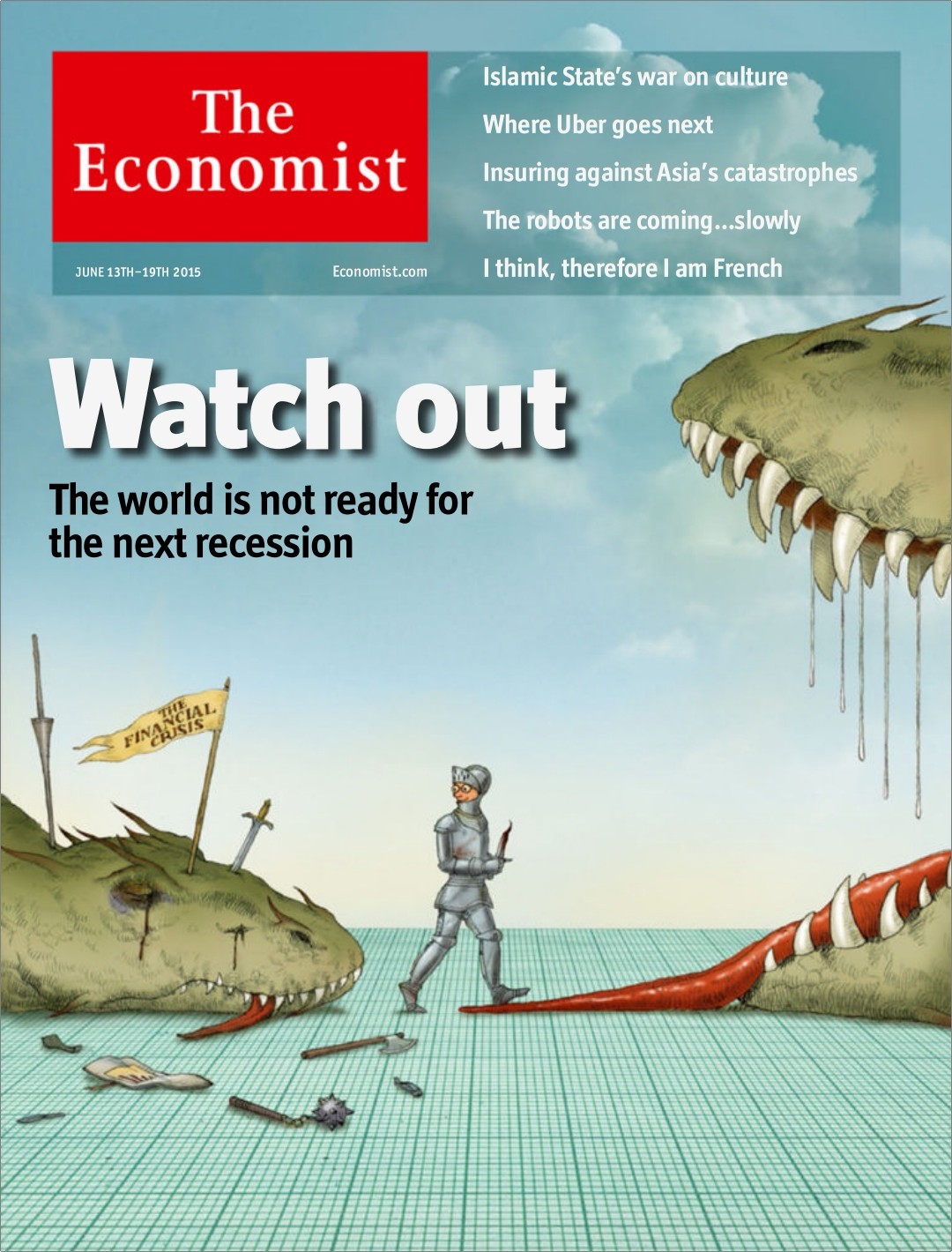
 

Economist cover 13 to 17 june walking into another recession

The spin doctor jumped in joy: “Don’t you know – bigger is always better. And recession means the market is correcting its course. That’s not just a good sign. That’s a great sign.”


Economy gasped. All the machines connected to Economy’s body went into overdrive and started making all kinds of sounds that indicated the vital signs were slipping. The federal reserve doctors and nurses came rushing with the crash-carts. They instantly infused a bottle of freshly printed currency from the government mints into the Economy. Then they pumped in more freshly printed cash just to hold it up. “Don’t you have to address the structural damage. Look a lot of the blood has leaked out already,” pointed the Economy. The spin doctors sang in a chorus, “That is a good sign. Be happy you did not ‘kick the bucket’ because we just kicked the can down the road. Everything we do we do for you.”


When Economy’s friend Global Democracy came visiting and asked: How are you doing?


Economy replied: “My friend, it seems I am dying of the good signs of recovery.”


***** *****


© Parababel, 2015


References:

http://www.economist.com/printedition/covers/2015-06-11/ap-e-eu-la-me-na-uk

http://www.telegraph.co.uk/finance/newsbysector/industry/11219688/Ten-million-jobs-at-risk-from-advancing-technology.html

https://www.nerdwallet.com/blog/credit-card-data/average-credit-card-debt-household/

The IT Party is over. Now is the time to reinvent or die: http://timesofindia.indiatimes.com/home/sunday-times/all-that-matters/IT-party-is-over-Nows-the-time-to-reinvent-or-die/articleshow/47486851.cms


We’ll leave the kids with Jack

Just the other day I was watching Mary Poppins with my 4 year old daughter. While it was the magic, and the songs, and the penguins that enthralled the young girl, I, on the other hand, was left wondering about the Sister Suffragette scene – particularly the lyrics of the song: “Our daughter’s daughters will adore us, and they’ll sing in grateful chorus, well done sister suffragettes”.


Is that true?

Will our daughters and grand-daughters adore us? Will they be grateful for what we do for them now?  Will we get any recognition from them? I guess only time will tell, but no mother who cares about the future of her children can ever ignore the voice inside of her that constantly asks: Am I teaching my children the right thing to do?


I was still pacing up and down in wonderland with all the questions in my head when my cell phone pinged. It was the Momyers’ chat-line, we were generally chatting and commenting on one thing and the other when Ale suggested that we should all go to Vegas to celebrate her little boy’s full recovery. Anticipating that one critical question in all our heads about going on a trip, she immediately typed: “We’ll leave the kids with Jack” which prompted LOL’s and emoticons of uncontrollable laughter.


Why, you may wonder?


Because the phrase – We’ll leave the kids with Jack  – has become an inside joke for the Momyers, especially about who we are and what we do. This Jack – imaginary or real – has become a part of the Momyer lore and identity.


*****

It all started a few months ago when Gaby traveled with her friends in a much needed vacation, she left her girls with her husband and had a weekend of relaxation. I guess her oldest girl was quite fascinated with the fact that her mom could travel without her and only with her friends, and the trip made an impression on her that was much bigger than Gaby anticipated.


Some time passed and Gaby’s daughter made a friend at kindergarten, she made a friend in that age where, of course, if he is a male friend he becomes your husband when you play pretend. The friend is called Jack, and Gaby started hearing about Jack very much and very often. One day Gaby’s daughter told her mom that one day she would marry Jack and have children, Gaby humored her daughters’ conversation and asked her what would she do once she was married to Jack and had children, to which the little girl replied: “I will travel to Paris only with my friends” Gaby asked “And what about your kids?”


After a bit of thinking, Gaby’s daughter, without any hesitation, answered: “We’ll leave the kids with Jack”.


It was so en pointe that Gaby had to try hard to keep a straight face and suppress her laughter.


There it was, boldly said, her daughter wanted to be just like her Mother.


*****

Gaby could hardly contain her excitement, though. She immediately went online and posted it to the Momyer’s chat-room; and in a minute the rest of us, wherever we stood, were all falling down laughing. The underlying message of the blunt answer was so simple and refreshing: It was ok to be like mom. It was perfectly all right to travel with friends, and of course it was obvious the kids will be left with their father. There, just like that, Gaby was validated by her daughter, by another girl, a woman from a different generation and that made all the Momyers feel good.


While the phrase – We’ll leave the kids with Jack  – has served us quite often whenever we plan a trip only for the five of us, or at least say that we will eventually do the trip and leave our husbands with our kids, it always brings me back to the entire Sister Suffragette debacle.


Kids learn with our example not with our words.


What are we teaching our kids by being the kind of mothers and women we are today? Are we teaching our daughters and sons the right thing to do by being independent women? Will my daughters grow to become professionals and mothers and run around a hundred miles per hour like I do? Or will they simply realize that the craziness of being a working mother is not worth it and choose to be full time mothers?


*****

We all usually wonder because it seems like the next generation of younger women always call into question any decision we’ve made as women of the preceding generation. I am sure they don’t realize it and they usually declare their judgment (because that is exactly what they are doing, judging) by saying: “If I were you, I would never…”


I’ve had a few associates tell me that they would never work as hard as I do, that they would stay at home with their kids, that they would do anything but be in a competitive firm, that they would choose a simpler or less demanding job, I could go on for hours and write pages after pages.


Some of my Momyer group have been told the opposite by the exact same women who question my crazy life, that they would never stop working full time, that they would never follow their husbands away due to a promotion of his work, that they would never take part-time or half pay, that they would never marry a man who doesn’t help around the house, and so on. I see now that what they do not realize is the choices they have, the possibilities and the flexibility. Like the Sister Suffragettes, if some of us aren’t “crazy enough” to defy the stereotype, to break the rules, to demand a chance to prove we can do it, other women would not be able to judge our choices, simply because they would not have them. Like the many women before us who paved the way for us, we are perhaps paving the way for other women after us and trying to teach our daughters and sons that allowing women to have choices and support them in their choices is the right thing to do.


I have arrived at the conclusion that what my daughters choose is not important, it doesn’t matter really, and I will not fall in the cliché of saying that as long as they are happy the choice is the right one; that goes without saying. But here is what I do hope the effort of running around, the hard choice of leaving behind a career to be a full time mother, the choice of not being a wife or a mother and fully develop a professional career or the tremendous effort of a woman who attempts to do it all, brings for my daughters and their daughters: the choice. It is about the choice.


And I guess that is exactly why the Sister Suffragette song resonated in my mind that day, because what we teach our daughters with our actions fully impacts the person they become, but our actions also can pave the road for many other women who may not exactly adore us or comprehend our choices. If anything, we are working hard and taking on challenges so that we can set examples – examples that will help everyone have that choice. And, who knows, sometime in her life, if my daughter decides to escape to Paris with her girlfriends, and worries about her children, then she can, without hesitation, say: We’ll leave the kids with Jack.


*****

© Paola Sanchez


© 2026 THE ESSAYIST

Theme by Anders Noren — Up ↑