Author: Michael Hviid Jacobsen

Kill the classics: Are the social sciences living in the past?

“In science, each of us knows that what he has accomplished will be antiquated in ten, twenty, fifty years. That is the fate to which science is subject […] Whoever wishes to serve science has to resign himself to this fact.”

– Max Weber, ‘Science as a Vocation’ (Wissenschaft als Beruf)

Lecture at Munich University, 1917


The discipline of sociology stands in an exceptional position within the sphere of the sciences – it is one of the few disciplines in which the past, as opposed to the present or the future, performs an extremely significant function and occupies a very prominent position.  What defines many sociologists, and provides an identity to them and their work, is an intimate knowledge of certain classical thinkers, and adherence to schools of thought or traditions founded in the late 19th century and early 20th century particularly in France, England and Germany later to be extended to the American continent. This obsession with the past makes sociologists, in a fashion unfamiliar to natural scientists but relatively similar to scholars within the humanities, constantly evoke and praise their founders, celebrate the classics, adhere to specific predefined canons and curricula, position themselves according to paradigms established decades ago by charismatic analysts of the days of yore and dwell in and regurgitate past academic achievements in an endless stream of new sociology books about the great classic books of the old sociology.


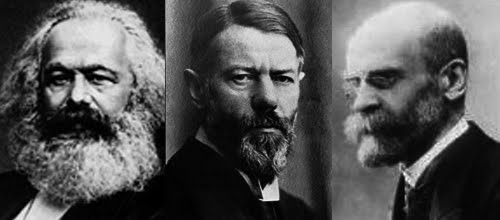
There is a stark difference between the cultures of the social sciences and the natural sciences. Hardly any respected researcher working within the natural sciences would today think of quoting Newton, Copernicus or Lavoisier as sources of ultimate wisdom or as defences in academic disputes. However, sociology continues to quote Marx, Durkheim, Weber and Simmel from the last couple of centuries as if they were the lasting authority on social and economic issues of today – a world that has probably changed dramatically in technology and global arrangements since these masters were alive? The reasons are to be found in the origins of sociology in the Golden Age of modernity and can be traced to the frequently discussed widespread confusion ever since in sociology pertaining to its own scientific status and identity: was the “social science” a child of the natural sciences or an offspring of the humanities? The result of this confusion was that the classics seemed the only secure, solid and unchanging point of reference and have remained so for the past 150 years in sociology. The term ‘cult’ seems appropriate to describe the way sociologists deal with their ancestors.
 

classics 3 together


According to the Oxford English Dictionary, ‘cult’ refers to reverential worshipping of or devotion to a person or thing and paying homage to their perspective or existence as done by a body of professed adherents or admirers often by way of specific rituals or ceremonies. These ceremonies or rituals in connection to the cult of the classics become obvious in the endless – some would even say mindless – use of citations, quotations and exegeses over the thoughts, lives and deeds of long-dead scholars by their devoted individual predecessors or generations of followers. The classics stand at the centre of attention, as the pioneers, legends, bigwigs and totems, in these sociological cults. And although many cults may compete internally with each other to take pole position in the discipline of sociology; the fact that many such cults of past-worshippers exist and thrive in the discipline also reinforces the hold of the past over the present. This hold of the past on the mind-set of sociologists obviously affects their way of seeing the present day world and the construction and discovery of new theoretical, methodical and thematic perspectives in sociology. Does this feature of sociology, an obsession with classics, hamper or facilitate the social sciences to move ahead the way a science should?


There is an ongoing debate within the social sciences and there are two schools of thought. One group of scholars in contemporary sociology want to rid themselves of the classical heritage, regarded as outdated and obfuscating. They argue that substantial amounts of the intellectual baggage of their discipline will necessarily have to be dumped on the historical scrapheap; that what ‘dead people’ said is not necessarily important today, and that the theory-heavy section of sociology is expanding beyond reasonable dimensions at the cost of sensible empirical research relevant to today. This group often find the classics a burdening ballast that hinders academic progress and view the excessive interest in theoretical dissection as being detrimental to empirical research.


Still others, it seems the majority, revere and embrace the classical traditions and the invaluable insights they contribute to contemporary sociology as well as to understanding today’s society. This second group dominates the academic agenda and have created a veritable cult of the classics in which identity, status, community and veracity is based on the reading, interpretation, rereading and reinterpretation of classical texts. In turn, certain academic normative and comparative reference groups, inclusive or exclusive, are developed in connection to these personalised classics – one is either a Marxian, a Weberian or a Durkheimian and so forth – but whether the one or the other, it is required that one specifically defines oneself as a sociologist by defining oneself exactly in relation to the classics.


The study of classics are also besieged by another serious contender that is external to the discipline – the pressures from new neo-liberal university reforms in many countries, including Scandinavia, demanding quantifiable bench-marking, pragmatic use-value and a mentality attuned to present needs of society instead of a re-reading of the past. In such a climate, a concern with the classics appears unacceptable and academically unrewarding. The neoliberal side questions whether the classics serve any purpose whatsoever in today’s age and time?


The Dead Sociologists’ Society


Dead_poets_societyThe book by Nancy H. Kleinbaum, which later turned into a box office success, titled The Dead Poets’ Society vividly demonstrated exactly from within the realm of the humanities how the teaching of and gathering around the classical past could create a sense of togetherness, inspiration, heightened awareness and mutual interest between the younger generation in times of radical social change, academic uncertainty and uprooting but also how this immersion in the classical tradition could equally lead to personal factions, strife and institutional conflicts. The background for the book was the literary classics such as Keats, Yeats, Shakespeare, Whitman and Lawrence but could equally illustrate how scientific, and thus also sociological, classics constitute mental monuments around which scholars and academics ceremonially and ritually gather.


Sociologists also have a tendency to hail their ancestors, heritage and classics and one can actually find an Internet domain titled ‘The Dead Sociologists’ Society.’ Based at Pfeiffer University in the U.S., this site is devoted to an undisguised glorification of the great sociological past. It contains links to special journals, thematic discussions, conceptual clarifications, etc. explicitly canonising the classics. Moreover, when surfing the Internet it is interesting and quite telling to note that a simple search on academic articles dealing with ‘the classics’ only lists hits from within either the social sciences or literary studies – the latter, as part of the humanities, containing by far the most hits.


Natural science journals apparently do not take a keen interest in these matters. In hardly any other scientific discipline are so many pieces published year in and year out on the past deeds and practices of the founders as in sociology or the humanities. A large proportion of the books and articles published deal with origins, the past, pedigrees, ancestry and heritage and the dissection of the life and deeds of the founders. This would never be the case within the natural sciences; books showing a scientist’s scholarly understanding of Copernicus, Newton and Galileo are seldom used as justification for one’s own current scientific practices.

 

shoulders of giants hawking


The leaning on the shoulders of the classics, according to Machlup, is an attempt to escape the so-called scientific ‘inferiority complex’ of the social sciences in general and sociology in particular. Some would claim that the result of this extensive scholarly research and time spent on the past paralyzes and incapacitates social scientists. However, others would quote Alvin Gouldner, and argue that the predilection for the theories and perspectives of the past show a reverence for where we are coming from in order to understand where we are going. However, it also points to deep chasms within and between different scientific cultures.


The humanities have, more than social sciences, been haunted by the classics as indispensable authorities without whose continuous invisible presence, the scientific status and legitimation of these disciplines would severely be in danger. The shadow of the past has encircled the present in these supposedly ‘softer’ sciences and sociology has to some extent also come to suffer from the same ailment. Perhaps this is due to sociology’s proximity to the humanities more than is the case of other social scientific disciplines such as economics, law studies or political science. This proximity is perhaps most obvious when looking at the style of sociological writing which often comes close to that of the humanities, or the way scientific discoveries are made and creativity is utilised, the way data is reported, and how the historical self-understanding of the practitioners of sociology is currently professed.


Robert K. Merton observed this tendency to immortalise the classics within the so-called ‘softer sciences’ such as the humanities when claiming that “firsthand acquaintance with the classics plays a small role in the work of the physical and life scientists and a very large one in the work of the humanistic scholars.” The social sciences, including sociology, stood, according to Merton, in a middle-position between the soft humanities and the hard, exact natural sciences, which meant that they imitated traits from both disciplinary ‘cultures’. Another sociologist Bennett M. Berger, writing in the same time period as Merton, commented on the hybrid nature of sociology: “It is the bastard son of the humanities, from which it gets its subject matter, and the sciences, from which it gets its methods. Fully acknowledged by neither parent, it finds itself in the role of upstart”. Yet another central figure in the sociology of the mid-20th century, C. Wright Mills described this outspoken uncertainty about its own origins, identity and unique status as a hybrid as sociology’s ‘moral and intellectual confusion’, leading to a necessity to hang on to the work of the classics in order to acquire the status of legitimised scientific discipline.


Sociology is seldom about stern principles or prediction, as for example law studies or economics, and thus the proximity to the humanities is substantial in many respects – cultural sociology being merely one of the most obvious examples of this disciplinary kinship. Moreover, sociology is unique in the sense, together with most of the other social sciences, that very few ‘scientific revolutions’ or ‘radical discoveries’ occur that entirely alters the research agenda, as is sometimes the case within the natural sciences. This means that it is seldom that the wisdom of yesteryears and erstwhile scholars are abandoned altogether; and this buttresses the position of the classics within the discipline in the long run. This is perhaps why Marx, Weber and Durkheim are discussed as vividly today in sociology as the work of, for example, Shakespeare, Goethe and Dostoyevsky appears to be recurrent themes within the humanities.


Generally speaking, one can claim that where natural sciences appear to be cumulative when it comes to the production of knowledge, the humanities and the social sciences, on the other hand seem repetitive. This repetitiveness lies at the heart of the humanities and also sociology, and as Lewis Coser, one of those scholars who himself has turned into some sort of classic, once remarked: “We neglect the classics only at our own peril. Were sociology as cumulative a discipline as, say, physics, it would hardly be necessary for the practicing sociologist to study the classics.” In Coser’s view, it is because we are repetitive, we study the classics – I would rather suggest that it is because we constantly return to the classics that we are repetitive (and not cumulative). As a consequence, sociology, to use Luhmann’s term, has become ‘self-referential’ or as Robert W. Connell suggested the social sciences have become ‘internalistic’.


The centrality of the classics in the social sciences


Ever since the debate between Alvin W. Gouldner and Alfred N. Whitehead on the classical heritage and its importance, sociologists have either opposed or supported the necessity of the central status the classics have occupied. Some see the reading and regurgitation of the classics as a pathological feature of modern thinking, others as a necessary evil and the price paid for disciplinary identification, while yet others welcome it without reservation.
 

classic book (1)


Niklas Luhmann made critical observations in the foreword to Social Systems on the reproductive tendency in writing and re-writing the biographies and theoretical accomplishments of the classics:


To a great extent, those interested in theory return to the classical authors. One constraint by which one earns a right to claim the title ‘theory’ is recourse to texts that already bear this title or have been treated as if they have. Then the task becomes one of dissecting, criticizing, and recombining already-existing texts […] The classical authors are classical because they are classical authors; their use today is identified by self-reference. Reliance on illustrious names and specialization in them can be proclaimed as theoretical research […] All of this is not without interest and effect. But the further the classical authors recede into the history of a discipline, the more necessary it becomes to distinguish a theoretical from a biographical, an abstract from a concrete treatment of them. If one dismembers them in this way, however, can one manage without them? (Luhmann 1995).


While Luhmann generally seems critical or sceptical of the classical control of the contemporary sociological agenda, the Journal of Classical Sociology, first published in 2001, also but on a much more positive tone takes the recent revival (or rather immortality) of the classics seriously. In the introduction to the journal, titled ‘The Fragmentation of Sociology’, the editors made it clear that “a commitment to defending classical sociology is important if contemporary sociology is to flourish without destructive fragmentation and dispersal […] Our approach to sociological theory is to avoid writing sociological theory as simply a history of ideas, or treating theory as merely a list of substantive areas […] or suggesting that sociological theory is only an exegesis of conventional texts.”


The reason behind the virtual immortality of the classics in sociology is that they fulfil, as Rune Åkvik Nilsen and Jeffrey C. Alexander, both noted, is a ‘functional need’ in the integration of the discipline or discourse, which would otherwise be in danger of becoming fragmented. Although the classics can create coherence and cohesion and function as bulwarks against a ‘decomposition of sociology’, as Irving Horowitz remarked, they can, however, also have a fragmenting and splintering impact on sociology, when their perspectives produce a myopic or paradigmatic following who are unsympathetic or hostile to the ideas or notions expressed by others.


Scholars who believe that only Weber, Marx, Durkheim, Simmel, Mead, Schütz, Goffman, Luhmann, Bauman, Bourdieu, Habermas or Giddens etc. exclusively have been able to understand, theorise or investigate society in a satisfying manner are equivalent to people trying to stand on one leg for a long time. First, their posture is obviously unstable, looks ridiculous and is for that reason often also a rather lonely activity. Second, their academic enemies will know exactly which leg to chew at to make them crumble. Finally, when their sole supportive leg is eventually undermined, which is always a matter of time, they will experience the agony and embarrassment of collapsing.


An extreme example of the cultish, paradigmatic and sometimes even sectarian cultivation of the classics, or certain flamboyant figures within this category, could be witnessed in the worshipping of Marx in many academic departments of social science in general and sociology in particular during the 1970’s. Here the excessive worshipping of and subordination to a single unified perspective, which initially appeared as a collective and united endeavour to revive an exorcised thinker, ended in bitter strife, internal fragmentation and a cutthroat mentality between structural Marxists, capital logic, and critical theorists.
 Karl_Marx_001

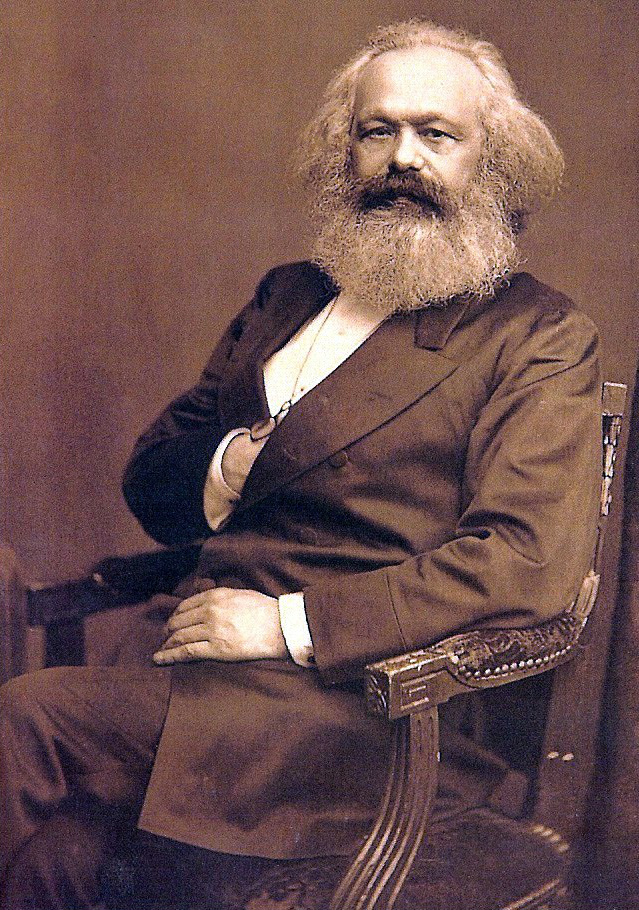
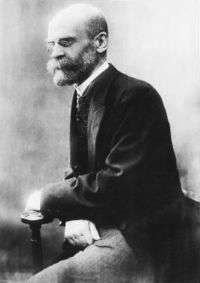
 Talking about the classics in sociology, especially and almost exclusively three names (excluding Simmel in this particular context) are often mentioned as so-called ‘paradigmatic’ figures – Marx, Durkheim and Weber. By paradigmatic is meant, in the words of respectively Kuhn (1970), Ritzer (1975) and Brante (1985) and numerous others, that they, when it comes to theoretical, methodical, analytical, historical as well as social factors such as status, prestige and relative importance, are seen as role models and have set the standards of scientific practice to be emulated by others. This means that they have been instrumental, unwittingly perhaps, in creating certain ‘disciplinary matrices’ or ‘tracks’, for later generations to follow – C. Wright Mills (1960) denoted such tracks ‘models’ serving as fertile foundations for theoretical development within many specific areas. These three central classic tracks have also had a heavy impact on how they have been regarded and evaluated by later generations of scholars; who on the basis of such tracks have been able to identify themselves and the practice of sociology they perform or adhere to.


Emile_Durkheim1


Thus, the status of the classics in sociology, as Lawrence Sherman (1974) reminds us, is bound up with the general paradigmatic view on sociology, one holds – either individually or institutionally. Sherman illustrates three possible ideal type sociological scenarios: (1) That sociologists search for and want to discover universal social laws (Durkheim), (2) that they want to interpret and understand the social world (Weber), and (3) that they want to change it (Marx). These three general views on sociology could be described respectively as a natural scientific progressive position, a hermeneutic humanistic position and a critical revolutionary position. These positions are relatively similar to Jürgen Habermas’ (1971), by now itself classic, description of empirical-analytic science, historical-hermeneutic science and critical science in that they point to how sociology is practised based on abstract ideals and concrete procedures.

 Max_Weber_1894

The first position does not ascribe a lot of status to the classics who are generally seen merely as relics from the past but nevertheless necessary building blocs in the general and relentless advancement of science – as when Newton famously stated that he was standing on the shoulders of giants allowing him to see farther than them. The classics themselves are not regarded as the apotheosis of academic achievements in this position but are viewed as the foundation or platform for a scientific take-off to more sophisticated and refined scientific discoveries ahead.


The second position, on the other hand, often believe that the sociological heritage stands as the heydays of the discipline – as a golden past which it is worthwhile remembering and the results of which we should honour and recall whenever we embark on new endeavours. Here the classical past is believed to contain the seeds from which we can still harvest and which ought to guide our search for questions as well as for answers.


The third and last position is marked by ambivalence regarding the role of the classics and is selective when it comes to ascribing value to the classical past of sociology. Often the classics are seen as reactionary or conservative figures preventing progress or standing in the way of revolutionary changes and only those classics who somehow sought to break free from their own imprisonment in time, such as Marx, and project their ideas into the future are worshipped – perhaps not because of their concrete analyses but due to the potential and potency in their line of thinking. Here Marx’ famous eleventh Feuerbach Thesis – that it is not enough to interpret the world but more important to change it – appears as the programmatic statement of the role of science in general and social science in particular. The evaluation of the classics, then, is bound up with a double bind, as it were; on the one hand the role they have played in the development and maintaining of paradigms, and on the other hand the nature of the paradigm one is working within.


Whereas most sociologists will have to be satisfied with following the principle of publish and perish, the classics, on the other hand, show a remarkable persistence and endurance within the discipline even in times marked by rapid change and academic uprooting. However, despite their persistence through paradigmatic emulation and elevation, classics are far from immortal, as those extraordinary artistic figures, e.g. Goethe, Mozart and Novalis, in Hermann Hesse’s wonderful novel The Steppenwolf, hovering well beyond the quotidian concerns of ordinary humans and surviving the test of time, and they can indeed be ritually and symbolically killed although within sociology that is a seldom occurrence. Such patricide, keeping in mind that all the classics were male, occurs if they are forgotten, by design or default, are gradually or suddenly removed from institutional canons and curricula, are devalued or discredited (for example by political leadership or committees on scientific conduct) or simply found analytically insufficient or unfitting for contemporary concerns.


Understanding and classifying something as classic


Ernan McMullin (1994), quoting Denis Sepper, who in turn was inspired by Hans-Georg Gadamer, differentiates between two broad understandings of the classics for a scientific discipline. The first type is called ‘stylistic-historiographical classics’ which is valued because it gives the reader an insight into the culture of which it is representative. This type of classic represents a particular style, mode of thinking or cultural movement that is based upon specific historical contexts. The other type is termed ‘classics of tradition’ and they, as he notes, “address us where we live; they are fecund even in the contemporary situation.” This latter type appears to be classical not because of some historical contengency but due to universality in its perspective, analyses or understandings. The line between the two types is admittedly, as McMullin contends, blurry and the terminology cumbersome. However, the distinction illustrates that classics are equally part of the lived culture of ordinary people as well as part and parcel of academic endeavours to understand quotidian life as well as abstract principles or modes of organisation.


Is there a more objective way of determining the ‘real’ classics, and differentiate them from mere pseudo or quasi classics? This is, naturally, quite difficult if not utterly impossible to determine. However, one quantifiable way to do it is to ask practising sociologists whom they consider to be the most important contributors of and to their discipline. This was exactly what ISA, The International Sociological Association, did when asking their members in 1998 during the Montreal World Conference to list the most important sociology books of the 20th century. The resulting Top-Ten, in the originally rated order, consisted of Max Weber: Economy and Society, C. Wright Mills: The Sociological Imagination, Robert K. Merton: Social Theory and Social Structure, Max Weber: The Protestant Ethic and the Spirit of Capitalism, Peter L. Berger and Thomas Luckmann: The Social Construction of Reality, Pierre Bourdieu: Distinction: A Social Critique of the Judgment of Taste, Norbert Elias: The Civilising Process, Jürgen Habermas: The Theory of Communicative Action, Talcott Parsons: The Structure of Social Action, and finally Erving Goffman: The Presentation of Self in Everyday Life. The author of eight out of the ten titles listed above is already dead.


Another, equally quantitative, way to find out the importance of the past is looking to the quantitative weight and presence of the classics in the articles and books written within the confines of the discipline. Here a simple content analysis would probably, lacking any concrete data material, reveal that the classics are still very much present and frequently quoted and debated in most of the major journals and maintained in the indexes of most books published if not occupying large proportions of them.


Another concrete way to document the importance of the classics in contemporary sociology would be to inquire about the status and importance of the classics in study programs of sociology courses around the world. Here one would probably discover that the classics still occupy the core position in most curricula whether in the North, South, East or West.


****


Robert W. Connell once asked: why is classical theory actually classical? By classical, we mean something or someone who belongs to another period of time, to a defining or fateful moment in history or to the birth of a discipline. Within the context of sociology, this period of time is the epoch we also label as ‘modernity’ – an era marked by three radical revolutions setting it apart from pre-modernity: (1) An industrial or technical revolution, (2) an intellectual revolution (the Enlightenment), and (3) a political revolution (initially in France and the U.S. but later in more reforming fashion in Germany as well as in the Scandinavian countries and elsewhere). Thus, the sociology classics are often equated with scholars during a certain period ranging from the mid-19th century to the early 20th century.


The classic scholars of sociology all wrote in this tumultuous time and commented, often critically, on it. These scholars took a keen interest in grand theorizing, materializing in their ability to and interest in erecting monolithic theoretical structures dealing with manifold aspects of modernization and its impact on society – seen in an overtly optimistic or equally pessimistic perspective. They often presented a poly-scientific understanding of the main drift of society – based on historical, psychological and social insights – with a combination of broad frameworks as well as detailed studies. These figures are, it is generally agreed, Marx, Durkheim, Weber and Simmel. They have, in and by posterity, achieved or been bestowed the status of classics – they are being read, discussed, dissected, analysed, quoted, imitated and their works are lavishly being published and republished. The classics in sociology are thus, it is generally agreed, equivalent to its founders – although it is often conveniently forgotten that the actual founders of sociology in many cases historically would be the likes of Comte, Saint-Simon and institutionally Albion Small. Today, very few articles or books, if any, within the field of sociology are written, irrespective of the topic, which refrain from lengthy discussions of or introductions and references to these four founders.


How does one, internally, within a discipline, define classicality and project it onto some person, text or tradition? Peter Baehr suggested the following understanding of the complexity involved in bestowing the label ‘classic’ to a text or person and how it can be maintained as such across temporal, cultural and geographical barriers: “In order for a text to achieve the accolade of classic, it must typically overcome a variety of cultural hurdles; while to survive as one, it must be subjected to continual critical engagement, its concepts reformulated to meet new problems and trials. Not many texts can survive, or attract, such scrutiny and productive reshaping. Those that are able to do so are quite properly described as ‘classic.’”


In short, the classics and their original formulations are capable of surviving the transformations of external social conditions as well as the changing internal scientific whims and allegiances. In line with this clarification, Danish political scientist Staffan Zetterholm, referring specifically to the work and oeuvre of Alexis de Tocqueville made the poignant observation that a classic is a person who:

is being studied by new generations, and who participates in a living intellectual tradition within as well as outside of the world of the university. In short, a classic is never out-dated but retains topicality and relevancy for our thinking, our perceptions and our interests. When we study a classic, we do it for our own sake. Within the social sciences – or more generally social thought – classics are found exactly in this understanding (Zetterholm 1988:9)[my translation].


Italian writer and fabulist Italo Calvino is a stout defender and sympathiser of the classical heritage; not as something to be addressed as awe-inspiring authorities or endlessly reproduced but as an emporium for insight, inspiration and imagination. His perspective is more oriented towards the (individual) experience the reader (especially humanities) gets when reading a classic than on the (institutional) role the classics might play for a discipline.


Calvino why read the classics


Calvino stated fourteen easily digestible suggestions for how one can understand what is a classic and the role or function they play for us today. They are recapitulated in toto below:


(1) One can characterise classics as the books about which we usually hear people say ‘I am rereading…’ and never ‘I’m reading…’. Classics, thus, are normally texts that have been processed through our mind previously and with which we are already to some extent familiar.

(2) ‘Classics’ is the appellation reserved for those books that are treasured by those who have read and loved them but those who read them for the very first time will also come to treasure them.

(3) The classics exert a peculiar influence over the lifespan of collectivities or individuals because they remain the same while our perspectives are continually and relentlessly altered allowing or urging us to view them from ever-new angles.

(4) Every rereading of a classic text is as much a virgin experience, a voyage of discovery, as the very first reading.

(5) Every classic is, per definition, a rereading – this is what ultimately earns it the designation as a classic.

(6) A classic is a book that has never finished saying what is has to say – it will continuously confront us as an inexhaustible source of insight into the past, the present as well as the future.

(7) Classics are books that come down to us bearing the traces of readings previous to ours and bringing with them in their wake the traces they themselves have once left on the embankments of the culture or cultures they have passed through.

(8) A classic text does not necessarily teach us anything new – but in it we can sometimes discover something we have always known but without knowing that this classic author said it in the first place or in some intricate or special way is associated with it.

(9) The classics are books which, upon reading them, we find even fresher, more unexpected and more marvellous than we had thought from merely hearing about them. The classics can continuously surprise us whenever we read them ourselves.

(10) We should use and reserve the term ‘classics’ to books that take the form of an equivalent to the universe; they are ‘total books’ that encompass a totality of ideas or notions, which can either be positively stated or presented as criticisms and antitheses to the perspectives offered by others.

(11) Thus, your classic author is someone you cannot feel indifferent towards and who assist you to defining yourself in relation to him/her – in sympathy or opposition.

(12) A classic is a book that comes before other classics; but anyone who has read the others first, and then reads this one, instantly recognises its place in the family tree. An archaeology or genealogy of knowledge is involved in the establishment and appreciation of classicality.

(13) A classic is something/someone that/who tends to regulate the concerns of the moment to the status of background noise, but at the same time this background noise is something we cannot do without – it directs or disrupts our attention even if and when our attention is directed elsewhere.

(14) A classic is something/someone that/who persists as a constant background noise even when the most incompatible momentary concerns are in control of the current situation. The classics permeate the present but in a subtle and mysterious manner.


These fourteen statements about the classics may appear common sense, yet they offer a refreshing examination of how classicality, as individual or intersubjective experience, is established, maintained and transferred. The critical or observant reader might claim that these statements do not capture the entire essence of sociological classicality, and I believe that they are right, but I also believe that these statements are a representative picture of how the classics generally ought to be perceived within the discipline of sociology. They should stand as sources of inspiration, stimulation and, to some extent, also emulation, however not as a blind and uncritical rehashing of past glory and achievements. Calvino simultaneously refrains from reifying or deifying the classics, thereby making them the only authoritative path to truth or scientific status, and thereby he avoids repeating the same mistake sociology made in its eagerness to earn academic accolade and acceptance.


The ‘real’ classics are thus classics because they seem to be spiritually alive, despite perhaps having been physically dead and buried for many decades or even centuries – because the provided concepts, analyses or theories that still seem poignant, precise or potent. Moreover, the classics in sociology are often classical because they were paradigmatic or have appeared to be so in the decades following their demise. It is actually in this particular respect that they distance themselves and appear superior to those thinkers who, although they also went into the annals of the discipline, remained relatively marginal figures in a paradigmatic sense of the term. This fact recently made Norwegian sociologist Rune Åkvik Nilsen denote them the ‘die hard classics’.


Problems with excessive use of classics in sociology


I believe that two of the major functions, either manifest or latent, of the classics in sociology have first and foremost been that they throughout a long period of time have helped legitimise the discipline, and second that their central position somehow has been instrumental in preserving the status quo. The problem in sociology, as I see it, is that the classics have come to occupy a position not as background noise, as Calvino recommended, but as a resounding choir of authoritative voices hindering and hampering scientific progression and innovation. Without wishing to sound excessively dramatic, sociologists are, in short, caught up in the classics and need to ask, as global society, economy and democracy are in a churn and in the throes of multiple recessions and warfare, where do we go from here?


We therefore need to be aware of what might seem to be certain problems relating to a heavy classical inclination in sociology. Anthony Giddens (1972), himself the archetypal ‘neo-classic’ sociologist, years ago called attention to what he believed the discipline regarded as four major myths of classical sociology – coherence or social order as the core concern, conservatism, a separation from the pre-scientific past and consensus-orientation – apparently standing in the way of sociological progress. Whether these myths are real or mere fallacies based on a misunderstanding of the classics, the sociological reliance on and repetition of the classics may prove to pose as a problem and an obstacle to progression and as a source of stagnation.


Peter Baehr, who provided us with a definition of ‘classicality’, also observed in Founders, Classics and Canons: “A classical legacy can both be a source of inspiration for an epoch or a crushing and stagnating burden on it […] It can both exclude potentially valuable ideas and prove capable of embracing them. It can both be a source of mindless regurgitation and of bracing intellectual challenge.” It is, in short, the sociologists’ application of the classics that imbues them with scientific or social utility, importance and value and therefore also the responsibility of sociologists to handle the classics sensibly. Left to themselves, as Collins finds, the classics are nothing but great ideas on blank sheets of paper, the mindless reproduction of which only serves to imprison the minds of students and teachers alike and stagnate intellectual innovation.


Stagnation, however, is not the only problem posed by very rigid definitions and utilisations of the classics. Selectivity, understood as inclusion and exclusion, is another pitfall dealing with who is promoted to intellectual immortality and who is relegated to immediate oblivion. Why do we read, for example, Marx, Weber, Durkheim and Simmel, but not Condorcet, Comte, Saint Simon, Spencer, de Tocqueville, Mosca, Pareto, Tarde, Michels, Lippmann, Sorokin, etc.? Why have some previous household names altogether disappeared – such as, for example, Sombart, while others have remained part of the cult of the classics? Why has exactly this trinity of thinkers, Marx, Durkheim and Weber, obtained and maintained such a prominent position within sociology on behalf of equally brilliant analysts of their contemporary societies? What has happened to the so-called socio-philosophical ‘forerunners’ of modern institutionalised sociology such as Münster, Sansovino, Bodin, Conring, Graunt, Neuman, Petty, Süssmilch, etc., who according to some chroniclers had such a heavy impact on the foundation of the discipline as far back as the 16th and 17th centuries but who today appear so unfamiliar to most of us? These important names appear to be missing from most sociological curricula today and may have been victims of what Giddens described as a desire to distance sociology from its supposedly pre-scientific origins. It goes to show how our perception of the sociological past is, indeed, based on selective perception and that such selectivity, inclusion and exclusion is mirrored in the canons and curricula we choose for the next generations of sociologists. As James Dowd remarked:


A graduate training program constitutes a type of canon. It specifies, although not always explicitly, an authoritative, approved list of courses, authors, works, and ideas […] The canon of sociology includes a set of texts written by the sociologists of the classical period, a set of procedures for conducting the research and for analyzing the data that it produces, and a set of ideas (that is concepts, generalizations, and theories) generated by empirical research […] Even given the large number of subfields within sociology, a common set of texts and procedures is acknowledged throughout the field. The ideas that are singled out for inclusion in the canon do, however, vary across subfields as well as over time (Dowd 1991:317 in Baehr & O’Brien 1994:111).


Intellectual stagnation and selective memory are thus some of the problems related to the mindless devotion to the cult of the classics in sociology.


BOOKS


Can we kill the classics – OR – Do classics perpetuate themselves?


Sociology is by its very nature a hybrid discipline, borrowing equally from the natural sciences and the humanities. From the former it finds the tendency for devaluation of the classics; from the latter it finds the tendency to worship the classics and the preoccupation with dissecting the past in its own right. Sociology is caught in the middle, which means that it is not exempt from the habit of either embracing or running away from its own past. This double-edged mentality is still present within the discipline and results in the fact that the classical past stands in an increasingly precarious or ambivalent situation which is furthermore enhanced by recent radical changes within the university systems, as mentioned above.


As some sort of conclusion on this commentary, an initial question in the article – can we kill the classics? – ought perhaps in retrospect to have been normatively rephrased as: Should we kill the classics?


My personal answer is in the negative. The reasons why the classics ought to be kept alive in the years ahead need to be clarified and critically discussed collectively among practicing sociologists. Some will claim that the classics need to be read and discussed because they can guide contemporary social action. This, I believe, is to demand too much of ideas and theories of the past. The functionality of the classics can no longer solely rely on their external power of explanation of the present situation, which is different from even the most visionary expectations of the founders. Therefore they will have to legitimise themselves internally and sui generis, as it were, and Italo Calvino also concluded his argument about the role and function of the classics by stating that the “classics ought to be read because they ‘serve any purpose’ whatever. The only reason one can possibly adduce is that to read the classics is better than not to read the classics.”


Charles Tilly noted that “the nineteenth century’s legacy to twentieth century social scientists resembles an old house inherited from a rich aunt: worn, over-decorated, cluttered, but probably salvageable.” Has this characterisation changed since the transition from the nineteenth to the twentieth century not to mention the recent transition from the twentieth to the twenty-first century? Tilly’s description could easily be recycled to describe also the present situation in sociology. The classics and their concepts still clutter the house of sociology – which is, indeed, salvageable but in desperate need of refurbishment. Norwegian sociologist Dag Østerberg, who for almost a lifetime has taken a keen interest in the classics, also recently discussed whether the classical concepts, formulated in large part in the 19th and early 20th century, are still analytically valid and still worthwhile utilising for sociologists when studying the rapidly changing social world of the 21st century. According to Østerberg, we will always have the key classical concepts of industrialism, capitalism, stratification, rationalisation, differentiation, power, community, etc. to fall back upon when the fluctuating success of fads and fashions is revealed and their analytical value or novelty wears off.


We must be careful not to forget our founders; but we must also beware not to sanctify or deify them or allow their ideas to monopolise our visions, as Danish sociologist Dominique Bouchet poignantly and recently stated: “Nothing is more dangerous than one idea, when you only have one, and nothing is more dangerous than a guru, when you similarly only have one. It is wondering, the many ideas, the many masters, the many critical perspectives that society and the sociological imagination feed on.” This not only pertains to trained scholars but equally to those being processed through the educational system and therefore we ought not to teach our students the marvels of a myopic mentality when it comes to classics. Pluralism is the best possible starting point for any education and here there should be institutional as well as individual interest in showing the broad spectrum of sociological insights offered by the classics instead of narrowing it down to one’s own favourites or heroes. It is our democratic duty to do so and the classics, collectively instead of individually, can widen our perspectives and open our eyes. As Lawrence Sherman rightly contended, “if the ascendancy of one or the other of the paradigms makes a difference in how sociology develops, or how it shapes social policy, then graduate students are morally obliged […] to give each paradigm a fair hearing. To know fully what I am doing, I need to know what I am not doing; in other words, I must know the opportunity costs. And for that, I must read the masters.”


Goethe once stated that ‘what you have inherited from your fathers, you must earn in order to possess’. The classics are an illustrative example of this insightful expression – that one must actively but also respectfully commemorate the past in order to acquire and claim the benefits and fruits associated with classical thinking. Merton, for example, summarised how the classics remain powerful presences even within contemporary thought:


Acquaintance and re-acquaintance with the classics have a variety of functions. These range from the direct pleasure of coming upon an aesthetically pleasing and more cogent version of one’s own ideas, through the satisfaction of independent confirmation of these ideas by a powerful mind, and the educative function of developing high standards of taste for sociological work to the interactive effect of developing new ideas by turning to older writings within the context of contemporary knowledge […] For that reason, sociologists in our time must continue to behave unlike their contemporaries in the physical and life sciences and devote more of themselves to close familiarity with their not-so-distant classical predecessors (Merton 1968).


Classics are indeed what Italian historian Gaetano Salvemini once termed libri fecondatori – books that are full to the brim of fertile thinking and fecundity for those who read them and whose own work is inspired by them. What I would describe as the ‘fecundity function’ of the classics cannot be neglected and it is perhaps in this somewhat informal capacity that the chances of survival, but also of a continued although latent and unobtrusive presence, for the classics is strongest and it will be here they will eventually have to find their own natural level in sociology.


Looking back at the by now long history of sociology, it makes some sense to seek to distinguish between ‘classics’, those original founders of the discipline who stand out as if marked in granite in contemporary canons and curricula, the ‘intermediary classics’, who elaborated on, transmitted, modified or criticised the classics, and the ‘neo-classics’, the latter being those grand names – Luhmann, Habermas, Giddens, Bourdieu, Bauman, Beck etc. – still alive or only recently demised and actively present in contemporary scholarly debates and developments. Neo-classics will, naturally and eventually, in time, turn out to be intermediary classics and later perhaps even become real or genuine classics when time takes its toll and their contributions are looked upon in historical hindsight. Such a threefold division and clarification of the concept of the classics also suggests that there is some sense of continuity between the different generations within sociology. Even some of those influential scholars, who themselves have now obtained the status of classic or at least intermediary classic, as Talcott Parsons (1981) provides a good example, have themselves been inspired by earlier generations of classics and been instrumental in commenting as well as building on the real classics. There is inherently, as a consequence, some circularity, but also repetition and reproduction, in the concept of the classics. This may lead to some problems primarily for scientific progress and secondarily for sociological integration – both problems can prove detrimental to scientific development and coherence.


It also seems as if the 21st century is seeing a revival of the concern with the roots, founders and classics of the discipline but also the beginning of a fragmentation where some regions, paradigms or institutional settings promote their own specific classics while other regions steadfastly support theirs. For instance, books by Alexander, Boudon and Cherkaoui illustrate the cultural or geographical contingency of the classics in that one of the volumes is exclusively devoted to American classics and the other entirely to their European counterparts in sociology. What is considered classical in the U.S. is not any longer necessarily and automatically also seen as the ‘real’ classics in Europe, what has been regarded as classics in the West may not necessarily be seen as the classics in the East, what the North defends as the central canon, the South may regard merely as ponderings at the periphery of a discipline, etc. The classics are apparently represented as classics differently according to time and space. The result is an even bigger expansion in the literature on the classics where each regional, epochal or institutional sector promotes its own canons, founders and classics. So despite the fact that the status and centrality of the classics remain as consolidated as previously, the commonness of our disciplinary heritage may be endangered in the years to come due to academic disputes over who is a classic and who is not, who is part of the canon and who is not, who should be honoured and revered as a substantial founder of the discipline of sociology and who was merely playing a subordinate or insignificant part.


scaffoldingThe classics can serve as scaffolds that can buttress sociological heritage and history but, as Erving Goffman noted, scaffolds are supposed to be dismantled once the real building has been erected. As scaffolds, the classics can assist contemporary sociologists in identifying past pedigree and can serve as a common point of reference but they cannot and should not dictate current research agendas.


The thin line between utilising and sanctifying the classics is indeed delicate and one must be careful not to cross it. The use of the classics must never merely be reproduction or exegesis without anchorage in contemporary concerns. The result of such fanatic reproduction may well turn out to be sociological stagnation where scientific progress, discoveries and advancements are hindered by a preoccupation with the past instead of an open orientation towards the present and the future, where a desire to legitimise previous authoritative achievements stand in the way of discovering or inventing something new.


Another danger is if the sociological imagination only turns into a repetition of past achievements. As Danish sociologist Klaus Rasborg pointed out, today we need a renewed sociological imagination based on late modern realities instead of relying on a sociological imagination that belonged to the erstwhile modern age where nation-state, the class society, industrial production, tradition-bound kinship relations and so on were the signs of the times. Although remnants of these features may still be with us, modernity has gradually but also thoroughly and relentless been transformed on almost all levels of social reality – the macro, intermediary and micro – and the interests of sociologists need to mirror these changes, document, record and analyse them. A sociological imagination worthy of its name and useful to generation after generation of students and scholars never sleeps but is continuously kept abreast by the changes in society. If one is not awake and watchful the ship of sociology can sink much like the Titanic. Therefore, the classics can be used as a navigational guide, like the stars or the compass, but a dead sociologist cannot be made the captain of the sociological ship.


*****


© Michael Jacobsen, 2015 (with inputs from The Essayist team)


For a list of the books and authors voted important of the 20th century in sociology differentiated according to the voters’ gender and age, see http://www.ucm.es/info/isa/books.

Image of 3 classic together from http://rafasociologia.blogspot.in/2011_10_01_archive.html


Readings and References

  • Alexander, Jeffrey C. (1987): “The Centrality of the Classics”, in Giddens, Anthony & Jona-than H. Turner (eds.): Social Theory Today. Stanford, CA: Stanford University Press.
  • Alexander, Jeffrey C.; Boudon, Raymond & Mohamed Cherkaoui (eds.)(1997a): The Classi-cal Tradition in Sociology: The American Tradition. London: Sage Publications.
  • Alexander, Jeffrey C.; Boudon, Raymond & Mohamed Cherkaoui (eds.)(1997b): The Classi-cal Tradition in Sociology: The European Tradition. London: Sage Publications.
  • Baehr, Peter (2003): Founders, Classics, Canons: Modern Disputes over the Origins and Ap-praisal of Sociology’s Heritage. New York: Transaction Books.
  • Baehr, Peter & Mike O’Brien (1994): “Founders, Classics and the Concept of a Canon”. Cur-rent Sociology, 42 (1):1-148.
  • Bauman, Zygmunt (1992): Intimations of Postmodernity. London: Routledge.
  • Bauman, Zygmunt (2002): Society Under Siege. Cambridge: Polity Press.
  • Berger, Bennett M. (1957): “Sociology and the Intellectual: An Analysis of a Stereotype”. Antioch Review, 17:275-290.
  • Bloom, Allan (1988): The Closing of the American Mind. New York: Simon & Schuster.
  • Bloom, Allan (1994): The Western Canon: The Books and Schools of the Ages. New York: Harcourt Brace.
  • Bottomore, Tom B. (1960): “The Ideas of the Founding Fathers”. Archives européennes de sociologie, 1 (1):33-49.
  • Bouchet, Dominique (2003): “Sociologi og marketing: Hvorfor skal sociologien interessere sig for marketing og for dens økonomiske grundlag?”, in Jacobsen, Michael H. (ed.): Sociologiske visioner – sytten bidrag fra en sociologisk brydningstid. Århus: Systime Academic.
  • Brante, Thomas (1985): “Paradigmteorin och samhällsvetenskaperna”. Häften för Kritiska Studier, 18 (3):6-28.
  • Calhoun, Craig (1996a): “Whose Classics? Which Readings? Interpretation and Cultural Dif-ference in the Canonization of Sociological Theory”, in Turner, Stephen P. (ed.): Social Theory and Sociology: The Classics and Beyond. Cambridge, MA: Blackwell.
  • Calhoun, Craig (1996b): “Editor’s Comment”. Sociological Theory, 14 (1):1-2.
  • Calvino, Italo (1986): “Why Read the Classics?”, in The Uses of Literature. New York: Har-vest Books.
  • Camic, Charles (ed.)(1997): Reclaiming the Sociological Classics: The State of the Scholarship. Oxford: Blackwell.
  • Carleheden, Mikael & Michael H. Jacobsen (eds.)(2001): The Transformation of Modernity – Aspects of the Past, Present and Future of an Era. Aldershot: Ashgate Publishers.
  • Chafetz, Janet S. (1993): “Sociological Theory: A Case of Multiple Personality Disorder”. American Sociologist, 24 (2):60-62.
  • Collins, Randall (1992): “On the Sociology of Intellectual Stagnation: The Late Twentieth Century in Perspective”. Theory, Culture & Society, 9 (1):73-96.
  • Connell, Robert W. (1997): “Why is Classical Theory Classical?”. American Journal of Sociol-ogy, 102 (6):1511-1557.
  • Coser, Lewis A. (1981): “The Uses of Classical Sociological Theory”, in Rhea, Buford (ed.): The Future of the Sociological Classics. London: Allen & Unwin.
  • Dowd, James (1991): “Revising the Canon: Graduate Training in the Two Sociologies”. Teaching Sociology, 19 (3):319-335.
  • Elmer, M. C. (1931): “Forerunners of Modern Sociology”. Journal of Educational Sociology, 4 (5):279-286.
  • Giddens, Anthony (1972): “Four Myths in the History of Social Thought”. Economy and So-ciety, 1:357-385.
  • Giddens, Anthony (1987): “Nine Theses of Social Theory”, in Social Theory and Modern So-ciology. Cambridge: Polity Press.
  • Gillispie, Charles C. (1960): The Edge of Objectivity: An Essay in the History of Scientific Ide-as. Princeton: Princeton University Press.
  • Gjertsen, Derek (1984): The Classics of Science: A Study of Twelve Enduring Scientific Works. New York: Lilian Barber Press.
  • Goffman, Erving (1959): The Presentation of Self in Everyday Life. New York: The Overlook Press.
  • Goldthorpe, John H. (1969): “Introduction”, in Raison, Timothy (ed.): The Founding Fathers of Social Science. Harmondsworth: Penguin Books.
  • Grundmann, Reiner & Nico Stehr (2001): “Why Is Werner Sombart Not Part of the Core of Classical Sociology? – From Fame to (Near) Oblivion”. Journal of Classical Sociology, 1 (2):257-287.
  • Habermas, Jürgen (1971): Knowledge and Human Interests. Boston: Beacon Press.
  • Horowitz, Irving L. (1995): The Decomposition of Sociology. New York: Oxford University Press.
  • Jacobsen, Michael H.; Carleheden, Mikael & Søren Kristiansen (eds.)(2001): Tradition og fornyelse – en problemorienteret teorihistorie for sociologien. Aalborg: Aalborg Universi-tetsforlag.
  • Jacobsen, Michael H. (1999): “The Search for Sociological Truth: A History of the Rise and Fall of the Reign of Positivism in the Social Sciences”. Sociologisk Arbejdspapir, 1 (1):1-70.
  • Jacobsen, Michael H. (2002): “Social science fiction: ‘Opfindelse’ overfor ‘opdagelse’ og ‘retfærdiggørelse’”, in Jacobsen, Michael H.; Kristiansen, Søren & Annick Prieur (red.): Liv, fortælling, tekst – Strejftog i kvalitativ sociologi. Aalborg: Aalborg Universitetsforlag.
  • Jacobsen, Michael H. (2003a): “Sociologiske visioner og visionær sociologi”, in Jacobsen, Michael H. (ed.): Sociologiske visioner – sytten bidrag fra en sociologisk brydningstid. Århus: Systime Academic.
  • Jacobsen, Michael H. (2003b): “Fremtidens sociologi: Fra sociologisk fundamentalisme og fanatisme til sociologisk fantasi”, in Jacobsen, Michael H. (ed.): Sociologiske visioner – sytten bidrag fra en sociologisk brydningstid. Århus: Systime Academic.
  • Jacobsen, Michael H. (2004): “Den sociologiske selvforståelse – om videnskabelige roller og selvidentitet i sociologien”, in Aagaard, Lars; Lystbæk Christian & Steen Brock (eds.): Videnskabsopfattelser. Århus: Philosophia [forthcoming].
  • Jones, Robert Alun (1977): “On Understanding a Sociological Classic”. American Journal of Sociology, 83 (2):279-319.
  • Journal of Classical Sociology (2001): “Editorial Introduction – The Fragmentation of Sociol-ogy”. Journal of Classical Sociology, 1 (1):5-12.
  • Keynes, John Maynard (1936): The General Theory of Employment, Interest and Money. London: Macmillan.
  • Korpi, Walter (1990): “Om undran inför sociologerna”. Sociologisk Forskning, 3:2-10.
  • Kuhn, Thomas S. (1970): The Structure of Scientific Revolutions, 2nd edition. Chicago: Uni-versity of Chicago Press.
  • Levine, Donald N. (1995): Visions of the Sociological Tradition. Chicago: University of Chi-cago Press.
  • Luhmann, Niklas (1995): Social Systems. Stanford, CA: Stanford University Press.
  • Machlup, Fritz (1956): “The Inferiority Complex of the Social Sciences”, in Sennholz, Mary (ed.): On Freedom and Free Enterprise – Essays in Honour of Ludwig von Mises. Am-sterdam: Van Nordstrand.
  • Machlup, Fritz (1963): “Are the Social Sciences Really Inferior?”, in Natanson, Maurice (ed.): Philosophy of the Social Sciences. New York: Random House.
  • McDonald, Lynn (1997): “Classical Social Theory with the Women Founders Included”, in Camic, Charles (ed.): Reclaiming the Sociological Classics: The State of the Scholarship. Oxford: Blackwell.
  • McLennan, Gregor (2003): “Sociology’s Complexity”. Sociology, 37 (3):547-564.
  • McMullin, Ernan (1994): “Scientific Classics and Their Fates”. PSA: Proceedings of the Bien-nial Meeting of the Philosophy of Science Association, 2:266-274.
  • Merton, Robert K. (1968): “History and Systematics of Social Theory”, in Social Theory and Social Structure. New York: Free Press.
  • Mills, Charles Wright (1960): Images of Man: The Classic Tradition in Sociological Thinking. New York: George Braziller Inc.
  • Nilsen, Rune Åkvik (2003): “De seiglivede klassikerne”. Sosiologisk Årbok, 1:27-56.
  • Nisbet, Robert (1970/1993): The Sociological Tradition. New York: Transaction Publishers.
  • Parsons, Talcott (1981): “Revisiting the Classics Throughout a Long Career”, in Rhea, Buford (ed.): The Future of the Sociological Classics. London: Allen & Unwin.
  • Poggi, Gianfranco (1996): “Lego Quia Inutile: An Alternative Justification for the Classics”, in Turner, Stephen P. (ed.): Social Theory and Sociology: The Classics and Beyond. Cam-bridge, MA: Blackwell.
  • Raison, Timothy (ed.)(1969): The Founding Fathers of Social Science. Harmondsworth: Penguin Books.
  • Rasborg, Klaus (2003): “Sociologien som samtidsdiagnose”, in Jacobsen, Michael H. (ed.): Sociologiske visioner – sytten bidrag fra en sociologisk brydningstid. Århus: Systime Ac-ademic.
  • Rhea, Buford (ed.)(1981): The Future of the Sociological Classics. London: Allen & Unwin.
  • Ritzer, George (1975): Sociology: A Multiple Paradigm Science. Boston: Allyn and Bacon.
  • Roth, Guenther (1992): “Interpreting and Translating Max Weber”. International Sociology, 7 (4):449-459.
  • Sherman, Lawrence W. (1974): “Uses of the Masters”. American Sociologist, 9 (4):176-181.
  • Skinner, Quentin (1995): The Return of Grand Theory in the Human Sciences. Cambridge: Cambridge University Press.
  • Snow, Charles P. (1974): The Two Cultures. Cambridge: Cambridge University Press.
  • Stinchcombe, Arthur L. (1982): “Should Sociologists Forget Their Mothers and Fathers”. American Sociologist, 17 (1):2-11.
  • Tilly, Charles (1984): Big Structures, Large Processes, Huge Comparisons. New York: Russell Sage Foundation.
  • Tucker, Kenneth H., Jr. (2002): Classical Social Theory: A Contemporary Approach. Oxford: Blackwell.
  • Turner, Stephen P. (ed.)(1996): Social Theory and Sociology: The Classics and Beyond. Cam-bridge, MA: Blackwell.
  • Weber, Max (1946): “Science as a Vocation”, in Gerth, Hans H. & Charles Wright Mills (eds.): From Max Weber: Essays in Sociology. New York: Oxford University Press.
  • Zetterholm, Staffan (ed.)(1988): Alexis de Tocqueville – seks samtaler med en klassiker. Copenhagen: Nyt fra Samfundsvidenskaberne.
  • Østerberg, Dag (2003): “Sosiologiens nøkkelbegreper – gjelder de stadig i dagens samfunn?”. Sosiologisk Årbok, 1:1-26.

ITNA – Is There No Alternative? The world is never made once and for all

 “Each moment of human history is, to a greater or lesser degree, an open-ended situation; a situation which is not entirely determined by the structure of its own past, and from which more than one string of events may follow.”


Is it possible to start anew? Is there an alternative? They say the world is never made once and for all. Einmal ist keinmal – a German phrase that translates as one day is not once. We start afresh only when we believe in the possibility of changing. Einmal ist keinmal – means something like once is never. Like if you do something just once it’s like you never did it.We all seem to believe in this possibility of starting afresh for ourselves as individuals. We start every New year thinking so. We get stuck in a rut, develop some bad habits and we seek change come January 1st. However, does the same possibility of starting over exist for our society too? Are there no alternatives? If one looks back into human history, then one finds that human society has also started over many times. It seems human societies also cannot be fixed in one interminable condition once and for all; and it is only because creative humans (within those societies) have thought their way out of impossible situations. In order to escape being fixed in one situation with no alternative, society desperately needs critical thought – by experts as well as laypeople – in order not to ossify in its habitual and routinized ways of thinking and doing.


 magic roundabout new

Einmal ist keinmal – also used if someone makes a mistake. One time is easily forgiven… like it never happened.


At the start of the New Year, I decided to explore the state of our world. Since I am trained as a sociologist my gaze turned towards society. And just like many of you, my reading of contemporary society provided neither encouragement nor enthusiasm. My mind turned to the writings of Zygmunt Bauman who critically diagnoses contemporary society (he terms it liquid-modern society) and some of its major ailments such as the liquefaction of everything solid, the evaporation of Politics (with a capital P), the rise of the TINA syndrome (there is no alternative), the abandoning of the agora (public space), the individualization of misfortune, and the feeble and toothless character of social critique. All in all, his work paints a rather bleak picture of contemporary liquid-modern society. Moreover, nowhere does he propose any concrete solutions, cures or prophylaxes against the ailments of liquid modernity – in this way his inherently dialectical thinking remains somewhat negative and his critique immanent.


However, in Zygmunt Bauman’s understanding, his chosen discipline of sociology is by its very nature an inquisitive and critical activity. As he once observed, “there is no choice between ‘engaged’ and ‘neutral’ ways of doing sociology. A non-committal sociology is an impossibility” (Bauman 2000:216). And despite the sombre and often bleak undertone in much of Zygmunt Bauman’s work on liquid-modern society, Bauman’s vision of sociology remains uncompromisingly optimistic and confident because sociology has the ability, critically, to pinpoint the problems faced by society and thereby inspire society to start questioning itself: Does it have to be this way? Are there any alternatives to the present? Can we change society for the better? Are there still undiscovered promises and potentials open to us?


Sociology as such is a committed, critical discipline and as an ongoing inquisitive conversation with human life-experience is an important and integral aspect of any autonomous society. Bauman’s vision of sociology has always been that of a committed, critical and iconoclastic discipline serving as a knife’s edge pressed relentlessly against the throat of everything that presents itself or parades as common sense, natural, habitual, taken-for-granted, inevitable or unchangeable.


Bauman’s critical sociology is indeed an enigmatic exemplar of what Austrian writer Robert Musil once wonderfully termed a ‘sense of possibility’ which is an indispensable supplement to the all-too familiar and all-too-safe ‘sense of reality’ found in most writings of philosophers and social scientists. This ‘sense of possibility, wrote Musil, “could be defined outright as the ability to conceive of everything there might be just as well, and to attach no more importance to what is than to what is not” (Musil 1953/1996:12). In Zygmunt Bauman’s work, critical sociology is precisely seen as such a distinctive sense of possibility, as a discoverer of horizons and as a harbinger of that which is – and maybe always remains – not yet.


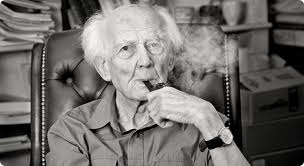
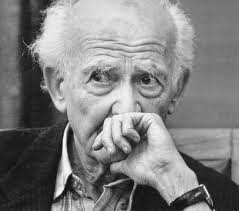
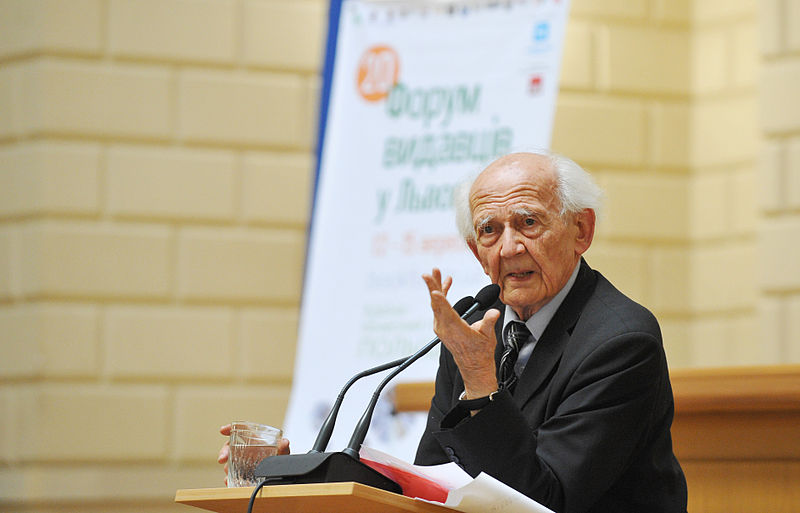
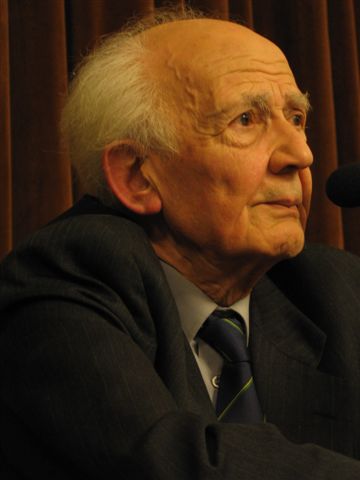
After a solid start in an academic career in Poland through the 1950s and 1960s where he went on to become a professor at the University of Warsaw, he, along with a group of critical professors, were accused of corrupting Polish youth and of being critical of the system. In 1968, he was dismissed and decided to leave the country. After shorter stays in Israel, Canada and Australia, Zygmunt Bauman and his wife Janina – whom he had met during the late 1940s – ended up in exile in Leeds in England where, until retirement in 1990, he served as Professor of Sociology. Today, more than twenty years after retirement, Zygmunt Bauman still lives in Leeds (Janina passed away in 2009). He has received many awards for his outstanding scholarship.


Throughout his entire career, Bauman has written at an incredible pace; particularly in the last few decades, publishing almost one or two new book titles every year. He has published more than 40 books in English, numerous articles in academic journals and book chapters in books, and several books in his native Polish language. Besides this he is a frequent columnist and interpreter in various newspapers providing insightful analyses of topical issues. Being often labelled an ‘intellectual guru’ or ‘sociological superstar’ – much to his own dislike – Bauman is frequently asked to reflect and comment on his own work in interviews published in academic journals or newspapers. Moreover, his work is by now translated into numerous languages making his thoughts and ideas accessible to a global audience. Zygmunt Bauman is regarded as one of the major stalwarts of contemporary sociology. Despite this recognition and success, he – perhaps by choice – remains an outsider and maverick within the discipline.


Inspired by the sociological imagination of their Emeritus Professor, Zygmunt Bauman, the University of Leeds has launched The Bauman Institute, an international research and teaching centre dedicated to analysing major social change around the world with their primary research interests in the areas of: money and consumerism, ethics and social responsibility, new technologies and data, as well as resistance and power in ‘liquid modernity’ (see http://baumaninstitute.leeds.ac.uk/).

 Bookshelf bauman books

x

*****

One of the key concerns of Zygmunt Bauman’s writings throughout the years has been to describe and diagnose the gradual transformation of modernity – from a pre-modern phase followed by a ‘solid modern’ to a contemporary ‘liquid modern’ phase. Acknowledging that these labels are merely analytical concepts aimed at reducing the unfathomable complexity of social life, they, however, according to Bauman, still provide sociology with some analytical substance, useful conceptual distinctions and interpretive value. ‘Liquid modernity’ – as an antithesis to ‘solid modernity’ – is a modernity characterized by the giving up of the long-term planning, the obsessive ordering, structuring and organizing as well as the abandoning of any collective insurance for individual misfortune so characteristic of its earlier solid incarnations.


So what exactly is Liquid Modernity?


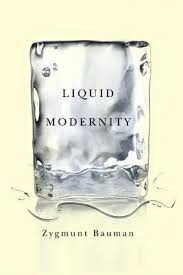
The idea of the liquefaction of modernity –‘liquid modernity’ as the new form of society – was first proposed by Zygmunt Bauman in his book Liquid Modernity (2000). In this book, Bauman moved on from many years of preoccupation and association with the idea of ‘postmodernity’ in the 1980s and 1990s; and instead began to develop a more comprehensive theoretical framework of ‘liquid modernity’. Bauman started using the term liquid modernity to better describe the condition of constant mobility and change he saw in relationships, identities, and global economics within contemporary society. Instead of referring to modernity and postmodernity (which implied a disjuncture), Bauman suggested that there was no rupture, rather a transition from solid modernity to a more liquid form of social life. Bauman’s characterization of modern society or solid modernity was that of a society obsessed with the need for order—a need to domesticate, categorize, and rationalize the world so it would be controllable, predictable, and understandable.


Liquid modernity bauman book cover


Solid modernity is made of those watershed changes in society noted also by Hungarian economist Karl Polanyi (1944) in his fascinating description in the mid-20th century of the so-called ‘great transformation’ during which ‘gain’ replaced ‘subsistence’ and through which a marketization of human relationships was achieved. ‘Solid modernity’ – although Bauman never dates its duration, is most probably an epoch spanning the centuries from the European Enlightenment project up to the latter part of the 20th century – would be something emphasizing the stable, heavy, lasting, condensed, systemic and orderly systems. Whereas the notions associated with ‘liquid modernity’ would rather be those of fluidity, lightness, short-term, network, the capillary and fragmentary (Bauman 1999b:123). Whereas solid modernity was top-heavy, the weight in liquid modernity has decidedly shifted to the bottom – on to the shoulders of the individual.


For Bauman, the one area where the shift to a liquid modernity can be discerned most easily is that of contemporary approaches to self-identity. In liquid modernity, constructing a durable identity that is coherent over time and space is near-impossible. Bauman says that contemporary humans have moved from a period where being human was understood as being a “pilgrim” in search of deeper meaning to that of a “tourist” in search of multiple but fleeting social experiences.


According to Bauman, liquid modernity’s main characteristics are about the individual, especially increasing feelings of uncertainty and the privatization of ambivalence. It is a chaotic continuation of modernity, where a person can shift from one social position to another in a fluid manner. Nomadism becomes a general trait of the ‘liquid modern’ man as he flows through his own life like a tourist, changing places, jobs, spouses, values and sometimes more—such as political or sexual orientation—excluding himself from traditional networks of support.


Entry into the globalized society is open to anyone with their own stance and the ability to fund it, in a similar way as was the reception of travellers at the old-fashioned caravanserai. The result is a normative mind-set with emphasis on shifting rather than on staying—on provisional in lieu of permanent (or ‘solid’) commitment.


Initially, the idea or metaphor of ‘liquid modernity’ was coined and used primarily as a general descriptive term capturing a variety of social processes and transformations characterizing the shift from solid to liquid modernity such as incessant individualization, dis-embedding without re-embedding, the separation of power from politics, the curtailing of collective responsibility for social development as well as individual life-challenges, and finally – and perhaps most dramatically – the relinquishing of any hope for a better future. Later, however, Bauman has applied the notion to various specific contexts such as love, fear, consumption, inequality, utopia, culture.

x

liquid love


According to Bauman, the idea of liquid modernity is to be seen as a root metaphor for a society in which the time-honoured, tried and tested moulds that previously held things together are rapidly disintegrating or are progressively dismantled. These social entities, thus, can no longer keep their content stable or solid for any substantial period of time. Everything – relationships, power structures, identities, communities, moralities and ideologies – begin to leak from their previously firm moulds and flow freely without any apparent ability to or interest in forcing them back into their previous solidity and stability. In Bauman’s writings, ‘liquid modernity’ is a metaphor that only makes analytical sense if contrasted with another important metaphor: that of ‘solid modernity’. In many ways, liquid modernity is an inversion of and diametrical opposition to the characteristics of solid modernity.


In Liquid Times, Bauman highlights five central features of liquid modernity that all point to different landslide developments differentiating the liquid-modern world from its solid-modern predecessor. First, the dissolution of ‘society’ and ‘the social’, which is now increasingly deregulated, privatized and individualized. There is, as Bauman often critically quotes the words of former British Prime Minister Margaret Thatcher, ‘no such thing as society’.


Everything solid decomposes and disintegrates making it impossible for structures and social forms to maintain their composition and coherence for any substantial period of time. Society is increasingly besieged on two fronts – by individualization and globalization – each in their way tearing society apart (Bauman 2002a).


Second is the separation and pending divorce of power from politics, leaving the former without substance, purpose or direction and the latter totally impotent and unable to have any real impact. Hence problems remain globally unsolvable because available political solutions remain entirely locally embedded.


Third, a gradual and apparently irreversible withdrawal or erosion of a common, collective, state-sponsored and state-guaranteed insurance against individual misfortune as was previously evident in the solid modern welfare state. With this we also see the demise of ideas about the ‘just society’ or the ‘good society’ which caters for the well-being of all its members and particularly the weakest.


Fourth, the breakdown of long-term planning, thinking and acting and the subsequent lack of investments in the future. Instead of developing, building, learning and maturing, now the most valuable skills – in individual lives as well as in society at large – are those of forgetting, avoiding binding obligations and responsibilities and constantly staying on the move.


Fifth, is that the responsibility for one’s own life, its successes and failures, its victories and misfortunes, now falls back upon the individual who has no one else to blame than himself or herself. Society no longer takes any responsibility – it is now all up to you. As Bauman says, living in liquid-modern society is like being on board a flight where all the passengers are painfully aware that the pilot – those in control – has long since evacuated the cockpit and that the plane is set on a crash course (Bauman 2007a:1-4).


‘There Is No Alternative’ (TINA)


Our society has stopped questioning itself – where it comes from, how it got to where it is now, how it may become different from what it currently is and where it is headed? One of the main and indeed paradoxical consequences of the rise of liquid modernity is the fact that society seems immune to change or self-critique. This situation has made Zygmunt Bauman proclaim the prevalence of the so-called ‘TINA Syndrome’. TINA is the acronym for a condition spelled out as: ‘There Is No Alternative’.

 roundabouts2 TINA in middle (1)

Just as Bauman’s previously mentioned statement that in liquid modernity ‘there is no such thing as society’; the notion that ‘there is no alternative’ is also attributed to British Prime Minister Margaret Thatcher. However, whereas Thatcher used the catchy phrase to pronounce that there was no viable alternative to liberalist society and capitalist economics, Bauman is rather suggesting that the world nowadays has altogether forgotten that it can be made and re-made in another way by men and women and therefore people live their lives as if this is the only world possible.


Ironically, our so-called liquid society that is living under the shadow of TINA Syndrome paradoxically is ushering a solid age, which means that it is becoming utterly resistant to critique, change and dialogue about alternatives. As Bauman insists, it is actually because of fluidity that the world seems stubbornly un-manageable and solid as ever before. The world has altogether forgotten the art of questioning itself and lost interest in imagining itself different from what it is or could be. The world succumbing to the TINA Syndrome is therefore a world surprisingly resistant to change and immune to as well as suspicious of suggestions for possible alternatives to or lives lived differently from what contemporary liquid modern consumer society deems worthy, interesting or desirable. Such a world is thoroughly self-confident – indeed impervious even to doubt itself – that it beyond any reasonable doubt is the best of all possible worlds:


‘Our form of life’ has once and for all proved both its viability and its superiority over any other real or imaginable form, our mixture of individual freedom and consumer market has emerged as the necessary and sufficient, truly universal principle of social organization, there will be no more traumatic turns in history, indeed no history to speak of. For ‘our way of life’ the world has become a safe place.” (Bauman 1992:175)


However, such a ‘safe place’ heralded by the dominance of the TINA Syndrome is not only a tedious place but also a dangerous place because it threatens to ossify and turn into an immutable entity existing beyond human intervention or control.


A world whose way of thinking is ruled by the “TINA” Syndrome refuses to talk about a different state of affairs, multiple realities, different paths lying ahead or an alternative future awaiting in the horizon. The concept of “utopia,” on the other hand, aims at setting imagination in motion, inspiring thought and prompting speech. Unlike TINA … utopia cannot but be an invitation to dialogue” (Bauman 2002b:183-184). Utopia – at least in some of its many incarnations – provides the alternatives deemed dubious, impossible or ineffective by TINA, thereby restoring the open debate and unrestricted dialogue so important to any truly autonomous, democratic and pluralistic society.


As Bauman has reminded us, if an optimist is someone who believes that we live in the best of all possible worlds, and the pessimist is someone who suspects that the optimist may be right, the utopian instead places himself or herself in the third camp: that of hope. By its refusal to pre-empt the shape of the ‘Good Society’, utopianism cannot but question, listen and seek alternatives to that which currently seems to be or parades as the only reality possible. According to Bauman, however, there is always an alternative. As he once stated, “each moment of human history is, to a greater or lesser degree, an open-ended situation; a situation which is not entirely determined by the structure of its own past, and from which more than one string of events may follow” (Bauman 1976a:10).


Furthermore, the prevalence of the TINA Syndrome not only questions viability of possible alternatives to the current state  – how is it possible to change things for the better – but, it also raises the problem of agency – who is going to change the world. The paradox is that with our heretofore unprecedented freedom of choice, our increasingly individualized lives and our increasingly popular ‘life politics’ comes also increased impotence and lack of engagement and investment in changes: “We believe too that, were we able to make a change, it would be futile, even unreasonable, to put our heads together to think of a different world from the one there is and to flex our muscles to bring it about if we consider it better than the one we are in” (Bauman 1999a:1).


In a world ruled by the TINA Syndrome, people are both blind to alternatives and unaware of possible paths to alternatives and thus live their lives wearing blinkers, being unable to see that the world can indeed be different from what it already is. It is a world of defeatism, despondence, disinterestedness and indeed a deadly limitation of mind. The people populating such a world are equivalent to what American sociologist C. Wright Mills (1959) once labelled ‘cheerful robots’ who go about their daily business without any consideration for anything but their immediate personal concerns and who do neither criticize nor want to change the present state of affairs. As Bauman thus observed, “dangers lurk on [two] sides. The world without an alternative needs self-criticism as a condition of survival and decency. But it does not make the life of criticism easy” (Bauman 1992:185-186).


One of the first and major casualties of the prevalence of the TINA Syndrome is therefore that of critique and critical thought. Bauman often quotes Cornelius Castoriadis for stating that the most dangerous situation arises when society stops questioning itself and that this is exactly what has happened to contemporary liquid-modern society. This deadly sin of stopping to question oneself is dangerous because it leads to a situation of stagnation, lack of critical reflection and opposition to the status quo and last but not least society self-consciously taking itself for granted. In such a society, the need for critical sociology is greater than ever before. According to Zygmunt Bauman, the main objective of critical theory – or at least of any kind of theory deserving of that distinguishable label – has always been human emancipation (Bauman 1999b:130). One of the key facets of any kind of critical theory is exactly its incessant inquisitiveness that never stops short of insisting that what ‘is’ or seems to ‘be’ might just as well have been different. As Bauman once wrote on the nature of critical theory:


Unlike other theories, critical theory will not be, therefore, satisfied with the optimally faithful reproduction of the world ‘as it is’. It will insist upon asking: ‘How has this world come about?’ It will demand that its history be studied, and that in the course of this historical study the forgotten hopes and lost chances of the past be retrieved. It will wish to explore how come that the hopes have been forgotten and the chances lost. It will also refuse to accept that whatever is, is out of necessity; it will suggest instead that the structures be explored which perpetuate what is and by the same token render the alternatives unrealistic. It will assume, in other words, that until the contrary is proved, the reality of some attributes of the world and of utopianism of their alternatives are both conditional on the continuation of some practices which, in principle, can be modified and altered … Critical theory, as it were, relativizes what seems to be absolute, pulverizes the solid contours of reality, transforms certainties into a mere game of chance, strips external pressures of their authority and brings them into the reach of human control (Bauman 1991b:280-281, 289).


Our present day world is perhaps not particularly well-attuned or accommodating to this type of critical thinking. In a world where the ‘tyranny of the moment’ reigns supreme (see, e.g. Eriksen 2001; Rosa & Scheuerman 2008), there is no time to stop and think, let alone conduct in-depth critical investigations suggested by Bauman.


Our world seems to have made critique utterly toothless and useless for the purposes of changing society or pointing towards alternatives. Critique is now commonplace, perhaps even ordinary – everybody is allowed to be critical and voice his or her critique or critical opinion at any time or place. Everyone is entitled to be heard – but the problem is also that nobody seems to listen to the millions of voices now communicating and incessantly chatting on television, on the cell phones or on the internet blogs and websites (Jacobsen 2015). In order for critique to be consequential, it needs to be heard – today critical voices overcrowd channels of communication and thus drown out each other.


Moreover, this liquid-modern type of critique remains solely at the level of life-politics as murmurings about private discontent or personal dissatisfaction from where it is unable to coagulate into collective concerns or have an impact on actually existing social arrangements. Self-critique has replaced or squeezed out societal critique, the former signalling a perpetual self-disappointment and self-disaffection that remains however inconsequential (Bauman 2000:38; Willig 2013). In Bauman’s view, societal critique has been disarmed and disassembled.


The Dissolution of ‘Politics’- More about “campaigns” and “carnivals” than about “movements”


One of the most prominent casualties of the advent of ‘liquid modernity’ is that of Politics (spelled with a capital P to emphasize that we are here talking about emancipatory and collective Politics and not the ‘life-politics’ concerned with self-identity, personal life and self-actualization). In his 1999-book In Search of Politics, Zygmunt Bauman makes it clear that the landscape of the “political” is undergoing some radical changes.  Under the influence of liquid-modern individualization processes the previously held collective agendas of most political ideologies are increasingly become focused on personal matters instead of that which concerns the larger public.


in search of politics bauman book


What happened to the political prophets, visionaries and dreamers who contemplated and shaped the ideas of the ‘Good Society’, the ‘Just Society’ or the ‘Great Society’? According to Bauman, they have increasingly been evacuated their offices and been replaced by other more up-to-date and less ideological protagonists. Today, “clerics, churchwardens and vergers of the new cult of pleasurable and entertaining sensations will do nicely” (Bauman 1999a:104). Politics – which previously was concerned with debating and securing a certain level of livelihood, influence and human decency for all the members of society – now becomes yet another charade that merely caters for individualized consumer demands. Politics is only interesting when something can be gained or obtained from engaging in it.


At the same time, according to Bauman, contemporary politics in liberal democracies has been decoupled from power leaving the former altogether impotent and the latter in the claws of capitalist and consumerist interests. We now have global capitalism but not global politics – the capitalist market has overtaken the role of the state in catering for individual and collective dreams and desires and in the process it has successfully elbowed out any opposition to its own monopoly. In such an increasingly capitalized and depoliticized world nobody seems to trust politicians to create a better society or to promise a better future.


Politics has been reduced merely to a means for providing pockets of consumption for the insatiable inhabitants of liquid modernity as well as promising them a sense of law and order in a world apparently ruled by the triple-headed spectre of unsafety, insecurity and uncertainty. Therefore, the rise of the ‘politics of fear’ – politicians consciously playing on human Unsicherheit by insisting on the presence of imminent dangers, risks and free-floating fears – has now replaced the previously positive agenda of ‘emancipatory politics’ aimed at promoting human well-being and social solidarity (Bauman 2006).


In solid modernity, the world was populated with planners. In today’s world of liquid modernity, Bauman claims, nobody seems to be a planner because there are no great plans to conceive let alone implement anymore. And the tedious task of planning and waiting to implement something in a society increasingly suffering from an ‘impatience syndrome’ seems utterly futile and pointless. In such a society, the waiting is to be taken out of the wanting so that immediate satisfaction can be achieved. Planning for the ‘Great Society’, the ‘Just Society’ or the ‘Good Society’ seems too elusive and/or too inclusive to attract the attention of politicians and their voters.


Delayed gratification – the driving mechanism of political ideology and planning in the past– is no longer the name of the game. The solid modernity of the past had the Puritans who willingly delayed their gratification according to German sociologist Max Weber wrote of the rise of the Protestant ethic and the spirit of modern capitalism. Today, these Puritans have been replaced by the ‘sensation seekers’ of liquid modernity for whom instant satisfaction is the only thing that really matters. They are not concerned with the emancipatory, collective or long-term effects of political decision-making but rather with the immediate outcomes of the ‘life-politics’ of which British sociologist Anthony Giddens stated that it was “concerned with human self-actualization” (Giddens (1991:9). However, the problem with ‘life-politics’, according to Bauman, is that it tends to be centred on the individual and his or her intimate life-sphere thus having little impact on more substantial social issues such as inequality, injustice or other topics that transcend the individual. ‘Life politics’ seems insufficient to provide lasting solutions for the problems confronting contemporary liquid-modern society.


Today, politics, like anything else, has become short-term and unconcerned with the big picture. We therefore need ‘movement politics’, in the terminology of Richard Rorty (1998), rather than ‘campaign politics’. We need long-term hopes for the future instead of short-term investments for profit; comprehensive political plans rather than merely sketchy politics based on individual cases, precautionary prognostications or lucky punches. The incrementalism and fragmentary character of ‘campaign politics’ will not be sufficient to counter contemporary causes of suffering and stem the waves of injustice and inequality threatening to tear society and solidarity asunder.


‘Campaign politics’ – which are rather similar to ‘life-politics’ – clearly seem sympathetic to the ‘contended majority’ of the well-off countries. But, to the ‘discontented minority’ within these countries or the global majority of sufferers it offers no substantial hope of salvation. ‘Campaign politics’ often merely scratches the surface or serves to provide absolution for deeds not done and are therefore ‘carnivalesque’ in their aspirations and celebrations.


In Bauman’s view, besides the shift from ‘Politics’ to ‘life-politics’, the main challenge for contemporary politics is not only that it needs to be re-oriented towards a more comprehensive and long-term political agenda in order to counter the exhaustion of political energies – it also needs determination and agency. As he states, “the hub of the present-day crisis of political process is not so much the absence of values or confusion caused by their plurality, as the absence of an agency effective enough to legitimate, promote, install and service any set of values or any consistent and cohesive agenda of choices” (Bauman 1999a:74).


If politics is to be revitalized in an individualized, liquid-modern society, it needs to emphasize autonomy as well as responsibility. According to Bauman, the art of Politics (again with a capital P) – if this kind of politics is deserving of the label of democratic politics – is simultaneously to dismantle limitations to citizens’ freedom at the same time as it also needs to insist on self-limitation (Bauman 1999a:4). A truly democratic society is only possible if the unprecedented freedom of the individual merges with collective aspirations to create a truly autonomous society. The question arises: Who will do it? Do we have the political agency to execute this task?


The camping site critique


In our society unprecedented freedom goes hand in hand with unprecedented impotence. Bauman uses the metaphor of the ‘camping site’ for the contemporary state of critique: “The place is open to everyone with own their caravan and money to pay the rent. Guests come and go, none taking much interest in how the site is run, providing they have been allocated a spot big enough to park the caravan, the electric sockets and the water taps are in good order and the passengers of nearby caravans do not make too much noise and keep down their portable hi-fi and TV speakers after 10 pm” (Bauman 1999b:122). In such a camping site milieu populated by individual (and individualized) caravan owners, no one takes any interest whatsoever in the ‘common good’ because there is nothing to have in common – apart from access to privatized means of keeping up a good, quiet and comfortable life at the camping site.


Bauman continues to admit that “while hospitable to the critique after the fashion of the camping site’s hospitability to caravan owners, our society is definitely and resolutely not hospitable to critique in the mode which the founders of the critical school assumed and to which they addressed their theory” (Bauman 1999b:122). However, the reason why our world is not hospitable to the kind of critique practiced by the founders – and their intellectual inheritors – of critical theory is not only to be found in the fact that the character of critique has changed but perhaps rather that the very object to be criticized – society – today is very different from when the classical critical theorists first wrote their incisive analyses. The society envisioned by the classical critical Frankfurt-thinkers such as Theodor M. Adorno, Max Horkheimer and Herbert Marcuse was that of a gigantic common household with certain norms and rules as well as rights and obligations (Bauman 1999b:123). Although this society, as classical critical theorists warned, also contained its imminent dangers (e.g. of totalitarianism, quantification, homogenizing, levelling and the subsequent erosion of the non-identical), the camping site society of contemporary liquid modernity – with its individualized, compartmentalized and privatized lives – has lost its coordinating core and is now splintered into uncountable and seemingly unconnected fragments. As Bauman thus proposes in what may be termed a ‘reversed colonization thesis’:


The task of critical theory has been reversed. That task used to be the defence of private autonomy from the advancing troops of the ‘public sphere’, smarting under the oppressive rule of the omnipotent impersonal state and its many bureaucratic tentacles or their smaller-scale replicas. The task is now to defend the vanishing public realm, or rather to refurnish and repopulate the public space fast emptying ... It is no more true that the ‘public’ is set on colonizing the ‘private’. The opposite is the case: it is the private that colonizes the public sphere (Bauman 2000:39).


Bauman proposes that the main problem today, in liquid modernity, is the invasion of the public sphere by private and individualized life-pursuits. Today, the main problem no longer seems to be that of totalitarianism against which so many of the classical critical theorists warned. So may the call to arms in order to secure individual autonomy, freedom of choice and the right to self-assertion in today’s thoroughly individualized and liquefied society finally be called off? Not all, insists Bauman, because that would indeed be a premature conclusion.


Critical theory’s main enemy from the age of solid modernity was the metaphor of the Panopticon – the notion of Big Brother who was constantly watching its subjects, intruding on their privacy and autonomy – the case of “the few (at the top) watching and monitoring the many (multitudes of masses).” In the age of broadcast television and celebrity gossip, this seems to have been supplanted by the notion of the ‘Synopticon’ (Norwegian sociologist Thomas Mathiesen’s term), where the many or multitudes watch the few on the media. Both Panopticon and Synopticon, have to do with the role of surveillance and control in society. However, the control in our liquid modern society is of a different variety – more a mental game than actual physical coercion. And it being won by dividing the people further and further into smaller and smaller units of private individuals.


The ‘private’ is now overtaking the ‘public’ thereby emptying everything that characterizes a real ‘public’ – deliberation, negotiation, mutual recognition and so on – of any value, meaning or purpose. In an individualized world, anything that oozes of being ‘public’ is now regarded with ill-concealed suspicion at best or as an obstacle to individual life-pursuits at worst.


What is the solution then? Bauman suggests that what is needed is a repopulation and a revitalization of the agora or public sphere – the meeting-ground between individual and collective where common problems or concerns are raised, discussed and resolved. With the rapid decline or demise of the agora, the hope to reach such a resolution is perhaps nowhere in the offing. However, exactly in such a society, critical sociology has an important – yet new – task to perform: to defend the public sphere from disappearing altogether while, at the same time, enhancing individual freedom and holding out the promise of human emancipation. Indeed a brave new and daunting – yet equally important – agenda for critical sociology.


Conclusion: Is then “A Sociology of Possibility” possible?


Bauman writes of a transition from solid modernity to a more liquid form of social life – liquid modernity. He says that these concepts exist only in juxtaposition to each other. One of the key aspects of solid modernity (and something that led Bauman away from using the term post-modernity) was Bauman’s view that modernity had always been characterized by an ambivalent, “dual” nature – a paradox. On one hand, underlying modern society was what Max Weber had described as a rationalizing tendency – a need for order, to categorize, and to rationalize the world so it could become controllable, predictable, and understandable; and on the other, there was a tendency to radical change built into modernity. A tendency to constantly overthrow tradition and traditional forms of economy, culture, and relationship. This was what Marx and Engels had described in their line —“all that is solid melts into air.” Thus, solid modernity was characterized by an inherent paradox.


Our (contemporary) time and age, going by Bauman’s analysis of liquid modernity, also has a long list of inherent paradoxes: freedom versus security, individualization versus a craving for community, self-sufficiency versus increased interdependency, globalization versus localization, fear versus indifference, a desperate search for love and recognition coupled with a detestation of intimacy and responsibility, and so on.


Bauman’s analysis of liquid modernity actually discloses and diagnoses the many paradoxes and inner ambivalences created by the increasing liquefaction of contemporary modernity. In this context, a paradox is defined as inner tensions or contradictions that defy common sense and which are created by or exist with a social environment – tensions and contradictions that are often accompanied by unintended consequences or unanticipated and indeed also undesirable side-effects. Obviously, all societies and all historical epochs, in one way or the other, create patterns of ambivalence or paradoxes on the social, interactional and psychological level (see, e.g., Merton 1976). Paradoxes, dilemmas, contradictions, chasms, ambivalences and tensions are endemic to most societies most of the time. Some of these paradoxes of liquid modernity are:


  • the paradox of saluting a world of open opportunities and nonetheless narrowing it down to no alternatives;
  • the paradox of celebrating the individualization of life-circumstances and life-choices at the same time as abandoning responsibility for life-consequences and making the individual solely blameable whenever life-problems arise;
  • the paradox of making life-politics as important as ever meanwhile denigrating all other more comprehensive forms of political engagement;
  • the paradox of emptying public space of meaningful action and at the same time making it thoroughly policed and closely monitored;
  • the paradox of simultaneously making critique ubiquitous and societal critique utterly irrelevant, redundant, trivial and impotent; and
  • the paradox of ridiculing earlier utopian aspirations of the ‘Good Society’ and simultaneously living every single day as if one could grasp utopia within moments – believing every consumer object can take us to that utopia.  Living life on the utopian treadmill.
  • the paradox of liquefying everything and simultaneously making society thoroughly solid and immune to change;


To the naked eye and according to most common-sensical conventions, it does seem paradoxical in itself to suggest that many features of liquid modernity are increasingly becoming solid. However, as Bauman once explained in interview on this apparent paradox between ‘liquid’ modernity and its drift towards increasing ‘solidity’:


“No contradiction here – I learned it from Claus Offe and Pierre Bourdieu. It is because of fluidity that the world is so stubbornly un-manageable. Offe explained the apparent paradox by pointing to the tools of actions being sorely inadequate to the enormity of the task – hence the forces let loose rebound as intractable necessity (I tried to grasp it in the trope of the ‘frontier-land’). Bourdieu uncharacteristically leaped into psychology pointing out that people deprived of the grasp on the present cannot seriously think of controlling the future. This way or the other, we are invited back to the problem of missing agency. Since we do not know who would be able do it were we aware what was to be done, we are disinclined to waste time designing what is to be done, and the summary result is the intractability of reality being perceived as self-reproducing. The odds appear overwhelming. But the odds are as fluid as the rest, and they keep changing in the course of action.” (Bauman in Jacobsen, Marshman & Tester 2007:269-270).


Therefore, the surprising solidity of liquid modernity is perhaps not so surprising after all – it stems from and reflects the fact that the abandonment of long-term investments, shared social responsibility, collective action and the belief in a better society means that human intervention in the social world is drastically reduced thus leading to a thoroughly static state of affairs.


One might surmise that the presence and myriad of so many paradoxes and inner tensions to some extent may also reflect an inner paradox, inconsistency or contradiction in the mind of the observer/writer. However, such ambivalences, inconsistencies or paradoxes are not only the result from the workings of the creative imagination of the observer/writer – they are also an endemic part of the world of modernity described, analysed and diagnosed. As has been observed about this world of modernity and its impact on sociological analysis:


“Such ambivalence has often been held against one or another modern theorist, for example, as a symptom of personal confusion or inconsistency, but it now needs to be recognized that modernity is complex and multi-faceted; any insightful analysis, and especially any penetrating evaluation, should recognize and reflect this complexity. It is not a question of personal confusion about an unambiguous phenomenon, but a question of personal insight into a phenomenon which is in many respects ambiguous.” (Kim 2003:109)


In Bauman’s work, insistently pointing to the paradoxes and inconsistencies of modernity – solid as well as liquid – should be seen as creative openings, as imaginative inroads and as interpretative ways of teasing out or breaking open a human world that is never as one-dimensional, never as unambiguous, never as transparent, never as uni-linear and never as predictable as we might hope for or, by the powers that preside over us, are deceivingly tricked into believing.


Bauman’s description of the metaphor of ‘liquid modernity’, primarily focuses on the negative or disruptive aspects of recent social development and hardly touches upon any positive outcomes or consequences. In this respect, Zygmunt Bauman’s sociological description and diagnosis of liquid modernity is one-sidedly sombre and dystopian – but this is indeed a conscious part of his methodological strategy to use the bleak picture to point to or tease out those yet undiscovered and still available possibilities to create society anew.


According to Bauman, to increase awareness about these paradoxes created by liquid modernity – that often remain largely invisible to the naked eye and which are often hailed as successful and laudable achievements – and especially to puncture the prevailing myths about the apparently impenetrable solidity of liquidity is exactly the ambition of and a new and daring task for contemporary critical sociology. Bauman’s writings look deep into some of the main reasons behind and the most spectacular repercussions of the paradoxes produced by liquid modernity, but besides pointing to the breeding-ground for and the consequences of liquidity, his work is also characterized by a deep-seated aspiration to make his readers aware that something can in fact be done about it and that the human world is not yet ossified into immutable structures. As noted by one observer:


“Instead of theoretical unity and the persistence of the same critical judgments, [Bauman’s] books relentlessly emphasize the intellectual need to cope with emerging social problems, crises, contradictions and paradoxes and highlight sociology’s role in facilitating responses to them.” (Přibáñ 2007:2)


One way to create or increase awareness of such paradoxes and ambivalences, not to mention to strengthen the ability to act on them, is continuously critically to question society as it confronts us. Such awareness thus calls for a critical attitude towards the present. It is, however, important to remember that the freedom of critique – in liquid modernity as well as elsewhere – does not come without a cost. The freedom of critique even in an open and autonomous society is always something intimately bound up with the outcome of protracted historical struggles. In Zygmunt Bauman’s inaugural lecture as Professor of Sociology at the University of Leeds in 1972, he thus stated on his own personal experiences in Poland:


“I have seen morally inspired, noble and lofty ideals smashed to pieces by the merciless logic of the reality their bearers failed to assess. I was with those who took … upon themselves to re-define the world they lived in, to fill the world with a new, better, more human meaning, to deny its repulsive reality in the name of the untrammelled human potential. I was with them still when they saw their ambition shattered against the wall of the same stubborn reality they refused to admit, and the same moral squalor sprouting again from below the thin film of ideals. And then, fortunately, I saw the same, always young and vigorous, indomitable spirit of exploration and perfection rising again to challenge the ungratifying reality. There seemed, indeed, to be no end to the drama in which the meaning and the reality, the subjective and the objective, the free and the determined, merge continuously to mould our present into our future. Such – contradictory and mischievously elusive to all clear-cut unilateral descriptions – is the shape of the human world (so I learned), my metier – sociology – is about. And the lesson I learned was, I think, congenial to the collective experience from which sociology in its modern form emerged. It was born of the painful realization of the vexing discrepancy between the ends people read into their actions and the consequences these actions bring about; between anticipations and results; ideals and reality; the ‘ought’ and the ‘is’.” (Bauman 1972:186-187)

xbauman pipe


As Bauman has since then continuously insisted, our world needs an iconoclastic and critical sociological perspective in order to open up for understanding and for the possibility of acting on the inherent paradoxes of human history and on the yawning and widening chasm between ‘inspired, noble and lofty ideals’ and the ‘merciless logic’ of a ‘stubborn reality’, or the discrepancy between what ‘is’ and what ‘ought’ (to be). Can we at least open the debate between the two this year rather than just letting things be?


*****

© Michael Jacobsen (editorial inputs from The Essayist)

Please visit The Bauman Institute at http://baumaninstitute.leeds.ac.uk/


See Readings for this article linked here: Reading List: Zygmunt Bauman


Images

The Magic Roundabout – http://en.wikipedia.org/wiki/Magic_Roundabout_(Swindon)

Some images from The Bauman Institute at http://baumaninstitute.leeds.ac.uk/


Bauman before ‘Bauman’ (Part 2) – Zygmunt Bauman talks about the 1960s, Poland, and his early work

This is Part 2 of a larger conversation between Zygmunt Bauman, Michael Hviid Jacobsen & Keith Tester. In this part they discuss and examine the decade of the 1960s in Poland as it unfolded in Professor Bauman’s academic and intellectual life; and the circumstances which shaped his early writing and growth as he left Poland, moved to Leeds, and went on to become the foremost sociologist and intellectual of our times.


Born in Poland, eminent sociologist Zygmunt Bauman has been writing since 1960 when he published his first book. However Bauman became the Bauman we know since the 1990s. After moving to University of Leeds Bauman published extensively; and his reputation has grown globally.


In the late 1980s and early 1990s Bauman wrote about modernity, bureaucracy, rationality and social exclusion. Bauman argued that modernity sought to address the uncertainties of life by creating rules and regulations, hierarchies and bureaucracies and essentially exert control over nature. The attempt to make chaotic human life ordered and systematic led to increased control over human society and categorisation. Thus, we essentially exchanged our individual freedoms with our need for security. Bauman also argued that such efforts to impose order and create manageable categories led to social exclusion and used the concept of the “stranger” to illustrate the ill-effects of such ordered categories.


In the mid-to-late 1990s, Bauman wrote on postmodernity and consumerism. Bauman noted a change from a society of producers into a society of consumers. The need for security was exchanged for the freedom to consume. Bauman wrote of this shift as being a shift from modernity to post-modernity. However, due to the mis-understanding of the term postmodernity, Bauman started using metaphors of “liquid” and “solid” modernity.


This conversation examines the man and his life and thoughts before he became Bauman. It starts with his early efforts in Poland and through his exile from Poland and migration to United Kingdom (UK) in the early 1970s.


michael-hviid-jacobsen keith-tester bauman-Octaedrajpg
MHJ: Michael Hviid Jacobsen (MHJ) Professor of Sociology, Aalborg University, Denmark KT: Keith Tester (KT) Professor of Sociology,
University of Hull, United Kingdom
ZB: Zygmunt Bauman  (ZB) Emeritus Professor of Sociology, Leeds & Warsaw


MHJ/KT: We would like to begin with your early English language work, for the most part the essays that were published while you were still based in Poland. Why was so much Polish sociology published in English (for example the Polish Sociological Bulletin was an English language publication)?


ZB: Every sociologist who thinks and writes in a ‘non-global’ language has been confronted with the question of publishing in English. It has been a question of “to-be-or-not-to-be” in the profession of sociology, which has been global since its inception. Nor is it any wonder that, in most non-English speaking countries, local sociologists lean over backwards to put together a periodical that makes their works available, and hopefully known, to the speakers of this global-language of English. In addition to the ‘Catch 22’ quandary in which all aspiring authors are everywhere cast (you won’t find a publisher unless you have made yourself a name, but you will not make a name unless you find a publisher), a foreign-language writer can hardly count on English publishers, because they are reluctant to invest money in translating the works of unknowns who are also blighted with unpronounceable names. I could tell a lot of stories about this. I have tried hard but mostly unsuccessfully to convince quite a few publishers to take a risk with some of the remarkable oeuvres of my Polish colleagues.


But I doubt whether Polish sociologists are any more keen or successful than others in getting their work published in English. The most profound and precious, and particularly the most original, works of the greatest Polish sociologists, including my masters, are still waiting in vain to be made available to a global readership. This situation is more harmful to the global English readers than the foreign, vernacular group since Poland is a large country with its own wide, avid, critical and grateful readership, and almost all Polish sociologists are fluent in English.


As to myself, the list of my Polish-language publications of the period includes the positions which were central to my preoccupations of the time and which, retrospectively, also appear to be the turning-points of my intellectual itinerary (works like On the Need of a Sociology of the Party, Essay on Bureaucracy, On the Profession of Sociologist, or Visions of Human Worlds). Those positions derived their inspiration and whatever meaning and significance they had from trials and tribulations that were internal and specific to Poland. They were too deeply and tightly enmeshed in Poland’s own (and at that time still mostly subterranean) struggles, to be of any interest, or indeed to be comprehensible, to native English readers.


MHJ/KT: You say that two of your Polish-language publications, On the Profession of Sociologist and Visions of Human Worlds, were essential to the emergence of your position. Could you tell us something about what these publications argued? What does the profession of sociologist require, and what are the ‘visions’ of the human world to which you referred?


ZB: A word of warning is in order: Contrary to a common opinion which social scientists tend to endorse, much of our thinking, and perhaps the most seminal part of it, is not ‘targeted’, not a ‘purposeful activity’. From my own experience, at least, I am rather inclined to endorse Adorno’s resigned conclusion that we think just because we cannot not think. The ‘objective’ of mental efforts usually comes as an afterthought, a codicil that is added later. I would be cavalier with the truth were I to say that I undertook the works you’ve mentioned with the intention of elaborating a position. The ‘in order to’ at the time I wrote them up was not the same ‘in order to’ as the one which later ruminations, and your question, have retrospectively imputed.


Trying hard to recall the ‘motivational causes’ that prompted and guided my search, or rather to fill blank spots in memory while calling imagination to help, I believe I need to start from remembering the situational setting. After a few years of exile, sociology was let back into the post-Stalinist era through the back door. No identity card was issued, no clear status accorded, let alone assured. Sociology lived in a sort of ‘suspended animation’ that could be terminated at any moment on any pretext, or without one. It was without doubt an unpleasant situation to be in, and yet with the benefit of hindsight I suspect that such a state of guilt without a charge, of under-definition unconstrained by any canon, unhampered by a ‘paradigm’, was in a way also a blessing, even if in a very unprepossessing disguise.


It spurred critical self-scrutiny that drew into focus the ‘self-evidences’, and so offered a closer look at a host of unspoken assumptions which under more enjoyable circumstances gladly would have been left in the shade and in silence. We went on asking ourselves about the fundamentals about which our ‘Western’ colleagues did not much worry and were genuinely puzzled when challenged to make explicit and analyse.


In Poland, I was just one among many aspiring sociologists who had first to find the address at which the new home was located and then to scan its interior to make it fit for decent, sensible living. The two pieces you ask about were inspired by (indeed, were a logical consequence of) that preoccupation.


The first piece On the Profession of Sociologist reported the search for location. Sociology collects the information about whatever follows from the fact that humans are not loners but live in company and willy-nilly influence each other’s choices and the condition under which choices are made, as well as their plausible range. In other words, sociology collects the information about the difference that is made by living ‘in society’. That much was commonly agreed. The rest, though, was ‘essentially contested’ and called for taking sides. Some of the contests called for taking sides more imperatively and urgently than others. One such contention was the main theme of the essay that was dedicated to unpacking the sociological profession, a somewhat updated and domesticated version of Weber’s Beruf. When working on it, I thought, mistakenly as it later transpired, that I was trying to resolve a thoroughly local and hopefully temporary, Polish (or the ‘socialist camp’s’) dilemma, which arose from the authoritarian nature of the political regime and from its bid to manage everything and eliminate the un-manageable. It did not occur to me that a life-long position would emerge on that occasion. I just did not realize at the time that the local Polish experience was but an extreme and particularly festering specimen of a contention that in the plight of sociology was neither incidental nor local. I did not realise then that it was precisely the extremity of the Polish case that made it possible to perceive a universal dilemma more clearly than elsewhere.


To start with, Polish state authorities were quite outspoken about matters in which other, non- or less-authoritarian, powers preferred to move in a roundabout, underhand and a rather inconspicuous fashion, while careful not to leave too many foot- and finger-prints. The Polish rulers left little doubt that what they wished sociologists to do (and the only sociological undertaking they would tolerate) was to help them make the obstreperous obedient and the obedient more docile yet, to convince the unconvinced and make the convinced immune to doubts. In short (to resort to Weber’s terms again) they wished the ‘really existing’ Herrschaft to rebound, just as its ideal type did in theory, in the unconditional Disziplin of the subjects.


Having made ‘value rationality’ their un-shared prerogative, they intended to use sociologists to amend and enhance ‘instrumental rationality’. They wished to know the rules guiding human behaviour, in order to manipulate the setting in which the behavioural choices were made – so that only such choices as agreed with intended effects would be taken, while other choices either would be made irrelevant or effectively marginalised. They most gladly accommodated sociology in its ‘behavioural science’ version, a version made to the measure of panoptical power and the ‘Fordist factory’, and at the time the dominant and still gathering tendency in Western, and particularly American, sociology.


I do not pretend that I understood all that when the essay on the profession of sociologist, focused as it was on the apparently local and hopefully transient worry, gestated. But what I did articulate and clarify for myself in the course of writing helped me later in grasping the nature of the contradictory pressures under which all sociological work, under any kind of regime, is conducted – and the fundamental choices no sociologist, wherever placed, can avoid. I believe now that it was then that the vision of sociology as an essentially critical activity took shape in my mind (a model that was more fully articulated only ten years later in the extended essay Towards a Critical Sociology that was written in parallel with Socialism: The Active Utopia). That was the only lasting benefit and saving grace of the effort invested in the writing. Otherwise, the essay was fatally misconceived. It reads now mostly as a testimony of the shameful naivety of its author.


The essay was an invitation to the rulers to join in a discussion, and an attempt to explain that they would benefit from opening themselves to argument. Something along the line of ‘what good government needs, is a watchful and imaginative opposition’, couched in terms that the rulers would (so I hoped…) understand and find acceptable. The idea, of course, was stillborn, only I was not aware of that at the time. I believed that the inanities of the country’s rulers and the ineptitudes of the ‘system’ they called into life were more like ‘unanticipated consequences’ than deliberate moves, and arose from errors of judgment, not from design. I thought that the rulers might be talked to and persuaded to listen, engage in a debate, argued with, and in the end – who knows? – converted to a different, better model of the state and a strategy of running it. A hiccup of the ‘enlightened despot’ dream, I suppose. Well, the rulers made no mistake. They just behaved true to form. It was I who was mistaken, grossly and totally. In the quasi-totalitarian quasi-Soviet regime, sociology as I saw it could only be an alien body and treated as the enemy’s fifth column. And the rulers understood it before I did. It took me a few more years to catch up with their wisdom.


The core of the Visions of Human Worlds book – a sort of an inventory of the house contents – was provided by three extended studies: of Talcott Parsons, C. Wright Mills and Antonio Gramsci. In the first study, I attempted to reconstruct the vision of society as seen from the managers’ offices and a model of sociology made to the measure of managerial reason and management tasks (Parsons’ work was a most conspicuous and authoritative exemplification of both). In the second, following Mills’s suggestions and example, I tried to develop an alternative programme, as well as a strategy of resistance to the advances of the ‘administered society’. I guess that between themselves those two studies, of Parsons and Mills, prepared a framework for the opposition, explored in the Towards a Critical Sociology book, between the ‘science of unfreedom’ of the kind represented most spectacularly by what I dubbed ‘Durksonian’ sociology, and a sociology bent on enhancing the range of freedom.


Finally, in the course of the third study, a distance from the concepts most common in the sociological discourse of the time (like system, totality, structure, determination etc.) was acquired and the broad outlines were drawn of the concept of ‘social reality’ as a continuous and infinite, open-ended interplay between human pursuits and countervailing social pressures experienced as ‘constraints’. I suppose that between themselves the studies of Mills and of Gramsci offered me basic insights from which the programme of ‘sociological hermeneutics’ soon afterwards emerged. Or at least so it seems to me after these years.


All in all, I’d describe the two works you’ve mentioned as ‘vanishing mediators’. They were extremely helpful, indeed indispensable, even if coarse, clumsy and awkward. Their role was to ease me (or push me?) into a realm of thought where their continued services were no longer needed. They, so to speak, worked themselves out of a job, and by doing that they proved their importance. In this lie their sole, though formidable, merit.


MHJ/KT: You have said before that you took up sociology because you wanted to play a part in rebuilding Poland in terms of justice, equality and an overcoming of the humiliation of poverty (see Bauman & Tester 2001). Was sociology allowed to play such a role in Poland in the 1950s and 1960s?


ZB: Allowed it was not, but it struggled to gain such a role and in the end it did play such a role, though not at all how I naïvely and gullibly expected it to. Polish sociology (which was resurrected and recovering its public voice after a brief numbness during the Stalinist period, which was considerably shorter in Poland than in other countries under Soviet influence) offered one of the very few independent standpoints and narratives that was available in a country where independent thought was fast becoming a rarity, and its chances of being heard even fewer and farther between. Sociology whispered an alternative to the story that was officially shouted, and so it became an element, however slight and insistently marginalised, of plurality in a forcefully ‘homogenised’ society. And it had to stand up against the new injustices and inequalities that the new powers spawned in profusion in the course of extirpating the old ones. The labours of sociology exemplified the resolution of the most thoughtful and conscientious part of Polish intellectuals to cooperate with the new powers in their good deeds, in lifting the country from its centuries-long backwardness, while at the same time watching carefully and vigilantly the hands of the power-holders.


MHJ/KT: In the English-language material that was published before 1968, it looks as if it took some time for your own voice to emerge. Some of the very earliest English-language pieces seem to be almost managerial thanks to their emphasis on statistics, graphs and so on. The present-day reader has to look very hard to find any critical dimension. It took a while for these essays to reflect the concerns of a more obviously critical sociology. Do these pieces accurately reflect your themes and concerns, and the changes that they underwent?


ZB:  ‘Managerial vein’… Stanislaw Ossowski and Julian Hochfeld, the two teachers to whom I owe most of what I learned at Warsaw University, were deeply suspicious of the cognitive value, and even more of the cultural impact, of the prevalent managerially oriented model of a thoroughly quantified and statistics-obsessed sociology. I guess that suspicion is an irremovable and indelible part of their bequest, to which as much as I could I tried to remain faithful from the start, and have carried on trying throughout my own work. At the same time, though, Ossowski and Hochfeld were only too aware that selling to the communist managers the kind of sociology that they preferred – a critical and ‘humanist’ kind of sociology – would be a tall order, if not a lost cause and waste of time. If any argument stood a chance of reaching the Polish rulers’ ears, it could only be a plea that emphasised the services that the sort of sociology imported from the U.S.A. promised to render to the managers. Sociology could only be ‘sold’ to the powers-that-be as a handmaiden of management, as a heads-counting enterprise and a briefing for those who sought conformity to their orders and were bent on making society obedient and pliant.


Such a setting was conducive to schizophrenic responses. Ossowski’s thoughtful yet tormented book on the peculiarities of social sciences was a vivid testimony of that. In other words, the two accents which you rightly spotted were not successive, but simultaneous. They coexisted, since they had to coexist, in an uneasy alliance rent with mutual suspicions.


MHJ/KT: Reading histories of this period creates the impression that sociology was a key player in a very broad oppositional culture that included intellectuals, journalists, filmmakers, and novelists. Could you say something about the circles in which your critical sociology circulated and participated?


ZB: The milieu you are asking about was far from unified. There were all possible degrees of opposition, and people differed as to how far they were prepared to go in manifesting their resistance, as well as in what kind of conduct would best serve the purpose. Not that the differences mattered much in the end. I remember a little play The Hand, by the outstanding Polish dramatist Slawomir Mrożek, in which a huge hand stretched from the wings of the stage and beckoned to two hapless little men to take off their clothes, bit by bit. One man meekly followed successive orders, the other loudly protested against each order, all the time furiously quarrelling between themselves about the respective virtues of their responses. Both men ended up naked. I remember our sad but sober admission that the play flawlessly assessed the practical value of our strategic querelle.


But you are right in principle. The various acts of resistance somehow added together and complemented each other in keeping the spirit of dissent alive and the fire of independent thought smouldering, even if the actors found it difficult to reconcile their programmes and their tactics. All the same, there was no ‘centre’ which all the scattered and diffuse, and often ephemeral, circles (‘condensations’) of opposition would have recognised as such. This was all the more the situation because the dividing lines were constantly redrawn, depending on the issues that were currently on the agenda. However in the 1960s a ‘hard core’ of people with the highest and a seldom questioned moral authority crystallised around a few persons of outstanding courage and determination – writers like the poet Antoni Słonimski, academics like Leszek Kołakowski, or just indomitable ‘professional revolutionaries’ like Jan Józef Lipski, a man who was always ready for the fray and always in the frontline of the battle.


In all though the ‘resistance movement’ was too diverse, too protean and complex, to be given justice in a short conversation like ours. Much has been written about it, but the multi-volume monograph that it deserves remains to be written.


MHJ/KT: During the period roughly 1963-1968 your work often focused on questions of youth and education. Why?


ZB: Looking back, I suspect that the outcome of our research into the attitudes of Polish youth marked, perhaps not the first, but certainly the most profound, of my disenchantments. What I found was not what I and other ‘believers’ like me had hoped to find. What I found was a mixture of downright conservative and parochial, petty bourgeois life ideals, with alarming symptoms of an emerging cult of shrewdness, craftiness and ‘getting by’. There was little trace of socialist values. The new social setting was not working. Most certainly, it did not turn out to be the school of humanity whose prospect attracted so many, myself including, to the idea of socialism. The task was now to find out what stopped it from becoming such a school.


Alongside other things and perhaps more than anything else, watching the hands of power meant finding out whether and how life-attitudes and characters had changed or were changing (to the better, of course – more ethical, more solidary) in the result of the ‘socialist transformations’. After all, a ‘new man’, feeling at one with the community of citizens, friendly and confident, trustworthy and trustful, free from fears, from suspicion towards others and from humiliating docility, was allegedly the ultimate purpose of those transformations and the test of their success or failure. And where was the answer to be found, if not in the younger generation, born and grown in the new post-transformation social setting?

 Zigmunt_Bauman_na_20_Forumi_vydavciv


MHJ/KT: After your exile, you must have been subjected to a number of pressures from the West to become a ‘dissident’ who would blow the whistle on the truth of actually existing socialism. But you never did this. You published some essays on Polish communism, but they are marked by a dialectic of sociological critique and the maintenance of socialist commitment. Did it ever feel like your work was in danger of being ‘filed away’ as ‘dissident’?


ZB: After leaving Poland I was inundated with offers to join all sorts of ‘sovietologist’ establishments, and with invitations to write for their journals. I was one of the ‘Warsaw six’ – the ‘dissident’ professors of Warsaw University who were demoted and expelled on 25 March 1968 on the accusation of fomenting student riots – and the case was widely publicised in the Western press. I refused the offers. I had no intention of living the second half of my life off the first (as things looked then, I could live quietly and happily ever after out of my ‘dissident past’). I wanted to remain what I was, a sociologist, and re-establishing myself in that role in new surroundings was to me a matter of personal honesty and self-respect. Most importantly, were I to have succumbed to the seductive offers and recycled myself into a ‘sovietologist’, I certainly would have found myself out of place among the hosts (and very soon have been found to be out of place by them), as much as I found myself (and was found) to be out of place in ‘really existing socialism’. Being ‘anti-communist’ was certainly not enough to make us feel comfortable in each other’s company.


MHJ/KT: Polish culture contains a powerful ideal of the romantic intellectual, speaking truth to power. British culture contains an equally powerful, but very different, image of the intellectual as a rather self-indulgent ‘chatterer’. Within that British image, the sociologist has a special role as either a corrupter of youth or speaker of platitudes. In 1970s Britain what was the role of the intellectual? What did you see your role as being?


ZB: Another hard nut to crack… Though, on second thoughts, perhaps it is unduly soft. It dissolves at the first bite! Even Richard Rorty, who made his name fighting for the liberal rather than socialist cause, called the American thinking-and-talking left to think less about theory and talk more about money, in other words, to get down to earth since this is where people suffer, mostly because some have too little money while others have too much. He could with equal justification address his appeal to the British learned classes – at least since the advent of the New Left.


It was not always like that. When studying the story of British socialism and its wedding to the labour movement, I was continuously impressed not only by the profundity of argument and depth of concern, but by the palpable feeling of responsibility that went with the learned vocation and the mission it undertook to perform (and it is exactly that responsibility which lifts a member of the learned classes to the rank of an ‘intellectual’). There was no shortage of intellectuals in Britain well before Georges Clemenceau coined the term! Nor after… In fact, there was no shortage of intellectuals in that sense well into the 20th century.


I do not know at what particular time the stereotype of the ‘chatterer’ entered into British popular imagery and settled there, but it was mostly in the last quarter of the last century that the learned people in the limelight made an earnest effort to live up to that stereotype. Like the rest of the elite, and not just in Britain, most of them opted out – seceded – from engagement with ‘the people’ and immersed themselves in their own elitist concerns. An example: the fashionable talk of emergent ‘hybridity’ and of budding cosmopolitanism, conducted in a world that is border-drawing mad and seething with tribal sentiments; this is talk that conveys nothing but the elite’s own sharply distinctive experience. Indeed – lecturing around Europe in all sorts of academic outfits – I am always asked the same questions, even if wrapped in different linguistic idioms. Having opted out, they locked the door behind them, fencing themselves off from the rest of society and its worries with the help of arcane topics and a hermetic language that was, I suspect, designed for that exact purpose. For the ordinary people struggling daily with their all-too-ordinary problems, the esoteric and impenetrable discourse must sound like (empty?) prattle. And there seems to be little sense in trying hard to penetrate such discourse. The drudgery won’t be re-paid since nothing is likely to be gained, unless you sweat in order to join the company you can’t beat.


You ask about the role of the intellectual today (not the role played, but the role waiting to be played once the ‘the intellectual today’ has been designed, I guess?). It consists in returning ‘the social’ to the limelight and placing it firmly in the focus of public concern, making it the core topic of public discourse. With the human condition acquiring increasingly planetary dimensions, ‘the social’ has escaped the institutional frame of the territorial nation-state where the ‘solid modern’ settlement placed it. In the process, it escaped understanding, and lost ‘materiality’ (by comparison, how easy it was for Durkheim to paint the familiar-to-all likeness of ‘social facts’!) and so evaded the surveilling and controlling capacities of the agora, stripping the agora by the same token of its magnetic power. The effect is that ‘individuality’, cut off in thought and in practice from its social habitat, elides understanding and enters awareness and life-pursuits as an extrinsic, ungraspable and probably un-tameable force, a fate rather than a negotiable social product. György Lukacs once declared ‘totality’ to be false; I suspect that it is now individuality’s turn to be so called, and revealed as deserving to be.


MHJ/KT: You arrived at Leeds in 1971. How congenial were British intellectual – and specifically sociological – debates to your concerns? You arrived in the days of student radicalism: Did all of this seem to be continuous with what you had discussed in Poland, or did it all seem like middle-class self-indulgence?


ZB: Beware similarities. They are treacherous. They easily misdirect and lead astray. From my new English friends, fresh from the battlefields of student rebellion, some full of nostalgia and some blowing on their burnt fingers, I heard exhilarating stories of a protracted, joyful and thoroughly enjoyable youth carnival, a Woodstock avant le letter. It struck me right away that when Warsaw students took to the streets no one laughed.


E. P. Thompson, who was then the guru of the British ‘intellectual left’, in his devastating newspaper review of my Between Class and Elite, accused me, together with the other exiled ‘dissidents’, of betraying the Western Left’s expectations. At the time Thompson believed that the British proletarian-socialist revolution was just around the next corner, while in the book I presented my ‘sociological deduction’ that the British labour movement had ran its course and gone as far as it was capable of going, a prognosis that time was to corroborate. Thompson’s ire was directed mostly against Leszek Kołakowski, who indeed, instead of offering the hoped for shot in the arm to the emergent British ‘New Left’, moved promptly to the right of the political spectrum. I was the ‘collateral casualty’, so to speak, of Thompson’s main frustration. I must admit, though, that his judgment was not completely erroneous. I did not, and could not make myself, share in the illusions of the ‘New Left’. I was a recent witness to the testing of those illusions, and to their failure of the test.


I remember that Perry Anderson castigated E. P. Thompson for sticking to the empirical and shunning theory. For me, however, both antagonists suffered of an excess of theory, and of a kind of theory that was clearly not my cup of tea (soon afterwards the majority of the ‘New Left’ was enthusiastically to embrace the worst variety of the excess in the form of Althusserian dogmatism). Their differences notwithstanding, they were too detached from the messy and unclean realities of human life. They seemed to me to be equally ‘intellectualistic’ (a rather morbid, most incapacitating disease that may befall the intellectual). Years later, Richard Rorty poignantly articulated for me my vague resentment of that time, when he called on the intellectuals of the Left to speak more about money and less about stigma, complexes and political correctness.


MJH/KT: Is there anything that you continue to carry with you from the early essays?


ZB: Myself, warts and all. Or at least, this is what I would wish to be true.


to be continued…

Important Note: This interview is an extract from the book Bauman Before Postmodernity. Aalborg: Aalborg University Press (2005).


© Michael Hviid Jacobsen & Keith Tester


Image References:

Professor Zygmunt Bauman’s Images:

Image 1: Accessed from http://octaedro.es/bauman-y-la-vida-liquida/zygmunt-bauman/

Image 2: Wikimedia Commons http://commons.wikimedia.org/wiki/File:Zigmunt_Bauman_na_20_Forumi_vydavciv.jpg


Bauman before ‘Bauman’ – A Conversation between Zygmunt Bauman, Michael Hviid Jacobsen and Keith Tester (Part 1)

This is Part 1 of a larger conversation which examines the decade of the 1980s and various issues form commodification of intellectual work, the role of culture in changing the future, the dilemma(s) of post-modernity, nuclear weaponry, and whether Russia is European?


Born in Poland, eminent sociologist Zygmunt Bauman has been writing since 1960 when he published his first book. However Bauman became the man we know since the 1990s. After moving to University of Leeds Bauman published extensively in the English language; and his reputation has grown globally.


In the late 1980s and early 1990s Bauman wrote about modernity, bureaucracy, rationality and social Zygmunt Bauman final t use 2014exclusion. Bauman said that modernity sought to address the uncertainties of life by creating rules and regulations, hierarchies and bureaucracies and essentially exert control over nature. The attempt to make chaotic human life ordered and systematic led to increased control over human society and categorisation. Thus, we exchanged our individual freedoms with our need for security. Bauman also argued that such efforts to impose order and create manageable categories also led to social exclusion and used the concept of the “stranger” to illustrate the ill-effects of such ordered categories.


In the mid-to-late 1990s, Bauman wrote on postmodernity and consumerism. Bauman noted a change from a society of producers into a society of consumers. The need for security was exchanged for the freedom to consume. Bauman wrote of this shift as being a shift from modernity to post-modernity. However, due to the mis-understanding of the term postmodernity, Bauman started using metaphors of “liquid” and “solid” modernity.


This conversation examines the man and his life and thoughts before he became Bauman. It starts with the 1980s and takes a cinematic flashback or “walk backwards” approach as we follow the man before Bauman from the 1980s to the 1960s when he started publishing his sociological writings.


michael-hviid-jacobsen keith-tester bauman-Octaedrajpg
MHJ: Michael Hviid Jacobsen (MHJ) Professor of Sociology,
Aalborg University, Denmark
KT: Keith Tester (KT) Professor of Sociology,
University of Hull, United Kingdom
ZB: Zygmunt Bauman  (ZB) Emeritus Professor of Sociology, Leeds & Warsaw


The 1980s

MHJ/KT: Since the end of the 1980s (early to mid-1990s) you have been a ‘big name’ sociologist and thinker- The Zygmunt Bauman, who travels internationally and whose books have become widely publicised. Does this mean that your own work has been commodified and, if it has, can it still be critical?


ZB: I would gladly exchange the doubtful honours of being a ‘big name’ for a bit more effectiveness of critical efforts. To take a hint from Daniel Boorstin: a ‘big name’ is a person who is known for being well-known, and that sad foible of our times puts a yet sadder meaning into Wittgenstein’s already sad conclusion that ‘philosophy leaves everything as it is’.

But your worry is accurately directed. I share the feeling that my work ‘has been commodified’ and I fully agree with your view that commodity markets are not the best sites from which to launch a critical reassessment of reality, let alone the fight to save or recover certain aspects of human togetherness from commodification.

I have been breaking my head in vain to find a way out of the quandary. The agora of our times is filled to the brim with market stalls and admits only the buyers and sellers of commodities. Information travels only when it is commodified, only when it is sold and bought. And if you wish to repair that sorry state of the agora, you must first gain an entry. You have to be listened to if you wish to be heard. Gaining entry to the market stalls is anything but the guarantee of being heard. But it is, alas, its unavoidable preliminary condition.


MHJ/KT: In 1987 you published Legislators and Interpreters, a book which contained a theme about the relationship of cultural production to the market. Can culture still be a ‘knife pressed against the future’ if it has been commodified? As a subsidiary question, where are the really sharp knives nowadays?


ZB: To start from the end, almost all of the sharp knives, as well as the blunt ones, have been confiscated by the security guards (barring a few carried by genuine terrorists).


That remark is only partly intended as a joke. Safety concerns (this is how the worries misnamed as ‘securitarian’ ought to be properly called) prompt retrenchment reflexes. They point to the past, to the good old times without Al Qaeda, asylum seekers and GM foods, and into an altogether different future, an unlike-anything-you-know future. These concerns can be and are expressed under any banner, a conservative one no less than a revolutionary one. What culture leaves behind is never exactly like what it found, even if its job has been done in the name of preservation or retreat to the old.


But I understand why you may doubt whether Santayana’s metaphor of the ‘knife pressed against the future’ is still applicable. First, the trope suggests the application of a steady force, and secondly it tacitly suggests that but one knife is in operation (if there were many knives, the ‘future’ would be cut into pieces rather than opened up, as the metaphor implies). Neither of these two assumptions sounds sensible today. There are so many knives around, each pointing in a different direction, and none keeping sharp for long. All the knives tend to be abandoned before they have the time to do their jobs. Knives cancel out each other’s effects and make the ‘future’ more like a bag of flour than a body pliable to carving. Perhaps the ‘culturalist turn’ in social thought followed the habit of Minerva’s owl and noted the future-carving function of culture when that function has been already played out and forsaken?


However, I am inclined to think that it is culture’s, and perhaps also the future’s, rather than the knife’s part in Santayana’s aphorism that makes us feel uneasy these days. Since the beginning of its presence in modern idiom, ‘culture’ implied a more or less cohesive totality and unity of purpose. And so did the future. It was a whole that could be handled in its entirety, rather than like flour, needing to be carried in a bag. And the future was a whole with a pointer, so that it might be turned one way but not the other. Nowadays such images are awfully difficult to uphold. They are challenged by daily experience. Can you apply a knife, sharp or blunt, to a liquid? And if you did, would the liquid show the cut?


Among the most fateful consequences of the liquid modern condition is that of the fragmentation of human aggregates and of time. The first is known under the name of ‘individualization’, the second has been recorded variously as the demise of the ‘long term’, as episodicity, or as the cité par projets… The outcome of individualization (beware though, this is a treacherous term, absorbing more meanings that it can carry) is that all forms of association, from the most formal to the most radically informal, evolve nowadays towards swarms (aggregates with no structure, hierarchy, command centre and lines of command – yet notorious for their astonishing similarity and synchrony of moves; see Bauman 2001a). The outcome of short-termism is that the swarm drifts aimlessly, with little rhyme or reason, from one meadow to another, hardly ever stopping for long. It is pushed by accumulating waste and tedium as well as diminishing returns, rather than pulled by fresh fragrances and guided by the discoverers’ curiosity. This is, I guess, why the metaphor that speaks of culture, future and the knife-cutting feels out-of-joint with the Lebenswelt. It was meant to answer a question few if any people are today inclined to ask…


MHJ/KT: Starting with the publication of Legislators and Interpreters in 1987, you wrote a series of books that played a very significant part in making postmodernity a key part of sociological discourse. But if your approach to the matter is compared with that of others, it is possible to identify a very distinctive way of thinking. For many people the question of postmodernity was conflated with postmodernism, and so there was a turn by sociologists to aesthetics, architecture, social geography and so on; all of this might be summed up in the phrase you just used, ‘the cultural turn’. Meanwhile your approach focused on questions of morality and ethics. Did you ever feel part of a wider debate, or was it more like writing in hope of finding readers?


ZB: If I ever took a ‘cultural turn’, it must have been in early 1960s, and it was Antonio Gramsci and his Prison Notebooks, hardly a postmodern or even a proto-postmodern tract, that took me along that path. Culture versus Society marked the breakthrough. I wrote it just after the publication in 1964 of my Introduction to Marxist Sociology, which was still a very orthodox piece by both Marxist and Parsonian standards. The Introduction presented society as a sort of recycling contraption, a mechanism that bribes or forces ordinary humans to do willingly what they must do, and which discharges fully ‘patterned’ humans at the far end of the assembly line and then uses that recycled product to go on reproducing itself so that further recycling may be done endlessly. Between the two diametrically different books stood my discovery of Gramsci.


From Gramsci I learned about culture being a thorn in the side of ‘society’ rather than a handmaiden of its monotonous order-reproducing routine; an adamantly and indefatigably mutinous agent, culture as propulsion to oppose and disrupt, a sharp edge pressed obstinately against what-already-is. Culture became shorthand for the human propensity to set apart the ‘is’ from ‘can be’, the ‘ought’ from the ‘is’, and for the inclination to rebel against the ‘is’ in the name of the ‘can be’ and/or ‘ought’. The concept of ‘culture’ refers to the lifting of the human mode of being-in-the world above and beyond the site which ‘society’ tried and goes on trying to ensconce and fence off. I came to Britain with such a view fully formed and operational. It was a time when the notion of culture, despite Mathew Arnold’s Herculean efforts, was only beginning to be recalled from its protracted exile, thanks mostly to Stuart Hall’s pioneering, formidable labours.


To cut a long story short: your guess is correct. I seem to have entered the ‘postmodernist’ discourse through a different door than most of its other participants. Well before the word ‘postmodernity’ was coined and much before it became the badge of belonging to an exclusive company of the chattering classes, I desperately sought a generic name for a large set of intuitions: that despite modern ambitions the war against human waywardness and historical contingency is unwinnable, that the resistance of human modality to logic and rule is here to stay, and that the modern crusade against ambivalence and the ‘messiness’ of human reality only multiplies the targets it aims to destroy. ‘Postmodernity’ fit the bill nicely. I first spotted the term in the context of architecture, where Charles Jencks put it. That helped me to invest all my concerns in it and so adopt the term in good conscience. After all, architecture was the very epitome, simultaneously, of the modern pilgrimage to finitude and the war of attrition which modernity waged against contingency. When applied to architecture, ‘postmodernity’ suggested most vividly a castrated modernity admitting its own impotence, a disempowered modernity, stripped of the confidence that the end is round the next corner or the corner after the next. ‘Postmodernity’ also seemed noncommittal and open-ended. It spoke about what no longer could be held to be true, but it wisely refrained from any alternative syntheses, which would be inevitably premature and half-baked.


Or at least this is what seemed to me to be the case at the time. Alas, I should have known better. Entering a discourse bent to become the talk of the town (of the urban salons, to be precise) meant giving hostages to fate from the start. Soon all my efforts to protect the intended meaning turned out to be hopeless. I had been ‘filed away’, and having read the label on the file’s cover, who would care to contemplate the possible subtleties inside?


MHJ/KT: Certainly, if we look at publishers’ catalogues, it is immediately clear that in the early to mid 1990s piles of books were published with the word ‘postmodernity’ in their title, but that around 1997 or so the tide started to turn. Nowadays postmodernity almost has become a love that dare not speak its name. There are three obvious reasons why the debate might be in the past rather than the present tense: First, perhaps the social world stopped being amenable to analysis as postmodern. Second, the debate might not have disappeared at all. Rather it has now seeped out to cover everything, so that now the word ‘postmodernity’ is obsolete – we are all postmodernists nowadays. Third, it was a publishing phenomenon and the academic publishers pulled the plug on titles with the word because the profit margin could not be guaranteed.


ZB: All three of your hypotheses have a lot going for them. I guess that the third hypothesis offers a hint to what has indeed happened. Consumer society works through excess and currently favoured targets tend to be overshot. But I trust the publishers to have learned (if only the hard way) when to pull the plug. They have by now become good judges of the admittedly shifty consumer moods, and above all they are well aware of the brevity of the consumers’ attention span. Boredom is the sequel and consequence of any hype, and seasoned publishers, like prudent generals, do not commence any action without an exit scenario. The trick is to spot in time when the hype has reached its limit, targets are no longer met and the time to dismantle the unused missiles or remainder (or shred) the unsold books has arrived.


Boredom was bound to come. We get tired of buzzwords. To this general factor add a specific one: the purely negative function of the ‘postmodernity’ concept. It said what social reality was no longer but it kept silent or sounded neutral about what it was instead. How long can you go on listing the has-been traits? The term ‘cleared the site’, but once ground-clearing jobs are done the bulldozers need to be removed lest they block the start of building works (by the way, in my view this applies to other contemporary and apparently alternative terms as well, notably ‘late’ and ‘second’ modernity’). It is high time to arrive at more ‘positive’ concepts, referring to what our realities are, instead to what they have ceased to be. For me, liquid modernity is such a concept.


The postmodernity debate may have been a ‘fleeting affair’, but in its time it was indispensable. Like many other good intentions, it went astray (see Bauman 2004b, 2005). The earth that was taken away from the future building site was dumped over the rocks on which the foundations of the new building should have rested. Or, to paraphrase the cliché, the baby has been drowned in the muddy bathwater…


MHJ/KT: For us, at least, one of the most important consequences of the postmodernity debate was that it raised in a contemporary way questions about the responsibility of intellectuals. And yet it is hard not to conclude from the debate as it worked itself out that intellectuals are more likely to be attracted by abstract questions rather than by any desire to enter into a dialogue with men and women in the world. Quite simply: Was the postmodernity debate a feast in the time of locusts?


ZB: Or I may say ‘fiddling when Rome is burning’ since I have already resorted to clichés. ‘Postmodernism’ was for a time a darling of the ‘Left’ or whatever part of it scrambled out of the debris of the Berlin Wall. The timing was perfect – bereaved minds on one side, an all-smiling chirpy toddler yelling for adoption on the other. The toddler’s vocabulary was colourful and naturally limited, and the few words it mastered were yet to be composed into meaningful sentences. For the would-be foster parents, the adoption was like being born again. The toddler’s babbling that politics is a sham, even though everything is political, was particularly endearing. It was exactly the kind of soothing balm that fingers singed to the bone in hot, fiery and yet shamefully lost political battles badly needed.


I thought I spotted a potential for lifting critical theory to the level of the new challenges in what I had provisionally called the ‘postmodern condition’. That was one thing. The ‘really existing postmodernism’ (that is, talking about the postmodern condition) was something else. The latter developed as a wholesale absolution for the critics bereaved of a vision of the ‘good society’ and as a consolation for the intellectuals, wardens deserted by their wards. Richard Rorty noted a number of years ago that nobody was “setting up a programme in unemployed studies, homeless studies, or trailer-park studies, because the unemployed, the homeless, and residents of trailer parks are not ‘other’ in the relevant sense”, in the sense relevant for the postmodern academic Left.


MHJ/KT: The 1980s were topped and tailed by events in Central and Eastern Europe. The decade started in Poland with Solidarity followed by martial law. It ended symbolically in November 1989 with the fall of the Berlin Wall. Was this the defeat of what Norberto Bobbio called the ‘upturned utopias’ of the East, or was it simply that the West won the Cold War?


ZB: I suppose archivists will go on quarrelling about ‘what it was’. They will not revise ‘what actually did happen’, as Ranke wanted historians to do, but they will try to develop the received wisdom, the one ‘historical truth’ of a reality that stoutly refuses to admit an ‘ultimate’, ‘last word’ interpretation. They are after the ‘one and only’ interpretation that would make all further interpretative effort redundant. I am inclined to grant the ostensibly competing versions – all of them or at any rate most of them – the virtue of complementarity, rather than the vice of exclusivity. That applies as well to the dilemma you’ve presented: it would benefit from ‘and-and’ instead of the ‘either-or’ treatment.


Right away, I would add to your two ‘complementary alternatives’ a few more. And I repeat: these are additions, not substitutes. They are but reports of my own mental turbulences at the time, the lessons which the collapse of the Berlin Wall seemed to me to contain.


First came the refutation of one more of Karl Marx’s ‘historical laws’, this time the ‘law’ that societies do not posit themselves tasks unless they are capable of fulfilling them. ‘Really existing socialism’ collapsed under the burden of the tasks it undertook, while being incapable of fulfilling them; to put it more simply, it crumbled under the load of its own unfulfilled promises. Its defeat was to no small extent the ‘unanticipated consequence’ of its success in arousing and prodding dreams and ambitions. It occurred to me that such bizarre and ultimately suicidal dialectics could be a wider phenomenon. Perhaps the tendency to set unfulfillable tasks comes closer to grasping ‘how history really works’ than Marx’s proposition. If that surmise was correct, it would go some way towards explaining all those frequent changes of regimes, political formulae, political agendas and ‘redemptive strategies’, none of which left the scene having completed its job, having resigned or been dismissed in the middle of its career.


Second, there was the collapse of the ‘logic of history’, of ‘progress’, of the preordained sequence of forms, and indeed of the whole set of tacit assumptions underpinning the evolutionary conception of human history. The Marxist evolutionary schema was a member of a big family of ‘natural sequences’, each implying a different, but similarly strict, succession of stages one after another riding into history on the backs of their immediate ancestors, while condemning their mounts to the abattoir or to an exile with no right to return. In that family of ‘natural sequences’, the Marxist schema was perhaps the most elegant, allowing each known form of human togetherness its rightful place in the temporal order of things – but only that one place and no other (remember ‘late Marx’ struggling desperately, though in vain, with the possibility of a ‘shortcut’ from the Russian rural commune straight to the socialist society; this was an illegitimate irruption and irresolvable mystery when set against his predetermined evolutionary sequence). All of that aesthetically pleasing order has been buried, though, under the debris of the Berlin Wall.


A third meaning of the Berlin Wall’s collapse: Since the communist venture was a plot to whip up sluggish history into an accelerated gallop towards the fulfilment of the modern dream of the perfect order, a fulfilment held back elsewhere because of insufficient concentration on the main task, the failure of the communist adventure could be seen as the resounding refutation of the viability of modern ambition as such. It said volumes about the value of the idea of the ‘perfect order’, the idea that was the cornerstone of all modernity and its principal moving spirit. I would say that for me precisely that lesson was one of the main reasons to explore the ‘postmodernity’ hypothesis: namely, that the pursuit of a ‘perfect order’ that would bring history to its natural end (the hope/anticipation that the communists borrowed after all from the prophets and advocates of modernity) is neither viable nor any longer plausible.


MHJ/KT: A question that often emerged in the wake of Soviet clampdowns in Central and Eastern Europe was one about whether or not Russia is European. Kundera is pretty sure that Russia is outside of Europe, while Gorbachev used to talk about the admittance of Russia to the ‘common European home’. Is Russia European, or is it an outsider?


ZB: Norman Davies, who is arguably the most ‘synthetic’ among the recent historians of Europe, is quite emphatic on that point, and I tend to agree with his opinion: Europe was anything but a geographical definable entity, as its borders were at all times contentious and no one quite managed to draw them clearly, un-contentiously and above all durably. When asked to describe the most conspicuous characteristics of ‘the European’, Alexander Wat (a Polish, yet much travelled and shuffled around avant-garde poet, at some points in his life a revolutionary and at others a victim of the revolution), listed the kinds of virtues that were of crucial, and of literally life-and-death, importance to the concentration camp prisoners. And then, having rummaged his capacious memory, he offered an exemplar of this European character: ‘I knew one such person. He was an Armenian’.


I guess you are not asking about ‘Europe’ as a geographic notion. If you were, you would have rather consulted the first handy atlas of the world, where conventional land divisions have been recorded. I gather instead that you ask about ‘Europe’ as an idea, as a notion that is always a step away from political, military and all other earthly realities. To make the quandary trickier yet, and to make this instance of Whitehead’s ‘essential contest’ yet more rabid, the idea in question departs from reality in more than one direction. Ideas, after all, reside in that nowhere place called ‘future’, the natural home for all disagreements and of the hope for their resolution; and in a nowhere place, all is similarly plausible and all similarly improvable. Unlike reality, imagination – the future’s sole tenant – has no limits except those it sets itself (until further notice, as it were).


Only quite recently, a mere half century ago, an authority was established that claimed the exclusive right to set those limits (that is, the limits to permissible and acceptable imagining) and so made the bid to confine the scattered works of imagination in the framework of politico-military-economic realities. This authority is of course the European Union, and with its establishment the kind of question you ask would be directed to ‘an appropriate department’ entitled to answer it in a no-appeal-allowed way. But having been so re-directed, it would no longer be the question you asked.


‘Europe’ stood and stands for the only way of life that presented (imposed?) itself as a pattern for universal emulation, and which was sometimes willingly, at other times resentfully, accepted as such, even while it staunchly refused to imitate any other form of life and was angry and disdainful when it was suggested that it do so. No wonder then that Europe (as an idea, a phantom, a Shangri La) is a magnet of enormous attractive power, a constant provocation to be joined. It is for that reason that the outer borderlines of the geographic, and now also ‘unionised’ Europe, are like an elastic band; push and pull forces join in stretching it, the pull taking over once the push runs out of energy and staving off the prospect of the ‘unionised’ Europe succeeding in its (half-hearted and in fact unconfident) efforts to fall upon itself.


I said that Europe is a magnet. But it is a curious magnet, since the further away from it that the iron filings are spilled, the stronger its attraction. Imagination, unlike reality, gains in vividness with the growth of spatial or temporal distance. I suppose that unlike the Russians, the Georgians and the Azerbaijanis, or for that matter the Kazakhs, wouldn’t think twice were they to be asked to join the EU. And I guess as well that there would be fewer doubts in Brussels about their eligibility than would arise in the case of Russia.


MHJ/KT: An important political theme in the 1980s was nuclear weaponry and nuclear power. In the early 1980s there was a widespread carnivalesque politics against the weapons and in 1985 Chernobyl blew up. Yet, unlike some social thinkers, none of this features terribly greatly in your work. Why not? What was your view on the ‘nuclear question’?


ZB: In the eighties the Moscow nukes, and today the (address unknown) Al-Qaeda terrorists, served or serve as a basket to locate (dislocate) the fears emanating from and saturating the human condition. The basket has changed now, though the warehouses are as full of nukes, if not fuller now, than they were in the eighties, and the nukes are still stocked as close to the major conflagration points of the globe as they were then. The function assigned to the basket (and, haltingly, performed by it) has not changed though. There was then, as there is now, a good deal of trickery or even downright swindle in the expedient of shuffling human anxieties away from the places where they could condense into domestic troubles. This is a convenient stratagem indeed, and one that is used whenever the powers-that-be wish to be seen as the protective shield and the warrant of security, even as they blatantly or surreptitiously add to the fears from which their subjects crave to be protected.


I know from Bakhtin that this is exactly what should be expected from the powers-that-be of the day, of any day. But to see the ‘thinking classes’ settling with relief and relish inside the comfort of the agenda set by the power-holders, and then to see the ‘thinking classes’ parroting and endorsing the official definitions of human problems and their solutions, should make our eyebrows rise.


(to be continued…)


Important Note: This interview is an extract from the book Bauman Before Postmodernity. Aalborg: Aalborg University Press (2005).


The Age of Organized Irresponsibility: (And) The Importance of Being C. Wright Mills

“Organized irresponsibility, in this impersonal sense, is this leading characteristic of modern industrial societies everywhere. On every hand the individual is confronted with seemingly remote organizations; he feels dwarfed and helpless before the managerial cadres and their manipulated and manipulative minions.” 

C. Wright Mills, White Collar: The American Middle Classes, (1951)


ORGANIZED IRRESPONSIBILITY is no longer the American phenomenon that C. Wright Mills described in the 1950s. The global financial crisis, both the cause and consequence of the housing crisis, the banking crisis, the stock market crisis, financial meltdowns of countries and high unemployment rates in the developed countries, to the existing political turmoil in the Middle East; the crisis of extreme and rampant corruption in India, genocide in Africa to environmental disasters in powerful nations such as China which most recently appeared in the most dramatic form in 2013, when a thick layer of poisonous pollutants smothered much of northern China and made air in Beijing toxic to breathe – these crises have spared no one, no region and no nation. There is a deep rooted crisis in our world today.


Who is responsible for these disasters, rather in the words of C. Wright Mills, to whose irresponsibility do we attribute these events?


C._Wright_Mills_-Image-1-wiki“The men of the higher circles are not representative; their high position is not a result of moral virtue; their fabulous success is not firmly connected with meritorious ability. Those who sit in the seats of the high and the mighty are selected and formed by the means of power, the sources of wealth, the mechanisms of celebrity, which prevail in “their” society.

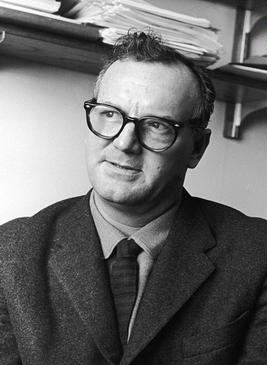
 

They are not men selected (because) of knowledge and sensibility. They are not men shaped by nationally responsible parties that debate openly (and clearly the issues this nation now so unintelligently confronts). They are not men held in responsible check by a plurality of voluntary associations which connect debating publics with the pinnacles of decision. Commanders of power, unequalled in human history; they have succeeded within the (American) system of ORGANIZED IRRESPONSIBILITY.”

C. Wright Mills The Power Elite, 1956: pg 277


Is it some rogue leader or corporate manager that is causing the crisis? Is it some bad man or woman behind these serious, life-threatening problems – just like a mean villain in some Hollywood movie? We do not even have to look closely to see that irresponsible behavior is the norm rather than the aberration – among governments, corporations and within every system.


The manner in which our leaders, including hallowed ones like Barack Obama, are choosing to deal with the issues is as if nothing has happened. It is business as usual. Most of our newspapers are happy to headline the fact that orderly and smooth elections were conducted in a particular region of the world and celebrate the growth and rise of democracy in our time and age. However, not many seem to want to discuss what happens after an election? Yes, the electorate behaved responsibly to usher in or sustain democracy? But what did the leaders do? Did they behave equally responsibly? Do they even understand the oaths and pledges they take when sworn into office? Or have they become so callous and hypocritical that they could care less about what they say and do the exact opposite. They give speeches about the values of democracy but in practice are the most undemocratic people who behave like feudal lords. Managers of corporations and financial companies often laugh about playing with OPM (other people’s money). The behavior of our leaders in governments and corporations only highlights and underlines the fact that we are living in an age of organized irresponsibility. This epidemic of organized irresponsibility runs rife in the corridors of power.


Everyone in power seems to be infected with it today. Or maybe it is just fashionable to be irresponsible when you are part of an organized system.


At the start of 2014 we turn back the clock to the 1950s, especially to one sociologist – C Wright Mills who wrote about ORGANIZED IRRESPONSIBILITY. We explore the idea and notion of organized irresponsibility in the works of C Wright Mills; as we try to understand his seminal construct of organized irresponsibility, the reasons for its existence, and why it still continue to thrive.This exploration of ORGANIZED IRRESPONSIBILITY in the writings of Mills will hopefully help us understand our age and time better:


Like many intellectuals who came of age during the (Great) Depression, Mills hoped that America would advance beyond the competitive capitalism implicated in the crash of 1929. But to his disappointment, the new politics appeared more tepid than transformative. Despite its social welfare advances, Keynesian economics substantially sustained the free-market system while liberalism’s do-or-die pledge to contain Soviet power contributed to the militarization of American society. In response, Mills posited what he called the “politics of truth,” shorthand for a searching and critical re-examination of the nation’s values, commitments, and goals. Notwithstanding the suggestive optimism in the phrase, it translated into a frankly dystopian vision of the Modern Age. In a series of important books on contemporary America — The New Men of Power (1948), White Collar (1951), and the aforementioned The Power Elite — Mills maintained that the imperatives of the U.S. consumer-based economy combined with imperial ambitions to constrict freedom of thought and action.

David Brown in Free Radical, 2009


Mills’ theory of power was used not merely as a sociological tool in pointing to the actual distribution of power but equally as a political instrument in order to make it clear to the reader, that this differential access to influence and decision-making was unfair and had to be rectified. Mills’ power studies were similar to what could be termed bottom-up investigations. He was a kind of whistle-blower on those who thought themselves immune to public criticism and sociological scrutiny – who thought they were “above the law.” He was also a spokesman for the masses against the mass society and he therefore started to appear as an advocate for those struck by adversity and misfortune with his image of life as a trap and a reality going on behind people’s backs. Mills was clearly on the side of the downtrodden and the underdogs in society, the ordinary citizen so to speak.

C._Wright_Mills_motorcycle Image 2

Who was C. (Charles) Wright Mills?


C. Wright Mills evoked mixed emotions in people. His supporters called him a straight-shooter. And his critics thought he was unnecessarily vitriolic and dramatic – reacting more to opinion than facts. They said he was more political than an academic. C. Wright Mills never came to occupy the position as a key figure within mainstream sociology and therefore always led a rather sequestrated existence at the outskirts of academia and therefore of sociological theory. An obscure hybrid of politics and social science who continuously antagonised established positions – the perpetual bee in the bonnet.


Mills decided quite early in his life to debunk the same society that he himself was part of (de-familiarize the familiar); to question the validity of the claims made by those in power positions and to try and to scream aloud the fact that the emperor simply has no clothes on:


“He hated sham and illusion. He did not fear the naked truth and realized that power needs to be clothed, lest if appear naked, and the Emperor has no clothes on like in Andersen’s fairy tale… He was tough-minded and loved tough-minded writers, men of tall talk and no bones about it” (Hans Gerth 1980:72).


Mills is often depicted as something of a mix of the secluded and snobbish intellectual and the uncompromising and cheeky cowboy with a tendency to shoot before asking.Due to Mills’ oppositional approach, he found both aversion and admiration. Thus there are supposedly two positions on Mills within the sociological tradition after his demise – either to valorise Mills or to debunk his influence and reduce his wisdom to trivial insights. Exponents of the admiring school write:


“When Charles Wright Mills died in 1962 at the age of forty-five, he was reputed to be the most widely read sociologist in the world. His work was marked by vigour and energy.He challenged much that passed for conventional wisdom in the spheres of politics and sociology”

(J. E. T. Eldridge 1983)


The second group of critics, though, claim that Mills…


“… has little importance for contemporary American sociology, although his books are bestsellers outside the field and are widely hailed within certain political circles.” 

(Lipset & Smelser 1961:50)


Although Mills was almost always unapologetic about always taking an opposite or oppositional view on a topic, it is only those who did not have the patience to understand his dissent and label him as a Marxist. He was perhaps influenced by a stream of thought that was quite resonant in the USA of his formative years – a farmer and labor organized resistance or movement such as that reflected in the literary writings of Sandburg (Carl) and Steinbeck (John). Mills had socialistic sympathies but he was not a classical Marxist writer. His work opened the doors to a world of power, mostly the abuse of power, and how people came into power not because of merit but due to their family of birth; and their standing in society. Those who were born in a higher class would remain in the higher circles. Mills wanted to expose and attack the very basis and foundation of American culture and thought – which believed in the ‘American Dream’: that America is a classless society and that anyone from any family or class could become whatever they wanted to be in this new country. It was not that Mills did not believe in that. In fact he was a firm believer of that America. It pained him to see that this America of his dreams was just a dream – it could never become reality because of the power elite.


Mills was a sociological prodigy as well as a provoking personage. His writings show a rather fascinating and ingenious radical sociological position of provoking and thought-provoking. His position is an unavoidable perspective within the field not as an obscure variant of Marxist sociology but at the centre-stage of American sociological thinking particularly in the period ranging from the early 1940’s until the late 1960’s:


“What does this solitary horseman – who is in part a prophet, in part a teacher, in part a scholar, and in part a rough-tongued brawler – a sort of Joe McCarthy of sociology, full of wild accusations and gross inaccuracies, bullying manners, harsh words, and shifting grounds – want of sociology?” 

(Shils 1960:78)


Leaving these very harsh words and gross inaccuracies of the above quotation, which J. E. T. Eldridge (1983:109) termed nothing but “an ugly insult” – this quotation probably is a somewhat accurate description of the way Mills was viewed by many of his peers and is viewed by many sociologists even today.


Mills’ contribution to sociology has been questioned, especially by his contemporary sociologists. Is that a good thing or a bad thing? Maybe for someone who is interested in following a safe career path – to be questioned and criticized by one’s colleagues and peers is not a good thing. But never judge a book by its cover and never uncritically accept so-called official accounts of how people are to be viewed and categorized especially of those whose ambition is to attack those in power.


People who attack the positions of power often have more enemies than the people in power themselves. And this is exactly the argument put forth by Mills in his book White Collar. He described the growth of the middle management group in corporations and bureaucracies and the middle class and argues that this group which really does not have much money or much power in reality is actually more invested in maintaining the status quo than anyone else.


As an analyst of his time, a critic of power in general, a castigator of the Cold War realism in international and military affairs and in constant opposition to the academic stalemate of American sociology, Mills always found himself in a never-ending battle with his contemporaries, a battle that in the long run gave him more agony than victories and eventually appeared to be instrumental in crushing him.


In a cultural climate where saying yes to whatever peers are saying or doing is considered clever and smart, the naysayers and objectors to “business as usual”  are the wet-blankets – the party poopers. They are kicked out of the system before they can say C. Wright Mills.


They are not simply kicked out; there is a systematic attempt to first find faults with their personal lives. Oh, now you say that the economic system is rotten – didn’t you buy your wife expensive jewellery for your anniversary then what right do you have to criticize our way of doing things and then simply shouting: You are a liar on 24/7 TV news channels. And then comes the ignoring. Once you have established the criticism of the current system comes from a person of dubious moral standing, you ignore them. And then the argument is turned around on its head – this person is being ignored because they have nothing worthwhile to say.


Although Mills never craved an academic career, never sought sociological salvation through titles, chairs and honors (Horowitz 1972:7), he was a person who liked to stage himself – particularly against the so-called orthodox consensus of the times (Giddens 1982) comprised by a mixture of positivist research techniques, structural-functionalist theories, pragmatic philosophy and modernization theories. Mills was therefore at odds with the mainstream of the sociological tradition of his time which relied heavily on the ideas of this orthodox consensus. And although an award for best book in sociology was eventually named after him, the orthodox consensus nevertheless completely dominated the picture of the sociology between 1940 and 1965. Mills never became a salonfähig scholar – not that he ever wanted to be. C. Wright Mills encountered this orthodox consensus, especially the positivist approach, many times in his lifetime and painstakingly attacked it; it was in diametrical opposition to his own more humanistic vision of the sociological imagination. Throughout his own life time he dedicated his effort to distance himself from this positivist and in his view also reactionary and arch-conservative epistemology.


Mills arrived at Morningside Heights in 1945 as a research associate at Columbia University’s Bureau for Applied Social Research (BASR), which was led by Paul F. Lazarsfeld. The bureau was a leader in the emerging field of survey research and Mills quite rightly regarded his appointment as “a hell of a big break for a kid 28 years old”. Eventually he moved to the sociology department, where he became a full professor in 1956. Among the cluster of public intellectuals who distinguished Columbia during this era — including Richard Hofstadter, Lionel Trilling, and Jacques Barzun — Mills remains a compelling figure whose scholarship continues to challenge our notions of what it means to live in a democracy that comfortably houses a power elite.


In the field of sociology, to be unfashionable, and indeed downright unpopular, some would claim, is the predicament of most C Wright Mills Image 7academics some of the time and something almost everybody will suffer from to certain moderate degrees at particular periods of one’s career; but continuously and intensively to be so is something of a rare honour only conferred on the very few chosen ones within this field. Charles Wright Mills, at one and the same time an intellectual prodigy and an enfant terrible of his discipline, appears to belong to this latter exquisite group of sociologists labelled as outcasts and unfashionable thinker, but as it has been rightly noted, that
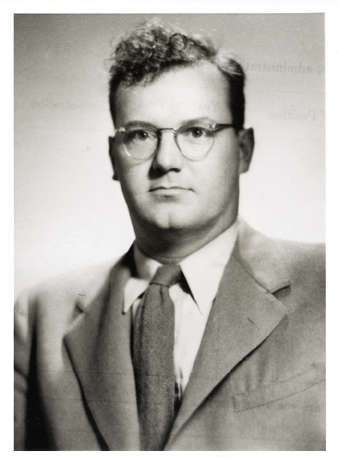
 

“a doctrine [or a person for that matter] that is unfashionable today is, among sociologists, almost guaranteed to be fashionable tomorrow.

(Cohen 1980:141)


But before we get entangled in more quibbling about the perceptions of Mills in society and sociology, let us start from the beginning or close to it.


From Texas to New York


The straight-shooting style of C Wright Mills seems to have been imbibed from his birth-place of Texas where he spent his formative years. Born on August 28th 1916 in Waco, Texas to parents of Irish and English origin with a touch of French ancestry, he was a hybrid of the countryside and cosmopolitanism. His parents were both religiously practising Catholics living in a Protestant area (Tilman 1984:5), but he, as Weber had also described himself some decades earlier, was religiously unmusical and despite being placed in the middle of the Bible Belt did not take an interest in religious matters.


In his adolescent years he went to a rural military school and according to many biographers had a miserable time there – an experience which together with his poor physical shape made him a conscientious objector during World War II. His academic career took off when he enrolled at the University of Texas in Austin where he studied philosophy and became acquainted with the writings of Thorstein Veblen and G. H. Mead. During this period he lived a rather insulated life of anonymity.


In early 1939, as an undergraduate student, he was transferred to Wisconsin, the birthplace of his great idol Thorstein Veblen, and it was here, at Mills’ second destination, that he took keen interest in sociology, guided by two equally liberal and muckraking sociologists – Howard Becker and Edward Ross. Mills subsequently received his PhD in sociology and anthropology from the same university. It was also here that Mills’ tendency to create academic havoc was born, as he ceaselessly started to confront his colleagues with his own ideas and vision of sociology and by many he was already now regarded as much as a provocateur as well as the prodigal son. His professors both praised him as a unique and unusually strong student and looked with concern about his eagerly critical nature.


C Wright Mills Image 5 ApplicationA few years later, Mills moved to the University of Maryland. It was here, when in the backdrop of the World War II and contrary to many other notable radical sociologists such as Herbert Marcuse and Barrington Moore Jr., he did not want to take up work in the State Department as he was a pacifist and believed that any involvement in the war would be an acceptance of war as a means to achieve a given end. He was also suspicious of the Roosevelt administration which, to him, represented a gigantic Leviathan with the ability as well as the ambition to control and regulate society.
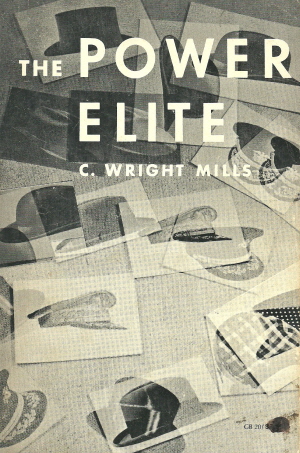
 

After the war Mills received a Guggenheim fellowship to the University of Columbia in New York and it was from this base that the world would come to hear of C. Wright Mills through the next 15 years or so. At Columbia Mills quickly earned the position of associate professor and came to work as director of the Bureau of Applied Social Research (BASR) under the direct supervision of Paul Lazarsfeld. After Mills’ arrival the BASR turned out to be a battlefield for conflicts and antagonism as well as a forum for alliances and new friendships. Throughout his years here,in one of the main two academic sociological strongholds in the U.S.A. at the time (Harvard University being the one and Columbia University the other – the return to sociological prominence of the University of Chicago had to wait until the 1960’s), he was connected to many fascinating empirical projects, most notably those dealing with the distribution of power in American society. He wrote several theoretical as well as downright polemical pieces of work which ranged from anywhere between superb to dubious in quality. It was here that his critique of how prosperity was a facade of misery in American society began to take its form and it was here that his own sociological imagination saw the light of day. Eventually it was also here that this light was finally extinguished.


C. Wright Mills’ Analysis of Power and Organized Irresponsibility


Mills lived in a time obsessed with power; an obsession that stemmed directly from the fact of having lived through a period of world history in which power manifestations were the order of the day, either on the international scene as World War II and de-colonisation struggles flamboyantly symbolised, or on the national level, as the struggle between men and women, capitalists and proletariat, the have and the have-nots were all special cases of. Mills’ writings were clearly contaminated by this obsession with power structures, domination and strong men but he did not so much focus on power as an end product but more on the power processes that took place.


Mills explained the transition of power from being a known force to the current complex force that produces an organized irresponsibility:


“In pre-capitalist societies, power was known and personal. The individual could see who was powerful, and he could understand the means of his power. His responses, of obedience and fear, were explicit and concrete; and if he was in revolt, the targets of that revolt were also explicit and concrete … In an impersonalized and more anonymous system of control, explicit responses are not so possible: anxiety is likely to replace fear; insecurity to replace worry. The problem is who really has power, for often the tangled and hidden system seems a complex yet organized irresponsibility. When power is delegated from a distant center, the one immediately over the individual is not so different from the individual himself; he does not decide either, he too is part of the network by means of which individuals are controlled. Targets for revolt, given the will to revolt, are not readily available. Symbols in terms of which to challenge power are not available – in fact, there are no explicit symbols of authority to challenge”

(White Collar: The American Middle Classes 1951:349).


Mills further explained how large bureaucratic organizations also affect the relations between the rulers and the ruled. Such organizations insulate the managers from those in lower offices, cutting them off from identifying with them (Mills 1951:110-111). In a bureaucratic setting the decision-maker is often far removed from his victims. Opposition in such a situation is difficult to organize. Because of manipulation, targets for revolt are not readily recognizable, because of bureaucratization they are not readily available (Mills 1951:349). Such a situation promotes not only schemers whose explicit ideology is to manipulate the ruled, but a system of social control that fosters irresponsibility on the part of the rulers.


Mills believed that the bureaucratization of the social structure was both partial and unevenly spread. Yet he saw it as an on-going C Wright Mills Image 4b Power Eliite Coverprocess, a process that threatened to replace our once loosely integrated democracy with a more managed “corporate-like society” (Mills 1951:78). The power of decision-makers, Mills points out, has always been limited by the technology of violence and the degree of organization that prevails in a society. But historically in the West, the means of violence has greatly increased, and the degree of organization has enlarged, centralized, and become ever more efficient, as Mills stated in The Power Elite (1956:23). Those at the top of the bureaucratic hierarchies that dominate modern industrial society are far more powerful than Caesar, Napoleon Bonaparte, Vladimir Lenin, or even Adolf Hitler:
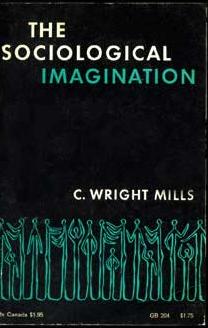
 

“That the facilities of power are enormously enlarged and decisively centralized means that the decisions of small groups are now more consequential” (Mills 1956:23).


Thus, C Wright Mills brought the spotlight directly on the powerful elite.


While there are many different approaches to the study and comprehension of the origin of power, Mills’ work appeared to be unique in its perspective. His approach could also be termed a positional approach since it basically is the institutionalised position that a person holds which grants him or her power and not, although he was aware of the importance and relevance of these aspects, the background, status or privileges to which one can fall back upon. He noted that:


“If we took the one hundred most powerful men in America, the one hundred wealthiest, and the one hundred most celebrated away from the institutional positions they now occupy, away from their resources of men and women and money, away from the media of mass communication that are now focused upon them – then they would be powerless, and poor and uncelebrated…To be celebrated, to be wealthy, to have power requires access to major institutions, for the institutional positions men occupy determine in large part their chances to have and to hold these valued experiences”(Mills in Putnam 1976:15).


Power according Mills, was thus situated in institutions and therefore in the men that occupy positions within these.Mills also clarified about his alleged obsession with power in the following fashion:


“It’s been said in criticism that I am too much fascinated by power. This is not really true. It is the intellect I have been most fascinated by, and power primarily in connection with that. It is the power IN the intellect and the power OF the intellect that most fascinates me, as a social analyst and cultural critic” (Mills 1968:5).


What does Organized Irresponsibility thrive on?


It is their similar social backgrounds that provide one of the major sources of unity among the elite. The majority of the elite, Mills wrote, come from the upper third of the income and occupational pyramids. They are born of the same upper class. Probably their parents were also elites. They attend the same preparatory schools and Ivy League universities. They join the same exclusive gentleman’s clubs, belong to the same organizations. They are closely linked through intermarriage. It is these common experiences and role expectations that produce men of similar character and values (Mills 1956:19).


Non-upper class members of the elite consist of hired corporate managers, experts, and corporate lawyers – men who are competent technocrats, who have risen through the ranks, and are subsequently sponsored by the elite and the organizations that they control. The unity of the power elite, however, does not rest solely on psychological similarity and social intermingling, nor entirely on the structural coincidences of commanding positions and interests; at times it is the unity of a more explicit co-ordination (Mills 1956:19).


Schools, Mills asserts, have become appendages of corporations and government, sorting and training young people for their corporate careers, and in so doing inculcating patriotism, respect for authority, and the glories of capitalism along the way. Families are still major socialization agents of the young, but they now share this function with schools and the mass media (Mills 1956:6).  Through the socialization process, each of us has come to embrace and internalize the system as it is. A general consensus of what is right and natural, good and just, valued and reviled is forged. The interests of the elites become our interests, they become internalized and legitimized.


Organized irresponsibility thrives on both hegemony and apathy of intellectuals.


Intellectual hegemony coupled with the apathy and moral insensibility of the masses and by the political inactivity of intellectuals in both communist and capitalist countries, has led to the domination of manufactured militarism. Most intellectual, scientific, and religious leaders are echoing the elaborate confusions of the elite. They are refusing to question elite policies; they are refusing to offer alternatives. They have abdicated their role, they allow the elite to rule unhindered (Mills 1958:88-89).


If as intellectuals we fail to confront these issues, Mills asserts, we are in default of our intellectual heritage and have abdicated our duty to our society (Mills 1951:158). Unfortunately, Mills concludes, very many in the intellectual community are in default:

“What scientist,” Mills asks, can claim to be part of the legacy of the great western scientific tradition and yet work for the Military Industrial Complex?  What social scientist can claim to be part of the legacy of western humanism and, despite a world in which “reason and freedom” are under attack, retreat into methodologically sophisticated studies of trivia?  What minister can know God and still approve of the immortality and irresponsibility of our leaders?  (Mills 1958:130).


Exertion of Power at a Global Level


Already in his books The New Men of Power (1948) and The Power Elite (1956)Mills began to contemplate the international aspects of power and how power is exercised on a trans-national basis. He clearly saw the connection of the distribution of power on the national scene and the politics of war on the international arena and his analyses were clearly coloured by his own pacifist conscience. This was the backdrop against which Mills unfolded his understanding of history in which the military had played a crucial role in the formation of states and the internal as well as external stability of these states.


International affairs are therefore, in his rather realist view, run by warlords and warmongers who take no interest in the consequences of their staged conflicts and pantomime of power. Furthermore, they were not capable – or interested for that matter – in the personal consequences of their decisions on ordinary people who had to live with fear, anxiety and distrust. In Mills’ view the U.S.A. were just as responsible for the maintenance of this climate of anxiety and threat of mutual destruction as the Eastern (Soviet) Bloc countries. With his focus on the imperialist tendencies of American foreign policy, as we shall return to below in our discussion of his polemical tour de force in The Causes of World War III (1958), Mills was seen as the traitor in American society by many of the so-called sophisticated conservatives as well as many of the more right-wing oriented people because America following World War II had begun to regard itself as the policeman or umpire of international conflicts.


Mills’ overtly questioned this role of international policeman in his writings, not only the role performed by the U.S.A. but by any super power, in which arbitrary and naked power was seen, not merely as illegitimate, but equally as an encroachment on and an injustice to humanity.


Can we then, do something about this organized irresponsibility? Can we hold the powerful elite responsible and address impending disasters?


The positions of the elite allow them to transcend the ordinary environments of men and women. The elite have access to levers of power that make their decisions (as well as their failure to act) consequential. In a society in which structural institutions have become enlarged, centralized, and all encompassing, who controls those institutions becomes the central issue of our time. One important consequence of this fact, Mills asserts, is that leaders of the modern nation state can exert much more coordination and control over the actions of that state.To date, Mills fears, these leaders are acting (or failing to act) with irresponsibility, thus leading us to disaster. But this does not mean that it always must be so.


“What ‘practical men of affairs’ do not face up to is the fact that ‘politics’ today has to do with the wilful making of history. The enlargement and the centralization of the means of history-making signify that, for better or for worse, power elites are no longer in a situation in which their will and reason need be overwhelmed by ‘impersonal forces beyond their control’ … A politics of responsibility is now much more possible than in a society with less far-reaching and less centralized means of power. The present fact is otherwise: A politics of semi-organized irresponsibility prevails. But that fact ought not to blind us to the political possibilities opened up by this great structural change: It is now sociologically realistic, morally fair, and politically imperative to make demands upon men of power and to hold them responsible for specific courses of events.”

(Mills, The Causes of World War III, 1958: 100)


Is there an answer to the problems of the present? Troubles and Issues


C. Wright Mills’thinking was based on the assumption that “human nature” is formed by the intricate interaction of historical and social structure (Mills 1959, p. 13). Socio-cultural systems, in particular the modern nation-state, determine the type of men and women who inhabit that system. Human beings, Mills asserts, cannot be understood apart from the social and historical structures in which they are formed and in which they interact (Mills 1959, p. 162). Through the socialization process, aspects of human character are liberated or repressed. As the history-making unit, the nation-state selects and forms the character of human beings; it opens up possibilities and imposes limits on the variety of men and women who make up the society.


The struggle between countries or blocs of countries – such as the struggles between fascism and democracy, or between capitalism and communism – is more than a struggle between which political or economic system will prevail, it is a struggle over which types of human beings will prevail (Mills 1959:158).


Historical transformations within societies, say the decline of agriculture and the rise of small business, also affect the predominant character of human beings, their values and ideologies, their beliefs and expectations, their very character. Again, men and women can only be understood in the context of the historical socio-cultural system in which they live and interact.


While human beings are motivated by the norms, values, and belief systems that prevail in their society, structural change often throw these “vocabularies of motivation” into some confusion (Mills, 1959, p. 162). The number and variety of structural changes within a society increase as institutions become larger, more embracing, and more interconnected (Mills 1959, pp. 20-21).  As structural institutions become enlarged and centralized the circle of those who control these organizations also becomes narrowed—the “iron law of oligarchy” prevails (Mills 1956, p. 21). Consequently, the tempo of change has sped up appreciably in the modern era, and the changes have become far more consequential for all—for those who are in control of these enlarged organizations, and for those who are subject to them.


Mills presents the “sociological imagination”as an approach to understand the present society as well as comprehend the future. Such an approach warrants sensitivity to the fact that the life of individuals and the history of societies are inextricably linked to each other, and that this link is not always immediately visible. But if we are armed with the sociological imagination, this link will become crystal clear and we will be able to understand connections previously hidden or impenetrable and be capable of explaining to people their lives and their problems more fully and adequately. Mills tries to capture the essence of his seminal contribution of ‘sociological imagination’ in the possibly most famous phrase from his masterpiece, by saying that:


“…the sociological imagination enables its possessor to understand the larger historical scene in terms of its meaning for the inner life and the external career of a variety of individuals. It enables him to take into account how individuals, in the welter of their daily experience, often become falsely conscious of their social positions. Within that welter, the framework of modern society is sought, and within that framework the psychologies of a variety of men and women are formulated. By such means the personal uneasiness of individuals is focused upon explicit troubles and the indifference of publics is transformed into involvement with public issues”

(Mills, The Sociological Imagination 1959:5)


One of the most central aspects of the sociological imagination has to do with the separation of troubles from issues (Mills 1959a: 8-C._Wright_Mills_Book Imagination Image 69), the public versus the private, and not just a separation but perhaps more importantly the ability to see the connection between the two. The former has to do with “the character of the individual and within the range of his immediate relations with others…a trouble is a private matter” (Mills 1959a: 15). Troubles are concerned with how the inner lives of individuals are shaped by outer social structures and how this has an impact on this individual’s behaviour. Issues, on the other hand, are concerned with the structural level and how this is constructed and maintained: “Issues have to do with matters that transcend these local environments of the individual and the range of his inner life. They have to do with the organization of many such milieux into the institutions of a historical society as a whole, with the ways in which various milieux overlap and interpenetrate to form the larger structure of social and historical life. An issue is a public matter” (Mills 1959:15).


The sociological imagination – a title supposedly inspired by Lionel Trilling’s The Liberal Imagination from 1950 – and the idea of craftsmanship also has a close resemblance to Weber’s notion of sociology as a vocation without which, sociology would be an endless drought: “Without this strange intoxication, ridiculed by every outsider; without this passion…you have no calling for science and you should do something else. For nothing is worthy of man as man unless he can pursue it with passionate devotion” (Weber 1948:135).


The ways of Weber and Mills, however, parted with Mills’ insistence that not only ought sociology be regarded as a humanistic vocation but it should also be a political past-time with political connotations in a fashion that would seem inappropriate to Weber’s idea of a value neutral sociological enterprise. The plea for a political sociology is evident when Mills says: “It is the political task of the sociologist – as of any liberal educator – continually to translate personal troubles into public issues, and public issues into the terms of their human meaning for a variety of individuals” (Mills 1959:187).


The problem with much social science today, as Mills sees it, is that it is both devoid of theory and any sense of history.  Being atheoretical, the social scientist often overlooks the relationships among various technologies, structures, and ideas.  Being ahistorical, many social scientists lack the ability to recognize new trends as well as to discriminate between trends of major and minor significance.  Classical social analysis, Mills repeatedly insists, is a set of usable traditions and insights that are strongly rooted in history and theory (Mills 1959, p. 21).


Classical social science focuses on substantive social problems.  It neither builds up from empirical observation nor does it begin with a grand theory of socio-cultural systems and deduce down to human behaviour.  Rather, classic social science places empirical research and theory building in a continuous interaction.  Practitioners of the craft attempt to develop comprehensive frameworks for understanding social order, social change, and social problems.  They then continually test and reformulate these explanatory frameworks in light of empirical study (Mills 1959, pg. 128). However, there are trends within the social sciences as well as trends in the broader society that are endangering the classical tradition and stand in the way of greater social understanding (Mills 1959, p.21). Within the social sciences, Mills maintains, three trends – abstracted empiricism, grand theory, and the use of social science to improve bureaucratic efficiency – have arisen that serve to obscure rather than increase people’s understanding of human social behavior.


Hence, he recommends sociological imagination as an alternative point of view. Mills’ own example of how the sociological imagination can be utilizzed is the case of unemployment. He shows how what appears to be an individual problem and the cause of much private distress actually is linked to the broader structures of society, and equally how a structural economic problem like unemployment is simultaneously the reason behind depressing daily struggle for many people, how the individual’s life is intimately connected to processes beyond his own reach. When contemplating this we must be aware, something which Weber also recognised, that many troubles as well as issues have an economic cause and Mills stated that “both the correct statement of the problem and the range of possible solutions require us to consider the economic and political institutions of the society, and not merely the personal situation and character of a scatter of individuals” (Mills 1959 a: 15).


Issues are, in short, politicised troubles and troubles are the intimately felt repercussions of structural and economic changes in wider society. In this way, the sociological imagination appears as an early attempt at integrating the individual level with the structural level and creates some kind of hybrid in the form of an undefined Giddensian structuration theory or Mertonian theory of the middle range. His attempt at integrating the individual and the collective level by focusing on their point of intersection in particular decisions of social importance, however, was criticized by William Spinrad, who stated that “his interest was in the ‘life’ and ‘death’ decisions, not the vast majority of political-economic-social acts that daily affect people’s lives” (Spinrad 1966). Mills’ megalomania made him focus on world events as the dynamic of social transformation and this meant that his focus on daily decisions was skewed in the direction of the big picture.


Mills wanted to instil in sociologists the desire to ask even the most trivial questions, to make them wonder about social reality and its constitution. Sociologists have to be inquisitive and questioning, to whom nothing seems too obvious and nothing appears too obscure. Only by asking questions can problems – either understood as troubles or issues – be illuminated and eventually solved. Make their troubles your issues and vice versa could almost be the manifesto of the sociological imagination. It ought, however, to be an imperative for the sociologist to ask certain questions: “Whatever else sociology may be, it is the result of consistently asking: (1) What is the meaning of this – whatever we are examining – for our society as a whole, and what is this social world like ? (2) What is the meaning of this for the types of men and women that prevail in this society? And (3) how does this fit into the historical trend of our times, and in what direction does this main drift seem to be carrying us? No matter how small-scale what he is examining, the sociologist must ask such questions about it or he has abdicated the classic sociological endeavor” (Mills 1972:572). In C. Wright Mills own words:


“What I am suggesting is that by addressing ourselves to issues and to troubles, and formulating them as problems of social science, we stand the best chance, I believe the only chance, to make reason democratically relevant to human affairs in a free society, and so to realize the classic values that underlie the promise of our studies” (Mills, 1959, p. 194).


Only the good die young?


“He [Mills] worked hard, often twenty-four hours at a stretch, and he relaxed hard. Since he knew nothing of tennis, swimming, skiing, even walking, he took his relaxation in the form of sleeping…eating…gadgetry, and building” (Life-long friend Harvey Swados (1963:38), reflecting on Mills’ life)


Due to excessive work burdens and the constant trench wars with colleagues at the University of Columbia Mills’ position in the end became increasingly uncomfortable, particularly after the publicised attacks on his superior Paul Lazarsfeld. His physical health began to deteriorate and ultimately his heart failed him, and Mills died in New York on March 20th 1962 at the age of forty-five.


C._Wright_Mills_Diner Image 3


Mills was never particularly popular amongst fellow colleagues, regarded by many as an outcast prophet or opportunist; yet,his work does remain alive among some sociology students and scholars. This essay at the start of 2014 is an attempt to rekindle the fire of “imagination” in societal thinking and action – a torch that has hopefully not been extinguished with Mills’ death.It is perhaps a torch that is passed on from one generation to another as the flame of Mills life and work seemed to be from the same torch lit by John Steinbeck (which he inherited from thinkers before him) and articulated in the voice of the character of Tom Joad in the 1939 novel The Grapes of Wrath:


“Whenever they’s a fight so hungry people can eat, I’ll be there. Whenever they’s a cop beatin’ up a guy, I’ll be there… I’ll be in the way guys yell when they’re mad an’-I’ll be in the way kids laugh when they’re hungry an’ they know supper’s ready. An’ when our folks eat the stuff they raise an’ live in the houses they build-why, I’ll be there.”


The show must go on…


Can we take on the epidemic of organized irresponsibility that plagues our planet today?  Will you be there– participating, watching or changing the channel?


 ©  Michael Jacobsen and Nilesh Chatterjee


Some References:


Brown, David (2009). Free Radical. In Columbia: The magazine of Columbia University. (Review of the book Radical Ambition: C. Wright Mills, the Left, and American Social Thought – by Daniel Geary, University of California Press) Access:

http://www.columbia.edu/cu/alumni/Magazine/Summer2009/reviews.html


Cohen, Percy (1980): “Is Positivism Dead ?”. Sociological Review, 28 (1):141-176.


Eldridge, J. E. T. (1983): C. Wright Mills. Chichester: Ellis Horwood Publishers.


Gerth, Hans H. (1980): “On C. Wright Mills (1962)”. Society, 17 (2):71-73.


Giddens, Anthony (1982): “Hermeneutics and Social Theory”, in Profiles and Critiques in Social Theory. University of California Press.


Horowitz, Irving L. (ed.)(1972): Power, Politics and People – The Collected Essays of C. Wright Mills. New York: Oxford University Press.


Lipset, Seymour M. & Neil Smelser (1961): “Change and Controversy in Recent American Sociol-ogy”. British Journal of Sociology, 12 (1).


Mills, Charles Wright (1951): White Collar: The American Middle Classes. New York: Oxford University Press.


Mills, Charles Wright (1954): “The Conservative Mood”. Dissent, 1:22-31.


Mills, Charles Wright (1956): The Power Elite. New York: Oxford University Press.


Mills, Charles Wright (1958a): The Causes of World War III. New York: Simon and Schuster.


Mills, Charles Wright (1958b): “The Structure of Power in American Society”. British Journal of Sociology, 9 (1):29-41.


Mills, Charles Wright (1959a): The Sociological Imagination. New York: Oxford University Press.


Mills, Charles Wright (1959b): “Culture and Politics: The Forth Epoch”. The Listener, March.


Mills, Charles Wright (1959c): “The Decline of the Left”. Contact, 3:5-18.


Mills, Charles Wright (1959d): “Crackpot Realism”. Fellowship, 25 (1):3-8.


Mills, Charles Wright (ed.)(1960a): Images of Man: The Classic Tradition in Sociological Thinking. New York: George Braziller.


Mills, Charles Wright (1960b): Listen Yankee: The Revolution in Cuba. New York: McGraw-Hill.


Mills, Charles Wright (1968): On Social Men and Social Movements: The Collected Addresses of C. Wright Mills (Only published in Spanish with the title De hombressociales y movimientossociales). Mexico City: SigloVeintiuonEditores.


Putnam, Robert (1976): The Comparative Study of Political Elites. New Jersey: Prentice-Hall.


Shils, Edward (1960): “Imaginary Sociology”. Encounter, 14.


Spinrad, William (1966): “The Socio-Political Orientations of C. Wright Mills: An Evaluation”. British Journal of Sociology, 17 (1):46-59.


Weber, Max (1948): “Science as a Vocation”, in Gerth, Hans H. & C. Wright Mills (eds.): From Max Weber – Essays in Sociology. London: Routledge.


Image references:


Image 1: Wikimedia Commons. Accessed from: http://en.wikipedia.org/wiki/File:C._Wright_Mills_Image.jpg

Image 2: Mills commuted to Columbia College on his motorcycle (Photo by Yaroslava Mills). Accessed at: http://www.cwrightmills.org/

Image 3: Roadside Diner: http://www.columbia.edu/cu/alumni/Magazine/Summer2009/reviews.html

Image 4: Power Elite: http://www.amazon.com/The-Power-Elite-Wright-Mills/dp/0195133544

Image 5: (Image 3 C). Wright Mills at age twenty-eight in a photo he submitted with his application for a Guggenheim Foundation grant in late 1944 (Photo by Brooke Studio, Maryland). Accessed at: http://www.cwrightmills.org/

Image 6: C. Wright Mills’ Book – The Sociological Imagination. Accessed from: http://www.sociologicalthoughts.com/tag/sociological-imagination/

Image 7: C. Wright Mills – Accessed from: https://criticalsociology.wikispaces.com/

Image  8. The New men of Power (Book cover). Accessed from: http://www.press.uillinois.edu/books/catalog/75cnb8yg9780252069482.html


The Gift of Erving Goffman: The Micro-Drama of Everyday Life

“He who would combat false consciousness and awaken people to their true interests has much to do, because the sleep is very deep. And I do not intend here to provide a lullaby but merely to sneak in and watch the way people snore”

(Goffman 1974:14).


Pierre Bourdieu shortly after Goffman’s death thus aptly described him as the ‘discoverer of the infinitely small’.


The Importance of the Everyday


The 1993 film Groundhog Day, voted as a classic American Film captures the power of the “everyday” comically. The word “groundhog” became a popularly used term for the unpleasantness and repetitiveness of the routine everyday. In 2006, the film was added to the United States National Film Registry as being culturally, historically, or aesthetically significant. In the movie, protagonist Phil Connors (played by Bill Murray), an arrogant Pittsburgh TV weatherman who is sent to cover the annual Groundhog Day event in Punxsutawney. He hates this assignment because it means going into a small town to report on an insignificant event. He finds this an insult to his capability and perceived stature as a newsman. To his dismay, the protagonist finds himself in a time-loop, waking up to and repeating the same day again and again. He is frustrated because he is the only one who seems to know that he is repeating the same day everyday. After indulging in pranks, hedonism and numerous suicide attempts, he begins to re-examine the everyday encounters with greater humanity; he approaches the same everyday with humility and respect for the other actors and players in this repetitive everyday life. By changing the way he behaves with the other actors everyday, he becomes a popular person in that town, wins the girl, and also re-examines his own life and priorities.


The “everyday” has always been an important component in all religions, which focus on human actions at a micro-level. However, in our time and era, it seems that economists, environmentalists and electioneering-politicians have become extremely interested in the everyday. The shift in economics towards consumerism in the past few decades necessitates an examination of the everyday habits of consumers. Companies have the mission of increasing sales and hire top-end marketers and advertisers to ensure that their products become a part of the everyday life of their consumers. With billions of people using chemicals, plastics, and fossil fuel, saving the environment requires that people change their everyday behaviours. With the rampant spread of elections (now conflated with democracy) in all parts and countries of the world, politicians are keen on promising a better “everyday” for their constituents whatever be the cost to the national budget or the environment.


Image-Erving_Goffman-wiki-234x300


Most of social science, according to C. Wright Mills, is known for its “grand theories” and “abstracted empiricism”. The work of sociologists about social life often seems unreadable and incomprehensible to most common people who live in that same society. However, thanks to the pioneering work of one post-World War 2 sociologist, many young social scientists are examining the “everyday” through their sociological lenses.


A Canadian-born sociologist who died in the month of November in 1982; Erving Goffman is considered as one of the most influential sociologists of the twentieth century. The Times Higher Education Guide (2007) listed him as the sixth most-cited author in the humanities and social sciences behind prominent names such as Michel Foucault, Pierre Bourdieu, Jacques Derrida, Albert Bandura and Anthony Giddens, but ahead of equally significant contributors to social thought: Jürgen Habermas, Max Weber and Sigmund Freud.


Throughout a career spanning three decades Goffman sought to rectify the gross neglect of ordinary social life and interactions in the study of sociology. Pierre Bourdieu shortly after Goffman’s death thus aptly described him as the ‘discoverer of the infinitely small’.


Towards the end of his life in an interview labelling himself an “ethnographer of small entities” (Verhoeven 1993:322) he summarised the entire essence and mission of his work in the statement:


“the gestures which we sometimes call empty are perhaps in fact the fullest thing of all” (Goffman 1967:90-91).


How the study of the trivialities that were perhaps not so trivial after all provided an important in-road into understanding more comprehensive social processes and more essential features of social life than were previously attempted. Erving Goffman’s sociology had the unique ability to spot and to refine the analysis of that which no one else seemed to take any serious notice of. He had a keen eye and an incisive sensitivity towards seeing the meaningful and important in the apparently trivial and unnoticed features of everyday situations.


image asylums


Goffman’s ability to capture this familiar and trivial world was described by Alasdair MacIntyre as a way of seeing “the familiar with the eyes of a stranger, while at the same time retaining his familiarity with what is being viewed.” Randall Collins (1981) termed him a ‘hero-anthropologist’, an ‘explorer of our social unconscious’.


The general public came to know of Goffman’s work from a feature article in Time Magazine that labelled him “one of the most illuminating – and disturbing – cartographers of that shadowy terrain where man plays at being a social animal without fully understanding exactly what he is doing” (Time Magazine 1969:50).


Goffman is known in academic social theory circles for his study of symbolic interaction, which took the form of dramaturgical analysis. One of his earlier books The Presentation of Self in Everyday Life (1956) captures Goffman’s approach to the study of society. Gofffman’s work lies in the area of the sociology of everyday life, social interaction, social construction of self, social organization (framing) of experience, and particular elements of social life such as total institutions and stigma. Other major works include Asylums (1961), Stigma (1963), Interaction Ritual (1967), Behavior in Public Places (1963), Strategic Interaction (1969), Where the Action Is (1969), Frame Analysis (1974), Gender Advertisements (1979) and Forms of Talk (1981).


Enigmatic and Creative Micro-Sociology Beyond Politics and Structural Analysis


One of the most distinctive and noted features of Goffman’s work – particularly if one recalls the time in which his career took off (in the fifties and sixties) – was his largely apolitical mentality. Contrary to many scholars at the time, Goffman remained unmoved in his work by political or ideological motives. Marshall Ledger recalls an exchange of words between Goffman and a colleague discussing politics.


When the colleague declared that “all the world will eventually be Marxist.” 

Goffman drily – and characteristically – replied: 

“I’m not denying that. But tell me one thing: Do Marxists brush their teeth in the morning?” 

(Ledger 1982:42). 


Goffman’s legacy was inspired by a variety of classical social thinkers and traditions such as Émile Durkheim, Georg Simmel, the early Chicago Sociologists, American pragmatism, ethology, existentialism and the work of Norbert Elias. Moreover, Goffman’s own ideas also went on to inspire as well as provoke many contemporary social thinkers, among them Anthony Giddens, Jürgen Habermas, Niklas Luhmann, Pierre Bourdieu, Randall Collins and Judith Butler. However, Goffman was almost allergic to macro-theorizing, grand theories and the almost vain use of social science theory to rouse people out of their stupor and use sociology as a means of awakening people. William A. Gamson quotes a story of how someone once asked Goffman about his politics: “[Goffman] seemed momentarily taken aback by the question:


“My ‘politics’?” (pause), I don’t think I have any ‘politics’. (Another pause). If anything, anarchist” 

(Gamson 1985:605). 


Gamson went on humorously to suggest how, “in the eternal hunt, Goffman ran with the hares (rather than the hounds)”.


Goffman himself poignantly declared in one of his books – especially aimed at those believing that social science should work as a vehicle for political purposes and sympathies:


“He who would combat false consciousness and awaken people to their true interests has much to do, because the sleep is very deep. And I do not intend here to provide a lullaby but merely to sneak in and watch the way people snore”

(Goffman 1974:14).


The topics that Goffman chose to examine had the potential of becoming political diatribes, however, Goffman wrote about sensitive topics such as stigma, institutionalization, deviance and other latently or manifestly political matters without political declarations. And perhaps this apolitical observance contributed to the continued relevance of his work within contemporary studies of minorities and the downtrodden. However, being apolitical does not amount to being without conscience or concern, or without analytical depth and sophistication, but as Goffman showed it requires that the sociologist understands that the task of social science is to generate knowledge not to provide ideological gun-fire for political campaigns. In the case of Goffman, indeed this knowledge creation is also innovative, thought-provoking, counter-intuitive and even dangerous and disliked knowledge.


He was an enigma because he provocatively sat astride many of the dogmatic barriers erected to keep things theories, paradigms and approaches apart. He was an eclectic well before eclecticism became fashionable.


Goffman presented himself as a detached, hard-boiled intellectual cynic, the sociologist as a 1940s private eye. His was a hip, existential, cool, essentially apolitical (at least in terms of prevailing ideologies) personal style. As a Canadian Jew of short stature working at the margins (or perhaps better, frontiers) of a marginal discipline, he was clearly an outsider (Marx 1984:653).


As should be evident, Goffman was neither unsympathetic to power nor politics – but his politics were not Politics with a capital P but rather politics as an integral part of everyday life and human intimate togetherness, a sort of personalised politics or body politics, as it were. Thus, although it on the surface seemed a distanced attitude to politics – which to the naked eye perhaps even seemed excessively uninvolved and dismissive – it was nevertheless an attitude reflecting a painful awareness of the fact that not everybody made it in the world. Books such as Asylums (1961) and Stigma (1963b) certainly testify to this and Bennett M. Berger emphasised how Goffman’s sympathies, despite his own success, for the losers was part of “the role distance which is obliged for the deviantly successful out of loyalty to all the beautiful losers who never made it” (Berger 1973:361).


Goffman’s work emerged on the sociological scene at a time when quantitative methods and macro-oriented analyses were regarded as the apex of social scientific creativity and when either structural (such as functionalist and later Marxist) or highly individual perspectives (such as behaviourism, exchange theory or psychoanalysis) prevailed. Studies of the everyday, social interaction and social occasions were generally regarded with great suspicion and not seen as desirable routes for aspiring academic candidates. Goffman’s critical comment about the status of the – at that time – sociological priorities perhaps says it all:


Sociology does not provide a ready framework that can order these data, let alone show comparisons and continuities with behavior in private gathering places such as offices, factory floors, living rooms and kitchens. To be sure, one part of ‘collective behavior’ – riots, crowds, panics – has been established as something to study. But the remaining part of the area, the study of ordinary human traffic and the patterning of ordinary social contacts, has been little considered (Goffman 1963a:4).


Despite his theoretical sources of inspiration (such as primarily Durkheim, Simmel and Sartre), and despite his intensive periods of naturalistic fieldwork and data collection, Goffman was neither an armchair/theoretical sociologist nor a naturalistic/empirical one either. He was a hybrid, a man with the ability to mix traditions, techniques and ideas into his own unique and eclectic position. His humorous disdain for those engaged only in airy or abstract theorising – what C. Wright Mills (1959) in Goffman’s own lifetime famously termed ‘grand theory’ – is well-known and he, according to Robin Williams, once described such theorising as:


“two thirds corn flakes, one third taffy” 

(Williams 1998:157) 


In the Preface to The Presentation of Self in Everyday Life he even warned his readers:


“the introduction is necessarily abstract and may be skipped.” 

(Goffman 1959:vi) 


This humorous disdain was counter-balanced by an equal amount of dissatisfaction with statistical or empirical fetishism (what C. Wright Mills had labelled ‘abstracted empiricism’) – without anchor in anything but numbers, scorecards and diagrams; the types of information and reporting that were hardly ever used by Goffman himself.


Goffman’s books and writings continually jostle the reader into chuckles, smiles or broad laughter” (Lofland 1984:19). Goffman consciously developed a refined written style. A man with a flair for words, he succeeded in enticing readers with eloquence and elaborated language games. Arnold Birenbaum and Edward Sagarin commented that Goffman “reminds us of no other social thinker so much as he does of great men of letters, perhaps Marcel Proust or Franz Kafka” (Birenbaum and Sagarin 1973:3-4).


Goffman’s much-publicized mastery of prose and language, his ironic attitude, his vivid essayism and his poignant examples from everyday life made it an exquisite pleasure to read his books compared to the often technical writings and abstract reasoning of many of his sociological colleagues. Also the reader would almost immediately identify with Goffman’s texts and in them recognise events and experiences from his or her own everyday life encounters – something a bit more difficult with the often abstract writings or sophisticated terminology of many structural functionalists or Marxist scholars.


Goffman, despite his outsider position within the social science circles of his time, left the discipline with a treasure trove of insights. Perhaps this is one of the main reasons why his work remains so alive and kicking within the social sciences. One of the major conceptual inventors of the discipline of sociology in the 20th century; he left behind a mind-boggling conceptual arsenal of taxonomies, schemes of classification, neologisms and gave worn-out words new meanings. Collins reports the following list of central concepts developed by Goffman:


Face-work, deference and demeanor, impression management, and the presentation of self; frontstage and backstage, teams and team-work, discrepant roles; a typology of secrets: dark, strategic, inside, entrusted, and free; moral careers, total institutions, and ways of making out in them; commitment, attachment, embracement, engagement, and role distance; focused and unfocused interaction, face engagements, accessible engagements, situational proprieties and improprieties, and the tightness and looseness of situation rules; vehicular units and participation units; territories of the self; personal space, use space, turns, information and conversational preserves; territorial violations; markers and tie-signs; supportive interchanges (access rituals) and remedial interchanges (accounts, apologies, body gloss); frames, keyings, fabrications, frame-breaking and out-of-frame activity 

(Collins 1981:222)


Robin Williams and Susan Jane Birrell’s hard work sorting out and indexing Goffman’s many concepts developed and utilized throughout the years point out that Goffman may have invented close to one thousand concepts (Williams 1988:88n). He was to microsociology what Aristotle was to philosophy or Linnaeus was to botany as he created schemes of classification, taxonomies and a wide range of immediately recognisable sensitising concepts to describe the micro-world of face-to-face interaction.


The Importance of Everyday Life and the Inherent Drama


Historian Eugen Weber once aptly captured the necessity of understanding the often invisible ‘petite histoire’ of social life:


A lot of life is about things so trivial that we do not bother to record them – only sometimes note their absence, as with manners. But the petite histoire is made up of details, and it can surely help to make vaster and more important processes clear (Weber 1986:80).


drama


Erving Goffman’s greatness consisted in his perceptive and courageous interest in conducting research into this ‘petite histoire’ – the intricacies of everyday life – which to most of his scholarly colleagues seemed dull and unimportant and to real people living everyday life appeared so familiar that they were blind to its analytical dimensions. Thus, in a sense Goffman was the quintessential essayist who (to paraphrase Zygmunt Bauman) de-familiarized the familiar. Goffman went against the grain of traditional social science schools of thought and ventured into a territory that everyone thought was quite useless for the advancement of the science. In order to do this Goffman not only started by studying marginal groups but also had to literally become marginal himself.  Thomas J. Scheff wrote:


Since there don’t seem to be any new Goffman on the horizon, perhaps we all need to practice his art of deconstructing taken-for-granted assumptions in social science, not just the Western fascination with the individual. To be as effective as Goffman, we need to be marginal persons, like him (Scheff 2006:31).


In his first best-selling book The Presentation of Self in Everyday Life (1959) Goffman used the imagery and metaphor of theater to portray the importance of human and social action and interaction. This has since been referred to as the dramaturgical model of social life. Goffman argues that social interaction may be likened to a theater and people in everyday life to actors on a stage, each playing a variety of roles. The audience consists of other individuals who observe the role-playing and react to the performances. In social interaction, like in theatrical performances, there is a front region where the actors are on stage in front of an audience. There is also a back region, or back stage, where individuals can be themselves and get rid of their role or identity that they play when they are in front of others. Concepts in the “dramaturgical framework” are similar to those in theatre such as performance, setting, manner, appearance, front, and front stage, back stage, off stage.

Image 2 The Presentation of Self in Everyday Life - Erving Goffman


Grimshaw has written how “Goffman’s gift was a facility to point out things about social life at once completely new and instantly recognizable” (Grimshaw 1983:147).


Javier Treviño in his introduction to Goffman’s Legacy summarizes some key aspects of Goffman’s sociological perspective as attention to the routine and seemingly trivial matters of everyday life; the use of a rich array of metaphors, rhetorical techniques and conceptual schemes; and powerful, yet unarticulated, qualitative research methodology.


Goffman’s great contributions were also to sociological methodology, observational methods and to the poetics of presenting scientific material even of the apparently most unscientific nature. He was one of the first sociologists to give serious academic attention to the micro-social world. And–the special way in which he communicated his scientific findings made Allen Grimshaw (1983) call him as the ‘genuine original.’


Goffman’s Perspective


“Not, then, men and their moments. Rather moments and their men”

– (Goffman 1967:3).


Goffman was an enigma and like a piece of creative work – his writings are constantly and continuously open to interpretation. This is what made him difficult-to-digest for traditional academics and sociologists. In that sense, Goffman was an academic rebel in a suit and without the motorcycle.  There is no one right way of reading, approaching or appreciating Goffman and there is no one correct or authoritative interpretation of his work. On his part, Goffman did not aspire to – provide sociology with a systematic ‘theory’, a ‘method’ or a ‘paradigm’. He provided the discipline with a ‘perspective’ that contained multiple theoretical, methodological, investigative and conceptual insights into a variety of aspects of social life.


A central and most enigmatic feature of Goffman’s sociological perspective was his preferred way of dealing with and describing his favourite research focus: face-to-face interaction in ordinary everyday settings. As many interpreters have pointed out, he described the grammar of social life through three perhaps four main metaphorical frameworks – the theatre, the ritual, the game and the frame.


Whereas his theatrical or dramaturgical metaphor was in part inspired by his devouring of novels and crime stories with dramatic plots and in part shaped by Kenneth Burke’s (1945/1969) idea of ‘dramatism’, his ritual metaphor was clearly informed by the writings of Durkheim and functional anthropology. And whereas the development of the game metaphor was to a large degree inspired by personal experiences as a dealer in a Las Vegas casino as well as his reading of the game-theoretical work of Thomas C. Schelling, his last frame metaphor (although perhaps not really a metaphor) was clearly informed by Gregory Bateson and the cognitive turn in the social sciences. The purpose of Goffman’s many metaphors was, as is often the case when invoking such literary-poetic devices in the social sciences (Rigney 2001) – to dress social reality in new, powerful, colourful and re-contextualised conceptual garments.


Goffman’s perspective was that of qualitative sociologist meets literary-poetic sociologist. As a qualitative sociologist, he believed in participant-observation, using all his senses – systematically as well as impressionistically – to capture face-to-face interaction and as a literary-poetic sociologist he used metaphors, novels, short stories, newspaper clippings and movies as creative sources of inspiration to concoct a sociological storyline about his research topic. Goffman’s insightful descriptions and conceptual delineation of face-to-face interaction was indeed an interplay of informal and flexible metaphorical ideas with a constant flow of impressions from everyday life events – all occurring in the backdrop of his immense knowledge of and inspiration from classical sociologists.


As a qualitatively-oriented sociologist, his preference for participant observation is well-known and celebrated and pertains both to the formally conducted fieldwork sessions in the Shetland Islands and in a mental asylum as well as to a generally observant and curious attitude to everything that went on around him. These events, incidents and observations of everyday life were then strategically used as evidence or examples in most of his books.


Goffman obviously enjoyed submerging into and subjecting himself to the micro-ecological universe of everyday life and he believed that the direct observation of events was indeed important to understanding. In this way, Goffman was a participant observer of all facets of social life and everyday life (around him) and as he commented on participant observation in the posthumously published reflections on fieldwork:


“It’s one [technique] of getting data, it seems to me, by subjecting yourself, your own body and your own personality, and your own social situation, to the set of contingencies that play upon a set of individuals” (Goffman 1989:125).


His books never contained lengthy methodological discussions or descriptions of what he actually did, how, when, why and to whom. Howard Becker commented on this reluctance to provide or reveal methodological guidelines by stating:


[Goffman] felt very strongly that you could not elaborate any useful rules of procedure for doing field research and that, if you attempted to do that, people would misinterpret what you had written, do it (whatever it was) wrong, and then blame you for the resulting mess. He refused to accept responsibility for such unfortunate possibilities (Becker 2003:660).

Direct interviewing – another favourite method among qualitative sociologists – was not a technique practiced by Goffman (perhaps apart from in his master’s thesis); neither was focus group interviewing or other means to extract meaning from people by way of their own accounts and explanations. Was this perhaps due to his suspicion that people refrain from telling the truth if interviewed or hide their actual opinions behind a variety of impression management games. Instead of asking people to say what they do or think, Goffman preferred to watch them.


“I don’t give hardly any weight to what people say, but I try to triangulate what they’re saying with events” (Goffman 1989:131).


In many ways, Goffman’s research strategy – or perhaps anti-strategy – embodied Ken Plummer’s notion of the AHFA Principle – the ‘ad hoc fumbling around’ with its emphasis on the impressionistic, pragmatic, tentative and explorative as compared to more systematic sampling procedures and coherent research designs. Most of his books consciously bear subtitles containing notions such as ‘essays’, ‘notes’ or ‘studies’ (see Goffman 1961, 1963a, 1963b, 1967, 1971, 1972, 1974) signalling something merely tentative, preliminary or suggestive rather than systematic theoretical treatises.


Goffman the Man


John Lofland’s (1984) wonderful and insightful ‘tales of Goffman’ reveal a man with a wholehearted ability to joke about himself and others. Many of these tales also contributed to the almost mythical status that Goffman obtained especially after his death:


  • Passing by a group of old friends in a hotel lobby at a sociologists’ convention, he was heard saying loud and clear: “If I can’t find anybody more important to talk with, I’ll come back and talk with you …
  • A line he used frequently: “In the time I’m talking to you, I could be writing a paper”.
  • At a sociology department party where he encounters an assistant professor who has just been denied tenure and who is angry and bitter about it: “After all, all of us aren’t good enough to teach here” …
  • Asked why he stood for the Presidency of the ASA, his instant one-word reply: “Vanity” …
  • Replying to a student who is suggesting that the dignity and integrity of the self are moral concerns that permeate his work: “I only put in all that self stuff because people like to read about it” (Lofland 1984:20-21).


Throughout his life, Goffman remained – and perhaps even nurtured an image of himself as – a marginal figure. In general, he was opposed to the pigeonholing and ‘boxing’ of intellectual ideas and he defiantly declined any direct affiliation with or membership of any school of thought or paradigm. As he according to Dell Hymes once stated when reviewing an article for a journal:


“I’m getting very tired of slogans and flags and kinship acknowledgements and membership badges”

(Hymes 1984:626).


Later, in Frame Analysis, he revealed even more of the nature of his own sporadic, impressionistic or anecdotal research approach and the data material involved in his analyses:


By and large, I do not present these anecdotes, therefore, as evidence or proof, but as clarifying depictions, as frame fantasies which manage, through the hundred liberties taken by their tellers, to celebrate our beliefs about the workings of the world. What was put into these tales is thus what I would like to get out of them. These data have another weakness. I have culled them over the years on a bit-or-miss basis using principles of selection mysterious to me which, furthermore, changed from year to year and which I could not recover if I wanted to. Here, too, a caricature of systematic sampling is involved (Goffman 1974:15, emphasis added).


Contrary to several other important sociologists writing at his time, Goffman did not establish a school of thought and did not leave a paradigm for his followers to praise or maintain. He was not a Pied Piper parading as paradigmatic founder or intellectual father figure. In Robert W. Friedrichs’s (1970) famous separation between ‘priestly’ and ‘prophetic’ modes of conducting sociological research, Goffman clearly belonged to the latter group as he seemed to have no aspirations to found a congregation of disciples worshipping his work. He rather wallowed in his status as a marginal figure because such a position luxuriously relieved him of the burdening obligation and expectation to conform to the mainstream. Also in this way, as in many others, Goffman was an enigma.


A commonly shared understanding is that Goffman was a mercurial persona, but also a complex human being. He lived a life far away from public spotlights and his appearances as keynote speaker at conferences or other public events were few and far between. He was not fond of the floodlight being turned on himself and contrary to many of his contemporaries who eagerly took part in public debates in the media or took the platform at political rallies, Goffman never showed up.


Goffman “never gave interviews to the media, he never allowed his publishers to release pictures of him and he never appeared on television” (Winkin 1999:19). Goffman was opposed to the “low form of hero worship, an attempt to humanize the field and insulate the sociologist from the study of society” (Goffman in Davis 1980:7) evident in the publication of book after book dealing with academics as if they were celebrities and superstars. He probably would not have liked this article because it places its human object on a pedestal and puts too much emphasis on the individual genius behind the ideas. As Marshall Berman observed:


“Wherever [Goffman] has been, he has been virtually anonymous. He has taken no part in political or cultural affairs. He does not speak at conferences or appear on talk shows. He almost never allows himself to be photographed … In his books, as in his life, he projects a persona of utter impersonality” (Berman 1972/2000:267).


Goffman “discouraged writing about himself” and how he when confronted with the intentions of publishing a book (The View From Goffman) in his honour – according to the editor Jason Ditton (1980) – was “totally against the volume”.


According to one close acquaintance to Goffman, his unimpressive height (he was apparently not very tall, close to 5 feet 4 inches) of which he was consciously aware – apart from occasionally making him the victim of colleagues’ joking – however also made him an almost unnoticed and impressive observer of all those apparently trivial things that took place before his very eyes. His own inconspicuousness thus turned advantageous when observing others and made him specifically alert and sensitive to the way people appeared to each other.


And not only personally and socially, but also academically and politically did Goffman refrain from taking or claiming centre-stage. Collins has noted that “Goffman seems hyper-reflexive; he himself manifests an extreme form of role-distance, separating himself from any clear, straightforward position, be it theoretical or popular. In this sense, he appears as the epitome of the 1950s intellectual – hip to the point of unwillingness to take any strong stance, even the stance of his own hipness” (Collins 1981:253).


Despite little doubt about Goffman’s genius and his gift for writing interesting, witty and thought-provoking sociology, he was not equally popular in all camps or circles of academic life. Everett C. Hughes, Goffman’s teacher at the University of Chicago, in a book review testified to the potential for opposition against Goffman’s observations:


Observation of this measure of intensity is indeed a threat to the face of the observed subjects, if they are moral beings. Laden with guilty embarrassing knowledge, Goffman saves the face of all who are content to let themselves be considered normal, fallible human beings. Those who cannot take his analysis are no doubt tempted to do away with him (Hughes 1969:426).


Erwin (1992) has speculated that Goffman “learned about interaction more by watching than by participating”. Without doubt Goffman was more of a voyeur than an exhibitionist and the fact that he was an entertaining and shrewd social choreographer is well beyond argument and Laurie Taylor (2000:239) dubbed him a ‘licensed voyeur’ wallowing in the watching and observing of people’s attempts to present themselves to each other.


Goffman was not good at dealing with criticism – either he seemed to ignore it or, in a few instances, provided comprehensive and biting counter-replies. One of these latter instances occurred when Norman K. Denzin and Charles Keller (1981) in the early 1980s critically assessed his position and perspective. Goffman carefully commented on their understanding of his work in an extended, sophisticated and irascible reply (Goffman 1981b).


Not Politics with Capital P but a Careful Examination of Power at the Micro-Level of Everyday Life


Sociological research always seeks to strike a balance between distanced or disinterested investigation of social life on the one hand and social engagement on the other. A “sociology” that is too distanced and disinterested runs the risk of becoming irrelevant to people and the world. A “sociology” that openly embraces political ideology or activism ends up diluting its own scientific potential. Traditionally sociology has often been associated with liberal or left-wing political observations. This was also – and perhaps particularly – the case during Goffman’s lifetime. However, if one attempts to find support for specific political ideas in the work of Goffman, one would have searched in vain. In his writings, Goffman remained clinically apolitical and even seemed to find pleasure in joking about his lack of convictions.


Goffman’s ‘politics’, if understood as his personal sympathies or worldview, were those – as so many other students of symbolic interaction, deviance and other morally debatable topics in those days – of an open-minded and tolerant man. Goffman never saw himself as a spokesperson for any political movement or aired macro-political visions, but as books such as Asylums (1961) and Stigma (1964a) clearly indicate, Goffman was clearly sympathetic to the plight of mental patients, deviants and the underdogs.


Goffman’s view on power and politics was therefore much more ‘bottom-up’, with an emphasis on how the less powerful – in institutional and non-institutional settings – resist surveillance and stigmatization and create a meaningful and viable sense of self (Alaszewski and Manthorpe 1995:39). In a micro-sociological and micro-political sense he was thus a very sensitive person – far from the politics concerned with state deficits, war campaigns, poverty, racial inequality or nuclear disarmament.


Peter L. Berger has talked about Goffman’s ‘demonic detachment’ – his own as observer of the micro-social world as well as the general attitude of those who inhabit and get by in this world and most of Goffman’s books were indeed written with this kind of ‘double’ detachment as a conscious and integral part of the plot. Regarding Goffman’s detached political stance (or rather anti-stance), T. R. Young also aptly captured the crux of the matter by stating that “Goffman neither celebrates the priest nor castigates the prostitute” and commented how Goffman was persistent in insisting that “the points of view of psychiatrists, salesmen, professors and police have no prior moral claim on the loyalty of the sociologist than do the points of view of the patient, the customer, the student or the criminal” (Young 1971:276).


The general apolitical nature of Goffman’s work was also noted by Alvin Gouldner who critically stated that his work is “a social theory that dwells on the episodic and sees life only as it is lived in a narrow interpersonal circumference, ahistorical and noninstitutional, an existence beyond history and society” (Gouldner 1970:379). Goffman’s work may be seen as apolitical only in a conventional understanding of ‘politics’ but that his work in fact had political connotations, repercussions and capacities for understanding the micro-battles and micro-conflicts which, every now and then, surface in social gatherings and situations.


Obviously, Goffman’s politics were not the macro-politics of nation-states and organised political parties but the micro-politics unfolding in episodic everyday encounters and in snapshot situations of stigmatisation and struggles to maintain face. Although power as a macro-phenomenon, as the possession of specific social positions or the privileges of particular offices, was almost entirely absent from his analyses, power as a micro-phenomenon permeated most parts of his work (Rogers 1977). In this way, Goffman’s view inspired many later attempts to theorise politics (and especially emotional politics) within micro-settings


Goffman also admitted that people in power positions enjoy privileges unavailable to other social groups and his very last words ever published in his presidential address touched – humorously and succinctly – upon the importance of investigating those segments of society apparently immune to sociological analysis and paid tribute to the continuous importance of sociology as a curious, inquisitive and obnoxious enterprise:


I’ve heard it said that we [the sociologists] should be glad to trade what we’ve so far produced for a few really good conceptual distinctions and a cold beer. But there’s nothing in the world we should trade for what we do have: the bent to sustain in regard to all elements of social life a spirit of unfettered, unsponsored inquiry, and the wisdom not to look elsewhere but ourselves and our discipline for this mandate. That is our inheritance and that so far is what we have to bequeath. If one must have warrant addressed to social needs, let it be for unsponsored analyses of the social arrangements enjoyed by those with institutional authority – priests, psychiatrists, school teachers, police, generals, government leaders, parents, males, whites, nationals, media operators, and all the other well-placed persons who are in a position to give official imprint to versions of reality (Goffman 1983:17).


What a shame he was unable to deliver this provocative speech in person – it may perhaps have given his critics a different view of his work instead of claiming that he was entirely negligent of or indifferent to central and conventional sociological themes such as social power, inequality and stratification. As Collins recollects, even the manner of the cancellation of the presidential address – to which so many looked forward, some perhaps more anxiously than others – was typically Goffmanesque:


“Everyone wondered what he would do for his presidential address: a straight, traditional presentation seemed unthinkable for Goffman with his reputation as an iconoclast, yet to be merely iconoclastic in a public forum was too easy, passé, a mere imitation of earlier cultural forms. I would have predicted yet another multi-levelled public address, polity and conventional on the surface but filled with esoteric claims for the cognoscenti and veiled put-downs of everyone else. Instead we got a far more dramatic message:


Presidential address cancelled, Goffman dying.


It was an appropriately Goffmanian way to go out.


Meadows 1


© Michael Hviid Jacobsen (with editing inputs from The Essayist)


This piece is abstracted and reworked from Michael Hviid Jacobsen (ed.): The Contemporary Goffman. Routledge Studies in Social and Political Thought. New York: Routledge, 2010, 396 pp.

Link to BIBLIOGRAPHY (Goffman)


Sociology of the Absurd

Michael Hviid Jacobsen suggests a list of readings to gain a better understanding of “Absurdity” –and “Sociology of the Absurd.” The Essayist welcomes you to add to this list and make it more comprehensive. To add more readings, please submit at the bottom of this page or email to essayistcomments@gmail.com


Readings:

  • Bauman, Zygmunt (1972): “Culture, Values and Science of Society”. University of Leeds Review, 15 (2):185-203.
  • Blumer, Herbert (1954): “What Is Wrong With Social Theory?”. American Sociological Review, 19:3-10.
  • Boorstin, Daniel J. (1969/1970): The Sociology of the Absurd, or the Application of Professor X. London: Thames & Hudson.
  • Boudon, Raymond (1977): Effets pervers et ordre social. Paris: Presses Universitaires de France.
  • Broadbent, Robert S. (1974): “Notes on the Sociology of the Absurd: ‘An Undersocialized Conception of Man’”. Pacific Sociological Review, 17 (1):35-45.
  • Brown, Richard H. & Stanford M. Lyman (eds.)(1977): Structure, Consciousness and History: New Writings in the Sociology of the Absurd. Cambridge: Cambridge University Press.
  • Burke, Kenneth (1952): A Grammar of Motives. New York: Prentice-Hall.
  • Camus, Albert (1955/2000): The Myth of Sisyphus. Harmondsworth: Penguin Books.
  • Carney, Larry S. (1998): “On Being Anchored in an Absurd World”. International Journal of Politics, Culture & Society, 11 (3):517-523.
  • Esslin, Martin (1991): The Theatre of the Absurd. Harmondsworth: Penguin Books.
  • Garfinkel, Harold & Harvey Sacks (1970): “The Formal Properties of Practical Actions”, in John C. McKinney & Edward A. Tiryakian (eds.): Theoretical Sociology. New York: Appleton-Century-Crofts.
  • Giddens, Anthony (1979): Central Problems in Social Theory. Berkeley, CA: University of California Press.
  • Goffman, Erving (1959): The Presentation of Self in Everyday Life. Harmondsworth: Penguin Books.
  • Goffman, Erving (1967): Interaction Ritual: Essays on Face-to-Face Behavior. New York: Pantheon.
  • Goodwin, Glenn A. (1971): “On Transcending the Absurd: An Inquiry in the Sociology of Meaning”. American Journal of Sociology, 76 (5):831-846.
  • Hall, Edward T. (1969): The Hidden Dimension. London: Bodley Head.
  • Hollis, Martin (1977): Models of Man. Cambridge: Cambridge University Press.
  • Lally, Jim & David L. Preston (1973): “Anti-Positivist Movements in Contemporary Sociology”. Journal of Sociology, 9 (2):3-9.
  • Lyman, Stanford M. (1972): The Black American in Social Thought – New Perspectives on Black America. New York: G. P. Putnam’s Sons.
  • Lyman, Stanford M. (1974): Chinese Americans. New York: Random House.
  • Lyman, Stanford M. (1990): “The Drama in the Routine: A Prolegomenon to a Praxiological Sociology”. Sociological Theory, 8 (2):217-223.
  • Lyman, Stanford M. (1995): NATO and Germany: A Study in the Sociology of Supranational Relations. Fayetteville: University of Arkansas Press.
  • Lyman, Stanford M. (1997): Postmodernism and a Sociology of the Absurd and Other Essays on the ‘Nouvelle Vague’ in American Social Science. Fayetteville: University of Arkansas Press.
  • Lyman, Stanford M. (2001): Roads to Dystopia: Sociological Essays on the Postmodern Condition. Fayetteville: University of Arkansas Press.
  • Lyman, Stanford M. & Marvin B. Scott (1970): A Sociology of the Absurd, First Edition. New York: Appleton-Century-Crofts.
  • Lyman, Stanford M. & Marvin B. Scott (1975): The Drama of Social Reality. New York: Oxford University Press.
  • Lyman, Stanford M. & Marvin B. Scott (1989): A Sociology of the Absurd, Second Edition. New York: General Hall Inc.
  • McCall, George J. & Jerry L. Simmons (1966): Identities and Interactions. New York: Free Press.
  • McDavitt, Joanne M. (1999): Fragments: The Social Construction of the Absurd and the American War in Vietnam. Unpublished PhD dissertation, Boston College.
  • McHugh, Peter (1968): Defining the Situation: The Organization of Meaning in Social Interaction. Indianapolis: Bobbs-Merrill.
  • McNall, Scott G. & James C. M. Johnson (1975): “The New Conservatives: Ethnomethodologists, Phenomenologists and Symbolic Interactionists”. Insurgent Sociologist, 4:49-65.
  • Mills, C. Wright (1940): “Situated Actions and the Vocabularies of Motive”. American Sociological Review, 9:904-913.
  • Milovanovic, Dragan & Jim Thomas (1989): “Overcoming the Absurd: Prisoner Litigation as Primitive Rebellion”. Social Problems, 36 (1):48-60.
  • Morris, Monica B. (1977): An Excursion into Creative Sociology. Oxford: Blackwell.
  • Parsons, Talcott (1949): The Structure of Social Action. Glencoe, Ill.: Free Press.
  • Renfrow, Daniel G. (2004): “A Cartography of Passing in Everyday Life”. Symbolic Interaction, 27 (4):485-506.
  • Rose, William (2003): “Postmodern Subjects: On Lyman’s Sociology of the Absurd”. International Journal of Politics, Culture & Society, 16 (4):569-586.
  • Sagi, Avi (1999): Albert Camus and the Philosophy of the Absurd. Amsterdam: Rodopi.
  • Schwartz, Barry (1971): “Critique of the Sociology of the Absurd”. American Journal of Sociology, 77:153-156.
  • Scott, Marvin B. (1968): The Racing Game. Chicago: Aldine.
  • Scott, Marvin B. & Stanford M. Lyman (1970): The Revolt of the Students. Columbus: Charles E. Merrill Publishing.
  • Shoham, Shlomo G. (1974/2006): Society and the Absurd: A Sociology of Conflictual Encounters. London: Sussex Academic Press.
  • Simmel, Georg (1907/1978): The Philosophy of Money. London: Routledge & Kegan Paul.
  • Simmel, Georg (1908/1955): Conflict and the Web of Group Affiliations. New York: Free Press.
  • Stearns, Peter N. (1994): American Cool: Constructing a Twentieth-Century Emotional Style. New York: New York University Press.
  • Stryker, Sheldon & Kevin D. Vryan (2006): “The Symbolic Interactionist Frame”, in Handbook of Social Psychology. New York: Springer.
  • Tiryakian, Edward A. (1973): “Review of Stanford M. Lyman & Marvin B. Scott: A Sociology of the Absurd”. Contemporary Sociology, 1 (3):220-221.
  • Wrong, Dennis H. (1961): “The Oversocialized Conception of Man in Modern Sociology”. American Sociological Review, 26:183-193.
  • Wrong, Dennis H. (1994): The Problem of Order: What Unites and Divides Society. New York: Free Press.


——————————

Michael Hviid Jacobsen, 2013

Edited by The Essayist Editorial Team


Parts of this article are excerpts from Chapter 11: The Sociology of the Absurd: An Absurd Man in an Absurd World from the book edited by Michael Jacobsen titled: Encountering the everyday: an introduction to the sociologies of the unnoticed. Palgrave Macmillan, 2009


Absurd Man +/- Absurd World Sociology of the Absurd


“The realization that life is absurd cannot be an end, but only a beginning. This is a truth nearly all great minds have taken as their starting point. It is not this discovery that is interesting, but the consequences and rules of action drawn from it.” – Albert Camus


In this article, Michael Hviid Jacobsen Interviews Michael Hviid Jacobsen on the absurdity of every-man looking for meaning every-day


pic 1 Michael Jacobsen standing


MHJ-I = Michael Hviid Jacobsen –Interviewer

MHJ-U = Michael Hviid Jacobsen –Unauthorized Biographer of the Absurd


MHJ-I: Thank you for your time or should I say thank you for my time? I am supposed to interview you, or me, on the meanings of absurdity? I don’t even know where to start – with You or with Me?


MHJ-U: Let’s start with Every-Man (or Every-woman). He wakes up Any-day in Any-city of the world. The time is 7 am. He lights the stove, puts a pot of water to boil, opens a jar of coffee or tea, and readies his cup. He is still in his pyjamas; yawning, not yet ready to face the world, but he boldly steps out of the door. No, he does not want to greet the world or yell good morning to the neighbourhood; he just wants to pick up his daily newspaper from the front porch. Some do not step outside; their hand reaches out and collects the newspaper pushed into the door-handle by the delivery boy.


Isn’t this an everyday practice – a habit for millions? Despite the dwindling sales of newspapers and the waning interest of the youth in newspapers, who would rather be on face-book; what makes every-man reach out for the newspaper every day?


Some say every-man is simply seeking information – to know what’s happening in our world. But, is it just about being informed? Do headlines serve the mere function of informing every-man? I think it’s much more. Newspaper reports help him create a larger story of the world around; and shape every-man’s perceptions of the world. Crime reports from his city tend to make him fearful about violence. Stories of corruption in high places change everyman’s ideas of power and his country’s politics. Thus, the every-day newspaper serves a larger function for evenry-man. It helps every-man make sense of the world – it helps every-man create meaning.


MHJ-I: I can buy that. But, what is the connection between newspapers and absurdity? 


MHJ-U: Let us look at some of the stories that have been published in newspapers in recent years. “Banks responsible for global recession and everyone’s bankruptcy.” The next week’s headline says; “Administration bails out bankrupt banks.” On page 1 the headlines read: “Climate change a serious threat to humankind.” And the business pages say: “Markets celebrate as sales of air-conditioners go up by 500 per cent in China and India.” One headline says: “Health Organization cites mobile phones as potential cause of cancers.” Another headline reads: “Teenagers using smartphones have more sex.”


What kind of sense do they make? I have shown these headlines to people. Some said: “It’s absolutely absurd. What’s happening to this world?” Others said: “It just doesn’t make sense.” What they probably meant was that whatever was going on in the world did not make any meaning to them…We are always trying to make “meanings” out of the smorgasbord of events and incidents that unfold around us. However all of the above only makes complete sense when you see them as totally absurd. (See link to article in this issue – The Absurdist)


Absurd! Isn’t it?


MHJ-I: So, why is absurdity important to understand and to study?
MHJ-U: Well, basically because we all have to die. As soon as we are born we know we will die. Life is absurd already from the onset – the absurdity lies in the fact that we need to create meaning with that ’in advance-limited-timespan’ allotted to each and every one of us – so the absurdity of life incessantly mingles with the horror and reality of death. This makes it even more important to approach, understand, address the inherent absurdity of life.

Pic 2 Tombstone_Albert_Camus


Although, Albert Camus may not have personally approved the label, he has been seen as a philsopher of the absurd. Camus’ writings underlines the fact that the human condition is mortal; however, for Camus, this is not a reason for sadness, in fact, this understanding of mortality shuold lead to a greater appreciation for life and happiness.


Canadian-American sociologist Erving Goffman once incisively – albeit merely in a footnote – stated:

“Poets and the religious are wont to argue that if an individual compares the very considerable time he is slated to spend dead to the relatively brief time allowed him to strut and fret in this world, he might well find reason for viewing all of his life as very fateful play of very short span, every second of which should fill him with anxiety about what is being used up.  And in truth, our rather brief time is ticking away, but we seem only to hold our breath for seconds and minutes of it”.


An epigram from The Rocky Horror Picture Show:

“And crawling on the planet’s face, some insects, called the human race, lost in time, lost in space … and meaning”


So the way humans seem to tackle the absurd knowledge that they are all mortal is by forgetting about it and living life as if death is no part of it. John Lennon’s famous phrase that: “Life is what happens while you’re busy doing other things” – captures the primary human survival-strategy – to live a meaningful and indeed absurd life that is forgetful of death.


MHJ-I: The epigram from the musical The Rocky Horror Picture Show as well Lennon’s quote captures how human beings are lost in time, space and meaning. You are an academic; you spend a lot of your time studying things. Has the “absurd” been studied formally?


MHJ-U: Yes, there is a field of study – “sociology of the absurd.” These sociologists of the absurd touch on issues of how people may act in order to understand and potentially reclaim this lost time, space and meaning. How people may approach the inherent absurdity of a life that is sure of an impending death.


Absurdist writer Albert Camus described his nihilistic novel The Stranger as “a study of an absurd man in an absurd world”. In this book (and many others), Camus claimed that the inhabitants of the modern world were becoming increasingly alienated and experiencing a new malaise materialising in their futile search for meaning and in their search for identity. He insisted that the 20th century marked a turning point in the values and ethics of human society, a radical departure from enchanted and community-based traditional society now setting man loose – to absurdity. This diagnosis sets the sombre tone for one of the most overlooked and least recognized perspectives within sociology, namely the ‘sociology of the absurd’.


Pic 3 Camus Quote


MHJ-I: Have many books been written on this subject: sociology of the absurd?


MHJ-U: Perhaps the “sociology of the absurd” qualifies as the most infinitesimal perspective or approach in sociology because only a book or two has been written within the direct scope of the perspective provided by the original proponents. Also, only a handful of articles dealing with, applauding, or critiquing the perspective of the absurd has subsequently been published.

As a consequence, “sociology of the absurd” is a forgotten perspective, seldom discussed in social theory, and hardly ever directly utilised in actual social research. Moreover, references to readings from the sociology of the absurd rarely appear in university teaching curricula with the consequence that new generations of sociologists remain largely ignorant of this “absurd” perspective. (see link to list of readings and references on sociology of the absurd)


MHJ-I: Does the lack of attention to this subject mean that the sociology of the absurd is utterly unimportant and useless for sociologists?


MHJ-U: Absolutely not. The importance or usefulness of theories or perspectives is not always automatically matched or measured by their popularity or the piles of works published in their honour. There are other reasons that propel a discipline or its books to best-seller status; reasons other than the actual importance of a subject to making human life understandable or better.


We have to rectify sociology’s negligence of this overlooked perspective by introducing the sociology of the absurd as an important field of study for everyone because it represents a perspective that in originality and creativity has covered terrain left uncharted and untouched by more orthodox theories.


However, the lack of sociological books does not in any way point to the ignor ing of the “absurdity” perspective by writers, playwrights, dramatists, and thinkers. Many intellectuals have tinkered with and dwelt upon ‘absurdity.’ Albert Camus was instrumental in providing lucid descriptions of the inherent meaninglessness and absurdity of life and used the term in his 1942 essay, “The Myth of Sisyphus”.

Pic 4 Myth Of Sisyphus Book cover


Then, there is a long list of scholars and writers such as Jean-Paul Sartre, Søren Kierkegaard, Karl Jaspers, Erving Goffman, Harold Garfinkel, Alfred Schutz, Maurice Merleau-Ponty, William Shakespeare, Nicolas Evreinoff, Georg Simmel, Max Weber, Max Frisch, Ludwig Wittgenstein, Edmund Husserl, Luigi Pirandello, Franz Kafka, Marquis de Sade and Friedrich Nietzsche.


“Theater of the Absurd” a term coined by critic Martin Esslin  in a 1960 essay, is well known to the public.  These absurdist plays, written mainly by European playwrights in the late 1950s, were a prominent and provocative presence among the performing arts during the 1950s and 1960s. Some of the eminent playwrights of the Theatre of the Absurd were Samuel Beckett, Eugène Ionesco, Jean Genet, Harold Pinter, and Tom Stoppard. They influenced a distinct style of theatre based on the premise that human existence is generally devoid of meaning or purpose. The plays ranged from tragedy to comedy or parody and often avant-garde plays. ”Waiting for Godot” is termed as one such absurdist play by Samuel Beckett. It has been called one of the most significant plays of the 20th century.


There is a strong tradition and star-studded intellectual lineage behind the sociology of the absurd.


MHJ-I: So, what is the history of this “sociology of absurd” perspective? Where do its roots lie? 


MHJ-U: The sociology of the absurd is a product or phenomenon of the experimental and progressive Zeitgeist of the late 1960s. It can be ranked among the avant-gardist ‘new sociologies’ seeing the light of day during this period, especially among those critical of the status quo of mainstream sociology on the American continent.


The late 1960s was a time of social upheaval, a time of confronting ingrained values and norms, of new social and political movements, of the appearance of new forms of life and of new waves of thinking. In the vortex of this development, the sociology of the absurd attempted to describe this new social environment and man’s role within it in what could – at first glance – be regarded as negative terms.


These new sociologies reacted to the dominance of the so-called ‘orthodox consensus’ consisting of functionalism, neopositivism and modernization theory, especially dominant in American sociology throughout the 1950s and 1960s. Many of the new sociologies were also so-called ‘creative sociologies’ in that they emphasized a creative and active image of the human actor and his meaning-creating capacity. Among these new sociologies were ethnomethodology, symbolic interactionism, phenomenology and other micro-oriented perspectives. Although these positions and traditions were not entirely new, the reception and backing they received especially in these early years was unprecedented in sociology.


The backbone of the field or perspective of absurdity is a collection of essays titled: A Sociology of the Absurd, by Stanford M. Lyman and Marvin B. Scott in 1970. They were employed at University of California and Sonoma State College respectively. Their research agendas primarily evolved around empirical studies of racial issues, student revolts and gambling behaviour; and therefore it was unsurprising that they would eventually venture into a more theoretical/conceptual enterprise culminating in the book A Sociology of the Absurd.


The ‘theatre of the absurd’ (of the 1950s and 1960s) constituted another of the major sources of inspiration for Lyman and Scott and responsible for the original naming of this perspective. On the first page of their manifesto A Sociology of the Absurd, the absurdists attest how this new wave of thinking, to which they subscribe, tries to understand and appreciate the inherent absurdity of life:


The term ‘absurd’ captures the fundamental assumption of this new wave: The world is essentially without meaning. In contrast to that sociology which seeks to discover the real meaning of action – a sociological reality, such as the functional meaning of social behaviour – this new sociology asserts that all systems of belief, including that of the conventional sociologists, are arbitrary. The problems previously supposed to be those of the sociologists are in fact everyday problems of the ordinary man. It is he who must carve out meaning in a world that is meaningless. Alienation and insecurity are fundamental conditions of life – though, they are experienced differently by individuals and groups – and the regular re-humanization of man is everyman’s task (Lyman & Scott 1970:1; original emphasis).


MHJ-I: But, why resort to the absurd? What is that impulse behind studying or examining “absurdity” – what pushes a sociologist of the absurd to study and think about it? 


MHJ-U: While many absurdist novelists and dramatists, take as their starting point of analysis the existential absurdity of human life, it is important to note that sociologists also examine the ‘institutional absurdity’ of modern life. This “institutional absurdity” perspective was developed by Glenn Goodwin in 1971. This perspective finds that there is a deep-seated and deepening dissonance, contradiction, conflict and chasm between self and society.


The absurdists therefore represent a dialectical line of thinking in highlighting the dilemmas and discrepancies between the conditions man create, the contradictions of these conditions and man’s attempt to transcend or annul the absurdity of life through action.


The sociologist of the absurd is actually trying to transcend the absurd.


Glenn A Goodwin has observed how


“… the final and definitive synthesis – ‘the good life’ – is an impossibility. Choosing to act in the face of this realization, it is argued, becomes the determinant of man’s freedom. In other words, man’s choosing to act, with the definitive understanding that his action will resolve nothing, is what determines his freedom … Predicated on this realization, social man consciously creates dissonance to which he can then react, and thus he achieves a semblance of meaning (Goodwin 1971:832; original emphasis).


MHJ-I: What you are saying is the opposite of commonly held beliefs. You are saying that man seeks dissonance whereas many traditional theories in of human behaviour would say that humans seek consonance?


MHJ-U: According to Goodwin, Man is more of a dissonance seeker than a consonance seeker. This creation of dissonance and continuous struggle to solve conflict, confront anomalies or bridge contradictions is fundamental to the absurdists’ view of man’s task in the world. 


Because the world is absurd, it is man’s own personal responsibility to make sense of the world and to carve out islands of meaning in a sea of meaninglessness. Because reality holds no inherent, absolute or objective meaning in store for human actors, and because this lack of meaning may frustrate, infuriate or create a sense of apathy and confusion, humans will have to conjure up meaning for themselves. Therefore, the absurdists present an everyday life consisting of people struggling, competing and fighting.


Man actually never is – he is always becoming through his endless, sisyphusian struggle to tackle absurdity.


MHJ-I: But then how can people possibly address this inherent existential and institutional absurdity of modern living? 


MHJ-U: Albert Camus captured it succinctly when he wrote “…there is a metaphysical honour in enduring the world’s absurdity. Conquest or role-playing, multiple loves, absurd revolt are tributes that man pays to his dignity in a campaign in which he is defeated in advance”.


The absurdity of everyday life cannot be entirely defeated or eliminated, merely momentarily postponed or transcended. An answer to the question: Can absurdity ever be transcended, would therefore be: to some extent, but not definitively. As Lionel Rubinoff explained:


Instead of facing up to the absurd, we either counterfeit or ignore it. Many of our current myths and images of man [such as underlie the practice of the social sciences] have been surreptitiously manufactured for the purpose of counterfeiting the experience of the absurd. I propose to confront the absurd directly by imaginatively living through it … A mind which has achieved a … critical awareness of the absurd … may be said, therefore, to have transcended it (Rubinoff in Goodwin 1971:836).


Absurdist poets and philosophers have often described the world as full of suffering, loss, death, despair, nausea and misery. Take as an example Eugène Ionesco’s poignant observation from Dans les armes de la ville:


“Absurd is that which is devoid of purpose … Cut off from his religious, metaphysical and transcendental roots, man is lost; all his actions become senseless, absurd, useless” (Ionesco in Esslin 1991:23).


When God is dead, as Nietzsche noticed, when there is no providential or metaphysical meaning, and when all traditional systems of thought are undermined, repudiated or found ineffective, man must establish meaning by and through himself. The sociology of the absurd follows this lead but turns it from a defeatist attitude into a constructive sociological agenda.


For ordinary people, rebellion, fight or the ability to say ‘no’ may therefore prove to be the ultimate means to transcend the absurd. ‘Man as a rebel’ fits the absurdists’ strategic worldview well.


Albert Camus has been quoted as saying:


“The realization that life is absurd cannot be an end, but only a beginning. This is a truth nearly all great minds have taken as their starting point. It is not this discovery that is interesting, but the consequences and rules of action drawn from it.”


MHJ-I: Like other social and cultural theories, are there any principles or tenets to the formal study of the “absurd”? 


MHJ-U: At the cost of making a die-hard absurdist flinch, six central tenets may be extracted from the programmatic statements of the absurdists:


(1) human existence is in essence absurd and meaningless,

(2) it is so, although to varying degrees, for everybody,

(3) the problems of creating meaning are not exclusively sociological but relate to everyman,

(4) the human responses to meaninglessness is alienation, uncertainty, conflict and confusion,

(5) it is up to human beings, individually or collectively, to counter this fateful absurdity and create meaning,

(6) this can be achieved, for example, by active intervention and/or strategic and reflexive efforts aimed at the re-humanization of life – that is, giving meaning to the meaningless.


Pic 6 Camus Quote


Since all systems of belief are deemed arbitrary, and since there is no inherent ‘real’ or essential meaning to the world, the human actor is empowered to construct the meaning of the world himself: “It is the meaningless-world-made-meaningful which is the strategic research site for the sociology of the absurd” (Lyman & Scott 1970:27). The ontological foundation for the absurdists is therefore the capacity of the human to be a meaning-creating animal – the ability to carve out meaning where meaninglessness prevails.


Furthermore, the idea of an intellectual or a discipline such as sociology as a saviour in the face of absurdity or suffering does not fit into the absurdist perspective. Because sociologists – like ordinary men – are incapable of releasing humans (including themselves) from their sense of absurdity or ambiguity since sociology is itself caught up in the self-same absurdity and only vicariously, through analyses of absurdity, manages to escape the absurd.


MHJ-I: Is absurdity anarchic? Does the “sociology of the absurd” basically promote the concept of disorder? 


MHJ-U: Absurdists define their sociological task as follows: “Every investigation carried out under the aegis of the “Sociology of the Absurd” is approached with a sense of astonishment that a social order exists.

The puzzle, the mystery of how social order somehow emerges from the chaos and conflict predicated by the inherently meaningless is the motive for the study of social phenomena” (Lyman & Scott 1970:9; original emphasis)


Despite presenting new perspectives and concepts to capture human existence, the sociology of the absurd actually aspires to provide clarification of or an answer to the classical sociological question: How is social order possible?


This ancient philosophical question has puzzled and haunted sociologists throughout history and a variety of widely different answers has been provided and proposed. According to ‘sociologists of the absurd,’ the answer to the question of social order or the problem of society should not be sought in macroscopic institutions or structural arrangements, but instead the answer to this macro-sociological problem might be fruitfully explored in the analysis of the interpersonal rituals and the very stuff of which most rituals are composed. These slightest aspects are, among other things, the daily rehearsed rituals of talk and interaction. The sociology of the absurd provides an original and unconventional framework for understanding and analysing this microcosm of social life and the everyday world.

Pic 7 Prague_ginger_u_fred_gehry


MHJ-I: How do the absurdists encounter this everyday world and how do they create meaning out of a world deemed devoid of meaning? 


MHJ-U: As such the problems of meaning confronting the sociological absurdist is no different from the problems of meaning confronting every human actor. Making sense and constructing meaning is everyman’s task.


Lyman and Scott assert how absurdists reject “the a priori existence of a determined world discovered by the sociologists. It regards man as an actor who builds up his actions on the basis of his goals and his continuing attempts to define and redefine the situation.” The sociologist’s perspective on the world is no more privileged than any other but it may provide important insights into aspects of human sociality that would otherwise remain undiscovered.


Taking drama and conflict as the outset of description and analysis, the absurdists proceed to provide a multitude of conceptual and descriptive tools for making sense of the social world. The aim of the absurdists is to provide descriptive knowledge of the social world enabling human actors to navigate in the world and act accordingly.


Absurdists, therefore, construct typologies and conceptual schemes of the everyday world showing ways to act (e.g. counter, minimise or avoid the inherent absurdity of life). In order to accurately to describe man’s struggle with this absurdity of life, the focus is extensively on topics such as power, conflict, drama, strategy and manipulation culminating in consecutive situations, episodes and encounters:


“It is not that all men are clever calculators constantly matching wits with other men, or that they all boldly stride out with stratagems to challenge fate. Rather, they succeed or fail according to whatever they can do and its effects on situation and chance” (Lyman & Scott 1970:25).


A Georg Simmel-inspired focus on conflict – man in conflict with society, man in conflict with nature and ultimately man in conflict with himself – constitutes a fundamental template for comprehending social life.


If life consists of encounters, episodes, and engagements, among persons pursuing goals of which they are consciously aware, or about which they can be made aware, then it appears that the fundamental structure of human action is conflict. This is true even if individuals are pursuing the same ends, since each is out to maximize his own interests. Thus, even two lovers in an erotic embrace, as Simmel once noted, may be regarded in conflict since each may be seeking to outdo the other in demonstrating affection or providing the other with feeling (Lyman & Scott 1970:5).


When describing and conceptualising the world in such conflictual and dramatic terms, absurdists seek to provide a sober and deep drilling description of social life which refrains from prioritising the views of some specific groups, ideologies or power formations in society:


The world has no objective meaning. One can study the social world from the point of view of the superior or the subordinate; of the lover or his mistress; of the bourgeoisie or the proletariat; of management or labour; of the deviant or of the person who labels him deviant, and so on. What is important is that one should have a perspective, but the particular perspective employed is irrelevant to the rectitude of theorizing. One can make true statements from any perspective, including those not consonant with any available ideology (Lyman & Scott 1970:16).


Absurdists privilege no particularistic perspective – no vantage point on the social world that may, from a moral or valuative perspective, be deemed better or more correct than another.


All perspectives are equal, none being more superior than the other.


MHJ-I: Has any research been conducted using the “absurd” perspective?


MHJ-U: Despite extensive conceptual and typological development and refinement, the absurdists have surprisingly not been particularly successful in proving a paradigm or general framework for carrying out empirical work within sociology and only a minority of scholars have utilised this perspective for empirical analysis.


Lyman and Scott write, “the most appropriate way to gather data for use in studies of the Absurd is by unobtrusive observation of natural settings or by examining reproductions of natural settings – movies, taped conversations, and so on … Today’s democratized prince cannot really be comprehended by survey research”.


One of the few studies in which an absurd perspective has been used is in a study by Dragan Milovanovic and Jim Thomas (1989) who empirically highlight the absurdity of conditions of life and the efficacious action of so-called ‘jailhouse lawyers’.


Drawing upon a body of absurdist assumptions, they illustrate – based on interviews with inmates in maximum security prisons in the US in the 1980s – how prisoners use the law to counter, and successfully suspend, the absurdity of dehumanized life in prison. Through strategic action, reason and cunning the prisoners are able to avoid oppression and keep absurdity at bay. Instead of silently acquiescing and surrendering, they confront the very base of absurdity – the authorities, the system’s ‘looping policies’ and existing definitions of power – by way of litigation and constant appeals to the law. Milovanovic and Thomas’s analysis might fruitfully be extrapolated to struggles against absurdity in many other institutional settings apart from the ‘total institution’ of the prison by showing how people continuously and laboriously seek to rehumanize a dehumanized existence.


MHJ-I: Is there any connection or resonance between the sociology of the absurd and the post-modernist school of thought?


MHJ-U: In a more general sense, at the time of its culmination, the sociology of the absurd anticipated much of what later became conceptualized under the acclaimed headings of postmodernism, social constructivism and deconstructivism associated predominantly with the works of Jean-Francois Lyotard, Jean Baudrillard, Jacques Derrida and Michel Foucault. Therefore, the sociology of the absurd can be seen as a neglected forerunner to postmodernism as well as a critical corrective to some of the ideas advanced by postmodernists. Absurdists were influenced by drama, theatre, literature and intellectuals. Post-modernism and deconstructivism has gone on to influence various disciplines including visual arts, design, cinema, literature, music and architecture (The Dancing House in Prague or Tančící dům in Czech is one such example of the deconstructivist style).


According to Stanford M. Lyman in his collection of essays in Postmodernism and a Sociology of the Absurd, the absurdists converge with – and stand as a precursor to – postmodernists in claiming that (1) although the world has no ultimate ontological or objective meaning, it still almost everywhere seems to make sense to human actors, and (2) the self and society are social constructions.


The sociology of the absurd, just as many varieties of postmodernism and social constructivism, is, preoccupied with how human actors create, construct and interpret the meaning of the reality they take part in. The absurdists reject the radical postmodernist notion of the ‘death of the subject (the human).’ To the sociologist of the absurd, the subject, the human actor, is still very much alive and kicking in everyday life.


MHJ-I: So what would an “absurdist” tell me if I were to ask for her help in doing something to change in my world? 


MHJ-U: The absurdists are concerned with re-humanization of the world. However, they see it as the task of Every-man. The absurdists are not concerned with instigating rebellion or inspiring revolt in order to obtain such re-humanization.  They are neither policy-oriented nor action researchers as many of the radical sociologists of the 1960s. Moreover, they hold no aspirations to alter the social world they encounter. The sociology of the absurd is a thoroughly analytical and descriptive enterprise that favours qualitative research designs.


In his The Myth of Sisyphus Albert Camus set the tone for the way absurdists approach the social world as human beings and investigate it as sociologists: “For the absurd man it is not a matter of explaining and solving, but of experiencing and describing. Everything begins with lucid indifference” (Camus 1955/2000:87).


The sociology of the absurd rests on the classic interactionist dictum that the sociologist should engage with and immerse himself/herself in the natural social environment but refrain from over-identifying with the subjects studied. An ‘involved distance’ is their preferred research strategy – involvement rather than identification.


Moreover, there is an everyday egalitarianism in the sociology of the absurd taking Alfred Schutz’s idea that we are all sociologists to its radical extremes. Thus, the absurdists turn their backs on any notions of the sociologist or scientist being superior to or more advanced in escaping absurdity than the ordinary man.


Every-man should strive to be a careful observer but not be misled into conceiving himself as a social reformer, muckraker, or social engineer. The absurdists therefore state that “the everyday world provides situations from which truth might be extracted by those who would take the trouble to look with the attitude appropriate to witnessing human and divine performances: wonder, astonishment and naïve puzzlement” (Lyman & Scott 1975:2).


In short, it is a matter of NOT taking the world for granted – so that we may approach it, understand it, transcend it and act in it. Like the human actors living in everyday life, the absurdist must try to create or carve out a sense of coherence and meaning from the fragmented, confused subjective encounter with an absurd world thereby allowing for some sort of transcendence. The sociologist of the absurd:


… must be a careful observer in any situation, and his awareness and exact description of the political, legal, social, and moral restraints on the individual is part of his task … [He must] locate the person precisely in the continuum between humanism and fatalism. He must uncover ideology and utopia in each man, wish and transfiguration in each situation. The Sociologist of the Absurd, by his very description of society, by his everlasting unfolding and illumination of the modes and styles of social order, can summon men to build the world of their dreams, but he cannot build it for them (Lyman & Scott 1970:10).


One way to ‘summon men to build the world of their dreams’ is through the path of ‘defamiliarization’ (link defamiliarization last issue interview with Bauman in April issue).


Defamiliarization (questioning and interpreting the familiar in new and different ways) is an important strategy deployed by the absurdists when seeking to comprehend and describe their subject matter – the everyday lives of human actors. By this they aspire to make the familiar world appear strange…


…because when the world is made to appear strange to us we may suddenly stop to think – and perhaps ACT.


*********************


MHJ-U: I have a list of books I would like for you to read. I have provided them (in the link at the bottom of this page).  You seem to have no idea of this very important school of thought – it seems like that your education was absurdly incomplete?


MHJ-I: Are you telling me that I have to read these books in order to complete my education?


MHJ-U: Yes, that is exactly what I am telling you.


MHJ-I: But that’s absurd. Am I not you? Are you are telling yourself to read these books?


MHJ-U: How can that be? I have read these books otherwise why would you interview me? That is not only absurd; it also seems a little bit silly.


MHJ-I: Are you calling me silly? Now that calls for a fight or maybe a duel?


MHJ-U: Are you going to fight with me? That means you are going to fight yourself. That’s weird.


MHJ-I: No, that’s absurd. Didn’t you say during this interview that the goal of “absurdity” is to create dissonance within oneself and in fighting that dissonance we humans create meaning.


MHJ-U: Well, I did say that. No wonder humans are always fighting?


MHJ-I: You mean they are fighting constantly because they are constantly trying to create meaning.


MHJ-U: Sounds absurd, doesn’t it?


MHJ-I: It does. It makes no sense. Violence is absurd and sad. But, there’s nothing like a good fight to pick us up out of our sadness. Really! So do you want to fight? When? Where?


MHJ-U: On the pages of this publication….Virtually?


*********************

*********************

Michael Hviid Jacobsen suggests a list of readings to Michael Hviid Jacobsen to gain a better understanding of “Absurdity” – (link to readings Page) and welcomes you to add to this list. To add more readings, submit at the bottom of this page or email to essayistcomments@gmail.com


READING LIST – Sociology of the Absurd (on separate page) (click here)


© Michael Hviid Jacobsen, 2013; Edited by The Essayist Editorial Team


Parts of this interview are taken from Chapter 11: The Sociology of the Absurd: An Absurd Man in an Absurd World from the book edited by Michael Jacobsen titled: Encountering the everyday: an introduction to the sociologies of the unnoticed. Palgrave Macmillan, 2009


********


Image references

Camus Tombstone: https://commons.wikimedia.org/wiki/File:20041113-002_Lourmarin_Tombstone_Albert_Camus.jpg

Albert Camus Picture: http://en.wikipedia.org/wiki/File:Albert_Camus,_gagnant_de_prix_Nobel,_portrait_en_buste,_pos%C3%A9_au_bureau,_faisant_face_%C3%A0_gauche,_cigarette_de_tabagisme.jpg

The Myth of Sisyphus from:  http://en.wikipedia.org/wiki/File:MythOfSisyphus.jpg

Waiting for Godot from: http://en.wikipedia.org/wiki/File:WaitingForGodot.JPG

Camus Quote: http://weheartit.com/entry/20280365

Dancing House, Prague from: http://en.wikipedia.org/wiki/File:Prag_ginger_u_fred_gehry.jpg


Copyright:

All copyright belongs to the author(s). The Essayist does not claim copyright over any of the materials published in this website. If you want to use any material, please contact the author or contact Essayist.in to get author’s contact details.


The images have been placed by the design and layout team for illustrative purposes only. The sources of the images and the web-links have been cited in the Image references list above. Please click on the links provided to access those pages.


Escaping Inside Utopia

Zygmunt_Bauman_by_Kubik

Part 2 of Zygmunt Bauman Interview


The idea of ‘the good life’ is often associated or equated with some notion of ‘the good society’ or at elast some form of ‘utopia’ – the imagination of alternative, better futures for humans and their societies. Although utopia is not a conventional concern of sociologists, the topic of utopia – the idea of a different or even better world – is nevertheless a recurrent theme in Bauman’s writings from the early books – e.g. Socialism: The Active Utopia (1976) to Liquid Times (2007). Profesor Bauman has argued in various writings that the notion of ’utopia’ serves an important purpose in that it undermines the sense that the present state of affairs in un-changeable and thereby stimulates action towards change.


michael-hviid-jacobsen keith-tester bauman-Octaedrajpg
MHJ: Michael Hviid Jacobsen (MHJ) Professor of Sociology, Aalborg University, Denmark KT: Keith Tester (KT) Professor of Sociology,
University of Hull, United Kingdom
ZB: Zygmunt Bauman  (ZB) Emeritus Professor of Sociology, Leeds & Warsaw


MHJ/KT: So Professor Bauman, why is utopia important for understanding society?


ZB: Utopian dreams, as prodromal symptoms of an approaching modernity, needed two conditions. First, was the overwhelming (even if diffuse and inarticulate) feeling that the world was not functioning properly and had to be attended to and overhauled to set it right. Second, the confidence in human potency to rise to the task; the belief that ‘we, humans, can do it’ – being armed as we are with enough reason to spy out what is wrong with the world and find out with what to replace its diseased parts, and with enough strength to graft such designs on human reality. In short, the potency to force the world into a shape better fit to the satisfaction of human needs – whatever those needs already are or yet may become.


With those two conditions now (at the present time) by and large missing or at least enfeebled, there is little or no room left for utopian musings; not many people would treat utopian blueprints seriously, were they offered them for consideration.


MHJ/KT: Why do you say that people in today’s world would not take utopian ideas or plans seriously?


ZB: Even if we knew what to do to make the world better, and took the job of making it better to our hearts, the truly puzzling question would be who has sufficient resources and strong enough will to do it …


For a large part of the modern era, the hope of re-making the world used to be vested in the resourceful authorities of nation states – but as Jacques Attali recently observed in La voie humaine, ‘nations lost influence on the course of affairs and have abandoned to the forces of globalization all means of orientation in the world’s destination and of the defence against all varieties of fear’.


Under the new circumstances, Roget’s Thesaurus, justly acclaimed for its faithful recording of the successive changes in verbal usages, had every right to list the concept of the ‘utopian’ in close proximity to ‘fanciful’, ‘fantastic’, ‘fictional’, ‘chimerical’, ‘air-built’, ‘impractical’, ‘unrealistic’, ‘unreasonable’, or ‘irrational’. And so are we indeed witnessing the end of utopia?


MHJ/KT: But isn’t the desire to move forward towards a better future also associated with “progress”?


ZB: ‘Progress.’ Yes, that is another, closely related notion, which played a seminal role in the shaping of the modern world; but the notion of ‘progress’  also seems to have fallen on hard times. When (if) that notion crops up nowadays in public discourse or private contemplation, it no longer refers to a forward drive — rather than a chase after a spinning-along utopia, it implies a threat that instead of promising improvement makes an imperative out of a lucky escape; it inspires the urge to run away from a breathing-down-the-neck disaster.


Progress, to cut the long story short, has moved from the discourse of shared improvement to that of the individual survival. Progress is thought about no longer in the context of propulsion to rush ahead, but in connection with the desperate effort to stay in the race. We do not think of ‘progress’ when we rejoice watching the world around running faster ahead, but when we worry about staving off the fall.


The notion of ‘progress’ is saturated with the anxiety and redolent with the odour of the rubbish heap: it exudes the fear of being excluded. The time flows on, and the trick is to keep pace with the waves. If you don’t wish to sink, keep surfing – and that means changing your wardrobe, your furnishings, your wallpapers, your look, your habits – in short, yourself; and as often as you can manage.


I don’t need to add, since this should be obvious, that the present emphasis on the disposal of things – abandoning them, getting rid of them – rather than on their appropriation, suits well the logic of consumer-oriented economy. People sticking to yesterday clothes, computers, mobiles, or cosmetics would spell disaster for an economy whose main concern and the condition sine qua non of survival is a rapid and accelerating assignment of sold and purchased products to waste, and in which the swift waste-disposal is the cutting-edge industry.


MHJ/KT: And so what has replaced the idea of utopia?


ZB: Increasingly, escape has become now the name of the most popular game in town. Semantically, escape is the very opposite of utopia, but psychologically it is the sole available substitute: one would say – its new rendition, re-fashioned to the measure of our deregulated, individualized society of consumers, the kind of society in which you can no longer seriously hope to make the world a better place to live and you can’t even make really secure that better place in the world which you might have managed to cut out for yourself.


What is left to your concerns and efforts is the fight against losing: try at least to stay among the hunters, since the only alternative is to find yourself among the hunted. And the fight against losing is a task which to be properly performed will require your full, undivided attention, twenty four hours a day and seven days a week vigilance, and above all keeping on the move – as fast as you can …


MHJ/KT: So what kind of life would that be – the life of escape?


ZB: Joseph Brodsky, the Russian-American philosopher-poet, vividly described the kind of life that has been set in motion and prompted by the compulsion to escape. The lot of the losers, of the poor, is – he says – violent rebellion or, more commonly, drug addiction: ‘In general, a man shooting heroin into his vein does so largely for the same reason you buy a video’ – Brodsky told the students of Dartmouth College in July 1989. As to the potential haves, which the Dartmouth College students aspire to become,


you’ll be bored with your work, your spouses, your lovers, the view from your window, the furniture or wallpaper in your room, your thoughts, yourselves. Accordingly, you’ll try to devise ways of escape. Apart from the self-gratifying gadgets mentioned before, you may take up changing jobs, residence, company, country, climate, you may take up promiscuity, alcohol, travel, cooking lessons, drugs, psychoanalysis…


In fact, you may lump all these together, and for a while that may work. Until the day, of course, when you wake up in your bedroom amid a new family and a different wallpaper, in a different state and climate, with a heap of bills from your travel agent and your shrink, yet with the same stale feeling toward the light of day pouring through your window…


Andrzej Stasiuk, an outstanding Polish novelist and particularly perceptive analyst of contemporary human condition, suggests that ‘the possibility of becoming someone else’ is the present-day substitute for the now largely discarded and uncared-for salvation or redemption:


Applying various techniques, we may change our bodies and re-shape them according to different pattern … When browsing through glossy magazines, one gets the impression that they tell mostly one story – about the ways in which one can re-make one’s personality, starting from diets, surroundings, homes, and up to rebuilding of psychical structure, often code-named a proposition to ‘be yourself’.


Sławomir Mrożek, a Polish writer of a world-wide fame with a first-hand experience of many lands, agrees with Stasiuk’s hypothesis: “In old times, when feeling unhappy, we accused God, then the world’s manager; we assumed that He did not run the business properly. So we fired Him and appointed ourselves the new directors”. “But”, as Mrożek, though notoriously loathe of clerics and everything clerical, finds out – business did not improve with the change of management. It has not – since once the dream and hope of a better life is focused fully on our own egos and reduced to tinkering with our own bodies or souls, “there is no limit to our ambition and temptation to make that ego grow ever bigger, but first of all refuse to accept all limits …


I was told: ‘invent yourself, invent your own life and manage it as you wish, in every single moment and from beginning to end’. But am I able to rise to such a task? With no help, trials, fittings, errors and rehashing, and above all without doubts?”.


The pain caused by the unduly limited choice has been replaced; we may say, by no lesser a pain, though this time inflicted by the obligation to choose while having no trust in the choices made and no confidence that further choices will bring the target any closer. Sławomir Mrożek compares the world we inhabit to a:


market-stall filled with fancy dresses and surrounded by crowds seeking their ‘selves’ … One can change dresses without end, so what a wondrous liberty the seekers enjoy … Let’s go on searching for our real selves, it’s smashing fun – on condition that the real self will be never found. Because if it were, the fun would end …


The dream of making uncertainty less daunting and happiness more plausible by changing one’s ego, and of changing one’s ego by changing its outer wrappings, is the ‘utopia’ of liquid modern times; the ‘deregulated’, ‘privatized’ and ‘individualized’ version of the old-style visions of good society, society hospitable to the humanity of its members.


MHJ/KT: Why have people adopted “ESCAPE”?


Zygmunt-front-600x297


ZB: As Blaise Pascal centuries ago prophetically noted, what people want now is “being diverted from thinking of what they are…by some novel and agreeable passion which keeps them busy, like gambling, hunting, some absorbing show…”. People want to escape the need to think of ‘our unhappy condition’ – and so ‘we prefer the hunt to the capture’. ‘The hare itself would not save us from thinking’ about the formidable but intractable faults in our shared condition, ‘but hunting it does so’.


The snag is, though, that once tried, hunt turns into compulsion, addiction and obsession. Catching a hare is an anti-climax; it only makes more seductive the prospect of another hunt, as the hopes that accompanied the hunt are found to be the most delightful (the only delightful?) experience of the whole affair. Catching the hare presages the end to those hopes – unless another hunt is immediately planned and undertaken.


MHJ/KT: So are we then seeing clear signals of the end of the idea of utopia?


ZB: Is this the end of utopia? In one respect it is – in as far as the early-modern utopias envisaged a point in which time will come to a stop; indeed, the end of time as history. There is no such point though in hunter’s utopia, no moment where one would say that the job has been done, the case open and shut, the mission accomplished – and so could look forward to the rest and enjoyment of the booty from now to eternity.


In the utopia of hunters, a prospect of an end to hunting is not tempting, but frightening – since it may arrive only as a personal defeat. The trumpets will go on announcing the start of another adventure, the greyhounds’ bark will go on resurrecting the sweet memory of past chases, the others around will go on hunting, and there will be no end to universal excitement … It’s only me who would be stood aside, excluded and no longer wanted, barred from other people’s joys; just a passive spectator on the other side of fence, watching the party but forbidden or unable to join the revellers, enjoying the sights and sounds at best from a distance and by proxy.


If a life of continuing and continuous hunting is another utopia, it is – contrary to the utopias of the past – a utopia of no end. A bizarre utopia indeed, if measured by orthodox standards; the original utopias promised temptingly the end to the toil – but the hunters’ utopia encapsulates the dream of toil never ending.


Strange, unorthodox utopia it is – but utopia all the same, as it promises the same unattainable prize as all utopias brandished, namely the ultimate and radical solution to human problems past, present and future, and the ultimate and radical cure for the sorrows and pains of human condition. It is unorthodox mainly for having moved the land of solutions and cures from the ‘far away’ into ‘here and now’.


Instead of living towards the utopia, hunters are offered a living inside the utopia. The end of the road would be the lived utopia’s final, ignominious defeat. Adding insult to injury, it would also be a thoroughly personal defeat and proof of a personal failure. Non-participation in the hunt can only feel as ignominy of personal exclusion, and so (presumably) of personal inadequacy.


Utopia brought from the misty ‘far away’ into the tangible ‘here and now’, utopia lived rather than being lived towards, is immune to tests; for all practical intents and purposes, and it is immortal. But its immortality has been achieved at the price of frailty and vulnerability of all and each one of those enchanted and seduced to live it …


MHJ/KT: Thank you once again.


© Michael Hviid Jacobsen & Keith Tester


Also see The Bauman Institute, School of Sociology & Social Policy, University of Leeds inspired by the sociological imagination of this unique thinker.

Find more images and Articles :

http://beinghumanthesedays.com/bauman-and-gadacz-a-debate-in-warsaw/

http://octaedro.es/bauman-y-la-vida-liquida/zygmunt-bauman/

http://www.ashgate.com/isbn/9780754670605

http://www.postcolonialeurope.eu/2012/06/liquid-europe-june-1st-univeristy-of.html

http://owni.eu/2011/03/25/egypt%E2%80%99s-liquid-modernity/


© 2026 THE ESSAYIST

Theme by Anders Noren — Up ↑