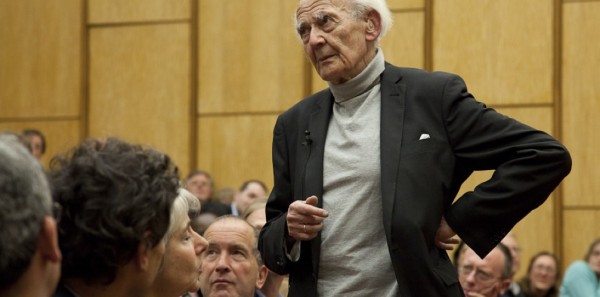
Author: Keith Tester

Bauman before ‘Bauman’ (Part 2) – Zygmunt Bauman talks about the 1960s, Poland, and his early work

This is Part 2 of a larger conversation between Zygmunt Bauman, Michael Hviid Jacobsen & Keith Tester. In this part they discuss and examine the decade of the 1960s in Poland as it unfolded in Professor Bauman’s academic and intellectual life; and the circumstances which shaped his early writing and growth as he left Poland, moved to Leeds, and went on to become the foremost sociologist and intellectual of our times.


Born in Poland, eminent sociologist Zygmunt Bauman has been writing since 1960 when he published his first book. However Bauman became the Bauman we know since the 1990s. After moving to University of Leeds Bauman published extensively; and his reputation has grown globally.


In the late 1980s and early 1990s Bauman wrote about modernity, bureaucracy, rationality and social exclusion. Bauman argued that modernity sought to address the uncertainties of life by creating rules and regulations, hierarchies and bureaucracies and essentially exert control over nature. The attempt to make chaotic human life ordered and systematic led to increased control over human society and categorisation. Thus, we essentially exchanged our individual freedoms with our need for security. Bauman also argued that such efforts to impose order and create manageable categories led to social exclusion and used the concept of the “stranger” to illustrate the ill-effects of such ordered categories.


In the mid-to-late 1990s, Bauman wrote on postmodernity and consumerism. Bauman noted a change from a society of producers into a society of consumers. The need for security was exchanged for the freedom to consume. Bauman wrote of this shift as being a shift from modernity to post-modernity. However, due to the mis-understanding of the term postmodernity, Bauman started using metaphors of “liquid” and “solid” modernity.


This conversation examines the man and his life and thoughts before he became Bauman. It starts with his early efforts in Poland and through his exile from Poland and migration to United Kingdom (UK) in the early 1970s.

 

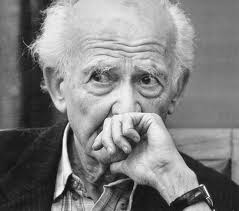
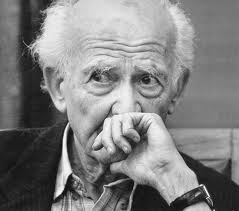
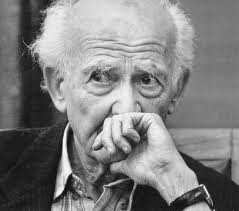
michael-hviid-jacobsen keith-tester bauman-Octaedrajpg
MHJ: Michael Hviid Jacobsen (MHJ) Professor of Sociology, Aalborg University, Denmark KT: Keith Tester (KT) Professor of Sociology,
University of Hull, United Kingdom
ZB: Zygmunt Bauman  (ZB) Emeritus Professor of Sociology, Leeds & Warsaw


MHJ/KT: We would like to begin with your early English language work, for the most part the essays that were published while you were still based in Poland. Why was so much Polish sociology published in English (for example the Polish Sociological Bulletin was an English language publication)?


ZB: Every sociologist who thinks and writes in a ‘non-global’ language has been confronted with the question of publishing in English. It has been a question of “to-be-or-not-to-be” in the profession of sociology, which has been global since its inception. Nor is it any wonder that, in most non-English speaking countries, local sociologists lean over backwards to put together a periodical that makes their works available, and hopefully known, to the speakers of this global-language of English. In addition to the ‘Catch 22’ quandary in which all aspiring authors are everywhere cast (you won’t find a publisher unless you have made yourself a name, but you will not make a name unless you find a publisher), a foreign-language writer can hardly count on English publishers, because they are reluctant to invest money in translating the works of unknowns who are also blighted with unpronounceable names. I could tell a lot of stories about this. I have tried hard but mostly unsuccessfully to convince quite a few publishers to take a risk with some of the remarkable oeuvres of my Polish colleagues.


But I doubt whether Polish sociologists are any more keen or successful than others in getting their work published in English. The most profound and precious, and particularly the most original, works of the greatest Polish sociologists, including my masters, are still waiting in vain to be made available to a global readership. This situation is more harmful to the global English readers than the foreign, vernacular group since Poland is a large country with its own wide, avid, critical and grateful readership, and almost all Polish sociologists are fluent in English.


As to myself, the list of my Polish-language publications of the period includes the positions which were central to my preoccupations of the time and which, retrospectively, also appear to be the turning-points of my intellectual itinerary (works like On the Need of a Sociology of the Party, Essay on Bureaucracy, On the Profession of Sociologist, or Visions of Human Worlds). Those positions derived their inspiration and whatever meaning and significance they had from trials and tribulations that were internal and specific to Poland. They were too deeply and tightly enmeshed in Poland’s own (and at that time still mostly subterranean) struggles, to be of any interest, or indeed to be comprehensible, to native English readers.


MHJ/KT: You say that two of your Polish-language publications, On the Profession of Sociologist and Visions of Human Worlds, were essential to the emergence of your position. Could you tell us something about what these publications argued? What does the profession of sociologist require, and what are the ‘visions’ of the human world to which you referred?


ZB: A word of warning is in order: Contrary to a common opinion which social scientists tend to endorse, much of our thinking, and perhaps the most seminal part of it, is not ‘targeted’, not a ‘purposeful activity’. From my own experience, at least, I am rather inclined to endorse Adorno’s resigned conclusion that we think just because we cannot not think. The ‘objective’ of mental efforts usually comes as an afterthought, a codicil that is added later. I would be cavalier with the truth were I to say that I undertook the works you’ve mentioned with the intention of elaborating a position. The ‘in order to’ at the time I wrote them up was not the same ‘in order to’ as the one which later ruminations, and your question, have retrospectively imputed.


Trying hard to recall the ‘motivational causes’ that prompted and guided my search, or rather to fill blank spots in memory while calling imagination to help, I believe I need to start from remembering the situational setting. After a few years of exile, sociology was let back into the post-Stalinist era through the back door. No identity card was issued, no clear status accorded, let alone assured. Sociology lived in a sort of ‘suspended animation’ that could be terminated at any moment on any pretext, or without one. It was without doubt an unpleasant situation to be in, and yet with the benefit of hindsight I suspect that such a state of guilt without a charge, of under-definition unconstrained by any canon, unhampered by a ‘paradigm’, was in a way also a blessing, even if in a very unprepossessing disguise.


It spurred critical self-scrutiny that drew into focus the ‘self-evidences’, and so offered a closer look at a host of unspoken assumptions which under more enjoyable circumstances gladly would have been left in the shade and in silence. We went on asking ourselves about the fundamentals about which our ‘Western’ colleagues did not much worry and were genuinely puzzled when challenged to make explicit and analyse.


In Poland, I was just one among many aspiring sociologists who had first to find the address at which the new home was located and then to scan its interior to make it fit for decent, sensible living. The two pieces you ask about were inspired by (indeed, were a logical consequence of) that preoccupation.


The first piece On the Profession of Sociologist reported the search for location. Sociology collects the information about whatever follows from the fact that humans are not loners but live in company and willy-nilly influence each other’s choices and the condition under which choices are made, as well as their plausible range. In other words, sociology collects the information about the difference that is made by living ‘in society’. That much was commonly agreed. The rest, though, was ‘essentially contested’ and called for taking sides. Some of the contests called for taking sides more imperatively and urgently than others. One such contention was the main theme of the essay that was dedicated to unpacking the sociological profession, a somewhat updated and domesticated version of Weber’s Beruf. When working on it, I thought, mistakenly as it later transpired, that I was trying to resolve a thoroughly local and hopefully temporary, Polish (or the ‘socialist camp’s’) dilemma, which arose from the authoritarian nature of the political regime and from its bid to manage everything and eliminate the un-manageable. It did not occur to me that a life-long position would emerge on that occasion. I just did not realize at the time that the local Polish experience was but an extreme and particularly festering specimen of a contention that in the plight of sociology was neither incidental nor local. I did not realise then that it was precisely the extremity of the Polish case that made it possible to perceive a universal dilemma more clearly than elsewhere.


To start with, Polish state authorities were quite outspoken about matters in which other, non- or less-authoritarian, powers preferred to move in a roundabout, underhand and a rather inconspicuous fashion, while careful not to leave too many foot- and finger-prints. The Polish rulers left little doubt that what they wished sociologists to do (and the only sociological undertaking they would tolerate) was to help them make the obstreperous obedient and the obedient more docile yet, to convince the unconvinced and make the convinced immune to doubts. In short (to resort to Weber’s terms again) they wished the ‘really existing’ Herrschaft to rebound, just as its ideal type did in theory, in the unconditional Disziplin of the subjects.


Having made ‘value rationality’ their un-shared prerogative, they intended to use sociologists to amend and enhance ‘instrumental rationality’. They wished to know the rules guiding human behaviour, in order to manipulate the setting in which the behavioural choices were made – so that only such choices as agreed with intended effects would be taken, while other choices either would be made irrelevant or effectively marginalised. They most gladly accommodated sociology in its ‘behavioural science’ version, a version made to the measure of panoptical power and the ‘Fordist factory’, and at the time the dominant and still gathering tendency in Western, and particularly American, sociology.


I do not pretend that I understood all that when the essay on the profession of sociologist, focused as it was on the apparently local and hopefully transient worry, gestated. But what I did articulate and clarify for myself in the course of writing helped me later in grasping the nature of the contradictory pressures under which all sociological work, under any kind of regime, is conducted – and the fundamental choices no sociologist, wherever placed, can avoid. I believe now that it was then that the vision of sociology as an essentially critical activity took shape in my mind (a model that was more fully articulated only ten years later in the extended essay Towards a Critical Sociology that was written in parallel with Socialism: The Active Utopia). That was the only lasting benefit and saving grace of the effort invested in the writing. Otherwise, the essay was fatally misconceived. It reads now mostly as a testimony of the shameful naivety of its author.


The essay was an invitation to the rulers to join in a discussion, and an attempt to explain that they would benefit from opening themselves to argument. Something along the line of ‘what good government needs, is a watchful and imaginative opposition’, couched in terms that the rulers would (so I hoped…) understand and find acceptable. The idea, of course, was stillborn, only I was not aware of that at the time. I believed that the inanities of the country’s rulers and the ineptitudes of the ‘system’ they called into life were more like ‘unanticipated consequences’ than deliberate moves, and arose from errors of judgment, not from design. I thought that the rulers might be talked to and persuaded to listen, engage in a debate, argued with, and in the end – who knows? – converted to a different, better model of the state and a strategy of running it. A hiccup of the ‘enlightened despot’ dream, I suppose. Well, the rulers made no mistake. They just behaved true to form. It was I who was mistaken, grossly and totally. In the quasi-totalitarian quasi-Soviet regime, sociology as I saw it could only be an alien body and treated as the enemy’s fifth column. And the rulers understood it before I did. It took me a few more years to catch up with their wisdom.


The core of the Visions of Human Worlds book – a sort of an inventory of the house contents – was provided by three extended studies: of Talcott Parsons, C. Wright Mills and Antonio Gramsci. In the first study, I attempted to reconstruct the vision of society as seen from the managers’ offices and a model of sociology made to the measure of managerial reason and management tasks (Parsons’ work was a most conspicuous and authoritative exemplification of both). In the second, following Mills’s suggestions and example, I tried to develop an alternative programme, as well as a strategy of resistance to the advances of the ‘administered society’. I guess that between themselves those two studies, of Parsons and Mills, prepared a framework for the opposition, explored in the Towards a Critical Sociology book, between the ‘science of unfreedom’ of the kind represented most spectacularly by what I dubbed ‘Durksonian’ sociology, and a sociology bent on enhancing the range of freedom.


Finally, in the course of the third study, a distance from the concepts most common in the sociological discourse of the time (like system, totality, structure, determination etc.) was acquired and the broad outlines were drawn of the concept of ‘social reality’ as a continuous and infinite, open-ended interplay between human pursuits and countervailing social pressures experienced as ‘constraints’. I suppose that between themselves the studies of Mills and of Gramsci offered me basic insights from which the programme of ‘sociological hermeneutics’ soon afterwards emerged. Or at least so it seems to me after these years.


All in all, I’d describe the two works you’ve mentioned as ‘vanishing mediators’. They were extremely helpful, indeed indispensable, even if coarse, clumsy and awkward. Their role was to ease me (or push me?) into a realm of thought where their continued services were no longer needed. They, so to speak, worked themselves out of a job, and by doing that they proved their importance. In this lie their sole, though formidable, merit.


MHJ/KT: You have said before that you took up sociology because you wanted to play a part in rebuilding Poland in terms of justice, equality and an overcoming of the humiliation of poverty (see Bauman & Tester 2001). Was sociology allowed to play such a role in Poland in the 1950s and 1960s?


ZB: Allowed it was not, but it struggled to gain such a role and in the end it did play such a role, though not at all how I naïvely and gullibly expected it to. Polish sociology (which was resurrected and recovering its public voice after a brief numbness during the Stalinist period, which was considerably shorter in Poland than in other countries under Soviet influence) offered one of the very few independent standpoints and narratives that was available in a country where independent thought was fast becoming a rarity, and its chances of being heard even fewer and farther between. Sociology whispered an alternative to the story that was officially shouted, and so it became an element, however slight and insistently marginalised, of plurality in a forcefully ‘homogenised’ society. And it had to stand up against the new injustices and inequalities that the new powers spawned in profusion in the course of extirpating the old ones. The labours of sociology exemplified the resolution of the most thoughtful and conscientious part of Polish intellectuals to cooperate with the new powers in their good deeds, in lifting the country from its centuries-long backwardness, while at the same time watching carefully and vigilantly the hands of the power-holders.


MHJ/KT: In the English-language material that was published before 1968, it looks as if it took some time for your own voice to emerge. Some of the very earliest English-language pieces seem to be almost managerial thanks to their emphasis on statistics, graphs and so on. The present-day reader has to look very hard to find any critical dimension. It took a while for these essays to reflect the concerns of a more obviously critical sociology. Do these pieces accurately reflect your themes and concerns, and the changes that they underwent?


ZB:  ‘Managerial vein’… Stanislaw Ossowski and Julian Hochfeld, the two teachers to whom I owe most of what I learned at Warsaw University, were deeply suspicious of the cognitive value, and even more of the cultural impact, of the prevalent managerially oriented model of a thoroughly quantified and statistics-obsessed sociology. I guess that suspicion is an irremovable and indelible part of their bequest, to which as much as I could I tried to remain faithful from the start, and have carried on trying throughout my own work. At the same time, though, Ossowski and Hochfeld were only too aware that selling to the communist managers the kind of sociology that they preferred – a critical and ‘humanist’ kind of sociology – would be a tall order, if not a lost cause and waste of time. If any argument stood a chance of reaching the Polish rulers’ ears, it could only be a plea that emphasised the services that the sort of sociology imported from the U.S.A. promised to render to the managers. Sociology could only be ‘sold’ to the powers-that-be as a handmaiden of management, as a heads-counting enterprise and a briefing for those who sought conformity to their orders and were bent on making society obedient and pliant.


Such a setting was conducive to schizophrenic responses. Ossowski’s thoughtful yet tormented book on the peculiarities of social sciences was a vivid testimony of that. In other words, the two accents which you rightly spotted were not successive, but simultaneous. They coexisted, since they had to coexist, in an uneasy alliance rent with mutual suspicions.


MHJ/KT: Reading histories of this period creates the impression that sociology was a key player in a very broad oppositional culture that included intellectuals, journalists, filmmakers, and novelists. Could you say something about the circles in which your critical sociology circulated and participated?


ZB: The milieu you are asking about was far from unified. There were all possible degrees of opposition, and people differed as to how far they were prepared to go in manifesting their resistance, as well as in what kind of conduct would best serve the purpose. Not that the differences mattered much in the end. I remember a little play The Hand, by the outstanding Polish dramatist Slawomir Mrożek, in which a huge hand stretched from the wings of the stage and beckoned to two hapless little men to take off their clothes, bit by bit. One man meekly followed successive orders, the other loudly protested against each order, all the time furiously quarrelling between themselves about the respective virtues of their responses. Both men ended up naked. I remember our sad but sober admission that the play flawlessly assessed the practical value of our strategic querelle.


But you are right in principle. The various acts of resistance somehow added together and complemented each other in keeping the spirit of dissent alive and the fire of independent thought smouldering, even if the actors found it difficult to reconcile their programmes and their tactics. All the same, there was no ‘centre’ which all the scattered and diffuse, and often ephemeral, circles (‘condensations’) of opposition would have recognised as such. This was all the more the situation because the dividing lines were constantly redrawn, depending on the issues that were currently on the agenda. However in the 1960s a ‘hard core’ of people with the highest and a seldom questioned moral authority crystallised around a few persons of outstanding courage and determination – writers like the poet Antoni Słonimski, academics like Leszek Kołakowski, or just indomitable ‘professional revolutionaries’ like Jan Józef Lipski, a man who was always ready for the fray and always in the frontline of the battle.


In all though the ‘resistance movement’ was too diverse, too protean and complex, to be given justice in a short conversation like ours. Much has been written about it, but the multi-volume monograph that it deserves remains to be written.


MHJ/KT: During the period roughly 1963-1968 your work often focused on questions of youth and education. Why?


ZB: Looking back, I suspect that the outcome of our research into the attitudes of Polish youth marked, perhaps not the first, but certainly the most profound, of my disenchantments. What I found was not what I and other ‘believers’ like me had hoped to find. What I found was a mixture of downright conservative and parochial, petty bourgeois life ideals, with alarming symptoms of an emerging cult of shrewdness, craftiness and ‘getting by’. There was little trace of socialist values. The new social setting was not working. Most certainly, it did not turn out to be the school of humanity whose prospect attracted so many, myself including, to the idea of socialism. The task was now to find out what stopped it from becoming such a school.


Alongside other things and perhaps more than anything else, watching the hands of power meant finding out whether and how life-attitudes and characters had changed or were changing (to the better, of course – more ethical, more solidary) in the result of the ‘socialist transformations’. After all, a ‘new man’, feeling at one with the community of citizens, friendly and confident, trustworthy and trustful, free from fears, from suspicion towards others and from humiliating docility, was allegedly the ultimate purpose of those transformations and the test of their success or failure. And where was the answer to be found, if not in the younger generation, born and grown in the new post-transformation social setting?
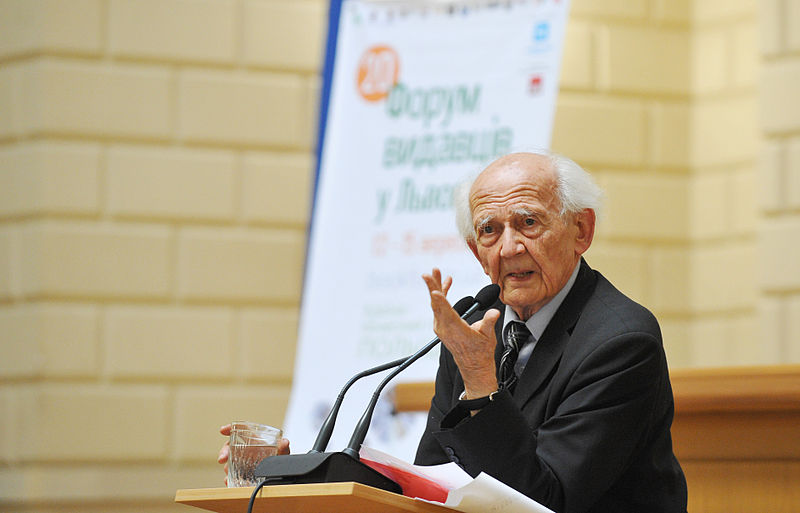
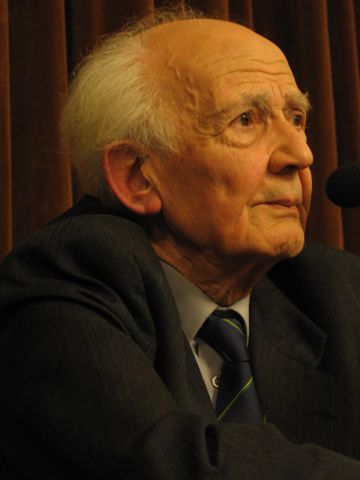
 Zigmunt_Bauman_na_20_Forumi_vydavciv


MHJ/KT: After your exile, you must have been subjected to a number of pressures from the West to become a ‘dissident’ who would blow the whistle on the truth of actually existing socialism. But you never did this. You published some essays on Polish communism, but they are marked by a dialectic of sociological critique and the maintenance of socialist commitment. Did it ever feel like your work was in danger of being ‘filed away’ as ‘dissident’?


ZB: After leaving Poland I was inundated with offers to join all sorts of ‘sovietologist’ establishments, and with invitations to write for their journals. I was one of the ‘Warsaw six’ – the ‘dissident’ professors of Warsaw University who were demoted and expelled on 25 March 1968 on the accusation of fomenting student riots – and the case was widely publicised in the Western press. I refused the offers. I had no intention of living the second half of my life off the first (as things looked then, I could live quietly and happily ever after out of my ‘dissident past’). I wanted to remain what I was, a sociologist, and re-establishing myself in that role in new surroundings was to me a matter of personal honesty and self-respect. Most importantly, were I to have succumbed to the seductive offers and recycled myself into a ‘sovietologist’, I certainly would have found myself out of place among the hosts (and very soon have been found to be out of place by them), as much as I found myself (and was found) to be out of place in ‘really existing socialism’. Being ‘anti-communist’ was certainly not enough to make us feel comfortable in each other’s company.


MHJ/KT: Polish culture contains a powerful ideal of the romantic intellectual, speaking truth to power. British culture contains an equally powerful, but very different, image of the intellectual as a rather self-indulgent ‘chatterer’. Within that British image, the sociologist has a special role as either a corrupter of youth or speaker of platitudes. In 1970s Britain what was the role of the intellectual? What did you see your role as being?


ZB: Another hard nut to crack… Though, on second thoughts, perhaps it is unduly soft. It dissolves at the first bite! Even Richard Rorty, who made his name fighting for the liberal rather than socialist cause, called the American thinking-and-talking left to think less about theory and talk more about money, in other words, to get down to earth since this is where people suffer, mostly because some have too little money while others have too much. He could with equal justification address his appeal to the British learned classes – at least since the advent of the New Left.


It was not always like that. When studying the story of British socialism and its wedding to the labour movement, I was continuously impressed not only by the profundity of argument and depth of concern, but by the palpable feeling of responsibility that went with the learned vocation and the mission it undertook to perform (and it is exactly that responsibility which lifts a member of the learned classes to the rank of an ‘intellectual’). There was no shortage of intellectuals in Britain well before Georges Clemenceau coined the term! Nor after… In fact, there was no shortage of intellectuals in that sense well into the 20th century.


I do not know at what particular time the stereotype of the ‘chatterer’ entered into British popular imagery and settled there, but it was mostly in the last quarter of the last century that the learned people in the limelight made an earnest effort to live up to that stereotype. Like the rest of the elite, and not just in Britain, most of them opted out – seceded – from engagement with ‘the people’ and immersed themselves in their own elitist concerns. An example: the fashionable talk of emergent ‘hybridity’ and of budding cosmopolitanism, conducted in a world that is border-drawing mad and seething with tribal sentiments; this is talk that conveys nothing but the elite’s own sharply distinctive experience. Indeed – lecturing around Europe in all sorts of academic outfits – I am always asked the same questions, even if wrapped in different linguistic idioms. Having opted out, they locked the door behind them, fencing themselves off from the rest of society and its worries with the help of arcane topics and a hermetic language that was, I suspect, designed for that exact purpose. For the ordinary people struggling daily with their all-too-ordinary problems, the esoteric and impenetrable discourse must sound like (empty?) prattle. And there seems to be little sense in trying hard to penetrate such discourse. The drudgery won’t be re-paid since nothing is likely to be gained, unless you sweat in order to join the company you can’t beat.


You ask about the role of the intellectual today (not the role played, but the role waiting to be played once the ‘the intellectual today’ has been designed, I guess?). It consists in returning ‘the social’ to the limelight and placing it firmly in the focus of public concern, making it the core topic of public discourse. With the human condition acquiring increasingly planetary dimensions, ‘the social’ has escaped the institutional frame of the territorial nation-state where the ‘solid modern’ settlement placed it. In the process, it escaped understanding, and lost ‘materiality’ (by comparison, how easy it was for Durkheim to paint the familiar-to-all likeness of ‘social facts’!) and so evaded the surveilling and controlling capacities of the agora, stripping the agora by the same token of its magnetic power. The effect is that ‘individuality’, cut off in thought and in practice from its social habitat, elides understanding and enters awareness and life-pursuits as an extrinsic, ungraspable and probably un-tameable force, a fate rather than a negotiable social product. György Lukacs once declared ‘totality’ to be false; I suspect that it is now individuality’s turn to be so called, and revealed as deserving to be.


MHJ/KT: You arrived at Leeds in 1971. How congenial were British intellectual – and specifically sociological – debates to your concerns? You arrived in the days of student radicalism: Did all of this seem to be continuous with what you had discussed in Poland, or did it all seem like middle-class self-indulgence?


ZB: Beware similarities. They are treacherous. They easily misdirect and lead astray. From my new English friends, fresh from the battlefields of student rebellion, some full of nostalgia and some blowing on their burnt fingers, I heard exhilarating stories of a protracted, joyful and thoroughly enjoyable youth carnival, a Woodstock avant le letter. It struck me right away that when Warsaw students took to the streets no one laughed.


E. P. Thompson, who was then the guru of the British ‘intellectual left’, in his devastating newspaper review of my Between Class and Elite, accused me, together with the other exiled ‘dissidents’, of betraying the Western Left’s expectations. At the time Thompson believed that the British proletarian-socialist revolution was just around the next corner, while in the book I presented my ‘sociological deduction’ that the British labour movement had ran its course and gone as far as it was capable of going, a prognosis that time was to corroborate. Thompson’s ire was directed mostly against Leszek Kołakowski, who indeed, instead of offering the hoped for shot in the arm to the emergent British ‘New Left’, moved promptly to the right of the political spectrum. I was the ‘collateral casualty’, so to speak, of Thompson’s main frustration. I must admit, though, that his judgment was not completely erroneous. I did not, and could not make myself, share in the illusions of the ‘New Left’. I was a recent witness to the testing of those illusions, and to their failure of the test.


I remember that Perry Anderson castigated E. P. Thompson for sticking to the empirical and shunning theory. For me, however, both antagonists suffered of an excess of theory, and of a kind of theory that was clearly not my cup of tea (soon afterwards the majority of the ‘New Left’ was enthusiastically to embrace the worst variety of the excess in the form of Althusserian dogmatism). Their differences notwithstanding, they were too detached from the messy and unclean realities of human life. They seemed to me to be equally ‘intellectualistic’ (a rather morbid, most incapacitating disease that may befall the intellectual). Years later, Richard Rorty poignantly articulated for me my vague resentment of that time, when he called on the intellectuals of the Left to speak more about money and less about stigma, complexes and political correctness.


MJH/KT: Is there anything that you continue to carry with you from the early essays?


ZB: Myself, warts and all. Or at least, this is what I would wish to be true.


to be continued…

Important Note: This interview is an extract from the book Bauman Before Postmodernity. Aalborg: Aalborg University Press (2005).


© Michael Hviid Jacobsen & Keith Tester


Image References:

Professor Zygmunt Bauman’s Images:

Image 1: Accessed from http://octaedro.es/bauman-y-la-vida-liquida/zygmunt-bauman/

Image 2: Wikimedia Commons http://commons.wikimedia.org/wiki/File:Zigmunt_Bauman_na_20_Forumi_vydavciv.jpg


Bauman before ‘Bauman’ – A Conversation between Zygmunt Bauman, Michael Hviid Jacobsen and Keith Tester (Part 1)

This is Part 1 of a larger conversation which examines the decade of the 1980s and various issues form commodification of intellectual work, the role of culture in changing the future, the dilemma(s) of post-modernity, nuclear weaponry, and whether Russia is European?


Born in Poland, eminent sociologist Zygmunt Bauman has been writing since 1960 when he published his first book. However Bauman became the man we know since the 1990s. After moving to University of Leeds Bauman published extensively in the English language; and his reputation has grown globally.


In the late 1980s and early 1990s Bauman wrote about modernity, bureaucracy, rationality and social Zygmunt Bauman final t use 2014exclusion. Bauman said that modernity sought to address the uncertainties of life by creating rules and regulations, hierarchies and bureaucracies and essentially exert control over nature. The attempt to make chaotic human life ordered and systematic led to increased control over human society and categorisation. Thus, we exchanged our individual freedoms with our need for security. Bauman also argued that such efforts to impose order and create manageable categories also led to social exclusion and used the concept of the “stranger” to illustrate the ill-effects of such ordered categories.


In the mid-to-late 1990s, Bauman wrote on postmodernity and consumerism. Bauman noted a change from a society of producers into a society of consumers. The need for security was exchanged for the freedom to consume. Bauman wrote of this shift as being a shift from modernity to post-modernity. However, due to the mis-understanding of the term postmodernity, Bauman started using metaphors of “liquid” and “solid” modernity.


This conversation examines the man and his life and thoughts before he became Bauman. It starts with the 1980s and takes a cinematic flashback or “walk backwards” approach as we follow the man before Bauman from the 1980s to the 1960s when he started publishing his sociological writings.


michael-hviid-jacobsen keith-tester bauman-Octaedrajpg
MHJ: Michael Hviid Jacobsen (MHJ) Professor of Sociology,
Aalborg University, Denmark
KT: Keith Tester (KT) Professor of Sociology,
University of Hull, United Kingdom
ZB: Zygmunt Bauman  (ZB) Emeritus Professor of Sociology, Leeds & Warsaw


The 1980s

MHJ/KT: Since the end of the 1980s (early to mid-1990s) you have been a ‘big name’ sociologist and thinker- The Zygmunt Bauman, who travels internationally and whose books have become widely publicised. Does this mean that your own work has been commodified and, if it has, can it still be critical?


ZB: I would gladly exchange the doubtful honours of being a ‘big name’ for a bit more effectiveness of critical efforts. To take a hint from Daniel Boorstin: a ‘big name’ is a person who is known for being well-known, and that sad foible of our times puts a yet sadder meaning into Wittgenstein’s already sad conclusion that ‘philosophy leaves everything as it is’.

But your worry is accurately directed. I share the feeling that my work ‘has been commodified’ and I fully agree with your view that commodity markets are not the best sites from which to launch a critical reassessment of reality, let alone the fight to save or recover certain aspects of human togetherness from commodification.

I have been breaking my head in vain to find a way out of the quandary. The agora of our times is filled to the brim with market stalls and admits only the buyers and sellers of commodities. Information travels only when it is commodified, only when it is sold and bought. And if you wish to repair that sorry state of the agora, you must first gain an entry. You have to be listened to if you wish to be heard. Gaining entry to the market stalls is anything but the guarantee of being heard. But it is, alas, its unavoidable preliminary condition.


MHJ/KT: In 1987 you published Legislators and Interpreters, a book which contained a theme about the relationship of cultural production to the market. Can culture still be a ‘knife pressed against the future’ if it has been commodified? As a subsidiary question, where are the really sharp knives nowadays?


ZB: To start from the end, almost all of the sharp knives, as well as the blunt ones, have been confiscated by the security guards (barring a few carried by genuine terrorists).


That remark is only partly intended as a joke. Safety concerns (this is how the worries misnamed as ‘securitarian’ ought to be properly called) prompt retrenchment reflexes. They point to the past, to the good old times without Al Qaeda, asylum seekers and GM foods, and into an altogether different future, an unlike-anything-you-know future. These concerns can be and are expressed under any banner, a conservative one no less than a revolutionary one. What culture leaves behind is never exactly like what it found, even if its job has been done in the name of preservation or retreat to the old.


But I understand why you may doubt whether Santayana’s metaphor of the ‘knife pressed against the future’ is still applicable. First, the trope suggests the application of a steady force, and secondly it tacitly suggests that but one knife is in operation (if there were many knives, the ‘future’ would be cut into pieces rather than opened up, as the metaphor implies). Neither of these two assumptions sounds sensible today. There are so many knives around, each pointing in a different direction, and none keeping sharp for long. All the knives tend to be abandoned before they have the time to do their jobs. Knives cancel out each other’s effects and make the ‘future’ more like a bag of flour than a body pliable to carving. Perhaps the ‘culturalist turn’ in social thought followed the habit of Minerva’s owl and noted the future-carving function of culture when that function has been already played out and forsaken?


However, I am inclined to think that it is culture’s, and perhaps also the future’s, rather than the knife’s part in Santayana’s aphorism that makes us feel uneasy these days. Since the beginning of its presence in modern idiom, ‘culture’ implied a more or less cohesive totality and unity of purpose. And so did the future. It was a whole that could be handled in its entirety, rather than like flour, needing to be carried in a bag. And the future was a whole with a pointer, so that it might be turned one way but not the other. Nowadays such images are awfully difficult to uphold. They are challenged by daily experience. Can you apply a knife, sharp or blunt, to a liquid? And if you did, would the liquid show the cut?


Among the most fateful consequences of the liquid modern condition is that of the fragmentation of human aggregates and of time. The first is known under the name of ‘individualization’, the second has been recorded variously as the demise of the ‘long term’, as episodicity, or as the cité par projets… The outcome of individualization (beware though, this is a treacherous term, absorbing more meanings that it can carry) is that all forms of association, from the most formal to the most radically informal, evolve nowadays towards swarms (aggregates with no structure, hierarchy, command centre and lines of command – yet notorious for their astonishing similarity and synchrony of moves; see Bauman 2001a). The outcome of short-termism is that the swarm drifts aimlessly, with little rhyme or reason, from one meadow to another, hardly ever stopping for long. It is pushed by accumulating waste and tedium as well as diminishing returns, rather than pulled by fresh fragrances and guided by the discoverers’ curiosity. This is, I guess, why the metaphor that speaks of culture, future and the knife-cutting feels out-of-joint with the Lebenswelt. It was meant to answer a question few if any people are today inclined to ask…


MHJ/KT: Starting with the publication of Legislators and Interpreters in 1987, you wrote a series of books that played a very significant part in making postmodernity a key part of sociological discourse. But if your approach to the matter is compared with that of others, it is possible to identify a very distinctive way of thinking. For many people the question of postmodernity was conflated with postmodernism, and so there was a turn by sociologists to aesthetics, architecture, social geography and so on; all of this might be summed up in the phrase you just used, ‘the cultural turn’. Meanwhile your approach focused on questions of morality and ethics. Did you ever feel part of a wider debate, or was it more like writing in hope of finding readers?


ZB: If I ever took a ‘cultural turn’, it must have been in early 1960s, and it was Antonio Gramsci and his Prison Notebooks, hardly a postmodern or even a proto-postmodern tract, that took me along that path. Culture versus Society marked the breakthrough. I wrote it just after the publication in 1964 of my Introduction to Marxist Sociology, which was still a very orthodox piece by both Marxist and Parsonian standards. The Introduction presented society as a sort of recycling contraption, a mechanism that bribes or forces ordinary humans to do willingly what they must do, and which discharges fully ‘patterned’ humans at the far end of the assembly line and then uses that recycled product to go on reproducing itself so that further recycling may be done endlessly. Between the two diametrically different books stood my discovery of Gramsci.


From Gramsci I learned about culture being a thorn in the side of ‘society’ rather than a handmaiden of its monotonous order-reproducing routine; an adamantly and indefatigably mutinous agent, culture as propulsion to oppose and disrupt, a sharp edge pressed obstinately against what-already-is. Culture became shorthand for the human propensity to set apart the ‘is’ from ‘can be’, the ‘ought’ from the ‘is’, and for the inclination to rebel against the ‘is’ in the name of the ‘can be’ and/or ‘ought’. The concept of ‘culture’ refers to the lifting of the human mode of being-in-the world above and beyond the site which ‘society’ tried and goes on trying to ensconce and fence off. I came to Britain with such a view fully formed and operational. It was a time when the notion of culture, despite Mathew Arnold’s Herculean efforts, was only beginning to be recalled from its protracted exile, thanks mostly to Stuart Hall’s pioneering, formidable labours.


To cut a long story short: your guess is correct. I seem to have entered the ‘postmodernist’ discourse through a different door than most of its other participants. Well before the word ‘postmodernity’ was coined and much before it became the badge of belonging to an exclusive company of the chattering classes, I desperately sought a generic name for a large set of intuitions: that despite modern ambitions the war against human waywardness and historical contingency is unwinnable, that the resistance of human modality to logic and rule is here to stay, and that the modern crusade against ambivalence and the ‘messiness’ of human reality only multiplies the targets it aims to destroy. ‘Postmodernity’ fit the bill nicely. I first spotted the term in the context of architecture, where Charles Jencks put it. That helped me to invest all my concerns in it and so adopt the term in good conscience. After all, architecture was the very epitome, simultaneously, of the modern pilgrimage to finitude and the war of attrition which modernity waged against contingency. When applied to architecture, ‘postmodernity’ suggested most vividly a castrated modernity admitting its own impotence, a disempowered modernity, stripped of the confidence that the end is round the next corner or the corner after the next. ‘Postmodernity’ also seemed noncommittal and open-ended. It spoke about what no longer could be held to be true, but it wisely refrained from any alternative syntheses, which would be inevitably premature and half-baked.


Or at least this is what seemed to me to be the case at the time. Alas, I should have known better. Entering a discourse bent to become the talk of the town (of the urban salons, to be precise) meant giving hostages to fate from the start. Soon all my efforts to protect the intended meaning turned out to be hopeless. I had been ‘filed away’, and having read the label on the file’s cover, who would care to contemplate the possible subtleties inside?


MHJ/KT: Certainly, if we look at publishers’ catalogues, it is immediately clear that in the early to mid 1990s piles of books were published with the word ‘postmodernity’ in their title, but that around 1997 or so the tide started to turn. Nowadays postmodernity almost has become a love that dare not speak its name. There are three obvious reasons why the debate might be in the past rather than the present tense: First, perhaps the social world stopped being amenable to analysis as postmodern. Second, the debate might not have disappeared at all. Rather it has now seeped out to cover everything, so that now the word ‘postmodernity’ is obsolete – we are all postmodernists nowadays. Third, it was a publishing phenomenon and the academic publishers pulled the plug on titles with the word because the profit margin could not be guaranteed.


ZB: All three of your hypotheses have a lot going for them. I guess that the third hypothesis offers a hint to what has indeed happened. Consumer society works through excess and currently favoured targets tend to be overshot. But I trust the publishers to have learned (if only the hard way) when to pull the plug. They have by now become good judges of the admittedly shifty consumer moods, and above all they are well aware of the brevity of the consumers’ attention span. Boredom is the sequel and consequence of any hype, and seasoned publishers, like prudent generals, do not commence any action without an exit scenario. The trick is to spot in time when the hype has reached its limit, targets are no longer met and the time to dismantle the unused missiles or remainder (or shred) the unsold books has arrived.


Boredom was bound to come. We get tired of buzzwords. To this general factor add a specific one: the purely negative function of the ‘postmodernity’ concept. It said what social reality was no longer but it kept silent or sounded neutral about what it was instead. How long can you go on listing the has-been traits? The term ‘cleared the site’, but once ground-clearing jobs are done the bulldozers need to be removed lest they block the start of building works (by the way, in my view this applies to other contemporary and apparently alternative terms as well, notably ‘late’ and ‘second’ modernity’). It is high time to arrive at more ‘positive’ concepts, referring to what our realities are, instead to what they have ceased to be. For me, liquid modernity is such a concept.


The postmodernity debate may have been a ‘fleeting affair’, but in its time it was indispensable. Like many other good intentions, it went astray (see Bauman 2004b, 2005). The earth that was taken away from the future building site was dumped over the rocks on which the foundations of the new building should have rested. Or, to paraphrase the cliché, the baby has been drowned in the muddy bathwater…


MHJ/KT: For us, at least, one of the most important consequences of the postmodernity debate was that it raised in a contemporary way questions about the responsibility of intellectuals. And yet it is hard not to conclude from the debate as it worked itself out that intellectuals are more likely to be attracted by abstract questions rather than by any desire to enter into a dialogue with men and women in the world. Quite simply: Was the postmodernity debate a feast in the time of locusts?


ZB: Or I may say ‘fiddling when Rome is burning’ since I have already resorted to clichés. ‘Postmodernism’ was for a time a darling of the ‘Left’ or whatever part of it scrambled out of the debris of the Berlin Wall. The timing was perfect – bereaved minds on one side, an all-smiling chirpy toddler yelling for adoption on the other. The toddler’s vocabulary was colourful and naturally limited, and the few words it mastered were yet to be composed into meaningful sentences. For the would-be foster parents, the adoption was like being born again. The toddler’s babbling that politics is a sham, even though everything is political, was particularly endearing. It was exactly the kind of soothing balm that fingers singed to the bone in hot, fiery and yet shamefully lost political battles badly needed.


I thought I spotted a potential for lifting critical theory to the level of the new challenges in what I had provisionally called the ‘postmodern condition’. That was one thing. The ‘really existing postmodernism’ (that is, talking about the postmodern condition) was something else. The latter developed as a wholesale absolution for the critics bereaved of a vision of the ‘good society’ and as a consolation for the intellectuals, wardens deserted by their wards. Richard Rorty noted a number of years ago that nobody was “setting up a programme in unemployed studies, homeless studies, or trailer-park studies, because the unemployed, the homeless, and residents of trailer parks are not ‘other’ in the relevant sense”, in the sense relevant for the postmodern academic Left.


MHJ/KT: The 1980s were topped and tailed by events in Central and Eastern Europe. The decade started in Poland with Solidarity followed by martial law. It ended symbolically in November 1989 with the fall of the Berlin Wall. Was this the defeat of what Norberto Bobbio called the ‘upturned utopias’ of the East, or was it simply that the West won the Cold War?


ZB: I suppose archivists will go on quarrelling about ‘what it was’. They will not revise ‘what actually did happen’, as Ranke wanted historians to do, but they will try to develop the received wisdom, the one ‘historical truth’ of a reality that stoutly refuses to admit an ‘ultimate’, ‘last word’ interpretation. They are after the ‘one and only’ interpretation that would make all further interpretative effort redundant. I am inclined to grant the ostensibly competing versions – all of them or at any rate most of them – the virtue of complementarity, rather than the vice of exclusivity. That applies as well to the dilemma you’ve presented: it would benefit from ‘and-and’ instead of the ‘either-or’ treatment.


Right away, I would add to your two ‘complementary alternatives’ a few more. And I repeat: these are additions, not substitutes. They are but reports of my own mental turbulences at the time, the lessons which the collapse of the Berlin Wall seemed to me to contain.


First came the refutation of one more of Karl Marx’s ‘historical laws’, this time the ‘law’ that societies do not posit themselves tasks unless they are capable of fulfilling them. ‘Really existing socialism’ collapsed under the burden of the tasks it undertook, while being incapable of fulfilling them; to put it more simply, it crumbled under the load of its own unfulfilled promises. Its defeat was to no small extent the ‘unanticipated consequence’ of its success in arousing and prodding dreams and ambitions. It occurred to me that such bizarre and ultimately suicidal dialectics could be a wider phenomenon. Perhaps the tendency to set unfulfillable tasks comes closer to grasping ‘how history really works’ than Marx’s proposition. If that surmise was correct, it would go some way towards explaining all those frequent changes of regimes, political formulae, political agendas and ‘redemptive strategies’, none of which left the scene having completed its job, having resigned or been dismissed in the middle of its career.


Second, there was the collapse of the ‘logic of history’, of ‘progress’, of the preordained sequence of forms, and indeed of the whole set of tacit assumptions underpinning the evolutionary conception of human history. The Marxist evolutionary schema was a member of a big family of ‘natural sequences’, each implying a different, but similarly strict, succession of stages one after another riding into history on the backs of their immediate ancestors, while condemning their mounts to the abattoir or to an exile with no right to return. In that family of ‘natural sequences’, the Marxist schema was perhaps the most elegant, allowing each known form of human togetherness its rightful place in the temporal order of things – but only that one place and no other (remember ‘late Marx’ struggling desperately, though in vain, with the possibility of a ‘shortcut’ from the Russian rural commune straight to the socialist society; this was an illegitimate irruption and irresolvable mystery when set against his predetermined evolutionary sequence). All of that aesthetically pleasing order has been buried, though, under the debris of the Berlin Wall.


A third meaning of the Berlin Wall’s collapse: Since the communist venture was a plot to whip up sluggish history into an accelerated gallop towards the fulfilment of the modern dream of the perfect order, a fulfilment held back elsewhere because of insufficient concentration on the main task, the failure of the communist adventure could be seen as the resounding refutation of the viability of modern ambition as such. It said volumes about the value of the idea of the ‘perfect order’, the idea that was the cornerstone of all modernity and its principal moving spirit. I would say that for me precisely that lesson was one of the main reasons to explore the ‘postmodernity’ hypothesis: namely, that the pursuit of a ‘perfect order’ that would bring history to its natural end (the hope/anticipation that the communists borrowed after all from the prophets and advocates of modernity) is neither viable nor any longer plausible.


MHJ/KT: A question that often emerged in the wake of Soviet clampdowns in Central and Eastern Europe was one about whether or not Russia is European. Kundera is pretty sure that Russia is outside of Europe, while Gorbachev used to talk about the admittance of Russia to the ‘common European home’. Is Russia European, or is it an outsider?


ZB: Norman Davies, who is arguably the most ‘synthetic’ among the recent historians of Europe, is quite emphatic on that point, and I tend to agree with his opinion: Europe was anything but a geographical definable entity, as its borders were at all times contentious and no one quite managed to draw them clearly, un-contentiously and above all durably. When asked to describe the most conspicuous characteristics of ‘the European’, Alexander Wat (a Polish, yet much travelled and shuffled around avant-garde poet, at some points in his life a revolutionary and at others a victim of the revolution), listed the kinds of virtues that were of crucial, and of literally life-and-death, importance to the concentration camp prisoners. And then, having rummaged his capacious memory, he offered an exemplar of this European character: ‘I knew one such person. He was an Armenian’.


I guess you are not asking about ‘Europe’ as a geographic notion. If you were, you would have rather consulted the first handy atlas of the world, where conventional land divisions have been recorded. I gather instead that you ask about ‘Europe’ as an idea, as a notion that is always a step away from political, military and all other earthly realities. To make the quandary trickier yet, and to make this instance of Whitehead’s ‘essential contest’ yet more rabid, the idea in question departs from reality in more than one direction. Ideas, after all, reside in that nowhere place called ‘future’, the natural home for all disagreements and of the hope for their resolution; and in a nowhere place, all is similarly plausible and all similarly improvable. Unlike reality, imagination – the future’s sole tenant – has no limits except those it sets itself (until further notice, as it were).


Only quite recently, a mere half century ago, an authority was established that claimed the exclusive right to set those limits (that is, the limits to permissible and acceptable imagining) and so made the bid to confine the scattered works of imagination in the framework of politico-military-economic realities. This authority is of course the European Union, and with its establishment the kind of question you ask would be directed to ‘an appropriate department’ entitled to answer it in a no-appeal-allowed way. But having been so re-directed, it would no longer be the question you asked.


‘Europe’ stood and stands for the only way of life that presented (imposed?) itself as a pattern for universal emulation, and which was sometimes willingly, at other times resentfully, accepted as such, even while it staunchly refused to imitate any other form of life and was angry and disdainful when it was suggested that it do so. No wonder then that Europe (as an idea, a phantom, a Shangri La) is a magnet of enormous attractive power, a constant provocation to be joined. It is for that reason that the outer borderlines of the geographic, and now also ‘unionised’ Europe, are like an elastic band; push and pull forces join in stretching it, the pull taking over once the push runs out of energy and staving off the prospect of the ‘unionised’ Europe succeeding in its (half-hearted and in fact unconfident) efforts to fall upon itself.


I said that Europe is a magnet. But it is a curious magnet, since the further away from it that the iron filings are spilled, the stronger its attraction. Imagination, unlike reality, gains in vividness with the growth of spatial or temporal distance. I suppose that unlike the Russians, the Georgians and the Azerbaijanis, or for that matter the Kazakhs, wouldn’t think twice were they to be asked to join the EU. And I guess as well that there would be fewer doubts in Brussels about their eligibility than would arise in the case of Russia.


MHJ/KT: An important political theme in the 1980s was nuclear weaponry and nuclear power. In the early 1980s there was a widespread carnivalesque politics against the weapons and in 1985 Chernobyl blew up. Yet, unlike some social thinkers, none of this features terribly greatly in your work. Why not? What was your view on the ‘nuclear question’?


ZB: In the eighties the Moscow nukes, and today the (address unknown) Al-Qaeda terrorists, served or serve as a basket to locate (dislocate) the fears emanating from and saturating the human condition. The basket has changed now, though the warehouses are as full of nukes, if not fuller now, than they were in the eighties, and the nukes are still stocked as close to the major conflagration points of the globe as they were then. The function assigned to the basket (and, haltingly, performed by it) has not changed though. There was then, as there is now, a good deal of trickery or even downright swindle in the expedient of shuffling human anxieties away from the places where they could condense into domestic troubles. This is a convenient stratagem indeed, and one that is used whenever the powers-that-be wish to be seen as the protective shield and the warrant of security, even as they blatantly or surreptitiously add to the fears from which their subjects crave to be protected.


I know from Bakhtin that this is exactly what should be expected from the powers-that-be of the day, of any day. But to see the ‘thinking classes’ settling with relief and relish inside the comfort of the agenda set by the power-holders, and then to see the ‘thinking classes’ parroting and endorsing the official definitions of human problems and their solutions, should make our eyebrows rise.


(to be continued…)


Important Note: This interview is an extract from the book Bauman Before Postmodernity. Aalborg: Aalborg University Press (2005).


Escaping Inside Utopia

Zygmunt_Bauman_by_Kubik

Part 2 of Zygmunt Bauman Interview


The idea of ‘the good life’ is often associated or equated with some notion of ‘the good society’ or at elast some form of ‘utopia’ – the imagination of alternative, better futures for humans and their societies. Although utopia is not a conventional concern of sociologists, the topic of utopia – the idea of a different or even better world – is nevertheless a recurrent theme in Bauman’s writings from the early books – e.g. Socialism: The Active Utopia (1976) to Liquid Times (2007). Profesor Bauman has argued in various writings that the notion of ’utopia’ serves an important purpose in that it undermines the sense that the present state of affairs in un-changeable and thereby stimulates action towards change.


michael-hviid-jacobsen keith-tester bauman-Octaedrajpg
MHJ: Michael Hviid Jacobsen (MHJ) Professor of Sociology, Aalborg University, Denmark KT: Keith Tester (KT) Professor of Sociology,
University of Hull, United Kingdom
ZB: Zygmunt Bauman  (ZB) Emeritus Professor of Sociology, Leeds & Warsaw


MHJ/KT: So Professor Bauman, why is utopia important for understanding society?


ZB: Utopian dreams, as prodromal symptoms of an approaching modernity, needed two conditions. First, was the overwhelming (even if diffuse and inarticulate) feeling that the world was not functioning properly and had to be attended to and overhauled to set it right. Second, the confidence in human potency to rise to the task; the belief that ‘we, humans, can do it’ – being armed as we are with enough reason to spy out what is wrong with the world and find out with what to replace its diseased parts, and with enough strength to graft such designs on human reality. In short, the potency to force the world into a shape better fit to the satisfaction of human needs – whatever those needs already are or yet may become.


With those two conditions now (at the present time) by and large missing or at least enfeebled, there is little or no room left for utopian musings; not many people would treat utopian blueprints seriously, were they offered them for consideration.


MHJ/KT: Why do you say that people in today’s world would not take utopian ideas or plans seriously?


ZB: Even if we knew what to do to make the world better, and took the job of making it better to our hearts, the truly puzzling question would be who has sufficient resources and strong enough will to do it …


For a large part of the modern era, the hope of re-making the world used to be vested in the resourceful authorities of nation states – but as Jacques Attali recently observed in La voie humaine, ‘nations lost influence on the course of affairs and have abandoned to the forces of globalization all means of orientation in the world’s destination and of the defence against all varieties of fear’.


Under the new circumstances, Roget’s Thesaurus, justly acclaimed for its faithful recording of the successive changes in verbal usages, had every right to list the concept of the ‘utopian’ in close proximity to ‘fanciful’, ‘fantastic’, ‘fictional’, ‘chimerical’, ‘air-built’, ‘impractical’, ‘unrealistic’, ‘unreasonable’, or ‘irrational’. And so are we indeed witnessing the end of utopia?


MHJ/KT: But isn’t the desire to move forward towards a better future also associated with “progress”?


ZB: ‘Progress.’ Yes, that is another, closely related notion, which played a seminal role in the shaping of the modern world; but the notion of ‘progress’  also seems to have fallen on hard times. When (if) that notion crops up nowadays in public discourse or private contemplation, it no longer refers to a forward drive — rather than a chase after a spinning-along utopia, it implies a threat that instead of promising improvement makes an imperative out of a lucky escape; it inspires the urge to run away from a breathing-down-the-neck disaster.


Progress, to cut the long story short, has moved from the discourse of shared improvement to that of the individual survival. Progress is thought about no longer in the context of propulsion to rush ahead, but in connection with the desperate effort to stay in the race. We do not think of ‘progress’ when we rejoice watching the world around running faster ahead, but when we worry about staving off the fall.


The notion of ‘progress’ is saturated with the anxiety and redolent with the odour of the rubbish heap: it exudes the fear of being excluded. The time flows on, and the trick is to keep pace with the waves. If you don’t wish to sink, keep surfing – and that means changing your wardrobe, your furnishings, your wallpapers, your look, your habits – in short, yourself; and as often as you can manage.


I don’t need to add, since this should be obvious, that the present emphasis on the disposal of things – abandoning them, getting rid of them – rather than on their appropriation, suits well the logic of consumer-oriented economy. People sticking to yesterday clothes, computers, mobiles, or cosmetics would spell disaster for an economy whose main concern and the condition sine qua non of survival is a rapid and accelerating assignment of sold and purchased products to waste, and in which the swift waste-disposal is the cutting-edge industry.


MHJ/KT: And so what has replaced the idea of utopia?


ZB: Increasingly, escape has become now the name of the most popular game in town. Semantically, escape is the very opposite of utopia, but psychologically it is the sole available substitute: one would say – its new rendition, re-fashioned to the measure of our deregulated, individualized society of consumers, the kind of society in which you can no longer seriously hope to make the world a better place to live and you can’t even make really secure that better place in the world which you might have managed to cut out for yourself.


What is left to your concerns and efforts is the fight against losing: try at least to stay among the hunters, since the only alternative is to find yourself among the hunted. And the fight against losing is a task which to be properly performed will require your full, undivided attention, twenty four hours a day and seven days a week vigilance, and above all keeping on the move – as fast as you can …


MHJ/KT: So what kind of life would that be – the life of escape?


ZB: Joseph Brodsky, the Russian-American philosopher-poet, vividly described the kind of life that has been set in motion and prompted by the compulsion to escape. The lot of the losers, of the poor, is – he says – violent rebellion or, more commonly, drug addiction: ‘In general, a man shooting heroin into his vein does so largely for the same reason you buy a video’ – Brodsky told the students of Dartmouth College in July 1989. As to the potential haves, which the Dartmouth College students aspire to become,


you’ll be bored with your work, your spouses, your lovers, the view from your window, the furniture or wallpaper in your room, your thoughts, yourselves. Accordingly, you’ll try to devise ways of escape. Apart from the self-gratifying gadgets mentioned before, you may take up changing jobs, residence, company, country, climate, you may take up promiscuity, alcohol, travel, cooking lessons, drugs, psychoanalysis…


In fact, you may lump all these together, and for a while that may work. Until the day, of course, when you wake up in your bedroom amid a new family and a different wallpaper, in a different state and climate, with a heap of bills from your travel agent and your shrink, yet with the same stale feeling toward the light of day pouring through your window…


Andrzej Stasiuk, an outstanding Polish novelist and particularly perceptive analyst of contemporary human condition, suggests that ‘the possibility of becoming someone else’ is the present-day substitute for the now largely discarded and uncared-for salvation or redemption:


Applying various techniques, we may change our bodies and re-shape them according to different pattern … When browsing through glossy magazines, one gets the impression that they tell mostly one story – about the ways in which one can re-make one’s personality, starting from diets, surroundings, homes, and up to rebuilding of psychical structure, often code-named a proposition to ‘be yourself’.


Sławomir Mrożek, a Polish writer of a world-wide fame with a first-hand experience of many lands, agrees with Stasiuk’s hypothesis: “In old times, when feeling unhappy, we accused God, then the world’s manager; we assumed that He did not run the business properly. So we fired Him and appointed ourselves the new directors”. “But”, as Mrożek, though notoriously loathe of clerics and everything clerical, finds out – business did not improve with the change of management. It has not – since once the dream and hope of a better life is focused fully on our own egos and reduced to tinkering with our own bodies or souls, “there is no limit to our ambition and temptation to make that ego grow ever bigger, but first of all refuse to accept all limits …


I was told: ‘invent yourself, invent your own life and manage it as you wish, in every single moment and from beginning to end’. But am I able to rise to such a task? With no help, trials, fittings, errors and rehashing, and above all without doubts?”.


The pain caused by the unduly limited choice has been replaced; we may say, by no lesser a pain, though this time inflicted by the obligation to choose while having no trust in the choices made and no confidence that further choices will bring the target any closer. Sławomir Mrożek compares the world we inhabit to a:


market-stall filled with fancy dresses and surrounded by crowds seeking their ‘selves’ … One can change dresses without end, so what a wondrous liberty the seekers enjoy … Let’s go on searching for our real selves, it’s smashing fun – on condition that the real self will be never found. Because if it were, the fun would end …


The dream of making uncertainty less daunting and happiness more plausible by changing one’s ego, and of changing one’s ego by changing its outer wrappings, is the ‘utopia’ of liquid modern times; the ‘deregulated’, ‘privatized’ and ‘individualized’ version of the old-style visions of good society, society hospitable to the humanity of its members.


MHJ/KT: Why have people adopted “ESCAPE”?


Zygmunt-front-600x297


ZB: As Blaise Pascal centuries ago prophetically noted, what people want now is “being diverted from thinking of what they are…by some novel and agreeable passion which keeps them busy, like gambling, hunting, some absorbing show…”. People want to escape the need to think of ‘our unhappy condition’ – and so ‘we prefer the hunt to the capture’. ‘The hare itself would not save us from thinking’ about the formidable but intractable faults in our shared condition, ‘but hunting it does so’.


The snag is, though, that once tried, hunt turns into compulsion, addiction and obsession. Catching a hare is an anti-climax; it only makes more seductive the prospect of another hunt, as the hopes that accompanied the hunt are found to be the most delightful (the only delightful?) experience of the whole affair. Catching the hare presages the end to those hopes – unless another hunt is immediately planned and undertaken.


MHJ/KT: So are we then seeing clear signals of the end of the idea of utopia?


ZB: Is this the end of utopia? In one respect it is – in as far as the early-modern utopias envisaged a point in which time will come to a stop; indeed, the end of time as history. There is no such point though in hunter’s utopia, no moment where one would say that the job has been done, the case open and shut, the mission accomplished – and so could look forward to the rest and enjoyment of the booty from now to eternity.


In the utopia of hunters, a prospect of an end to hunting is not tempting, but frightening – since it may arrive only as a personal defeat. The trumpets will go on announcing the start of another adventure, the greyhounds’ bark will go on resurrecting the sweet memory of past chases, the others around will go on hunting, and there will be no end to universal excitement … It’s only me who would be stood aside, excluded and no longer wanted, barred from other people’s joys; just a passive spectator on the other side of fence, watching the party but forbidden or unable to join the revellers, enjoying the sights and sounds at best from a distance and by proxy.


If a life of continuing and continuous hunting is another utopia, it is – contrary to the utopias of the past – a utopia of no end. A bizarre utopia indeed, if measured by orthodox standards; the original utopias promised temptingly the end to the toil – but the hunters’ utopia encapsulates the dream of toil never ending.


Strange, unorthodox utopia it is – but utopia all the same, as it promises the same unattainable prize as all utopias brandished, namely the ultimate and radical solution to human problems past, present and future, and the ultimate and radical cure for the sorrows and pains of human condition. It is unorthodox mainly for having moved the land of solutions and cures from the ‘far away’ into ‘here and now’.


Instead of living towards the utopia, hunters are offered a living inside the utopia. The end of the road would be the lived utopia’s final, ignominious defeat. Adding insult to injury, it would also be a thoroughly personal defeat and proof of a personal failure. Non-participation in the hunt can only feel as ignominy of personal exclusion, and so (presumably) of personal inadequacy.


Utopia brought from the misty ‘far away’ into the tangible ‘here and now’, utopia lived rather than being lived towards, is immune to tests; for all practical intents and purposes, and it is immortal. But its immortality has been achieved at the price of frailty and vulnerability of all and each one of those enchanted and seduced to live it …


MHJ/KT: Thank you once again.


© Michael Hviid Jacobsen & Keith Tester


Also see The Bauman Institute, School of Sociology & Social Policy, University of Leeds inspired by the sociological imagination of this unique thinker.

Find more images and Articles :

http://beinghumanthesedays.com/bauman-and-gadacz-a-debate-in-warsaw/

http://octaedro.es/bauman-y-la-vida-liquida/zygmunt-bauman/

http://www.ashgate.com/isbn/9780754670605

http://www.postcolonialeurope.eu/2012/06/liquid-europe-june-1st-univeristy-of.html

http://owni.eu/2011/03/25/egypt%E2%80%99s-liquid-modernity/


© 2026 THE ESSAYIST

Theme by Anders Noren — Up ↑