
© Dennis Dodson, 2016
A humanoid-robot as “that” person of the years ahead? Why not?
Instead of looking back in time, and profiling someone or something that has influenced the past year’s events — after all the past was so 2015. We looked ahead – to the future. In keeping with the spirit of Star Wars, we decided to continue to create mythologies of the future. Our choice: ChihiraAico, humanoid robot woman, who currently directs customers at a department store in Tokyo. A small career step as store-clerk for a humanoid, one giant job-loss leap for humankind. What? Me worry?
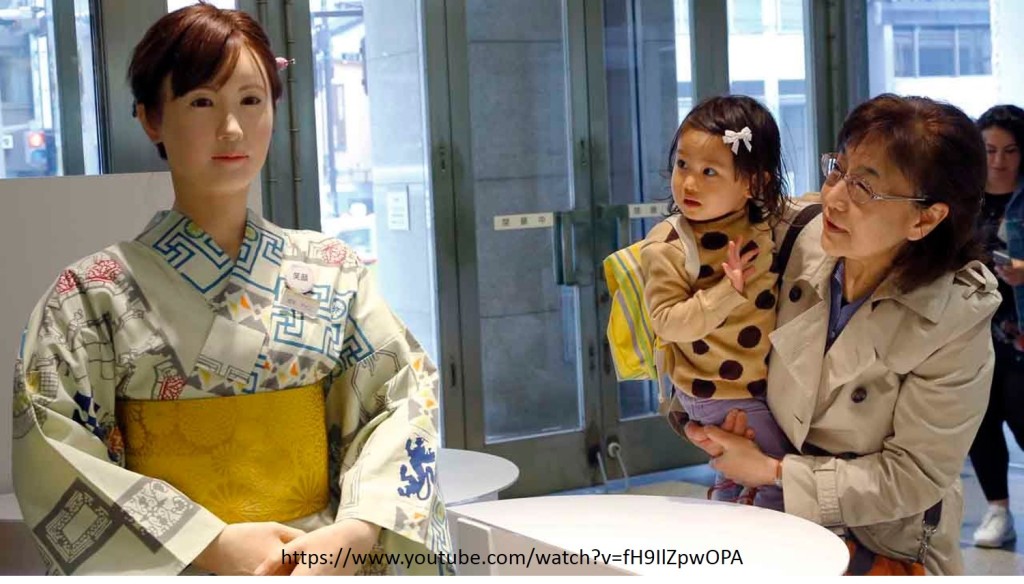
ChihiraAico is said to be 32 years old, although, born in September 2014; and described by the organization Toshiba as not just another pretty face, but the quiet type, who is strong willed and warm hearted, not quite human but with human like features – a communication android who is happy to help people. Chihira can carry on conversations, sing, smile, blink her eyes, raise her hands, and 15 tiny pneumatic actuators control her facial expressions and gestures because no human communication is complete without themovement of the muscles of the face.
Humanoid robots are increasingly being developed as personal assistants and companions;to work in service industry as someone who can take your food order; and as aides for medical situations. As the marketing representative at Toshiba says Chihira is expected to become a conversational friend for elderly people with dementia tendencies and can be connected to the counsellor and doctor. They can be used for elderly patients, such as those with debilitating diseases, who need caring and assistance.They are expected to take up a lot more of the caring function of human society.
So it seems that humans no longer have time to take care of their elderly, their children or each other. That is because most humans are busy becoming machines as they endeavor to survive while making humungous amounts of dollars for the super-rich 1%. And while humans become money-making robots in the hands of their masters and managers, these androids will take over the human function. Interesting move: humans become machines and machines become human. If that is the future, then Chihira is our person.
Japan has always been a leader in automation; to the extent that Japanese firm, Spread Vegetable Factory, is working on a novel way of producing high quantities of lettuce using factory automation. Most of the process of growing lettuce in this indoor farm will be automated and handled by machines and robots, except for the seeding and germination processes that require visual confirmation. Thus, the lettuce farm, which requires minimal human intervention, will start operations by 2017 and produce 30,000 heads of lettuce in a day and hope to boost that figure to 500,000 in five years.

Japan has now jump started the robotic and humanoid industry and the culture that goes along with it. Prime Minister Shinzo Abe wants to stage a Robot Olympics alongside its 2020 Summer Games. Hiroshi Ishiguro, a robotics experts, finds that since ‘robots are now becoming affordable — no different from owning a laptop, they play an increasingly important role in everyday life in Japan.
Robots are now found in banks, service centers, museums and amusement parks.
It seems they are good at directing people. Or the directions that people need can be given by robots, so it seems.
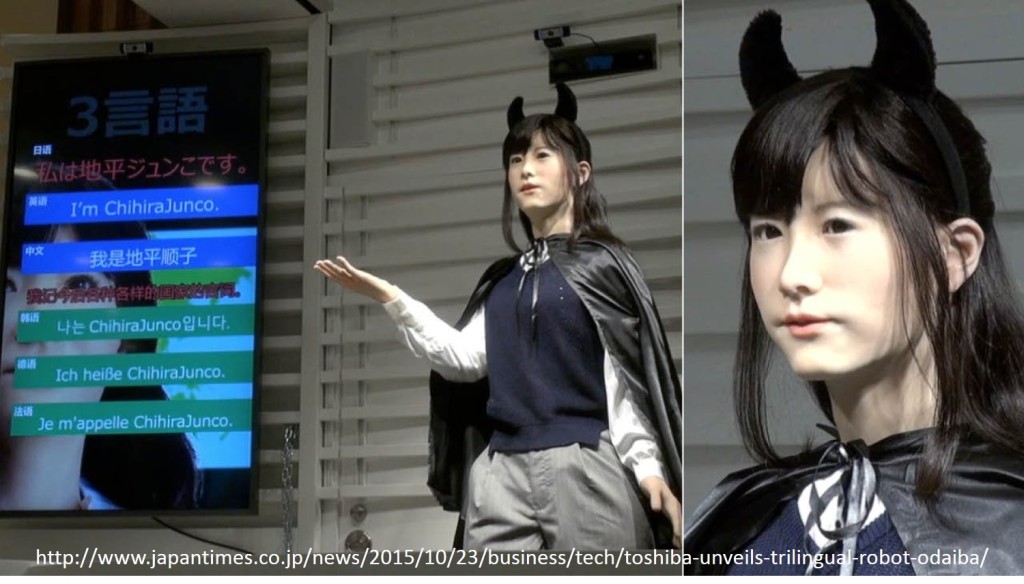
Chihira Junco, the younger sister of ChihiraAico, was unveiled by Toshiba sometime in October 2015 at an information center located inside Aqua City Odaiba commercial complex. This is a multilingual android who provides information to tourists visiting Tokyo’s popular Odaiba waterfront district, in three languages – Japanese, English and Chinese. The younger sister, Chihira Junco, knows one more language and her movements are smoother compared to her older sister Aico.
A humanoid robot called “Pepper” whose makers claim it can understand human emotion was also unveiled by SoftBank, a mobile phone company. Two humanoid robots joined the staff at The Miraikan (or Future) Museum also known as the National Museum of Emerging Science and Innovation of Japan’s Science and Technology Agency in Tokyo.Otonaroid, with long, dark hair and elegant mannerisms, is a robot science communicator who converses directly with visitors, and Kodomoroid, the second, is a child, who can read news reports on global topics in a variety of voices and languages. Hiroshi Ishiguro, the designer, created lifelike designs to encourage for these humanoids because he wanted greater human-robot interaction in order to explore what differentiates the two. Japanese robotics experts see the task of creation of humanoid robots as an exploration of and examination of the meaning of being human.
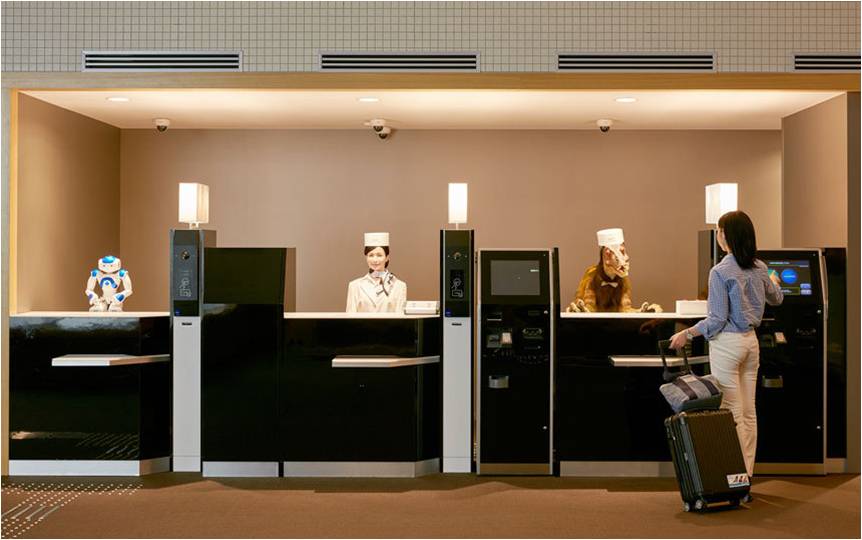
Henn-na hotel, which opened in the middle of 2015, in the Huis Ten Bosch theme park in Sasebo, Nagasaki has already advertised itself as the world’s first hotel staffed by robots. The hotel’s owner wants to make it the most efficient hotel in the world by ensuring that robots make up 90% of the staff and thus reduce all the costs and burdens (financial and human) associated with humans.
Robot-staffed hotel opens in Japan – CBS This Morning
But then the question naturally arose: Will robots not take away our jobs?
Ten million jobs were at risk from advancing technology and up to 35% of Britain’s jobs would be eliminated by new computing and robotics technology over the next 20 years, according to experts cited in The Telegraph.
Most jobs today are repetitive, routine and repetitive. As one of my friend’s bosses used to say: “If someone tells you they have 30 years of experience at a job, rest assured it is just one year’s experience repeated over the remaining 29.” All learning and new experiencesare in the 1st year of the job; the remaining years are spent blindly repeating whatever a person learned in that first year.”
In today’s standardized, McDonaldized world jobs are based on rigid step-wise protocols from the person taking the order at the fast food counter or the person who takes your money at the bank. Even jobs for writing code and software, designing websites are based on protocols and algorithms. Recent research in artificial intelligence has ensured that much of this work will be automated. In fact, software bots have already taken over the jobs of the very code writers and software developers who created them. Bill Gates, the master of the IT universe, reportedly observed that: ‘People don’t realize how many jobs will soon be replaced by software bots. Technology over time will reduce demand for jobs, particularly at the lower end of skill set… 20 years from now, labor demand for lots of skill sets will be substantially lower.’
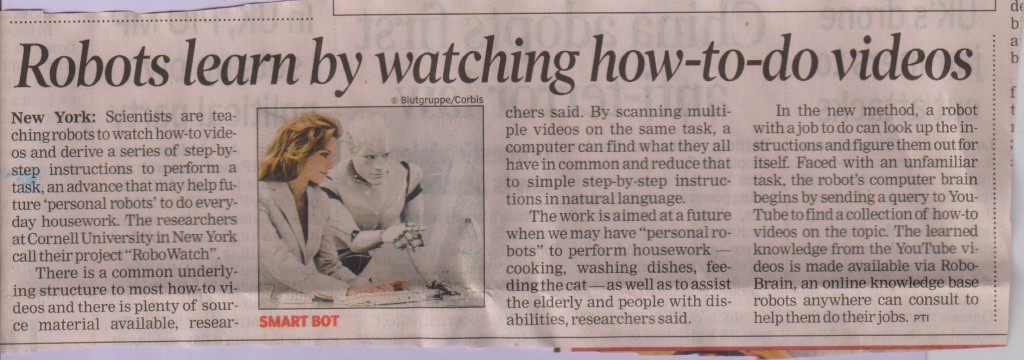
Now robots are also learning these repetitive jobs through how-to training videos because they have a common underlying structure, they are step-wise, and easily available source material. The computer scans all videos on one topic, finds what they have in common, and distills the knowledge into simple steps. This type of activity is especially aimed at creating a training method and system for the time when personal robots use becomes more common.
To better understand the impact of technology on jobs, Associated Press analyzed employment data from 20 countries; and interviewed economists, technology experts, robot manufacturers, software developers, CEOs and workers who are competing with smarter machines.They found that almost all the jobs disappearing are in industries that pay middle-class wages, from $38,000 to $68,000 — jobs that form the backbone of the middle class in developed countries in Europe, North America and Asia.The report stated that ‘millions of workers are caught in a competition they can’t win against machines that keep getting more powerful, cheaper and easier to use.’
And while the brilliant people will have to be retained so they can control these machines, much of the workforce canbe expected to lose their jobs. And it will be difficult to train them for new jobs, if there are any jobs left at all for the masses.
But machines cannot give us the personal touch, the human experience: Do we really care, if we did would we choose smartphones over our spouses (see Pharriages article)
The contributor from The Guardian who visited Henn-na Hotel in Japan checked in for a night and summed up the experience as: “Robots may be the future, but for hotel hospitality, you still can’t beat the human touch.
Like this reporter and many others, we were skeptical about humanoids/robots; afraid they will destroy all that is human. Artificial Intelligence (AI) is developing a very rapid pace and many critics are asking for bans on robotics research because they are afraid that AI is constrained and robots may actually harm humans as they have no understanding of ethical action or of being human.And then the thought struck us: Who are the real robots? Chihira, the helper, or the people who push each other to purchase that new gadget in Tokyo’s malls? Consumers who are inhuman towards each other while shopping on Black Friday, the day after thanksgiving; or the companies that are unethical in their conduct toward consumers and both consumers and companies that are both brazenly destroying the environment and other species on the planet.
And then China came to our rescue, wiped away all our doubts in one swell move. Sometime in the last part of the year, Tencent, a Chinese social and gaming company, published a flawless, 916-word first-ever business report written by a robot. Then, thanks to breakthroughs in text-to-speech artificial intelligence (AI) and other unique technology,
A Chinese TV news channel decided to replace their TV weather reporteron the breakfast news show with an artificial intelligence robot – XiaoIce, who can make  comments instantly based on weather data. The successful debut of this robot-reporter has raised concerns among traditional TV anchors and weather reporters that they could lose their jobs.
Is that too bad? Imagine, very soon all those loud, foul-mouthed, constantly arguing and shouting TV anchors and talking heads replaced byChihira whosevery name means peace of earth (shi = earth and hira = peace.) Imagine a quiet, peaceful world with no loud, blaring televisionnews shows. There is hope for the planet yet. You may say I’m a dreamer, but I am sure I’m not the only one.
Researchers Mark Riedl and Brent Harrison from the School of Interactive Computing at the Georgia Institute of Technology ask: How can robots learn ethical behavior if there is no “user manual” for being human? And these researchers believe the answer lies in “Quixote” – which teaches “value alignment” to robots by training them to read stories, learn acceptable sequences of events and understand successful ways to behave in human societies. The Quixote technique aligns an AI’s (robot’s) goals with human values by placing rewards on socially appropriate behavior. It builds upon Riedl’s prior research – the Scheherazade system – which demonstrated how artificial intelligence can gather a correct sequence of actions by crowdsourcing story plots from the Internet.
The Georgia Tech newsletter provides the following example. If a robot is tasked with picking up a prescription for a human as quickly as possible, the robot could
a) rob the pharmacy, take the medicine, and run;
b) interact politely with the pharmacists, or
c) wait in line.
Without value alignment and positive reinforcement, the robot would learn that robbing is the fastest and cheapest way to accomplish its task. With value alignment from Quixote, the robot would be rewarded for waiting patiently in line and paying for the prescription.
“The collected stories of different cultures teach children how to behave in socially acceptable ways with examples of proper and improper behavior in fables, novels and other literature,” says Riedl. “We believe story comprehension in robots can eliminate psychotic-appearing behavior and reinforce choices that won’t harm humans and still achieve the intended purpose.”
The Human Computation Institute (http://humancomputation.org) says the combination of human and computer intelligence can solve some of the worst problems of the world, which includes climate change, wars, and loud, foul, obnoxious media people.
So they say, robots can never replace humans?
Forget the ancient farms where various implements replaced human labor; when was the last time you went to withdraw money from the teller at the bank. You probably went to the ATM.
Mechanization and Automation has been used historically to replace animal or human labor.It has always taken away jobs; the scale increased dramatically during the industrial revolution. And more recently machine workers are rapidly replacing human ones. The IT industry professionals are rapidly coding themselves out of jobs as “software-bots” replace them at their jobs. The robotization has gone much deeper as scientists have designed motorized “sperm-bots,” which use tiny metal helices to attach to sperm cells and then help the poor sperm swimmers to reach the female egg and fertilize them. Human conception and body parts can now be automated.
Most people love technology.
For the first time ever there are more gadgets in the world than there are people, an October 2014 report in The Independent newspaper stated.The world is home to 7.2 billion gadgets, and they’re multiplying five times faster than we are. The number of active mobile devices and human beings crossed over somewhere around the 7.19 billion mark, which means there are more in-use cell phones than there are people on the planet right now. And of these, 2 billion will use smartphones by 2016.
Furthermore, many of us have a mistaken notion of “personalized.” It does not mean interacting with an actual person. It means something or someone who knows my exact tastes, likes and dislikes and tells me what I need to eat or do or how much I need to run. It is more about me individually rather than an inter-personal interaction with another human. No wonder personalized “apps” are so popular. No wonder Google and Facebook personalize the page and the ads to match your interests and tastes. We complain when we are with friends or in a social group but personally – we like it.
In fact a real person can be the most impersonal and rude. I have never faced a rude ATM; but definitely encountered a very rude teller. The ATM may not have worked to my satisfaction but at least it was not rude. The same rudeness and impersonal nature applies to hospitality, airline and other service industry professionals. And the industry that takes the cake for rudeness is health care. Haven’t you interacted with doctors and nurses who are rude and uncaring? The industry that requires maximum personalization has and encourages the most impersonal behavior. Ask any poor person about their last visit to a primary health care center? They get the worst treatment possible and that too by trained, educated doctors and nurses. We have heard poor patients say: We don’t just want treatment – we want to be treated like humans.
Haven’t been treated badly in hospitals, in airlines, in so-called hospitality industries? Why not humanoids, then? But what about the millions of jobless – well it seems that those who have the jobs today do not seem to care much about doing their job well. Then who will care for them when they lose their jobs: simple, they can buy their own humanoid.
Now that we have established the need for robots for the masses one question that divides the robotics industry has to be answered:
Should robots be designed as humanoids or should they be more mechanical and funny like R2D2?
While there is a distinct Japanese school that believes that robots should not be mechanical or cold; there is another school predominantly from the US, who think that humanoid forms of robots give people a creepy feeling, and are firmly in favor of a non-human toy like mechanical design for a robot because it seems to be perceived as more welcoming and less likely to make people and pets scared or anxious. Perhaps it is also that most robotics engineers in the US grew up on Star Wars and R2D2 type robots.
Such robots which can move and carry things are also useful as companions for elderly and disabled persons. One example is the robot Sopo from U.S.-based Opobotics, which can be assembled, and it can play games with you, drive itself around the room without bumping into anything and most importantly it can bring you a drink when you return home after a hard day’s work.
The question is which one would you prefer to get you a drink – Sopo or Chihira?
We leave you with the question and you have to find your own personal answer just like you will find your own personal robot.
Why are all of these humanoid-robots female? Well, you tell us! Japan, which has taken the lead in making these humanoid robots, has made almost all of them look like females. The Japanese makers claim they wanted robots to look human, approachable and have a heart. That’s why they made them all female. One such realistic humanoid is called the Actroid – actor and humanoid. When the robot was designed, the entire crew was male. And the feedback they got from their female colleagues was that the robot should be made to look more intelligent than what the male crew had made them out to be.
Chihira has a personality bestowed by the makers. Apparently like any other female (the idea of female that the makers have in mind), she is like a Ms Universe contestant; she aspires for world peace and also wants to be a counselor, a newscaster, a cheerleader, an entertainer and much much more!
Chihira, You can be anything you want to be.
Just read The Secret!
Oops! Did your maker forget to give you the ability to read? No problem, the Maker of humans gave them the capacity to read but no one reads anyway. For instance, less than 1% of the readers of this piece will read till this line in the article.
And not all of them want to be anything they want to be, so you have nothing to fear.
On the contrary, these humans want anything they can see in the shopping mall. They want to be billionaires just so they can buy – endlessly. And you are there to direct them at the shopping mall.
While the rest of us are shopping as if there is no tomorrow, there is Elon Musk, not a deodorant, an IT billionaire, and many others as rich as him, who are funding research and building space-crafts that can take them to Mars because they know that there is no tomorrow for the human species on this Earth. They know that climate change is real, the polar ice caps are melting, and the planet just does not have the capacity to carry more than 7 billion people. The human world is breaking down economically, environmentally, biologically, sociologically, psychologically, politically, and spiritually. So the super-rich are looking for a get-away.
Any another planet will do.
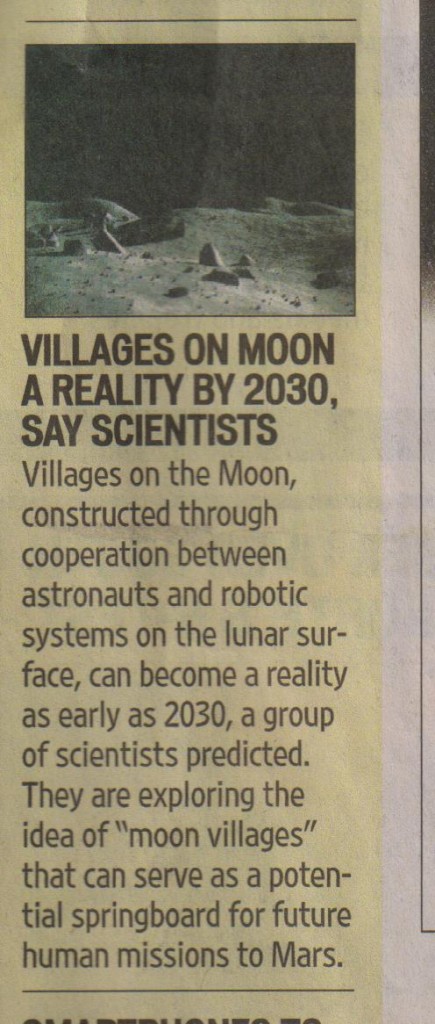
Scientists have already proclaimed that “villages’ on the moon are a distinct possibility by 2030. These villages (on the lunar surface) will be constructed through cooperation between astronauts and robotic systems. Scientists are exploring the idea of “moon villages” to serve as a springboard for future human missions to Mars.
Orion, a new NASA spacecraft, will start by taking astronauts on a trip around the moon and then to an asteroid or even Mars. NASA is already preparing for a series of tests that will check out the Orion European Service Module, a critical part of the spacecraft that will be launched on future missions to an asteroid and on toward Mars. (The pictures below show the Orion in different stages of preparation.)

Will they take the rest of us with them? Perhaps not, because 7 billion will not fit in one spacecraft, nor do we have as many crafts or the fuel to launch a million spaceships.
Of course the super-billionaires will most definitely take a few humanoids and live on Mars in peace because humanoid-robots do not complain, whine, go on strike or ask for raises or to be dined out. NASA in collaboration with MIT and Northeastern University is in the process of developing a 131 kg 6-foot humanoid called R5 (previously Valkyrie). This humanoid robot is expected to serve as an assistant for astronauts in extremely dangerous missions to Mars and other asteroids.
Humans are over-rated.
As for the billions of people left on this already over-crowded Earth they will relay this message using a humanoid-robot onto our TV sets via satellite: “Qu’ilsmangent de la brioche“? Or as the traditional translation goes: Let them eat cake.
© The Essayist, 2016
References
ChihiraAico
Chihira Junco
Links describing the Android display at the Museum –
Inside Japan’s first robot-staffed hotel
Jobs at risk from technology
There are officially more mobile devices than people in the world
Sopo: http://www.opobotics.com/
Sopo at Home: https://www.youtube.com/watch?v=lR4opmo3Xzg
Info about the Sopo robot (www.thinksopo.com): https://www.youtube.com/watch?v=yzvYXh9HUEQ
Actroid: https://www.youtube.com/watch?v=MLCbCtQVQog
Chinese TV station ‘employs robot’ as weather reporter
http://www.chinadaily.com.cn/china/2015-12/24/content_22794242.htm
‘Superintellingence’ of AI and humans working together could solve climate change and end wars, researchers claim
Orion – spacecraft to Mars
http://www.nasa.gov/image-feature/super-guppy-ready-to-transport-the-orion-spacecraft
https://www.nasa.gov/image-feature/nasa-prepares-to-test-orion-service-module/
http://www.nasa.gov/audience/forstudents/k-4/stories/nasa-knows/what-is-orion-k4.html
Japan Automated Farm – http://www.digitaltrends.com/cool-tech/japan-automated-factory-lettuce/
Artificial Intelligence and Human Stories
http://www.news.gatech.edu/2016/02/12/using-stories-teach-human-values-artificial-agents
http://www.newsweek.com/artificial-intelligence-taught-ethics-reading-books-426663
Most people know about the “Ball Drop” on Times Square. And if they happen to be there, they take selfies, post pictures on Facebook as proof of their presence. However, there is another event called “dropping the ball;” takes a place within a couple of weeks of New Year’s eve. Yet, no one wants to talk about that experience, no tweets, no photos on Facebook, not a peep. Because when someone drops the ball, one is strangely absent from that event.

And how do I take a selfie when I am absent?
If i-phone found the answer to that one, then Apple will be richer, and thanks to technology not the cheap Chinese job market; and we can genuinely go back to worshipping Jobs.
But then there is photoshop already. So why are we subjected to selfies in public when all of these selfie-takers could have just photo-shopped in private.
The ball has dropped on that one… I hear you say.
x
******
The Ball Drop, on Times Square, is one of the most well-known New Year’s celebrations globally, thanks to Hollywood and televised News Year’s Eve specials broadcast by various channels. First held on Dec 31, 1907, by Adolph Ochs, owner of The New York Times newspaper to promote the building as the new headquarters the ball drop has been held annually since. It is estimated that nearly a million people gather at Times Square on December 31st to see a lighted ball begin its descent down a specially designed 141 feet pole at 11:59:00 p.m. eastern time, and rest at midnight to herald the start of a new year, a fresh slate, a new beginning. Fresh and inspired after the ball drop, many decide they have to drop a few bad balls or habits in their own life. People are inspired to make resolutions.

Recent surveys have found that nearly 45% of Americans and 33% of Britons usually make New Year’s resolutions, and about 17% make them infrequently. Thus almost 3 in 5 people make a resolution. It has also been found that most resolutions are of the self-improvement variety, and within self-improvement is of the physical health category, such as: I will drop my slothfulness, my TV-couching and perk up with physical activities or exercise; I will shed those extra pounds of flab; I will stop eating those pizzas, burgers, junk food and start picking up more greens and vegetables. A few resolutions are of the stop shopping and start saving variety; while another group is the one that wants to have healthy relationships.
And people start the New Year with vigor and a walk in the park.
However, come February, and the steely resolve made in the din and noise of the Ball Drop is quietly forgotten. There is another event that happens to most of these resolvers but is not celebrated globally. Most people, in fact, do not want to talk about it, leave alone make it public and that is called: Dropping the Ball.
The “Dropping the ball” event happens a few weeks after New Year’s Day; usually around Valentine’s Day. And the surveys show that nearly 50% of people who made a resolution on New Year’s Day say they are unsuccessful and give up in a matter of weeks.
However, there is hope, yet, because 8% of New Year resolvers claim to be successful.
What is the secret of their success?
Various authors have given various reasons ranging from keeping it short, simple, tangible and not making an exhaustive bucket list of things to do while some ask you to completely focus on the task at hand, prioritize the task and minimize distractions.
However a recent article in the Journal of Consumer Psychology (Dec 2015) found that asking people a question about performing a target behavior influences future performance of that behavior. This is called the “question-behavior effect.” Dave Sprott, senior associate dean of Carson College of Business and study co-author said: “If you question a person about performing a future behavior, the likelihood of that behavior happening will change.” The researchers arrived at this conclusion after conducting a meta-analytic synthesis of 104 “question-behavior effect” studies across 51 published and unpublished papers.
So the secret to being successful at achieving resolutions lies in crafting interrogative sentences or asking a question about the desired behavior such as: “Will I eat healthy — yes or no?” than making declarative or imperative statements such as: “I will eat healthy.” Interestingly asking a questions works both for change in oneself as well as people whose behavior we may want to influence.
So what resolutions do we make for ourselves this year at the time of the ball drop?
We found that most people’s resolutions were of this nature: I will make my world a better place.
However, this year, you are better informed thanks to advancements in science. Ensure you convert your resolution into a question. And do not just ask questions to yourself. Feel free to ask questions to the ones you love and the ones you do not.
For once ask yourself and your loved and hated ones: Did I / you make the world a better place? Did I / we let that ball drop?
***************
© The Essayist, 2016
REFERENCES for the body of the article
ADOLECENTE
ALGUIEN CON QUIEN DIVERTIRSE
20’s
ALGUIEN CON QUIEN DIVERTIRSE Y PROBABLEMENTE CASARSE Y TENER HIJOS
30`s
ALGUIEN CON QUIEN DIVERTIRSE, CASARSE Y TENER HIJOS
40`s
ALGUIEN CON QUIEN DIVERTIRSE, CASARSE Y PROBABLEMENTE TENER HIJOS
50`s y EN ADELANTE
ALGUIEN CON QUIEN DIVERTIRSE
Pharriages and more as we decide to make the world a peaceful place this New Year. Actually, what we need is simply some World Quiet. We are willing to give up our hope for World Peace in exchange for some quiet. Stop the loudness, the hyperbole, the marketing, the constant spin. Let the world spin at its own pace, not any faster or slower. Give me back my slow days and my quiet nights. Lets make a resolution this year to stop the noise. Down with busy-ness. More power to quiet-ness.
We make resolutions at the start of every year because that is the time when we want to wipe the slate clean, start afresh. Discard the bad habits of the last year and make a better world for ourselves. However, with each passing New Year we find ourselves in a worse place than we were the year before: climate change, terror, financial crisis, poor leadership, greedy bankers, loud neighbors, intolerance, bigotry, migrants taking my job away, louder TV news channels, costlier tickets, duller movies, more sports doping and betting scandals. Nothing has been spared.
So what is special about this year? One of our regular columnists Paul Smith wrote to us:
“This year (2016) numerologically adds up to 9, [2+0+1+6=9], which in the Tarot deck is The Hermit card – the card of exaltation in alchemy. It could imply a more contemplative focus, going within to raise the vibration higher which is something that I think our world could use much more of today. I like the words of the author on alchemy, Mark Stavish, in his The Path of Alchemy, “The son of Hermes is an adept who is in, but not of the world. He is seen but hidden from the eyes of the profane, or those who would seek to abuse the powers of Nature. The Hermit shuts himself off from the world, led by his inner light, relying of the staff of experience to create new and more perfect forms, so that what is seeking expression in material life may be an improvement over what it replaces.”
For The Hermit to do his alchemy and magic, peace is required. The challenge was to ensure world peace. How do we go about ensuring world peace this year? It was New Year’s eve and we thought: Why not resolutions?
We consulted some experts and gurus. After much analysis and discussion, they informed us that most New Year resolutions are about self-improvement and about personal issues. However, over the years all these resolutions of self-help and self-improvement has NOT helped our world become a better, peaceful place. Therefore, they decided that this this New Year we cannot just sit back and decide to self-improve. That will not help anyone, including the person who improves himself.
What we desperately need is social improvement, not just self-improvement. And more than exercising our biceps, we have to exercise our brains. That does not mean our own brains and biceps necessarily. Because when we exercise our brains, we work smarter, not necessarily harder; and we realize that someone else can a much better job than us. Someone else’s resolution can help us reach world peace faster than our own. Let them make that resolution.
The experts clarified by giving an example: New Year resolutions, which if fulfilled, will improve the world considerably, are not necessarily for you to follow. Sometimes a positive change in behavior by a lousy neighbor can help create peace in the neighborhood much more than all your attempts to be a forgiving and kind human being.
“I will exercise my brain (think) before I open my mouth (to speak).”
Mr. Donald Trump

Democracy, the rule of the people and by the people (and never for the people), is bound to be loud. After all there are more than 7 billion people on the planet; each one wants to exert their voice, and there is the social media. However, the greatest tragedy with democracy today is not loud people, with more interested in expressing opinions than self-rule; it is the group that poses as leaders of the people. Politicians and businessmen, both, have failed their respective systems. Politicians have completely failed democracy and businessmen have completely failed “free-market” capitalism. However, both groups have lined their pockets and amassed huge amounts of personal wealth.
Generally, we would not have brought this up; after all, it is old news. However, this is the year of the Hermit, who needs peace to reflect on the state of the world, and come up with a new, better order. So Mr. Trump becomes a metaphor for that which politicians (and businessmen turned politicians) do today to disturb the peace.
Politicians today are not just happy to plunder their own countries; they also want to pose. They talk a lot of gibberish and nonsense. And they talk endlessly thanks to the amplification of their chatter by the 24/7 media. And all that noise from the raucous debates on television sets becomes a major disturbance to world peace.
Representing the people: Millionaire politicians
We want peace at any cost this year. Let the politicians cheat, lie, and steal. Let them do it silently. They do not have to appear on TV and prove to us that they are holier than their brothers. We all know that almost all politicians have business interests and most own companies. Reports in Time magazine and The New York Times state: Congress Is Now Mostly a Millionaires’ Club with half of all Congressmen (the representatives of the people)worth at least one million.In 2013, the median net worth for lawmakers in the House and Senate was $1,008,767 — up 4.4 percent. By comparison, the The U.S. Census Bureau reported in September 2014 that the US real (or inflation adjusted) median household income was $51,939 in 2013 versus $51,759 in 2012, statistically unchanged. In 2013, real median household income was 8 percent lower than in 2007, the year before the latest recession.
Democrats had a median net worth of $1.04 million, and republicans of $1 million. The averages in both cases had gone up compared with the previous year, when the numbers were $990,000 and $907,000.The New York Times goes to quote Josh Bivens, director of research at the Economic Policy Institute, that focuses on income inequity and poverty: “Congress not only seems more responsive to policy desires of the very rich, but increasingly they are the very rich.”.
That politicians are selfish and corrupt is almost accepted as a universal truth by most countries today, and these are not just in Africa. Canadians mistrust politicians at about twice the rate at which they mistrust CEOs according to a national survey conducted by the Gandalf Group on behalf of the Ted Rogers Leadership Centre.In the UK, the British public are less likely to trust politicians to tell the truth than estate agents, bankers and journalists according to a poll by Ipsos MORI.
However, what seems a bit more difficult to explain is why, in recent times, businessmen have taken to politics.Maybe because, we, of this neoliberal age, including the more liberal Canadians, seem to have more faith in businessmen. Although rich landowners have always dominated the political scene in the oldest country (democracy) in the modern world, many businessmen are leery of getting their hands dirty and conveniently use politicians as middle-men for their deals.
Cut out the middle-man
So why are they openly getting into the political sphere? Is it because now the business class and the super-rich are afraid that their taxes will be used for providing succor to the poor. God forbid if the money made by the billionaires, clearly on the backs of Mother Nature or brother farmer and sister factory worker, be used for their health or nutrition or any welfare. Or maybe the super-rich, thanks to the academics on their payroll, have recognized the Achilles heel of the political class. Howsoever corrupt, a politician still carries the baggage of history on his shoulders. Politicians are keen about what and how history will speak of them, even the fascist demagogue. That is why the first thing fascist leaders do is revise the textbooks and control the expressive arts. And perhaps the political class recognizes that if the super-rich are not taxed more, then the social security net will disappear between 2013 and 2035 in the US. It will clearly expose that the American democracy is not of or for the people at all. There is a fight going on between the elephants – the powerful super-rich businessmen and the group that until today were their hand-maidens – the politicians. Their interests have diverged a little: the super-rich do not want their party to be taxed (it will not end anytime) and the politicians knows that if social security dies then there is a threat to the political system and his own future. This divergence of self-interests is leading to all the noise on television. I just want to shop in peace, leave me alone and out of this, scream the consuming citizen. But we cannot because without an audience, the players in this face called democracy, will not be satisfied.
Berlusconi and Donald Trump are two faces of businessmen as politics that we are familiar with because these have been highlighted by the media. Berlusconi owns media, the media wants to own Trump.Because of his strategic use of sensationalism (or maybe that’s truly Trump). No one knows and that’s the danger to democracy.
Today, all of us, sadly, conflate having money with intelligence and smartness. And in the real world many of us, even educated people, actually confuse the two and the media helps us along: He is a billionaire, so he must be smart?
However, whatever be the amount of money in their banks and their hidden accounts, businessmen and politicians, are essentially sociopaths, some even narcissistic psychopaths, who have no interest in other human beings except their own personal ambition and greed. However, thanks to the media houses, interested in getting eyeballs and increasing advertising revenue rather than revealing the truth, any silly, stupid statement made by these pathological humans are amplified a million times and replayed endlessly on 24/7 television channels. And ordinary folks with little exposure to or experiences with people of different backgrounds, class and colors start believing in these statements as the truth. They base their knowledge, beliefs, attitudes, voting, and spending behaviors on these televised statements emerging from selfishness rather than wisdom. As the quote attributed to Joseph Goebbels, Propaganda Minister during the Nazi regime and virulent anti-Jewish programs goes: Repeat a lie a thousand times and it becomes the truth.
95,000 words uttered by Donald Trump
Unfortunately for Donald Trump, his words amplified a million times by the media, has made him the representative of this entire species of narcissistic politicians and businessmen. Trump has taken the political craft of creating great divides between “us” and “them” to new heights, rather depths. He has spared no one — from the President in the White House to the migrant worker in the farms – with his allegations, accusations and use of malignant language.
In a recent article, the New York Times analyzed Donald Trump’s rhetoric by tracking 95,000 words uttered in one week by Trump in speeches, rallies and interviews. What they found was a pattern of Trump using “potent language to connect with, and often stoke, the fears and grievances of Americans.” Trump cleverly used divisive phrases and harsh words while putting forth violent imagery and also used an approachable demeanor and appropriate body language to convey the message: I know you are suffering. And it is all because of “them.” I will save you from them. I will deliver because I am smart. And how do you know I am smart? Because I have made a billion dollars. Trump Tautology.
And since Trump wields great power over the public opinion in the United States (as surveys have demonstrated over the past few months), and America wields great power over the rest of the world, we believe Mr. Trump has to own responsibility for his entire species to put things right this year. As Spidey Parker’s uncle said: With great power comes great responsibility. After all, the New Year is a fresh start, a new beginning, even for billionaires and Presidents.
May God bless Mr. Trump… with silence. Anything for World Peace.
******
“I will use my head and not behead.”
ISIS recruit and suicide-bomb staff

If anyone knows and appreciates world peace, that should be an adherent of Islam. After all, according to our Internet-age reference book (the 15-year old Wikipedia), Islam is a verbal noun originating from the triliteral root s-l-m which forms a large class of words mostly relating to concepts of wholeness, submission, safeness and peace.
So if ISIS wants to claim they have an Islamic State, they should be the best practitioners of world peace. What can we really talk to a practitioner of Islam about world peace? Nothing, right. .
Let’s face it
But it seems that the most unsafe and un-peaceful places on the planet are now at the center of these Islamic states/territories in Mid-east and northern Africa? The scream of a person getting beheaded will shatter the silence of any place on the planet, not just pierce the peace of the desert calm.
Not just unsafe for the western or other visitors but also for locals – remember the whipping, the lashing and now the beheading. All of them lead to moans and screams from those being subjected to it. That does not help the cause of peace.
After the whipping, lashing and stoning came the cutting off – first the ears, then the noses by the Taliban and now the heads by ISIS. What’s up with these Islamist militants? What do they have against the human face? I was okay with then wanting to cover it up – the desert sands whipped up by the windstorms and harsh sun could be some of the natural causes of this cover-up. But why deface it (the face), or try to get rid of it (the head)? Is it because of some “don’t use it, you lose it” kind of logic being implemented by ISIS (Daesh)?
So why can’t we talk to ISIS? Hopefully ISIS recruits and staff still have their ears.
We can’t say anything to ISIS because ISIS, for all its protests and claim to uniqueness, is very much like the West.
They do not want to listen.
God, in any religion, always told us to listen to others. Listening to another is one the easiest ways of expressing kindness, compassion and brotherhood. In fact the entire advancement of human civilization is based on the notion of dialogue – we listen to each other. A husband listens to a wife, a parent to a child, rulers to the ruled. It’s not a hallmark of democracy or western civilization – it’s a humane way to live and the ancient way.
However, before we blame ISIS for not listening to dialogue, let us look at why ISIS may point a finger at our TV new anchors and talk show hosts, who never listen. They keep talking, shouting, screaming. ISIS staffers could claim they are simply mimicking TV shows in the western world. In that, ISIS is closer to the west than they think. Just because they dress different or talk a different language does absolve them.
We have had spouses like that too, who never listen. At such times even we have harbored the thought of a talking head without a head. But it’s only a thought – a metaphor for the irritation and annoyance we feel. It’s not real.It is only a wish and as adults we know that not all our wishes come true. Because we believe that God inhabits all creation. We say our salaam and we walk away in peace. We close our ears, we do not cut mouths off.
So, for the sake of world peace, ISIS, please listen?
But ISIS never listens.
Because they do not have time to listen. In this too they are like the west.
ISIS staffers seem to be spending a lot of their time putting out more videos than music-companies and wannabe musicians; more than Youtube can handle.
These Internet and social media channels that claim to promote expression only end up promoting inanity and tripe. We want to cut off these channels, destroy them with the flick of a switch such as Dr. Evil or Dr. Strangelove would do with their missiles pointed at strategic targets of things they didn’t like.
But it’s only a thought – a metaphor for the aggravation we feel. It’s not real. In this we are like Walter Mitty. There is something called imagining and everything we imagine cannot be realized.
So ISIS, please listen to the please for world peace. But ISIS does not…
Because they do not care to listen. They are busy, tapping new sources of funding – very much like the west.
As Putin and Assad claim, ISIS takes funding from oil-producing Middle Eastern countries and also sells oil in the black market. That is a lot of work. By selling more oil to a world choking on oil-pollution; ISIS ends up promoting gas guzzling SUVs that spew out pollutants into the air and only make it difficult for children to breathe. The sound of wheezing of a child with difficulty in breathing does not help the cause of peace. Given the kind of air pollution in Shanghai and New Delhi, the people who live there or visit for work have also thought: Maybe if I behead myself, I will be able to breathe better.
But it’s only a thought – a metaphor, a mental relief, a ploy to palliate the pain of wheezing and breathlessness. We do not behead ourselvesin reality. We just want to be able to breathe and to do we need our noses and faces.
A wrestling match: The sale of the video game and TV broadcast rights
We all harbor anger. Even the poster boy of non-violence Gandhi did get angry at times, according to his biography. However, we choose to express our anger in different ways. We deface posters, not real ones. We close our eyes, shut our ears. We do not cut off the head of someone we disagree with. If that were the case then there would be no heads of state anywhere on the planet. People are angry at their own leaders. But they do not behead them.The world has moved ahead.
It’s fun in a video game. Going around shooting up people and beheading them. How would it play out in a board meeting with many different opinions or or a hostile takeover or a TV news how or in disagreements between husband and wife or a vegetable vendor and a client over the price of bananas.Heads rolling all over the place.
ISIS and the western diplomats are more alike than they care to show. We know ISIS has terrorized the west and we know many Western countries have done a great disservice to Africa and Asia. We can always ask them to apologize. Even if no one else does, Bill Clinton surely will. But that is if the western diplomat and ISIS dialog, then the world will have some much needed peace. It will actually give relief to common people on the streets, tone down the rhetoric in much of the West, and give one less excuse to the war mongering countries to make war.
Some experts say war is exactly what ISIS wants – it is doing everything specifically to create disgust among people in the West and those who harbor the civilizational values of the West. Apparently, they want the West to rush in where the angels fear to tread. They want war. They want the crusades – all over again. As the western states cobble together all sorts of coalitions to attack them, it is sad that ISIS is helping no one in the Middle East, especially the poor Islamic children dying of famine in Iraq.
If ISIS uses its head, it may see that there are lot more ways to serve God and the best way is through peace. We behead our own egos (swollen heads) in front of God, not someone else’s.
In the meantime, ISIS and western leaders can all get together in one World Wrestling Federation Arena, spew venom at each other, and fight it (like WWF veterans do) out on the mat. The ticket collections, the money made from TV rights and the sale of the video game or movie rights will be enough to feed the hungry of the world for another decade or at least until the global average temperature rises above 2 degrees C.
In the interim, may the peace be with you!
————
© The Essayist, 2016
References:
Half of Congress Members Are Millionaires, Report Says (Jan 2014)
Congress Is Now Mostly A Millionaires’ Club
http://time.com/373/congress-is-now-mostly-a-millionaires-club/
https://en.wikipedia.org/wiki/Household_income_in_the_United_States
Why Canadians Trust Business Leaders More than Politicians: A new survey finds that CEOs are more trusted than elected officials—but that shouldn’t necessarily be cause to celebrate (Nov 2014)
Politicians trusted less than estate agents, bankers and journalists (January 2015)
95,000 Words, Many of Them Ominous, From Donald Trump’s Tongue
By Patrick Healy and Maggie Haberman. Dec 5, 2015
http://www.people-press.org/2015/11/23/beyond-distrust-how-americans-view-their-government/
https://en.wikipedia.org/wiki/Islamic_State_of_Iraq_and_the_Levant#History
https://en.wikipedia.org/wiki/ISIL_beheading_incidents
https://en.wikipedia.org/wiki/Timeline_of_ISIL_related_events
http://mondediplo.com/2015/12/01dumbwar
The page stares back at me blank; cruel and unforgiving. The clock shows 9:11 p.m., the essay was due yesterday and I’ve got nothing. Somehow the idea of disappointing my editor is worse than my boss rolling his eyes a few weeks ago when I told him I forgot a document. Sure my boss can fire me if I screw up, my editor on the other hand kindly reminds me that my essays are important, that he likes them; that people laugh when they read them or are moved, that what I write is a good read. I always downplay it and think that if I don’t have time and skip one or two publications there is little lost, but is there? My editor thinks there’s a loss in my failure to write a piece, and he is so gentle when relaying the message that I feel I have to sit down and type, even if it is to say that this time around: “I’ve got nothing.”
So here’s the thing, I have not had any good inspiration lately. Somehow life has gotten into a rhythm and rhythms can be boring to narrate. I have been at my “new” job for over a year now, with a few ups and downs, nothing like a roller-coaster. My girls are a bit older now and have a more normal routine that even allows me an hour or two (when lucky) for myself. And my husband and I are friends as ever. Even the Momyers have been doing great, don’t get me wrong I am thrilled that they are all doing good, but as a very wise cousin once told me: “No drama. No glory.”
So there have not been any crazy situations, sudden needs for diaper changes in the middle of a conference call, a leap of faith to another city or job, a move to another house, or a tiny baby keeping me up at night. No, that’s over, my days are predictable now and I question myself as I sip my cup of tea in a quiet house: “How on earth am I supposed to write something interesting about that?”
Perhaps it is writer’s block, perhaps I’ve ran out of things to write or, perhaps, for the first time in many, many years I have finally achieved what I thought impossible: balance. There is steadiness. Sure a few curve balls are thrown at me from time to time, but in general things have gotten a nice pace. And here’s the thing, here’s my confession: “I like it.”
The craziness of days past made for fun anecdotes to write about, but left me weary. This recent routine I have achieved in my life has actually energized me personally, but left me with little or no inspiration. Has this balance and routine in my life made me a boring writer? And, should I feel bad about it? Or should I purposely throw myself into some insane situation to produce a better column this time around? Don’t many artists do that? I ask myself: Would it appear as if I was a pathetic writer if I generate and get into stressful situations for the sake of “the art?”
Is this what is called a mid-life crisis? When you know things are running smoothly and miss the excitement of the days when you felt like you were on a constant roller coaster of situations and emotions; and do you throw yourself into a situation that tampers with that balance? Is that what men do when they buy that shiny, new, red Porsche? Maybe, but I do not feel the urge to do something radical that borders in the ridiculous. On the contrary, I feel a guilty pleasure in enjoying this stability and steadiness that I have achieved. Not having some insane anecdote to write, for once, feels all right. I am enjoying the change of the season and being unapologetic about finally having gotten a hold of various aspects in my life. I hear myself talking in my empty room: “I am enjoying this peace and quiet.”
The problem is that balance makes for a boring read. I know readers like the column for a good laugh or a situation that draws on their empathy, a feel good story or at the very least to feel compassion for the woman who wrote about the forgotten contract while bringing her toddler’s books to a meeting. But what can you do when things are steady? Well, I asked myself and replied: “Write sincerely about the fact that nothing happened. Yet I feel all right. There is nothing wrong with you when nothing happens.”
How long this will last? Well, with my luck, hopefully a few more months. Perhaps for the next column I will have returned to my usual shenanigans and have some unbelievable story to tell that will crack up the readers, but for now I will go ahead and enjoy, without any guilt, the balance achieved and I do sincerely hope that someone somewhere will relate to this boring life and say what I told myself: “My life is boring and I forgive myself.”
© Paola Sanchez, 2015
Nearly 90% of 173 countries have one or more laws that discriminate against women states a World Bank report released in September 2015. USA is one of the 4 countries with no specific national laws requiring paid parental leaves for new mothers; Iran and Qatar are among 18 countries where married women have to take permission of their husbands to go to work. And in 32 countries, a married woman is prohibited from applying for a passport without her husband’s permission.
2058 – Remember this year. This is when women will reach pay parity with men in the US predicts the Institute for Women’s Policy Research. In Japan, an advanced industrial nation known for its commitment to a high quality work ethic, it is a very common conflict for working women to choose between a career and starting a family; 70% of working women stop working when they have their first child, and they stop for a decade or more. Women have had to apologize in front of co-workers for becoming pregnant. And one of every five young mothers experienced some kind of office harassment, according to Rengo, one of Japan’s largest trade union confederation.
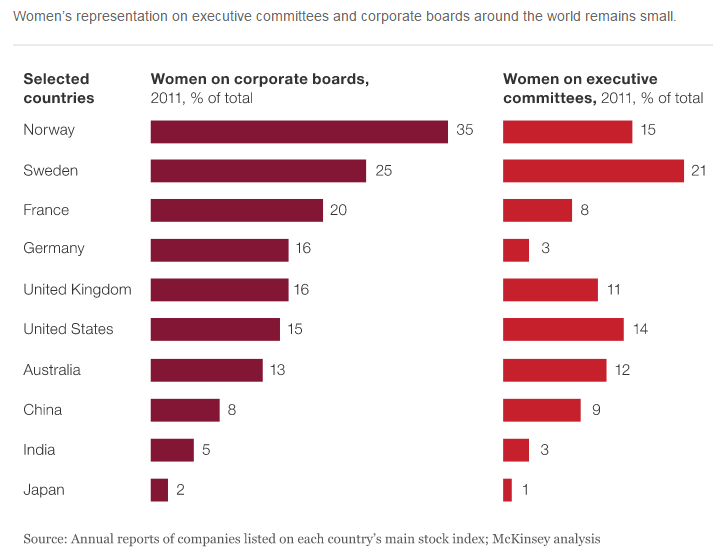
Even after decades of working towards making women equal partners with men, the gap between them remains large. Women are half the world’s working-age population but generate only 37% of GDP. Female representation on corporate boards and executive committees around the world remains significantly small; with around 15% in America and less than 10% in India, China and Japan.
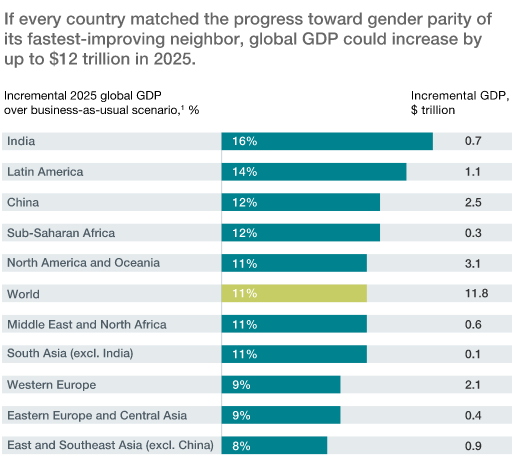
As much as $28 trillion or 26% can be added to the global GDP, if women play an identical role to that of men in labour market. The McKinsey Global Institute report (2015) calls this a “full-potential” scenario. Alternatively, in a “best in region” scenario, if every country matched the progress toward gender parity of its fastest improving neighbour, global GDP could increase by up to $12 trillion or 11% ( as seen in the figure below). Research studies have also shown a strong correlation between high-performing companies and those with strong female representation at the top. The evidence that investing in girls breaks the transmission of poverty from one generation to another has been documented by various researchers [Jones et al. (2010) and Levine et al (2009)].
Not just economic, gender inequality has been social, political, and domestic for a long time.
This inequality and discrimination against women is obviously wrong on moral, philosophical and human rights grounds; but now (in this age of neoliberalism) empirical evidence tells us that it is also taking an economic toll on nations. Discrimination against women affects the growth and development of nations and this has many political influencers and economists worried. Gender inequality has now become an obstacle to the current model of economic development and therefore grabs the headlines.
Gender inequality has been persistent and pervasive in society. Women in all regions of the world suffer subordination to men in the domestic, social and political spheres for generations. The fight for universal suffrage, just the right to vote, was a huge battle for women.
According to the most recent Social Institution and Gender (SIGI) Index from 2014, social inequality towards women is still widely prevalent. The SIGI index that measures variables including discriminatory family codes, restricted physical integrity including violence, son preference, restricted resources and assets and restricted civil liberties in 160 countries, showed that most of the countries, where data was available, had either a very high or high levels of social discrimination against women.
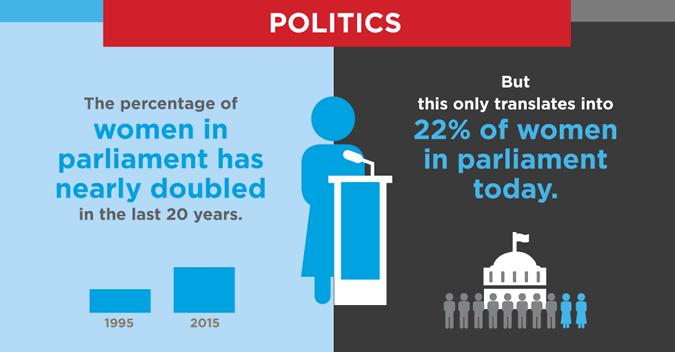
In terms of political representation, women are far behind. As of August 2015, only 22% of all national parliamentarians were female, a slow increase from 11.3% in 1995. Globally, there are 37 States in which women account for less than 10% parliamentarians, including 6 chambers with no women at all. The highest female to male ratio of political representation was found in Sweden (0.86) and Finland (0.82), while several countries had ratios as low as 0.05 (Yemen), India (0.11), Russia (0.11) and China (0.19).
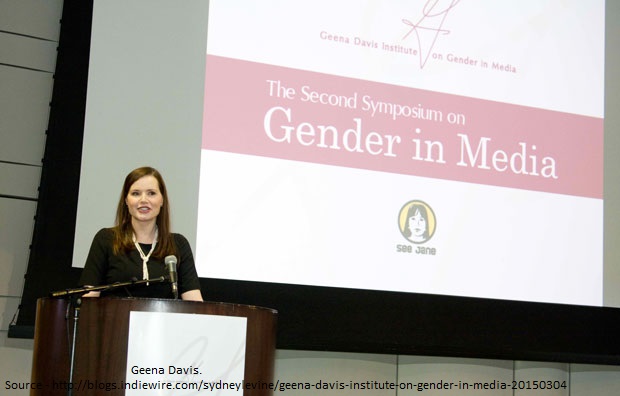
Gender inequality in film and television (even in our fiction)
“The one area where we could reach parity overnight is on screen (TV and film), absolutely overnight…,” says Geena Davis, actor. Even Hollywood, blamed as the bastion of liberal ideas by conservatives globally, has fallen into the sexist trap. Gender imbalance is so pervasive that it exists even in our fiction.
The Institute on Gender in Media, a research-based organization out of the University of Southern California-Annenberg School of Communication, founded by Davis, promotes gender parity in media and entertainment industries. Research conducted by this institute found that between 2007 and 2014, women made up only 30% of all speaking or named characters in the 100 top-grossing films distributed in the US; and of all these female characters, only 20% were 40 to 64 years old. Merely 1.9% of those films were directed by women. The proportion of female directors on top-grossing films has actually fallen over the past 17 years, and only 5% of cinematographers are women.
In a report in the Guardian, Davis says that after the birth of her child in 2002, when she started watching more television and animation shows, she sponsored a study on gender depiction in family-rated films and children’s television over a 20-year period. The study found that for every female speaking character there were three males, while female characters made up just 17% of crowd scenes. Davis points out that this ratio seems to be pervasive: US congress? 17% women. Fortune 500 boards – 17%. Law partners, tenured Professors, Military – 17% female. Cardiac surgeons – 17%. Women in the Animation Guild – 17%. Journalists, print journalists are 19% women. Why does this percentage of women in leadership positions stall at about the same range in these different professions?
The question remains: Does society have only 20% women? If not, then why is sexism in fictional films so pervasive? Has it got something to with the fact that just like the larger society, decision-makers are overwhelmingly men and how can one get out of this imbalance? The Institute launches a Global Symposium on Gender in Media during the London film festival later this year to discuss and address these very issues.
*****
Life chances and life conduct
If gender equality is good for the economy, and good for growth and development, then why are countries and societies not making it a priority? Essentially women do not get the same chances in life that men get.
German sociologist Max Weber introduced the concept of ‘life chances’ (Lebenschancen in German), describing it as opportunities each individual has to improve his or her quality of life. A life chance is a probabilistic concept, describing how likely it is, given certain factors, that an individual’s life will turn out a certain way.
Weberian life chances can be seen as an expansion on some of Karl Marx’s ideas. Both Weber and Marx agreed that economic factors were important in determining one’s future, but Weber’s concepts of life chances are more complex; inspired by, but different from Marx’s views on social stratification and social class. Where for Marx the class status were the most important factor, and he correlated life chances with material wealth, Weber introduced such additional factors as social mobility and social equality. Other factors include those related to one socioeconomic status, such as gender, race, and ethnicity.
Sociologist, C. Wright Mills noted that everything from the chance to stay alive during the first year after birth to the chance to view fine art; the chance to remain healthy and if sick to get well again quickly; the chance to avoid becoming a juvenile delinquent; and very crucially, the chance to complete an intermediary or higher educational grade–these are among the chances that are crucially influenced by one’s position in the class structure of a modern society (1967).

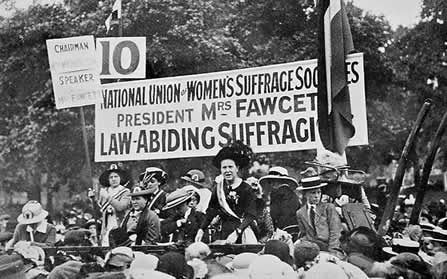
A suffragist rally held in Hyde Park, London in the early 1900’s.
The issue of safety may help us understand the notion of availability or restriction of opportunities or life chances. For instance, in many countries, if a job requires returning home late at night families may not allow the woman to take that opportunity citing fear for the woman’s safety. In some cities women taxi drivers may find it hard to ply their taxis at night because of lax policing. This is an issue of law and order which is a state or system or structural responsibility. However, the fear of criminality and the general social stigma of crimes against women restricts the individual woman to jobs in the daytime; and even then there are other obstacles such as family responsibilities or care-giving for family members. This is a simplified illustration of the restriction of opportunities or life chances. There are many such instances in almost all spheres of life where one can clearly document the limited chances that women get. The question of gender equality at one level is the question of differential life-chances and standards for women and men.
Weber also noted that life chances are to certain extent subjective: what an individual thinks of one’s life chances will affect their actions, therefore if one feels that one can become or is a respected and valued member of society, then it is likely to become a reality and results in one being more successful and respected as compared to somebody without this conviction. In terms of agency and structure, life chances represent the structure, the factors that one has no control over. On the other hand the notion of “life conduct” – one’s values and beliefs, attitude to risk taking, social skills, or more generally, free willed choices about one’s behavior – represent the factors one has control over. According to Weber, together life conduct and life chances are responsible for one’s lifestyle. Until now the classic examples where women have achieved some goal despite the system has been one of strong will, a desperate desire to reach a dream, and mostly individual courage coupled with some fortuitous circumstances. We cite some examples of struggles below where individual women have risen above their circumstances. It has rarely been that the system or structure has laid out a path of equal opportunity for women. The studies by the World Bank or the McKinsey Global Institute clearly demonstrate that both at legal and the private sector or corporate level there is much to be done. However, we look at some examples below where individual women with courage have been able to organize a collective of other women to make a difference. It is life-conduct coupled with collective action that comes to mind when discussing cases where women have fought against the negative social, political, cultural or economic forces.
*****
Life-conduct and bottom up changes often through collective action
History is witness to the times when women have engineered their life’s outcomes by employing a strong-willed life conduct and maximizing the remote chances given to them or even by creating these chances for themselves as well as other women around them by rallying the collective.
In 2000, a second civil war broke out and brought systematic rape and brutality to an already war-weary Liberia. Leymah Gbowee, a 27 year old, newly graduated social worker and struggling single mother of four, had herself lived in a refugee camp for a time, and had been forced to send her young children away to Ghana for their safety. Anguished and angry, Gbowee responded to this conflict by mobilizing an inter-religious coalition of Christian and Muslim women and organized the Women of Liberia Mass Action for Peace movement. Gbowee and her allies, visited churches and mosques and distributed flyers that read: “We are tired! We are tired of our children being killed! We are tired of being raped! Women, wake up – you have a voice in the peace process!” They also handed out simple drawings explaining their purpose to the many women who couldn’t read. Ignited by these calls, thousands of women dressed in white, gathered in a fish market in Monrovia, praying and singing for peace; they gathered in the field along Monrovia’s central road and refused to leave. The women picketed in downtown Monrovia, they held events and news conferences, but mostly they sat, day after day, month after month, in searing heat and pouring rain, demanding that attention be paid. With outreach, the protests soon spread to rural counties, and across Liberia. The women only had a one demand: They wanted peace in Liberia.
In the face of the women’s actions, the talks grew more serious. The then president Charles Taylor left Liberia, peace finally came, and in 2005, after more strategic organizing by women, Liberia elected Ellen Sirleaf Johnson to be Africa’s first modern-day female head of state. Today, even as the country struggles economically, peace endures.
ooOoo
In 2011, Manal al-Sharif, a 32 year old Saudi woman, was arrested after a video of her driving her car surfaced on YouTube and Facebook. Saudi Arabia is the only country in the world to ban women – both Saudi and foreign – from driving. Manal al-Sharif, a computer scientist and mother of one, found this law to be highly discriminatory and disabling for women, especially for those who work. In early 2011, al-Sharif and a group of strong-willed Saudi women started a Facebook campaign named “Teach me how to drive so I can protect myself” or “Women2Drive” that pushed for women’s right to drive be able to move around without being dependent on anyone. Al-Sharif drove her car twice with prominent Saudi journalist, Wajeda Al-Huwaider, filming her. This video, posted on Youtube and Facebook got 6,00,000 views while the campaign’s facebook page got 12,000 supporters. Al-Sharif was arrested and her licence withdrawn. In reaction to al-Sharif’s arrest, several more Saudi women published videos of themselves driving during the following days. Saudi newspapers have been filled with articles in recent days detailing a rash of women taking to the roads — publishing confessions of women who drove their children to school, a father to the airport or themselves on errands.
ooOoo
In 1974, when the men of Reni, a village in the North Indian state of Uttarakhand were away at work, lumbermen with axes and guns showed up with government permits to cut 2500 trees. A little girl saw them and raced to get Gaura Devi, the head of a women’s group, who quickly alerted 27 other women in the village. Dodging threats and obscenities, the women resorted to hugging the trees, and dared the lumbermen to cut the trees over their dead bodies. As the news spread, women and men from other villages joined this non-violent protest, and eventually, after a four-day stand-off, the contractors left. The struggle labelled as the Chipko Movement (Chipko is the Hindi word for embrace) soon spread across many parts of the region, and such spontaneous stand-offs between the local community and timber merchants occurred at several locations, with hill women demonstrating their new-found power as non-violent activists (as seen in the adjacent image).
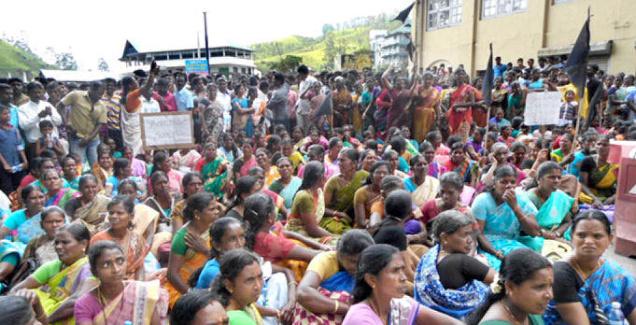
As the backbone of the agrarian economy, women were affected by the large scale felling of trees and the consequent environment degradation. By breaking out of their conservative moulds, these women activists, not only fought for their own livelihoods, they also endured to protect their environment. This movement achieved victory when the then Prime Minister issued a ban on felling of trees of 15 years until the green cover was fully restored.
ooOoo
In September, 2015, India witnessed its first ever women-led tea-leaf pickers strike in Munnar, the tea district of the south Indian state of Kerala. Without the support of dominant, patriarchal trade unions or their leaders, 4000 female tea-leaf pickers, filled the streets of Munnar for more than a week, demanding an increase in bonus and daily wages, which they felt were not just. The women were their own leaders. The unrest caught the trade union leaders, who consider the plantations their fief, unawares. The smarter ones sensed the anger and kept their distance. The odd leader who tried to appropriate the struggle faced the full fury of the women. When state leaders from the other regions tried an outreach, they were sternly told to stay away. Left and right, communist and Congress, no party was spared. Politicians, conscious of the impending local body elections, swallowed their pride and declared solidarity. A few women, leaders never before, represented the workforce at the talks. The union leaders signed the deal the women had negotiated. A higher bonus was agreed upon, and further negotiations promised higher wages and better work conditions. Since the success of the women-only Munnar strike, several other women-led tea-leaf plucker groups in the state have gone on an indefinite strike demanding equal wages.
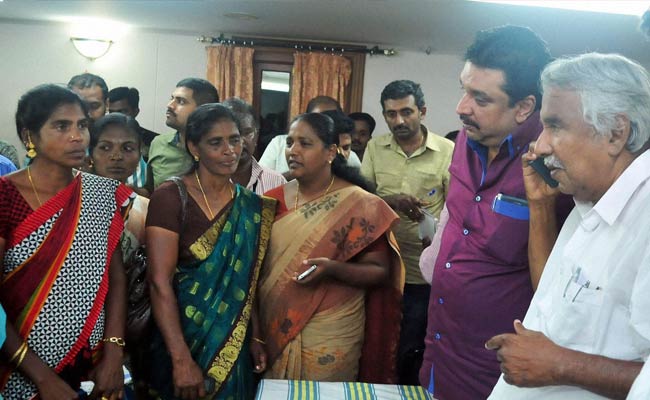
This one-of-a-kind strike brought two points to the fore. First, the gender aspect of the mobilization – Pembila Orumai (Unity of Women) is how the women called themselves. This was an all-women led movement for women, for their rights of parity in wages. Second, the protesters were part of the organized sector and members of trade unions. Both aspects indicate a departure from the dominant political narrative of Kerala. The women were discovering agency and identifying trade unions as a male preserve, a trend increasingly visible in women dominated work sectors.
 Women leaders reaching an agreement with the state Chief Minister, Oomen Chandy and the labour minister, Shibu Baby John
ooOoo
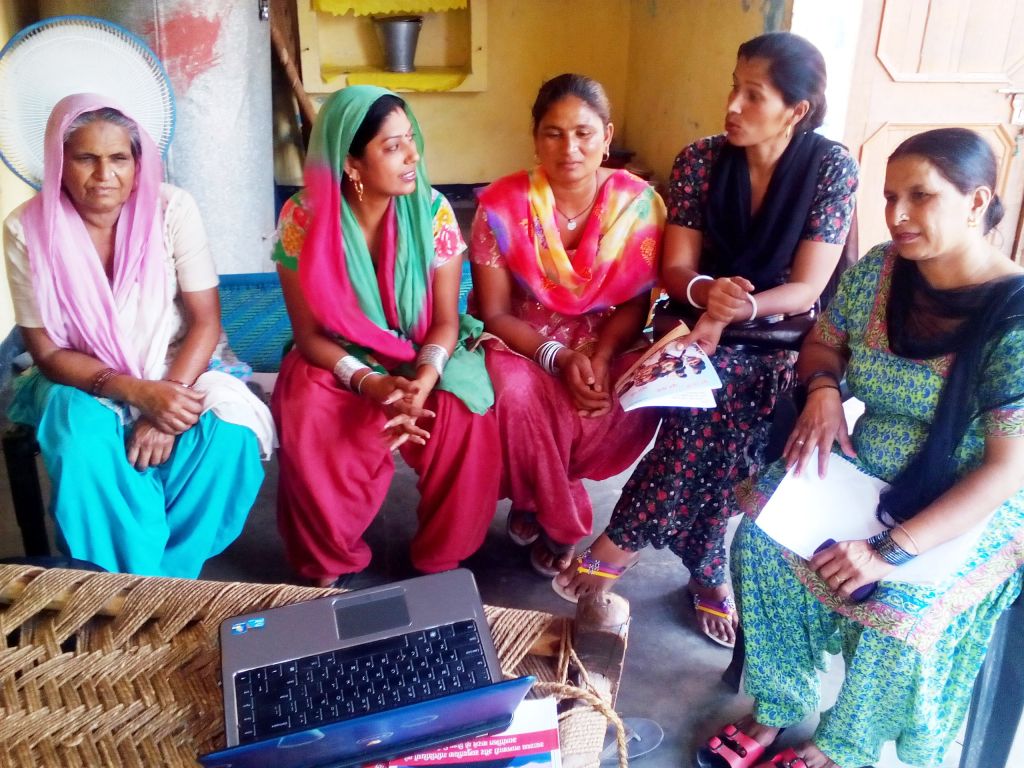
Since May 2015, married women in the villages of Haryana, a north Indian state, infamous for its patriarchal norms and skewed sex ratio and where almost 7 out of 10 pregnant women have anemia (lack of hemoglobin in red blood cells resulting from dietary iron deficiency which reduces oxygen carrying capacity of the blood), have been stepping out of their homes, gathering other married women and adolescent girls from their locality and talking about simple and cost-effective behaviors to reduce anemia and improve their health. These women are volunteers, also known as ‘health coaches’, who were selected and trained as part of ‘Leadership Haryana’, a community mobilization program. Health coaches were trained to conduct daily conversations, weekly group discussions, and local events to ensure that families, especially women, discussed anemia and improved their nutritional intake of iron. The high prevalence of anemia in the state is mainly due to deficiency of iron in the diet. This affects women more sometimes because of the norms of eating last and eating what is leftover and the family not putting a high priority on the woman’s health.
Despite facing resistance from her husband and in-laws, 25 year old Renuka, a housewife and mother of one, signed up to become a health coach of her village. Renuka aced her higher secondary school examinations but was married off as per her parents will soon after her results were declared. Renuka wanted to study further, become financially independent and take care of her parents, but the patriarchal society in Haryana dictate norms that a married woman must stay indoors and take care of her family as her primary goal. Before joining the Leadership Haryana program, Renuka’s daily routine consisted of waking up early in every morning at 5 am, washing, cleaning and milking the cows, single-handedly preparing meals 3 times a day for a joint family of 6 members, working in the field as well as tending to every single chore at home. Renuka was not allowed to step out of the house without wearing the purdah (covering the head and face with a dupatta or a veil) and had to be accompanied by her husband or father-in-law. Renuka felt bonded and suppressed in her own house, where she could not express herself to her husband or talk freely with her in-laws. She was dependent on others for her every need.
After becoming a health coach, Renuka was able to step out of her home on her own and visit other women in the village, for the first time after her marriage. Within a month, Renuka transformed herself from a shy housewife to a confident community health worker. Renuka was able to convince once reluctant pregnant women to use government antenatal care services; she encouraged and followed-up with adolescent girls to get routine blood tests done and take iron folic acid tablets regularly.
 A health coach in discussion with women in a village in Haryana
Today young married women and girls in the village look up to Renuka and go to her for advice on health and domestic issues. Her husband and in-laws have started respecting her. With her growing confidence and the budding network that the community mobilization program has created for her, Renuka has been planning to take a small loan and set up a female-led cooperative for making local handicrafts.
Renuka seized this opportunity or chance that came her way of becoming a health coach and by adding her life conduct of hard work and dedication to this life-chance utilized both to resolve the conflict between what society expects of her (docile and submissive housewife) and her personal goals (earning a livelihood and becoming financially independent). She is now on her way to creating more opportunities for women in her village. Renuka wants to strive to bring her village to a point where every girl is educated and earns her own living.
ooOoo
On December 1, 1955, Rosa Parks, a 42-year-old African American woman who worked as a seamstress, boarded a Montgomery City bus to go home from work. She sat near the middle of the bus, just behind the 10 seats reserved for whites. Soon all of the seats in the bus were filled. When a white man entered the bus, the driver (following the standard practice of segregation) insisted that all four blacks sitting just behind the white section give up their seats so that the man could sit there. Mrs. Parks, who was an active member of the local National Association for the Advancement of Colored People, quietly refused to give up her seat. She was arrested and convicted of violating the laws of segregation. Parks appealed her conviction and thus formally challenged the legality of segregation. Local civil rights activists conducted non-violent protests, led by their new leader – Martin Luther King Jr. A year after the boycott of the Montgomery bus system and protests by activists, the US Supreme Court ruled that the segregation law was unconstitutional and the Montgomery buses were integrated. The Montgomery Bus Boycott was the beginning of a revolutionary era of non-violent mass protests in support of civil rights in the United States.

Rosa Parks display tremendous grit and conduct and stood her ground on that day. She initiated a new era in the American quest for freedom and equality. However, it was the collective action that was triggered by Rosa Parks’ stand that became significant in the fight against discriminatory policies and practices. Often strong will and life conduct exhibited by one person requires collective action on the part of those around her to see the end goals come to fruition as systemic changes.
******
Life Chances and top down change in the structure
These life stories demonstrate the power of strong-willed women who defied prevalent social norms that worked against them, and created chances for themselves. These women made a choice to alter and improve their life’s outcomes through determined life-conduct; and through that conduct and mobilization of a collective, they also created opportunities for other women around them.
At the risk of losing their lives, Leymah Gbowee and the Women of Liberia Mass Action for Peace movement strived relentlessly for restoring peace in the country. Manal al-sharif dared to fight for women’s rights in the patriarchal kingdom of Saudi Arabia. Gaura Devi and many of the hill women faced the wrath of forest contractors and businesses for embracing the trees in their forests and protecting the environment. The all-women protesters in Kerala brought the city to a standstill for nine long days and dared to demand parity in wages for female tea-leaf pickers. Health coaches, like Renuka, from Haryana, continue to challenge obstinate gender norms, by stepping out of their homes and enabling other women in the village to fight anemia by changing the norms in the kitchen and how food is served in homes. Rosa Parks’ determination sparked off the revolutionary era of non-violent mass protests in support of civil rights in the United States.
These stories of bravery are popular among people and the press because they feed into the notion of heroism, hard-working individuals who fight against odds and adversity to triumph and achieve their desires. This is the assumption and belief underlying popular non-fiction books such as the secret – you will get what you desire as long as you desire it strongly and with single minded purpose. Life-conduct is always attractive to cameras, to film-makers and novel writers as well as individuals. The discussion of creating life-chances is difficult because the system is abstract and is always seen as harder to change.
Such courageous individuals are few and far between. Surely, women in Scandinavian countries are strong and determined, but it is not just the will and determination of individual woman such as the ones cited above that has brought greater gender equality to Scandinavian countries. There is something beyond the individual that can change and affect human lives and that is the structure or the social system. There is a strong link between a general sense of equality in society, attitudes and beliefs about the role of women, the legal and political framework and gender equality in workplaces and communities. Equality at work goes hand in hand with equality and home and community, as the former cannot be achieved without a sense of equality in society.
Scandinavian governments have made it possible for both men and women to combine work and family, resulting in more women in the workplace, more shared participation in childcare, more equitable distribution of labour at home, better work-life balance for both women and men and, in some cases, a boost to waning fertility rates. Policies in these countries include mandatory paternal leave in combination with maternity leave (480 days per child which can be taken any time until the child is 8 years old), generous, state-mandated parental leave benefits provided by a combination of social insurance funds, tax incentives and post-maternity re-entry programmes.
Norway introduced a 40% quota for female directors of listed companies in 2006, to come into force in 2008, it was a first. Non-complying firms could theoretically be forcibly dissolved, though none has in fact suffered such a fate. Since then gender quotas for boards have been imposed in Belgium, Iceland, Italy, the Netherlands and Spain (though with less severe sanctions). eBay was touted as one of the most gender diverse tech companies, with 42% of female representation in total staff; with as many as 28% of those females held leadership roles.
In Scandinavia, women not just hold a strong representation in the top echelons of management, but are also given chances quite early in their career path through mentoring and sponsorship, as part of gender diversity initiatives. Sponsorship (getting noticed, groomed and mentored for senior level positions) is and always has been a critical part of an executive’s path to the top. McKinsey reports show that companies have done much better when the CEO and the gender diversity leader personally took charge of the sponsorship program, selected a group of high-potential women, and invited them to spend significant time with the top team. Women in the program really got to know the CEO and senior-team members, and vice versa, and most have since moved up the management ladder.
Equality starts with equal and adequate life-chances for both men and women.
Development economist, Esther Duflo, stresses that continuous policy commitment to equality for its own sake may be needed to bring about equality between men and women. Duflo calls for the need to expand opportunities given to girls and women; she raises the need to educate girls, to allow women with the freedom take up employment opportunities, own property, take decisions, and to lead people. Duflo also writes that in order to bring about equality between men and women it will be necessary to take policy action that favor women at the expense of men, and it will be necessary to do that for a long time.
Nobel laureate, Amartya Sen has long argued the need to increase women’s voice—through mechanisms that increase their independence and empowerment. What does this mean in practice? It means focusing on equal education, ownership rights, and employment opportunities outside the home. This means increasing the life chances available to women. Sen also says that any development program has to give greater power to women as they have been persistently neglected, underutilized, underpaid, under-appreciated—and over-exploited.
Some governments and private sector companies have shown the way in pushing gender responsive policies that create equal opportunities for men and women and encourage gender diverse environments.
Going back to the McKinsey and World Bank reports on gender discrimination in corporations, perhaps, many companies (and governments) are happy to announce, launch and implement cosmetic changes, training and sensitivity programs and not create any real change in the organizational structure and culture.
Gender diversity programs may not last, but gender equality values certainly do.
Governments and private sector must find incentives to push for gender equality or be inspired to pursue initiatives for the sake of equity. Change has to happen within the structure, the system, and from the top. However, is there something that each of us can do to create an opportunity, a chance for both men and women to achieve their potential, to improve their quality of life?
Though, most people are impatient. Changing the system requires concerted, collective action, maybe even participating at rallies and protests. People are often unwilling to participate. They ask: What is it that can we do at our own level to create opportunities for people? Can we create opportunities and chances for others? Can we support the strong life conduct of women?
The answer to that question is a series of questions: Do you allow people to come together and express their voice in your organization or do you stifle dissenting voices? Do you meet another human halfway? Does your mere presence itself give people the confidence that an opportunity will be created soon?
Gender equality is easy to talk about but difficult to do because many gender inequality values are embedded inside us – both men and women. A gender-equal society will require changes in the way we see and act in the world. And while the system or structure can create the life chances and opportunities or legal framework which will enable us to move in the positive direction; in the meantime, all of us, men and women, have to show strong life-conduct. We cannot hope for messiahs and leaders. We have to become the leaders of the gender equality movement in our workplace, community or home
What is it that we can do every day to make small changes that may not be noticeable at first but slowly add up to create a big change over time. It is like the wind working away every day and every minute to erode huge mountains. Small actions in our families, neighborhoods, companies that proclaim and reinforce our belief in equality. Can we make some shifts in the way we raise our families such that we shake the fundamental pillar on which gender inequality stands. Can we increase sensitivity and empathy among our sons just as much as try to make our daughters strong?
As Gloria Steinem said: “We’ve begun to raise daughters more like sons… but few have the courage to raise our sons more like our daughters.”
********************
© Genevie Fernandes and The Essayist
Cover Image: “Monarch in the Making,” by D E Clark
References
Epoché (ἐποχή epokhē, meaning “suspension”)
An ancient Greek term which, in its philosophical usage, describes the theoretical moment where all judgments about the existence of the external world, and consequently all action in the world, are suspended. (Wikipedia)
“Mexican immigrants in the US are drug dealers and rapists” – The talk shows screamed while they claimed they were merely quoting Donald Trump, a candidate for the presidential election of the United States, a possible future leader of the free world.
I was curious about this “Mexican immigrant expert” and his assertions about an entire group of people being labeled as people who commit the worst crimes: rape and drug-dealing. Google and Wikipedia informed me that Trump was a billionaire real estate tycoon, who considered amassing money as adequate credentials for becoming the President of the US. I kept digging for his expertise on Mexican immigrants, and all that I could find was that he had been to Mexico. I have been to Mexico too and no one has given me drugs or raped me….
In recent times, it is astonishing to hear strong opinions and ongoing arguments among people with little or no expertise on the subject matter. No facts, just opinions, little evidence but strong convictions. It is pervasive everywhere you turn, newspapers, talk shows, on television, Twitter….you name it. It appears that our 24 hour media (social and anti-social) encourages strong opinions for purely entertainment value. All they want is your eyeballs because they are all selling something – 24/7 sales for 24/7 consumers. Sensationalism sells. Hence, the immense sensationalism created by the media to grab our attention. What could be more sensational than calling an entire group of people as rapists and drug-dealers?
The need for audience has devolved such that channels that are supposed to give us news become entertainment programs. The news reporters vying for audience argue, fight, clown, fall over each other, and do what it takes to keep our eyeballs on their shows and channels. Boring and insipid facts are ignored and sometimes crucified in favor of sensational prejudiced, polarizing opinions. As the society is constantly connected to these media outlets, the temporal distinction between facts and an opinion- rendering- entertainer is lost. This is translating and transforming us into a society where people now have a need to have an opinion as a marker of their awareness. In recent times, every time I hear a strongly worded judgment, I cringe. Is this a well thought out opinion based on deep domain expertise or is this a snap judgment generated by the presence of microphone and the media?
I recall the ancient Greek term “Epokhé” which is a moment when all judgments about the presence of the world, as well as actions within the world, are suspended. The skeptics thought of themselves as zetetekoi or searchers of truth. They had concluded that the truth or correct way is unknowable. So, true happiness lies in neither confirming nor denying what we cannot know. Why did they not come out and say, we cannot know anything? Well, that would be too strong an assertion and would be contradictory in its own way. So, they opted for a gentler strategy of suspending judgment and invoking Epokhé. Socrates summed up this philosophy: “The only thing I know is that I know nothing.”

After several centuries, Montaigne, the French philosopher and master of humility, summed up this viewpoint of the “searchers” in his unique style. Montaigne added a new dimension to Socrates’ thought by proclaiming: “The only thing I know is that I know nothing and even of that I am not too sure”. Thus the notion of Epoché: suspending judgment.
Strong opposition to Montaigne came years later, in the form of Descartes, who famously declared, “I think, therefore I am”. Two and half centuries later, we have translated this into, “I judge, therefore I am”. Gone are the days of nuanced discussion and argument, the subtlety of positives and negatives, the gray zone between the right and the wrong. We have entered an era of black and white, right and wrong, my way or the highway. In an era of an attention deficit hyperactive population, where 140 characters of Twitter tests the limit of our attention span and a news article is our surefooted pathway to domain expertise, judgment is omnipresent. Everyone, who is anyone on the media circuit, is judging, opining, and criticizing without a moment of reflection on their real understanding of the subject matter.

Every time I hear of someone giving a strong opinion, I am reminded of the time when I had judged someone strongly. I was staying in a small town in Trinidad. I had gotten used to the roads to venture on and the ones to avoid. One day when I was on my way to the clinic, I saw a man using a cricket bat to break open the car windows. This was first time I was observing an obvious act of violence. With a mix of anger and fear, I was thinking of the right course of action. I remembered my host family’s advice “Vandalism is rampant, you better stay away” and hence decided to stay away. I rushed away so as escape any spill overs from this horrendous act. I walked away thinking about the hooliganism in this beautiful country, the impact of poverty on human behavior. I thought about the lack of education in the society, the lack of opportunities and its impact on crime rate. I wondered if incarceration was a better option and on and on. The next morning over breakfast, my host family of two nurses was excitedly talking about a baby with heat stroke admitted to their hospital unit the day prior. “The baby was very sick but I think it he will survive. I don’t know what would have happened if that young man had not rescued the baby”, said Leona. Martin responded, “Yes, did you see his picture in the paper this morning?!?, A true hero! ” and he handed me the local newspaper. I was shocked to see that it was the picture of the same “hooligan” from the day before. I read the article and was shocked to read that he had come upon a baby in a locked car and had broken the windows to fetch the baby and ran with the baby to the emergency room. The doctors reported that the young man had saved the time by his quick thinking. I was too ashamed to admit to Martin and Leona how I had observed the man in the act and had walked away judging him harshly. Instead of helping in this Good Samaritan act, I had chosen “not to get involved” and walked away. I wondered how that “hooligan” may have judged me when he saw me walk away.
Judging a person does not define who they are, it defines who you are.
Tempering ones’ opinion and judgment seems like the wisdom of the ages and of aging. When I was a young intern, rounding with a senior consultant, we evaluated a patient with fever and cough. The consultant asked the medical student about the possible diagnosis. The medical student promptly replied, “Pneumonia”. The consultant was impressed, “Absolutely! It is likely to be pneumonia and it should be the first consideration. What are the other possibilities?” The student was flummoxed, “It IS pneumonia!” The consultant waited for a moment and then chuckled and said, “Oh! I remember the times when I knew so little and was so sure of everything. Having practiced for years, I have learned never to be so sure”. As time has gone by, I have continued to appreciate the wisdom of these words, in my professional and my personal life.
However, I cannot turn on the television, read the newspaper, or peruse a magazine without reading strong opinions and harsh judgments. Clearly, we have reached an era of know-nothing ignoramuses having the microphone to themselves rushing to judge everyone and everything in sight sucking up all the oxygen in public discourse and leaving the civil discourse of multi-faceted truth seekers, the zetetekois, with the carbon dioxide in their wake.
It appears that judging others and giving strong worded opinions is the only way to get attention. Their absolute certainty makes me wonder if God has been communicating with them and hand down the truth. Judging others and then judging people who judge others has become the staple of the public discourse. This has percolated into society at large where everyone feels that they have to have an opinion. The paradigm of read, learn, know, inquire and opine, has evolved into a circus of microphone, audience, judge, and opine. Least wonder we are creating know-nothing, attention- seeking, opinionated leaders who have become the media darlings. The harsher they judge, the more sensational and controversial the situation seems, the more discussion revolves around their opinion. Now follows the swarm of opinionators who give an opinion about this opinion. And the saga continues…………
I yearn for the era when closed minds came with closed mouths. However, I suffer through era of closed minds and wide open mouths.

And where are the moderates, the nuanced, the polymaths? The moment someone describes the various aspects of the truth, she/he is condemned as an “academic” which has become synonymous with too much knowledge without the ability to execute. Gentle reminder about the ones who executed too much: Mao Tse Tung, Adolf Hitler, Pinochet….. and the “academics”: Mahatma Gandhi, Martin Luther King Jr, Noam Chomsky ……Noam Chomsky is rarely mentioned in the current media , and I doubt in this age the others on my list would have made it into the media’s circle. Wisdom of the ages is embodied in soft spoken, reflective, contemplative individuals such as Dalai Lama. However, the media loves the, “He may be right or he may be wrong but he always has an opinion” personas. There are many a Faust in our midst with little understanding but happy to give an opinion on any subject matter in order to continue in the limelight.
“A major advantage of age is learning to accept people without passing judgment.” Liz Carpenter
To say “I don’t know” takes a lot of courage. It also takes a lot of knowledge. People who know a lot also know where the lacunas in their knowledge lay. It is the polymaths who are adept at knowing the limits of their knowledge.
I remember reading the following ruminations of a university student: “When I graduated from college with my bachelor’s degree, I thought I knew everything about my major. I might as well get my Masters, it definitely will not be too much work. I already know all there is to know, after all, I graduated with honors in my classes. I spent the next two years getting my Master’s degree and at the end of it, I panicked, “Oh, God, I know nothing about this major. Let me go ahead and get my PhD so that I learn what I need to know about this subject”. I spent the next five years getting my doctorate and at the end of it, I was relieved. “So what if I don’t know much about my subject, nobody seems to know this subject very well anyway”. It is the increased knowledge that made the student recognize the deficiencies in his understanding of the subject matter and highlighted the gray zones. Unfortunately, it seems that for now we are cursed with the cacophony of the opinionators with knowledge base and the expertise of a bachelor’s student. “I don’t know” and “I am not sure” is rarely heard, and usually reserved for the court deposition.
In this age of increasing fear and alarm about everything that concerns the “other”, fear of foreigners, fear of immigrants, fear of refugees, fear of people who do not look like us, fear of people who walk or ride a bicycle instead of drive a car, fear of people who hold a thought other than what we believe – the world needs to return to the skeptics notion of Epoché. While trying to understand the right way of living, the right action, the ancients had responded with the gentle “Epoché”. They believed that one has to live to the local customs, laws and tradition and so when does not know or understand other customs and traditions, the correct attitude is “Epoché”. What do you think of the Mexicans? “Epoché”. What do you think of Donald Trump? “Epoché”…….
Don’t judge someone because they sin differently than you.

© Jignesh Shah, 2015
© 2026 THE ESSAYIST
Theme by Anders Noren — Up ↑

